500+ Opposite Words in English: Antonyms List A–Z
Knowing the opposite of a word doubles your vocabulary power. When you learn “brave,” learning “cowardly” at the same time gives you two words instead of one — and builds a mental map of meaning that makes both words stick. This is not just theory: research shows that learning words in pairs (synonyms and antonyms together) improves retention by 30–40% compared to learning words in isolation.
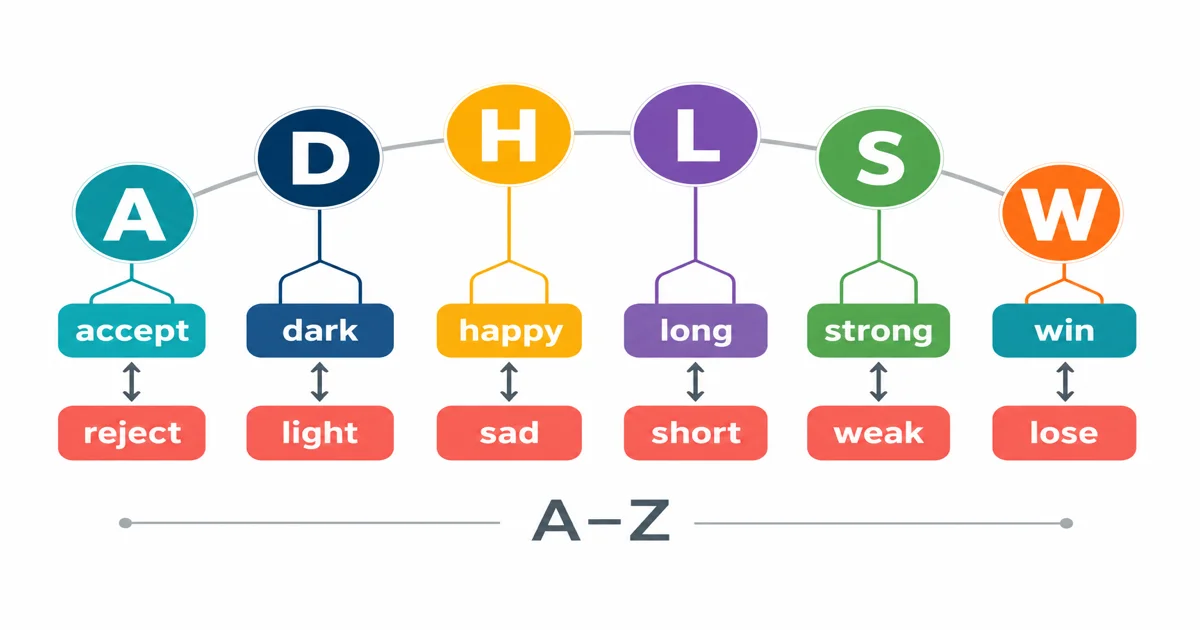
This list gives you 500+ opposite word pairs in English, organized alphabetically. Each pair includes a simple example sentence showing both words in context. Use this as a study reference, an exam prep resource, or a writing tool when you need the perfect antonym.
- Total: 500+ opposite word pairs
- Format: Word ↔ Opposite + Example
- Organized by: A–Z alphabetical
- Level: A1–C1
- For: vocabulary building, IELTS/TOEFL prep, essay writing, everyday fluency
For a deeper exploration of how synonyms and antonyms work together, see our English Synonyms and Antonyms: Complete Guide.
What Are Antonyms?
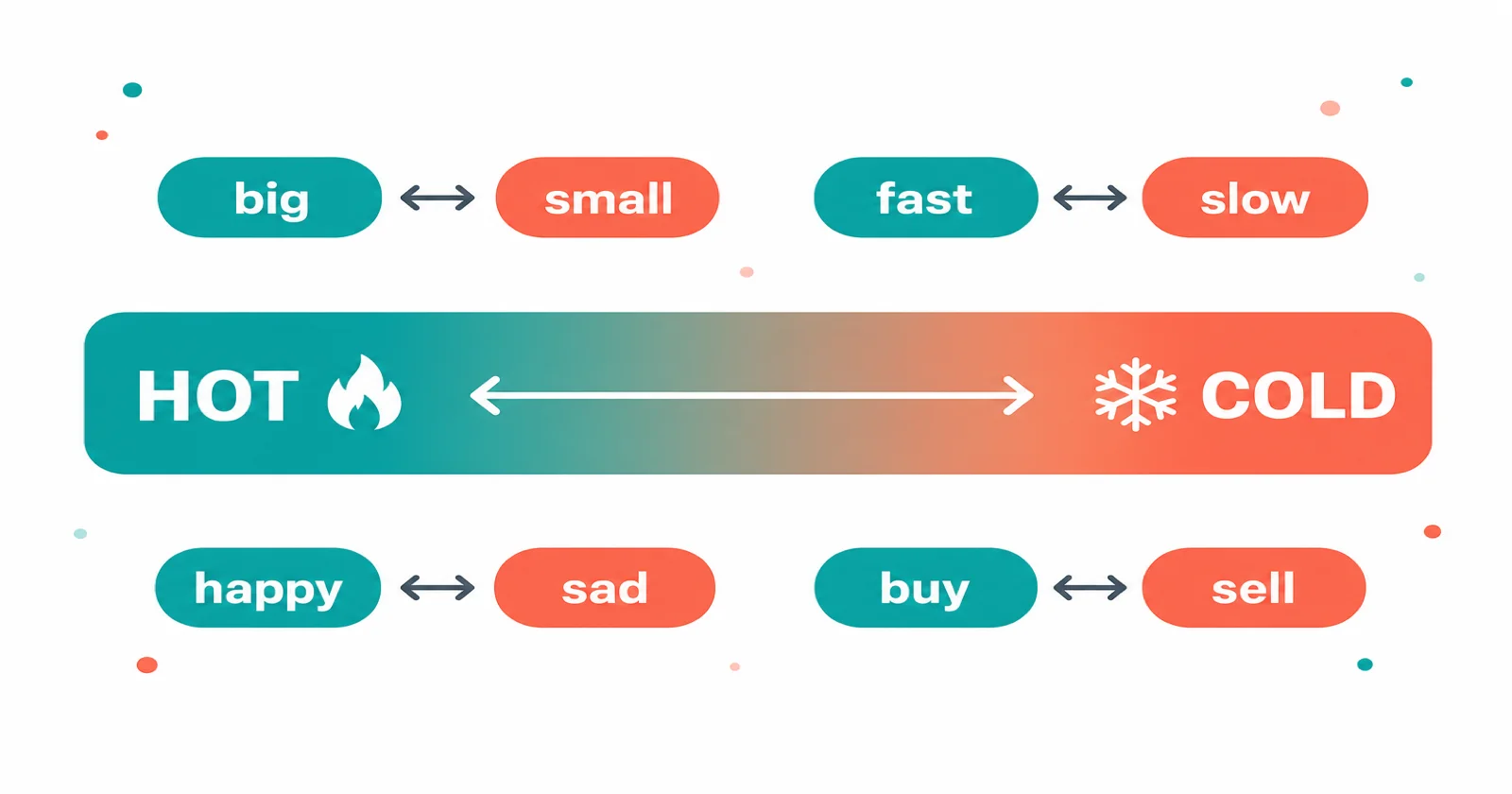
An antonym is a word with the opposite meaning of another word. The term comes from Greek: anti- (against) + onoma (name) — literally “opposite name.”
| Word | Antonym |
|---|---|
| hot | cold |
| big | small |
| fast | slow |
| happy | sad |
| begin | end |
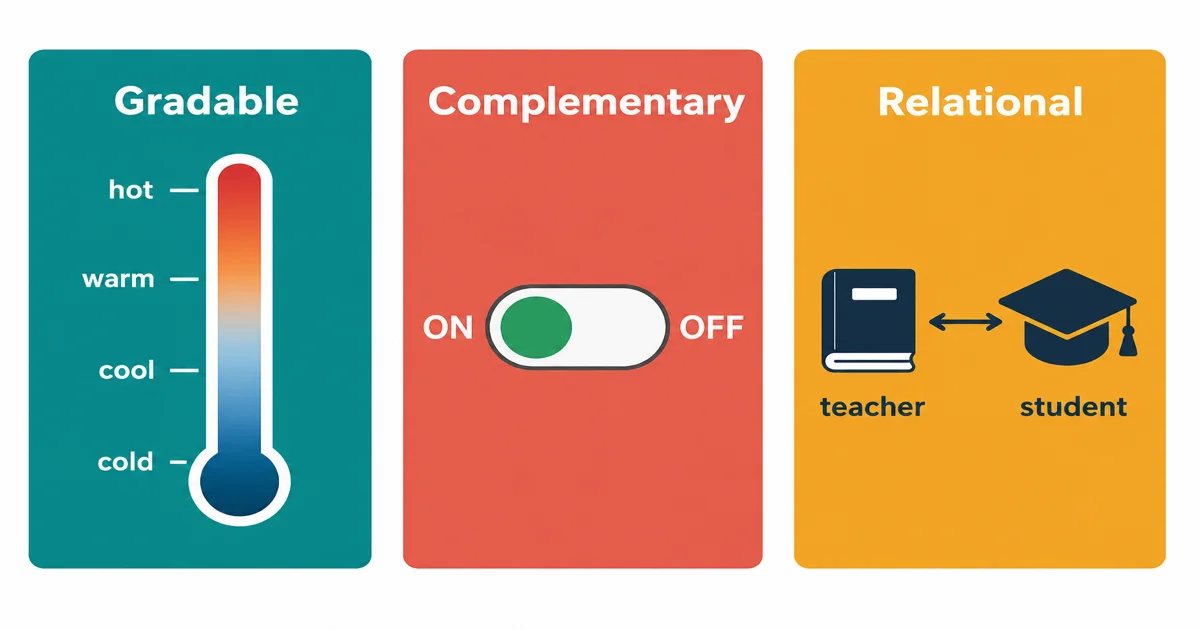
Three Types of Antonyms
| Type | Description | Examples |
|---|---|---|
| Gradable | Opposites on a scale; degrees are possible | hot–cold, big–small, fast–slow |
| Complementary | Either one or the other; no middle ground | alive–dead, true–false, on–off |
| Relational | Each word implies the other | teacher–student, buy–sell, parent–child |
Most antonyms in this list are gradable — they represent two ends of a spectrum with many points in between (“warm” falls between “hot” and “cold”).
Opposite Words: A–B
| # | Word | Opposite | Example |
|---|---|---|---|
| 1 | above | below | The painting hangs above the fireplace; the shoes are below the bench. |
| 2 | absent | present | Three students were absent; the rest were present. |
| 3 | abstract | concrete | Abstract ideas need concrete examples to be understood. |
| 4 | accept | reject | She decided to accept the offer rather than reject it. |
| 5 | accurate | inaccurate | The report was accurate, but the summary was inaccurate. |
| 6 | active | passive | An active learner asks questions; a passive learner just listens. |
| 7 | add | subtract | Add the tax, then subtract the discount. |
| 8 | admit | deny | He admitted the mistake instead of denying it. |
| 9 | advance | retreat | The army advanced in the morning and retreated by evening. |
| 10 | after | before | The meeting is after lunch, not before. |
| 11 | agree | disagree | I agree with the first point but disagree with the conclusion. |
| 12 | alive | dead | The plant looked dead, but it was still alive. |
| 13 | allow | forbid | The school allows casual clothes on Fridays but forbids them on exam days. |
| 14 | always | never | She always arrives early; he never does. |
| 15 | ancient | modern | Ancient ruins stand next to modern skyscrapers. |
| 16 | answer | question | Every answer raises a new question. |
| 17 | appear | disappear | Stars appear at night and disappear at dawn. |
| 18 | approve | disapprove | The board approved the budget but disapproved the staffing plan. |
| 19 | arrive | depart | Guests arrive at 6 PM and depart by 10 PM. |
| 20 | artificial | natural | The flowers looked real but were artificial, not natural. |
| 21 | ascend | descend | We ascended the mountain in the morning and descended before dark. |
| 22 | ask | answer | She asked a question, and I answered immediately. |
| 23 | asleep | awake | The baby was asleep, but the dog was wide awake. |
| 24 | attack | defend | The lawyer attacked the claim, and the witness tried to defend it. |
| 25 | attractive | unattractive | The package design was attractive; the old one was unattractive. |
| 26 | backward | forward | Take one step backward, then two steps forward. |
| 27 | bad | good | The food was bad at that restaurant, but the service was good. |
| 28 | beautiful | ugly | The sunset was beautiful; the building next to it was ugly. |
| 29 | begin | end | Classes begin in September and end in June. |
| 30 | beneficial | harmful | Exercise is beneficial to health; smoking is harmful. |
| 31 | best | worst | This is the best pizza I’ve had — and that was the worst. |
| 32 | better | worse | The weather is better today than yesterday, but tomorrow will be worse. |
| 33 | big | small | She lives in a big house; I live in a small apartment. |
| 34 | bitter | sweet | The coffee was bitter without sugar; add some to make it sweet. |
| 35 | blame | praise | Don’t blame others when things go wrong; praise them when things go right. |
| 36 | bold | timid | She gave a bold speech; he was too timid to speak at all. |
| 37 | boring | exciting | The first half was boring, but the second half was exciting. |
| 38 | bottom | top | The heaviest items go at the bottom; the lightest at the top. |
| 39 | brave | cowardly | The brave firefighter ran in; the cowardly bystander ran away. |
| 40 | break | fix | He managed to break the machine, and she managed to fix it. |
| 41 | brief | lengthy | Keep the introduction brief; the analysis can be more lengthy. |
| 42 | bright | dim | The living room was bright; the hallway was dim. |
| 43 | broad | narrow | The river is broad at the delta but narrow near the source. |
| 44 | build | destroy | It takes years to build trust and seconds to destroy it. |
| 45 | busy | free | I’m busy on Monday, but I’m free on Tuesday. |
| 46 | buy | sell | I want to buy a car; she wants to sell hers. |
Opposite Words: C–D
| # | Word | Opposite | Example |
|---|---|---|---|
| 47 | calm | anxious | She remained calm while everyone else was anxious. |
| 48 | capable | incapable | He’s capable of running the department; the other candidate is incapable. |
| 49 | careful | careless | A careful driver avoids accidents; a careless one causes them. |
| 50 | cause | effect | Every cause has an effect. |
| 51 | cheap | expensive | The generic brand is cheap; the designer version is expensive. |
| 52 | cheerful | gloomy | Her cheerful attitude brightened the gloomy office. |
| 53 | clean | dirty | The kitchen was clean this morning but dirty by evening. |
| 54 | clear | unclear | The instructions were clear; the footnotes were unclear. |
| 55 | clever | foolish | A clever strategy beats a foolish one every time. |
| 56 | close | open | Close the window if it’s cold; open it if it’s warm. |
| 57 | cold | hot | The soup was too cold; the tea was too hot. |
| 58 | combine | separate | Combine the ingredients first, then separate the mixture into two bowls. |
| 59 | comfort | discomfort | The new chair provides comfort; the old one caused discomfort. |
| 60 | common | rare | Pigeons are common in the city; eagles are rare. |
| 61 | complex | simple | The tax code is complex; the instructions should be simple. |
| 62 | compulsory | voluntary | Attendance is compulsory on weekdays and voluntary on Saturdays. |
| 63 | confident | insecure | She seems confident in meetings, but she feels insecure inside. |
| 64 | connect | disconnect | Connect the charger to charge; disconnect it when full. |
| 65 | conscious | unconscious | He was still conscious after the fall but later became unconscious. |
| 66 | constant | variable | The speed was constant; the direction was variable. |
| 67 | construct | demolish | They plan to construct a new building after they demolish the old one. |
| 68 | continue | stop | Continue reading if you enjoy it; stop if you don’t. |
| 69 | correct | incorrect | Your first answer was correct; the second was incorrect. |
| 70 | courageous | cowardly | A courageous leader speaks up; a cowardly one stays silent. |
| 71 | create | destroy | Artists create; wars destroy. |
| 72 | cruel | kind | The villain was cruel; the hero was kind. |
| 73 | cry | laugh | The children cry during sad movies and laugh during comedies. |
| 74 | curious | indifferent | She was curious about the results; he was completely indifferent. |
| 75 | dangerous | safe | The old bridge is dangerous; the new one is safe. |
| 76 | dark | light | The basement was dark, but the attic was full of light. |
| 77 | dawn | dusk | We started hiking at dawn and returned at dusk. |
| 78 | deep | shallow | The ocean is deep in the center and shallow near the shore. |
| 79 | defeat | victory | After years of defeat, they finally tasted victory. |
| 80 | defend | attack | The lawyer defended the client while the prosecutor attacked the argument. |
| 81 | definite | indefinite | We need a definite answer, not an indefinite “maybe.” |
| 82 | demand | supply | When demand exceeds supply, prices rise. |
| 83 | dense | sparse | The forest was dense near the river and sparse on the hillside. |
| 84 | different | similar | The twins look similar but have very different personalities. |
| 85 | difficult | easy | The first question was easy; the last one was difficult. |
| 86 | divide | unite | Conflict divides people; shared goals unite them. |
| 87 | domestic | foreign | Domestic sales are strong, but foreign markets are growing faster. |
| 88 | doubt | trust | I doubt his intentions, but I trust his ability. |
| 89 | downward | upward | The graph shows a downward trend this quarter after an upward trend last year. |
| 90 | dry | wet | The towel was dry this morning and wet by afternoon. |
| 91 | dull | sharp | A dull knife is more dangerous than a sharp one. |
Opposite Words: E–F
| # | Word | Opposite | Example |
|---|---|---|---|
| 92 | early | late | I arrived early; he arrived late. |
| 93 | earn | spend | You need to earn money before you can spend it. |
| 94 | east | west | The sun rises in the east and sets in the west. |
| 95 | easy | hard | The first part was easy, but the second was hard. |
| 96 | efficient | inefficient | The new system is efficient; the old one was inefficient. |
| 97 | elegant | clumsy | Her movements were elegant; his were clumsy. |
| 98 | empty | full | The glass was empty; I filled it until it was full. |
| 99 | encourage | discourage | Good teachers encourage students; bad feedback can discourage them. |
| 100 | enemy | friend | Yesterday’s enemy can become tomorrow’s friend. |
| 101 | enjoy | hate | I enjoy cooking, but I hate cleaning up. |
| 102 | enormous | tiny | The cathedral was enormous; the chapel was tiny. |
| 103 | enter | exit | Please enter through the front door and exit through the back. |
| 104 | equal | unequal | All employees deserve equal treatment, not unequal pay. |
| 105 | even | odd | Two is even; three is odd. |
| 106 | exact | approximate | I need the exact figure, not an approximate one. |
| 107 | expand | contract | Metals expand when heated and contract when cooled. |
| 108 | export | import | Japan exports cars and imports oil. |
| 109 | external | internal | The external walls are stone; the internal walls are plaster. |
| 110 | extra | missing | We have extra chairs but missing tables. |
| 111 | fact | fiction | It’s hard to tell fact from fiction in the news. |
| 112 | fail | succeed | You may fail ten times before you succeed once. |
| 113 | fair | unfair | The decision seemed fair to some but unfair to others. |
| 114 | fake | genuine | The painting was fake; the signature was genuine. |
| 115 | familiar | unfamiliar | The route was familiar to locals but unfamiliar to tourists. |
| 116 | famous | unknown | She went from unknown to famous in a single year. |
| 117 | far | near | The airport is far from the city, but the train station is near. |
| 118 | fast | slow | Internet in the office is fast; at home it’s slow. |
| 119 | fat | thin | The book was fat — over 800 pages; the pamphlet was thin. |
| 120 | few | many | A few people came early; many arrived late. |
| 121 | final | initial | The final draft was much better than the initial one. |
| 122 | find | lose | I always find my keys where I’m most likely to lose them. |
| 123 | finish | start | We need to start the project today if we want to finish by Friday. |
| 124 | first | last | She was the first to arrive and the last to leave. |
| 125 | flat | steep | The road was flat for the first mile, then became steep. |
| 126 | flexible | rigid | The company has a flexible schedule, not a rigid one. |
| 127 | float | sink | Wood floats; iron sinks. |
| 128 | forget | remember | Don’t forget your passport — remember to check before you leave. |
| 129 | formal | informal | The dinner is formal; the lunch is informal. |
| 130 | fortune | misfortune | One person’s fortune can be another’s misfortune. |
| 131 | free | captive | The bird was captive for years before being set free. |
| 132 | freeze | melt | Water freezes at 0°C and ice melts above it. |
| 133 | frequent | rare | Bus service is frequent in the city but rare in rural areas. |
| 134 | fresh | stale | The bread was fresh in the morning and stale by night. |
| 135 | front | back | Sit at the front if you want to see; sit at the back for quiet. |
| 136 | full | empty | The restaurant was full at 7 PM and empty by 10 PM. |
Opposite Words: G–I
| # | Word | Opposite | Example |
|---|---|---|---|
| 137 | gain | lose | You gain experience by working; you lose it by staying idle. |
| 138 | general | specific | Give me a specific answer, not a general one. |
| 139 | generous | selfish | She’s generous with her time; he’s selfish with his. |
| 140 | gentle | rough | Handle the glass with gentle hands, not rough ones. |
| 141 | giant | miniature | The giant sculpture stood next to a miniature replica. |
| 142 | give | take | It’s better to give than to take. |
| 143 | glad | sad | I’m glad you came; I’d be sad if you hadn’t. |
| 144 | global | local | The company has both global and local operations. |
| 145 | good | bad | The news was good in the morning and bad in the evening. |
| 146 | grant | refuse | The bank may grant the loan or refuse it. |
| 147 | grateful | ungrateful | Be grateful for what you have, not ungrateful for what you lack. |
| 148 | great | terrible | The food was great; the service was terrible. |
| 149 | grow | shrink | The economy grew last year but may shrink this year. |
| 150 | guilty | innocent | The jury found him guilty, though he claimed to be innocent. |
| 151 | happiness | sadness | Happiness and sadness are both part of life. |
| 152 | hard | soft | The mattress was too hard; I prefer a softer one. |
| 153 | harm | help | Pollution harms the environment; recycling helps it. |
| 154 | harsh | mild | The winter was harsh; the spring was mild. |
| 155 | hate | love | Some people hate mornings; others love them. |
| 156 | healthy | unhealthy | A balanced diet is healthy; fast food daily is unhealthy. |
| 157 | heavy | light | The suitcase was heavy; the backpack was light. |
| 158 | here | there | The keys are not here — they must be over there. |
| 159 | hide | reveal | She tried to hide her disappointment, but her face revealed it. |
| 160 | high | low | Prices are high in the city and low in the countryside. |
| 161 | hire | fire | The company plans to hire 50 people this year, not fire anyone. |
| 162 | honest | dishonest | An honest answer is always better than a dishonest one. |
| 163 | hope | despair | Where there is hope, there is no despair. |
| 164 | horizontal | vertical | The shelves are horizontal; the poles are vertical. |
| 165 | huge | tiny | The difference was huge — not tiny. |
| 166 | humble | arrogant | The best leaders are humble, not arrogant. |
| 167 | hungry | full | I was hungry before lunch and full afterward. |
| 168 | ignore | notice | Don’t ignore the warning signs — notice them early. |
| 169 | imaginary | real | The threat turned out to be imaginary, not real. |
| 170 | import | export | Countries import what they need and export what they produce. |
| 171 | impossible | possible | What seems impossible today may be possible tomorrow. |
| 172 | improve | worsen | The situation will improve if we act; it will worsen if we don’t. |
| 173 | include | exclude | The price includes breakfast but excludes dinner. |
| 174 | increase | decrease | Sales increased in Q1 and decreased in Q2. |
| 175 | individual | group | Individual effort matters, but group collaboration is more effective. |
| 176 | inferior | superior | The cheap version is inferior; the premium version is superior. |
| 177 | innocent | guilty | She was proven innocent after being falsely declared guilty. |
| 178 | inside | outside | It’s warm inside but freezing outside. |
| 179 | intelligent | stupid | An intelligent decision saves time; a stupid one wastes it. |
| 180 | intentional | accidental | The damage was accidental, not intentional. |
| 181 | interior | exterior | The interior was renovated; the exterior remains unchanged. |
| 182 | invest | withdraw | She chose to invest rather than withdraw her savings. |
Opposite Words: J–L
| # | Word | Opposite | Example |
|---|---|---|---|
| 183 | join | separate | The rivers join at the delta and separate upstream. |
| 184 | joy | sorrow | Life is a balance of joy and sorrow. |
| 185 | junior | senior | She started as a junior developer and became a senior in three years. |
| 186 | just | unjust | A just society treats everyone fairly; an unjust one does not. |
| 187 | keep | discard | Keep the important files and discard the rest. |
| 188 | kind | cruel | A kind word heals; a cruel one wounds. |
| 189 | knowledge | ignorance | Knowledge leads to understanding; ignorance leads to fear. |
| 190 | land | sea | The journey was partly by land and partly by sea. |
| 191 | large | small | We ordered a large pizza, not a small one. |
| 192 | laugh | cry | The audience would laugh one moment and cry the next. |
| 193 | lazy | hardworking | He’s too lazy to study; his sister is incredibly hardworking. |
| 194 | lead | follow | Some people lead; others prefer to follow. |
| 195 | legal | illegal | Driving at 60 mph is legal here; 90 is illegal. |
| 196 | lend | borrow | I’ll lend you the book if you promise to return it; you can borrow it for a week. |
| 197 | less | more | Spend less time worrying and more time acting. |
| 198 | lie | truth | A lie travels fast, but the truth catches up eventually. |
| 199 | liquid | solid | Water is liquid at room temperature; ice is solid. |
| 200 | little | much | I have little patience but much determination. |
| 201 | long | short | The movie was too long; the trailer was too short. |
| 202 | loose | tight | The shirt was too loose; the jeans were too tight. |
| 203 | loud | quiet | The music was loud downstairs and quiet upstairs. |
| 204 | love | hate | Thin line between love and hate, they say. |
| 205 | low | high | The river is low in summer and high in spring. |
| 206 | loyal | disloyal | A loyal friend stays; a disloyal one leaves. |
| 207 | lucky | unlucky | She was lucky to win; he was unlucky to miss by one point. |
Opposite Words: M–O
| # | Word | Opposite | Example |
|---|---|---|---|
| 208 | major | minor | The major issues are fixed; only minor ones remain. |
| 209 | majority | minority | The majority agreed; the minority dissented. |
| 210 | male | female | The survey included both male and female participants. |
| 211 | many | few | Many applied, but few were selected. |
| 212 | mature | immature | A mature response helps; an immature one escalates conflict. |
| 213 | maximum | minimum | The maximum speed is 120 km/h; the minimum is 60. |
| 214 | mean | generous | Don’t be mean with compliments — be generous. |
| 215 | messy | neat | His desk is messy; hers is neat. |
| 216 | mild | severe | The symptoms were mild at first but became severe later. |
| 217 | modern | traditional | The design blends modern elements with traditional ones. |
| 218 | moist | dry | The cake was moist inside and dry on the crust. |
| 219 | morning | evening | Exercise in the morning or relax in the evening. |
| 220 | narrow | wide | The hallway was narrow; the lobby was wide. |
| 221 | natural | artificial | The flavoring is natural, not artificial. |
| 222 | neat | messy | Her handwriting is neat; mine is messy. |
| 223 | negative | positive | A negative attitude produces negative results; a positive one attracts opportunities. |
| 224 | new | old | The new policy replaces the old one. |
| 225 | night | day | Owls hunt at night; hawks hunt during the day. |
| 226 | noisy | quiet | The restaurant was noisy downstairs but quiet on the terrace. |
| 227 | none | all | None of the predictions came true — or perhaps all of them did. |
| 228 | normal | abnormal | The test results were normal, not abnormal. |
| 229 | north | south | Birds fly south in winter and return north in spring. |
| 230 | nothing | everything | He went from having nothing to having everything. |
| 231 | obey | disobey | Children who obey rules learn discipline; those who disobey learn consequences. |
| 232 | obvious | hidden | The answer was obvious to some but hidden from others. |
| 233 | occupied | vacant | The office upstairs is occupied; the one downstairs is vacant. |
| 234 | odd | even | The odd-numbered seats are on the left; even ones are on the right. |
| 235 | offense | defense | A good offense is the best defense. |
| 236 | old | young | The old generation learns from experience; the young generation learns from technology. |
| 237 | open | closed | The shop is open on weekdays and closed on Sundays. |
| 238 | optimistic | pessimistic | She’s optimistic about the future; he’s pessimistic. |
| 239 | order | chaos | The system brought order to what was previously chaos. |
| 240 | ordinary | extraordinary | What seemed like an ordinary day became an extraordinary one. |
| 241 | outer | inner | The outer layer protects the inner core. |
| 242 | over | under | The bridge goes over the river; the tunnel goes under it. |
Opposite Words: P–R
| # | Word | Opposite | Example |
|---|---|---|---|
| 243 | part | whole | You only see part of the picture, not the whole thing. |
| 244 | partial | complete | The renovation is only partial — the complete version comes next month. |
| 245 | pass | fail | She managed to pass the exam, while many others failed. |
| 246 | past | future | Learn from the past and plan for the future. |
| 247 | patient | impatient | A patient teacher gets better results than an impatient one. |
| 248 | peace | war | Nations choose between peace and war. |
| 249 | permanent | temporary | The fix is temporary; we need a permanent solution. |
| 250 | permit | prohibit | The law permits free speech but prohibits hate speech. |
| 251 | plain | fancy | She prefers plain food; he likes fancy restaurants. |
| 252 | pleasant | unpleasant | The first impression was pleasant; the second was unpleasant. |
| 253 | plenty | scarce | Water is plenty in the valleys and scarce in the desert. |
| 254 | polite | rude | A polite email gets a better response than a rude one. |
| 255 | poor | rich | The gap between poor and rich continues to widen. |
| 256 | possible | impossible | What seems impossible today may be possible tomorrow. |
| 257 | powerful | weak | A powerful argument beats a weak one. |
| 258 | practical | theoretical | The course has both practical and theoretical components. |
| 259 | praise | criticize | It’s easy to criticize and hard to praise. |
| 260 | private | public | The meeting was private; the announcement was public. |
| 261 | problem | solution | Every problem has a solution. |
| 262 | professional | amateur | The professional version costs more; the amateur version is free. |
| 263 | profit | loss | The first year showed a profit; the second showed a loss. |
| 264 | progress | decline | The economy shows progress in one sector and decline in another. |
| 265 | protect | expose | Sunscreen protects the skin; removing it exposes you to UV rays. |
| 266 | proud | ashamed | She was proud of her work; he was ashamed of his. |
| 267 | push | pull | Push the door to open it; pull to close it. |
| 268 | quality | quantity | Focus on quality, not quantity. |
| 269 | quick | slow | Send a quick reply — don’t be slow. |
| 270 | raise | lower | Raise your hand to ask a question; lower it when done. |
| 271 | random | systematic | The approach was random at first, then became systematic. |
| 272 | rapid | gradual | The change was rapid in cities and gradual in rural areas. |
| 273 | real | fake | Is the diamond real or fake? |
| 274 | receive | give | To receive, you must first be willing to give. |
| 275 | reduce | increase | We need to reduce costs and increase efficiency. |
| 276 | refuse | accept | He refused the first offer but accepted the second. |
| 277 | regular | irregular | The bus runs on a regular schedule; the ferry is irregular. |
| 278 | reject | accept | The publisher rejected the first manuscript and accepted the revised one. |
| 279 | relax | stress | Weekends are for relaxing; weekdays can be stressful. |
| 280 | release | capture | The police captured the suspect and released the hostages. |
| 281 | reliable | unreliable | The old system was unreliable; the new one is much more reliable. |
| 282 | remember | forget | Remember your password — don’t forget it again. |
| 283 | repair | damage | The storm damaged the roof, and we repaired it the next day. |
| 284 | reply | ignore | Please reply to the email — don’t just ignore it. |
| 285 | rest | work | You need to balance rest with work. |
| 286 | reveal | conceal | The investigation revealed what they tried to conceal. |
| 287 | reward | punish | Reward good behavior and punish rule violations. |
| 288 | right | wrong | There’s a right way and a wrong way to apologize. |
| 289 | right | left | Turn right at the intersection, not left. |
| 290 | rise | fall | Prices rise in summer and fall in winter. |
| 291 | rough | smooth | The surface was rough on one side and smooth on the other. |
| 292 | rural | urban | Life in rural areas differs greatly from urban areas. |
Opposite Words: S–T
| # | Word | Opposite | Example |
|---|---|---|---|
| 293 | sad | happy | She looked sad in the morning but happy by afternoon. |
| 294 | safe | dangerous | The neighborhood is safe during the day but dangerous at night. |
| 295 | same | different | We have the same goal but very different methods. |
| 296 | satisfy | disappoint | The results satisfied the client but disappointed the team. |
| 297 | save | waste | Save your energy — don’t waste it on arguments. |
| 298 | scatter | gather | The wind scattered the papers we had gathered. |
| 299 | seldom | often | I seldom eat fast food; she eats it often. |
| 300 | senior | junior | The senior manager mentors the junior staff. |
| 301 | serious | playful | He’s always serious; she’s naturally playful. |
| 302 | sharp | blunt | A sharp pencil writes well; a blunt one does not. |
| 303 | short | tall | The short child stood next to the tall teenager. |
| 304 | shout | whisper | Don’t shout — just whisper it to me. |
| 305 | show | hide | Show your strengths; don’t hide them. |
| 306 | shrink | expand | The market will expand or shrink depending on demand. |
| 307 | sick | healthy | She was sick last week but is healthy now. |
| 308 | significant | insignificant | The change was significant, not insignificant. |
| 309 | silence | noise | The silence of the library contrasted with the noise of the street. |
| 310 | silly | serious | Stop being silly — this is a serious matter. |
| 311 | simple | complicated | The idea is simple, but the execution is complicated. |
| 312 | single | married | He was single for years before getting married. |
| 313 | sit | stand | Sit during the presentation; stand during the break. |
| 314 | slow | fast | The download was slow; the upload was fast. |
| 315 | smooth | rough | The road was smooth in the city and rough in the countryside. |
| 316 | sober | drunk | He was sober at the start and drunk by the end. |
| 317 | social | antisocial | She’s very social; her brother is somewhat antisocial. |
| 318 | solid | liquid | Ice is solid; water is liquid. |
| 319 | south | north | They drove south in winter and north in summer. |
| 320 | speak | listen | A good leader knows when to speak and when to listen. |
| 321 | spend | save | They spend too much and save too little. |
| 322 | start | finish | Let’s start now so we can finish early. |
| 323 | static | dynamic | The old website was static; the new one is dynamic. |
| 324 | straight | curved | The road was straight for miles, then suddenly curved. |
| 325 | strange | normal | His behavior was strange — not at all normal. |
| 326 | strength | weakness | Knowing your strengths and weaknesses is key to growth. |
| 327 | strict | lenient | The new teacher is strict; the old one was lenient. |
| 328 | strong | weak | The coffee was strong in the morning and weak by the afternoon. |
| 329 | student | teacher | Every student can learn from a good teacher — and every teacher learns from their students. |
| 330 | stupid | smart | That was a stupid decision; a smarter one would have saved time. |
| 331 | succeed | fail | If you prepare, you will succeed; if not, you may fail. |
| 332 | success | failure | Success teaches confidence; failure teaches resilience. |
| 333 | sudden | gradual | The change was sudden, not gradual. |
| 334 | suffer | enjoy | They suffered through winter but enjoyed the spring. |
| 335 | supply | demand | When supply exceeds demand, prices drop. |
| 336 | support | oppose | Half the team supports the plan; the other half opposes it. |
| 337 | sure | unsure | I’m sure about the date but unsure about the time. |
| 338 | surface | depth | The issue is visible on the surface but complex at depth. |
| 339 | sweet | sour | The fruit was sweet on the outside and sour on the inside. |
| 340 | take | give | Don’t just take — learn to give too. |
| 341 | tall | short | The tall buildings blocked the view of the short ones. |
| 342 | temporary | permanent | This is a temporary fix; we need a permanent solution. |
| 343 | thick | thin | The walls were thick downstairs and thin upstairs. |
| 344 | tight | loose | The lid was too tight; make it a bit looser. |
| 345 | together | apart | They worked together for years, then moved apart. |
| 346 | top | bottom | Start reading from the top and work your way to the bottom. |
| 347 | total | partial | We need total agreement, not partial support. |
| 348 | tough | tender | The steak was tough on the outside but tender in the middle. |
| 349 | transparent | opaque | Glass is transparent; wood is opaque. |
| 350 | true | false | Is the statement true or false? |
| 351 | trust | distrust | There’s a deep distrust in politics where there should be trust. |
Opposite Words: U–Z
| # | Word | Opposite | Example |
|---|---|---|---|
| 352 | ugly | beautiful | The caterpillar was ugly; the butterfly was beautiful. |
| 353 | unanimous | divided | The vote was unanimous this time — last time it was divided. |
| 354 | under | over | The cat is under the table; the lamp is over it. |
| 355 | unique | common | This design is unique; the other is common. |
| 356 | unite | divide | Great leaders unite; poor leaders divide. |
| 357 | unknown | known | The cause is still unknown; the effect is well known. |
| 358 | up | down | Prices went up last month and came down this month. |
| 359 | upper | lower | The upper floors have a better view; the lower floors are warmer. |
| 360 | urban | rural | Urban life is fast; rural life is slower. |
| 361 | useful | useless | A sharp knife is useful; a broken one is useless. |
| 362 | vacant | occupied | The seat is vacant — all the others are occupied. |
| 363 | vague | precise | Your instructions were vague — please be more precise. |
| 364 | valuable | worthless | The painting is valuable; the frame is worthless. |
| 365 | victory | defeat | They celebrated victory while we accepted defeat. |
| 366 | visible | invisible | The moon was visible last night; tonight it’s invisible behind clouds. |
| 367 | voluntary | compulsory | Overtime is voluntary, not compulsory. |
| 368 | warm | cool | The coffee was warm; the juice was cool. |
| 369 | wealth | poverty | Wealth without purpose feels like poverty of the soul. |
| 370 | wet | dry | Hang the wet clothes outside until they’re dry. |
| 371 | whole | partial | I want the whole truth, not a partial version. |
| 372 | wide | narrow | The highway is wide; the side street is narrow. |
| 373 | wild | tame | The horse was wild at first but became tame after training. |
| 374 | win | lose | You win some, you lose some. |
| 375 | wise | foolish | A wise investment grows; a foolish one shrinks. |
| 376 | within | outside | The answer lies within you, not outside. |
| 377 | wrong | right | If something feels wrong, it probably isn’t right. |
Antonyms Formed with Prefixes
Many English antonyms are created by adding a prefix to the original word. Learning these prefixes lets you generate antonyms automatically.
un-
| Word | Antonym | Example |
|---|---|---|
| happy | unhappy | The results made everyone unhappy. |
| fair | unfair | The decision was unfair. |
| comfortable | uncomfortable | The seats were uncomfortable. |
| likely | unlikely | A comeback seems unlikely. |
| certain | uncertain | The outcome remains uncertain. |
in-/im-/il-/ir-
| Word | Antonym | Example |
|---|---|---|
| possible | impossible | Finishing by Friday is impossible. |
| polite | impolite | Interrupting is impolite. |
| legal | illegal | Parking here is illegal. |
| responsible | irresponsible | That was an irresponsible decision. |
| accurate | inaccurate | The data was inaccurate. |
dis-
| Word | Antonym | Example |
|---|---|---|
| agree | disagree | I completely disagree. |
| appear | disappear | The fog made the bridge disappear. |
| honest | dishonest | His answers were dishonest. |
| connect | disconnect | Please disconnect the cable. |
| advantage | disadvantage | The main disadvantage is the cost. |
mis-
| Word | Antonym | Example |
|---|---|---|
| understand | misunderstand | Don’t misunderstand my intention. |
| lead | mislead | The headline was misleading. |
| inform | misinform | Social media can misinform the public. |
How to Learn Antonyms Effectively
Learn in pairs, always
Never learn a word in isolation. When you add “generous” to your vocabulary, add “selfish” at the same time. Your brain stores connected concepts more efficiently than isolated ones.
Use the prefix strategy
Once you know un-, in-/im-, dis-, and mis-, you can generate antonyms for hundreds of words without memorizing them individually. Practice this: cover the antonym column above and try to produce the opposite using prefixes.
Practice with “opposite sentences”
Take any sentence and rewrite it with the opposite meaning:
- The meeting was long and boring. → The meeting was short and exciting.
- She always arrives early. → She never arrives late. (or: She always arrives late.)
This exercise forces you to think in antonym pairs, which builds retrieval speed.
Add to spaced repetition
Add word pairs to your Linglify dictionary. Tag them as “antonyms” so you can review them as a set. Seeing both words together during review reinforces the connection.
Words to Practice
These 25 words appear frequently alongside antonyms in natural English. Add them to your Linglify dictionary for spaced repetition.
boom
noun
A loud, deep sound or a sudden increase in activity or popularity.
Examples
- The boom of thunder echoed across the valley.
- The technology boom created many new millionaires.
cooperate
verb
To work together with others towards a common goal.
evaluate
verb
To judge or measure the value, quality, or importance of something.
Examples
- Companies evaluate job candidates based on experience, skills, and personality.
- Teachers evaluate student progress through tests, projects, and classroom participation.
graduate
verb
To complete a course of study at a school or university.
Examples
- She will graduate from university next year with a degree in engineering.
- Students must complete all requirements before they can graduate from high school.
horizon
noun
The line where the earth or the sky appears to meet in the distance.
Examples
- The sun disappeared behind the horizon as evening approached.
- Traveling broadens your horizon and exposes you to new cultures.
indispensable
adjective
Absolutely necessary; essential.
Examples
- Clean water is indispensable for human survival and good health.
- Her experience and skills make her indispensable to the research team.
jury
noun
A group of people who listen to evidence in a court and decide if someone is guilty.
Examples
- The jury deliberated for several hours before reaching a verdict.
- The talent show jury consisted of professional musicians and entertainers.
lifelong
adjective
Continuing for a very long time or for the whole life.
Examples
- Learning is a lifelong process that never truly ends.
- Their lifelong friendship began during elementary school years.
motivated
adjective
Feeling driven or inspired to do something because of a reason or goal.
Examples
- Motivated employee seeks additional responsibilities and challenges at work.
- Success requires being motivated even when facing difficult obstacles.
normally
adverb
Usually; under normal conditions.
Examples
- Heart normally beats between sixty and hundred times per minute.
- Students normally arrive at school before morning bell rings.
off
adjective
Describes something that is not fresh or is no longer suitable for eating, often used for food and drinks.
Examples
- Please turn off the lights before leaving the room.
- The dog ran off into the forest chasing wild rabbits.
prejudice
noun
Preconceived opinions or feelings, often negative, about a person or group.
Examples
- Education helps overcome prejudice and promotes understanding.
- Racial prejudice damages communities and individuals alike.
resolve
verb
To find a solution or answer to a problem or question.
Examples
- Mediator helps parties resolve dispute through negotiation.
- Technical team will resolve software problems quickly.
stress
verb
To feel mental or emotional pressure or worry; to emphasize or give importance to something.
Examples
- Heavy workload may stress employees beyond limits.
- Teacher will stress importance of homework completion.
total
adjective
An adjective describing something that is complete or whole, not divided or broken.
Examples
- Total cost includes all fees and expenses.
- Total silence fills room during meditation session.
tragedy
noun
An extremely sad or serious event that causes suffering or loss.
Examples
- Natural tragedy affects thousands of innocent people.
- Personal tragedy changes person's life perspective completely.
union
noun
A group of people or things joined together for a purpose.
Examples
- Labor union protects worker rights and interests.
- Marriage union joins two people in partnership.
voyage
noun
A long journey to a distant place, often by sea or air.
Examples
- Space exploration represents humanity's greatest voyage into the unknown.
- The ocean voyage from Europe to America took several weeks in the past.
candidate
noun
A person who is competing in an election or contest.
Examples
- Each presidential candidate presented their policy plans to voters.
- The job candidate impressed the interview panel with her experience.
discourage
verb
To try to make someone feel less confident or hopeful about something.
Examples
- Don't let one failure discourage you from pursuing your dreams.
- High prices discourage many people from buying organic food products.
donate
verb
To give something, especially money or goods, to help a cause or person.
Examples
- Many people donate money to charities that help homeless individuals.
- She decided to donate blood to help patients in emergency situations.
firmly
adverb
An adverb indicating a way of doing something with certainty or stability.
Examples
- Hold the rope firmly while climbing down the steep mountain slope.
- The manager firmly believed in treating all employees with respect.
guide
verb
To show or direct someone how to do something.
Examples
- Parents should guide their children to make responsible decisions.
- The experienced hiker will guide the group through the mountain trail safely.
humorous
adjective
Funny or amusing, often making people laugh.
Examples
- She writes humorous articles about everyday life and family experiences.
- The humorous speech made everyone laugh and lightened the serious mood.
admission
noun
The process or fact of being allowed to enter or join.
Examples
- Her admission to the prestigious medical school was the result of hard work.
- The museum offers free admission on the first Sunday of every month.
What to Do Next
-
Test yourself. Cover the “Opposite” column and try to produce the antonym from memory. Check your answers after each section.
-
Learn the prefix patterns. Knowing un-, in-/im-/il-/ir-, dis-, and mis- lets you generate antonyms for hundreds of words. Practice with 10 new words per day.
-
Add pairs to Linglify for spaced repetition. Reviewing words in pairs (word + opposite) strengthens both words simultaneously.
-
Read the complete guide — our English Synonyms and Antonyms: 1000+ Word Pairs covers synonyms alongside antonyms for a complete vocabulary picture.
-
Use antonyms in writing. In IELTS and TOEFL essays, antonyms help you express contrast clearly: “While urban areas are densely populated, rural areas remain sparsely populated.”
FAQ
What is an antonym? Give 5 examples.
An antonym is a word that means the opposite of another word. Five common examples: (1) hot–cold, (2) big–small, (3) fast–slow, (4) happy–sad, (5) buy–sell. Antonyms come in three types: gradable (on a scale, like hot–cold), complementary (either/or, like alive–dead), and relational (paired roles, like teacher–student).
What are 100 opposite words in English?
This article contains 377 opposite word pairs organized A–Z — far more than 100. The most common 100 include pairs like: accept–reject, add–subtract, alive–dead, always–never, begin–end, big–small, buy–sell, clean–dirty, cold–hot, create–destroy, dark–light, early–late, easy–hard, empty–full, fail–succeed, fast–slow, find–lose, first–last, give–take, good–bad, happy–sad, high–low, love–hate, new–old, open–closed, rich–poor, right–wrong, start–finish, strong–weak, and win–lose.
How do you form antonyms with prefixes?
The four most common antonym prefixes are: un- (happy → unhappy), in-/im-/il-/ir- (possible → impossible, legal → illegal, responsible → irresponsible), dis- (agree → disagree), and mis- (understand → misunderstand). Which prefix a word takes depends on its origin and phonetics — there is no universal rule, so you need to learn each one. However, “un-“ works with most adjectives as a safe default.
Are antonyms always exact opposites?
Not always. Many antonyms are “gradable” — they represent two ends of a scale with degrees in between. “Hot” and “cold” are antonyms, but between them you have “warm,” “cool,” “lukewarm,” and “tepid.” Only “complementary” antonyms are true either/or opposites: alive–dead, true–false, on–off. Understanding this distinction helps you choose the right word for the exact shade of meaning you want.
Why should I learn antonyms for IELTS and TOEFL?
Both IELTS and TOEFL reward vocabulary range. Knowing antonyms helps in three ways: (1) You can paraphrase questions without repeating words — “advantages and disadvantages” becomes “benefits and drawbacks.” (2) You can express contrast, which is essential for comparison essays. (3) Reading comprehension passages often test whether you can identify opposite meanings in context. Learning 200–300 antonym pairs covers most exam scenarios.