4000 Essential English Words: Complete Study Guide
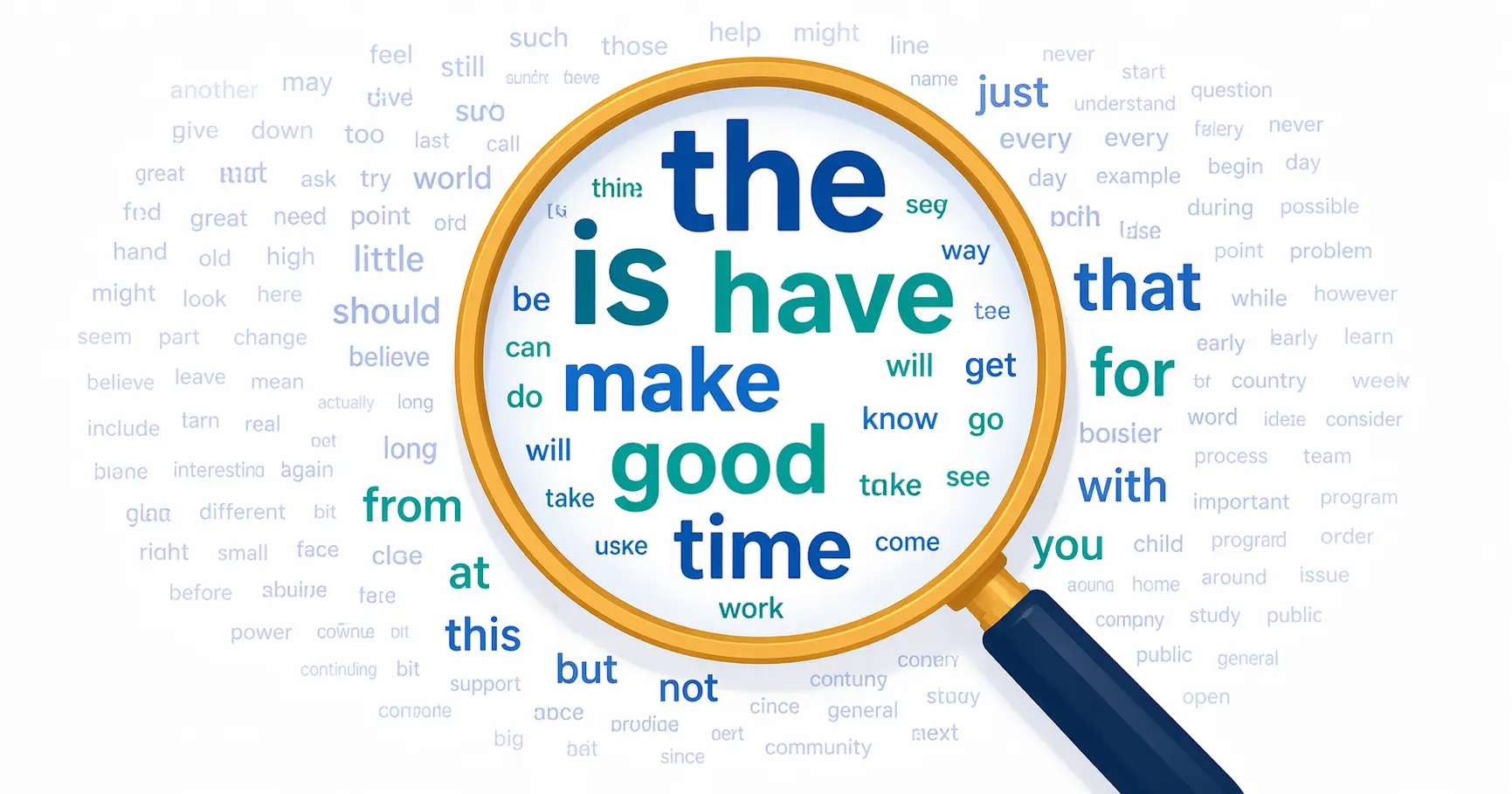
There is a magic number in vocabulary research: 4,000 word families. That is the point where you can understand approximately 95% of everyday English — conversations, news articles, TV shows, and most written texts. Below 4,000 words, you are constantly guessing. Above 4,000, you can learn new words from context because you already understand the sentences around them.
This guide is a complete study plan for reaching that 4,000-word threshold. It breaks the journey into four levels, gives you sample words at each stage, and provides a realistic schedule to get there in six months.
- Target vocabulary: 4,000 word families
- Levels covered: A1 → A2 → B1 → B2
- Time to complete: 5–6 months (20 words per day)
- Best for: intermediate learners, self-study, IELTS/TOEFL preparation, general fluency
Why 4,000 Words? The Science Behind the Number
Vocabulary researchers have studied how many words you need to function in English. The numbers are consistent across dozens of studies:
| Words Known | What You Can Do |
|---|---|
| 500 | Survive as a tourist — greetings, basic shopping, simple directions |
| 1,000 | Handle basic daily conversations — weather, family, food, time |
| 2,000 | Understand 90% of everyday speech — enough for A2 level |
| 4,000 | Understand 95% of speech and most written texts — B2 level |
| 6,000 | Read newspapers and academic texts comfortably — C1 level |
| 10,000 | Understand virtually everything — C2 / native-like level |
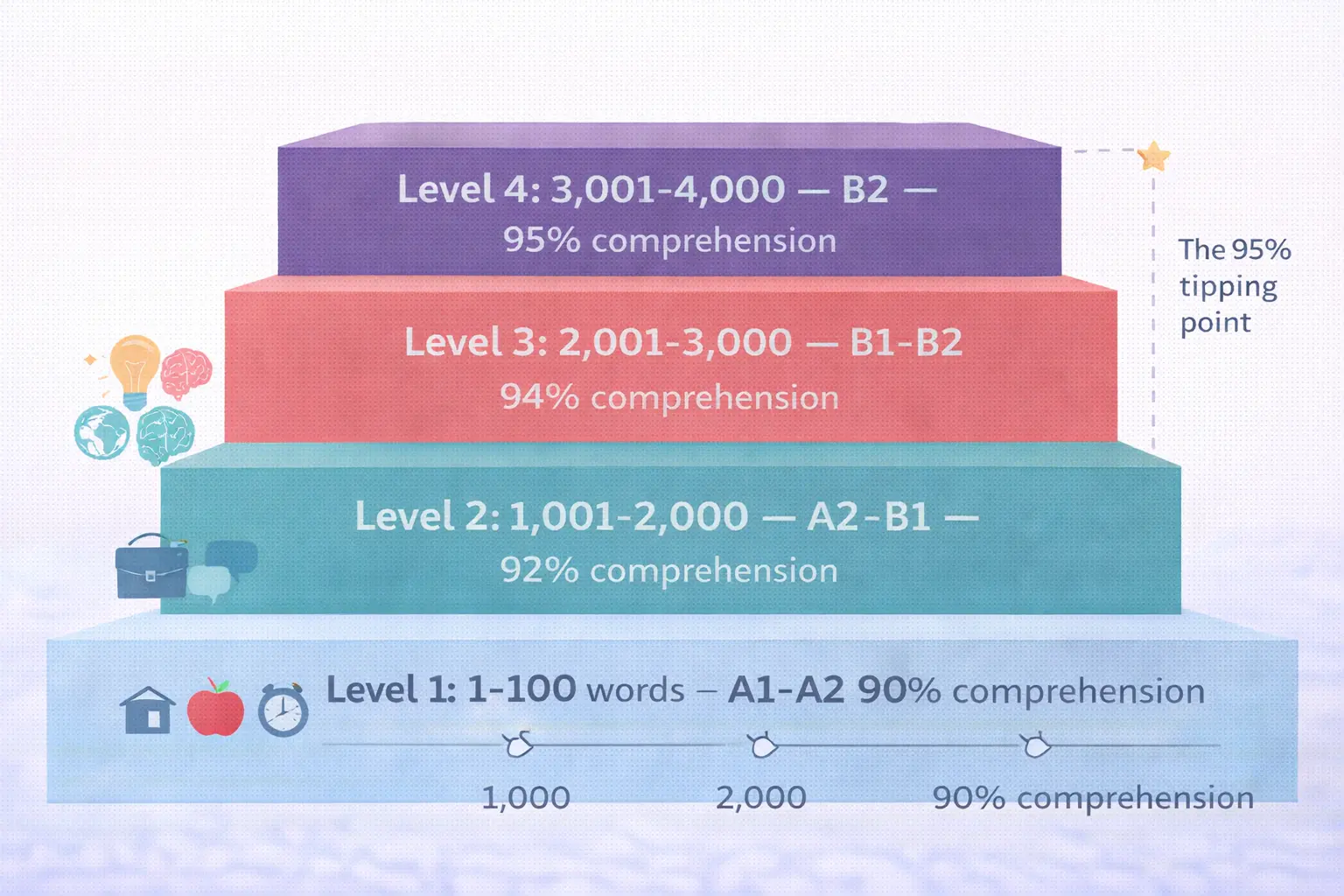
The jump from 90% to 95% comprehension sounds small, but it changes everything. At 90% comprehension, you miss 1 word in every 10 — roughly 2–3 unknown words per sentence. At 95%, you miss 1 word in every 20, which is usually enough to guess the meaning from context. This is the tipping point where you stop needing a dictionary for every paragraph and start learning new words naturally through reading and listening.
The term “word families” is important here. A word family includes the base word plus its common forms: “develop,” “development,” “developing,” “developed,” and “developer” count as one family. When researchers say 4,000, they mean 4,000 families — which translates to roughly 12,000–16,000 individual word forms.
How the 4,000 Words Are Organized
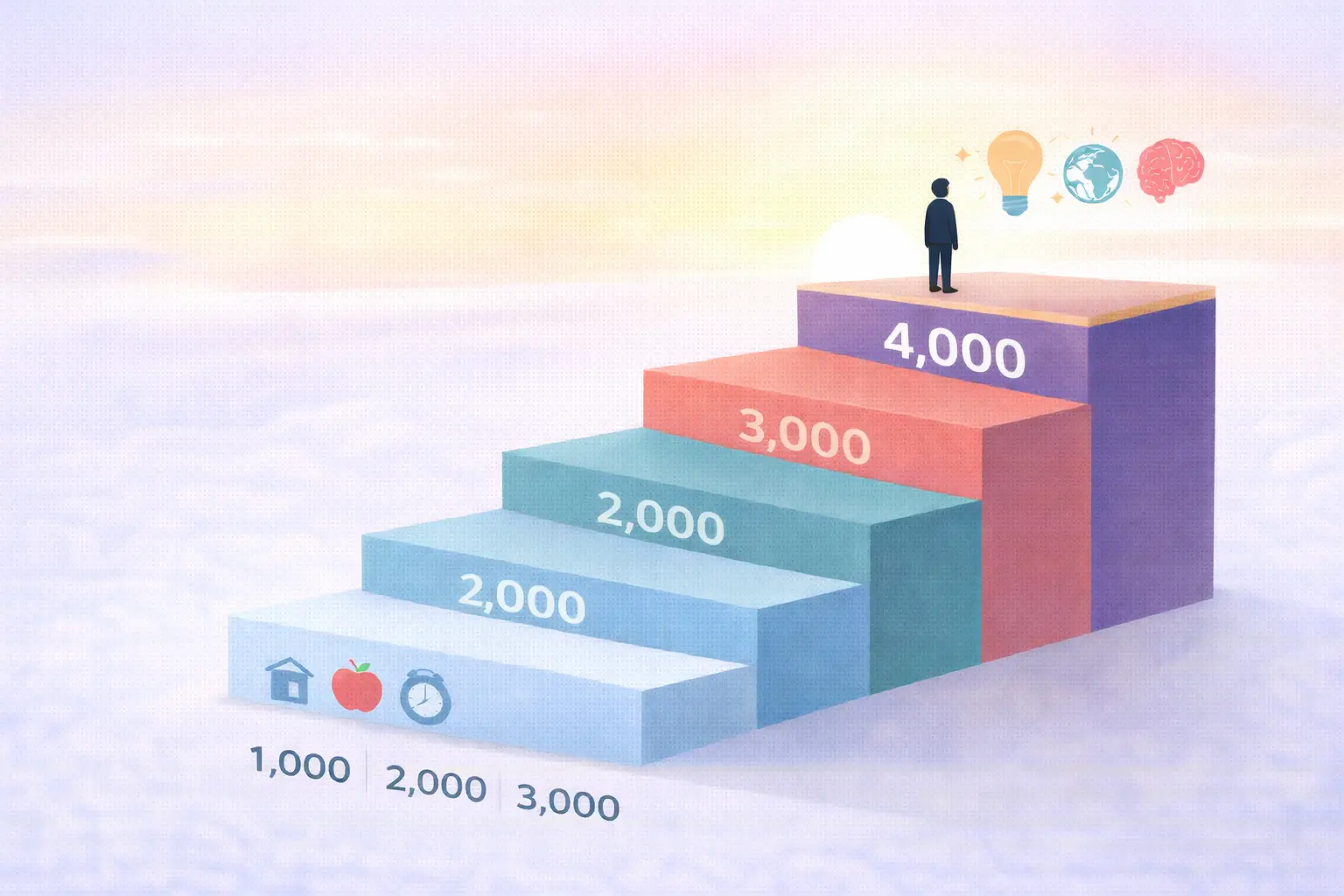
The most effective way to learn 4,000 words is by frequency — the most common words first. This guide breaks them into four levels based on how frequently they appear in English:
| Level | Words | CEFR | Description |
|---|---|---|---|
| Level 1 | Words 1–1,000 | A1–A2 | The absolute essentials — function words, basic nouns, common verbs |
| Level 2 | Words 1,001–2,000 | A2–B1 | Everyday vocabulary — work, health, social life, opinions |
| Level 3 | Words 2,001–3,000 | B1–B2 | Academic and professional — abstract concepts, formal verbs, precise adjectives |
| Level 4 | Words 3,001–4,000 | B2 | Advanced everyday — nuance, precision, less common but important words |
Each level builds on the previous one. Do not skip to Level 3 before you know Level 1 — frequency-based learning works because every new word you learn makes the next 100 words easier to understand.
Level 1: Words 1–1,000 (A1–A2)
These are the building blocks of English. They include function words (the, is, in, at, with), basic verbs, common nouns, and high-frequency adjectives. Most learners already know 60–70% of these — the goal is to fill the gaps.
High-Frequency Verbs
| Word | Meaning | Example |
|---|---|---|
| agree | have the same opinion | I agree with your suggestion. |
| belong | be owned by; be a member of | This book belongs to the school library. |
| contain | have something inside | The box contains all the documents you need. |
| describe | say what something is like | Can you describe the person you saw? |
| expect | think something will happen | I expect the results will be ready by Friday. |
| follow | go behind; come after | Follow the signs to the exit. |
| improve | make or become better | She improved her English by reading every day. |
| mention | refer to something briefly | He mentioned the meeting during lunch. |
| realize | become aware of something | I realized I had left my wallet at home. |
| suppose | think something is probably true | I suppose you are right about that. |
Everyday Nouns
| Word | Meaning | Example |
|---|---|---|
| advantage | a positive quality or benefit | Living near the office is a big advantage. |
| attempt | an effort to do something | She passed the exam on her second attempt. |
| bottom | the lowest part | The answer is at the bottom of the page. |
| century | a period of 100 years | The church was built in the 18th century. |
| crowd | a large group of people | A crowd gathered outside the stadium. |
| demand | a strong request; need | There is a growing demand for online courses. |
| effort | physical or mental energy used to do something | Learning a language requires daily effort. |
| journey | traveling from one place to another | The journey from London to Paris takes two hours by train. |
| opinion | what someone thinks about something | In my opinion, the second option is better. |
| purpose | the reason for doing something | The purpose of this meeting is to discuss the budget. |
Common Adjectives
| Word | Meaning | Example |
|---|---|---|
| available | able to be used or obtained | The manager is not available until 3 PM. |
| certain | sure; specific | I am certain she will arrive on time. |
| entire | whole; complete | He read the entire book in one day. |
| familiar | well known; easy to recognize | This place looks familiar — have we been here before? |
| necessary | needed; required | It is necessary to bring your passport to the interview. |
| ordinary | normal; not special | It was just an ordinary day — nothing unusual happened. |
| previous | coming before in time | My previous job was at a marketing agency. |
| recent | happening not long ago | Have you read any good books recently? |
| separate | not joined or connected | The house has a separate entrance for guests. |
| worth | having a value of; deserving | The museum is worth visiting if you have time. |
At Level 1, your goal is speed. Most of these words have simple, concrete meanings. Aim for 30 words per day — you can complete Level 1 in about five weeks.
Level 2: Words 1,001–2,000 (A2–B1)
At this level, vocabulary becomes more specific. You start learning words for opinions, emotions, work, health, and social situations. These are the words that move you from “surviving” to “communicating.”
Opinion and Communication
| Word | Meaning | Example |
|---|---|---|
| claim | state something is true (often disputed) | He claims he was not at the scene. |
| confirm | verify that something is true | Can you confirm the time of the appointment? |
| convince | make someone believe something | She convinced her boss to approve the project. |
| deny | say something is not true | The company denied any involvement in the scandal. |
| distinguish | recognize the difference between | It is hard to distinguish between the two products. |
| express | communicate a feeling or idea | He expressed his gratitude in a letter. |
| indicate | show; point to | The data indicates a significant change. |
| persuade | cause someone to do something through reasoning | They persuaded the council to build a new park. |
| recommend | suggest as a good choice | I recommend reading this book before the course starts. |
| warn | tell someone about a danger | The sign warns drivers about the sharp curve. |
Work and Professional Life
| Word | Meaning | Example |
|---|---|---|
| achieve | successfully reach a goal | She achieved her sales target three months early. |
| budget | a plan for how money will be spent | The project went over budget by $50,000. |
| colleague | a person you work with | My colleague helped me finish the report. |
| deadline | the last date for completing something | The deadline for the application is March 15. |
| employ | give work to someone; use something | The factory employs over 500 people. |
| invest | put money into something to make profit | She invested in a small startup company. |
| promote | give someone a higher position; advertise | He was promoted to regional manager last month. |
| resign | voluntarily leave a job | She resigned after ten years with the company. |
| qualify | meet the requirements; become eligible | You need 3 years of experience to qualify for the role. |
| supervise | watch over and direct work | She supervises a team of 12 engineers. |
Health and Well-Being
| Word | Meaning | Example |
|---|---|---|
| cure | a treatment that makes someone healthy again | There is still no cure for the common cold. |
| diagnose | identify an illness or problem | The doctor diagnosed him with a vitamin deficiency. |
| exhaust | make extremely tired; use up completely | The long flight exhausted everyone on the team. |
| immune | protected against a disease | Vaccination makes you immune to certain infections. |
| injury | physical damage to the body | He missed the season because of a knee injury. |
| nutrition | the process of taking in food and using it for growth | Good nutrition is essential for children’s development. |
| recover | return to a normal state after illness or difficulty | It took her six weeks to recover from surgery. |
| symptom | a sign that something is wrong (especially illness) | Headache and fever are common symptoms of the flu. |
| therapy | treatment for an illness or condition | Physical therapy helped him walk again after the accident. |
| treat | give medical care; behave toward someone in a certain way | The hospital treats over 1,000 patients per day. |
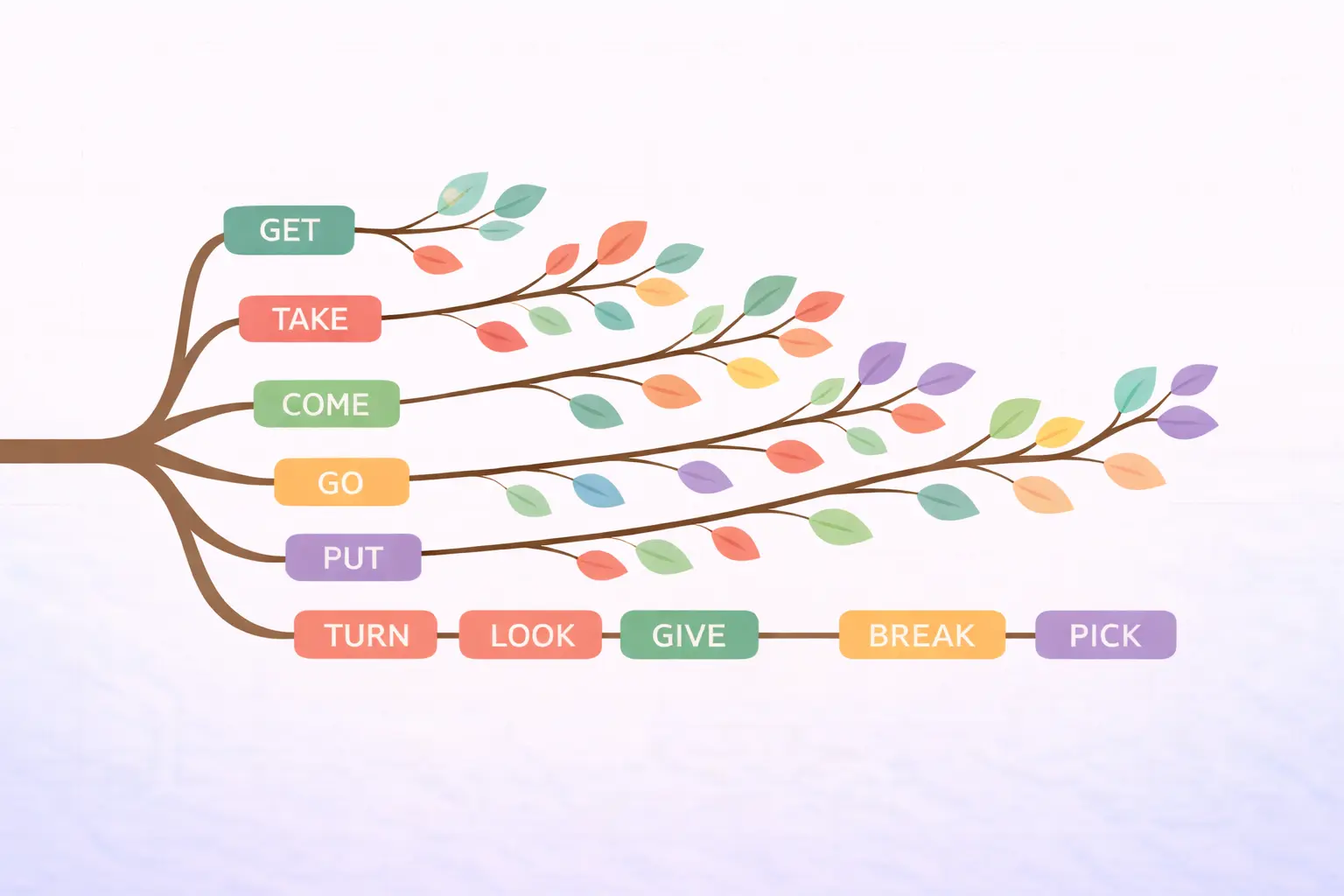
At Level 2, many words have multiple meanings (“treat” = medical care AND behavior). Start paying attention to context and collocations — not just definitions.
Level 3: Words 2,001–3,000 (B1–B2)
This is where English starts to feel academic. Level 3 words appear frequently in newspapers, university lectures, professional emails, and standardized tests like IELTS and TOEFL. They are more abstract and often have Latin or Greek roots.
Academic and Analytical
| Word | Meaning | Example |
|---|---|---|
| alternative | another option or choice | We need to consider alternative solutions. |
| contribute | give something (money, time, ideas) to help | Several factors contributed to the company’s success. |
| evaluate | assess the quality or value of | The committee will evaluate all proposals next week. |
| implement | put a plan or system into action | The school implemented a new grading system. |
| investigate | examine or study something closely | Police are investigating the cause of the fire. |
| maintain | keep in good condition; continue | The city maintains over 200 parks and green spaces. |
| obtain | get or acquire | You can obtain a visa at the embassy. |
| perspective | a particular way of thinking about something | The article offers a fresh perspective on the debate. |
| reveal | make something known; show | The study revealed surprising results. |
| significant | important; large enough to have an effect | There has been a significant improvement in air quality. |
Society and Culture
| Word | Meaning | Example |
|---|---|---|
| circumstance | a condition or fact connected with an event | Under the circumstances, we had no other choice. |
| conflict | a serious disagreement or fight | The conflict between the two countries lasted for years. |
| demonstrate | show clearly; protest publicly | The experiment demonstrates how gravity works. |
| ethnic | relating to a group with shared culture or origin | The city is home to many ethnic communities. |
| generation | all people born around the same time | This generation of students grew up with smartphones. |
| inequality | lack of equal treatment or opportunity | Income inequality is a growing concern worldwide. |
| migrate | move from one place to another (permanently) | Millions of people migrate to cities for better opportunities. |
| poverty | the state of being extremely poor | Nearly 700 million people live in extreme poverty. |
| reform | improve by making changes | The government announced major education reforms. |
| tradition | a custom passed down through generations | Exchanging gifts is a holiday tradition in many cultures. |
Science and Technology
| Word | Meaning | Example |
|---|---|---|
| calculate | determine by using mathematics | The app calculates your daily calorie intake. |
| component | a part of a larger system | The engine has over 300 individual components. |
| data | facts and statistics collected for analysis | The researchers collected data from 10,000 participants. |
| device | a piece of equipment made for a specific purpose | Smartphones are the most widely used electronic devices. |
| efficient | achieving maximum results with minimum waste | The new system is 40% more energy-efficient. |
| generate | produce or create | Wind turbines generate electricity without emissions. |
| innovation | a new idea, method, or device | The company is known for innovation in battery technology. |
| precise | exact and accurate | The measurements need to be precise to within 0.1 mm. |
| resource | a supply of something useful | Water is the most precious natural resource. |
| sustain | maintain over a long period; support | The country cannot sustain this level of economic growth. |
Level 3 is where most learners slow down — the words are more abstract and harder to visualize. Use example sentences and collocations, not just definitions. “Contribute” does not just mean “give” — it collocates with “to” (contribute to success) and is used for abstract ideas, not physical objects.
Level 4: Words 3,001–4,000 (B2)
The final 1,000 words add precision and nuance. They are the words that separate competent speakers from truly fluent ones — the vocabulary that earns Band 7+ in IELTS or unlocks advanced reading comprehension.
Precision Verbs
| Word | Meaning | Example |
|---|---|---|
| accumulate | gather over time | He accumulated a huge collection of rare books. |
| allocate | distribute for a specific purpose | The government allocated $2 billion to infrastructure. |
| compensate | make up for something; pay in return | The company compensated workers for the overtime. |
| diminish | become smaller, fewer, or less important | Her enthusiasm did not diminish despite the setbacks. |
| eliminate | remove completely | The new policy aims to eliminate food waste in schools. |
| fluctuate | change frequently between higher and lower levels | Oil prices fluctuate depending on global demand. |
| inhibit | slow down or prevent | Fear of failure inhibits creativity. |
| manipulate | control or influence skillfully (often unfairly) | The data was manipulated to show better results. |
| reinforce | strengthen or support | The study reinforces the link between sleep and memory. |
| utilize | use, especially in a practical or effective way | The company utilizes AI to improve customer service. |
Abstract Nouns
| Word | Meaning | Example |
|---|---|---|
| bureaucracy | complicated official systems and processes | The project was delayed by government bureaucracy. |
| consensus | general agreement among a group | The committee reached a consensus after three hours. |
| ideology | a system of ideas and beliefs | Political ideology shapes how people view the world. |
| integrity | honesty and strong moral principles | She is known for her professional integrity. |
| phenomenon | an observable event; something unusual | Social media addiction is a modern phenomenon. |
| prosperity | the state of being successful, especially financially | The country enjoyed a period of unprecedented prosperity. |
| stereotype | an oversimplified idea about a group of people | We should challenge stereotypes rather than accept them. |
| threshold | the level at which something begins to happen | The pain threshold varies from person to person. |
| transition | the process of changing from one state to another | The transition from school to work can be challenging. |
| vulnerability | the quality of being easily hurt or attacked | The report highlighted the vulnerability of coastal cities. |
Advanced Adjectives
| Word | Meaning | Example |
|---|---|---|
| ambiguous | having more than one possible meaning; unclear | The contract language was deliberately ambiguous. |
| compelling | very convincing or interesting | She made a compelling argument for renewable energy. |
| comprehensive | including everything; thorough | The report provides a comprehensive analysis of the market. |
| inevitable | certain to happen; unavoidable | Change is inevitable in any growing organization. |
| legitimate | lawful; reasonable and acceptable | Citizens have legitimate concerns about data privacy. |
| predominant | most common; having the greatest influence | English is the predominant language in international business. |
| subtle | not obvious; delicate | There is a subtle difference between “effect” and “affect.” |
| sustainable | able to continue over a long period | Sustainable farming practices protect the soil for future generations. |
| trivial | of little importance | Do not waste time on trivial details — focus on the big picture. |
| unprecedented | never done or known before | The pandemic caused unprecedented disruption to global trade. |
Level 4 words rarely appear in everyday conversation, but they appear constantly in news, academic texts, and professional communication. If you are preparing for IELTS, TOEFL, or university study, these words are essential.
The 6-Month Study Plan
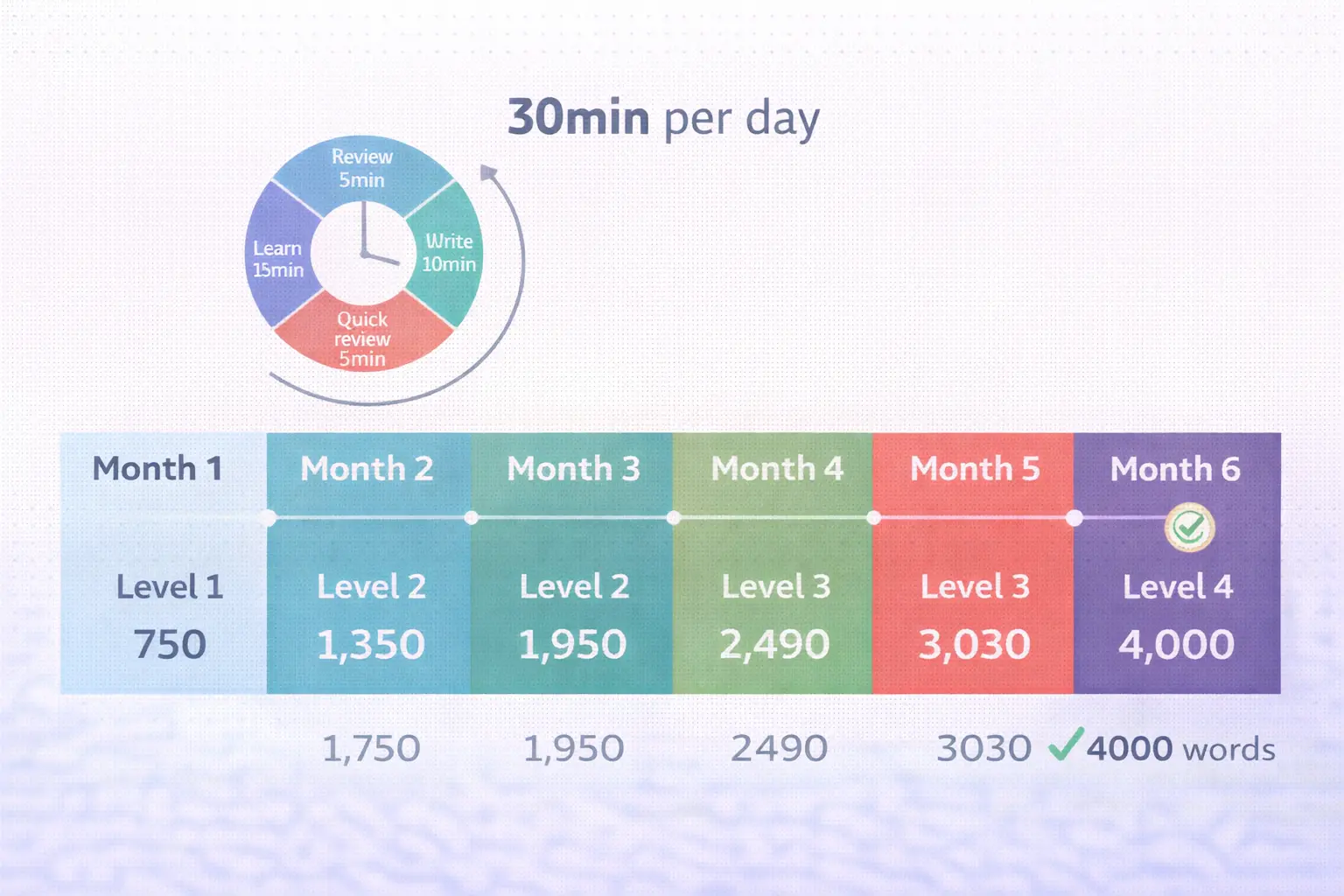
Here is a realistic schedule for learning 4,000 words from scratch. It assumes 30–45 minutes of study per day and uses spaced repetition to prevent forgetting.
| Month | Level | New Words/Day | Total New Words | Cumulative |
|---|---|---|---|---|
| Month 1 | Level 1 (words 1–1,000) | 25 | ~750 | 750 |
| Month 2 | Level 1 → Level 2 | 20 | ~600 | 1,350 |
| Month 3 | Level 2 (words 1,001–2,000) | 20 | ~600 | 1,950 |
| Month 4 | Level 3 (words 2,001–3,000) | 18 | ~540 | 2,490 |
| Month 5 | Level 3 → Level 4 | 18 | ~540 | 3,030 |
| Month 6 | Level 4 (words 3,001–4,000) + review | 18 | ~540 + review | ~3,570 + existing knowledge |
Why not exactly 4,000 new words? Because you already know many Level 1 words (greetings, numbers, colors, days of the week). Most adult learners already know 500–1,000 English words before starting serious study. The plan fills in the gaps.
Daily Study Routine (30 minutes)
| Time | Activity |
|---|---|
| 5 min | Review yesterday’s words using spaced repetition (Linglify flashcards) |
| 10 min | Learn 18–25 new words: read each word, its meaning, and the example sentence |
| 10 min | Active practice: write 5 sentences using today’s new words |
| 5 min | Quick review of words from 3 and 7 days ago (spaced repetition cycle) |
Weekly Review Session (Saturday or Sunday, 20 minutes)
Go through all words learned that week. For each word, test yourself: can you recall the meaning? Can you use it in a sentence? Mark any words you forgot and add them back to your daily review.
Vocabulary to Practice
Here are 25 essential words from across all four levels. Add them to your Linglify dictionary to start practicing with spaced repetition.
finance
verb
This verb means to provide money for a project or activity, or to manage financial matters.
Examples
- Many students need loans to finance their college education expenses.
- The bank agreed to finance the construction of the new shopping center.
executive
adjective
Relating to people in high positions of management or authority.
Examples
- Executive decisions require careful consideration of multiple factors and consequences.
- The executive branch of government is responsible for implementing laws.
valid
adjective
Having legal or official force; acceptable.
Examples
- Valid argument supports logical reasoning and conclusion.
- Valid passport allows international travel without problems.
flexible
adjective
Able to change or bend without breaking; adaptable.
Examples
- Flexible working arrangements help employees balance work and family life.
- The flexible plastic tube can bend without breaking or cracking.
transmit
verb
To send or pass on information, signals, or messages.
Examples
- Disease may transmit through contact with surfaces.
- Satellites transmit signals across vast distances effectively.
culmination
noun
The highest point or final stage of a process or event.
Examples
- The graduation ceremony was the culmination of four years of hard study.
- Winning the championship represented the culmination of the team's efforts.
gulp
verb
This verb means to swallow quickly or in large amounts, often with a gulping sound.
Examples
- She had to gulp nervously before giving her presentation to the board.
- The thirsty runner gulped down an entire bottle of cold water.
tribe
noun
A group of people who share a common culture, language, or history.
Examples
- Ancient tribe lived in harmony with nature.
- Indigenous tribe preserves traditional customs and languages.
cherished
adjective
Deeply loved or valued; treasured.
Examples
- His cherished dream of becoming a pilot finally came true.
- The old photograph was her most cherished possession from childhood.
fate
noun
The power or force that is believed to determine what happens in the future.
Examples
- She believes that fate brought them together at the right moment.
- The explorer's fate remained unknown after he disappeared in the jungle.
territory
noun
An area of land with defined borders, often controlled by a country.
Examples
- Animal territory provides food and shelter resources.
- National territory requires protection from foreign invasion.
payable
adjective
Able to be paid; due for payment.
Examples
- All dues are payable at the end of the month.
- The invoice is payable within 30 days.
serenity
noun
A state of calm, peacefulness, and mental clarity.
Examples
- She maintained her serenity despite the chaos.
- The serenity of the lake was calming.
classy
adjective
This adjective describes someone or something that is stylish, elegant, or of high quality.
Examples
- Classy restaurant serves gourmet food in elegant dining atmosphere.
- Her classy appearance impressed everyone at formal business meeting.
revolt
verb
To openly oppose or fight against authority, rules, or established order.
Examples
- A revolt broke out in the city center last night.
- The workers decided to revolt against the unfair conditions.
rethink
verb
To reconsider or think about something again, often leading to a new decision or opinion.
Examples
- He decided to rethink his position on the issue.
- We need to rethink our strategy for the project.
gypsy
noun
A member of a traditionally nomadic ethnic group known for their itinerant lifestyle and distinct culture.
Examples
- Traditional gypsy music features violin and passionate vocals.
- Wandering gypsy caravan traveled through European countryside.
buffoon
noun
A person who acts in a silly or foolish way, often to entertain others.
Examples
- Court buffoon entertained royal family with silly performances.
- Don't act like buffoon during important business presentation.
execution
noun
The act of carrying out a plan or law; the process of killing or executing.
Examples
- Perfect execution of the dance routine impressed judges and audience members.
- The execution of the business plan requires careful coordination and timing.
spellbound
adjective
Fascinated or captivated by something.
Examples
- Audience sits spellbound during magical performance tonight.
- Children remain spellbound by storyteller's fascinating tales.
pet
adjective
Relating to a domesticated animal kept for companionship or amusement.
Examples
- Pet project receives extra attention and resources.
- Pet theory explains professor's research focus area.
master
noun
A person who has control or authority over something or someone, often skilled in a particular area.
Examples
- Apprentices learn traditional crafts from experienced master craftsmen.
- The chess master defeated opponents using brilliant strategic moves.
salvage
noun
The act of saving or rescuing something from loss or destruction.
Examples
- Antique dealer specializes in salvage from demolished buildings.
- Divers recovered valuable salvage from sunken merchant ship.
Common Mistakes When Learning 4,000 Words
1. Trying to learn too many words at once. 50 words per day sounds productive, but you will forget 80% of them within a week without review. 18–25 words per day with daily spaced repetition beats 50 words with no review.
2. Learning words without context. Memorizing “allocate = distribute” is not enough. You need to know that “allocate” collocates with “budget,” “resources,” “funds,” and “time.” Always learn from example sentences.
3. Skipping levels. Level 3 and 4 words are more impressive, but if you have gaps in Level 1 and 2, your overall comprehension stays low. A solid foundation of common words matters more than a handful of advanced ones.
4. Only studying receptive knowledge. Recognizing a word when you read it is different from producing it in speech or writing. For every 5 words you learn receptively, practice using at least 2 of them actively — in a sentence you write or say.
5. Not reviewing. The forgetting curve is steep: without review, you lose 50% of new words within 24 hours and 80% within a week. Spaced repetition is not optional — it is the entire system.
What to Do Next
-
Start with the right level. If you already know 1,000+ words, skip to Level 2. If you are preparing for IELTS, focus on Levels 3 and 4 — those are the words that move you from Band 6 to Band 7+. Browse our vocabulary library by level:
-
Build a study system. Use our step-by-step vocabulary learning guide to set up a daily routine with spaced repetition.
-
Learn complete sentences too. Words are more useful when you learn them in sentences. See our simple English sentences for daily use for 200+ ready-to-use phrases.
-
Apply proven memorization techniques. Read how to improve your vocabulary for 10 methods backed by research — including spaced repetition, contextual learning, and the keyword method.
-
Prepare for exams. If your goal is IELTS, our IELTS vocabulary guide maps words to specific band scores. For general vocabulary, see our guide on new English words in 2026 to stay current.
FAQ
Can I learn 4,000 English words for free?
Yes. The word lists themselves are widely available — frequency-based word lists like the General Service List (GSL) and the Academic Word List (AWL) are free and well-researched. What matters more than the list is the study method: spaced repetition, contextual learning, and active use. Linglify offers free vocabulary practice with spaced repetition built in. This guide gives you the structure to study any 4,000-word list effectively.
How long does it take to learn 4,000 words?
At a pace of 20 new words per day with daily review, most learners can learn 4,000 words in 5–6 months. Faster learners who study 30+ words per day can finish in 4 months. The key variable is not speed — it is consistency. Studying 20 words every day for 6 months beats studying 100 words per week with gaps.
What is the difference between “4000 Essential English Words” and the Academic Word List?
The “4000 Essential English Words” series (by Paul Nation, published by Compass Publishing) covers general high-frequency words across all topics. The Academic Word List (AWL) is a separate list of 570 word families that appear frequently in university-level texts. There is overlap — about 30% of AWL words appear in the 4,000 essential words. If you are preparing for IELTS Academic or university study, learn both.
Are 4,000 words enough for IELTS Band 7?
4,000 word families give you strong B2-level vocabulary, which aligns with IELTS Band 6–6.5 for most candidates. For Band 7, you need 5,000–6,000 word families plus strong active command of academic vocabulary. Our IELTS Band 7 vocabulary guide covers the specific words you need beyond the 4,000 base.
Should I learn words alphabetically or by frequency?
By frequency — always. Alphabetical order puts “aardvark” before “about,” but “about” is one of the most common words in English while “aardvark” appears almost never. Frequency-based learning ensures every word you study has maximum real-world usefulness. The level-based organization in this guide follows frequency order.
What is the best app for learning 4,000 words?
The best app is one that uses spaced repetition and lets you learn words in context (with example sentences), not just word-definition pairs. Linglify combines both: you can save words to your personal dictionary, see them in real sentences, and review them with spaced repetition scheduling. For a comparison of vocabulary apps, stay tuned for our upcoming vocabulary app guide.