Phrasal Verbs with MAKE: Complete List with Meanings and Examples
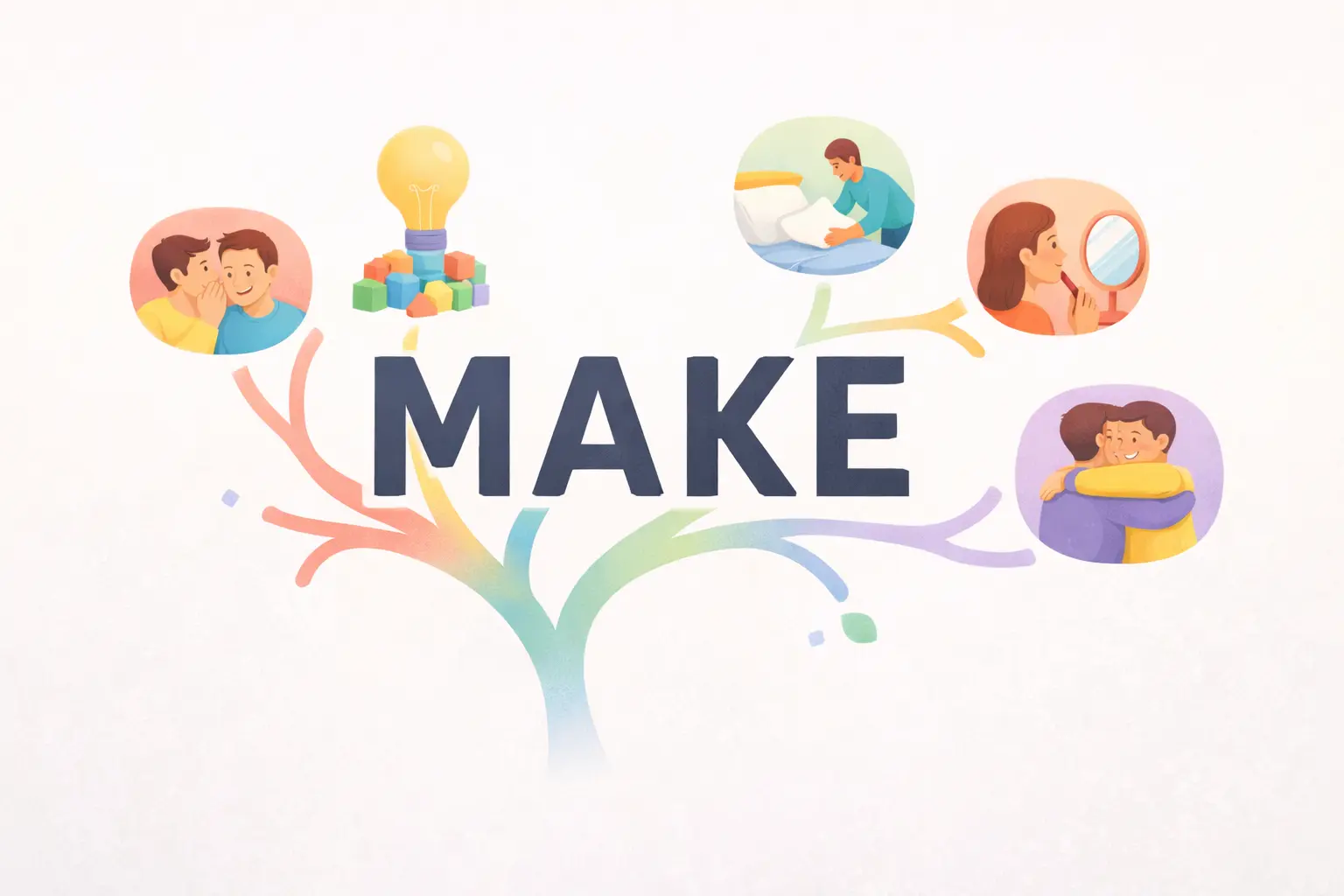
MAKE is one of the most versatile verbs in English. Add a preposition or adverb — up, out, off, for — and the meaning changes completely. “Make up” alone has five different meanings depending on context, and that is just one combination.
This guide covers every major phrasal verb with MAKE, organized by meaning groups. Each entry includes a clear definition, real-life example sentences, and notes on formality. Whether you are preparing for IELTS, studying for business English, or simply want to sound more natural — this is the reference you need.
- Phrasal verbs covered: 20+
- Level: B1–B2 (intermediate to upper-intermediate)
- Focus: meanings, example sentences, usage notes, common mistakes
MAKE UP — The Most Common (5 Meanings)
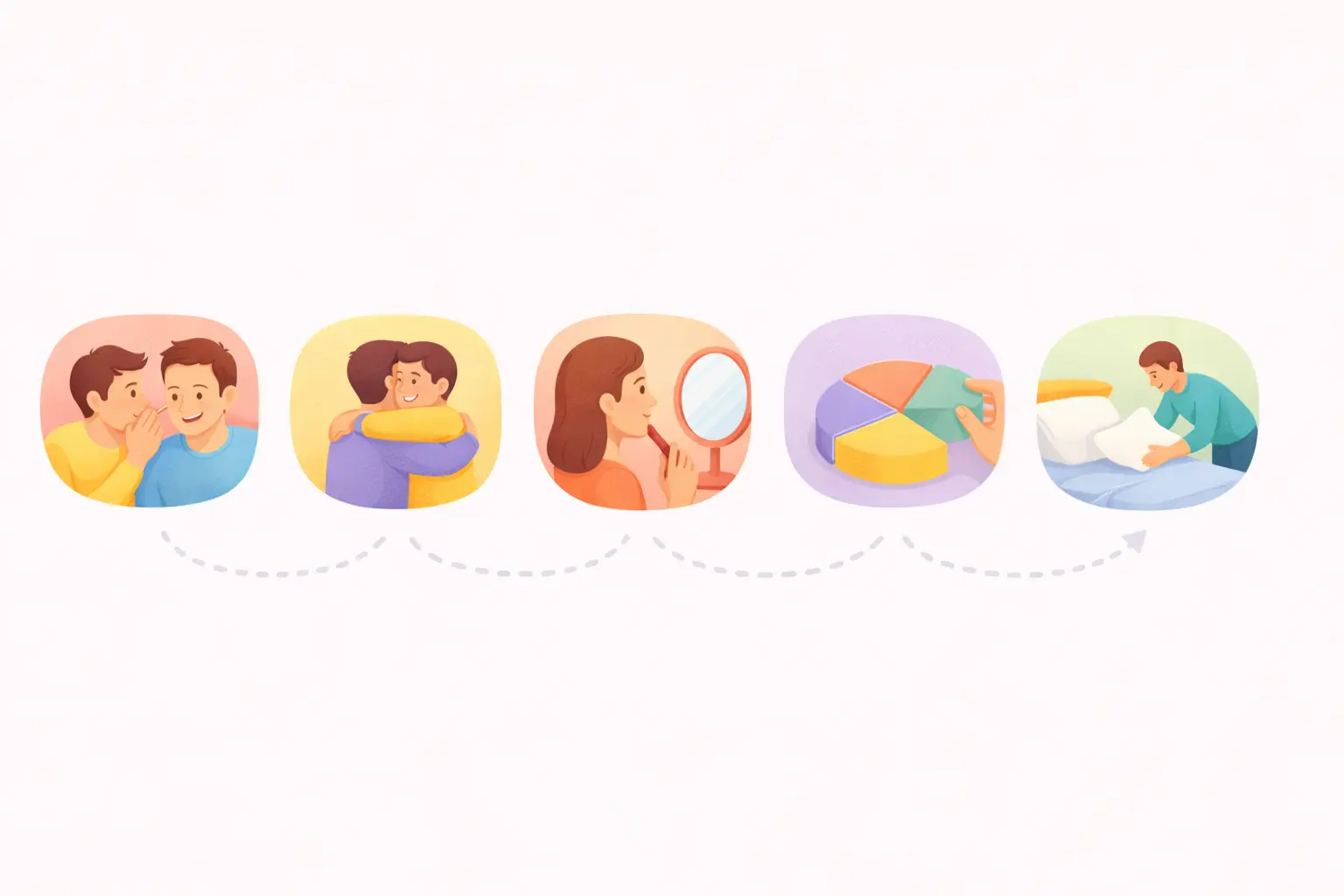
“Make up” is the most searched phrasal verb with MAKE — and for good reason. It has five distinct meanings, and confusing them is one of the most common mistakes learners make.
1. To invent (a story, excuse, or lie)
To create something untrue or fictional.
She made up an excuse for being late to the meeting. Children love making up stories about imaginary friends. Don’t believe him — he made the whole thing up.
2. To reconcile after an argument
To become friends again after a disagreement.
They argued about money but made up the next day. Life is short — make up with your sister before it is too late.
3. To apply cosmetics
To put on makeup (cosmetics for the face).
She usually makes herself up before video calls. The actress was made up to look 20 years older for the role.
4. To compose or form a whole
To be the parts that create something.
Women make up 52% of the company’s workforce. Three short stories make up the second part of the book.
5. To prepare or arrange
To prepare something (a bed, a room, a package).
Could you make up the guest room? We have visitors arriving tonight. The pharmacist made up the prescription while I waited.
Memory tip: The context always tells you which meaning is intended. Look at the subject and object: person + excuse = invent, two people = reconcile, percentage + group = compose.
MAKE OUT — 4 Meanings
Another highly searched phrasal verb with multiple meanings.
1. To see, hear, or understand with difficulty
To barely manage to perceive or comprehend something.
I could not make out what the sign said from that distance. The handwriting was so bad I could barely make out the words. Can you make out what he is saying? The audio is terrible.
2. To claim or suggest
To assert something, often implying doubt about whether it is true.
He makes out that he is an expert, but he only started learning last month. The article makes out that the problem is simple, but it is not.
3. To write out (a cheque, receipt, or document)
To fill in or write a formal document.
Please make the cheque out to “Smith & Associates.” I will make out a receipt for your records.
4. To manage or fare
To do or perform in a particular way (informal, mainly American English).
How did you make out at the job interview? We made out pretty well on the sale — doubled our investment.
MAKE FOR — Moving Toward or Contributing To
Two related but distinct meanings.
1. To move toward a place
To head in the direction of something.
When the fire alarm went off, everyone made for the exit. After lunch, we made for the coast and arrived by sunset.
2. To contribute to or result in
To create conditions that lead to something.
Good lighting and comfortable chairs make for a productive workspace. Mixing experienced and junior team members makes for better results.
MAKE OFF / MAKE OFF WITH — Escaping and Stealing
Make off
To leave quickly, especially to escape.
The thieves made off before the police arrived. He made off through the back door when he heard the sirens.
Make off with
To steal something and escape with it.
Someone made off with my laptop while I was getting coffee. The hackers made off with millions in cryptocurrency.
MAKE UP FOR — Compensating
To compensate for something lost, missed, or done wrong.
He worked overtime to make up for the days he missed. The beautiful scenery more than made up for the long drive. She bought him dinner to make up for forgetting his birthday.
This is different from “make up” (reconcile). “Make up for” always involves compensation — replacing something negative with something positive.
MAKE DO (WITH) — Managing with Less
To manage with whatever is available, even if it is not ideal.
We do not have a projector, so we will have to make do with a laptop screen. During the crisis, families had to make do with very little. There is no fresh bread — we will have to make do with what is in the freezer.
Note: This phrasal verb uses “do,” not “due.” A common spelling mistake is writing “make due with.”
MAKE INTO — Transformation
To change or transform something into something different.
They made the old warehouse into a modern art gallery. The book was made into a film in 2024. With some paint and new furniture, we can make this room into a proper office.
MAKE OF — Interpreting or Understanding
To think about or interpret something. Often used in questions.
What do you make of the new proposal? I do not know what to make of his behavior lately. What did you make of the film? I thought it was brilliant.
Complete Phrasal Verbs with MAKE — Quick Reference
Here is every phrasal verb with MAKE in one table for quick lookup.
| Phrasal Verb | Meaning | Level | Example |
|---|---|---|---|
| make up | invent (a story/excuse) | B1 | He made up the story. |
| make up | reconcile | B1 | They made up after the fight. |
| make up | apply cosmetics | B1 | She made herself up for the party. |
| make up | compose / form | B2 | Imports make up 60% of supply. |
| make up | prepare (a bed/room) | B2 | Can you make up the spare room? |
| make out | perceive with difficulty | B2 | I can’t make out the writing. |
| make out | claim / suggest | B2 | He makes out he’s innocent. |
| make out | write (a cheque/receipt) | B2 | Make the cheque out to me. |
| make out | manage / fare | B2 | How did you make out? |
| make for | move toward | B2 | We made for the nearest exit. |
| make for | contribute to / result in | B2 | This makes for good reading. |
| make off | escape quickly | B2 | The thief made off on foot. |
| make off with | steal and escape | B2 | He made off with the cash. |
| make up for | compensate | B1 | She made up for lost time. |
| make do (with) | manage with less | B2 | We’ll make do with what we have. |
| make into | transform | B2 | They made it into a museum. |
| make of | interpret / think about | B2 | What do you make of this? |
| make over | renovate / transform appearance | B2 | They made over the entire shop. |
| make towards | move in the direction of | B2 | She made towards the door. |
| make it | succeed / arrive on time | B1 | We barely made it to the airport. |
Vocabulary to Practice
Strengthen your general English alongside these phrasal verbs. Click any word to see its definition, pronunciation, and examples.
worthless
adjective
An adjective describing something that has no value or use.
Examples
- Don't let anyone make you feel worthless or unimportant.
- The broken watch became completely worthless and couldn't be repaired.
formally
adverb
In a manner that follows accepted customs or conventions.
Examples
- Students must formally register for classes before the semester begins.
- The new president will be formally inaugurated next month in the capital.
border
noun
An area or line that separates two countries, states, or regions.
Examples
- The garden had a beautiful flower border along the path.
- They crossed the border between France and Germany.
unload
verb
To remove a load or burden from something or someone.
Examples
- Ship crew must unload containers at port.
- Workers unload cargo from delivery truck efficiently.
stress
verb
To feel mental or emotional pressure or worry; to emphasize or give importance to something.
Examples
- Heavy workload may stress employees beyond limits.
- Teacher will stress importance of homework completion.
willingly
adverb
In a way that shows eagerness or enthusiasm to do something.
Examples
- He willingly shared his knowledge with younger students.
- The volunteers worked willingly without expecting any payment.
prospect
noun
A possible future event or situation that may happen, often based on current evidence.
Examples
- Economic prospect looks optimistic for next year.
- Job prospect improves with additional education training.
willingness
noun
The quality of being eager or ready to do something.
Examples
- Her willingness to learn impressed all the teachers.
- The company values employees' willingness to work as a team.
timeliness
noun
The quality or state of being appropriate or suitable at the right time.
Examples
- Project timeliness determines success in competitive business environment.
- Report timeliness affects decision making processes significantly.
calm
adjective
Not feeling worried or upset; peaceful.
Examples
- She remained calm despite the stressful situation at work.
- The calm ocean reflected the beautiful colors of the sunset.
bewilderment
noun
A feeling of being confused or unable to understand.
Examples
- She stared in bewilderment at the unexpected test results.
- The tourist's bewilderment was obvious when he got lost downtown.
brick
noun
A solid block of clay or other material used in construction or for building walls.
Examples
- He's been a real brick during this crisis.
- The house was built with traditional red brick.
revise
verb
To change or improve something, especially a piece of writing or a plan.
Examples
- Author must revise manuscript before publication deadline.
- Student will revise lessons before final examination.
lap
noun
The top part of the body of a person or animal when sitting or lying down.
Examples
- The cat curled up comfortably on her lap while reading.
- The runner completed another lap around the track successfully.
transfer
verb
To move from one place to another, often of goods or people.
Examples
- Bank will transfer money between accounts quickly.
- Student may transfer to different university program.
max
noun
A short form of a name or nickname, often used for a person or thing.
Examples
- Students can borrow max of five books from library.
- The speed limit max on highway is seventy miles per hour.
exhausted
adjective
Very tired or worn out; lacking energy.
Examples
- After running the marathon, she felt completely exhausted and needed to rest.
- The exhausted workers finally finished their twelve-hour shift at the factory.
diligent
adjective
Showing care and effort in work or duties.
Examples
- Diligent students typically achieve better grades through consistent hard work.
- The diligent researcher spent years collecting data for the scientific study.
independent
adjective
Not dependent on others; self-reliant.
Examples
- She's very independent and prefers to solve problems on her own.
- The independent research confirmed the results of the original study.
impolitely
adverb
In a way that is not polite or respectful.
Examples
- He spoke impolitely to the waiter and made everyone uncomfortable.
- She impolitely refused to answer the reporter's questions.
characterize
verb
To describe or portray the character or qualities of someone or something.
Examples
- Honesty and integrity characterize his approach to business dealings.
- The report characterizes the current economic situation as generally stable.
yell
verb
A verb meaning to shout loudly, often in anger or excitement.
Examples
- Don't yell at the children when they make innocent mistakes.
- The coach had to yell instructions over the crowd noise.
aggressive
adjective
Ready to attack or confront; showing strong energy or determination.
Examples
- Some drivers become aggressive when stuck in heavy traffic for hours.
- The aggressive marketing campaign helped increase sales by thirty percent last quarter.
alphabet
noun
A set of letters used to write a language.
Examples
- Children learn the alphabet before they can read complete sentences.
- The English alphabet has twenty-six letters from A to Z.
How to Practice Phrasal Verbs with MAKE
1. Start with the top 5. Do not try to memorize all 20 at once. Begin with make up (invent), make out (understand), make for (move toward), make up for (compensate), and make do with (manage). These cover 80% of real-world usage.
2. Write your own sentences. For each phrasal verb, write 2–3 sentences about your own life. “I made up an excuse when I was late to work” is more memorable than reading someone else’s example.
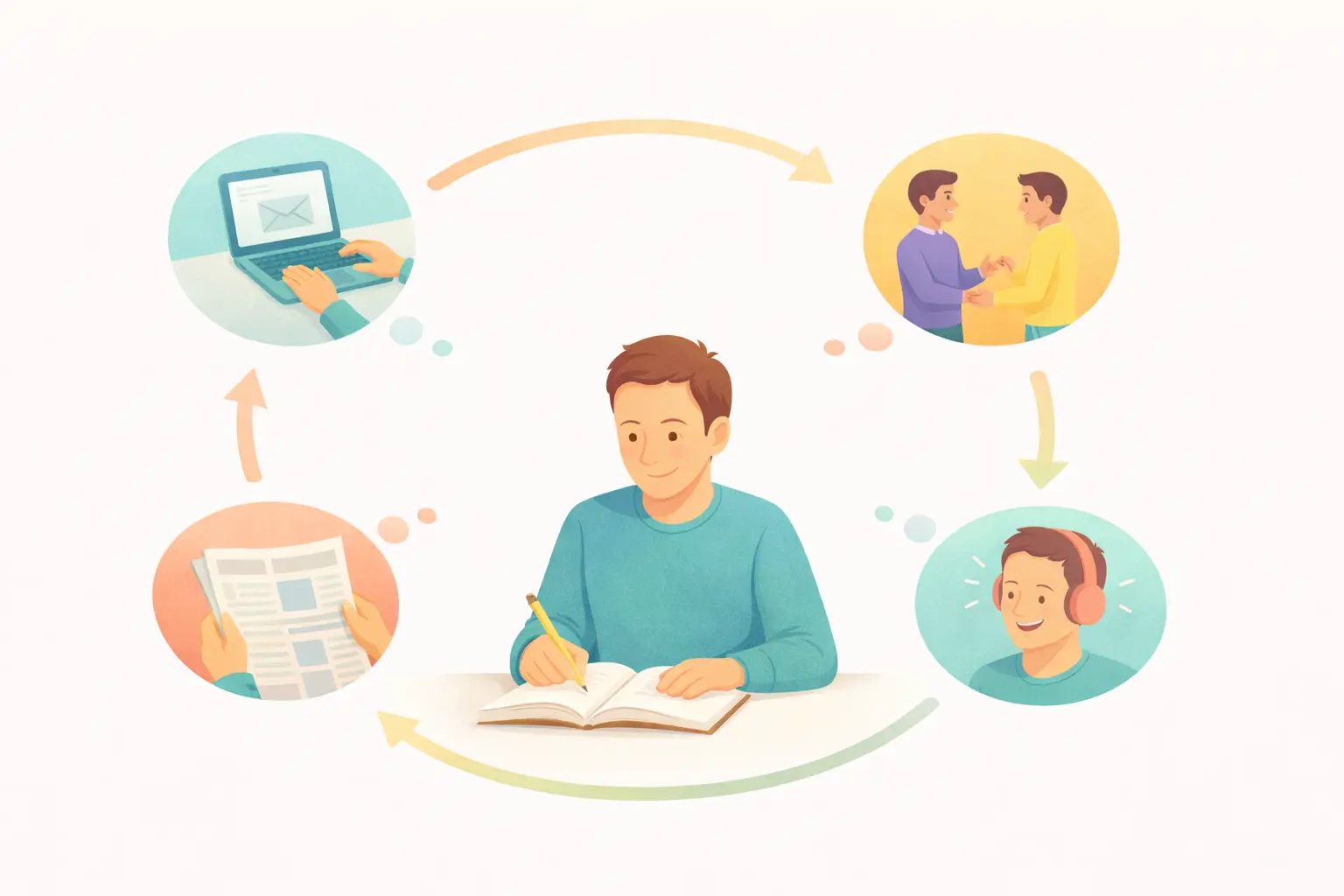
3. Watch for them in context. Business podcasts, TV shows, and news articles are full of phrasal verbs with MAKE. When you hear one, pause and identify which meaning is being used.
4. Test yourself with context clues. Cover the “meaning” column in the table above and try to guess from the example sentence alone. This builds the skill of understanding phrasal verbs from context — exactly what you need in conversations and exams.
For a complete vocabulary learning system, see our step-by-step guide to building your vocabulary.
Common Mistakes with MAKE Phrasal Verbs
1. Confusing “make up” meanings. “We made up” (reconciled) vs. “We made it up” (invented it). The pronoun “it” changes the meaning entirely. Without an object, “make up” usually means reconcile. With a specific object, it means invent.
2. Writing “make due” instead of “make do.” This is one of the most common spelling errors. The correct phrase is “make do with” — never “make due with.”
3. Mixing up “make out” and “find out.” “Make out” = perceive with difficulty (“I can’t make out the text”). “Find out” = discover information (“I found out the truth”). They are not interchangeable.
4. Forgetting “for” in “make up for.” “I’ll make up the lost time” (ambiguous — could mean “compose”). “I’ll make up for the lost time” (clearly means compensate). The preposition “for” is essential.
5. Using “make of” when you mean “make from.” “What do you make of this?” = What is your opinion? “What is this made from?” = What material? These are completely different questions.
What to Read Next
-
Learn the 100 essential phrasal verbs. For the complete list of the most common phrasal verbs across all topics, see our 100 phrasal verbs with meanings and sentences.
-
More phrasal verbs. For advanced C1–C2 phrasal verbs across all contexts, see our advanced phrasal verbs guide.
-
Phrasal verbs for work. If you use English professionally, our business phrasal verbs guide covers 60+ workplace-specific phrases.
-
Practice phrasal verbs. Browse our phrasal verbs library for interactive practice with flashcards and quizzes.
-
Improve your vocabulary. Read our guide on how to improve your vocabulary with 10 proven methods.
FAQ
How many phrasal verbs does MAKE have?
MAKE has approximately 20 distinct phrasal verbs, but several of them — especially “make up” and “make out” — have multiple meanings. In total, MAKE produces over 30 different meaning combinations, making it one of the most productive verbs for phrasal verb formation in English.
What is the difference between “make up” and “make up for”?
“Make up” means to reconcile (“They made up after arguing”), to invent (“She made up a story”), or to compose (“Water makes up 70% of the body”). “Make up for” always means to compensate — to replace something negative with something positive: “He made up for his mistake by working extra hours.”
What does “make out” mean?
“Make out” has four main meanings: (1) to see or understand with difficulty — “I can’t make out the writing on the sign”; (2) to claim or suggest — “He makes out that he’s rich”; (3) to write a formal document — “Make the cheque out to my company”; (4) to manage or fare — “How did you make out at the interview?”
Are phrasal verbs with MAKE formal or informal?
Most are neutral and appropriate for both spoken and written English. “Make for” (contribute to), “make up” (compose), and “make out” (write a document) work well in formal writing. “Make off with” (steal) and “make out” (fare) are more informal and better suited for conversation.
What is the best way to memorize phrasal verbs with MAKE?
Focus on one meaning group at a time. Start with the five meanings of “make up” since it is the most common. Write example sentences about your own experiences, then practice using them in conversation within 24 hours. Spaced repetition — reviewing at increasing intervals — locks them into long-term memory. You can practice with Linglify’s spaced repetition system.