Lista de Verbos en Inglés: Los 300 Más Importantes por Nivel
Los verbos son el motor de toda oración en inglés. Sin un verbo, nada ocurre: nadie hace nada, se convierte en nada ni experimenta nada. Los sustantivos nombran el mundo; los adjetivos lo describen; pero los verbos lo ponen en movimiento.
El inglés tiene aproximadamente 25.000 verbos, pero no necesitas la mayoría de ellos. Las investigaciones sobre el inglés hablado y escrito demuestran que los 300 verbos más frecuentes cubren aproximadamente el 90% de todo el uso verbal en la comunicación cotidiana. Domina estos 300 y podrás expresar prácticamente todo lo que necesites decir.
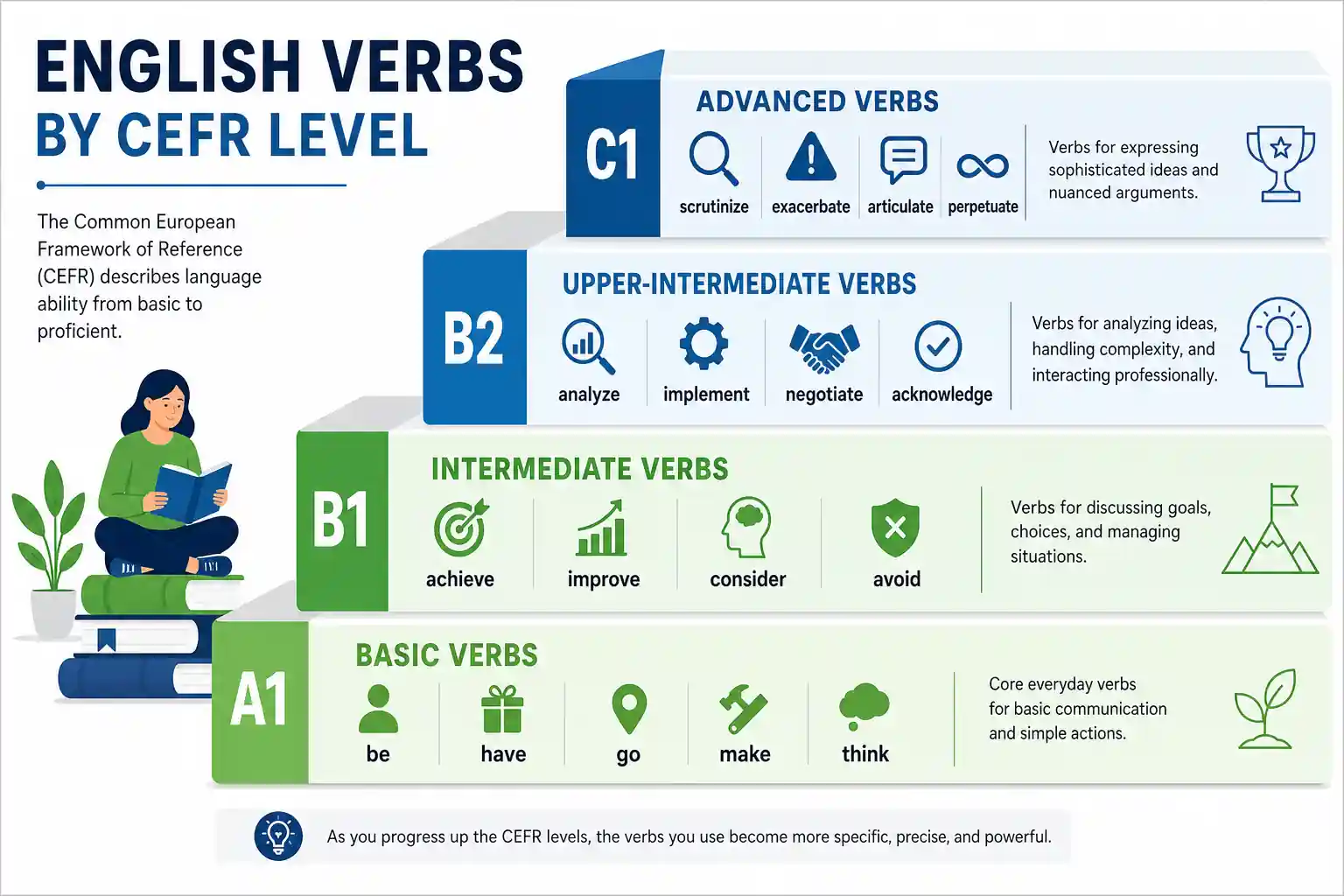
Esta guía te ofrece esos 300 verbos organizados por nivel MCERL (A1–C1) y categoría de uso. Cada verbo incluye su significado, una oración de ejemplo y los patrones más comunes que muestran cómo los usan realmente los hablantes nativos. Úsala como lista de estudio, referencia o herramienta de autoevaluación para encontrar lagunas en tu vocabulario.
- Total de verbos: 300
- Organizados por: nivel MCERL (A1–C1) y categoría semántica
- Formato: Verbo → Significado → Patrón → Ejemplo
- Ideal para: construcción de vocabulario, referencia gramatical, preparación de exámenes
Para las formas irregulares de los verbos (pasado simple y participio pasado), consulta Lista de verbos irregulares: 200 verbos con formas de pasado. Para los verbos que se combinan con preposiciones, consulta Verbos frasales del inglés: guía completa.
Cómo funcionan los verbos en inglés: resumen rápido
Formas verbales
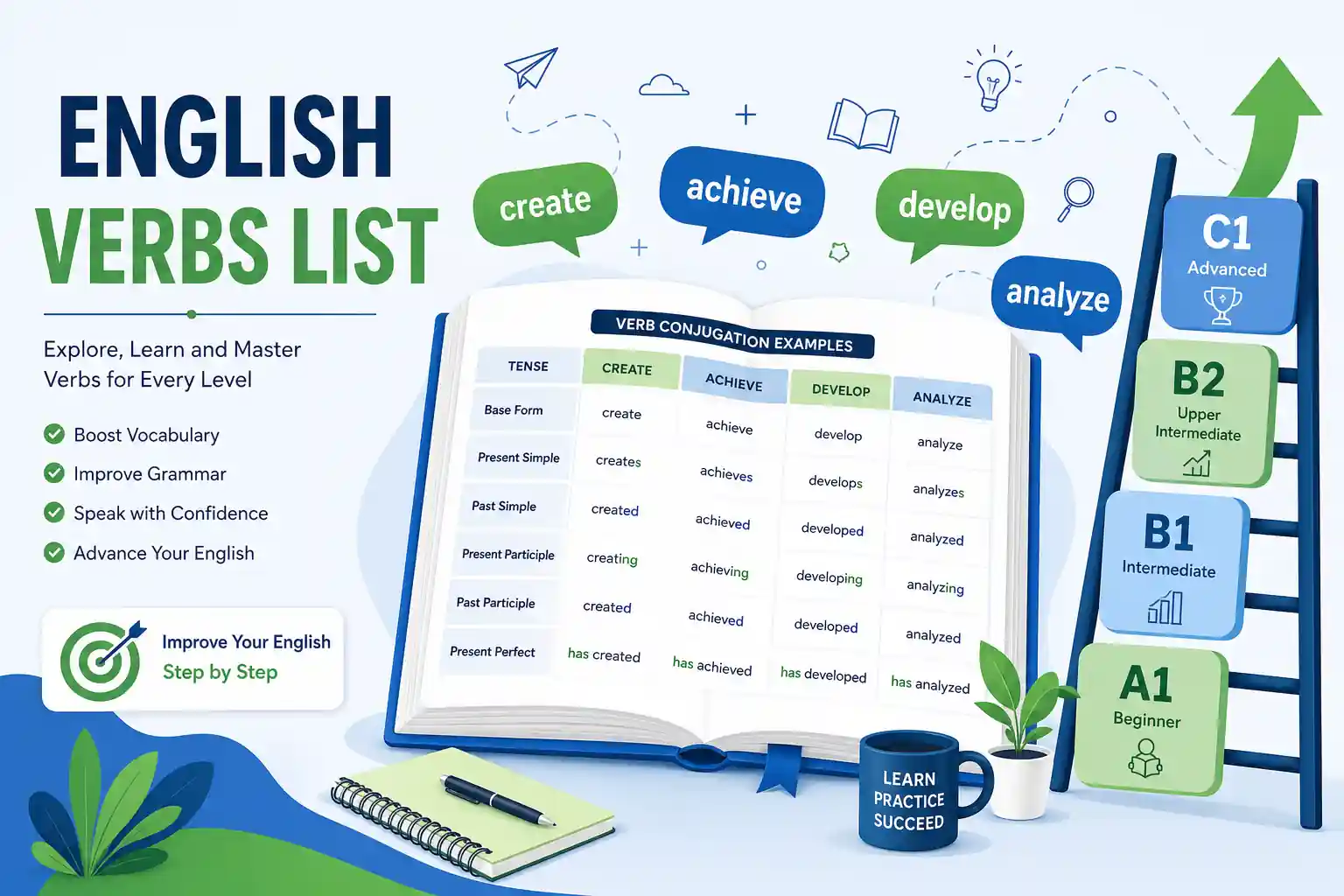
Todo verbo inglés tiene 5 formas (verbos regulares) o hasta 5 formas irregulares:
| Forma | Regular (work) | Irregular (go) | Se usa para |
|---|---|---|---|
| Base | work | go | Presente simple, infinitivo |
| 3.ª persona -s | works | goes | He/she/it en presente |
| Pasado simple | worked | went | Eventos pasados |
| Participio pasado | worked | gone | Tiempos perfectos, voz pasiva |
| Forma -ing | working | going | Tiempos continuos, gerundios |
Transitivos vs. intransitivos
| Tipo | Definición | Ejemplo |
|---|---|---|
| Transitivo | Necesita un objeto | She wrote a letter. (¿escribió qué?) |
| Intransitivo | No necesita objeto | He arrived late. (¿llegó qué? — nada) |
| Ambos | Se usa de las dos formas | She runs a company. (transitivo) / She runs every morning. (intransitivo) |
Patrones verbales
Conocer el significado de un verbo no es suficiente: necesitas saber qué lo sigue:
| Patrón | Ejemplo |
|---|---|
| verbo + infinitivo (to + verbo) | I want to learn English. (Quiero aprender inglés.) |
| verbo + -ing | I enjoy reading books. (Disfruto leyendo libros.) |
| verbo + objeto | She made a decision. (Tomó una decisión.) |
| verbo + objeto + infinitivo | He asked me to help. (Me pidió que le ayudara.) |
| verbo + preposición | She depends on her family. (Depende de su familia.) |
La lista de verbos que aparece a continuación incluye el patrón más común para cada verbo, para que sepas cómo usarlo, no solo qué significa.
Nivel A1: Verbos esenciales (75 verbos)
Estos verbos son la base absoluta. Todo estudiante de inglés los necesita desde el primer día.
Ser y tener
| # | Verbo | Significado | Patrón | Ejemplo |
|---|---|---|---|---|
| 1 | be | existir; ser igual | be + adjetivo/sustantivo | She is happy. / He is a teacher. (Es feliz. / Es profesor.) |
| 2 | have | poseer; experimentar | have + sustantivo | I have two children. / She had a great time. (Tengo dos hijos. / Lo pasó genial.) |
| 3 | do | realizar una acción | do + sustantivo | He does his homework every evening. (Hace los deberes cada tarde.) |
| 4 | become | convertirse en | become + adjetivo/sustantivo | She became a doctor. / It became clear. (Se hizo médica. / Quedó claro.) |
| 5 | seem | parecer | seem + adjetivo/to + verbo | He seems tired. (Parece cansado.) |
Movimiento
| # | Verbo | Significado | Patrón | Ejemplo |
|---|---|---|---|---|
| 6 | go | moverse a un lugar | go + to + lugar | I go to work at 8 AM. (Voy al trabajo a las 8.) |
| 7 | come | moverse hacia el hablante | come + to/from | Come to my office after lunch. (Ven a mi despacho después de comer.) |
| 8 | get | obtener; llegar; ponerse | get + sustantivo/adj/to | I got a message. / She got angry. (Recibí un mensaje. / Se enfadó.) |
| 9 | run | moverse rápido a pie | run + dirección | He runs every morning in the park. (Corre todas las mañanas en el parque.) |
| 10 | walk | moverse a pie | walk + to/along | We walked to the station in ten minutes. (Fuimos andando a la estación en diez minutos.) |
| 11 | move | cambiar de posición/lugar | move + to/from | They moved to London last year. (Se mudaron a Londres el año pasado.) |
| 12 | leave | marcharse de | leave + lugar/hora | She leaves the office at 6 PM. (Sale de la oficina a las 6 de la tarde.) |
| 13 | arrive | llegar a un destino | arrive + at/in | We arrived at the airport two hours early. (Llegamos al aeropuerto con dos horas de antelación.) |
| 14 | return | volver | return + to | He returned to his hometown after 10 years. (Volvió a su ciudad natal después de 10 años.) |
| 15 | follow | ir detrás de | follow + sustantivo | Follow this road until you reach the bridge. (Siga por esta carretera hasta llegar al puente.) |
Comunicación
| # | Verbo | Significado | Patrón | Ejemplo |
|---|---|---|---|---|
| 16 | say | pronunciar palabras | say + that/cita | She said she was busy. (Dijo que estaba ocupada.) |
| 17 | tell | dar información a alguien | tell + persona + that/to | Tell me what happened. (Cuéntame qué pasó.) |
| 18 | ask | pedir información/ayuda | ask + persona + pregunta/to | He asked me to wait outside. (Me pidió que esperara fuera.) |
| 19 | speak | hablar; conocer un idioma | speak + idioma/to persona | She speaks three languages fluently. (Habla tres idiomas con fluidez.) |
| 20 | talk | tener una conversación | talk + to/about | We talked about the project for an hour. (Hablamos del proyecto durante una hora.) |
| 21 | call | telefonear; llamar | call + persona/sustantivo | I’ll call you tomorrow morning. (Te llamaré mañana por la mañana.) |
| 22 | answer | responder | answer + sustantivo/that | She didn’t answer my question. (No respondió a mi pregunta.) |
| 23 | write | poner palabras en papel/pantalla | write + sustantivo/to persona | He wrote a long email to the team. (Escribió un largo correo electrónico al equipo.) |
| 24 | read | entender palabras escritas | read + sustantivo | She reads the newspaper every morning. (Lee el periódico todas las mañanas.) |
| 25 | listen | prestar atención al sonido | listen + to | Listen to this song — it’s beautiful. (Escucha esta canción; es preciosa.) |
Acciones y trabajo
| # | Verbo | Significado | Patrón | Ejemplo |
|---|---|---|---|---|
| 26 | make | crear; causar | make + sustantivo/adj | She made a cake for his birthday. (Hizo un pastel para su cumpleaños.) |
| 27 | take | coger; llevar; requerir tiempo | take + sustantivo/tiempo | Take your keys. / It takes 20 minutes. (Coge tus llaves. / Tarda 20 minutos.) |
| 28 | give | entregar a alguien | give + persona + cosa | He gave her a beautiful gift. (Le regaló algo muy bonito.) |
| 29 | put | colocar en una posición | put + cosa + lugar | Put the book on the table. (Pon el libro en la mesa.) |
| 30 | use | utilizar para un propósito | use + sustantivo + to/for | I use this app to learn vocabulary. (Uso esta aplicación para aprender vocabulario.) |
| 31 | work | tener un trabajo; funcionar | work + at/for/as | She works for a tech company. (Trabaja para una empresa tecnológica.) |
| 32 | play | participar en un juego/deporte | play + deporte/música | The children play in the park every afternoon. (Los niños juegan en el parque cada tarde.) |
| 33 | help | asistir a alguien | help + persona + (to) verbo | Can you help me carry these boxes? (¿Puedes ayudarme a llevar estas cajas?) |
| 34 | try | intentar | try + to verbo / -ing | I’m trying to learn 5 new words every day. (Intento aprender 5 palabras nuevas cada día.) |
| 35 | start | comenzar | start + -ing/to verbo | She started learning English two years ago. (Empezó a aprender inglés hace dos años.) |
| 36 | stop | cesar | stop + -ing | Stop talking and listen. (Deja de hablar y escucha.) |
| 37 | open | hacer accesible | open + sustantivo | He opened the door and invited us in. (Abrió la puerta y nos invitó a entrar.) |
| 38 | close | cerrar | close + sustantivo | Please close the window — it’s cold. (Cierra la ventana, por favor; hace frío.) |
| 39 | turn | girar; cambiar de dirección | turn + dirección | Turn left at the traffic light. (Gire a la izquierda en el semáforo.) |
| 40 | pay | dar dinero | pay + for/cantidad | She paid $50 for the ticket. (Pagó 50 $ por la entrada.) |
Pensamiento y sentimiento
| # | Verbo | Significado | Patrón | Ejemplo |
|---|---|---|---|---|
| 41 | think | usar la mente; creer | think + about/that | I think this is a good idea. (Creo que es una buena idea.) |
| 42 | know | tener información/habilidad | know + that/how/sustantivo | I know how to cook Italian food. (Sé cocinar comida italiana.) |
| 43 | want | desear | want + to verbo/sustantivo | She wants to travel the world. (Quiere viajar por el mundo.) |
| 44 | need | necesitar | need + to verbo/sustantivo | You need to study more before the exam. (Necesitas estudiar más antes del examen.) |
| 45 | like | gustar; encontrar agradable | like + -ing/sustantivo | I like reading before bed. (Me gusta leer antes de dormir.) |
| 46 | love | sentir un fuerte afecto | love + -ing/sustantivo/persona | She loves her job. (Le encanta su trabajo.) |
| 47 | feel | experimentar emoción/sensación | feel + adjetivo | I feel tired after a long day. (Me siento cansado después de un día largo.) |
| 48 | believe | pensar que algo es verdad | believe + that/in | I believe this plan will work. (Creo que este plan funcionará.) |
| 49 | understand | comprender el significado | understand + sustantivo/that | I don’t understand this question. (No entiendo esta pregunta.) |
| 50 | remember | conservar en la memoria | remember + -ing/to verbo | I remember meeting her at the conference. (Recuerdo haberla conocido en la conferencia.) |
| 51 | forget | no recordar | forget + to verbo/about | Don’t forget to lock the door. (No olvides cerrar la puerta con llave.) |
| 52 | hope | desear algo | hope + to verbo/that | I hope to see you again soon. (Espero verte pronto.) |
| 53 | worry | sentirse ansioso | worry + about | Don’t worry about the exam — you’ll be fine. (No te preocupes por el examen; lo harás bien.) |
Vida cotidiana
| # | Verbo | Significado | Patrón | Ejemplo |
|---|---|---|---|---|
| 54 | live | tener tu hogar; estar vivo | live + in/at | She lives in a small apartment downtown. (Vive en un pequeño apartamento en el centro.) |
| 55 | eat | consumir alimentos | eat + sustantivo | We usually eat dinner at 7 PM. (Normalmente cenamos a las 7.) |
| 56 | drink | consumir líquidos | drink + sustantivo | He drinks three cups of coffee a day. (Bebe tres tazas de café al día.) |
| 57 | sleep | descansar sin consciencia | sleep + tiempo/lugar | I slept for ten hours last night. (Dormí diez horas anoche.) |
| 58 | buy | comprar | buy + sustantivo + for | She bought a new laptop for work. (Compró un portátil nuevo para el trabajo.) |
| 59 | sell | intercambiar por dinero | sell + sustantivo + to/for | They sold their house for a good price. (Vendieron su casa a un buen precio.) |
| 60 | bring | llevar hacia uno | bring + sustantivo + to | Bring your book to class tomorrow. (Trae tu libro a clase mañana.) |
| 61 | carry | sostener y mover | carry + sustantivo | He carried the bags to the car. (Llevó las bolsas al coche.) |
| 62 | send | hacer que algo llegue a alguien | send + sustantivo + to | I sent the document to your email. (Te envié el documento al correo.) |
| 63 | wait | quedarse hasta que algo ocurra | wait + for | We waited for the bus in the rain. (Esperamos el autobús bajo la lluvia.) |
| 64 | look | dirigir los ojos | look + at/for | Look at this photo — isn’t it beautiful? (Mira esta foto; ¿no es preciosa?) |
| 65 | see | percibir con los ojos | see + sustantivo/that | I can see the mountains from my window. (Veo las montañas desde mi ventana.) |
| 66 | watch | observar intencionalmente | watch + sustantivo/-ing | She watches the news every evening. (Ve las noticias cada tarde.) |
| 67 | hear | percibir con los oídos | hear + sustantivo/that | I heard a strange noise outside. (Escuché un ruido extraño fuera.) |
| 68 | find | descubrir; localizar | find + sustantivo + adjetivo | I found the exercise difficult. (Encontré el ejercicio difícil.) |
| 69 | keep | seguir teniendo; mantener | keep + -ing/sustantivo | Keep studying — you’re making progress. (Sigue estudiando; estás progresando.) |
| 70 | learn | adquirir conocimiento/habilidad | learn + to verbo/sustantivo | She learned to drive when she was 17. (Aprendió a conducir a los 17 años.) |
| 71 | teach | dar conocimiento a otros | teach + persona + sustantivo/to | He teaches English to beginners. (Enseña inglés a principiantes.) |
| 72 | change | hacer/volverse diferente | change + sustantivo/into | The city has changed a lot in ten years. (La ciudad ha cambiado mucho en diez años.) |
Nivel B1: Verbos de nivel intermedio (75 verbos)
En B1, los verbos se vuelven más específicos y expresivos. Pasas de las acciones básicas a describir procesos, opiniones y conceptos abstractos.
Trabajo y logros
| # | Verbo | Significado | Patrón | Ejemplo |
|---|---|---|---|---|
| 76 | manage | dirigir; lograr | manage + to verbo/sustantivo | She manages a team of 15 people. (Dirige un equipo de 15 personas.) |
| 77 | achieve | alcanzar un objetivo con esfuerzo | achieve + sustantivo | He achieved his target of saving $10,000. (Alcanzó su objetivo de ahorrar 10.000 $.) |
| 78 | develop | crecer; crear | develop + sustantivo/into | The company developed a new product line. (La empresa desarrolló una nueva línea de productos.) |
| 79 | improve | hacer o volverse mejor | improve + sustantivo/at | Her English has improved significantly. (Su inglés ha mejorado significativamente.) |
| 80 | produce | fabricar; crear producción | produce + sustantivo | The factory produces 10,000 units per day. (La fábrica produce 10.000 unidades al día.) |
| 81 | provide | dar; suministrar | provide + sustantivo + for/to | The school provides lunch for all students. (La escuela proporciona almuerzo a todos los alumnos.) |
| 82 | create | hacer algo nuevo | create + sustantivo | She created a website for her small business. (Creó un sitio web para su pequeño negocio.) |
| 83 | build | construir | build + sustantivo | They built the house in just four months. (Construyeron la casa en solo cuatro meses.) |
| 84 | support | ayudar; sostener | support + sustantivo/persona | I support your decision completely. (Apoyo tu decisión completamente.) |
| 85 | lead | guiar; estar al frente | lead + sustantivo/to | She leads the marketing department. (Dirige el departamento de marketing.) |
| 86 | complete | terminar completamente | complete + sustantivo | She completed her degree in three years. (Terminó su carrera en tres años.) |
| 87 | continue | seguir avanzando | continue + -ing/to verbo | They continued working despite the difficulty. (Siguieron trabajando a pesar de la dificultad.) |
| 88 | increase | hacer o volverse mayor | increase + sustantivo/by | Sales increased by 20% this quarter. (Las ventas aumentaron un 20% este trimestre.) |
| 89 | reduce | hacer más pequeño/menor | reduce + sustantivo + by/to | We reduced costs by eliminating waste. (Reducimos los costes eliminando el desperdicio.) |
Decisión y control
| # | Verbo | Significado | Patrón | Ejemplo |
|---|---|---|---|---|
| 91 | decide | tomar una decisión | decide + to verbo/that | She decided to accept the job offer. (Decidió aceptar la oferta de trabajo.) |
| 92 | choose | seleccionar entre opciones | choose + sustantivo/to verbo | I chose the cheaper option to save money. (Elegí la opción más económica para ahorrar.) |
| 93 | allow | permitir | allow + persona + to verbo | The company allows employees to work from home. (La empresa permite a los empleados trabajar desde casa.) |
| 94 | prevent | impedir que ocurra algo | prevent + sustantivo + from -ing | The barrier prevents cars from entering the area. (La barrera impide que los coches entren en la zona.) |
| 95 | avoid | mantenerse alejado de | avoid + -ing/sustantivo | She avoids eating sugar during the week. (Evita comer azúcar durante la semana.) |
| 96 | accept | estar de acuerdo en recibir/creer | accept + sustantivo/that | He accepted the invitation to speak at the conference. (Aceptó la invitación para hablar en la conferencia.) |
| 97 | refuse | decir que no; rechazar | refuse + to verbo/sustantivo | She refused to sign the contract without changes. (Se negó a firmar el contrato sin cambios.) |
| 98 | offer | presentar para su aceptación | offer + to verbo/sustantivo | They offered her a promotion with a higher salary. (Le ofrecieron un ascenso con mayor salario.) |
| 99 | suggest | proponer una idea | suggest + -ing/that | I suggest taking a break before continuing. (Sugiero tomar un descanso antes de continuar.) |
Comunicación (nivel avanzado)
| # | Verbo | Significado | Patrón | Ejemplo |
|---|---|---|---|---|
| 101 | explain | aclarar | explain + sustantivo/that/how | Can you explain how this works? (¿Puedes explicar cómo funciona esto?) |
| 102 | describe | decir cómo es algo | describe + sustantivo + as | She described the experience as life-changing. (Describió la experiencia como transformadora.) |
| 103 | discuss | hablar en detalle | discuss + sustantivo/with | We discussed the plan with the whole team. (Discutimos el plan con todo el equipo.) |
| 104 | argue | dar razones para; discrepar | argue + that/with/about | They argued about politics for hours. (Discutieron sobre política durante horas.) |
| 105 | admit | confesar; aceptar como verdad | admit + -ing/that | She admitted that she had made a mistake. (Admitió que había cometido un error.) |
| 106 | promise | comprometerse a hacer algo | promise + to verbo/that | He promised to call her every day. (Prometió llamarla cada día.) |
| 107 | warn | alertar sobre un peligro | warn + persona + about/not to | The sign warns visitors not to feed the animals. (El cartel advierte a los visitantes que no alimenten a los animales.) |
| 108 | encourage | dar confianza/apoyo | encourage + persona + to verbo | His teacher encouraged him to apply to university. (Su profesor le animó a solicitar plaza en la universidad.) |
Experiencia y emoción
| # | Verbo | Significado | Patrón | Ejemplo |
|---|---|---|---|---|
| 111 | enjoy | encontrar placer en | enjoy + -ing/sustantivo | I really enjoy traveling to new countries. (Disfruto mucho viajando a nuevos países.) |
| 112 | prefer | gustar más una cosa | prefer + sustantivo/-ing + to | She prefers working from home to commuting. (Prefiere trabajar desde casa a ir en transporte.) |
| 113 | miss | sentir tristeza por la ausencia | miss + -ing/sustantivo | I miss living near the sea. (Echo de menos vivir cerca del mar.) |
| 114 | expect | pensar que algo ocurrirá | expect + to verbo/that | I didn’t expect to win — it was a surprise. (No esperaba ganar; fue una sorpresa.) |
| 115 | notice | darse cuenta de | notice + sustantivo/that | I noticed a change in his behavior recently. (Noté un cambio en su comportamiento recientemente.) |
| 116 | realize | tomar conciencia; entender | realize + that | She realized she had left her keys at home. (Se dio cuenta de que había dejado las llaves en casa.) |
| 117 | wonder | querer saber | wonder + if/why/what | I wonder why he didn’t come to the meeting. (Me pregunto por qué no vino a la reunión.) |
| 118 | consider | pensar detenidamente sobre algo | consider + -ing/sustantivo | Have you considered changing jobs? (¿Has considerado cambiar de trabajo?) |
| 119 | imagine | formar una imagen mental | imagine + -ing/sustantivo | Imagine living in a city with no cars. (Imagina vivir en una ciudad sin coches.) |
Físico y cambio
| # | Verbo | Significado | Patrón | Ejemplo |
|---|---|---|---|---|
| 121 | grow | aumentar de tamaño; cultivar | grow + adjetivo/sustantivo | The company has grown rapidly this year. (La empresa ha crecido rápidamente este año.) |
| 122 | fall | caer hacia abajo | fall + down/off | The temperature fell to minus 10 last night. (La temperatura bajó a menos 10 anoche.) |
| 123 | rise | moverse hacia arriba | rise + by/to | Prices have risen by 15% since January. (Los precios han subido un 15% desde enero.) |
| 124 | push | aplicar fuerza alejándola de uno | push + sustantivo/dirección | He pushed the door open with one hand. (Abrió la puerta de un empujón con una sola mano.) |
| 125 | pull | aplicar fuerza hacia uno | pull + sustantivo/dirección | She pulled the curtains shut. (Cerró las cortinas tirando de ellas.) |
| 126 | break | separar en trozos | break + sustantivo | Who broke the window? (¿Quién rompió la ventana?) |
| 127 | connect | unir | connect + sustantivo + to/with | Connect your phone to the Wi-Fi network. (Conecta tu teléfono a la red Wi-Fi.) |
| 128 | share | dar una parte a otros; usar juntos | share + sustantivo + with | She shared her experience with the audience. (Compartió su experiencia con el público.) |
| 129 | involve | requerir participación/incluir | involve + -ing/sustantivo | The job involves traveling twice a month. (El trabajo implica viajar dos veces al mes.) |
| 130 | depend | verse afectado por; depender de | depend + on | The result depends on how hard you work. (El resultado depende de cuánto te esfuerces.) |
Nivel B2: Verbos de nivel intermedio-alto (75 verbos)
En B2, los verbos expresan matices, competencia profesional y pensamiento abstracto. Estos son los verbos que separan el inglés «bueno» del inglés «fluido».
Análisis e investigación
| # | Verbo | Significado | Patrón | Ejemplo |
|---|---|---|---|---|
| 151 | analyze | examinar en detalle | analyze + sustantivo | The team analyzed the data and found three trends. (El equipo analizó los datos y encontró tres tendencias.) |
| 152 | investigate | buscar hechos | investigate + sustantivo/whether | Police are investigating the cause of the fire. (La policía investiga la causa del incendio.) |
| 153 | determine | averiguar; decidir oficialmente | determine + sustantivo/that/whether | Scientists determined that the drug was effective. (Los científicos determinaron que el fármaco era eficaz.) |
| 154 | identify | reconocer; establecer qué | identify + sustantivo + as | Researchers identified stress as the main factor. (Los investigadores identificaron el estrés como el factor principal.) |
| 155 | assess | evaluar la calidad o importancia | assess + sustantivo | We need to assess the risks before proceeding. (Necesitamos evaluar los riesgos antes de continuar.) |
| 156 | evaluate | juzgar el valor de | evaluate + sustantivo | The committee evaluated all applications carefully. (El comité evaluó todas las solicitudes detenidamente.) |
| 157 | indicate | mostrar; señalar | indicate + that/sustantivo | Studies indicate that exercise reduces anxiety. (Los estudios indican que el ejercicio reduce la ansiedad.) |
Influencia y control
| # | Verbo | Significado | Patrón | Ejemplo |
|---|---|---|---|---|
| 161 | influence | afectar cómo algo se desarrolla | influence + sustantivo | Social media strongly influences consumer behavior. (Las redes sociales influyen mucho en el comportamiento del consumidor.) |
| 162 | affect | tener impacto en | affect + sustantivo | The new policy will affect all employees. (La nueva política afectará a todos los empleados.) |
| 163 | establish | fundar; demostrar | establish + sustantivo/that | The company established a new office in Berlin. (La empresa estableció una nueva oficina en Berlín.) |
| 164 | maintain | mantener en buen estado; afirmar | maintain + sustantivo/that | It’s expensive to maintain an old building. (Es caro mantener un edificio antiguo.) |
| 165 | ensure | asegurarse de | ensure + that | Double-check to ensure that everything is correct. (Compruébalo dos veces para asegurarte de que todo está correcto.) |
| 166 | require | necesitar; exigir oficialmente | require + sustantivo/-ing | The position requires five years of experience. (El puesto requiere cinco años de experiencia.) |
| 167 | restrict | limitar | restrict + sustantivo + to | Access is restricted to authorized personnel only. (El acceso está restringido al personal autorizado.) |
| 168 | enable | hacer posible | enable + persona + to verbo | Technology enables us to work from anywhere. (La tecnología nos permite trabajar desde cualquier lugar.) |
Negocios y estrategia
| # | Verbo | Significado | Patrón | Ejemplo |
|---|---|---|---|---|
| 171 | invest | poner dinero para obtener beneficio | invest + in + sustantivo | She invested heavily in renewable energy stocks. (Invirtió mucho en acciones de energías renovables.) |
| 172 | generate | producir; crear | generate + sustantivo | The campaign generated significant media coverage. (La campaña generó una cobertura mediática importante.) |
| 173 | launch | empezar algo nuevo públicamente | launch + sustantivo | They launched the product with a global marketing campaign. (Lanzaron el producto con una campaña de marketing global.) |
| 174 | expand | crecer; ampliar | expand + sustantivo/into | The company expanded into Asian markets in 2024. (La empresa se expandió a los mercados asiáticos en 2024.) |
| 175 | implement | poner un plan en acción | implement + sustantivo | The school implemented a new attendance policy. (La escuela implantó una nueva política de asistencia.) |
| 176 | negotiate | dialogar para llegar a un acuerdo | negotiate + sustantivo/with | She negotiated a better salary before accepting. (Negoció un mejor salario antes de aceptar.) |
Comunicación (sofisticada)
| # | Verbo | Significado | Patrón | Ejemplo |
|---|---|---|---|---|
| 181 | acknowledge | reconocer; admitir públicamente | acknowledge + sustantivo/that | The CEO acknowledged that mistakes were made. (El director ejecutivo reconoció que se cometieron errores.) |
| 182 | clarify | aclarar | clarify + sustantivo/that | Could you clarify what you mean by “soon”? (¿Podrías aclarar qué quieres decir con «pronto»?) |
| 183 | emphasize | recalcar la importancia | emphasize + sustantivo/that | She emphasized the need for better communication. (Subrayó la necesidad de mejorar la comunicación.) |
| 184 | convince | persuadir para que crea/actúe | convince + persona + to verbo/that | She convinced me to apply for the position. (Me convenció para solicitar el puesto.) |
| 185 | confirm | verificar como verdadero | confirm + sustantivo/that | Can you confirm that the meeting is at 3 PM? (¿Puedes confirmar que la reunión es a las 3?) |
| 186 | deny | decir que algo no es cierto | deny + -ing/that | He denied taking the money from the register. (Negó haber cogido dinero de la caja.) |
| 187 | reveal | dar a conocer; mostrar | reveal + sustantivo/that | The report revealed that costs had doubled. (El informe reveló que los costes se habían duplicado.) |
| 188 | propose | sugerir formalmente | propose + -ing/that/sustantivo | She proposed a new approach to the problem. (Propuso un nuevo enfoque para el problema.) |
| 189 | respond | responder; reaccionar | respond + to + sustantivo | The company responded to criticism by changing its policy. (La empresa respondió a las críticas modificando su política.) |
Abstracto y académico
| # | Verbo | Significado | Patrón | Ejemplo |
|---|---|---|---|---|
| 201 | assume | suponer sin pruebas | assume + that | I assumed you already knew about the change. (Supuse que ya sabías del cambio.) |
| 202 | conclude | llegar a una decisión; terminar | conclude + that/sustantivo | The study concluded that diet affects concentration. (El estudio concluyó que la dieta afecta a la concentración.) |
| 203 | justify | dar buenas razones para | justify + -ing/sustantivo | How can you justify spending so much money? (¿Cómo puedes justificar gastar tanto dinero?) |
| 204 | distinguish | ver la diferencia entre | distinguish + between | It’s important to distinguish between facts and opinions. (Es importante distinguir entre hechos y opiniones.) |
| 205 | reflect | pensar profundamente; mostrar | reflect + on/sustantivo | Take some time to reflect on what you’ve learned. (Tómate tiempo para reflexionar sobre lo que has aprendido.) |
| 206 | vary | diferir; cambiar | vary + from/by | Prices vary depending on the season. (Los precios varían según la temporada.) |
| 207 | obtain | obtener mediante esfuerzo | obtain + sustantivo + from | She obtained permission from the director. (Obtuvo permiso del director.) |
| 208 | solve | encontrar la solución a | solve + sustantivo | We need to solve this problem before it gets worse. (Necesitamos resolver este problema antes de que empeore.) |
| 209 | handle | tratar; gestionar | handle + sustantivo | She handled the situation with impressive calm. (Manejó la situación con una calma impresionante.) |
| 210 | adapt | cambiar para nuevas condiciones | adapt + to + sustantivo | It took time to adapt to the new work environment. (Llevó tiempo adaptarse al nuevo entorno laboral.) |
| 211 | overcome | vencer; tratar con éxito | overcome + sustantivo | She overcame her fear of public speaking with practice. (Superó su miedo a hablar en público con la práctica.) |
| 212 | recover | volver a la normalidad | recover + from | He fully recovered from the surgery within a month. (Se recuperó por completo de la operación en un mes.) |
Nivel C1: Verbos avanzados (75 verbos)
Los verbos C1 son precisos, sofisticados y te identifican como un hablante de inglés de alta competencia. Te permiten expresar matices sutiles de significado que los verbos más simples no pueden.
Pensamiento crítico
| # | Verbo | Significado | Patrón | Ejemplo |
|---|---|---|---|---|
| 226 | perceive | notar; entender de cierta manera | perceive + sustantivo + as | The public perceived the decision as unfair. (El público percibió la decisión como injusta.) |
| 227 | anticipate | esperar y prepararse para | anticipate + sustantivo/that | We anticipated strong demand and increased production. (Anticipamos una demanda fuerte y aumentamos la producción.) |
| 228 | speculate | formular teorías sin pruebas | speculate + about/that | Analysts speculated that the company might be sold. (Los analistas especularon con que la empresa podría venderse.) |
| 229 | infer | concluir a partir de evidencias | infer + that/sustantivo + from | From his tone, I inferred that he was not happy. (Por su tono, deduje que no estaba contento.) |
| 230 | contemplate | pensar profundamente sobre | contemplate + -ing/sustantivo | He contemplated leaving his career for a year of travel. (Consideró abandonar su carrera para viajar un año.) |
| 231 | scrutinize | examinar con mucho cuidado | scrutinize + sustantivo | The auditors scrutinized every transaction from the past year. (Los auditores escrutaron cada transacción del último año.) |
| 232 | validate | confirmar como correcto/valioso | validate + sustantivo | The experiment validated the original hypothesis. (El experimento validó la hipótesis original.) |
| 233 | undermine | debilitar gradualmente | undermine + sustantivo | Constant criticism undermines a person’s confidence. (La crítica constante mina la confianza de una persona.) |
| 234 | contradict | decir lo contrario; entrar en conflicto con | contradict + sustantivo/persona | The new evidence contradicts earlier findings. (Las nuevas pruebas contradicen los hallazgos anteriores.) |
Causalidad y cambio
| # | Verbo | Significado | Patrón | Ejemplo |
|---|---|---|---|---|
| 236 | trigger | provocar que algo empiece repentinamente | trigger + sustantivo | The announcement triggered widespread protests. (El anuncio desencadenó protestas generalizadas.) |
| 237 | facilitate | facilitar; posibilitar | facilitate + sustantivo | Good infrastructure facilitates economic growth. (Una buena infraestructura facilita el crecimiento económico.) |
| 238 | accelerate | hacer más rápido | accelerate + sustantivo | The pandemic accelerated the shift to remote work. (La pandemia aceleró el cambio hacia el trabajo remoto.) |
| 239 | diminish | hacer o volverse más pequeño/menor | diminish + sustantivo | His influence has diminished over the past decade. (Su influencia ha disminuido en la última década.) |
| 240 | intensify | volverse o hacer más fuerte | intensify + sustantivo | Competition in the sector has intensified significantly. (La competencia en el sector se ha intensificado significativamente.) |
| 241 | exacerbate | empeorar | exacerbate + sustantivo | Poor communication exacerbated the conflict between teams. (La mala comunicación exacerbó el conflicto entre los equipos.) |
| 242 | sustain | mantener a lo largo del tiempo; sufrir | sustain + sustantivo | The economy cannot sustain this level of growth indefinitely. (La economía no puede sostener indefinidamente este nivel de crecimiento.) |
| 243 | erode | destruir/debilitar gradualmente | erode + sustantivo | Years of neglect eroded public trust in the institution. (Años de negligencia erosionaron la confianza pública en la institución.) |
| 244 | disrupt | interrumpir; cambiar radicalmente | disrupt + sustantivo | Streaming services disrupted the traditional TV industry. (Los servicios de streaming disrumpieron la industria televisiva tradicional.) |
Profesional e institucional
| # | Verbo | Significado | Patrón | Ejemplo |
|---|---|---|---|---|
| 246 | allocate | distribuir con un propósito | allocate + sustantivo + to/for | The government allocated additional funds for healthcare. (El gobierno asignó fondos adicionales para la sanidad.) |
| 247 | oversee | supervisar | oversee + sustantivo | She oversees the operations of three regional offices. (Supervisa las operaciones de tres oficinas regionales.) |
| 248 | enforce | hacer cumplir las normas | enforce + sustantivo | The new parking rules will be strictly enforced. (Las nuevas normas de aparcamiento se aplicarán con rigor.) |
| 249 | comply | actuar de acuerdo con las normas | comply + with | All companies must comply with the new data protection law. (Todas las empresas deben cumplir la nueva ley de protección de datos.) |
| 250 | consolidate | fortalecer; combinar | consolidate + sustantivo | The merger consolidated their position as market leader. (La fusión consolidó su posición como líder del mercado.) |
| 251 | delegate | asignar tareas a otros | delegate + sustantivo + to | Good managers delegate tasks instead of doing everything themselves. (Los buenos directivos delegan tareas en lugar de hacerlo todo ellos mismos.) |
| 252 | terminate | finalizar formalmente | terminate + sustantivo | The company terminated his contract due to repeated absences. (La empresa rescindió su contrato por ausencias reiteradas.) |
Comunicación precisa
| # | Verbo | Significado | Patrón | Ejemplo |
|---|---|---|---|---|
| 256 | articulate | expresar con claridad | articulate + sustantivo | She articulated her vision for the company with impressive clarity. (Articuló su visión para la empresa con una claridad impresionante.) |
| 257 | convey | comunicar (significado/sentimiento) | convey + sustantivo + to | The painting conveys a sense of loneliness and isolation. (El cuadro transmite una sensación de soledad y aislamiento.) |
| 258 | elaborate | explicar con más detalle | elaborate + on | Could you elaborate on your second point? (¿Podrías ampliar tu segundo punto?) |
| 259 | dispute | discrepar con; cuestionar | dispute + sustantivo/that | Scientists dispute the claim that the product is safe. (Los científicos cuestionan la afirmación de que el producto es seguro.) |
| 260 | advocate | apoyar públicamente | advocate + for/sustantivo/-ing | She advocates for better working conditions in factories. (Aboga por mejores condiciones de trabajo en las fábricas.) |
| 261 | assert | afirmar con firmeza y confianza | assert + that/sustantivo | He asserted that the project would be finished on schedule. (Afirmó que el proyecto se terminaría a tiempo.) |
| 262 | concede | admitir a regañadientes; ceder | concede + that/sustantivo | She conceded that the opposing argument had some merit. (Reconoció que el argumento contrario tenía cierto mérito.) |
Social y psicológico
| # | Verbo | Significado | Patrón | Ejemplo |
|---|---|---|---|---|
| 266 | empathize | entender y compartir sentimientos | empathize + with | I empathize with anyone trying to learn a new language as an adult. (Empatizo con cualquiera que intente aprender un nuevo idioma de adulto.) |
| 267 | cherish | valorar mucho y proteger | cherish + sustantivo | She cherishes the memories from that summer in Italy. (Atesora los recuerdos de aquel verano en Italia.) |
| 268 | endure | sufrir pacientemente; durar | endure + sustantivo | The team endured months of setbacks before succeeding. (El equipo soportó meses de reveses antes de tener éxito.) |
| 269 | nurture | cuidar y fomentar el crecimiento | nurture + sustantivo | Good teachers nurture curiosity in their students. (Los buenos maestros fomentan la curiosidad en sus alumnos.) |
| 270 | captivate | atraer y mantener la atención | captivate + persona | The speaker captivated the audience for a full hour. (El orador cautivó al público durante una hora entera.) |
| 271 | compel | forzar; hacer necesario | compel + persona + to verbo | The evidence compelled them to change their conclusion. (Las pruebas les obligaron a cambiar su conclusión.) |
| 272 | inhibit | impedir; dificultar | inhibit + sustantivo | Fear of making mistakes inhibits many learners from speaking. (El miedo a cometer errores inhibe a muchos estudiantes a la hora de hablar.) |
Precisión abstracta
| # | Verbo | Significado | Patrón | Ejemplo |
|---|---|---|---|---|
| 276 | constitute | componer; equivaler a | constitute + sustantivo | Women constitute 60% of the university’s graduates. (Las mujeres constituyen el 60% de los graduados universitarios.) |
| 277 | entail | implicar necesariamente | entail + -ing/sustantivo | The role entails extensive international travel. (El puesto implica viajes internacionales extensos.) |
| 278 | warrant | justificar; hacer necesario | warrant + sustantivo/-ing | The situation warrants immediate action. (La situación justifica una acción inmediata.) |
| 279 | transcend | ir más allá de los límites | transcend + sustantivo | Good music transcends language and cultural barriers. (La buena música trasciende las barreras lingüísticas y culturales.) |
| 280 | fluctuate | cambiar frecuente e irregularmente | fluctuate + between | Oil prices fluctuate between $60 and $80 per barrel. (Los precios del petróleo fluctúan entre 60 y 80 $ por barril.) |
| 281 | correlate | tener una relación mutua | correlate + with | Research shows that exercise correlates with better sleep quality. (Las investigaciones demuestran que el ejercicio se correlaciona con una mejor calidad del sueño.) |
| 282 | proliferate | aumentar rápidamente en número | proliferate + across/in | Misinformation has proliferated across social media platforms. (La desinformación se ha proliferado en las plataformas de redes sociales.) |
| 283 | deteriorate | empeorar | deteriorate | His health deteriorated rapidly after the diagnosis. (Su salud se deterioró rápidamente tras el diagnóstico.) |
| 284 | alleviate | hacer menos grave | alleviate + sustantivo | The new measures aim to alleviate traffic congestion. (Las nuevas medidas tienen como objetivo aliviar la congestión del tráfico.) |
| 285 | mitigate | reducir los efectos dañinos | mitigate + sustantivo | Steps were taken to mitigate the environmental impact. (Se tomaron medidas para mitigar el impacto medioambiental.) |
| 286 | perpetuate | hacer que continúe indefinidamente | perpetuate + sustantivo | The media perpetuates harmful stereotypes about certain groups. (Los medios perpetúan estereotipos dañinos sobre ciertos grupos.) |
| 287 | supersede | reemplazar algo más antiguo | supersede + sustantivo | The new guidelines supersede all previous versions. (Las nuevas directrices sustituyen a todas las versiones anteriores.) |
| 288 | withhold | negarse a dar | withhold + sustantivo + from | The company withheld information from investors. (La empresa ocultó información a los inversores.) |
| 289 | elucidate | aclarar; explicar | elucidate + sustantivo | The professor elucidated the theory with a series of examples. (El profesor aclaró la teoría con una serie de ejemplos.) |
| 290 | synthesize | combinar elementos en un todo | synthesize + sustantivo | The essay synthesizes ideas from multiple fields into a coherent argument. (El ensayo sintetiza ideas de múltiples campos en un argumento coherente.) |
Patrones verbales: referencia completa
La fuente más común de errores no es el significado del verbo, sino lo que lo sigue. Aquí tienes una referencia de los patrones clave:
Verbo + TO + Infinitivo
Estos verbos van seguidos de «to + verbo»:
want, need, decide, hope, plan, offer, refuse, promise, agree, learn, seem, appear, tend, manage, fail, afford, attempt, expect, intend, pretend
She decided to leave early. (Decidió marcharse pronto.) / They agreed to pay the full amount. (Acordaron pagar el importe total.)
Verbo + -ING (Gerundio)
Estos verbos van seguidos de la forma -ing:
enjoy, avoid, consider, suggest, finish, mind, keep, practice, deny, admit, imagine, involve, risk, miss, delay, recommend, appreciate
I enjoy reading before bed. (Disfruto leyendo antes de dormir.) / She avoided answering the question. (Evitó responder a la pregunta.)
Verbo + Objeto + TO + Infinitivo
Estos verbos necesitan un objeto y luego «to + verbo»:
ask, tell, want, expect, allow, encourage, invite, force, remind, persuade, advise, warn, convince, enable, require
He asked me to help. (Me pidió que ayudara.) / They encouraged her to apply. (La animaron a solicitar el puesto.)
Verbo + Preposición
Estas combinaciones comunes de verbo + preposición causan errores cuando los estudiantes usan la preposición incorrecta:
| Verbo | Preposición correcta | Ejemplo |
|---|---|---|
| depend | on | It depends on the weather. (Depende del tiempo.) |
| consist | of | The team consists of ten people. (El equipo consta de diez personas.) |
| belong | to | This belongs to me. (Esto me pertenece.) |
| apply | for (trabajo) / to (regla) | She applied for a visa. (Solicitó un visado.) |
| suffer | from | He suffers from allergies. (Sufre alergias.) |
| contribute | to | Exercise contributes to good health. (El ejercicio contribuye a la buena salud.) |
| comply | with | You must comply with the rules. (Debes cumplir las normas.) |
Vocabulario para practicar
cooperate
verbo
colaborar, trabajar juntos
evaluate
verbo
evaluar, valor, valoración
Ejemplos
- Companies evaluate job candidates based on experience, skills, and personality.
- Teachers evaluate student progress through tests, projects, and classroom participation.
donate
verbo
donar, contribuir
Ejemplos
- Many people donate money to charities that help homeless individuals.
- She decided to donate blood to help patients in emergency situations.
discourage
verbo
desalentar
Ejemplos
- Don't let one failure discourage you from pursuing your dreams.
- High prices discourage many people from buying organic food products.
graduate
verbo
graduar
Ejemplos
- She will graduate from university next year with a degree in engineering.
- Students must complete all requirements before they can graduate from high school.
resolve
verbo
resolver, solucionar, determinar
Ejemplos
- Mediator helps parties resolve dispute through negotiation.
- Technical team will resolve software problems quickly.
off
adjetivo
fuera, apagado, desactivado
Ejemplos
- Please turn off the lights before leaving the room.
- The dog ran off into the forest chasing wild rabbits.
stress
verbo
estresar, tensar, presionar
Ejemplos
- Heavy workload may stress employees beyond limits.
- Teacher will stress importance of homework completion.
guide
verbo
guiar, dirigir, orientar
Ejemplos
- Parents should guide their children to make responsible decisions.
- The experienced hiker will guide the group through the mountain trail safely.
artery
sustantivo
arteria, vena, conducto
Ejemplos
- The blocked artery required immediate surgical intervention to save his life.
- This highway is a major artery connecting the city to surrounding areas.
coastal
adjetivo
costero, marítimo, litoral
Ejemplos
- Coastal towns often depend on fishing and tourism for their economy.
- The coastal erosion threatens many beachfront properties and buildings.
candidate
sustantivo
candidato
Ejemplos
- Each presidential candidate presented their policy plans to voters.
- The job candidate impressed the interview panel with her experience.
horizon
sustantivo
horizonte, línea de visión, línea de horizonte
Ejemplos
- The sun disappeared behind the horizon as evening approached.
- Traveling broadens your horizon and exposes you to new cultures.
jury
sustantivo
jurado
Ejemplos
- The jury deliberated for several hours before reaching a verdict.
- The talent show jury consisted of professional musicians and entertainers.
prejudice
sustantivo
prejuicio, sesgo
Ejemplos
- Education helps overcome prejudice and promotes understanding.
- Racial prejudice damages communities and individuals alike.
tragedy
sustantivo
tragedia, catástrofe, desgracia
Ejemplos
- Natural tragedy affects thousands of innocent people.
- Personal tragedy changes person's life perspective completely.
boom
sustantivo
auge, explosión
Ejemplos
- The boom of thunder echoed across the valley.
- The technology boom created many new millionaires.
admission
sustantivo
admisión, entrada
Ejemplos
- Her admission to the prestigious medical school was the result of hard work.
- The museum offers free admission on the first Sunday of every month.
union
sustantivo
sindicato, asociación, alianza
Ejemplos
- Labor union protects worker rights and interests.
- Marriage union joins two people in partnership.
voyage
sustantivo
viaje, excursión, trayecto
Ejemplos
- Space exploration represents humanity's greatest voyage into the unknown.
- The ocean voyage from Europe to America took several weeks in the past.
humorous
adjetivo
gracioso, humorístico, cómico
Ejemplos
- She writes humorous articles about everyday life and family experiences.
- The humorous speech made everyone laugh and lightened the serious mood.
lifelong
adjetivo
de por vida, para siempre
Ejemplos
- Learning is a lifelong process that never truly ends.
- Their lifelong friendship began during elementary school years.
motivated
adjetivo
motivado, inspirado, entusiasmado
Ejemplos
- Motivated employee seeks additional responsibilities and challenges at work.
- Success requires being motivated even when facing difficult obstacles.
indispensable
adjetivo
indispensable, esencial, necesario
Ejemplos
- Clean water is indispensable for human survival and good health.
- Her experience and skills make her indispensable to the research team.
total
adjetivo
total, completo, global
Ejemplos
- Total cost includes all fees and expenses.
- Total silence fills room during meditation session.
Qué hacer a continuación
-
Encuentra tu nivel. Repasa la lista en tu nivel MCERL actual. Marca los verbos que puedes entender pero no usar activamente: esos son tus objetivos prioritarios.
-
Aprende 5 verbos al día. Para cada verbo, aprende su significado, su patrón principal (qué lo sigue) y una oración de ejemplo. Escribe tu propia oración usando el mismo patrón.
-
Céntrate en los patrones. Saber que «suggest» lleva -ing (no «to + verbo») previene errores que incluso los aprendices avanzados cometen. Presta tanta atención a los patrones como a los significados.
-
Lee contenido con muchos verbos. Los artículos de noticias, los textos académicos y la escritura empresarial están repletos de verbos B2–C1. Nuestros artículos del blog están redactados para exponerte a estos verbos de forma natural.
-
Estudia las formas relacionadas. Cada verbo conecta con una familia de palabras. Analyze → analysis (sustantivo), analytical (adjetivo), analytically (adverbio). Aprender toda la familia a partir de un solo verbo multiplica tu vocabulario de forma eficiente.
Preguntas frecuentes
¿Cuáles son los verbos más comunes del inglés?
Los 10 verbos más frecuentes del inglés son: be, have, do, say, go, get, make, know, think, take. Representan aproximadamente el 25% de todo el uso verbal en el inglés hablado. Combinados con los siguientes 40 verbos más comunes (sección A1), cubren aproximadamente el 70% del uso verbal cotidiano.
¿Cuántos verbos hay en inglés?
El inglés tiene aproximadamente 25.000 verbos en total, pero la mayoría son raros o muy especializados. Para la fluidez práctica, conocer entre 300 y 500 verbos (con sus patrones y colocaciones) es suficiente para expresar prácticamente cualquier cosa en la comunicación cotidiana.
¿Cuál es la diferencia entre verbos regulares e irregulares?
Los verbos regulares forman el tiempo pasado añadiendo «-ed» (work → worked, play → played). Los verbos irregulares tienen formas de pasado impredecibles que deben memorizarse (go → went, think → thought, be → was). Unos 200 verbos ingleses de uso común son irregulares, y tienden a ser los más frecuentes. Para la lista completa de verbos irregulares con todas sus formas, consulta nuestra Guía de verbos irregulares.
¿Qué son los patrones verbales y por qué importan?
Los patrones verbales son las estructuras gramaticales que siguen a verbos específicos. Por ejemplo, «enjoy» siempre va seguido de -ing (enjoy reading), mientras que «want» siempre va seguido de «to + verbo» (want to read). Usar el patrón incorrecto (enjoy to read o want reading) es un error gramatical que los hablantes nativos notan de inmediato. Aprender los patrones verbales junto con los significados evita estos errores y hace que tu inglés suene natural.
¿Cómo puedo aprender los verbos en inglés más rápido?
Aprende los verbos en contexto, no de forma aislada. Para cada nuevo verbo: (1) aprende su significado, (2) aprende su patrón principal (qué lo sigue), (3) lee 2 o 3 oraciones de ejemplo, (4) escribe tu propia oración. Usa la repetición espaciada para repasar. Agrupa los verbos por tema (todos los verbos de «comunicación» juntos) en lugar de hacerlo alfabéticamente: los grupos temáticos se recuerdan mejor porque el cerebro almacena palabras relacionadas en redes.