
Sinónimos para el IELTS: 200+ Palabras para Parafrasear en Banda 7–9
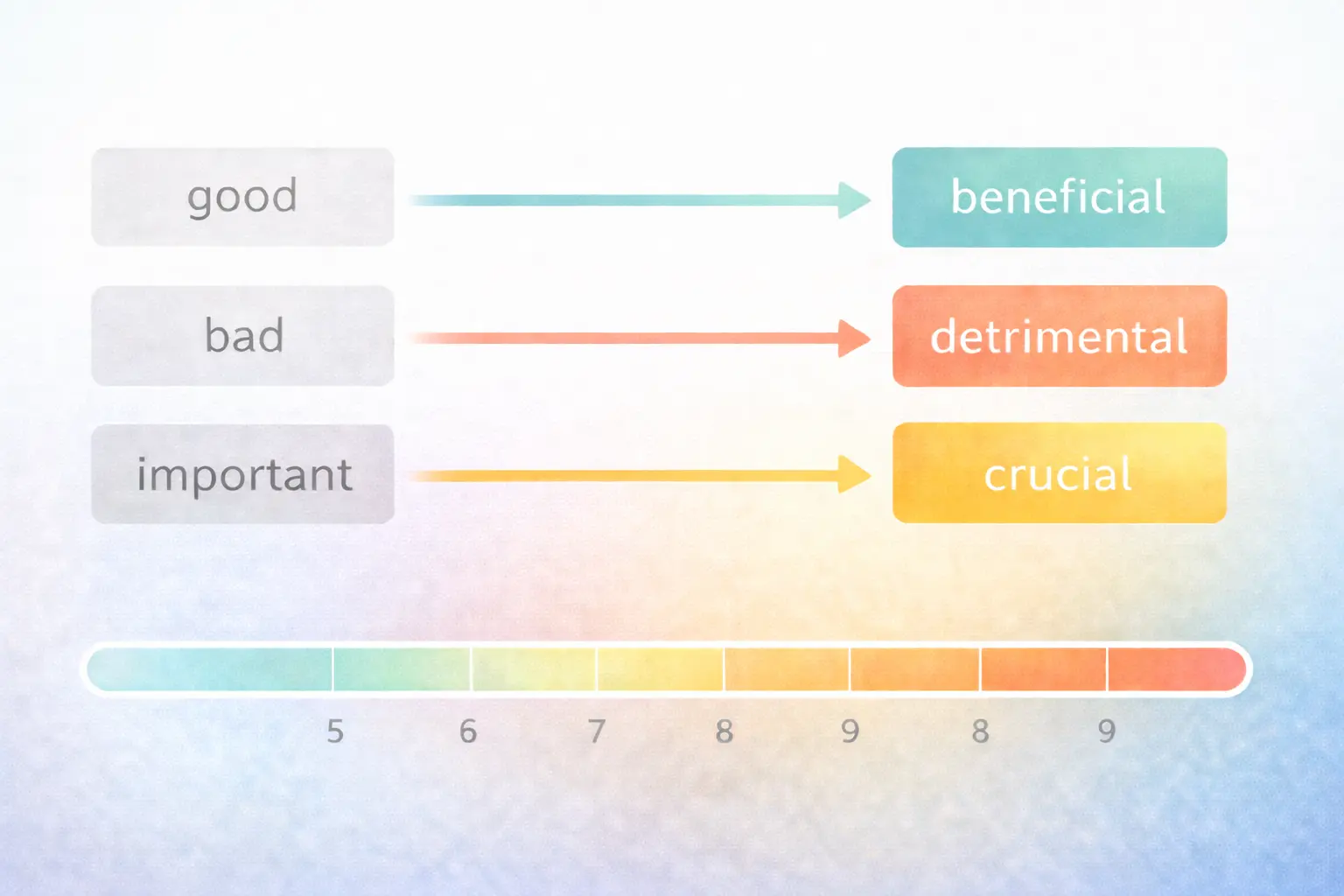
La forma más rápida de pasar de la Banda 6 a la Banda 7+ en el IELTS no es la gramática — es la variedad de vocabulario. Los examinadores buscan específicamente sinónimos y paráfrasis. Si escribes «important» cinco veces en un ensayo, obtienes Banda 5–6 en Recurso Léxico. Si usas «important», «significant», «crucial», «vital» y «essential» — demuestras la variedad que requieren las Bandas 7–9.
Esta guía te ofrece más de 200 sinónimos listos para usar, organizados por las palabras que los candidatos del IELTS usan más en exceso. Cada sinónimo incluye su nivel de formalidad y una oración de ejemplo para que sepas exactamente cuándo usarlo — en la Tarea 1 de Redacción, la Tarea 2 o el Speaking.
- Total de sinónimos: 200+
- Organizados por: 30 palabras que se usan en exceso, con 5–8 sinónimos cada una
- Ideal para: Tarea 1 y Tarea 2 de Redacción del IELTS, Partes 2 y 3 del Speaking, preparación Banda 7–9
- Bonus: Estrategias de paráfrasis para cada sección del IELTS
Por qué los sinónimos importan más que cualquier otra habilidad del IELTS
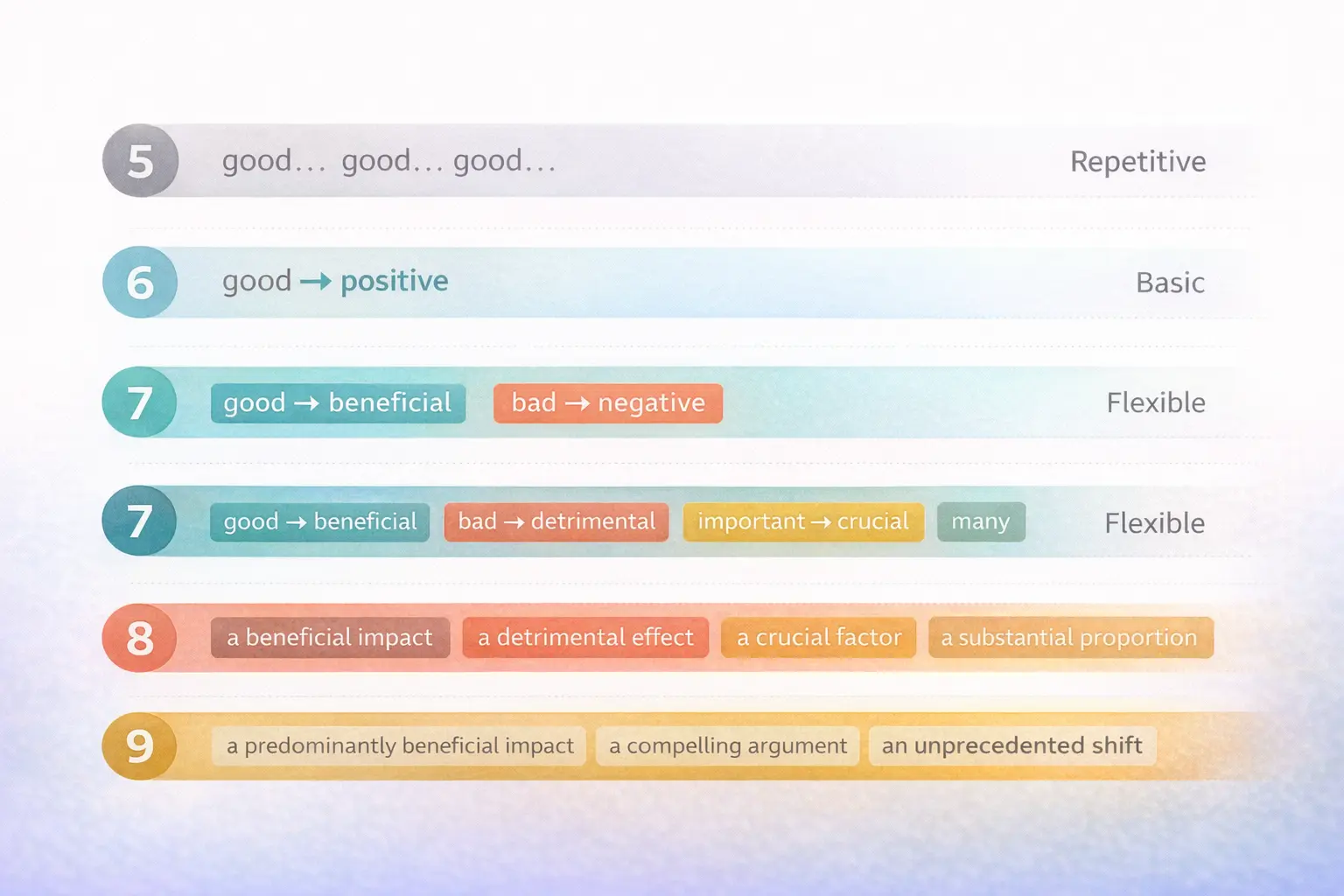
El IELTS puntúa tu vocabulario en una categoría llamada Recurso Léxico — representa el 25% de tus puntuaciones en Redacción y Speaking. Esto es lo que requiere cada nivel de banda:
| Banda | Descriptor del Recurso Léxico |
|---|---|
| 5 | Vocabulario limitado; repetición frecuente de las mismas palabras |
| 6 | Vocabulario adecuado pero con alguna imprecisión; intenta parafrasear |
| 7 | Vocabulario suficiente para permitir flexibilidad y precisión; usa palabras menos comunes |
| 8 | Amplia variedad de vocabulario usada de forma natural y precisa; errores raros |
| 9 | Flexibilidad total y uso preciso; muy natural y sofisticado |
El salto de la Banda 6 a la Banda 7 depende de una cosa: ¿puedes expresar la misma idea usando palabras diferentes? Eso es parafrasear, y los sinónimos son la herramienta que lo hace posible.
Sinónimos para la Redacción del IELTS
Las 15 palabras más usadas en exceso en los ensayos del IELTS
Estas palabras aparecen en casi todos los ensayos de Banda 6. Sustitúyelas y tu puntuación subirá de inmediato.
1. Important (importante)
| Sinónimo | Formalidad | Mejor para | Ejemplo |
|---|---|---|---|
| significant | formal | Tarea 2 | Education plays a significant role in economic development. |
| crucial | formal | Tarea 2 | Time management is crucial for exam success. |
| vital | formal | Tarea 2 | Clean water is vital for public health. |
| essential | neutro | Tareas 1 y 2 | It is essential to consider both sides of the argument. |
| key | neutro | Tareas 1 y 2 | Tourism is a key driver of the local economy. |
| fundamental | formal | Tarea 2 | Freedom of speech is a fundamental human right. |
| pivotal | formal | Tarea 2 (Banda 8+) | Technology has played a pivotal role in transforming education. |
2. Increase (aumentar)
| Sinónimo | Formalidad | Mejor para | Ejemplo |
|---|---|---|---|
| rise | neutro | Tarea 1 | Sales rose sharply in the third quarter. |
| grow | neutro | Tareas 1 y 2 | The population grew by 15% over the decade. |
| surge | formal | Tarea 1 | Demand surged during the holiday season. |
| climb | neutro | Tarea 1 | Unemployment climbed to 8% in 2024. |
| soar | formal | Tarea 1 | House prices soared in major cities. |
| expand | formal | Tarea 2 | The government plans to expand public transport. |
| escalate | formal | Tarea 2 | Costs escalated beyond the original budget. |
3. Decrease (disminuir)
| Sinónimo | Formalidad | Mejor para | Ejemplo |
|---|---|---|---|
| decline | formal | Tareas 1 y 2 | The birth rate has declined steadily since 2010. |
| drop | neutro | Tarea 1 | Temperatures dropped to below zero overnight. |
| fall | neutro | Tarea 1 | Exports fell by 12% compared to the previous year. |
| diminish | formal | Tarea 2 | Interest in traditional media has diminished significantly. |
| shrink | neutro | Tareas 1 y 2 | The workforce shrank due to automation. |
| plummet | formal | Tarea 1 | Tourism numbers plummeted during the pandemic. |
| dwindle | formal | Tarea 2 | Natural resources continue to dwindle. |
4. Show (mostrar) — para descripciones de datos en la Tarea 1
| Sinónimo | Formalidad | Mejor para | Ejemplo |
|---|---|---|---|
| illustrate | formal | Tarea 1 | The chart illustrates the trends in energy consumption. |
| demonstrate | formal | Tarea 1 | The data demonstrates a clear correlation. |
| indicate | formal | Tarea 1 | The figures indicate a significant shift in consumer behavior. |
| reveal | formal | Tarea 1 | The survey reveals that 60% of respondents prefer online shopping. |
| depict | formal | Tarea 1 | The graph depicts changes in population over 50 years. |
| present | neutro | Tarea 1 | The table presents a comparison of five countries. |
5. Many / A lot of (muchos / mucho)
| Sinónimo | Formalidad | Mejor para | Ejemplo |
|---|---|---|---|
| numerous | formal | Tarea 2 | Numerous studies support this conclusion. |
| a significant number of | formal | Tareas 1 y 2 | A significant number of students dropped out. |
| a considerable amount of | formal | Tarea 2 | A considerable amount of research has been conducted. |
| the majority of | formal | Tareas 1 y 2 | The majority of respondents agreed with the statement. |
| a substantial proportion of | formal | Tarea 1 | A substantial proportion of the budget was allocated to defense. |
| widespread | formal | Tarea 2 | There is widespread concern about air pollution. |
6. Good (bueno)
| Sinónimo | Formalidad | Mejor para | Ejemplo |
|---|---|---|---|
| beneficial | formal | Tarea 2 | Exercise is beneficial for both physical and mental health. |
| advantageous | formal | Tarea 2 | Living near the city center is advantageous for commuters. |
| positive | neutro | Tarea 2 | Technology has had a positive impact on education. |
| favorable | formal | Tarea 2 | Economic conditions were favorable for small businesses. |
| effective | neutro | Tarea 2 | Online learning can be an effective alternative to classroom teaching. |
7. Bad (malo)
| Sinónimo | Formalidad | Mejor para | Ejemplo |
|---|---|---|---|
| detrimental | formal | Tarea 2 | Excessive screen time is detrimental to children’s development. |
| adverse | formal | Tarea 2 | Pollution has adverse effects on public health. |
| harmful | neutro | Tarea 2 | Processed food can be harmful if consumed regularly. |
| negative | neutro | Tarea 2 | Social media can have a negative influence on self-esteem. |
| damaging | neutro | Tarea 2 | The scandal was damaging to the company’s reputation. |
8. Think / Believe (pensar / creer)
| Sinónimo | Formalidad | Mejor para | Ejemplo |
|---|---|---|---|
| argue | formal | Tarea 2 | Some experts argue that AI will replace most jobs. |
| contend | formal | Tarea 2 (Banda 8+) | Critics contend that the policy has failed. |
| maintain | formal | Tarea 2 | The government maintains that the economy is recovering. |
| assert | formal | Tarea 2 | The report asserts that climate change is accelerating. |
| hold the view that | formal | Tarea 2 | Many educators hold the view that exams are outdated. |
| be of the opinion that | formal | Tarea 2 | I am of the opinion that education should be free. |
9. Problem (problema)
| Sinónimo | Formalidad | Mejor para | Ejemplo |
|---|---|---|---|
| issue | neutro | Tarea 2 | Unemployment is a pressing issue in many countries. |
| challenge | neutro | Tarea 2 | Climate change is the biggest challenge of our time. |
| concern | formal | Tarea 2 | There is growing concern about data privacy. |
| drawback | neutro | Tarea 2 | One drawback of remote work is social isolation. |
| obstacle | formal | Tarea 2 | Language barriers are a major obstacle for immigrants. |
| dilemma | formal | Tarea 2 | This creates a moral dilemma for policymakers. |
10. Give / Provide (dar / proporcionar)
| Sinónimo | Formalidad | Mejor para | Ejemplo |
|---|---|---|---|
| offer | neutro | Tarea 2 | Universities offer a wide range of courses. |
| supply | neutro | Tareas 1 y 2 | The factory supplies components to three countries. |
| deliver | neutro | Tarea 2 | The program delivers training to over 5,000 teachers. |
| present | formal | Tarea 1 | The data presents a clear picture of the trend. |
| yield | formal | Tareas 1 y 2 | The investment yielded a 15% return. |
11. Change (cambiar)
| Sinónimo | Formalidad | Mejor para | Ejemplo |
|---|---|---|---|
| transform | formal | Tarea 2 | Technology has transformed the way people communicate. |
| alter | formal | Tarea 2 | Climate change is altering weather patterns worldwide. |
| shift | neutro | Tareas 1 y 2 | There has been a significant shift toward renewable energy. |
| modify | formal | Tarea 2 | The government modified the policy after public outcry. |
| evolve | neutro | Tarea 2 | Consumer behavior has evolved rapidly in the digital age. |
| fluctuate | formal | Tarea 1 | Oil prices fluctuated throughout the year. |
12. People (personas)
| Sinónimo | Formalidad | Mejor para | Ejemplo |
|---|---|---|---|
| individuals | formal | Tarea 2 | Individuals should take responsibility for their health. |
| citizens | formal | Tarea 2 | Citizens have the right to access public services. |
| the population | formal | Tareas 1 y 2 | The population of urban areas is growing. |
| residents | neutro | Tarea 2 | Local residents opposed the construction project. |
| the public | formal | Tarea 2 | The public has become more aware of environmental issues. |
| society | formal | Tarea 2 | Society benefits when education is accessible to all. |
13. Help (ayudar)
| Sinónimo | Formalidad | Mejor para | Ejemplo |
|---|---|---|---|
| assist | formal | Tarea 2 | Technology can assist students with learning disabilities. |
| facilitate | formal | Tarea 2 (Banda 8+) | Online platforms facilitate communication across borders. |
| enable | formal | Tarea 2 | Scholarships enable students from low-income families to attend university. |
| support | neutro | Tarea 2 | Governments should support small businesses through tax incentives. |
| contribute to | formal | Tarea 2 | Regular exercise contributes to better mental health. |
14. Cause (causar)
| Sinónimo | Formalidad | Mejor para | Ejemplo |
|---|---|---|---|
| lead to | neutro | Tarea 2 | Poverty often leads to higher crime rates. |
| result in | formal | Tarea 2 | The policy resulted in widespread job losses. |
| give rise to | formal | Tarea 2 (Banda 8+) | Rapid urbanization has given rise to numerous social problems. |
| trigger | formal | Tarea 2 | The announcement triggered a sharp decline in stock prices. |
| bring about | formal | Tarea 2 | Technological advances brought about a revolution in communication. |
| stem from | formal | Tarea 2 | Many health problems stem from a sedentary lifestyle. |
15. About (aproximadamente)
| Sinónimo | Formalidad | Mejor para | Ejemplo |
|---|---|---|---|
| approximately | formal | Tarea 1 | Approximately 45% of respondents chose option A. |
| roughly | neutro | Tarea 1 | Roughly half of the population lives in urban areas. |
| around | neutro | Tarea 1 | Around 30 million tourists visit the country annually. |
| just over / just under | neutro | Tarea 1 | Just over 60% of students passed the exam. |
| in the region of | formal | Tarea 1 | The cost was in the region of $5 million. |
Sinónimos para el IELTS Speaking
El Speaking requiere sinónimos diferentes a los de la Redacción. Necesitas palabras que suenen naturales en la conversación — no excesivamente académicas.
16. Very (muy)
| Sinónimo | Registro | Ejemplo |
|---|---|---|
| extremely | neutro | The exam was extremely difficult. |
| incredibly | informal | The food there is incredibly good. |
| remarkably | formal | She is remarkably talented for her age. |
| exceptionally | formal | The weather was exceptionally warm this year. |
| particularly | neutro | I am particularly interested in marine biology. |
| highly | neutro | It is a highly competitive program. |
17. Like (gustar)
| Sinónimo | Registro | Ejemplo |
|---|---|---|
| enjoy | neutro | I really enjoy hiking in the mountains. |
| be fond of | ligeramente formal | I am quite fond of Italian cuisine. |
| be keen on | neutro (inglés brit.) | I have always been keen on photography. |
| be passionate about | neutro | I am passionate about environmental conservation. |
| be into | informal | I am really into Korean dramas at the moment. |
| appreciate | neutro | I appreciate good architecture when I travel. |
18. Interesting (interesante)
| Sinónimo | Registro | Ejemplo |
|---|---|---|
| fascinating | neutro | The documentary about deep-sea creatures was fascinating. |
| captivating | formal | The speaker gave a captivating presentation. |
| compelling | formal | The book presents a compelling argument for change. |
| thought-provoking | formal | It was a thought-provoking discussion. |
| intriguing | neutro | I find the history of ancient civilizations intriguing. |
| engaging | neutro | The course was highly engaging. |
19. Difficult (difícil)
| Sinónimo | Registro | Ejemplo |
|---|---|---|
| challenging | neutro | The project was challenging but rewarding. |
| demanding | neutro | It is a very demanding job that requires long hours. |
| tough | informal | It was a tough decision to leave my hometown. |
| daunting | formal | Moving to a foreign country can be quite daunting. |
| complex | formal | The issue is more complex than it appears. |
20. Happy (feliz)
| Sinónimo | Registro | Ejemplo |
|---|---|---|
| delighted | neutro | I was delighted to receive the scholarship. |
| thrilled | neutro | I am thrilled about starting my new job. |
| pleased | neutro | I am really pleased with my progress. |
| content | neutro | I feel content with my life at the moment. |
| ecstatic | informal | I was ecstatic when I heard the news. |
| grateful | neutro | I am grateful for the opportunities I have had. |
21. Big (grande)
| Sinónimo | Registro | Ejemplo |
|---|---|---|
| enormous | neutro | There is an enormous demand for affordable housing. |
| vast | formal | The country has vast natural resources. |
| substantial | formal | They made a substantial investment in renewable energy. |
| immense | formal | The project required an immense amount of effort. |
| considerable | formal | There is a considerable difference between the two systems. |
22. Small (pequeño)
| Sinónimo | Registro | Ejemplo |
|---|---|---|
| slight | neutro | There was a slight improvement in test scores. |
| marginal | formal | The difference in results was marginal. |
| modest | neutro | The country saw modest economic growth. |
| negligible | formal | The environmental impact was negligible. |
| minor | neutro | It was a minor issue that was quickly resolved. |
23. Fast (rápido)
| Sinónimo | Registro | Ejemplo |
|---|---|---|
| rapid | formal | There has been rapid growth in the tech industry. |
| swift | formal | The government took swift action. |
| prompt | formal | They received a prompt response to their complaint. |
| dramatic (para cambios) | neutro | There was a dramatic increase in online shopping. |
| steep (para datos) | neutro | The graph shows a steep rise in prices. |
24. Slow (lento)
| Sinónimo | Registro | Ejemplo |
|---|---|---|
| gradual | neutro | There was a gradual improvement over the decade. |
| steady | neutro | The recovery has been slow but steady. |
| moderate | neutro | Growth was moderate compared to the previous year. |
| sluggish | formal | Economic growth remained sluggish throughout the period. |
Sinónimos para la Banda 9 — Paráfrasis avanzada
Estos son los sinónimos de alto nivel que separan la Banda 7–8 de la Banda 9. Úsalos con moderación — uno o dos por ensayo o respuesta del Speaking.
25. As a result / Therefore (como resultado / por lo tanto)
| Sinónimo | Ejemplo |
|---|---|
| consequently | Consequently, many families were forced to relocate. |
| as a consequence | As a consequence, the government introduced new regulations. |
| thereby | The program reduces waste, thereby lowering operational costs. |
| hence | The evidence is inconclusive; hence, further research is needed. |
| thus | The population is aging, thus increasing demand for healthcare. |
| this has led to | This has led to a significant shift in public opinion. |
26. However / But (sin embargo / pero)
| Sinónimo | Ejemplo |
|---|---|
| nevertheless | The plan was expensive. Nevertheless, the government approved it. |
| nonetheless | The evidence is limited. Nonetheless, the trend is clear. |
| on the other hand | Urban areas offer more jobs. On the other hand, rural areas offer better quality of life. |
| conversely | Developed nations consume more energy. Conversely, developing nations face energy poverty. |
| despite this | The policy was unpopular. Despite this, it achieved its goals. |
| that said | The system is not perfect. That said, it is a significant improvement. |
27. For example (por ejemplo)
| Sinónimo | Ejemplo |
|---|---|
| for instance | For instance, Japan has invested heavily in renewable energy. |
| such as | Many countries, such as Norway and Sweden, have strong social safety nets. |
| to illustrate | To illustrate, consider the case of Singapore’s education system. |
| a case in point is | A case in point is the success of Finland’s education model. |
| this is exemplified by | This is exemplified by the rapid growth of e-commerce. |
28. In conclusion (en conclusión)
| Sinónimo | Ejemplo |
|---|---|
| to sum up | To sum up, the benefits of public transport outweigh the drawbacks. |
| in summary | In summary, a balanced approach is needed. |
| on balance | On balance, globalization has been positive for developing countries. |
| all things considered | All things considered, the policy has been a success. |
| taking everything into account | Taking everything into account, I believe education is the key. |
29. In my opinion (en mi opinión)
| Sinónimo | Ejemplo |
|---|---|
| from my perspective | From my perspective, work-life balance is more important than salary. |
| I would argue that | I would argue that government regulation is necessary. |
| it seems to me that | It seems to me that technology has made life easier overall. |
| I am inclined to believe | I am inclined to believe that traditional education still has value. |
| as I see it | As I see it, the advantages outweigh the disadvantages. |
30. According to (según)
| Sinónimo | Ejemplo |
|---|---|
| research suggests that | Research suggests that bilingual children develop cognitive advantages. |
| studies have shown that | Studies have shown that regular exercise reduces stress. |
| evidence indicates that | Evidence indicates that early intervention is most effective. |
| data reveals that | Data reveals that urban populations are growing rapidly. |
| experts maintain that | Experts maintain that renewable energy is the future. |
Cómo parafrasear en cada sección del IELTS
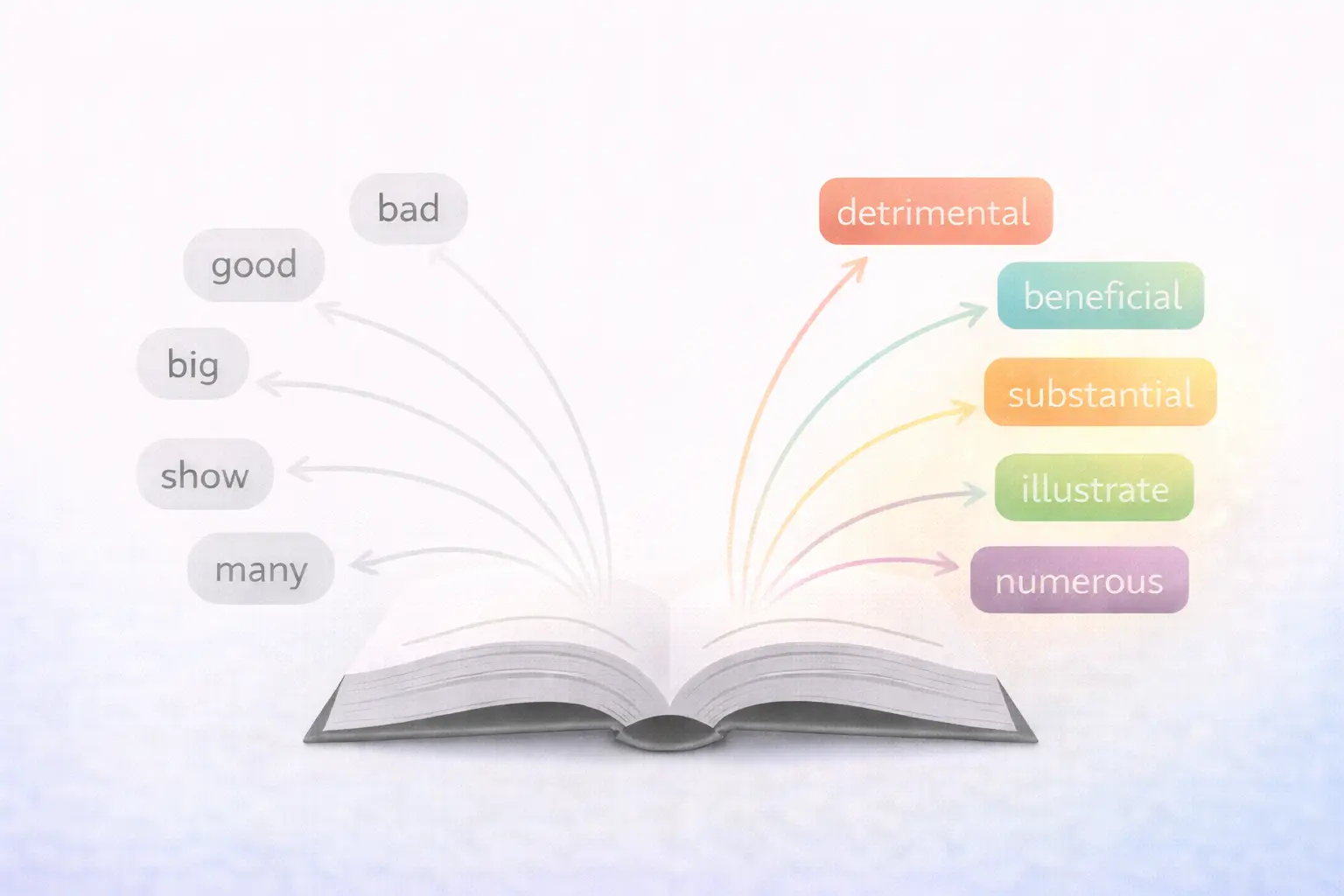
Conocer los sinónimos es solo la mitad de la habilidad. También necesitas estrategias para parafrasear oraciones enteras.
Paráfrasis en la Tarea 1 de Redacción
En la Tarea 1, debes parafrasear la pregunta en tu introducción. Nunca copies las palabras exactas.
Pregunta: The chart below shows the percentage of households with internet access in three countries between 2000 and 2020.
| Enfoque | Versión parafraseada |
|---|---|
| Cambiar el vocabulario | The chart illustrates the proportion of homes with internet connectivity in three nations over a twenty-year period. |
| Cambiar la estructura | Internet access rates in three countries from 2000 to 2020 are depicted in the chart. |
| Combinar ambos | The given chart compares the share of households that had access to the internet in three different countries between 2000 and 2020. |
Sustituciones clave: shows → illustrates/depicts, percentage → proportion/share, households → homes, countries → nations, between 2000 and 2020 → over a twenty-year period.
Paráfrasis en la Tarea 2 de Redacción
En la Tarea 2, parafrasea la pregunta del ensayo en tu introducción Y usa sinónimos a lo largo del texto para evitar la repetición.
Pregunta: Some people think that governments should spend money on faster public transport. Others think money should be spent on other priorities like education and healthcare.
Introducción parafraseada: It is widely debated whether government funding should be directed toward improving public transport or allocated to other essential services such as education and healthcare. While both sides present valid arguments, I believe that investing in transport infrastructure yields the greatest long-term benefits.
Cambios realizados: spend money → funding should be directed/allocated, faster → improving, other priorities → other essential services, think → present valid arguments/believe, should be spent → investing in.
Paráfrasis en el Speaking
En el Speaking, el examinador evalúa si puedes reformular la pregunta en tu respuesta sin repetirla palabra por palabra.
Pregunta: Do you think technology has changed the way people communicate?
| Banda 6 (repite la pregunta) | Banda 7+ (parafrasea) |
|---|---|
| Yes, I think technology has changed the way people communicate because… | Absolutely. I think digital tools have completely transformed how we interact with one another. For instance… |
Cambios clave: technology → digital tools, changed → transformed, the way people communicate → how we interact with one another.
Vocabulario para practicar
Aquí tienes 25 palabras académicas de nivel B2–C1 que se usan frecuentemente como sinónimos en el IELTS. Haz clic en cualquier palabra para ver su definición, pronunciación y ejemplos.
valid
adjetivo
válido, justo
Ejemplos
- Valid argument supports logical reasoning and conclusion.
- Valid passport allows international travel without problems.
flexible
adjetivo
flexible, maleable, adaptable
Ejemplos
- Flexible working arrangements help employees balance work and family life.
- The flexible plastic tube can bend without breaking or cracking.
transmit
verbo
transmitir, difundir, emitir
Ejemplos
- Disease may transmit through contact with surfaces.
- Satellites transmit signals across vast distances effectively.
executive
adjetivo
ejecutivo, directivo, gerente
Ejemplos
- Executive decisions require careful consideration of multiple factors and consequences.
- The executive branch of government is responsible for implementing laws.
finance
verbo
financiar, costear
Ejemplos
- Many students need loans to finance their college education expenses.
- The bank agreed to finance the construction of the new shopping center.
culmination
sustantivo
culminación
Ejemplos
- The graduation ceremony was the culmination of four years of hard study.
- Winning the championship represented the culmination of the team's efforts.
gulp
verbo
beber, tragar
Ejemplos
- She had to gulp nervously before giving her presentation to the board.
- The thirsty runner gulped down an entire bottle of cold water.
tribe
sustantivo
tribu, clan, pueblo
Ejemplos
- Ancient tribe lived in harmony with nature.
- Indigenous tribe preserves traditional customs and languages.
cherished
adjetivo
valorado, querido
Ejemplos
- His cherished dream of becoming a pilot finally came true.
- The old photograph was her most cherished possession from childhood.
fate
sustantivo
destino, suerte, fatum
Ejemplos
- She believes that fate brought them together at the right moment.
- The explorer's fate remained unknown after he disappeared in the jungle.
territory
sustantivo
territorio, zona
Ejemplos
- Animal territory provides food and shelter resources.
- National territory requires protection from foreign invasion.
payable
adjetivo
pagadero, a pagar, de pago
Ejemplos
- All dues are payable at the end of the month.
- The invoice is payable within 30 days.
serenity
sustantivo
serenidad, tranquilidad, calma
Ejemplos
- She maintained her serenity despite the chaos.
- The serenity of the lake was calming.
classy
adjetivo
elegante, clase, distinguido
Ejemplos
- Classy restaurant serves gourmet food in elegant dining atmosphere.
- Her classy appearance impressed everyone at formal business meeting.
revolt
verbo
rebelarse, levantarse, revoltarse
Ejemplos
- A revolt broke out in the city center last night.
- The workers decided to revolt against the unfair conditions.
rethink
verbo
repensar, reconsiderar, reflexionar
Ejemplos
- He decided to rethink his position on the issue.
- We need to rethink our strategy for the project.
gypsy
sustantivo
gitano, romani, nómada
Ejemplos
- Traditional gypsy music features violin and passionate vocals.
- Wandering gypsy caravan traveled through European countryside.
buffoon
sustantivo
bufón, payaso
Ejemplos
- Court buffoon entertained royal family with silly performances.
- Don't act like buffoon during important business presentation.
execution
sustantivo
ejecución, cumplimiento, desempeño
Ejemplos
- Perfect execution of the dance routine impressed judges and audience members.
- The execution of the business plan requires careful coordination and timing.
spellbound
adjetivo
absorto, hipnotizado, fascinado
Ejemplos
- Audience sits spellbound during magical performance tonight.
- Children remain spellbound by storyteller's fascinating tales.
pet
adjetivo
pequeño, chico, menudo
Ejemplos
- Pet project receives extra attention and resources.
- Pet theory explains professor's research focus area.
master
sustantivo
maestro, experto, jefe
Ejemplos
- Apprentices learn traditional crafts from experienced master craftsmen.
- The chess master defeated opponents using brilliant strategic moves.
salvage
sustantivo
rescate, salvamento
Ejemplos
- Antique dealer specializes in salvage from demolished buildings.
- Divers recovered valuable salvage from sunken merchant ship.
Errores comunes con los sinónimos en el IELTS
1. Usar sinónimos que cambian el significado. «Big» y «immense» son sinónimos, pero «immense pressure» funciona mientras que «big pressure» no. Comprueba siempre las colocaciones — no todos los sinónimos encajan en todas las oraciones.
2. Usar sinónimos demasiado informales en la Redacción. «Awesome» es un sinónimo de «good», pero no tiene lugar en un ensayo del IELTS. Cíñete a sinónimos neutros y formales para la Redacción; guarda los informales para el Speaking.
3. Forzar demasiados sinónimos en un párrafo. Si cada oración contiene una palabra inusual, la escritura parece poco natural. Usa entre 2 y 3 sinónimos fuertes por párrafo. El resto de tu vocabulario debe ser claro y natural.
4. Memorizar sinónimos sin contexto. Saber que «facilitate» significa «help» no es suficiente. Necesitas saber que «facilitate» se combina con «communication», «learning» y «development» — no con «my friend» o «my homework».
5. Usar el mismo sinónimo «avanzado» repetidamente. Si sustituyes cada «important» por «significant», no has demostrado variedad — simplemente has sustituido una repetición por otra. Varía tus sinónimos.
Qué hacer a continuación
-
Domina primero los sinónimos de la Redacción. Céntrate en las 15 palabras más usadas (important, increase, decrease, show, many, good, bad, think, problem, give, change, people, help, cause, about). Cubren el 80% de las necesidades de vocabulario en los ensayos del IELTS.
-
Practica la paráfrasis cada día. Toma una pregunta de ensayo del IELTS cada día y escribe 3 introducciones parafraseadas diferentes. Esto construye el hábito del uso automático de sinónimos.
-
Estudia las guías del IELTS relacionadas. Para vocabulario específico por sección, consulta nuestra Tarea 1 de Redacción del IELTS para gráficos, la Tarea 2 de Redacción del IELTS para ensayos, el vocabulario del IELTS Speaking por temas y la guía completa de vocabulario para el IELTS.
-
Construye tu vocabulario general. Los sinónimos requieren una base de vocabulario sólida. Lee nuestra guía sobre cómo mejorar tu vocabulario para 10 métodos probados.
-
Apunta a la Banda 8–9. Si buscas las puntuaciones más altas, consulta nuestro vocabulario IELTS Banda 7 para listas de palabras específicas por banda.
Preguntas frecuentes
¿Cuántos sinónimos necesito para el IELTS Banda 7?
Para la Banda 7, necesitas demostrar «una variedad suficiente que permita flexibilidad y precisión». En la práctica, esto significa conocer entre 3 y 4 sinónimos de las 15 palabras más comunes del IELTS y usar al menos 5–6 elementos de vocabulario menos comunes por ensayo. Los 200+ sinónimos de este artículo te dan mucho más que suficiente — céntrate en aprender entre 50 y 60 que te resulten naturales.
¿Cuál es la mejor manera de aprender los sinónimos del IELTS?
Apréndelos en contexto, no como pares de palabras aisladas. Para cada sinónimo, lee la oración de ejemplo, observa la colocación y escribe tu propia oración. Luego practica reescribiendo las preguntas de los ensayos del IELTS con distintos sinónimos. El uso activo supera a la memorización pasiva.
¿Puedo usar el mismo sinónimo dos veces en un ensayo?
Sí, pero evita usar el mismo sinónimo poco común más de una vez en un ensayo de 250 palabras. Las palabras comunes como «the», «is» y «however» pueden repetirse, pero si usas «significant» dos veces, intenta usar «crucial» o «vital» la segunda vez. La variedad es el objetivo.
¿Estos sinónimos son apropiados para el IELTS Academic y el General?
Sí. Todos los sinónimos de este artículo funcionan tanto para el IELTS Academic como para el General Training. Los sinónimos de Redacción son esenciales para la Tarea 1 Académica (gráficos) y la Tarea 2 de ambas versiones. Los sinónimos del Speaking funcionan de forma idéntica para los dos tipos de examen.
¿Cuál es la diferencia entre los sinónimos de Redacción y los del Speaking?
Los sinónimos de Redacción tienden a ser más formales y académicos: «significant», «detrimental», «facilitate». Los del Speaking deben sonar naturales en la conversación: «fascinating», «challenging», «passionate». Usar palabras excesivamente académicas en el Speaking puede sonar ensayado y poco natural, lo que en realidad baja tu puntuación.
¿Cómo parafraseo la pregunta de la Tarea 1 de Redacción del IELTS?
Sustituye los sustantivos y verbos clave por sinónimos manteniendo el mismo significado. «The chart shows» se convierte en «The chart illustrates». «The percentage of» se convierte en «The proportion of». «Between 2000 and 2020» se convierte en «over a two-decade period». Nunca cambies números, nombres de países ni el tipo de gráfico — solo reformula el lenguaje descriptivo que los rodea.