
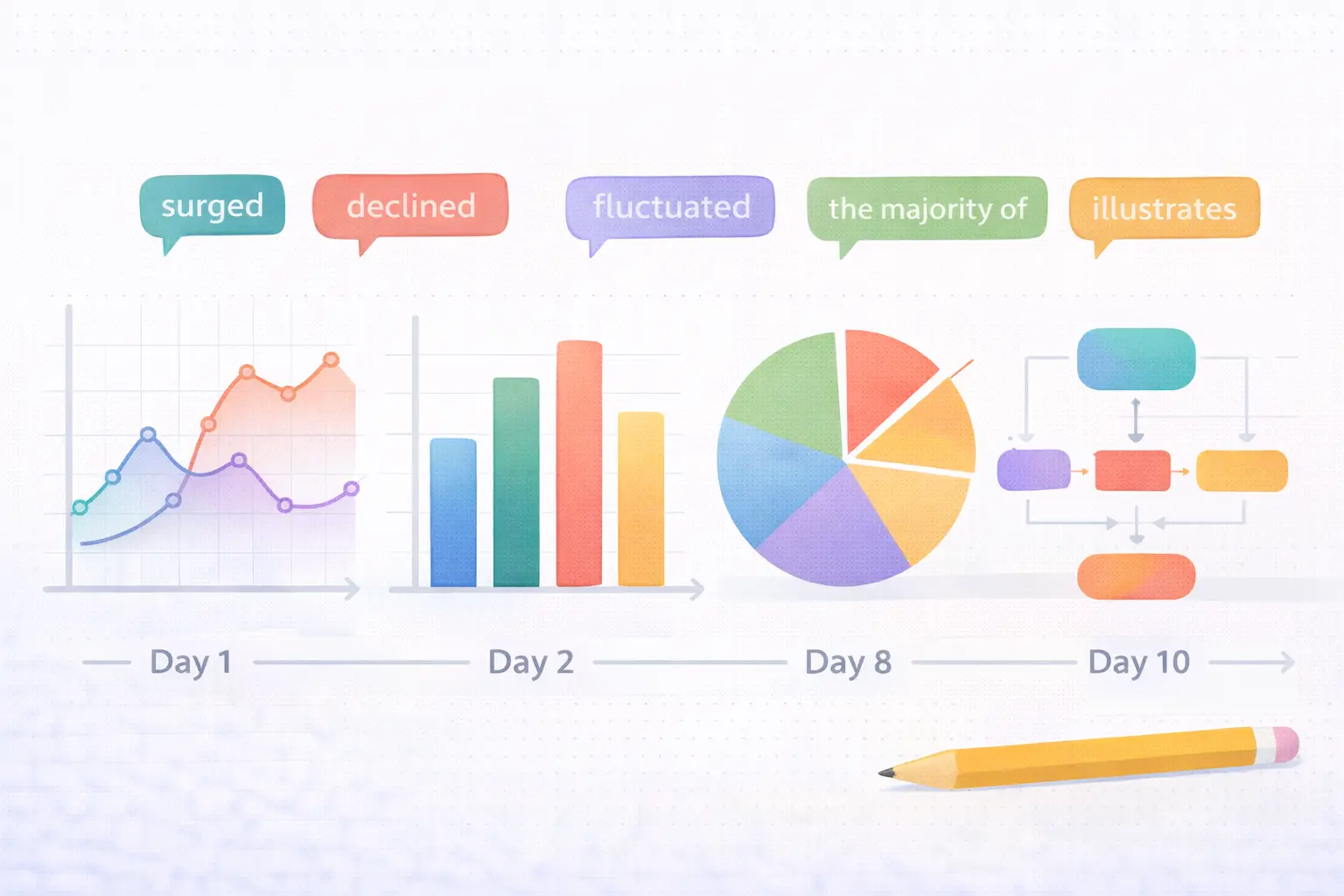
Vocabulario IELTS Tarea 1 de Redacción: Palabras Esenciales para Gráficos y Mapas
La Tarea 1 de Redacción del IELTS no es un ensayo — es una descripción de datos. Tienes 20 minutos para describir un gráfico, tabla, mapa o diagrama de proceso en al menos 150 palabras. El vocabulario que necesitas es completamente diferente al de la Tarea 2. En lugar de opiniones y argumentos, necesitas palabras para tendencias, comparaciones, proporciones y períodos de tiempo.
La mayoría de los candidatos pierden puntos aquí no porque malinterpreten los datos, sino porque los describen usando siempre las mismas tres palabras: «increased», «decreased» y «the chart shows». Esta guía te ofrece 150+ palabras y frases organizadas exactamente según cómo se usan en la Tarea 1 — para que puedas describir cualquier tipo de gráfico con la precisión y variedad que requieren las Bandas 7–9.
- Total de vocabulario: 150+ palabras y frases
- Organizado por: función (tendencias, comparaciones, proporciones, introducciones de gráficos, tiempo)
- Tipos de gráficos cubiertos: gráficos lineales, gráficos de barras, gráficos circulares, tablas, mapas, diagramas de proceso
- Ideal para: Tarea 1 del IELTS Academic, preparación para Bandas 6–9
Cómo se puntúa el vocabulario en la Tarea 1
La Tarea 1 usa los mismos cuatro criterios que la Tarea 2, cada uno con un 25%:
| Criterio | Qué significa para la Tarea 1 |
|---|---|
| Logro de la tarea | ¿Describiste las características clave e hiciste comparaciones? |
| Coherencia y cohesión | ¿Está tu descripción bien organizada y enlazada? |
| Recurso Léxico | ¿Usaste una variedad de vocabulario con precisión? |
| Variedad gramatical | ¿Usaste una variedad de estructuras oracionales? |
El Recurso Léxico es donde el vocabulario determina directamente tu puntuación:
| Banda | Qué esperan los examinadores |
|---|---|
| 5 | Vocabulario limitado; puede usar la palabra incorrecta para las tendencias; repetitivo |
| 6 | Vocabulario adecuado; intenta palabras menos comunes pero con algunos errores |
| 7 | Variedad suficiente para describir datos con flexibilidad; usa vocabulario menos común |
| 8 | Amplia variedad de vocabulario usada de forma natural; errores raros; elección precisa de palabras |
| 9 | Flexibilidad y precisión totales; la escritura parece un informe profesional |
El mayor error de vocabulario en la Tarea 1 es la repetición. Si escribes «increased» cuatro veces y «decreased» tres veces, tu puntuación se limitará a la Banda 6 independientemente de cuán precisa sea tu descripción de datos.

Categoría 1: Introducir el gráfico
Cada respuesta de la Tarea 1 comienza parafraseando lo que muestra el gráfico. Nunca copies la pregunta palabra por palabra — los examinadores penalizan esto.
Verbos para «The chart shows…»
| Verbo | Formalidad | Ejemplo |
|---|---|---|
| illustrates | formal | The line graph illustrates changes in unemployment rates over a 20-year period. |
| depicts | formal | The bar chart depicts the number of tourists visiting five countries in 2024. |
| presents | neutro | The table presents a comparison of average salaries across four industries. |
| compares | neutro | The chart compares the percentage of households with internet access in three nations. |
| outlines | formal | The diagram outlines the process of water purification. |
| provides information about | neutro | The graph provides information about energy consumption by sector. |
| gives a breakdown of | neutro | The pie chart gives a breakdown of government spending by category. |
Sustantivos para los tipos de gráficos
Usa sustantivos precisos — no llames «the chart» a todo.
| Tipo de gráfico | Frases nominales |
|---|---|
| Gráfico lineal | the line graph, the graph, the figure |
| Gráfico de barras | the bar chart, the chart, the figure |
| Gráfico circular | the pie chart, the chart |
| Tabla | the table, the data, the figures |
| Mapa | the two maps, the diagrams |
| Proceso | the diagram, the flow chart, the figure |
Expresiones de tiempo para la introducción
| Expresión | Ejemplo |
|---|---|
| over a _-year period | …over a 30-year period from 1990 to 2020. |
| between and | …between 2010 and 2025. |
| from to | …from January to December 2024. |
| during the period | …during the period shown. |
| in the year _ | …in the year 2023. |
Introducción de ejemplo (Banda 7+): The line graph illustrates the average monthly rainfall in three Asian cities over a 12-month period from January to December.
Categoría 2: Describir tendencias ascendentes
Esta es la categoría de vocabulario más importante para la Tarea 1. Necesitas múltiples formas de decir «went up».
Verbos (movimiento ascendente)
| Verbo | Intensidad | Ejemplo |
|---|---|---|
| rose | moderada | Sales rose from 200 to 350 units. |
| increased | moderada | The number of students increased steadily. |
| grew | moderada | The population grew by 15% over the decade. |
| climbed | moderada–fuerte | Unemployment climbed to 8% in the third quarter. |
| surged | fuerte | Demand surged during the holiday season. |
| soared | muy fuerte | House prices soared to record levels. |
| rocketed | muy fuerte | Internet usage rocketed between 2000 and 2010. |
| jumped | repentina | Exports jumped by 25% in a single month. |
| doubled | específica | The figure doubled from 500 to 1,000. |
| tripled | específica | Revenue tripled in the space of five years. |
Sustantivos (movimiento ascendente)
| Sustantivo | Intensidad | Ejemplo |
|---|---|---|
| a rise | moderada | There was a rise in the number of applicants. |
| an increase | moderada | The chart shows an increase of 20%. |
| growth | moderada | The country experienced steady economic growth. |
| a surge | fuerte | There was a sharp surge in demand. |
| a jump | repentina | A sudden jump occurred in March. |
| a peak | máximo | The figure reached a peak of 450 in July. |
Adverbios y adjetivos (velocidad y magnitud)
| Descripción | Adverbio (con verbo) | Adjetivo (con sustantivo) |
|---|---|---|
| cambio pequeño | slightly, marginally | a slight, a marginal |
| cambio moderado | moderately, steadily | a moderate, a steady |
| cambio grande | significantly, considerably | a significant, a considerable |
| cambio rápido | sharply, rapidly, dramatically | a sharp, a rapid, a dramatic |
| cambio muy rápido | steeply, exponentially | a steep, an exponential |
Combinándolos:
- Sales rose sharply from 200 to 500. (verbo + adverbio)
- There was a sharp rise from 200 to 500. (adjetivo + sustantivo)
- The figure increased significantly, reaching 500 by December. (verbo + adverbio)

Categoría 3: Describir tendencias descendentes
Verbos (movimiento descendente)
| Verbo | Intensidad | Ejemplo |
|---|---|---|
| fell | moderada | The temperature fell to below zero overnight. |
| decreased | moderada | Exports decreased by 12% compared to the previous year. |
| declined | moderada | The birth rate has declined steadily since 2010. |
| dropped | moderada–fuerte | Attendance dropped sharply in the second quarter. |
| shrank | moderada | The workforce shrank due to automation. |
| plummeted | muy fuerte | Tourism numbers plummeted during the pandemic. |
| plunged | muy fuerte | Share prices plunged after the announcement. |
| halved | específica | The number of complaints halved within one year. |
| dipped | leve/temporal | Revenue dipped briefly in March before recovering. |
Sustantivos (movimiento descendente)
| Sustantivo | Intensidad | Ejemplo |
|---|---|---|
| a fall | moderada | There was a fall of 15% in the third quarter. |
| a decrease | moderada | The data shows a decrease in household spending. |
| a decline | moderada | A steady decline is visible from 2015 onwards. |
| a drop | moderada–fuerte | A sharp drop occurred between June and July. |
| a dip | leve/temporal | There was a slight dip in sales during the summer. |
| a low | mínimo | The figure reached a low of 120 in February. |
Los mismos adverbios y adjetivos de la Categoría 2 se aplican aquí: fell sharply, a dramatic decline, decreased slightly.
Categoría 4: Describir la estabilidad y la fluctuación
No todos los datos suben o bajan. Necesitas vocabulario para las líneas planas y el movimiento inestable.
Estabilidad (sin cambios)
| Expresión | Ejemplo |
|---|---|
| remained stable at | The rate remained stable at approximately 5%. |
| stayed constant at | Prices stayed constant at $200 throughout the year. |
| leveled off at | After rising sharply, the figure leveled off at 300. |
| plateaued at | Growth plateaued at 3% between 2018 and 2022. |
| remained unchanged | The proportion of female employees remained unchanged. |
| held steady at | Interest rates held steady at 2.5%. |
| maintained the same level | Exports maintained the same level as the previous year. |
Fluctuación (subidas y bajadas)
| Expresión | Ejemplo |
|---|---|
| fluctuated between and | The exchange rate fluctuated between 1.2 and 1.5. |
| varied considerably | Rainfall varied considerably from month to month. |
| experienced fluctuations | The stock price experienced significant fluctuations. |
| was erratic / volatile | Sales figures were erratic throughout the period. |
Categoría 5: Comparar datos
La Tarea 1 casi siempre requiere comparaciones — entre países, períodos de tiempo, categorías o grupos.
Comparar valores más altos
| Expresión | Ejemplo |
|---|---|
| was higher than | Spending on education was higher than spending on defense. |
| exceeded | Exports exceeded imports for the first time in 2019. |
| was the highest | Japan had the highest internet usage rate at 92%. |
| surpassed | Renewable energy surpassed coal as the primary source. |
| outnumbered | Female graduates outnumbered male graduates by 2 to 1. |
| accounted for the largest share | Housing accounted for the largest share of expenditure. |
Comparar valores más bajos
| Expresión | Ejemplo |
|---|---|
| was lower than | The average salary was lower than the national median. |
| was the lowest | Country C had the lowest GDP per capita. |
| fell behind | Rural areas fell behind urban areas in internet access. |
| accounted for the smallest proportion | Transport accounted for the smallest proportion of spending. |
Comparar valores similares
| Expresión | Ejemplo |
|---|---|
| was similar to | Male and female participation rates were similar. |
| was comparable to | The 2020 figure was comparable to that of 2015. |
| was almost the same as | Spending on food was almost the same as spending on transport. |
| was roughly equal to | The number of imports was roughly equal to exports. |
Frases de contraste
| Expresión | Ejemplo |
|---|---|
| whereas | Japan had a rate of 92%, whereas India had only 34%. |
| while | While exports rose, imports declined sharply. |
| in contrast | Spending on education grew. In contrast, defense spending fell. |
| compared to / compared with | The figure was 45% in 2020, compared to only 12% in 2000. |
| by contrast | Urban areas grew rapidly. By contrast, rural populations shrank. |
| on the other hand | Europe saw growth. On the other hand, Africa experienced a decline. |
Categoría 6: Describir proporciones y cantidades
Imprescindible para los gráficos circulares y las tablas.
| Expresión | Rango aproximado | Ejemplo |
|---|---|---|
| the vast majority of | 80–95% | The vast majority of respondents preferred option A. |
| the majority of | 50–80% | The majority of students chose science subjects. |
| over half / more than half | 50–65% | Over half of the budget was allocated to salaries. |
| a significant proportion of | 30–50% | A significant proportion of energy came from coal. |
| around a third / roughly a third | ~33% | Roughly a third of the population lived in urban areas. |
| a quarter / approximately a quarter | ~25% | A quarter of all exports went to China. |
| a small minority of | 5–15% | A small minority of households had no internet access. |
| a negligible proportion of | <5% | A negligible proportion of energy came from solar power. |
Palabras de aproximación
| Palabra | Ejemplo |
|---|---|
| approximately / roughly | Approximately 45% of students passed. |
| around / about | Around 30 million tourists visited annually. |
| just over / just under | Just over 60% of respondents agreed. |
| nearly / almost | Nearly 90% of households had internet access. |
| exactly / precisely | The figure was exactly 50%. |
Categoría 7: Vocabulario para mapas y diagramas de proceso
Los mapas y los procesos requieren un vocabulario diferente al de los gráficos de datos. Muchos candidatos pierden puntos porque aplican vocabulario de gráficos a estos tipos de preguntas.
Mapas — Describir cambios
| Expresión | Ejemplo |
|---|---|
| was replaced by | The farmland was replaced by a shopping center. |
| was converted into | The warehouse was converted into apartments. |
| was demolished / was knocked down | The old factory was demolished to make way for a park. |
| was constructed / was built | A new bridge was constructed across the river. |
| was extended / was expanded | The road was extended to connect the two villages. |
| was relocated to | The hospital was relocated to the outskirts of town. |
| remained unchanged | The church in the center remained unchanged. |
| underwent significant development | The area to the east underwent significant development. |
Mapas — Describir la ubicación
| Expresión | Ejemplo |
|---|---|
| to the north / south / east / west of | A park was built to the north of the river. |
| in the center of | The town hall is located in the center of the map. |
| adjacent to / next to | The new school was built adjacent to the library. |
| on the outskirts of | A new housing estate was developed on the outskirts. |
| along the coast / riverbank | Hotels were constructed along the coast. |
| in the northeast / southwest corner | A factory appeared in the northeast corner. |
Diagramas de proceso — Secuenciación
| Expresión | Ejemplo |
|---|---|
| in the first stage / step | In the first stage, raw materials are collected. |
| then / next / subsequently | The mixture is then heated to 100°C. |
| following this / after this | Following this, the liquid is filtered. |
| at this point / at this stage | At this stage, quality checks are performed. |
| finally / in the final stage | Finally, the finished product is packaged for distribution. |
| the process begins with | The process begins with the extraction of raw materials. |
| once _ is complete | Once filtration is complete, the water enters the storage tank. |
Antes y después: respuesta completa de la Tarea 1
La pregunta
The line graph below shows the percentage of households with internet access in three countries between 2000 and 2020.
Versión de Banda 5
The chart shows the percentage of households with internet access in three countries between 2000 and 2020. In 2000, Japan had 30%, the USA had 40%, and India had 5%. The internet access increased in all three countries. Japan increased to 95%, the USA increased to 90%, and India increased to 50%. Japan had the highest percentage in 2020. India had the lowest percentage. The internet access increased a lot in all countries.
Problemas: «increased» usado 4 veces, «shows» copiado de la pregunta, «a lot» es vago, no hay lenguaje de comparación ni adverbios.
Versión de Banda 7+
The line graph illustrates the proportion of households with internet connectivity in Japan, the USA, and India over a two-decade period from 2000 to 2020.
Overall, internet access rose significantly in all three nations, with Japan achieving the highest penetration rate by the end of the period.
In 2000, the USA led with approximately 40% of households connected, followed by Japan at 30%, while India lagged considerably behind at just 5%. Over the next decade, Japan experienced the most dramatic growth, surging from 30% to around 80%, thereby surpassing the USA, which climbed more steadily to 75%.
Between 2010 and 2020, Japan’s figure continued to rise, reaching a peak of 95%. The USA followed a similar trajectory, plateauing at roughly 90% by 2018. India, although starting from a much lower base, saw the steepest proportional increase, rising from 15% in 2010 to 50% by 2020 — a more than threefold increase in a single decade.
Qué cambió:
- «shows» → «illustrates»
- «percentage» → «proportion»
- «countries» → «nations»
- «increased» (×4) → «rose», «surging», «climbed», «continued to rise»
- Adverbios de intensidad añadidos: «significantly», «dramatically», «steadily», «considerably»
- Lenguaje de comparación añadido: «surpassing», «followed a similar trajectory», «lagged behind»
- Aproximación añadida: «approximately», «roughly», «around»
- Párrafo general añadido que resume la tendencia principal
Vocabulario para practicar
Guarda estas palabras de alto impacto para la Tarea 1 en tu diccionario de Linglify. Haz clic en cualquier palabra para ver su definición completa y pronunciación.
valid
adjetivo
válido, justo
Ejemplos
- Valid argument supports logical reasoning and conclusion.
- Valid passport allows international travel without problems.
flexible
adjetivo
flexible, maleable, adaptable
Ejemplos
- Flexible working arrangements help employees balance work and family life.
- The flexible plastic tube can bend without breaking or cracking.
transmit
verbo
transmitir, difundir, emitir
Ejemplos
- Disease may transmit through contact with surfaces.
- Satellites transmit signals across vast distances effectively.
executive
adjetivo
ejecutivo, directivo, gerente
Ejemplos
- Executive decisions require careful consideration of multiple factors and consequences.
- The executive branch of government is responsible for implementing laws.
finance
verbo
financiar, costear
Ejemplos
- Many students need loans to finance their college education expenses.
- The bank agreed to finance the construction of the new shopping center.
culmination
sustantivo
culminación
Ejemplos
- The graduation ceremony was the culmination of four years of hard study.
- Winning the championship represented the culmination of the team's efforts.
gulp
verbo
beber, tragar
Ejemplos
- She had to gulp nervously before giving her presentation to the board.
- The thirsty runner gulped down an entire bottle of cold water.
tribe
sustantivo
tribu, clan, pueblo
Ejemplos
- Ancient tribe lived in harmony with nature.
- Indigenous tribe preserves traditional customs and languages.
cherished
adjetivo
valorado, querido
Ejemplos
- His cherished dream of becoming a pilot finally came true.
- The old photograph was her most cherished possession from childhood.
fate
sustantivo
destino, suerte, fatum
Ejemplos
- She believes that fate brought them together at the right moment.
- The explorer's fate remained unknown after he disappeared in the jungle.
territory
sustantivo
territorio, zona
Ejemplos
- Animal territory provides food and shelter resources.
- National territory requires protection from foreign invasion.
payable
adjetivo
pagadero, a pagar, de pago
Ejemplos
- All dues are payable at the end of the month.
- The invoice is payable within 30 days.
serenity
sustantivo
serenidad, tranquilidad, calma
Ejemplos
- She maintained her serenity despite the chaos.
- The serenity of the lake was calming.
classy
adjetivo
elegante, clase, distinguido
Ejemplos
- Classy restaurant serves gourmet food in elegant dining atmosphere.
- Her classy appearance impressed everyone at formal business meeting.
revolt
verbo
rebelarse, levantarse, revoltarse
Ejemplos
- A revolt broke out in the city center last night.
- The workers decided to revolt against the unfair conditions.
rethink
verbo
repensar, reconsiderar, reflexionar
Ejemplos
- He decided to rethink his position on the issue.
- We need to rethink our strategy for the project.
gypsy
sustantivo
gitano, romani, nómada
Ejemplos
- Traditional gypsy music features violin and passionate vocals.
- Wandering gypsy caravan traveled through European countryside.
buffoon
sustantivo
bufón, payaso
Ejemplos
- Court buffoon entertained royal family with silly performances.
- Don't act like buffoon during important business presentation.
execution
sustantivo
ejecución, cumplimiento, desempeño
Ejemplos
- Perfect execution of the dance routine impressed judges and audience members.
- The execution of the business plan requires careful coordination and timing.
spellbound
adjetivo
absorto, hipnotizado, fascinado
Ejemplos
- Audience sits spellbound during magical performance tonight.
- Children remain spellbound by storyteller's fascinating tales.
pet
adjetivo
pequeño, chico, menudo
Ejemplos
- Pet project receives extra attention and resources.
- Pet theory explains professor's research focus area.
master
sustantivo
maestro, experto, jefe
Ejemplos
- Apprentices learn traditional crafts from experienced master craftsmen.
- The chess master defeated opponents using brilliant strategic moves.
salvage
sustantivo
rescate, salvamento
Ejemplos
- Antique dealer specializes in salvage from demolished buildings.
- Divers recovered valuable salvage from sunken merchant ship.
Estrategia de práctica para el vocabulario de la Tarea 1
1. Describe un gráfico al día. Busca gráficos de práctica del IELTS en línea (Cambridge, British Council, IDP) y escribe una descripción de 150 palabras. Céntrate en usar un verbo de tendencia diferente cada vez que describas un cambio.
2. Crea cadenas de sinónimos para los conceptos clave. Escribe estas cinco cadenas en una tarjeta y repásalas cada día:
- subió: rose, increased, grew, climbed, surged, soared, rocketed
- bajó: fell, decreased, declined, dropped, plummeted, dipped
- se mantuvo igual: remained stable, held steady, leveled off, plateaued
- el gráfico muestra: illustrates, depicts, presents, compares, outlines
- aproximadamente: roughly, around, about, nearly, just over/under
3. Practica la forma sustantivo + adjetivo. Para cada verbo de tendencia que uses, reescribe la misma oración usando la forma nominal: «Sales rose sharply» → «There was a sharp rise in sales». Esto duplica instantáneamente tu variedad de vocabulario.
4. Cronométrate. En el examen real, tienes 20 minutos para la Tarea 1. Practica escribiendo bajo presión de tiempo — el recuerdo de vocabulario bajo estrés es diferente al estudio relajado.
Para un sistema completo de aprendizaje de vocabulario, lee nuestra guía sobre cómo mejorar tu vocabulario.
Qué hacer a continuación
-
Construye tu banco de vocabulario del IELTS. Añade palabras de la Tarea 1 a tu diccionario de Linglify:
-
Aprende el vocabulario de la Tarea 2 a continuación. La Tarea 1 y la Tarea 2 requieren conjuntos de palabras diferentes. Lee nuestra guía de vocabulario para la Tarea 2 del IELTS para el vocabulario de opinión, contraste y académico.
-
Domina la paráfrasis. El párrafo de introducción requiere parafrasear la pregunta. Nuestra guía de sinónimos para el IELTS cubre más de 200 sinónimos organizados por las palabras que los candidatos más usan en exceso.
-
Lee la guía completa del IELTS. Para vocabulario de las cuatro secciones — Redacción, Speaking, Lectura y Listening — consulta La guía completa de vocabulario para el IELTS.
-
Mejora tu vocabulario general. Un vocabulario general más amplio hace que las descripciones de la Tarea 1 suenen más naturales. Lee nuestra guía sobre cómo aprender vocabulario en inglés para un sistema paso a paso.
Preguntas frecuentes
¿Qué vocabulario es más importante para la Tarea 1 de Redacción del IELTS?
El vocabulario de tendencias — palabras para describir aumentos, disminuciones, estabilidad y fluctuaciones. Este constituye el 60–70% de lo que escribes en una respuesta de la Tarea 1. Después, el vocabulario de comparación (whereas, in contrast, surpassed) y las palabras de aproximación (approximately, roughly, nearly) son las categorías más importantes.
¿Cuántas palabras debo escribir para la Tarea 1?
El mínimo es de 150 palabras, pero la mayoría de las respuestas de Banda 7+ tienen entre 170 y 190 palabras. Escribir significativamente más de 200 palabras es arriesgado — le resta tiempo a la Tarea 2, que vale el doble de puntos. Céntrate en la calidad y la precisión, no en la extensión.
¿Debo incluir todos los números del gráfico?
No. Selecciona los datos más significativos: los valores más altos, más bajos, iniciales y finales, además de cualquier punto de inflexión notable. Los examinadores recompensan tu capacidad para identificar las características clave, no para enumerar cada número.
¿Qué es el párrafo «general» y por qué importa?
El párrafo general es un resumen de 1–2 oraciones de las tendencias o características principales — escrito después de la introducción y antes de los detalles. Es esencial para la Banda 7+. Sin un párrafo general, no puedes superar la Banda 6 en Logro de la Tarea. Ejemplo: «Overall, internet access rose significantly in all three nations, with Japan achieving the highest penetration rate.»
¿El vocabulario de la Tarea 1 es diferente al de la Tarea 2?
Sí, significativamente. La Tarea 1 necesita vocabulario de descripción de datos (tendencias, proporciones, comparaciones), mientras que la Tarea 2 necesita vocabulario de opinión y argumentación (contend, advocate, consequently). Algunas palabras se solapan (p. ej., «significant», «illustrate»), pero los conjuntos de vocabulario básicos son diferentes.
¿Cómo describo un gráfico circular de forma diferente a un gráfico lineal?
Los gráficos circulares requieren vocabulario de proporciones y porcentajes: «accounted for», «comprised», «the majority of», «a quarter». Los gráficos lineales requieren vocabulario de tendencias: «rose», «fell», «fluctuated», «peaked». Las tablas necesitan vocabulario de comparación: «the highest», «exceeded», «was comparable to». Adaptar tu vocabulario al tipo de gráfico es una señal de escritura de Banda 7+.


