
Kolokasi Bahasa Inggris: Kuasai Kombinasi Kata Alami dengan 300+ Contoh
Anda dapat mengetahui 10.000 kata bahasa Inggris dan tetap terdengar keliru. Bukan tidak tata bahasa—melainkan keliru dengan cara yang membuat penutur asli berhenti sejenak, memiringkan kepala, lalu berkata, “Saya mengerti, tetapi kami tidak mengatakannya seperti itu.” Alasannya hampir selalu kolokasi.
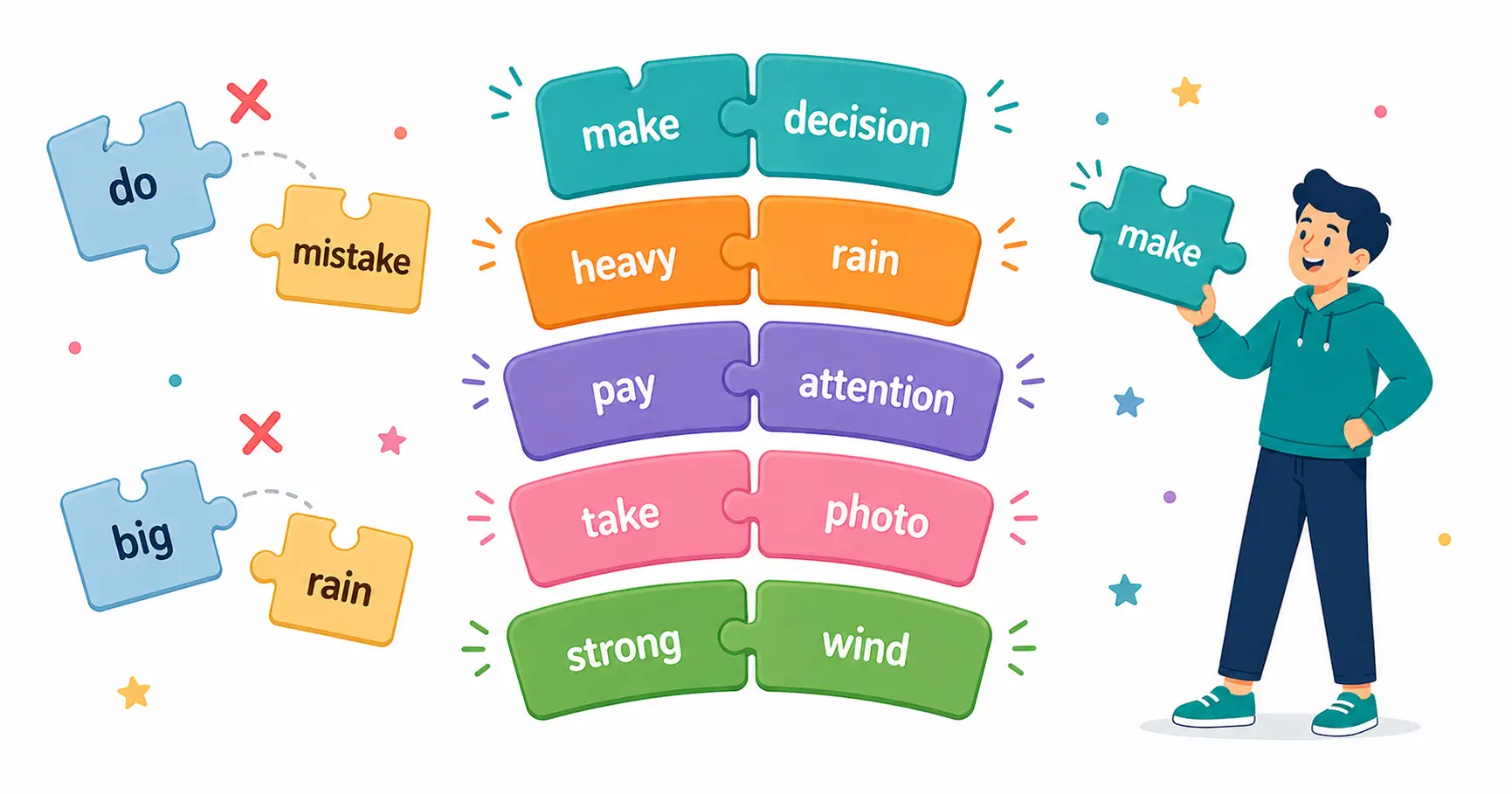
Kolokasi adalah pasangan atau kelompok kata yang secara alami dipakai bersama dalam bahasa Inggris. Penutur asli mengatakan “make a decision,” bukan “do a decision.” Mereka mengatakan “heavy rain,” bukan “strong rain,” dan “take a photo,” bukan “catch a photo.” Setiap katanya benar, tata bahasanya baik, tetapi kombinasinya salah dan segera menandai Anda bukan penutur asli.
Perbedaan antara pelajar B2 dan penutur C1 jarang terletak pada tata bahasa. Perbedaannya adalah kolokasi. Inilah keterampilan kosakata yang sering dilewatkan buku pelajaran dan aplikasi, padahal paling besar pengaruhnya terhadap seberapa alami bahasa Inggris Anda terdengar.
Panduan ini mencakup:
- apa itu kolokasi dan mengapa penting;
- enam jenis kolokasi dengan contoh jelas;
- 300+ kolokasi penting yang disusun menurut jenis;
- kesalahan kolokasi paling umum yang dibuat pelajar;
- cara belajar kolokasi dengan efektif.
Apa Itu Kolokasi?
Kolokasi adalah kombinasi kata yang sering muncul bersama dan terdengar alami bagi penutur asli. Kata ini berasal dari Latin: co- (bersama) + locare (menempatkan)—secara harfiah, “ditempatkan bersama.”
Ciri utamanya: kolokasi bukan aturan, melainkan kebiasaan. Tidak ada aturan tata bahasa yang menyatakan “heavy rain” benar dan “strong rain” salah. Kedua kata tersebut dapat berarti “banyak/kuat,” tetapi penutur Inggris memilih heavy untuk hujan dan selama berabad-abad kombinasi itu menjadi tetap. Anda harus mempelajarinya sebagai pasangan, bukan menebaknya dari logika.
| Alami (benar) | Tidak alami (salah) | Mengapa? |
|---|---|---|
| make a decision |
|
Bahasa Inggris memakai MAKE dengan “decision” |
| heavy rain |
|
“Heavy” berkolokasi dengan rain |
| take a photo |
|
Bahasa Inggris memakai TAKE dengan “photo” |
| fast food |
|
“Fast” adalah pewatas tetap untuk jenis makanan ini |
| pay attention |
|
Bahasa Inggris memakai PAY dengan “attention” |
| do homework |
|
Bahasa Inggris memakai DO dengan “homework” |
Mengapa Kolokasi Penting
1. Kolokasi membedakan penutur lancar dan penutur yang hanya akurat. Anda dapat 100% benar secara tata bahasa tetapi tetap terdengar tidak alami. Kolokasilah yang membuat perbedaan itu.
2. Kolokasi memengaruhi nilai ujian. Dalam IELTS, kriteria “Lexical Resource” secara khusus menilai akurasi kolokasi. Band 7 mensyaratkan “kesadaran akan gaya dan kolokasi.” Band 8 mensyaratkan “penggunaan terampil item leksikal yang tidak umum” dengan “hanya ketidakakuratan sesekali dalam pilihan kata dan kolokasi.”
3. Kolokasi mempercepat komunikasi. Saat memakai kolokasi benar, pendengar memproses ujaran Anda lebih cepat karena kombinasi katanya sesuai harapan. Kolokasi yang salah menimbulkan jeda kecil dalam pemahaman.
4. Kolokasi adalah dasar tulisan alami. Esai akademis, email bisnis, dan tulisan kreatif semuanya mengandalkan kolokasi baku. “Conduct research” terdengar profesional. “Do research” memadai. “Make research” terdengar salah.
Kolokasi vs. Idiom vs. Phrasal Verb
| Ciri | Kolokasi | Idiom | Phrasal verb |
|---|---|---|---|
| Makna | Dapat diprediksi dari bagiannya | Tidak harfiah | Tidak harfiah |
| Contoh | make a mistake | kick the bucket (= meninggal) | give up (= berhenti) |
| Tetap? | Semi-tetap (ada sedikit keluwesan) | Sepenuhnya tetap | Tetap |
| Dapat diterjemahkan? | Sering kali ya | Biasanya tidak | Biasanya tidak |
| Keterampilan utama | Mengetahui kata mana yang cocok | Mengetahui makna tersembunyi | Mengetahui makna baru |
Ada tumpang tindih: beberapa phrasal verb juga merupakan kolokasi (“take off” dalam “the plane took off”), dan beberapa idiom memuat kolokasi (“break the ice” memakai “break” + “ice”). Namun pembeda utamanya tetap: kolokasi membahas kata mana yang cocok bersama, idiom membahas makna tersembunyi.
Untuk rujukan idiom lengkap, baca Idiom Bahasa Inggris: 500+ Ungkapan Umum. Untuk phrasal verb, baca Phrasal Verb Bahasa Inggris: Panduan Lengkap.
Jenis Kolokasi
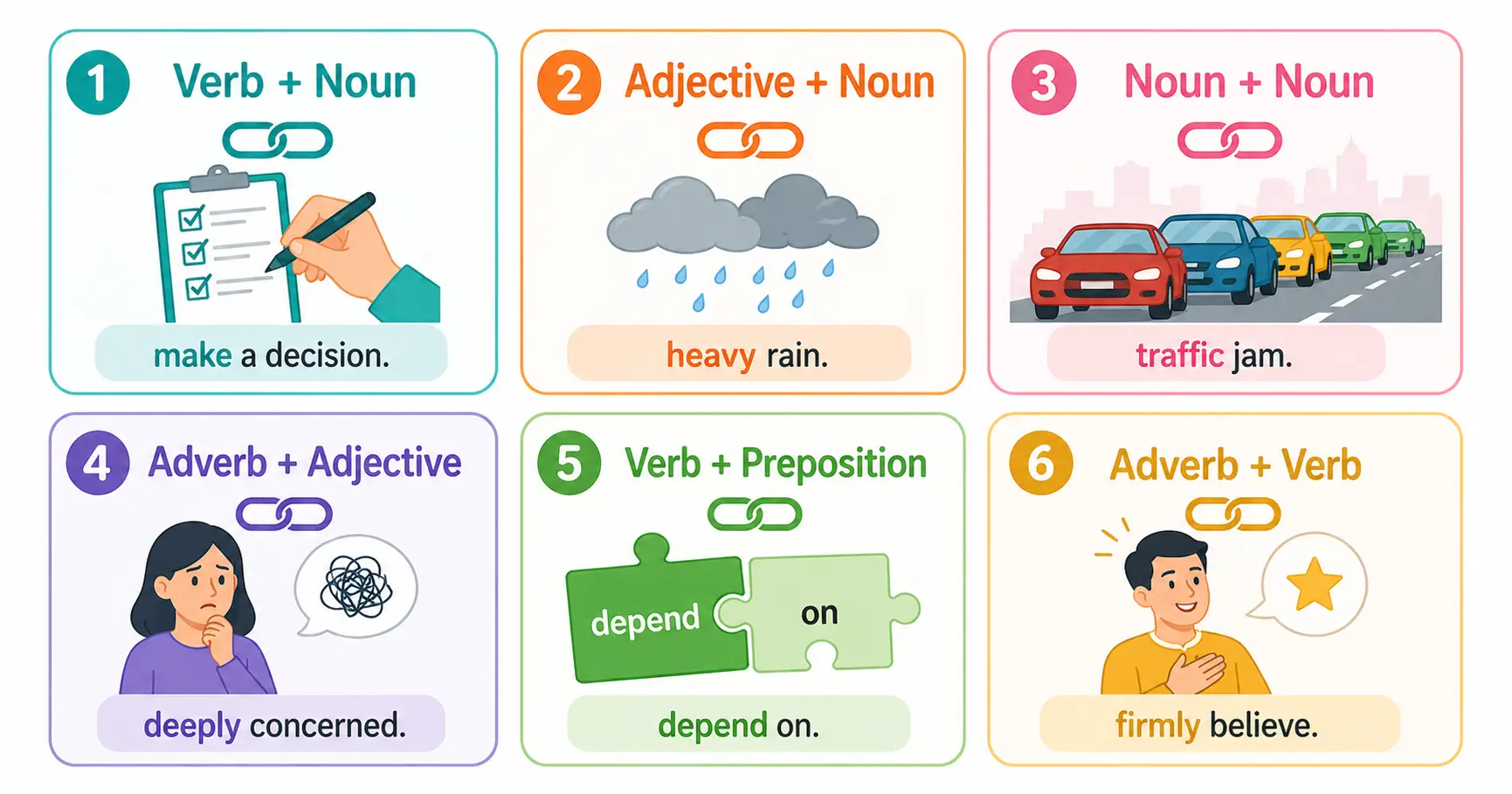
Kolokasi bahasa Inggris terbagi dalam enam jenis utama. Memahami jenisnya membantu Anda melihat pola dan belajar lebih cepat.
Jenis 1: Kata Kerja + Kata Benda
Jenis terpenting bagi pelajar. MAKE, DO, TAKE, GET, HAVE, PAY, GIVE, KEEP, BREAK, dan CATCH masing-masing memiliki puluhan pasangan kata benda tetap.
MAKE
| Kolokasi | Contoh |
|---|---|
| make a decision | We need to make a decision by Friday. |
| make a mistake | Everyone makes mistakes — the key is learning from them. |
| make progress | The students are making good progress this term. |
| make an effort | He didn’t even make an effort to arrive on time. |
| make money | She makes good money as a software engineer. |
| make a difference | Small changes can make a big difference over time. |
| make a plan | Let’s make a plan before we start the project. |
| make an appointment | I need to make an appointment with the dentist. |
| make a complaint | She made a formal complaint about the noise. |
| make a promise | He made a promise to his daughter and kept it. |
| make an impression | First impressions matter — make a good one. |
| make a choice | You have to make a choice between the two options. |
| make sense | That explanation doesn’t make sense to me. |
| make room | Can you make room for one more person? |
| make a living | It’s hard to make a living as a freelance writer. |
| make a suggestion | Can I make a suggestion? |
| make an exception | I’ll make an exception this time, but don’t be late again. |
| make arrangements | We need to make arrangements for the conference. |
DO
| Kolokasi | Contoh |
|---|---|
| do homework | Have you done your homework yet? |
| do the dishes | I’ll do the dishes after dinner. |
| do business (with) | We’ve been doing business with them for 10 years. |
| do research | She’s doing research on climate change. |
| do damage | The storm did significant damage to the coast. |
| do your best | Just do your best — that’s all anyone can ask. |
| do a favor | Could you do me a favor and check my email? |
| do the laundry | I need to do the laundry this weekend. |
| do a good job | She did a great job on the presentation. |
| do harm | The new policy may do more harm than good. |
| do exercise | I try to do some exercise every morning. |
| do an experiment | The students did an experiment to test the hypothesis. |
TAKE
| Kolokasi | Contoh |
|---|---|
| take a photo / picture | Can you take a photo of us? |
| take a break | Let’s take a 10-minute break. |
| take action | The government must take action to reduce pollution. |
| take a risk | Starting a business means taking risks. |
| take a look | Take a look at this report. |
| take a seat | Please take a seat — the doctor will see you shortly. |
| take notes | She always takes detailed notes in class. |
| take responsibility | He took responsibility for the error. |
| take advice | I should have taken your advice. |
| take a chance | I took a chance and applied for the job. |
| take care (of) | Take care of yourself while I’m away. |
| take turns | The children took turns playing with the toy. |
| take part (in) | Over 200 people took part in the marathon. |
| take place | The meeting will take place on Monday at 3 PM. |
| take time | Learning a language takes time. |
GET, HAVE, PAY, GIVE
| Kolokasi | Contoh |
|---|---|
| get permission | You need to get permission from the manager. |
| get a job | She got a job at a tech company after graduation. |
| get an idea | I’ve just got an idea for the project. |
| get the impression | I got the impression that he wasn’t happy. |
| have a meeting | We’re having a meeting at 2 PM. |
| have a conversation | Let’s have a conversation about your performance. |
| have an argument | They had an argument about money. |
| have a look | Have a look at this and tell me what you think. |
| have an effect (on) | Sleep has a huge effect on your concentration. |
| have access (to) | Students have access to the library 24/7. |
| pay attention | Pay attention — this will be on the exam. |
| pay a compliment | He paid her a compliment on her presentation. |
| pay a visit | I’ll pay you a visit when I’m in London. |
| give advice | She gave me some excellent advice. |
| give permission | The teacher gave them permission to leave early. |
| give a speech | The CEO gave a speech at the conference. |
| give priority (to) | We should give priority to urgent cases. |
KEEP, BREAK, CATCH, COME
| Kolokasi | Contoh |
|---|---|
| keep a secret | Can you keep a secret? |
| keep a promise | Always keep your promises. |
| keep in touch | Let’s keep in touch after you move. |
| keep a record | Keep a record of all your expenses. |
| keep calm | Keep calm — panicking won’t help. |
| break the law | If you break the law, you face consequences. |
| break a record | She broke the world record in the 100m sprint. |
| break the rules | He’s always breaking the rules at school. |
| break the news | I had to break the news to her about the layoffs. |
| break a habit | Breaking a bad habit takes about 66 days on average. |
| catch a cold | I caught a cold from someone at the office. |
| catch fire | The building caught fire due to faulty wiring. |
| catch someone’s attention | The headline caught my attention immediately. |
| come to a conclusion | After reviewing the data, we came to a conclusion. |
| come to an agreement | Both parties came to an agreement after long negotiations. |
Jenis 2: Kata Sifat + Kata Benda
Kolokasi ini menentukan kata sifat mana yang “cocok” dengan kata benda tertentu. Menguasainya adalah salah satu cara tercepat agar terdengar lebih alami.
| Kolokasi | BUKAN | Contoh |
|---|---|---|
| heavy rain |
|
There was heavy rain all weekend. |
| strong wind |
|
A strong wind blew the tent away. |
| heavy traffic |
|
We were stuck in heavy traffic for two hours. |
| fast food |
|
I try to avoid fast food as much as possible. |
| deep sleep |
|
She was in such a deep sleep that the alarm didn’t wake her. |
| high temperature |
|
The patient has a high temperature. |
| strong coffee |
|
I need a strong coffee this morning. |
| broad daylight |
|
The robbery happened in broad daylight. |
| close friend |
|
She’s one of my closest friends. |
| bitter cold |
|
We endured the bitter cold for three hours. |
| narrow escape |
|
We had a narrow escape — the car missed us by inches. |
| bright idea |
|
Whose bright idea was it to start at 5 AM? |
| keen interest |
|
She took a keen interest in the project. |
| blissful ignorance |
|
He lived in blissful ignorance of the company’s problems. |
| sharp increase |
|
There was a sharp increase in online sales. |
| slight problem |
|
There’s a slight problem with the schedule. |
| steady progress |
|
The team is making steady progress toward the deadline. |
| bitter disappointment |
|
The result was a bitter disappointment for the team. |
| golden opportunity |
|
This is a golden opportunity to expand the business. |
| overwhelming majority |
|
The overwhelming majority voted in favor. |
Jenis 3: Kata Benda + Kata Benda
Beberapa kata benda secara konvensional dipasangkan bersama.
| Kolokasi | Contoh |
|---|---|
| traffic jam | We were stuck in a traffic jam for an hour. |
| road rage | Road rage incidents have increased this year. |
| blood pressure | The doctor checked my blood pressure. |
| cell phone | I left my cell phone at home. |
| greenhouse effect | The greenhouse effect is causing global warming. |
| heart attack | He suffered a heart attack at the age of 52. |
| job satisfaction | Job satisfaction is more important than a high salary to many people. |
| budget cuts | The university announced major budget cuts. |
| career change | She made a career change at 40 and became a teacher. |
| human rights | The organization campaigns for human rights worldwide. |
| climate change | Climate change is the defining issue of our time. |
| time management | Good time management is essential for university success. |
| brain drain | Brain drain is a serious problem for developing countries. |
| birth rate | The birth rate has been declining in many European countries. |
| action plan | We need a clear action plan for the next quarter. |
Jenis 4: Kata Keterangan + Kata Sifat
Kolokasi ini mengintensifkan atau memodifikasi kata sifat dengan cara tertentu yang sudah tetap.
| Kolokasi | BUKAN | Contoh |
|---|---|---|
| highly unlikely |
|
It’s highly unlikely that the project will finish on time. |
| deeply concerned |
|
I am deeply concerned about the recent test results. |
| bitterly disappointed |
|
She was bitterly disappointed with the outcome. |
| perfectly natural |
|
It’s perfectly natural to feel nervous before an interview. |
| fully aware |
|
I’m fully aware of the risks involved. |
| utterly ridiculous |
|
The suggestion was utterly ridiculous. |
| wildly popular |
|
The show became wildly popular overnight. |
| painfully obvious |
|
It was painfully obvious that he hadn’t prepared. |
| blissfully unaware |
|
She was blissfully unaware of the chaos behind her. |
| seriously injured |
|
Three people were seriously injured in the accident. |
| heavily influenced |
|
Her work was heavily influenced by Japanese art. |
| vitally important |
|
It is vitally important to follow the safety procedures. |
| strictly forbidden |
|
Smoking is strictly forbidden inside the building. |
| widely recognized |
|
She is widely recognized as a leading expert in the field. |
Jenis 5: Kata Kerja + Preposisi
Ini bukan phrasal verb—kata kerjanya mempertahankan makna inti, tetapi harus memakai preposisi tertentu.
| Kolokasi | BUKAN | Contoh |
|---|---|---|
| depend on |
|
The outcome depends on several factors. |
| believe in |
|
Do you believe in life after death? |
| succeed in |
|
She succeeded in passing the bar exam on her first try. |
| apologize for |
|
He apologized for being late. |
| insist on |
|
She insisted on paying for dinner. |
| complain about |
|
He always complains about the weather. |
| concentrate on |
|
I need to concentrate on my work. |
| consist of |
|
The team consists of five members. |
| refer to |
|
Are you referring to the report I sent yesterday? |
| belong to |
|
This book belongs to the library. |
| respond to |
|
She hasn’t responded to my email yet. |
| participate in |
|
Over 500 students participated in the competition. |
| result in |
|
The accident resulted in two injuries. |
| suffer from |
|
He suffers from chronic back pain. |
| invest in |
|
The company invested heavily in new technology. |
Jenis 6: Kata Keterangan + Kata Kerja
Kolokasi ini menjelaskan cara suatu tindakan biasanya dilakukan.
| Kolokasi | Contoh |
|---|---|
| firmly believe | I firmly believe that education changes lives. |
| strongly recommend | I strongly recommend this book to all language learners. |
| deeply regret | We deeply regret the inconvenience caused. |
| fully understand | I fully understand your concerns. |
| flatly refuse | He flatly refused to answer the question. |
| greatly appreciate | I would greatly appreciate your help. |
| seriously consider | You should seriously consider the offer before declining. |
| wholeheartedly agree | I wholeheartedly agree with your proposal. |
| categorically deny | The company categorically denied the allegations. |
| vaguely remember | I vaguely remember meeting her at a party years ago. |
| thoroughly enjoy | We thoroughly enjoyed the concert last night. |
| totally disagree | I totally disagree with that assessment. |
| readily available | The information is readily available online. |
| carefully consider | The committee carefully considered all options. |
Kesalahan Kolokasi yang Umum
Kesalahan ini terus dibuat bahkan oleh pelajar tingkat menengah. Mempelajari versi yang benar akan segera memperbaiki bahasa Inggris Anda.
MAKE vs. DO
Ini adalah kesalahan kolokasi tunggal yang paling umum bagi penutur non-asli.
| Benar | Salah |
|---|---|
| make a decision |
|
| make a mistake |
|
| make money |
|
| make progress |
|
| make a suggestion |
|
| do homework |
|
| do research |
|
| do business |
|
| do a favor |
|
| do exercise |
|
Polanya: MAKE dipakai untuk menciptakan, menghasilkan, atau membangun sesuatu (make a plan, make a cake, make an effort). DO dipakai untuk melakukan aktivitas atau tugas (do the laundry, do work, do an experiment).
Kesalahan Kata Sifat + Kata Benda yang Umum
| Benar | Salah | Mengapa |
|---|---|---|
| heavy rain |
|
Dalam bahasa Inggris hujan itu “heavy” |
| strong wind |
|
Angin adalah “strong,” bukan “heavy” |
| fast food |
|
Gabungan tetap: “fast food” |
| high price |
|
Harga disebut “high” atau “low,” bukan expensive |
| big mistake |
|
Kesalahan adalah “big” (atau “huge”), bukan “large” |
| do/cause damage |
|
Damage itu “done” atau “caused” |
Kesalahan Kata Kerja + Kata Benda yang Umum
| Benar | Salah | Mengapa |
|---|---|---|
| take a photo |
|
Bahasa Inggris memakai TAKE, bukan MAKE |
| pay attention |
|
Kolokasi tetap dengan PAY |
| catch a cold |
|
“Catch” adalah kolokasi standar |
| break the law |
|
“Break” adalah kolokasi sehari-hari |
| tell a lie |
|
Kebohongan “told,” bukan “said” |
| tell the truth |
|
Pola sama: TELL, bukan SAY |
Kolokasi berdasarkan Tingkat
A2–B1 (Dasar hingga Menengah)
Ini kolokasi pertama yang perlu dipelajari karena terus muncul dalam percakapan sehari-hari:
make a mistake, do homework, take a photo, have a meeting, pay attention, give advice, keep a secret, break the rules, catch a cold, fast food, heavy rain, strong wind, make a decision, do your best, take a break, have fun, get a job, close friend, big deal, traffic jam
B2 (Menengah Atas)
Kolokasi ini muncul dalam konteks akademis, berita, dan komunikasi profesional:
make progress, do research, take action, have an effect, pay a compliment, give priority, keep in touch, break a record, come to a conclusion, sharp increase, steady progress, golden opportunity, bitter disappointment, highly unlikely, deeply concerned, firmly believe, strongly recommend, career change, time management, budget cuts
C1–C2 (Lanjut)
Kolokasi ini membedakan penutur yang nyaris setara penutur asli dari yang lain:
make an allegation, do justice (to), take precedence, have ramifications, pay dividends, give rise to, keep abreast (of), break new ground, come to fruition, stark contrast, vested interest, sweeping changes, heightened awareness, categorically deny, flatly refuse, wholly inadequate, bitterly divided, disproportionately affected, inextricably linked, mutually exclusive
Untuk panduan lengkap kolokasi tingkat lanjut, baca Kolokasi Bahasa Inggris Lanjut: Kombinasi Kata C1–C2.
Kolokasi untuk IELTS dan Tulisan Akademis
Jika Anda mempersiapkan IELTS, TOEFL, atau tulisan akademis, kolokasi ini penting. Kolokasi tersebut terus muncul dalam topik ujian dan bernilai tinggi pada kriteria “Lexical Resource.”
Kolokasi untuk Pembuka Esai
| Kolokasi | Contoh |
|---|---|
| raise a question | This trend raises the question of whether traditional education is still relevant. |
| a growing concern | Air pollution is a growing concern in major cities. |
| play a significant role | Technology plays a significant role in modern education. |
| draw attention to | The report draws attention to the widening gap between rich and poor. |
| a matter of debate | Whether zoos should exist remains a matter of debate. |
Kolokasi Sebab dan Akibat
| Kolokasi | Contoh |
|---|---|
| have a profound impact | Social media has had a profound impact on how we communicate. |
| lead to consequences | Deforestation can lead to devastating consequences for biodiversity. |
| pose a threat | Plastic waste poses a serious threat to marine ecosystems. |
| trigger a response | The crisis triggered an immediate government response. |
| face a challenge | Developing countries face unique challenges in combating climate change. |
Data dan Tren (IELTS Task 1)
| Kolokasi | Contoh |
|---|---|
| show a steady increase | The graph shows a steady increase in renewable energy adoption. |
| reach a peak | Unemployment reached a peak of 12% in 2009. |
| undergo a dramatic change | The industry underwent a dramatic change between 2015 and 2020. |
| remain relatively stable | Consumer spending remained relatively stable throughout the period. |
| account for a significant proportion | Asia accounted for a significant proportion of global exports. |
Untuk strategi kosakata IELTS yang menyeluruh, baca Panduan Kosakata IELTS Lengkap. Untuk kolokasi khusus ujian, baca Kolokasi untuk PTE dan IELTS.
Kosakata untuk Dilatih
Tambahkan 25 kata yang muncul dalam kolokasi penting ini ke kamus Linglify Anda untuk pengulangan berspasi.
affordable
adjektiva
terjangkau
Contoh
- The government is working to provide affordable housing for low-income families.
- This restaurant offers delicious and affordable meals for college students.
commute
verba
berkomuter, bepergian pulang-pergi
Contoh
- Public transportation helps people commute efficiently reducing traffic congestion.
- Workers commute daily between suburban homes and downtown offices.
conservation
nomina
pelestarian, konservasi
Contoh
- Water conservation becomes increasingly important during periods of severe drought.
- Wildlife conservation is essential for protecting endangered species from extinction.
demanding
adjektiva
berat, menuntut banyak tenaga
Contoh
- Medical school is very demanding and requires years of intensive study.
- She has a demanding boss who expects perfection in all tasks.
DJ
nomina
disjoki
Contoh
- The DJ played my favorite song.
- The DJ took song requests all night.
heritage
nomina
warisan budaya
Contoh
- She inherited a rich heritage of family traditions from her grandparents.
- The ancient castle is an important part of our cultural heritage.
leisure
nomina
waktu luang
Contoh
- People enjoy various leisure activities during weekends and holidays.
- Reading books is popular leisure pursuit for many educated people.
luxurious
adjektiva
mewah
Contoh
- She dreams of owning luxurious car with leather seats and sunroof.
- The luxurious hotel suite includes marble bathroom and ocean view.
memorable
adjektiva
berkesan
Contoh
- Graduation day was memorable occasion for entire family.
- The memorable speech inspired students to pursue their dreams.
nutritious
adjektiva
bergizi
Contoh
- Fresh vegetables are nutritious and support overall health.
- Nutritious breakfast provides energy for productive school day.
passionate
adjektiva
penuh semangat, bergairah
Contoh
- Passionate speech moves audience to take action.
- Passionate teacher inspires students to learn more.
pollution
nomina
polusi, pencemaran
Contoh
- Air pollution affects public health in cities.
- Ocean pollution threatens marine life worldwide.
privacy
nomina
privasi, hak privasi
Contoh
- Hotel guests expect privacy during their stay.
- Internet privacy becomes increasingly important issue nowadays.
scenic
adjektiva
indah, berpanorama indah
Contoh
- Scenic overlook provides perfect spot for photographs.
- Scenic route takes longer but offers beautiful.
traditional
adjektiva
tradisional
Contoh
- Traditional cooking methods preserve authentic flavors perfectly.
- Traditional music reflects cultural history and values.
uneven
adjektiva
tidak rata
Contoh
- Uneven ground makes walking difficult and dangerous.
- Uneven performance shows inconsistent skill level development.
volunteer
verba
menjadi relawan, menawarkan diri
Contoh
- Citizens volunteer time for community improvement projects.
- Students volunteer at local charity organizations regularly.
substantially
adverbia
secara signifikan, secara substansial
Contoh
- Her performance substantially improved after additional training and practice.
- Prices have increased substantially over the past few months.
liaison
nomina
hubungan kerja, jalur komunikasi
Contoh
- Military liaison officers coordinate operations between allied forces.
- She serves as liaison between different departments.
sustainable
adjektiva
berkelanjutan
Contoh
- Company implements sustainable business model for long-term success.
- Sustainable farming practices protect soil and water resources.
acclaimed
adjektiva
dipuji, diakui
Contoh
- His performance was acclaimed by critics.
- The acclaimed author received many awards for her novel.
cancellation
nomina
pembatalan
Contoh
- Due to weather, the flight cancellation was inevitable.
- The concert's cancellation disappointed many fans.
discretion
nomina
kebijaksanaan, pertimbangan
Contoh
- He exercised discretion in his decisions.
- Use your discretion when sharing information.
indication
nomina
indikasi, tanda
Contoh
- The indication of his illness was clear after the tests.
- There was no indication that she was unhappy.
serenity
nomina
ketenangan, kedamaian
Contoh
- She maintained her serenity despite the chaos.
- The serenity of the lake was calming.
Cara Belajar Kolokasi
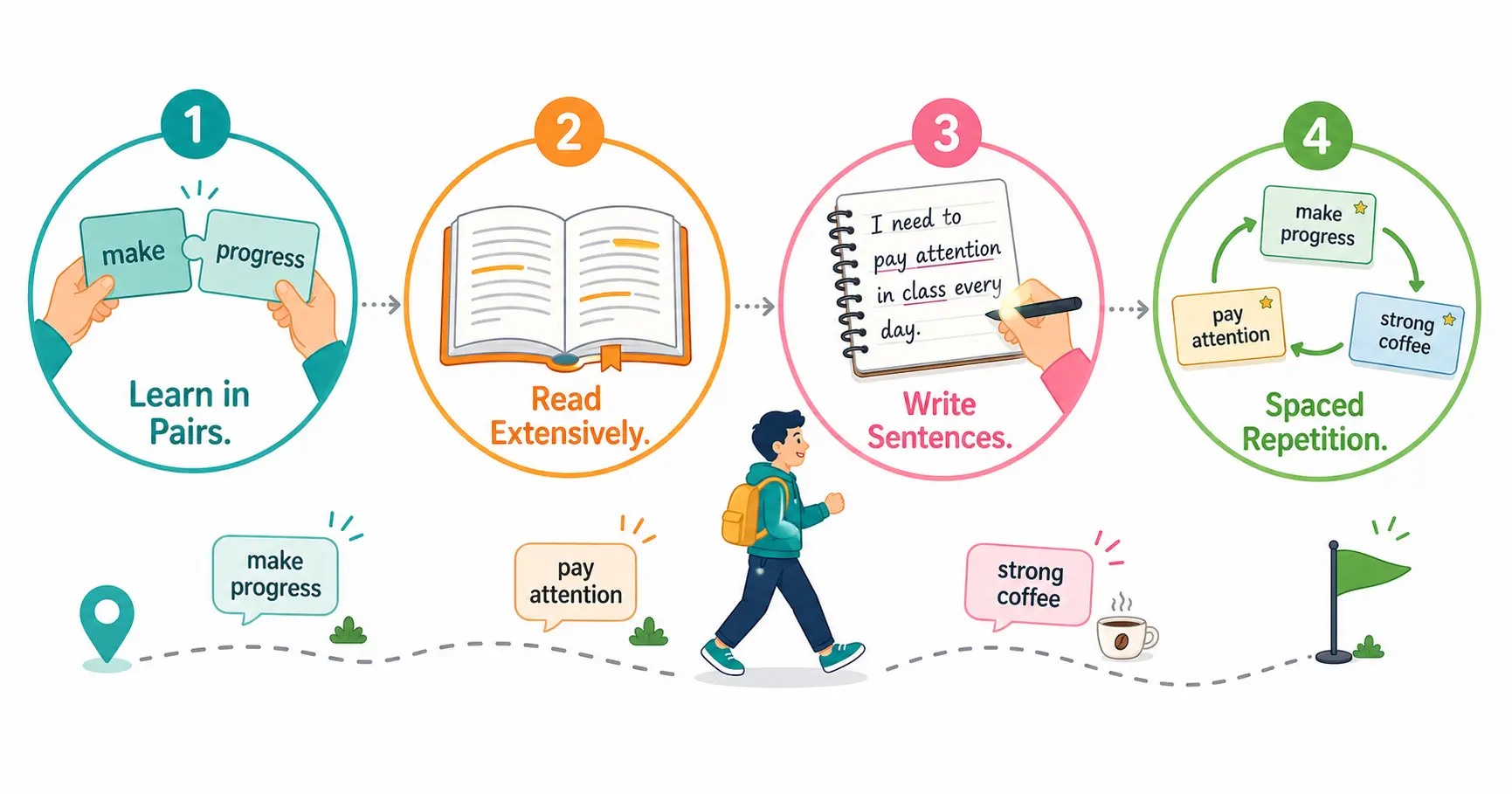
1. Pelajari kata sebagai pasangan, bukan sendirian
Jangan pernah mempelajari kata secara terpisah. Saat belajar “decision,” langsung pelajari “make a decision.” Saat belajar “rain,” pelajari “heavy rain.” Buku catatan kosakata Anda seharusnya memiliki dua kolom: kata dan kolokasi paling umumnya.
2. Banyak membaca
Kolokasi lebih banyak diserap melalui paparan daripada hafalan. Bacalah artikel dari Economist, BBC, Guardian, dan jurnal akademis. Saat melihat kombinasi kata yang terdengar alami, catatlah. Lama-kelamaan, kolokasi yang tepat akan mulai “terasa benar” meskipun Anda tidak dapat menjelaskan alasannya.
3. Gunakan kamus kolokasi
Oxford Collocations Dictionary for Students of English adalah sumber khusus terbaik. Untuk kata mana pun yang dicari, kamus ini menunjukkan setiap kolokasi umum berdasarkan jenis (verba+, adjektiva+, nomina+, dan sebagainya). Alat daring seperti Ozdic.com menawarkan pencarian kolokasi gratis.
4. Belajar dari kesalahan
Ketika penutur asli atau guru mengoreksi pilihan kata Anda—“Kami mengatakan ‘heavy rain,’ bukan ‘strong rain’”—catat kolokasi yang benar. Kesalahan yang Anda sadari dan perbaiki melekat jauh lebih lama daripada kolokasi yang dibaca secara pasif.
5. Gunakan pengulangan berspasi
Tambahkan kolokasi ke Linglify atau sistem pengulangan berspasi lainnya. Pelajari sebagai unit lengkap: “make + decision” dalam satu kartu, bukan “make” dan “decision” secara terpisah. Untuk pendekatan hafalan berbasis sains, baca Cara Menghafal Kosakata.
6. Berlatih dengan membangun kalimat
Untuk setiap kolokasi baru, tulislah tiga kalimat dalam konteks berbeda. “Heavy rain” → (1) “We cancelled the picnic due to heavy rain.” (2) “Heavy rain is expected throughout the week.” (3) “The heavy rain caused flooding in low-lying areas.” Ini membangun keluwesan, bukan sekadar pengenalan.
Bacaan Selanjutnya
Panduan pilar ini memberi kerangka lengkap untuk memahami kolokasi. Berikut panduan pendalaman sesuai kebutuhan:
Menurut tingkat:
- Kolokasi Bahasa Inggris dalam Pemakaian: Kombinasi Penting berdasarkan Tingkat—kolokasi dari A2 hingga C2;
- Kolokasi Bahasa Inggris Lanjut: Kombinasi Kata C1–C2—untuk pelajar menengah atas dan lanjut.
Menurut jenis:
- Kolokasi berdasarkan Jenis: Kata Sifat+Kata Benda, Kata Kerja+Kata Benda, dan Lainnya — pendalaman setiap kategori kolokasi.
Untuk ujian:
- Kolokasi untuk PTE dan IELTS: Daftar Kolokasi Ujian—kolokasi khusus ujian yang meningkatkan nilai Lexical Resource;
- Kosakata IELTS Writing Task 1—kolokasi deskripsi data untuk Task 1;
- Kosakata IELTS Writing Task 2—kolokasi esai untuk Task 2.
Kosakata terkait:
- Idiom Bahasa Inggris: 500+ Ungkapan Umum—ungkapan tetap dengan arti kiasan;
- Phrasal Verb Bahasa Inggris: Panduan Lengkap—kombinasi kata kerja + partikel;
- Cara Meningkatkan Kosakata—strategi lengkap membangun kosakata;
- Kata Bahasa Inggris Lanjut: 300+ Kosakata C1–C2—kata tunggal yang berpasangan dengan kolokasi ini.
FAQ
Apa itu kolokasi dalam kata sederhana?
Kolokasi adalah dua kata atau lebih yang secara alami digunakan bersama dalam bahasa Inggris. “Make a decision” adalah kolokasi karena penutur Inggris selalu mengatakan “make” dengan “decision,” bukan “do a decision” atau “take a decision.” Kolokasi adalah kemitraan kata: kata tertentu memang cocok bersama, dan menggunakan pasangan salah terdengar tidak alami meskipun tata bahasanya benar.
Ada berapa banyak kolokasi dalam bahasa Inggris?
Puluhan ribu. Setiap kata benda umum mempunyai beberapa kolokasi kata kerja, sifat, dan keterangan. Oxford Collocations Dictionary mencantumkan lebih dari 150.000 kolokasi untuk 9.000 kata utama. Untuk kelancaran praktis, mempelajari kolokasi dari 2.000 kata bahasa Inggris yang paling umum mencakup sebagian besar kebutuhan hidup sehari-hari dan ujian.
Apa beda kolokasi dan kata majemuk?
Kata majemuk adalah unit tetap yang berfungsi sebagai satu kata: “traffic jam,” “greenhouse,” “cell phone.” Kolokasi adalah kemitraan kata yang lebih longgar: “heavy rain,” “make a decision,” “strongly recommend.” Banyak kata benda majemuk bermula sebagai kolokasi yang menjadi sangat tetap hingga menyatu sebagai satu konsep. Secara praktis, kata majemuk ada dalam kamus sebagai entri tunggal; kolokasi ditemukan di kamus kolokasi atau dipelajari melalui paparan.
Apakah kolokasi berbeda antara bahasa Inggris Britania dan Amerika?
Kebanyakan kolokasi sama pada kedua ragam. Namun, beberapa berbeda: orang Amerika mengatakan “take a shower” sedangkan sebagian penutur Britania mengatakan “have a shower.” Amerika memakai “do the math” dan Britania memakai “do the maths.” Perbedaan ini kecil dan kedua bentuk dipahami luas. Untuk IELTS dan TOEFL, kedua ragam diterima.
Seberapa penting kolokasi untuk IELTS?
Sangat penting. IELTS Band Descriptors untuk Lexical Resource menyebut kolokasi pada setiap tingkat band. Band 6 memakai “some less common items despite some inaccuracy.” Band 7 menunjukkan “awareness of style and collocation.” Band 8 memakai “uncommon lexical items” dengan “skilful use of collocation.” Dalam praktiknya, kolokasi tepat adalah salah satu cara tercepat naik dari Band 6,5 ke Band 7+.
Apa cara terbaik belajar kolokasi?
Pelajari sebagai pasangan (jangan belajar “decision” tanpa “make a decision”), banyak membaca dalam bahasa Inggris (kolokasi diserap melalui paparan), gunakan kamus kolokasi (Oxford Collocations Dictionary adalah standar emas), dan belajar dengan pengulangan berspasi. Inti pentingnya: kolokasi tidak dapat diturunkan dari aturan tata bahasa—kolokasi perlu ditemui, disadari, dan dilatih.
Dapatkah saya memakai tesaurus untuk mencari kolokasi?
Tidak. Tesaurus memberi sinonim (“big” → “large,” “huge,” “massive”), tetapi tidak memberi tahu sinonim mana yang cocok dengan kata benda tertentu. Tesaurus dapat menyatakan “big” dan “strong” sama-sama penguat, tetapi tidak akan memberi tahu bahwa hujan adalah “heavy” (bukan “big” atau “strong”) dan angin adalah “strong” (bukan “heavy” atau “big”). Gunakan kamus kolokasi khusus sebagai gantinya.