
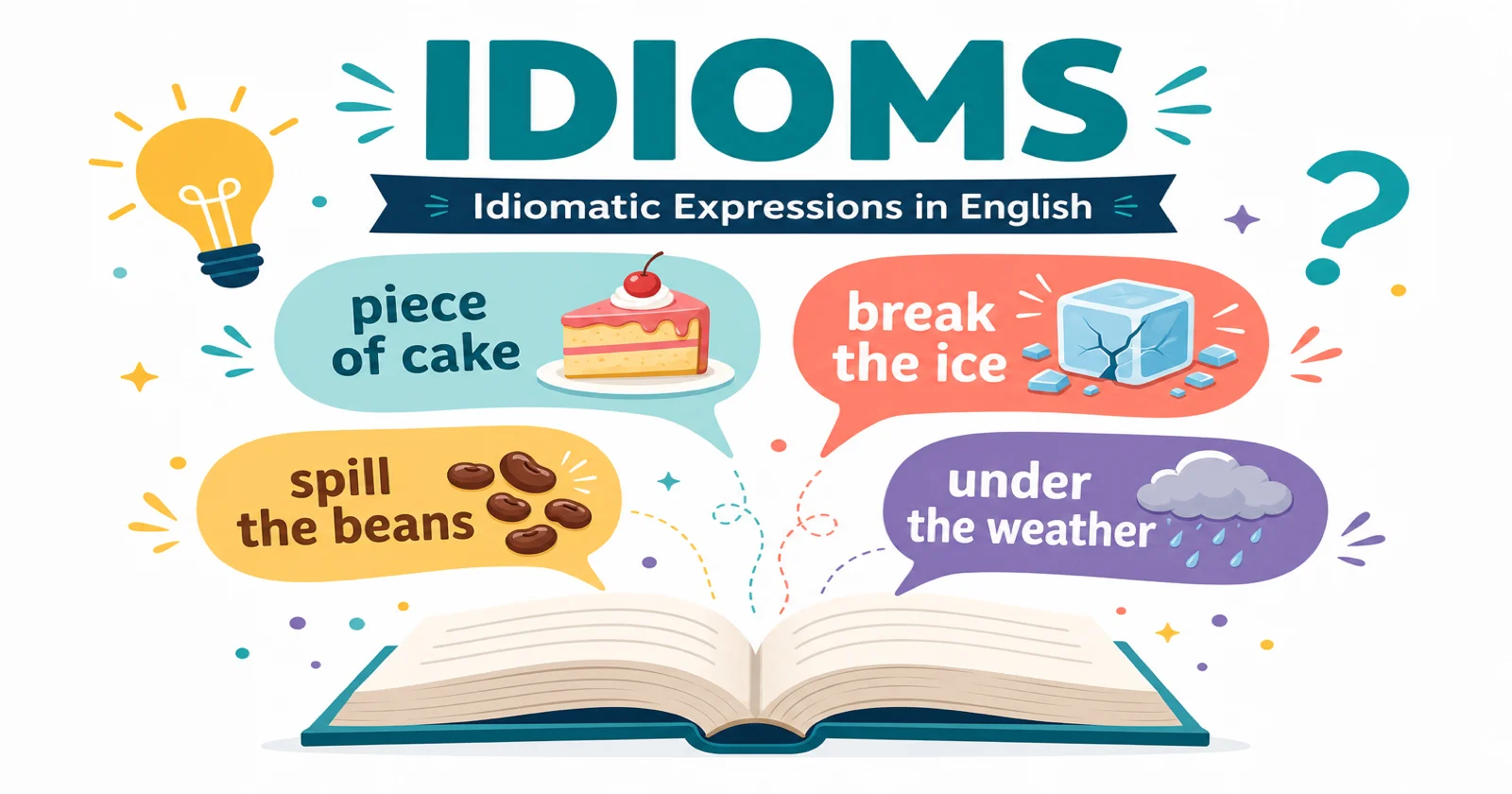
Ungkapan Idiomatis dalam Bahasa Inggris: Apa Artinya dan Cara Menggunakannya
Anda dapat mengetahui setiap kata dalam “She let the cat out of the bag” tetapi tetap tidak tahu arti kalimat itu. Penyebabnya adalah kalimat tersebut merupakan ungkapan idiomatis—frasa yang maknanya tidak dapat dipahami dari kata-kata penyusunnya. Kalimat ini tidak berhubungan dengan kucing atau tas. Artinya “dia membocorkan rahasia.”
Ungkapan idiomatis ada di mana-mana dalam bahasa Inggris. Penutur asli menggunakannya dalam setiap percakapan, email, rapat, dan pesan teks—sering kali tanpa menyadarinya. Bagi pelajar, ini menciptakan kesenjangan yang membuat frustrasi: tata bahasa Anda benar, kosakata Anda kuat, tetapi separuh hal yang dikatakan orang tampaknya tidak masuk akal.
Panduan ini menjelaskan apa sebenarnya ungkapan idiomatis, cara kerjanya, jenis-jenisnya, dan—yang paling penting—cara mempelajari serta menggunakannya. Panduan ini mencakup 100+ contoh yang disusun berdasarkan jenis dan topik, dengan arti yang jelas serta kalimat alami.
- Yang akan dipelajari: definisi, jenis, dan struktur ungkapan idiomatis
- Contoh yang disertakan: 100+ ungkapan idiomatis beserta arti
- Level: B1–C1
- Untuk: memahami bahasa Inggris alami, persiapan ujian, kefasihan percakapan
Untuk daftar lengkap 500+ idiom bahasa Inggris, lihat Idiom Bahasa Inggris: 500+ Ungkapan Umum.
Apa Itu Ungkapan Idiomatis?
Ungkapan idiomatis (juga disebut idiom) adalah frasa atau kalimat yang maknanya berbeda dari makna harfiah kata-kata penyusunnya.
| Ungkapan | Makna Harfiah | Makna Sebenarnya (Idiomatis) |
|---|---|---|
| break the ice | memecahkan es secara fisik | memulai percakapan dalam situasi canggung |
| hit the nail on the head | memukul paku dengan palu | mengatakan sesuatu dengan tepat sekali |
| under the weather | berada di bawah cuaca | merasa sakit |
| piece of cake | sepotong kue | sesuatu yang sangat mudah |
| cost an arm and a leg | kehilangan bagian tubuh sebagai pembayaran | sangat mahal |
Ciri utamanya: Anda tidak dapat menebak maknanya dari kata-katanya. Jika seseorang berkata “It’s a piece of cake,” ia tidak membicarakan makanan penutup. Jika seseorang berkata “He kicked the bucket,” ia tidak membicarakan menendang sesuatu—artinya ia meninggal.
Inilah yang membedakan idiom dari jenis frasa lain. Frasa seperti “heavy rain” memakai “heavy” secara metaforis, tetapi Anda masih dapat menebak artinya. Pada idiom, menebak dari kata-katanya tidak mungkin.
Bahasa Idiomatis vs. Bahasa Harfiah
| Ciri | Bahasa Harfiah | Bahasa Idiomatis |
|---|---|---|
| Makna | sesuai dengan kata-katanya | berbeda dari kata-katanya |
| Dapat diprediksi? | ya | tidak |
| Dapat diterjemahkan? | kata demi kata | harus menerjemahkan maknanya |
| Contoh | “She closed the door” | “She let the cat out of the bag” |
Mengapa Ungkapan Idiomatis Ada?
Setiap bahasa memiliki idiom. Idiom berkembang secara alami selama berabad-abad karena beberapa alasan:
1. Efisiensi. “He kicked the bucket” lebih pendek dan lebih hidup daripada “He died.” Idiom memadatkan gagasan rumit menjadi frasa singkat.
2. Pengalaman budaya bersama. Banyak idiom berasal dari kegiatan sejarah tertentu—bertani (“separate the wheat from the chaff”), berlayar (“learn the ropes”), olahraga (“move the goalposts”), atau perang (“bury the hatchet”). Konteks asalnya memudar, tetapi ungkapannya bertahan.
3. Warna emosional. “I’m a bit tired” bersifat netral. “I’m running on empty” melukiskan gambaran. Idiom menambah kedalaman emosional dan kepribadian pada bahasa.
4. Ikatan sosial. Menggunakan idiom menandakan bahwa Anda termasuk dalam komunitas tutur. Ketika rekan berkata “Let’s not reinvent the wheel,” semua orang yang mengenal idiom itu merasa terhubung. Idiom adalah kata sandi budaya.
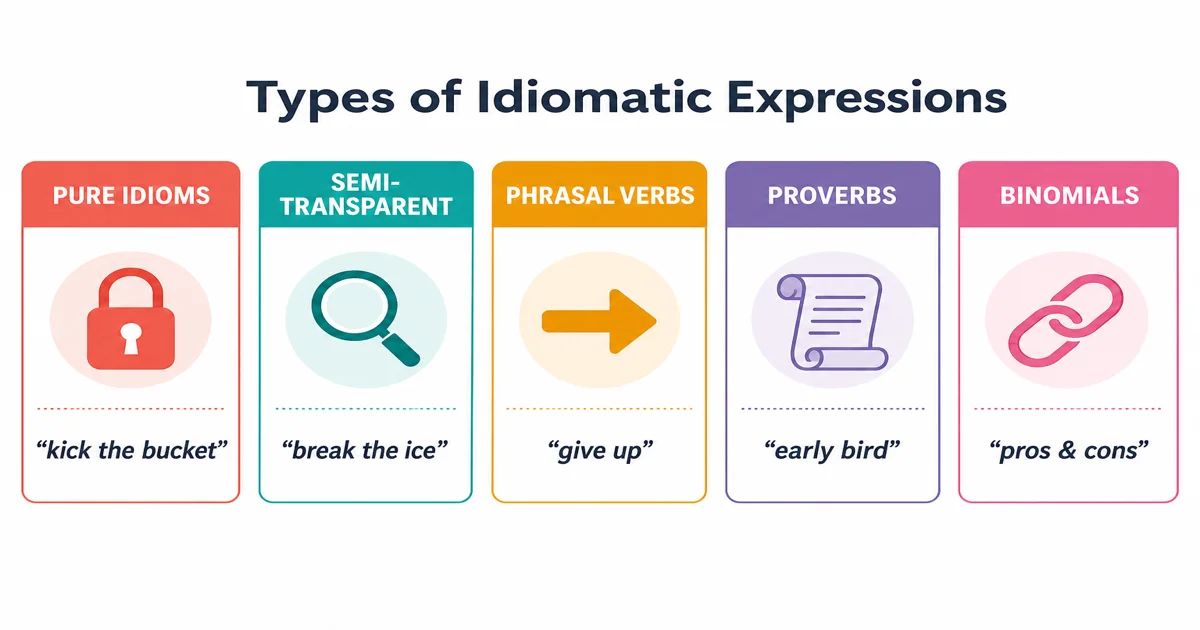
Jenis Ungkapan Idiomatis
Tidak semua idiom bekerja dengan cara yang sama. Memahami jenis yang berbeda membantu Anda mengenali dan mempelajarinya dengan lebih efisien.
1. Idiom Murni (Tidak Transparan)
Maknanya tidak memiliki hubungan dengan kata-kata harfiahnya. Anda sama sekali tidak dapat menebak maknanya.
| Idiom | Arti |
|---|---|
| kick the bucket | meninggal |
| spill the beans | membocorkan rahasia |
| bite the bullet | menanggung sesuatu yang menyakitkan |
| break a leg | semoga beruntung |
| by the skin of your teeth | nyaris; tepat waktu |
| once in a blue moon | sangat jarang |
| the whole nine yards | semuanya; jumlah lengkap |
| fly off the handle | tiba-tiba menjadi marah |
Ini paling sulit dipelajari karena tidak ada jembatan logis antara kata dan makna. Anda harus menghafalnya.
2. Idiom Semi-Transparan
Maknanya sebagian dapat ditebak dari kata-katanya. Ada hubungan metaforis, tetapi tidak jelas.
| Idiom | Arti | Mengapa Semi-Transparan |
|---|---|---|
| break the ice | memulai percakapan | es = dingin/kecanggungan sosial |
| see eye to eye | sepakat sepenuhnya | mata bertemu = pemahaman bersama |
| burn bridges | merusak hubungan secara permanen | jembatan = koneksi |
| light at the end of the tunnel | harapan setelah kesulitan | terowongan = masa gelap |
| turn over a new leaf | memulai ulang | leaf = halaman buku |
| let sleeping dogs lie | jangan mengusik situasi yang tenang | sleeping = damai |
| hit the nail on the head | mengatakan sesuatu dengan tepat sekali | nail = titik sasaran |
| beat around the bush | menghindari topik utama | bush = inti persoalan |
Ini lebih mudah diingat karena metaforanya memberi Anda kait mental.
3. Idiom Phrasal Verb
Banyak phrasal verb bersifat idiomatis—maknanya tidak dapat ditebak dari kombinasi kata kerja + partikel.
| Phrasal Verb | Arti |
|---|---|
| give up | berhenti mencoba |
| look up to | mengagumi dan menghormati |
| put up with | menoleransi |
| get away with | lolos dari hukuman |
| run into | bertemu secara tak terduga |
| come across | menemukan secara kebetulan |
| bring up | menyebutkan topik; membesarkan anak |
| figure out | memahami setelah berpikir |
Untuk pembahasan mendalam tentang phrasal verb, lihat Phrasal Verbs dengan GET dan Phrasal Verbs Bahasa Inggris: Panduan Lengkap.
4. Peribahasa dan Pepatah
Peribahasa adalah kalimat lengkap yang menyatakan kebenaran umum atau nasihat. Banyak di antaranya bersifat idiomatis.
| Peribahasa | Arti |
|---|---|
| Don’t put all your eggs in one basket. | Jangan mempertaruhkan semuanya pada satu rencana. |
| The early bird catches the worm. | Keberhasilan datang kepada mereka yang bertindak lebih dahulu. |
| Every cloud has a silver lining. | Sesuatu yang baik dapat muncul dari situasi buruk. |
| Don’t count your chickens before they hatch. | Jangan menganggap keberhasilan sebelum itu terjadi. |
| Actions speak louder than words. | Apa yang Anda lakukan lebih penting daripada yang Anda katakan. |
| When in Rome, do as the Romans do. | Menyesuaikan diri dengan kebiasaan setempat. |
| The grass is always greener on the other side. | Situasi lain selalu tampak lebih baik. |
| You can’t judge a book by its cover. | Penampilan dapat menipu. |
5. Idiom Binomial (Pasangan)
Dua kata yang dihubungkan oleh “and” atau “or” dalam urutan tetap.
| Binomial | Arti |
|---|---|
| pros and cons | kelebihan dan kekurangan |
| give and take | kompromi timbal balik |
| now and then | kadang-kadang |
| sick and tired | benar-benar muak |
| odds and ends | aneka barang kecil |
| by and large | secara umum; sebagian besar |
| sooner or later | pada akhirnya |
| more or less | kira-kira |
Urutan katanya tetap: “pros and cons” benar; “cons and pros” terdengar salah.
100 Ungkapan Idiomatis Penting Berdasarkan Topik
Kehidupan Sehari-hari
| # | Ungkapan | Arti | Contoh |
|---|---|---|---|
| 1 | a piece of cake | sangat mudah | The test was a piece of cake. |
| 2 | break the ice | memulai percakapan | He told a joke to break the ice. |
| 3 | call it a day | berhenti bekerja | We’ve done enough — let’s call it a day. |
| 4 | get out of hand | menjadi tidak terkendali | The party got out of hand quickly. |
| 5 | in the long run | dalam jangka waktu panjang | Exercise pays off in the long run. |
| 6 | on the same page | sepakat | Let’s make sure we’re all on the same page. |
| 7 | the last straw | masalah terakhir yang memicu reaksi | His late arrival was the last straw. |
| 8 | at the end of the day | pada akhirnya | At the end of the day, family matters most. |
| 9 | give it a shot | mencoba | I’ve never done it, but I’ll give it a shot. |
| 10 | no-brainer | keputusan yang mudah | Accepting the scholarship was a no-brainer. |
Keberhasilan dan Kegagalan
| # | Ungkapan | Arti | Contoh |
|---|---|---|---|
| 11 | hit the nail on the head | tepat sekali | You hit the nail on the head with that analysis. |
| 12 | back to square one | memulai lagi | The plan failed, so we’re back to square one. |
| 13 | cut corners | melakukan sesuatu dengan murah atau tidak semestinya | They cut corners on safety to save money. |
| 14 | go the extra mile | berusaha lebih dari yang diwajibkan | She always goes the extra mile for her clients. |
| 15 | miss the boat | melewatkan kesempatan | If you don’t apply now, you’ll miss the boat. |
| 16 | the ball is in your court | ini keputusan/giliran Anda | I’ve made my offer — the ball is in your court. |
| 17 | learn the ropes | mempelajari dasar-dasar pekerjaan | It took a month to learn the ropes. |
| 18 | throw in the towel | menyerah | After three failed attempts, he threw in the towel. |
| 19 | up in the air | tidak pasti, belum diputuskan | Our vacation plans are still up in the air. |
| 20 | ahead of the curve | lebih maju daripada yang lain | Their technology is ahead of the curve. |
Uang dan Bisnis
| # | Ungkapan | Arti | Contoh |
|---|---|---|---|
| 21 | cost an arm and a leg | sangat mahal | The repair cost an arm and a leg. |
| 22 | break the bank | terlalu mahal | A weekend trip doesn’t have to break the bank. |
| 23 | make ends meet | memiliki uang yang hanya cukup | It’s hard to make ends meet on minimum wage. |
| 24 | penny for your thoughts | apa yang sedang Anda pikirkan? | You look worried — penny for your thoughts? |
| 25 | get the ball rolling | memulai suatu proses | Let’s get the ball rolling on this project. |
| 26 | in the red | berutang, merugi | The company has been in the red for two quarters. |
| 27 | bring to the table | berkontribusi | What skills do you bring to the table? |
| 28 | think outside the box | berpikir kreatif | We need to think outside the box to solve this. |
| 29 | the bottom line | pokok terpenting | The bottom line is we need more revenue. |
| 30 | a ballpark figure | perkiraan kasar | Give me a ballpark figure for the project cost. |
Emosi dan Perasaan
| # | Ungkapan | Arti | Contoh |
|---|---|---|---|
| 31 | on cloud nine | sangat bahagia | She’s been on cloud nine since the proposal. |
| 32 | under the weather | merasa sakit | I’m feeling under the weather today. |
| 33 | over the moon | sangat bahagia | They were over the moon about the baby. |
| 34 | down in the dumps | sedih, murung | He’s been down in the dumps since the breakup. |
| 35 | butterflies in my stomach | kegembiraan yang gugup | I always get butterflies before a presentation. |
| 36 | blow off steam | melepaskan stres atau kemarahan | I go for a run to blow off steam. |
| 37 | keep a stiff upper lip | tetap tenang di bawah tekanan | The British are famous for keeping a stiff upper lip. |
| 38 | lose your cool | menjadi marah atau kesal | Try not to lose your cool during the interview. |
| 39 | get cold feet | menjadi gugup sebelum acara besar | He got cold feet before the wedding. |
| 40 | have a heart of gold | sangat baik dan dermawan | Despite her tough exterior, she has a heart of gold. |
Komunikasi
| # | Ungkapan | Arti | Contoh |
|---|---|---|---|
| 41 | beat around the bush | menghindari topik utama | Stop beating around the bush and tell me the truth. |
| 42 | spill the beans | membocorkan rahasia | Someone spilled the beans about the surprise party. |
| 43 | get straight to the point | membicarakan isu utama secara langsung | I’ll get straight to the point — we need to cut costs. |
| 44 | speak your mind | mengatakan apa yang benar-benar Anda pikirkan | She’s not afraid to speak her mind. |
| 45 | read between the lines | memahami makna tersembunyi | You have to read between the lines of his email. |
| 46 | keep someone in the loop | memberi informasi kepada seseorang secara teratur | Please keep me in the loop on any developments. |
| 47 | ring a bell | terdengar familier | The name rings a bell, but I can’t place it. |
| 48 | word of mouth | informasi yang menyebar melalui percakapan | The restaurant became famous through word of mouth. |
| 49 | take with a grain of salt | jangan percaya semuanya | Take his claims with a grain of salt. |
| 50 | cut to the chase | langsung ke pokok persoalan | Let’s cut to the chase — what do you want? |
Hubungan
| # | Ungkapan | Arti | Contoh |
|---|---|---|---|
| 51 | see eye to eye | sepakat sepenuhnya | We don’t always see eye to eye on politics. |
| 52 | get along like a house on fire | langsung menjadi akrab | They got along like a house on fire. |
| 53 | stab in the back | mengkhianati seseorang | I can’t believe he stabbed me in the back. |
| 54 | give someone the cold shoulder | sengaja mengabaikan seseorang | She gave him the cold shoulder after the argument. |
| 55 | bend over backwards | berusaha sangat keras untuk membantu | She bent over backwards to make us comfortable. |
| 56 | bury the hatchet | berdamai, mengakhiri konflik | It’s time to bury the hatchet and move on. |
| 57 | a shoulder to cry on | seseorang yang mendengarkan masalah Anda | She’s always been a shoulder to cry on. |
| 58 | give someone the benefit of the doubt | mempercayai seseorang meski ada ketidakpastian | I’ll give him the benefit of the doubt this time. |
| 59 | hit it off | langsung akrab | We hit it off on our first date. |
| 60 | two-faced | tidak tulus, munafik | She’s two-faced — nice to you, then talks behind your back. |
Waktu
| # | Ungkapan | Arti | Contoh |
|---|---|---|---|
| 61 | in the nick of time | nyaris tepat waktu | We arrived at the airport in the nick of time. |
| 62 | once in a blue moon | sangat jarang | I only eat fast food once in a blue moon. |
| 63 | around the clock | 24 jam sehari | The team worked around the clock to finish. |
| 64 | at the eleventh hour | pada saat terakhir yang mungkin | The deal was saved at the eleventh hour. |
| 65 | time flies | waktu berlalu cepat | Time flies when you’re having fun. |
| 66 | kill time | melakukan sesuatu sambil menunggu | I killed time by reading a magazine. |
| 67 | behind the times | ketinggalan zaman | His management style is behind the times. |
| 68 | stand the test of time | tetap relevan atau efektif | Their friendship has stood the test of time. |
| 69 | ahead of time | lebih awal daripada yang diharapkan | She finished the project ahead of time. |
| 70 | rain or shine | apa pun yang terjadi | We’ll be there, rain or shine. |
Pengetahuan dan Pembelajaran
| # | Ungkapan | Arti | Contoh |
|---|---|---|---|
| 71 | learn the hard way | belajar dari pengalaman yang menyakitkan | He learned the hard way not to trust strangers online. |
| 72 | a steep learning curve | sulit dipelajari pada awalnya | There’s a steep learning curve with this software. |
| 73 | know something inside out | mengetahui sesuatu secara menyeluruh | She knows the industry inside out. |
| 74 | pick someone’s brain | meminta nasihat atau informasi | Can I pick your brain about the marketing strategy? |
| 75 | food for thought | sesuatu untuk dipikirkan | Your proposal is food for thought. |
| 76 | in a nutshell | secara ringkas | In a nutshell, we need more time and money. |
| 77 | get the hang of it | mempelajari cara melakukan sesuatu | It takes a few weeks to get the hang of it. |
| 78 | scratch the surface | hanya menangani bagian kecil | We’ve barely scratched the surface of this topic. |
| 79 | do your homework | melakukan riset sebelum membuat keputusan | Make sure you do your homework before investing. |
| 80 | the tip of the iceberg | hanya bagian kecil yang terlihat | What we found is just the tip of the iceberg. |
Kesulitan dan Masalah
| # | Ungkapan | Arti | Contoh |
|---|---|---|---|
| 81 | between a rock and a hard place | dalam situasi sulit tanpa pilihan yang baik | He’s between a rock and a hard place. |
| 82 | the elephant in the room | masalah nyata yang tidak disebut siapa pun | The company’s debt is the elephant in the room. |
| 83 | at the end of your rope | berada pada batas kesabaran atau daya tahan | I’m at the end of my rope with this project. |
| 84 | a can of worms | situasi rumit | That question opened a whole can of worms. |
| 85 | add fuel to the fire | memperburuk situasi buruk | His comments only added fuel to the fire. |
| 86 | a blessing in disguise | sesuatu yang buruk yang ternyata baik | Losing that job was a blessing in disguise. |
| 87 | burn the midnight oil | bekerja hingga larut malam | Students burn the midnight oil before finals. |
| 88 | weather the storm | bertahan melalui masa sulit | The company managed to weather the storm. |
| 89 | nip it in the bud | menghentikan masalah sejak dini | Address the issue now — nip it in the bud. |
| 90 | turn a blind eye | sengaja mengabaikan sesuatu | Management turned a blind eye to the violations. |
Tindakan dan Keputusan
| # | Ungkapan | Arti | Contoh |
|---|---|---|---|
| 91 | bite the bullet | menanggung sesuatu yang sulit | I bit the bullet and booked the dentist appointment. |
| 92 | pull someone’s leg | bergurau dengan seseorang | I’m just pulling your leg — I didn’t really quit. |
| 93 | let the cat out of the bag | membocorkan rahasia | Who let the cat out of the bag about the surprise? |
| 94 | play it by ear | memutuskan sambil berjalan | We don’t have a plan — let’s play it by ear. |
| 95 | sit on the fence | tidak membuat keputusan | Stop sitting on the fence and choose a side. |
| 96 | take it with a pinch of salt | jangan sepenuhnya mempercayainya | Take online reviews with a pinch of salt. |
| 97 | bite off more than you can chew | mengambil terlalu banyak tanggung jawab | I think I bit off more than I could chew with this project. |
| 98 | jump on the bandwagon | mengikuti tren populer | Everyone’s jumping on the AI bandwagon. |
| 99 | cross that bridge when you come to it | menangani masalah ketika muncul | Don’t worry about it now — cross that bridge when you come to it. |
| 100 | leave no stone unturned | mencari di mana-mana, mencoba segalanya | The police left no stone unturned in their investigation. |
Cara Ungkapan Idiomatis Bekerja dalam Tata Bahasa
Idiom mengikuti aturan tata bahasa tertentu. Memahami aturan ini membantu Anda menggunakan idiom dengan benar—bukan sekadar mengenalinya.
Struktur Tetap vs. Fleksibel
Beberapa idiom benar-benar tetap—Anda tidak dapat mengubah kata apa pun:
- Tetap: by and large, once in a blue moon, under the weather
- Anda TIDAK BISA berkata: “under a weather” atau “once in a red moon”
Yang lain memungkinkan beberapa perubahan tata bahasa (kala, pronomina):
- Fleksibel: break the ice → She broke the ice. / The ice was broken.
- Fleksibel: spill the beans → He spilled the beans. / Don’t spill the beans.
Dapat Dipisahkan vs. Tidak Dapat Dipisahkan
Beberapa phrasal verb idiomatis dapat dipisahkan; yang lain tidak:
| Jenis | Contoh | Bentuk Terpisah |
|---|---|---|
| Dapat dipisahkan | figure out | She figured it out. |
| Dapat dipisahkan | bring up | He brought the topic up. |
| Tidak dapat dipisahkan | run into | I ran into her. (BUKAN: I ran her into.) |
| Tidak dapat dipisahkan | look up to | I look up to my teacher. |
Idiom Frasa Nomina
Beberapa idiom berfungsi sebagai nomina:
- It’s a piece of cake. (pelengkap subjek)
- That’s the tip of the iceberg. (pelengkap subjek)
- He’s a jack of all trades. (pelengkap subjek)
Kesalahan Umum dengan Ungkapan Idiomatis
| Kesalahan | Bentuk Benar | Masalah |
|---|---|---|
| “under weather” | under the weather | Artikel hilang |
| “break the legs” | break a leg | Artikel salah + jumlah salah |
| “it costs arm and leg” | it costs an arm and a leg | Artikel hilang |
| “I’m on the cloud nine” | I’m on cloud nine | Artikel tambahan |
| “by large” | by and large | “and” hilang |
| “He bit the dust” (= died) | He bit the dust | Bukan kesalahan—tetapi memakai idiom kematian dengan santai tidak peka |
Aturan terpenting: pelajari idiom sebagai frasa lengkap, bukan kata demi kata. Perlakukan setiap idiom sebagai satu item kosakata.
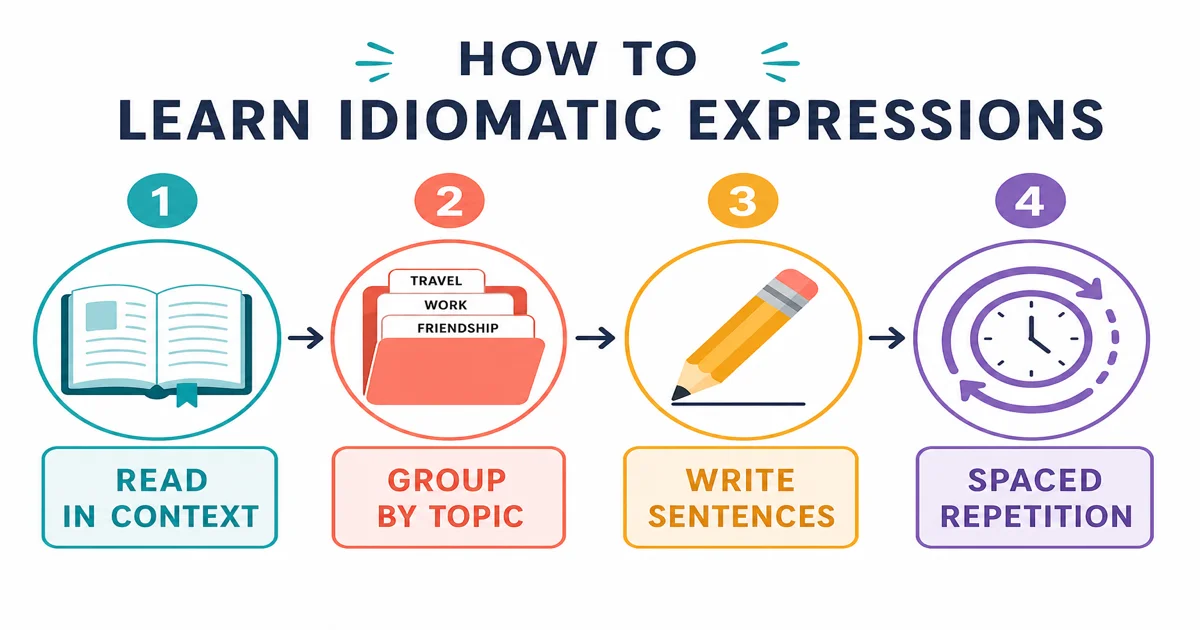
Cara Mempelajari Ungkapan Idiomatis
Langkah 1: Belajar dalam Konteks
Jangan pernah menghafal idiom dari daftar terpisah. Bacalah dalam artikel, tonton dalam film, dan dengarkan dalam podcast. Ketika menemukan idiom secara alami, konteks membantu Anda mengingat makna dan penggunaannya.
Langkah 2: Kelompokkan menurut Topik
Mempelajari “idiom tubuh” bersama-sama (break a leg, cold shoulder, heart of gold) lebih efektif daripada daftar acak. Otak Anda menciptakan kategori mental, dan setiap idiom baru memperkuat yang lain.
Langkah 3: Buat Kalimat Contoh
Untuk setiap idiom yang dipelajari, tulislah 2–3 kalimat tentang kehidupan Anda sendiri. “I got butterflies in my stomach before my job interview” bersifat pribadi dan mudah diingat. Contoh umum cepat memudar.
Langkah 4: Latih Penggunaan Aktif
Gunakan idiom dalam percakapan dan tulisan dengan sengaja. Mulailah dari yang aman (piece of cake, in the long run, at the end of the day) sebelum beralih ke yang lebih berwarna. Jika tidak pernah memakai idiom secara aktif, Anda tidak akan benar-benar memilikinya.
Langkah 5: Gunakan Pengulangan Berjarak
Tambahkan idiom ke kosakata Linglify Anda. Sistem akan menguji Anda pada interval yang meningkat, memindahkan idiom dari memori jangka pendek ke memori jangka panjang secara otomatis.
Kata untuk Dilatih
boom
nomina
dentuman, lonjakan
Contoh
- The boom of thunder echoed across the valley.
- The technology boom created many new millionaires.
cooperate
verba
bekerja sama
evaluate
verba
menilai, mengevaluasi
Contoh
- Companies evaluate job candidates based on experience, skills, and personality.
- Teachers evaluate student progress through tests, projects, and classroom participation.
graduate
verba
lulus
Contoh
- She will graduate from university next year with a degree in engineering.
- Students must complete all requirements before they can graduate from high school.
horizon
nomina
cakrawala, horizon
Contoh
- The sun disappeared behind the horizon as evening approached.
- Traveling broadens your horizon and exposes you to new cultures.
indispensable
adjektiva
mutlak diperlukan, sangat penting
Contoh
- Clean water is indispensable for human survival and good health.
- Her experience and skills make her indispensable to the research team.
jury
nomina
juri
Contoh
- The jury deliberated for several hours before reaching a verdict.
- The talent show jury consisted of professional musicians and entertainers.
lifelong
adjektiva
seumur hidup, sepanjang hidup
Contoh
- Learning is a lifelong process that never truly ends.
- Their lifelong friendship began during elementary school years.
motivated
adjektiva
termotivasi, terdorong
Contoh
- Motivated employee seeks additional responsibilities and challenges at work.
- Success requires being motivated even when facing difficult obstacles.
normally
adverbia
biasanya, secara normal
Contoh
- Heart normally beats between sixty and hundred times per minute.
- Students normally arrive at school before morning bell rings.
off
adjektiva
basi
Contoh
- Please turn off the lights before leaving the room.
- The dog ran off into the forest chasing wild rabbits.
prejudice
nomina
prasangka
Contoh
- Education helps overcome prejudice and promotes understanding.
- Racial prejudice damages communities and individuals alike.
resolve
verba
menyelesaikan, memecahkan
Contoh
- Mediator helps parties resolve dispute through negotiation.
- Technical team will resolve software problems quickly.
stress
verba
merasa tertekan, menekankan
Contoh
- Heavy workload may stress employees beyond limits.
- Teacher will stress importance of homework completion.
total
adjektiva
utuh, menyeluruh
Contoh
- Total cost includes all fees and expenses.
- Total silence fills room during meditation session.
tragedy
nomina
tragedi, musibah
Contoh
- Natural tragedy affects thousands of innocent people.
- Personal tragedy changes person's life perspective completely.
union
nomina
persatuan, gabungan
Contoh
- Labor union protects worker rights and interests.
- Marriage union joins two people in partnership.
voyage
nomina
pelayaran, perjalanan jauh
Contoh
- Space exploration represents humanity's greatest voyage into the unknown.
- The ocean voyage from Europe to America took several weeks in the past.
candidate
nomina
calon, kandidat
Contoh
- Each presidential candidate presented their policy plans to voters.
- The job candidate impressed the interview panel with her experience.
discourage
verba
mematahkan semangat, membuat kecil hati
Contoh
- Don't let one failure discourage you from pursuing your dreams.
- High prices discourage many people from buying organic food products.
donate
verba
menyumbangkan, mendonasikan
Contoh
- Many people donate money to charities that help homeless individuals.
- She decided to donate blood to help patients in emergency situations.
firmly
adverbia
dengan teguh, secara mantap
Contoh
- Hold the rope firmly while climbing down the steep mountain slope.
- The manager firmly believed in treating all employees with respect.
guide
verba
memandu, membimbing
Contoh
- Parents should guide their children to make responsible decisions.
- The experienced hiker will guide the group through the mountain trail safely.
humorous
adjektiva
lucu, jenaka
Contoh
- She writes humorous articles about everyday life and family experiences.
- The humorous speech made everyone laugh and lightened the serious mood.
admission
nomina
penerimaan, izin masuk
Contoh
- Her admission to the prestigious medical school was the result of hard work.
- The museum offers free admission on the first Sunday of every month.
Langkah Selanjutnya
-
Mulai dengan 10 idiom. Pilih 10 dari daftar di atas yang pernah Anda dengar tetapi belum pernah gunakan. Tulis kalimat dengan masing-masing idiom.
-
Perhatikan idiom dalam bahasa Inggris nyata. Saat berikutnya Anda menonton film atau membaca artikel, catat ungkapan idiomatis apa pun. Cari maknanya dan tambahkan ke koleksi Anda.
-
Tambahkan idiom ke Linglify untuk pengulangan berjarak.
-
Jelajahi daftar idiom lengkap—Idiom Bahasa Inggris: 500+ Ungkapan Umum memiliki idiom yang disusun dalam 20 kategori topik.
-
Pelajari contoh idiom—Contoh Idiom: 200+ dengan Arti menyediakan contoh tambahan dengan konteks.
FAQ
Apa perbedaan antara idiom dan frasa?
Frasa adalah kelompok kata apa pun yang berfungsi bersama (“in the morning,” “very quickly,” “on the table”). Idiom adalah jenis frasa khusus yang maknanya tidak dapat dipahami dari kata harfiah (“kick the bucket” = meninggal, “spill the beans” = membocorkan rahasia). Semua idiom adalah frasa, tetapi tidak semua frasa adalah idiom. Perbedaan utamanya adalah apakah maknanya kiasan (idiom) atau harfiah (frasa biasa).
Berapa banyak ungkapan idiomatis dalam bahasa Inggris?
Perkiraannya berkisar dari 5.000 hingga 25.000, bergantung pada seberapa luas Anda mendefinisikan “idiom”. Jika memasukkan phrasal verb, peribahasa, dan ungkapan slang, jumlahnya lebih tinggi. Untuk tujuan praktis, mengetahui 200–300 idiom umum mencakup sebagian besar yang akan Anda temui dalam bahasa Inggris sehari-hari, film, dan komunikasi bisnis standar.
Dapatkah saya menggunakan idiom dalam tulisan formal?
Itu bergantung pada idiom dan konteksnya. Beberapa idiom dapat diterima dalam tulisan formal (“in the long run,” “at the end of the day,” “the bottom line”), sementara yang lain terlalu santai (“piece of cake,” “no-brainer,” “kick the bucket”). Untuk esai akademik dan dokumen hukum, hindari idiom sama sekali. Untuk email dan presentasi bisnis, gunakan idiom umum dan netral dengan hemat. Untuk tulisan IELTS, satu atau dua idiom yang ditempatkan dengan baik dapat menunjukkan rentang kosakata.
Mengapa idiom sangat sulit diterjemahkan?
Karena idiom membawa makna budaya, bukan hanya makna linguistik. “It’s raining cats and dogs” berarti “hujan lebat” dalam bahasa Inggris, tetapi menerjemahkannya secara harfiah ke bahasa lain menghasilkan omong kosong. Setiap bahasa memiliki idiom sendiri untuk konsep yang sama—bahasa Prancis berkata “il pleut des cordes” (hujan tali), bahasa Jepang berkata “土砂降り” (hujan deras). Anda harus menerjemahkan maknanya, bukan kata-katanya.
Apa cara tercepat mempelajari ungkapan idiomatis?
Tiga strategi bekerja paling baik: (1) Pelajari idiom dalam kelompok topik (semua idiom uang bersama, semua idiom waktu bersama) agar saling menguatkan. (2) Belajarlah dari konteks nyata—film, podcast, dan buku—bukan daftar terpisah. (3) Gunakan pengulangan berjarak untuk memindahkan idiom dari pengenalan ke penggunaan aktif. Kesalahan terbesar adalah mencoba menghafal ratusan sekaligus. Mulailah dengan 30–50 idiom umum dan gunakan secara aktif sebelum menambah lagi.


