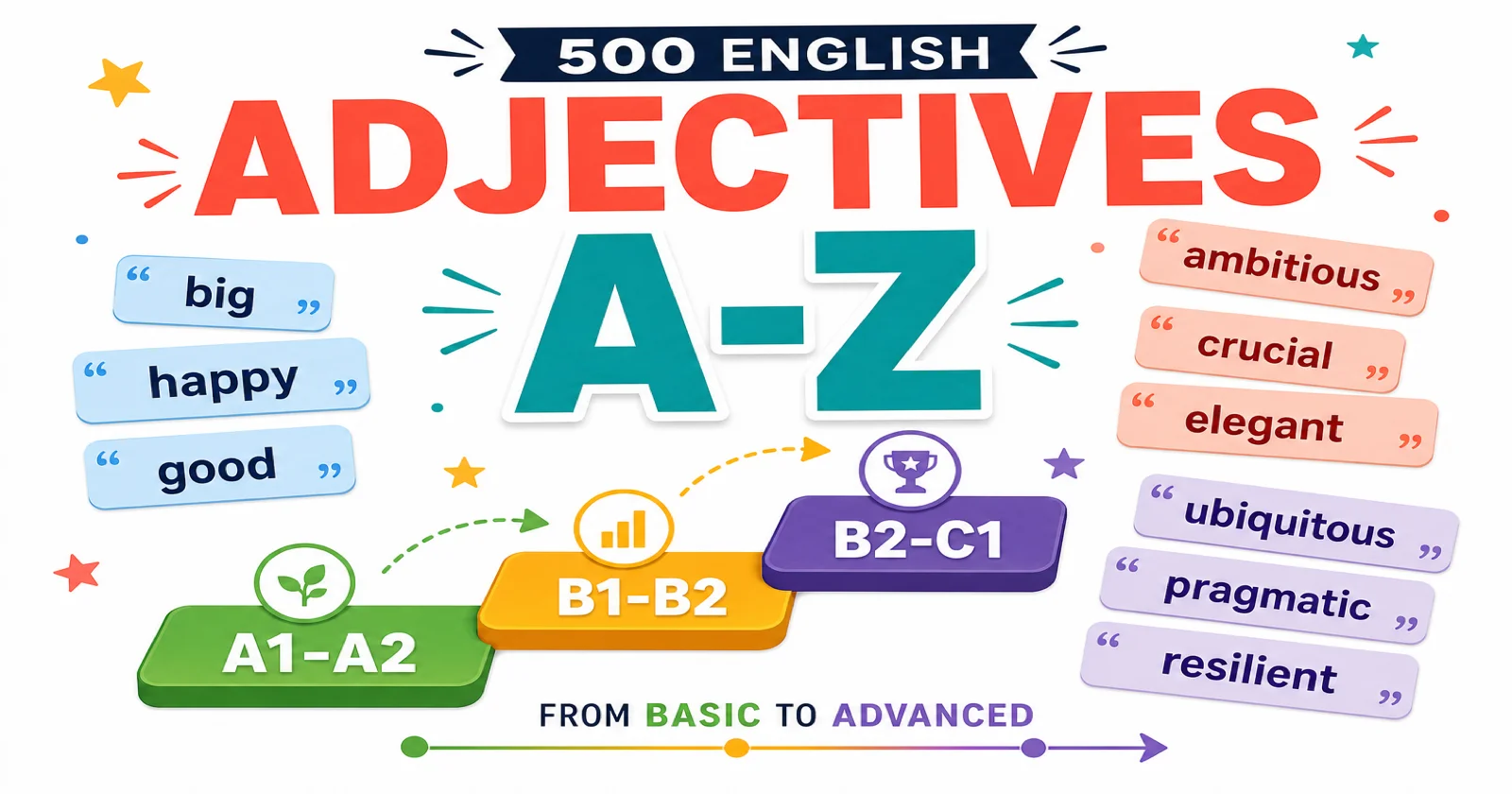
500 Adjetivos em Inglês: Do Básico ao Avançado
Os adjetivos são as palavras que dão vida à linguagem. Sem eles, tudo é plano: “I saw a dog” vira “I saw a huge, scruffy, adorable dog.” O substantivo é o mesmo, mas os adjetivos pintam uma imagem — tamanho, condição, reação emocional — tudo em três palavras.
O inglês tem milhares de adjetivos, mas a maioria dos estudantes acaba recorrendo sempre aos mesmos vinte: good, bad, big, small, nice, happy, sad, beautiful, ugly, old, new, young, fast, slow, easy, hard, hot, cold, long, short. Eles funcionam — mas fazem seu inglês soar básico e repetitivo.
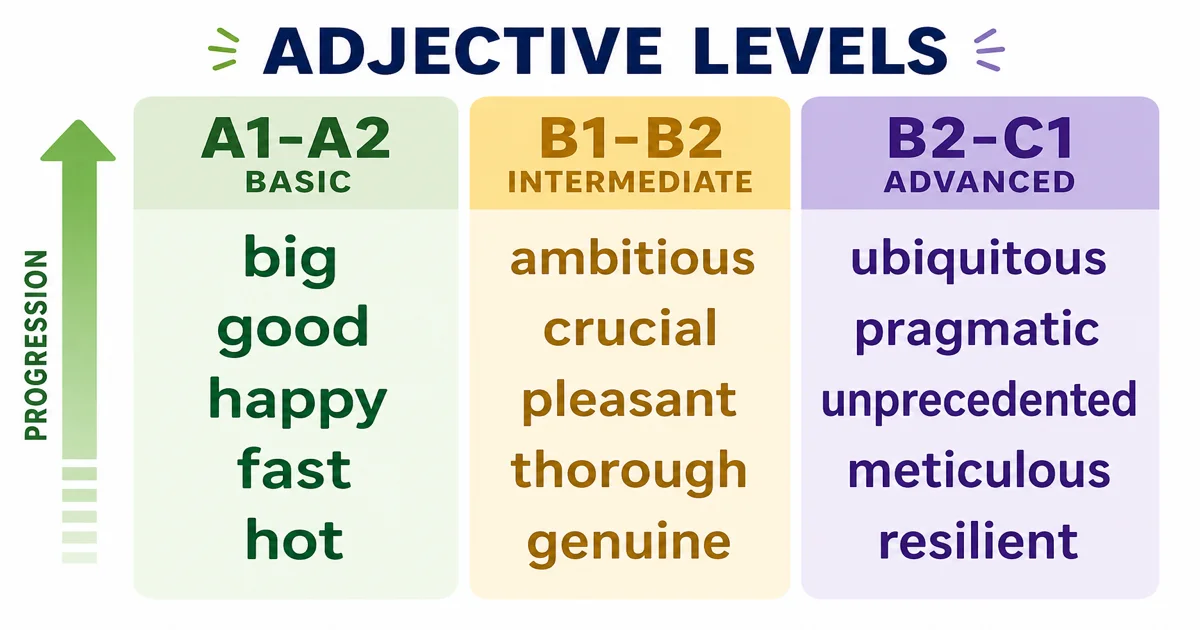
Este guia reúne 500 adjetivos organizados por nível (A1–C1) e categoria. Cada um traz uma definição clara e uma frase de exemplo. Use-o como referência para ampliar seu vocabulário de forma sistemática.
- Total: 500 adjetivos
- Organizado por: nível CEFR (A1–C1) e categoria semântica
- Formato: Adjetivo → Significado → Exemplo
- Para: ampliar o vocabulário, melhorar a escrita e se preparar para exames
Para encontrar sinônimos que substituam adjetivos usados em excesso, veja Sinônimos para Palavras Comuns: 200+ Melhorias.
O Que É um Adjetivo?
Um adjetivo é uma palavra que descreve ou modifica um substantivo. Ele responde perguntas como:
- Que tipo? — a tall building, a beautiful sunset
- Quantos? — several options, few mistakes
- Qual? — this book, that car
- Quanto? — enough time, little patience
Onde os Adjetivos Vão na Frase
| Posição | Exemplo | Regra |
|---|---|---|
| Antes do substantivo | a red car | Posição mais comum |
| Após verbo de ligação | The car is red. | Após be, seem, look, feel, taste, smell, sound |
| Após o substantivo | something interesting | Após pronomes indefinidos |
Ordem de Múltiplos Adjetivos
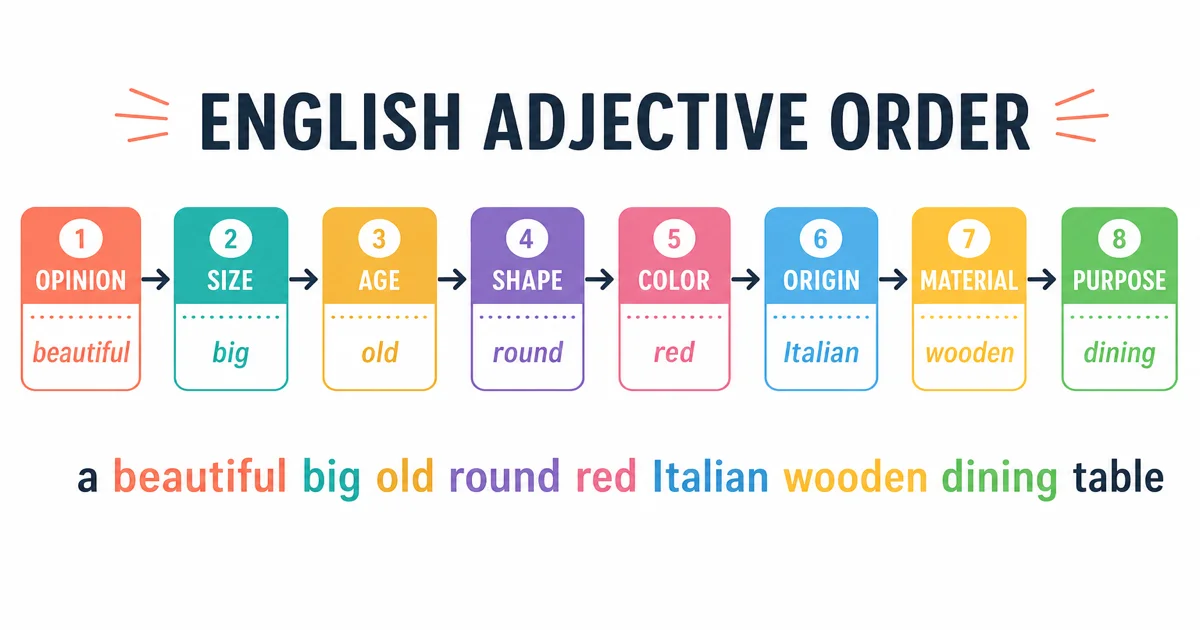
Ao usar vários adjetivos antes de um substantivo, o inglês segue uma ordem específica:
Opinião → Tamanho → Idade → Forma → Cor → Origem → Material → Finalidade
| Ordem | Exemplo |
|---|---|
| Opinião + Tamanho | a beautiful large house |
| Opinião + Idade | a lovely old church |
| Tamanho + Cor | a small red car |
| Opinião + Origem + Material | an expensive Italian leather bag |
| Tamanho + Idade + Cor | a big old brown dog |
Você diz “a beautiful old Italian painting” — nunca “an Italian old beautiful painting.”
A1–A2: Adjetivos Básicos (100 Palavras)
Aparência e Descrição Física
| # | Adjetivo | Significado | Exemplo |
|---|---|---|---|
| 1 | big | grande em tamanho | They live in a big house. |
| 2 | small | pequeno em tamanho | She has a small apartment. |
| 3 | tall | de grande altura | He is very tall — about 190 cm. |
| 4 | short | não alto; breve | She is short but strong. |
| 5 | long | grande em comprimento ou duração | The movie was really long. |
| 6 | old | que viveu muitos anos | My grandmother is 85 years old. |
| 7 | young | não velho | She’s too young to drive. |
| 8 | new | feito ou comprado recentemente | I got a new phone yesterday. |
| 9 | beautiful | muito atraente | What a beautiful view! |
| 10 | ugly | desagradável de ver | The building is really ugly. |
| 11 | clean | livre de sujeira | The kitchen is very clean. |
| 12 | dirty | não limpo | His shoes are dirty from the mud. |
| 13 | fat | com excesso de peso corporal | The cat is getting fat. |
| 14 | thin | não espesso; magro | She’s very thin. |
| 15 | dark | sem luz; de cor profunda | The room is too dark to read. |
| 16 | light | com brilho; não pesado | The bag is very light. |
| 17 | heavy | de grande peso | This box is too heavy to carry. |
| 18 | round | de forma circular | The table is round. |
| 19 | flat | com superfície nivelada | The land here is flat. |
| 20 | sharp | com borda cortante fina | Be careful — that knife is sharp. |
Sentimentos e Personalidade
| # | Adjetivo | Significado | Exemplo |
|---|---|---|---|
| 21 | happy | sentindo alegria | She looks very happy today. |
| 22 | sad | sentindo tristeza | He was sad to leave. |
| 23 | angry | sentindo forte desagrado | Don’t make her angry! |
| 24 | tired | precisando de descanso | I’m so tired after work. |
| 25 | hungry | querendo comida | Are you hungry? Let’s eat. |
| 26 | thirsty | querendo água | I’m really thirsty — can I have water? |
| 27 | scared | sentindo medo | She’s scared of spiders. |
| 28 | nice | agradável | He’s a very nice person. |
| 29 | kind | generoso, atencioso | That was very kind of you. |
| 30 | funny | causando risos | She tells really funny jokes. |
| 31 | quiet | fazendo pouco barulho | The library is quiet. |
| 32 | loud | fazendo muito barulho | The music is too loud. |
| 33 | friendly | caloroso e acolhedor | People here are very friendly. |
| 34 | brave | mostrando coragem | The firefighter was very brave. |
| 35 | lazy | não disposto a trabalhar | Don’t be lazy — study harder. |
| 36 | busy | tendo muito a fazer | Sorry, I’m very busy today. |
| 37 | stupid | não inteligente | That was a stupid mistake. |
| 38 | smart | inteligente | She’s the smartest kid in class. |
| 39 | strong | tendo poder físico | He’s very strong. |
| 40 | weak | sem força | I felt weak after the illness. |
Qualidade e Avaliação
| # | Adjetivo | Significado | Exemplo |
|---|---|---|---|
| 41 | good | de alta qualidade | This is a really good book. |
| 42 | bad | de baixa qualidade | The weather is bad today. |
| 43 | great | muito bom; grande | That’s a great idea! |
| 44 | terrible | extremamente ruim | The food was terrible. |
| 45 | easy | não difícil | The test was easy. |
| 46 | hard | difícil; sólido | Math is hard for some people. |
| 47 | fast | movendo-se rapidamente | She’s a fast runner. |
| 48 | slow | não rápido | The internet is really slow. |
| 49 | hot | alta temperatura | The coffee is too hot. |
| 50 | cold | baixa temperatura | It’s very cold outside. |
| 51 | warm | confortavelmente quente | The water is warm. |
| 52 | cool | levemente frio; também “na moda” | It’s cool outside today. |
| 53 | expensive | custando muito | The restaurant is too expensive. |
| 54 | cheap | não custando muito | The food is cheap and good. |
| 55 | free | sem custo; não restrito | Entry is free on Sundays. |
| 56 | rich | tendo muito dinheiro | She’s very rich. |
| 57 | poor | tendo pouco dinheiro | The family is very poor. |
| 58 | safe | livre de perigo | This neighborhood is safe. |
| 59 | dangerous | propenso a causar dano | The road is dangerous at night. |
| 60 | important | tendo grande valor | Education is very important. |
Cores, Sabores e Outros Básicos
| # | Adjetivo | Significado | Exemplo |
|---|---|---|---|
| 61 | red | a cor do sangue | She wore a red dress. |
| 62 | blue | a cor do céu | The sky is bright blue today. |
| 63 | green | a cor da grama | The park is very green in summer. |
| 64 | black | a cor mais escura | He drives a black car. |
| 65 | white | a cor mais clara | The walls are white. |
| 66 | yellow | a cor do sol | She bought yellow flowers. |
| 67 | sweet | sabor de açúcar | This cake is very sweet. |
| 68 | sour | sabor de limão | The milk has gone sour. |
| 69 | salty | com sabor de sal | The soup is too salty. |
| 70 | spicy | com sabores fortes | I love spicy food. |
| 71 | delicious | muito gostoso | The pasta was delicious! |
| 72 | horrible | muito ruim, desagradável | The taste was horrible. |
| 73 | open | não fechado | The door is open. |
| 74 | closed | não aberto | The shop is closed today. |
| 75 | full | contendo o máximo | The glass is full. |
| 76 | empty | não contendo nada | The room is empty. |
| 77 | wet | coberto de água | My shoes are wet. |
| 78 | dry | não molhado | Is the paint dry yet? |
| 79 | right | correto; oposto de esquerdo | That’s the right answer. |
| 80 | wrong | não correto | You gave the wrong address. |
| 81 | same | não diferente | We have the same birthday! |
| 82 | different | não igual | The two plans are very different. |
| 83 | next | vindo imediatamente depois | The next bus leaves in 10 minutes. |
| 84 | last | vindo no final | This is the last chance. |
| 85 | first | vindo antes de todos os outros | She was the first to arrive. |
| 86 | ready | preparado | Are you ready to go? |
| 87 | sure | certo | Are you sure about this? |
| 88 | true | de acordo com os fatos | Is that story true? |
| 89 | real | existindo de fato | Is that a real diamond? |
| 90 | possible | capaz de acontecer | Is it possible to change the date? |
| 91 | simple | fácil de entender | The instructions are simple. |
| 92 | difficult | difícil de fazer ou entender | The question was difficult. |
| 93 | special | melhor ou diferente do usual | Today is a special day. |
| 94 | popular | apreciado por muitas pessoas | This song is very popular. |
| 95 | famous | conhecido por muitas pessoas | She’s a famous actress. |
| 96 | common | acontecendo frequentemente | Colds are common in winter. |
| 97 | main | mais importante | What’s the main problem? |
| 98 | only | único | He’s the only child. |
| 99 | own | pertencendo a si mesmo | I want my own room. |
| 100 | whole | inteiro, completo | I ate the whole pizza. |
B1–B2: Adjetivos Intermediários (200 Palavras)
Personalidade e Caráter
| # | Adjetivo | Significado | Exemplo |
|---|---|---|---|
| 101 | ambitious | com forte desejo de ter sucesso | She’s very ambitious — she wants to be CEO. |
| 102 | arrogant | com senso exagerado de importância | He’s talented but incredibly arrogant. |
| 103 | confident | autoconfiante | She’s confident in her abilities. |
| 104 | creative | capaz de produzir novas ideias | The designer is very creative. |
| 105 | curious | ansioso para aprender ou saber | Children are naturally curious. |
| 106 | generous | disposto a dar livremente | She’s very generous with her time. |
| 107 | honest | verdadeiro | I appreciate your honest opinion. |
| 108 | humble | não orgulhoso ou arrogante | Despite his success, he remains humble. |
| 109 | jealous | invejoso de alguém | She’s jealous of her sister’s success. |
| 110 | loyal | fiel e comprometido | He’s a loyal friend. |
| 111 | mature | totalmente crescido; sensato | She’s very mature for her age. |
| 112 | moody | com humores imprevisíveis | He’s been moody all week. |
| 113 | naive | sem experiência | She was too naive to see the danger. |
| 114 | optimistic | esperando bons resultados | She’s optimistic about the future. |
| 115 | pessimistic | esperando maus resultados | Don’t be so pessimistic — we’ll be fine. |
| 116 | patient | capaz de esperar calmamente | Teachers need to be very patient. |
| 117 | polite | bem-educado | The staff are always polite. |
| 118 | reliable | confiável | She’s the most reliable person I know. |
| 119 | selfish | pensando apenas em si mesmo | Don’t be selfish — share with others. |
| 120 | sensible | com bom julgamento | That’s a sensible decision. |
| 121 | sensitive | facilmente afetado emocionalmente | She’s very sensitive to criticism. |
| 122 | shy | nervoso ao redor de pessoas | He’s too shy to speak in public. |
| 123 | stubborn | recusando-se a mudar de ideia | She’s too stubborn to admit she’s wrong. |
| 124 | tolerant | aceitando diferenças | We need to be more tolerant of each other. |
| 125 | witty | inteligente e humorístico | She always has a witty response. |
Aparência e Descrições
| # | Adjetivo | Significado | Exemplo |
|---|---|---|---|
| 126 | attractive | agradável de olhar | She’s an attractive woman. |
| 127 | brilliant | muito brilhante; muito inteligente | The sun is brilliant today. |
| 128 | charming | agradavelmente atraente | What a charming little village! |
| 129 | elegant | graciosamente elegante | She wore an elegant dress. |
| 130 | enormous | extremamente grande | The house has an enormous garden. |
| 131 | fascinating | extremamente interessante | The documentary was fascinating. |
| 132 | gorgeous | muito bonito | The sunset was gorgeous. |
| 133 | handsome | bonito (tipicamente para homens) | He’s a very handsome man. |
| 134 | huge | extremamente grande | There’s a huge crowd outside. |
| 135 | massive | muito grande e pesado | The storm caused massive damage. |
| 136 | narrow | não largo | The road is too narrow for two cars. |
| 137 | neat | organizado e arrumado | Her desk is always neat. |
| 138 | pale | claro; sem cor | She looked pale and tired. |
| 139 | rough | não liso | The surface feels rough. |
| 140 | smooth | com superfície uniforme | The baby’s skin is so smooth. |
| 141 | steep | subindo abruptamente | The hill is very steep. |
| 142 | straight | sem curvas | Draw a straight line. |
| 143 | thick | largo de um lado ao outro | The walls are very thick. |
| 144 | tight | ajustado de perto | These shoes are too tight. |
| 145 | tiny | extremamente pequeno | She lives in a tiny apartment. |
| 146 | vast | extremamente grande em área | The Sahara is a vast desert. |
| 147 | wide | de grande largura | The river is very wide here. |
| 148 | hollow | com espaço vazio dentro | The tree trunk is hollow. |
| 149 | solid | firme, duro | The table is made of solid oak. |
| 150 | transparent | que permite ver através | The water is transparent. |
Emoções e Estados
| # | Adjetivo | Significado | Exemplo |
|---|---|---|---|
| 151 | anxious | preocupado, inquieto | She’s anxious about the interview. |
| 152 | ashamed | sentindo culpa ou embaraço | He was ashamed of his behavior. |
| 153 | confused | incapaz de entender | I’m confused by the instructions. |
| 154 | content | satisfeito e tranquilo | She felt content with her life. |
| 155 | delighted | muito satisfeito | I’m delighted to meet you. |
| 156 | desperate | em necessidade urgente | He’s desperate for a job. |
| 157 | disappointed | triste porque as expectativas não foram atendidas | She was disappointed with the result. |
| 158 | embarrassed | sentindo-se desconfortável ou envergonhado | He was embarrassed by the mistake. |
| 159 | exhausted | extremamente cansado | I’m completely exhausted. |
| 160 | frustrated | sentindo-se chateado ou irritado | She’s frustrated with the slow progress. |
| 161 | grateful | sentindo-se agradecido | I’m grateful for your help. |
| 162 | guilty | sentindo-se responsável por uma ação errada | He felt guilty about lying. |
| 163 | hopeful | sentindo-se otimista | I’m hopeful about the outcome. |
| 164 | impressed | sentindo admiração | I was impressed by her presentation. |
| 165 | lonely | sentindo-se sozinho e triste | She felt lonely in the new city. |
| 166 | nervous | sentindo-se preocupado com algo | He’s nervous about the exam. |
| 167 | overwhelmed | sentindo-se sobrecarregado | She was overwhelmed by the workload. |
| 168 | proud | sentindo satisfação nas conquistas | Her parents are very proud. |
| 169 | relieved | sentindo o estresse aliviado | I was relieved when the results came back. |
| 170 | satisfied | sentindo que as necessidades foram atendidas | Are you satisfied with the service? |
Qualidade, Situações e Conceitos Abstratos
| # | Adjetivo | Significado | Exemplo |
|---|---|---|---|
| 171 | accurate | correto, exato | The report is accurate. |
| 172 | appropriate | adequado para a situação | That outfit isn’t appropriate for the office. |
| 173 | available | que pode ser usado ou obtido | Is this room available? |
| 174 | capable | tendo a capacidade de fazer algo | She’s a very capable manager. |
| 175 | complex | tendo muitas partes | The problem is more complex than we thought. |
| 176 | convenient | fácil de usar, adequado | The hotel is in a convenient location. |
| 177 | crucial | extremamente importante | Timing is crucial. |
| 178 | effective | produzindo o resultado desejado | The medicine was effective. |
| 179 | essential | absolutamente necessário | Water is essential for life. |
| 180 | familiar | bem conhecido, reconhecido | The name sounds familiar. |
| 181 | flexible | capaz de mudar ou adaptar | We need a flexible schedule. |
| 182 | fortunate | tendo boa sorte | We were fortunate to survive. |
| 183 | frequent | acontecendo frequentemente | Frequent exercise improves health. |
| 184 | genuine | real, autêntico | Is this a genuine leather bag? |
| 185 | gradual | acontecendo lentamente com o tempo | There was a gradual improvement. |
| 186 | inevitable | certo de acontecer | Change is inevitable. |
| 187 | obvious | claramente aparente | The answer is obvious. |
| 188 | permanent | duradouro para sempre | The damage is permanent. |
| 189 | pleasant | agradável | We had a pleasant conversation. |
| 190 | practical | útil, realista | We need a practical solution. |
| 191 | previous | vindo antes no tempo | In the previous chapter… |
| 192 | rapid | acontecendo rapidamente | The country saw rapid growth. |
| 193 | reasonable | justo, sensato | The price is reasonable. |
| 194 | relevant | relacionado ao assunto | Is this information relevant? |
| 195 | severe | muito sério, extremo | The storm caused severe damage. |
| 196 | significant | importante, significativo | There was a significant change. |
| 197 | sufficient | o suficiente | Is the evidence sufficient? |
| 198 | suitable | apropriado para o fim | The hotel is suitable for families. |
| 199 | thorough | completo e cuidadoso | She did a thorough investigation. |
| 200 | unusual | não comum | It’s unusual to see snow here. |
Mais Adjetivos Intermediários
| # | Adjetivo | Significado | Exemplo |
|---|---|---|---|
| 201 | absent | ausente, não presente | She was absent from school. |
| 202 | aware | ciente, com conhecimento de algo | Are you aware of the risk? |
| 203 | blind | incapaz de enxergar | He is blind in one eye. |
| 204 | brief | de curta duração | She gave a brief speech. |
| 205 | broad | largo, amplo | He has broad shoulders. |
| 206 | calm | sem estar agitado ou preocupado | Stay calm — everything is fine. |
| 207 | certain | seguro, certo | I’m certain she’ll agree. |
| 208 | constant | que acontece o tempo todo | The constant noise is annoying. |
| 209 | current | que acontece no momento | What’s the current situation? |
| 210 | deep | que se estende muito para baixo | The lake is very deep. |
| 211 | entire | inteiro, completo | She read the entire book. |
| 212 | extreme | muito intenso ou elevado | The heat was extreme. |
| 213 | fierce | agressivo, intenso | The competition was fierce. |
| 214 | firm | sólido, não macio | The mattress is very firm. |
| 215 | gentle | gentil e cuidadoso | He has a gentle voice. |
| 216 | guilty | responsável por um crime | The jury found him guilty. |
| 217 | harsh | desagradavelmente severo | The winter was harsh. |
| 218 | ideal | perfeito | This is the ideal location. |
| 219 | immediate | que acontece sem demora | We need an immediate response. |
| 220 | incredible | difícil de acreditar; incrível | The view was incredible. |
| 221 | independent | que não depende dos outros | She’s very independent. |
| 222 | keen | entusiasmado; perspicaz | She’s keen to start the project. |
| 223 | legal | permitido por lei | Is this legal? |
| 224 | logical | baseado na razão | That’s a logical conclusion. |
| 225 | mild | não severo; ameno | The weather is mild today. |
| 226 | mutual | compartilhado entre duas partes | We have mutual respect. |
| 227 | precise | exato, preciso | Be more precise in your answer. |
| 228 | rare | que não acontece com frequência | Snow is rare in this region. |
| 229 | remote | distante, afastado | They live in a remote village. |
| 230 | separate | separado, não unido | The rooms are separate. |
| 231 | slight | pequeno em intensidade | There was a slight delay. |
| 232 | steady | constante, sem oscilações | The economy showed steady growth. |
| 233 | strict | que exige obediência | The teacher is very strict. |
| 234 | sudden | que acontece rápida e inesperadamente | There was a sudden change in weather. |
| 235 | terrible | extremamente ruim | The traffic was terrible. |
| 236 | typical | característico, normal | That’s a typical response. |
| 237 | ultimate | final; o melhor | This is the ultimate guide. |
| 238 | unique | único, sem igual | Every fingerprint is unique. |
| 239 | urban | relacionado a uma cidade | Urban areas have higher costs. |
| 240 | valuable | de grande valor | She gave me valuable advice. |
| 241 | violent | que usa força física | The protest turned violent. |
| 242 | visible | que pode ser visto | The mountain is visible from here. |
| 243 | vital | absolutamente necessário | Sleep is vital for health. |
| 244 | voluntary | feito por escolha própria | Participation is voluntary. |
| 245 | vulnerable | sujeito a sofrer danos | Children are the most vulnerable. |
| 246 | wealthy | que tem muito dinheiro | They’re a very wealthy family. |
| 247 | worthy | merecedor de respeito | She’s a worthy opponent. |
| 248 | annual | que acontece todos os anos | The annual report is ready. |
| 249 | artificial | feito por pessoas, não natural | The flowers are artificial. |
| 250 | contemporary | moderno, da época atual | She loves contemporary art. |
B2–C1: Adjetivos Avançados (250 Palavras)
Personalidade e Comportamento
| # | Adjetivo | Significado | Exemplo |
|---|---|---|---|
| 251 | assertive | confiante e firme | She’s assertive without being aggressive. |
| 252 | benevolent | bondoso, caridoso | A benevolent donor funded the project. |
| 253 | charismatic | que inspira devoção nos outros | He’s a charismatic leader. |
| 254 | compassionate | sentindo simpatia pelos outros | Nurses need to be compassionate. |
| 255 | conscientious | minucioso e cuidadoso | She’s a conscientious worker. |
| 256 | cynical | desconfiando dos motivos das pessoas | He’s become cynical about politics. |
| 257 | diligent | trabalhador e cuidadoso | She’s a diligent student. |
| 258 | discreet | cuidadoso para não chamar atenção | Please be discreet about this. |
| 259 | eccentric | não convencional, ligeiramente estranho | She’s a lovable eccentric. |
| 260 | eloquent | falando fluentemente e persuasivamente | She gave an eloquent speech. |
| 261 | empathetic | compreendendo os sentimentos dos outros | Good leaders are empathetic. |
| 262 | enigmatic | misterioso, difícil de entender | She has an enigmatic smile. |
| 263 | gullible | facilmente enganado | He’s too gullible — he believes everything. |
| 264 | impulsive | agindo sem pensar | She made an impulsive purchase. |
| 265 | indifferent | não se importando | He seemed indifferent to the outcome. |
| 266 | insightful | tendo compreensão profunda | Her comments were very insightful. |
| 267 | meticulous | muito cuidadoso com os detalhes | He’s meticulous about his work. |
| 268 | nonchalant | casualmente tranquilo | She was nonchalant about the danger. |
| 269 | obnoxious | extremamente desagradável | The customer was obnoxious. |
| 270 | persistent | continuando apesar das dificuldades | She’s persistent — she never gives up. |
| 271 | pragmatic | lidando com as coisas praticamente | We need a pragmatic approach. |
| 272 | pretentious | tentando parecer mais importante | The restaurant is pretentious. |
| 273 | resilient | capaz de se recuperar rapidamente | Children are remarkably resilient. |
| 274 | skeptical | não facilmente convencido | I’m skeptical about his claims. |
| 275 | spontaneous | feito sem planejamento | Let’s be spontaneous — go on a road trip! |
Descritivo e Abstrato
| # | Adjetivo | Significado | Exemplo |
|---|---|---|---|
| 276 | abundant | existindo em grandes quantidades | The region has abundant natural resources. |
| 277 | adequate | suficiente | The budget is adequate for the project. |
| 278 | adverse | desfavorável, prejudicial | Adverse weather delayed the flight. |
| 279 | ambiguous | tendo múltiplos significados | The instructions are ambiguous. |
| 280 | compelling | poderosamente convincente | The evidence is compelling. |
| 281 | conceivable | imaginável, possível | Every conceivable option was considered. |
| 282 | conducive | tornando algo provável | The environment is conducive to learning. |
| 283 | consecutive | seguindo um após o outro | She won three consecutive titles. |
| 284 | conspicuous | claramente visível, chamando atenção | His absence was conspicuous. |
| 285 | controversial | causando desacordo | The decision was controversial. |
| 286 | conventional | seguindo padrões tradicionais | She rejected conventional thinking. |
| 287 | definitive | final, conclusivo | This is the definitive guide. |
| 288 | deliberate | feito intencionalmente | It was a deliberate mistake. |
| 289 | detrimental | causando dano | Smoking is detrimental to health. |
| 290 | dismal | deprimentemente ruim | The team’s performance was dismal. |
| 291 | distinct | claramente diferente | The two species are distinct. |
| 292 | diverse | mostrando variedade | The city has a diverse population. |
| 293 | drastic | extremo, severo | We need drastic action. |
| 294 | elusive | difícil de encontrar ou alcançar | Success remains elusive. |
| 295 | eminent | famoso e respeitado | She’s an eminent professor. |
| 296 | erratic | imprevisível, irregular | His behavior has been erratic. |
| 297 | exquisite | extremamente bonito | The craftsmanship is exquisite. |
| 298 | feasible | possível e prático | Is the plan feasible? |
| 299 | formidable | inspirando medo ou respeito | She’s a formidable opponent. |
| 300 | futile | inútil, sem sentido | Resistance is futile. |
Mais Adjetivos Avançados (301–500)
| # | Adjetivo | Significado | Exemplo |
|---|---|---|---|
| 301 | imminent | prestes a acontecer | A decision is imminent. |
| 302 | implicit | implícito, não declarado diretamente | There was an implicit agreement. |
| 303 | indispensable | absolutamente necessário | She became indispensable to the team. |
| 304 | inherent | existindo como parte natural | Risk is inherent in business. |
| 305 | innate | inato, natural | She has an innate talent for music. |
| 306 | intriguing | despertando curiosidade | The discovery is intriguing. |
| 307 | lucrative | produzindo grande lucro | He found a lucrative career in tech. |
| 308 | mundane | entediante, cotidiano | She wanted to escape her mundane routine. |
| 309 | negligible | tão pequeno que não tem significado | The side effects are negligible. |
| 310 | notorious | famoso por algo ruim | The prison is notorious. |
| 311 | obscure | pouco conhecido | She referenced an obscure law. |
| 312 | paramount | de suprema importância | Safety is paramount. |
| 313 | peculiar | estranho, incomum | That’s a peculiar thing to say. |
| 314 | pertinent | relevante, aplicável | Is this pertinent to the discussion? |
| 315 | plausible | parecendo razoável | His explanation is plausible. |
| 316 | predominant | mais comum ou influente | English is the predominant language. |
| 317 | preliminary | vindo antes da parte principal | The preliminary results are encouraging. |
| 318 | profound | muito profundo ou intenso | The book had a profound effect on me. |
| 319 | prominent | importante, bem conhecido | She’s a prominent figure in politics. |
| 320 | prosperous | bem-sucedido, rico | The country is becoming prosperous. |
| 321 | redundant | não mais necessário; repetitivo | His position was made redundant. |
| 322 | rigorous | minucioso, exigente | The testing was rigorous. |
| 323 | robust | forte e saudável | The economy is robust. |
| 324 | scarce | em falta | Clean water is scarce here. |
| 325 | shrewd | com julgamento aguçado | She’s a shrewd businesswoman. |
| 326 | skeptical | cético, desconfiado | Scientists remain skeptical. |
| 327 | sophisticated | complexo, refinado | The system is sophisticated. |
| 328 | sporadic | ocorrendo em intervalos irregulares | There was sporadic fighting. |
| 329 | staggering | assombrosamente grande | The cost was staggering. |
| 330 | stringent | rigoroso, preciso | The regulations are stringent. |
| 331 | subsequent | que vem depois | In subsequent years, profits rose. |
| 332 | substantial | grande em tamanho ou valor | She received a substantial raise. |
| 333 | superficial | que existe apenas na superfície | The analysis is superficial. |
| 334 | surplus | em quantidade maior que a necessária | The farm has a surplus of wheat. |
| 335 | tangible | que pode ser tocado ou medido | We need tangible results. |
| 336 | tentative | incerto, cauteloso | We have a tentative agreement. |
| 337 | trivial | sem importância, insignificante | Don’t waste time on trivial matters. |
| 338 | ubiquitous | encontrado em toda parte | Smartphones are ubiquitous. |
| 339 | unprecedented | nunca visto antes | The growth was unprecedented. |
| 340 | viable | capaz de funcionar | Is the plan viable? |
| 341 | volatile | sujeito a mudar rapidamente | The stock market is volatile. |
| 342 | worthwhile | que vale o tempo ou o esforço | The training was worthwhile. |
| 343 | abrupt | repentino e inesperado | His departure was abrupt. |
| 344 | acute | intenso, agudo | She felt acute pain. |
| 345 | ample | mais do que suficiente | There is ample time. |
| 346 | arbitrary | baseado em uma escolha aleatória | The decision seemed arbitrary. |
| 347 | bleak | sem esperança; frio e desolado | The outlook is bleak. |
| 348 | coherent | lógico e consistente | She made a coherent argument. |
| 349 | compatible | capaz de funcionar em conjunto | The systems are compatible. |
| 350 | comprehensive | abrangente, que inclui tudo | This is a comprehensive guide. |
| 351 | concise | breve, mas completo | Write a concise summary. |
| 352 | concrete | específico, definido | We need concrete evidence. |
| 353 | cumulative | que aumenta por adição | The cumulative effect is significant. |
| 354 | deficient | sem algo necessário | The diet is deficient in iron. |
| 355 | dense | compacto, com elementos muito próximos | The forest is very dense. |
| 356 | discrete | separado individualmente | The project has three discrete phases. |
| 357 | dominant | mais poderoso ou influente | She’s the dominant player. |
| 358 | durable | duradouro, resistente | The material is durable. |
| 359 | elaborate | detalhado, complexo | She gave an elaborate explanation. |
| 360 | empirical | baseado em observação | The study provides empirical evidence. |
| 361 | explicit | declarado com clareza | The instructions are explicit. |
| 362 | finite | limitado | Resources are finite. |
| 363 | fragile | que se quebra com facilidade | The vase is fragile. |
| 364 | futile | que não produz resultado | Further resistance is futile. |
| 365 | grueling | exaustivo e exigente | The training was grueling. |
| 366 | hazardous | perigoso | The chemicals are hazardous. |
| 367 | hypothetical | imaginário, teórico | This is a hypothetical scenario. |
| 368 | impartial | imparcial, sem preconceito | The judge must be impartial. |
| 369 | impeccable | impecável, sem falhas | Her taste is impeccable. |
| 370 | integral | essencial, fundamental | Teamwork is integral to success. |
| 371 | intermittent | que começa e para repetidamente | There was intermittent rain. |
| 372 | ironic | contrário ao que se espera | It’s ironic that the fire station burned down. |
| 373 | legitimate | legal, legítimo | Is this a legitimate business? |
| 374 | lethal | capaz de causar a morte | The snake’s venom is lethal. |
| 375 | marginal | muito pequeno; situado na margem | The improvement was marginal. |
| 376 | mediocre | de qualidade mediana | The performance was mediocre. |
| 377 | modest | sem se gabar; moderado | She’s modest about her achievements. |
| 378 | nominal | muito pequeno; apenas no nome | The fee is nominal. |
| 379 | objective | não influenciado por sentimentos | Try to be objective. |
| 380 | optimal | o melhor possível | This is the optimal solution. |
| 381 | pivotal | de importância central | It was a pivotal moment. |
| 382 | plausible | que parece razoável | That’s a plausible explanation. |
| 383 | prevalent | disseminado, muito comum | The disease is prevalent in tropical areas. |
| 384 | prolific | que produz muito | She’s a prolific author. |
| 385 | provisional | temporário | This is a provisional arrangement. |
| 386 | reluctant | sem vontade, hesitante | He was reluctant to agree. |
| 387 | rigid | rígido; inflexível | The rules are too rigid. |
| 388 | ruthless | sem piedade | He’s a ruthless competitor. |
| 389 | scarce | insuficiente, difícil de encontrar | Food was scarce during the war. |
| 390 | sheer | puro e simples; íngreme | It was sheer luck. |
| 391 | solemn | sério e digno | He made a solemn promise. |
| 392 | stark | severo, despojado | The contrast is stark. |
| 393 | static | que não se move nem muda | Sales have been static. |
| 394 | subtle | delicado, pouco perceptível | There’s a subtle difference. |
| 395 | swift | que acontece rapidamente | She took swift action. |
| 396 | synthetic | artificial, feito pelo ser humano | The fabric is synthetic. |
| 397 | tedious | entediante, monótono | The work is tedious. |
| 398 | turbulent | cheio de conflitos; instável | The country has a turbulent history. |
| 399 | unanimous | aprovado por todos | The vote was unanimous. |
| 400 | underlying | fundamental, subjacente | What’s the underlying cause? |
Adjetivos Acadêmicos e Profissionais (401–500)
| # | Adjetivo | Significado | Exemplo |
|---|---|---|---|
| 401 | abstract | teórico, não concreto | The concept is too abstract. |
| 402 | accessible | fácil de acessar ou usar | The building is wheelchair accessible. |
| 403 | analogous | semelhante em certos aspectos | The situation is analogous to 2008. |
| 404 | authoritative | confiável e que inspira respeito | She wrote the authoritative guide. |
| 405 | chronic | que dura muito tempo | He suffers from chronic pain. |
| 406 | cognitive | relacionado aos processos mentais | Cognitive skills decline with age. |
| 407 | collaborative | que envolve trabalho em equipe | It was a collaborative effort. |
| 408 | complementary | que se complementa | The two approaches are complementary. |
| 409 | contingent | que depende de outra coisa | The offer is contingent on funding. |
| 410 | corresponding | correspondente, relacionado | Sales rose, with a corresponding increase in profit. |
| 411 | credible | confiável, verossímil | Is the witness credible? |
| 412 | demographic | relacionado às estatísticas populacionais | The demographic data is clear. |
| 413 | detrimental | prejudicial, que causa danos | Pollution is detrimental to health. |
| 414 | diplomatic | diplomático, que demonstra tato | She gave a diplomatic response. |
| 415 | dynamic | dinâmico, em constante mudança | The market is dynamic. |
| 416 | ethical | ético, moralmente correto | Is this an ethical decision? |
| 417 | forthcoming | iminente; disposto a compartilhar | The report is forthcoming. |
| 418 | holistic | holístico, que considera o todo | We take a holistic approach. |
| 419 | incremental | que avança em pequenas etapas | Change is incremental. |
| 420 | indigenous | nativo de um lugar, indígena | The indigenous population was affected. |
| 421 | innovative | que introduz ideias novas | The company is highly innovative. |
| 422 | instrumental | que serve como meio para algo | She was instrumental in the project. |
| 423 | liable | legalmente responsável; sujeito a | He’s liable for the damage. |
| 424 | mandatory | obrigatório por lei | Attendance is mandatory. |
| 425 | marginal | mínimo, situado na margem | The marginal benefit is small. |
| 426 | nuanced | que apresenta diferenças sutis | The issue is more nuanced than it seems. |
| 427 | peripheral | periférico, não central | This is a peripheral concern. |
| 428 | perpetual | que nunca termina | They live in perpetual fear. |
| 429 | pivotal | de importância crucial | It was a pivotal decision. |
| 430 | polarizing | que divide em grupos opostos | The topic is polarizing. |
| 431 | proactive | que age antes que surjam problemas | Be proactive, not reactive. |
| 432 | provisional | temporário, pendente de confirmação | This is a provisional offer. |
| 433 | qualitative | relacionado à qualidade | We need qualitative research. |
| 434 | quantitative | relacionado à quantidade | The quantitative data supports this. |
| 435 | reciprocal | mútuo, dado em troca | They have a reciprocal agreement. |
| 436 | residual | restante, que sobra depois que a maior parte desaparece | There’s residual damage. |
| 437 | retrospective | que olha para o passado | In retrospective analysis… |
| 438 | scalable | capaz de crescer em escala | The solution must be scalable. |
| 439 | semantic | relacionado ao significado | It’s a semantic difference. |
| 440 | simultaneous | que acontece ao mesmo tempo | There were simultaneous events. |
| 441 | speculative | baseado em suposições | The article is speculative. |
| 442 | subjective | baseado em opinião pessoal | Beauty is subjective. |
| 443 | supplementary | adicional, complementar | The teacher gave supplementary materials. |
| 444 | sustainable | que pode continuar a longo prazo | We need sustainable energy. |
| 445 | systematic | feito de forma organizada | She took a systematic approach. |
| 446 | theoretical | baseado em teoria, não na prática | The model is theoretical. |
| 447 | unanimous | unânime | The committee was unanimous. |
| 448 | unbiased | imparcial, sem preconceitos | The report is unbiased. |
| 449 | warranted | justificado | The criticism was warranted. |
| 450 | widespread | que ocorre em uma área extensa | The problem is widespread. |
| # | Adjetivo | Significado | Exemplo |
|---|---|---|---|
| 451–500 | contentious, cumbersome, defiant, desolate, diminishing, dire, disposable, divergent, dormant, dubious, exemplary, exhaustive, exorbitant, expedient, flawed, fleeting, futile, gratuitous, immutable, impending, incidental, incoherent, inconsistent, inert, inflammatory, insurmountable, intangible, intricate, invasive, irrevocable, latent, lavish, malicious, negligent, obsolete, omitted, overt, paradoxical, precarious, presumptuous, provisional, relentless, resilient, rudimentary, scrupulous, sporadic, susceptible, tangential, tenuous, volatile | Consulte exemplos em contexto | Essas palavras avançadas aparecem em artigos acadêmicos, relatórios empresariais e jornalismo de qualidade. |
Adjetivos para Praticar
boom
substantivo
explosão, auge
Exemplos
- The boom of thunder echoed across the valley.
- The technology boom created many new millionaires.
cooperate
verbo
cooperar, colaborar
evaluate
verbo
avaliar, julgar
Exemplos
- Companies evaluate job candidates based on experience, skills, and personality.
- Teachers evaluate student progress through tests, projects, and classroom participation.
graduate
verbo
se formar
Exemplos
- She will graduate from university next year with a degree in engineering.
- Students must complete all requirements before they can graduate from high school.
horizon
substantivo
horizonte
Exemplos
- The sun disappeared behind the horizon as evening approached.
- Traveling broadens your horizon and exposes you to new cultures.
indispensable
adjetivo
indispensável, essencial, fundamental
Exemplos
- Clean water is indispensable for human survival and good health.
- Her experience and skills make her indispensable to the research team.
jury
substantivo
juri
Exemplos
- The jury deliberated for several hours before reaching a verdict.
- The talent show jury consisted of professional musicians and entertainers.
lifelong
adjetivo
para toda a vida
Exemplos
- Learning is a lifelong process that never truly ends.
- Their lifelong friendship began during elementary school years.
motivated
adjetivo
motivado
Exemplos
- Motivated employee seeks additional responsibilities and challenges at work.
- Success requires being motivated even when facing difficult obstacles.
normally
advérbio
normalmente
Exemplos
- Heart normally beats between sixty and hundred times per minute.
- Students normally arrive at school before morning bell rings.
off
adjetivo
fora, desligado, apagado
Exemplos
- Please turn off the lights before leaving the room.
- The dog ran off into the forest chasing wild rabbits.
prejudice
substantivo
preconceito
Exemplos
- Education helps overcome prejudice and promotes understanding.
- Racial prejudice damages communities and individuals alike.
resolve
verbo
resolver
Exemplos
- Mediator helps parties resolve dispute through negotiation.
- Technical team will resolve software problems quickly.
stress
verbo
estressar, sobrecarregar, pressionar
Exemplos
- Heavy workload may stress employees beyond limits.
- Teacher will stress importance of homework completion.
total
adjetivo
total
Exemplos
- Total cost includes all fees and expenses.
- Total silence fills room during meditation session.
tragedy
substantivo
tragédia
Exemplos
- Natural tragedy affects thousands of innocent people.
- Personal tragedy changes person's life perspective completely.
union
substantivo
união, associação
Exemplos
- Labor union protects worker rights and interests.
- Marriage union joins two people in partnership.
voyage
substantivo
viagem
Exemplos
- Space exploration represents humanity's greatest voyage into the unknown.
- The ocean voyage from Europe to America took several weeks in the past.
candidate
substantivo
candidato
Exemplos
- Each presidential candidate presented their policy plans to voters.
- The job candidate impressed the interview panel with her experience.
discourage
verbo
desencorajar
Exemplos
- Don't let one failure discourage you from pursuing your dreams.
- High prices discourage many people from buying organic food products.
donate
verbo
doar
Exemplos
- Many people donate money to charities that help homeless individuals.
- She decided to donate blood to help patients in emergency situations.
firmly
advérbio
firmemente, com firmeza
Exemplos
- Hold the rope firmly while climbing down the steep mountain slope.
- The manager firmly believed in treating all employees with respect.
guide
verbo
orientar
Exemplos
- Parents should guide their children to make responsible decisions.
- The experienced hiker will guide the group through the mountain trail safely.
humorous
adjetivo
engraçado, divertido, cômico
Exemplos
- She writes humorous articles about everyday life and family experiences.
- The humorous speech made everyone laugh and lightened the serious mood.
admission
substantivo
admissão
Exemplos
- Her admission to the prestigious medical school was the result of hard work.
- The museum offers free admission on the first Sunday of every month.
O Que Fazer a Seguir
-
Identifique seu nível. Consulte a lista A1–A2. Se você já conhece todos esses adjetivos, avance para B1–B2. Concentre-se no nível em que começar a encontrar palavras desconhecidas.
-
Aprenda 5 novos adjetivos por dia. Escreva cada um numa frase sobre sua própria vida.
-
Substitua adjetivos básicos. Na próxima vez que escrever “good”, pare e escolha uma alternativa mais precisa: excellent, remarkable, adequate, decent.
-
Adicione ao Linglify para prática com repetição espaçada.
-
Aprenda sinônimos — Sinônimos para Palavras Comuns: 200+ Melhorias ajuda você a encontrar alternativas precisas para adjetivos usados em excesso.
FAQ
Quais são os 10 adjetivos mais comuns em inglês?
Os adjetivos mais usados em inglês são: good, new, first, last, long, great, little, own, other, old. Eles aparecem em quase todas as conversas e textos. No entanto, por serem tão comuns, também acabam sendo usados em excesso. Aprender sinônimos para esses adjetivos básicos — especialmente good, great e nice — amplia bastante seu vocabulário.
Qual é a ordem correta dos adjetivos em inglês?
O inglês segue uma ordem específica: Opinião → Tamanho → Idade → Forma → Cor → Origem → Material → Finalidade → Substantivo. Por exemplo: “a beautiful (opinião) large (tamanho) old (idade) round (forma) brown (cor) Italian (origem) wooden (material) dining (finalidade) table.” Falantes nativos seguem essa ordem instintivamente — simplesmente “soa certo”. Mudar a ordem soa pouco natural.
Quantos adjetivos devo usar em uma frase?
Um ou dois adjetivos por substantivo é o ideal. Três são aceitáveis na escrita criativa (“a beautiful old stone cottage”). Quatro ou mais deixam a frase estranha e difícil de processar. Na escrita acadêmica, um adjetivo preciso é melhor do que três vagos: “a comprehensive analysis” comunica mais do que “a really good and complete analysis”.
Qual é a diferença entre adjetivos em -ed e -ing?
Adjetivos terminados em -ed descrevem como uma pessoa se sente: “I’m bored” (estou entediado). Os terminados em -ing descrevem aquilo que provoca o sentimento: “The movie is boring” (o filme é entediante). Essa é uma das confusões mais comuns: “I’m boring” quer dizer que você entedia os outros, não que está entediado.
Como posso aprender adjetivos avançados com eficiência?
Três estratégias ajudam: (1) leia jornalismo de qualidade e textos acadêmicos — neles, os adjetivos avançados aparecem em contexto; (2) aprenda os adjetivos junto com seus opostos (abundant/scarce, implicit/explicit, volatile/stable); e (3) use repetição espaçada para passar do reconhecimento ao uso ativo. O maior erro é memorizar listas sem contexto: aprenda sempre os adjetivos dentro de frases.