
Sinônimos para o IELTS: 200+ Palavras para Paráfrase da Banda 7–9
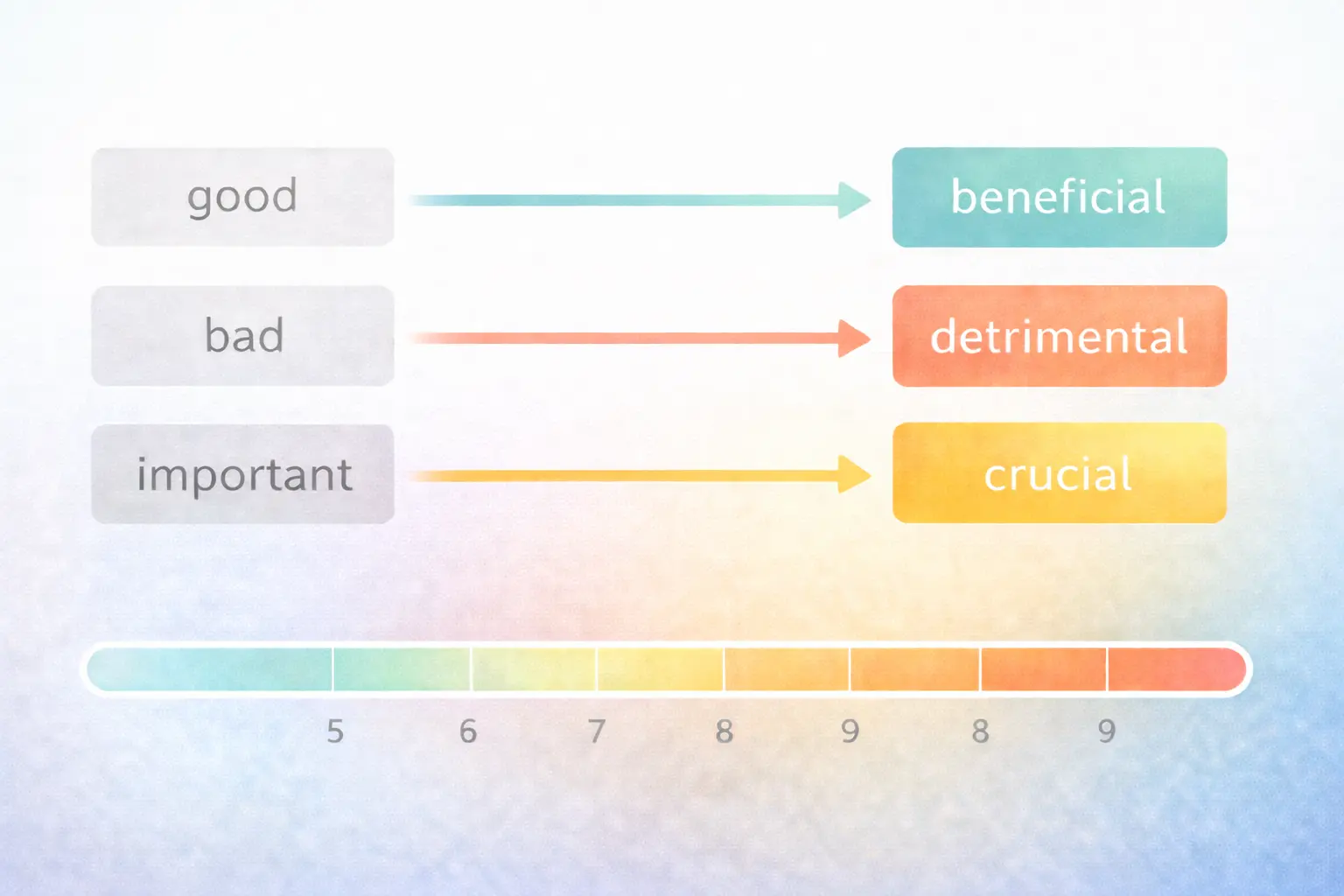
A maneira mais rápida de saltar da Banda 6 para a Banda 7+ no IELTS não é gramática — é variedade de vocabulário. Os examinadores procuram especificamente por sinônimos e paráfrases. Se você escrever “important” cinco vezes em uma redação, sua nota em Lexical Resource ficará na Banda 5–6. Se você usar “important,” “significant,” “crucial,” “vital” e “essential” — você demonstra a variedade que a Banda 7–9 exige.
Este guia oferece mais de 200 sinônimos prontos para uso, organizados pelas palavras que os candidatos ao IELTS mais usam em excesso. Cada sinônimo inclui o nível de formalidade e uma frase de exemplo para você saber exatamente quando usá-lo — no Writing Task 1, no Task 2 ou no Speaking.
- Total de sinônimos: 200+
- Organizados por: 30 palavras usadas em excesso com 5–8 sinônimos cada
- Ideal para: IELTS Writing Task 1 e 2, Speaking Partes 2 e 3, preparação para Banda 7–9
- Bônus: Estratégias de paráfrase para cada seção do IELTS
Por que Sinônimos Importam Mais do que Qualquer Outra Habilidade no IELTS
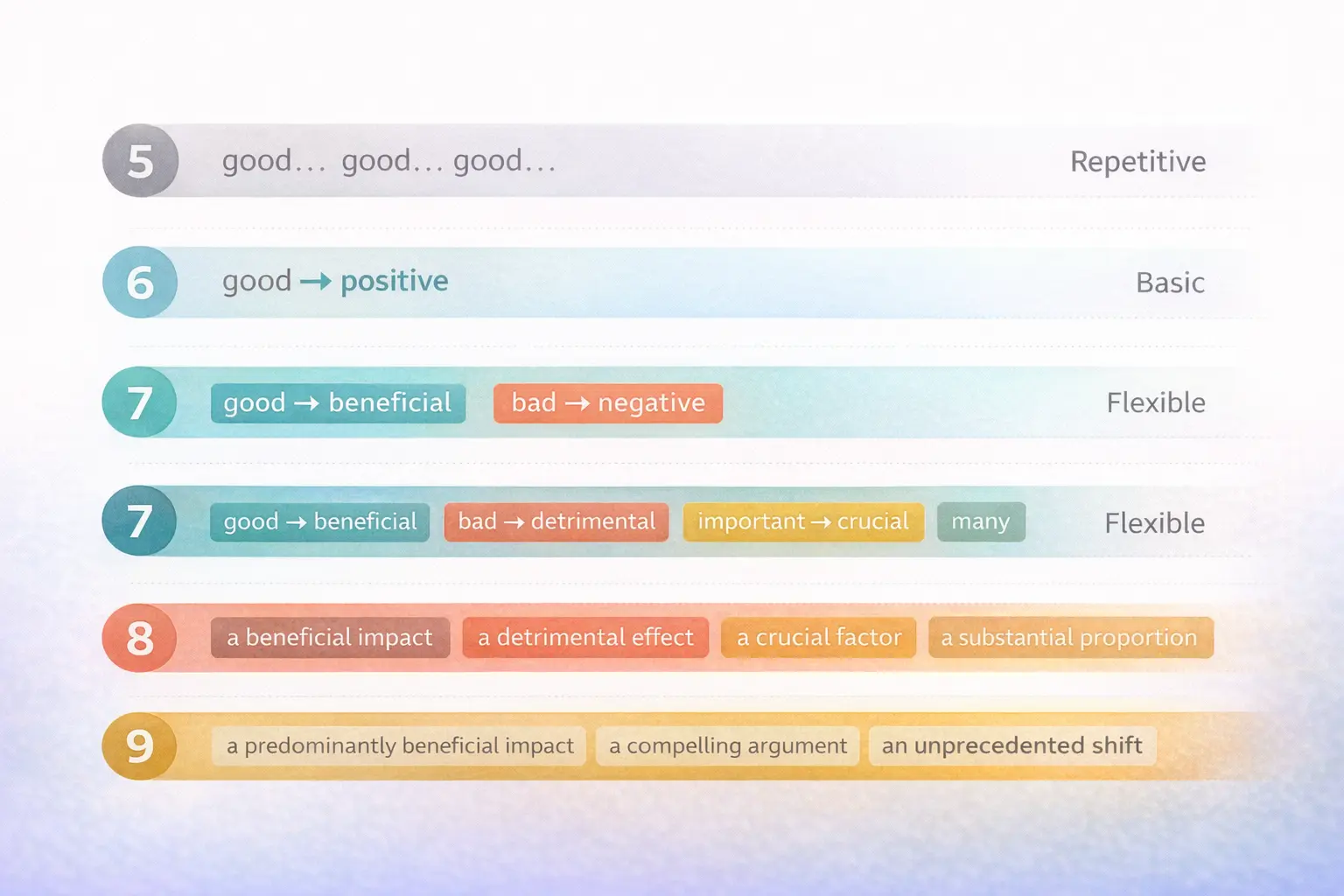
O IELTS avalia seu vocabulário em uma categoria chamada Lexical Resource — que vale 25% das suas notas de Writing e Speaking. Veja o que cada banda exige:
| Banda | Descrição do Lexical Resource |
|---|---|
| 5 | Vocabulário limitado; repetição frequente das mesmas palavras |
| 6 | Vocabulário adequado, mas com alguma imprecisão; tenta parafrasear |
| 7 | Vocabulário suficiente para flexibilidade e precisão; usa palavras menos comuns |
| 8 | Ampla variedade usada de forma natural e precisa; erros raros |
| 9 | Flexibilidade total e uso preciso; muito natural e sofisticado |
O salto da Banda 6 para a Banda 7 se resume a uma coisa: você consegue dizer a mesma ideia usando palavras diferentes? Isso é paráfrase, e sinônimos são a ferramenta que a torna possível.
Sinônimos para o IELTS Writing
As 15 Palavras Mais Usadas em Excesso nas Redações do IELTS
Essas palavras aparecem em quase todas as redações de Banda 6. Substitua-as e sua pontuação sobe imediatamente.
1. Important (importante)
| Sinônimo | Formalidade | Melhor para | Exemplo |
|---|---|---|---|
| significant | formal | Task 2 | Education plays a significant role in economic development. |
| crucial | formal | Task 2 | Time management is crucial for exam success. |
| vital | formal | Task 2 | Clean water is vital for public health. |
| essential | neutro | Task 1 e 2 | It is essential to consider both sides of the argument. |
| key | neutro | Task 1 e 2 | Tourism is a key driver of the local economy. |
| fundamental | formal | Task 2 | Freedom of speech is a fundamental human right. |
| pivotal | formal | Task 2 (Banda 8+) | Technology has played a pivotal role in transforming education. |
2. Increase (aumentar)
| Sinônimo | Formalidade | Melhor para | Exemplo |
|---|---|---|---|
| rise | neutro | Task 1 | Sales rose sharply in the third quarter. |
| grow | neutro | Task 1 e 2 | The population grew by 15% over the decade. |
| surge | formal | Task 1 | Demand surged during the holiday season. |
| climb | neutro | Task 1 | Unemployment climbed to 8% in 2024. |
| soar | formal | Task 1 | House prices soared in major cities. |
| expand | formal | Task 2 | The government plans to expand public transport. |
| escalate | formal | Task 2 | Costs escalated beyond the original budget. |
3. Decrease (diminuir)
| Sinônimo | Formalidade | Melhor para | Exemplo |
|---|---|---|---|
| decline | formal | Task 1 e 2 | The birth rate has declined steadily since 2010. |
| drop | neutro | Task 1 | Temperatures dropped to below zero overnight. |
| fall | neutro | Task 1 | Exports fell by 12% compared to the previous year. |
| diminish | formal | Task 2 | Interest in traditional media has diminished significantly. |
| shrink | neutro | Task 1 e 2 | The workforce shrank due to automation. |
| plummet | formal | Task 1 | Tourism numbers plummeted during the pandemic. |
| dwindle | formal | Task 2 | Natural resources continue to dwindle. |
4. Show (para Task 1 — descrição de dados)
| Sinônimo | Formalidade | Melhor para | Exemplo |
|---|---|---|---|
| illustrate | formal | Task 1 | The chart illustrates the trends in energy consumption. |
| demonstrate | formal | Task 1 | The data demonstrates a clear correlation. |
| indicate | formal | Task 1 | The figures indicate a significant shift in consumer behavior. |
| reveal | formal | Task 1 | The survey reveals that 60% of respondents prefer online shopping. |
| depict | formal | Task 1 | The graph depicts changes in population over 50 years. |
| present | neutro | Task 1 | The table presents a comparison of five countries. |
5. Many / A lot of (muitos / muito)
| Sinônimo | Formalidade | Melhor para | Exemplo |
|---|---|---|---|
| numerous | formal | Task 2 | Numerous studies support this conclusion. |
| a significant number of | formal | Task 1 e 2 | A significant number of students dropped out. |
| a considerable amount of | formal | Task 2 | A considerable amount of research has been conducted. |
| the majority of | formal | Task 1 e 2 | The majority of respondents agreed with the statement. |
| a substantial proportion of | formal | Task 1 | A substantial proportion of the budget was allocated to defense. |
| widespread | formal | Task 2 | There is widespread concern about air pollution. |
6. Good (bom)
| Sinônimo | Formalidade | Melhor para | Exemplo |
|---|---|---|---|
| beneficial | formal | Task 2 | Exercise is beneficial for both physical and mental health. |
| advantageous | formal | Task 2 | Living near the city center is advantageous for commuters. |
| positive | neutro | Task 2 | Technology has had a positive impact on education. |
| favorable | formal | Task 2 | Economic conditions were favorable for small businesses. |
| effective | neutro | Task 2 | Online learning can be an effective alternative to classroom teaching. |
7. Bad (ruim)
| Sinônimo | Formalidade | Melhor para | Exemplo |
|---|---|---|---|
| detrimental | formal | Task 2 | Excessive screen time is detrimental to children’s development. |
| adverse | formal | Task 2 | Pollution has adverse effects on public health. |
| harmful | neutro | Task 2 | Processed food can be harmful if consumed regularly. |
| negative | neutro | Task 2 | Social media can have a negative influence on self-esteem. |
| damaging | neutro | Task 2 | The scandal was damaging to the company’s reputation. |
8. Think / Believe (pensar / acreditar)
| Sinônimo | Formalidade | Melhor para | Exemplo |
|---|---|---|---|
| argue | formal | Task 2 | Some experts argue that AI will replace most jobs. |
| contend | formal | Task 2 (Banda 8+) | Critics contend that the policy has failed. |
| maintain | formal | Task 2 | The government maintains that the economy is recovering. |
| assert | formal | Task 2 | The report asserts that climate change is accelerating. |
| hold the view that | formal | Task 2 | Many educators hold the view that exams are outdated. |
| be of the opinion that | formal | Task 2 | I am of the opinion that education should be free. |
9. Problem (problema)
| Sinônimo | Formalidade | Melhor para | Exemplo |
|---|---|---|---|
| issue | neutro | Task 2 | Unemployment is a pressing issue in many countries. |
| challenge | neutro | Task 2 | Climate change is the biggest challenge of our time. |
| concern | formal | Task 2 | There is growing concern about data privacy. |
| drawback | neutro | Task 2 | One drawback of remote work is social isolation. |
| obstacle | formal | Task 2 | Language barriers are a major obstacle for immigrants. |
| dilemma | formal | Task 2 | This creates a moral dilemma for policymakers. |
10. Give / Provide (dar / fornecer)
| Sinônimo | Formalidade | Melhor para | Exemplo |
|---|---|---|---|
| offer | neutro | Task 2 | Universities offer a wide range of courses. |
| supply | neutro | Task 1 e 2 | The factory supplies components to three countries. |
| deliver | neutro | Task 2 | The program delivers training to over 5,000 teachers. |
| present | formal | Task 1 | The data presents a clear picture of the trend. |
| yield | formal | Task 1 e 2 | The investment yielded a 15% return. |
11. Change (mudar)
| Sinônimo | Formalidade | Melhor para | Exemplo |
|---|---|---|---|
| transform | formal | Task 2 | Technology has transformed the way people communicate. |
| alter | formal | Task 2 | Climate change is altering weather patterns worldwide. |
| shift | neutro | Task 1 e 2 | There has been a significant shift toward renewable energy. |
| modify | formal | Task 2 | The government modified the policy after public outcry. |
| evolve | neutro | Task 2 | Consumer behavior has evolved rapidly in the digital age. |
| fluctuate | formal | Task 1 | Oil prices fluctuated throughout the year. |
12. People (pessoas)
| Sinônimo | Formalidade | Melhor para | Exemplo |
|---|---|---|---|
| individuals | formal | Task 2 | Individuals should take responsibility for their health. |
| citizens | formal | Task 2 | Citizens have the right to access public services. |
| the population | formal | Task 1 e 2 | The population of urban areas is growing. |
| residents | neutro | Task 2 | Local residents opposed the construction project. |
| the public | formal | Task 2 | The public has become more aware of environmental issues. |
| society | formal | Task 2 | Society benefits when education is accessible to all. |
13. Help (ajudar)
| Sinônimo | Formalidade | Melhor para | Exemplo |
|---|---|---|---|
| assist | formal | Task 2 | Technology can assist students with learning disabilities. |
| facilitate | formal | Task 2 (Banda 8+) | Online platforms facilitate communication across borders. |
| enable | formal | Task 2 | Scholarships enable students from low-income families to attend university. |
| support | neutro | Task 2 | Governments should support small businesses through tax incentives. |
| contribute to | formal | Task 2 | Regular exercise contributes to better mental health. |
14. Cause (causar)
| Sinônimo | Formalidade | Melhor para | Exemplo |
|---|---|---|---|
| lead to | neutro | Task 2 | Poverty often leads to higher crime rates. |
| result in | formal | Task 2 | The policy resulted in widespread job losses. |
| give rise to | formal | Task 2 (Banda 8+) | Rapid urbanization has given rise to numerous social problems. |
| trigger | formal | Task 2 | The announcement triggered a sharp decline in stock prices. |
| bring about | formal | Task 2 | Technological advances brought about a revolution in communication. |
| stem from | formal | Task 2 | Many health problems stem from a sedentary lifestyle. |
15. About / Approximately (aproximadamente)
| Sinônimo | Formalidade | Melhor para | Exemplo |
|---|---|---|---|
| approximately | formal | Task 1 | Approximately 45% of respondents chose option A. |
| roughly | neutro | Task 1 | Roughly half of the population lives in urban areas. |
| around | neutro | Task 1 | Around 30 million tourists visit the country annually. |
| just over / just under | neutro | Task 1 | Just over 60% of students passed the exam. |
| in the region of | formal | Task 1 | The cost was in the region of $5 million. |
Sinônimos para o IELTS Speaking
O Speaking exige sinônimos diferentes do Writing. Você precisa de palavras que soem naturais na conversa, não de vocabulário acadêmico. Usar “facilitate” no Speaking soa artificial — prefira “help” ou “make it easier”.
16. Very (muito)
| Sinônimo | Registro | Exemplo |
|---|---|---|
| extremely | neutro | The exam was extremely difficult. |
| incredibly | informal | The food there is incredibly good. |
| remarkably | formal | She is remarkably talented for her age. |
| exceptionally | formal | The weather was exceptionally warm this year. |
| particularly | neutro | I am particularly interested in marine biology. |
| highly | neutro | It is a highly competitive program. |
17. Like / Enjoy (gostar)
| Sinônimo | Registro | Exemplo |
|---|---|---|
| enjoy | neutro | I really enjoy hiking in the mountains. |
| be fond of | levemente formal | I am quite fond of Italian cuisine. |
| be keen on | neutro (britânico) | I have always been keen on photography. |
| be passionate about | neutro | I am passionate about environmental conservation. |
| be into | informal | I am really into Korean dramas at the moment. |
| appreciate | neutro | I appreciate good architecture when I travel. |
18. Interesting (interessante)
| Sinônimo | Registro | Exemplo |
|---|---|---|
| fascinating | neutro | The documentary about deep-sea creatures was fascinating. |
| captivating | formal | The speaker gave a captivating presentation. |
| compelling | formal | The book presents a compelling argument for change. |
| thought-provoking | formal | It was a thought-provoking discussion. |
| intriguing | neutro | I find the history of ancient civilizations intriguing. |
| engaging | neutro | The course was highly engaging. |
19. Difficult (difícil)
| Sinônimo | Registro | Exemplo |
|---|---|---|
| challenging | neutro | The project was challenging but rewarding. |
| demanding | neutro | It is a very demanding job that requires long hours. |
| tough | informal | It was a tough decision to leave my hometown. |
| daunting | formal | Moving to a foreign country can be quite daunting. |
| complex | formal | The issue is more complex than it appears. |
20. Happy (feliz)
| Sinônimo | Registro | Exemplo |
|---|---|---|
| delighted | neutro | I was delighted to receive the scholarship. |
| thrilled | neutro | I am thrilled about starting my new job. |
| pleased | neutro | I am really pleased with my progress. |
| content | neutro | I feel content with my life at the moment. |
| ecstatic | informal | I was ecstatic when I heard the news. |
| grateful | neutro | I am grateful for the opportunities I have had. |
21. Big (grande)
| Sinônimo | Registro | Exemplo |
|---|---|---|
| enormous | neutro | There is an enormous demand for affordable housing. |
| vast | formal | The country has vast natural resources. |
| substantial | formal | They made a substantial investment in renewable energy. |
| immense | formal | The project required an immense amount of effort. |
| considerable | formal | There is a considerable difference between the two systems. |
22. Small (pequeno)
| Sinônimo | Registro | Exemplo |
|---|---|---|
| slight | neutro | There was a slight improvement in test scores. |
| marginal | formal | The difference in results was marginal. |
| modest | neutro | The country saw modest economic growth. |
| negligible | formal | The environmental impact was negligible. |
| minor | neutro | It was a minor issue that was quickly resolved. |
23. Fast (rápido)
| Sinônimo | Registro | Exemplo |
|---|---|---|
| rapid | formal | There has been rapid growth in the tech industry. |
| swift | formal | The government took swift action. |
| prompt | formal | They received a prompt response to their complaint. |
| dramatic (para mudanças) | neutro | There was a dramatic increase in online shopping. |
| steep (para dados) | neutro | The graph shows a steep rise in prices. |
24. Slow (lento)
| Sinônimo | Registro | Exemplo |
|---|---|---|
| gradual | neutro | There was a gradual improvement over the decade. |
| steady | neutro | The recovery has been slow but steady. |
| moderate | neutro | Growth was moderate compared to the previous year. |
| sluggish | formal | Economic growth remained sluggish throughout the period. |
Sinônimos para Banda 9 — Paráfrase Avançada
Estas são expressões de alto nível que diferenciam a Banda 7–8 da Banda 9. Use-as com moderação — uma ou duas por redação ou resposta no Speaking.
25. As a result / Therefore (como resultado / portanto)
| Sinônimo | Exemplo |
|---|---|
| consequently | Consequently, many families were forced to relocate. |
| as a consequence | As a consequence, the government introduced new regulations. |
| thereby | The program reduces waste, thereby lowering operational costs. |
| hence | The evidence is inconclusive; hence, further research is needed. |
| thus | The population is aging, thus increasing demand for healthcare. |
| this has led to | This has led to a significant shift in public opinion. |
26. However / But (no entanto / mas)
| Sinônimo | Exemplo |
|---|---|
| nevertheless | The plan was expensive. Nevertheless, the government approved it. |
| nonetheless | The evidence is limited. Nonetheless, the trend is clear. |
| on the other hand | Urban areas offer more jobs. On the other hand, rural areas offer better quality of life. |
| conversely | Developed nations consume more energy. Conversely, developing nations face energy poverty. |
| despite this | The policy was unpopular. Despite this, it achieved its goals. |
| that said | The system is not perfect. That said, it is a significant improvement. |
27. For example (por exemplo)
| Sinônimo | Exemplo |
|---|---|
| for instance | For instance, Japan has invested heavily in renewable energy. |
| such as | Many countries, such as Norway and Sweden, have strong social safety nets. |
| to illustrate | To illustrate, consider the case of Singapore’s education system. |
| a case in point is | A case in point is the success of Finland’s education model. |
| this is exemplified by | This is exemplified by the rapid growth of e-commerce. |
28. In conclusion (em conclusão)
| Sinônimo | Exemplo |
|---|---|
| to sum up | To sum up, the benefits of public transport outweigh the drawbacks. |
| in summary | In summary, a balanced approach is needed. |
| on balance | On balance, globalization has been positive for developing countries. |
| all things considered | All things considered, the policy has been a success. |
| taking everything into account | Taking everything into account, I believe education is the key. |
29. In my opinion (na minha opinião)
| Sinônimo | Exemplo |
|---|---|
| from my perspective | From my perspective, work-life balance is more important than salary. |
| I would argue that | I would argue that government regulation is necessary. |
| it seems to me that | It seems to me that technology has made life easier overall. |
| I am inclined to believe | I am inclined to believe that traditional education still has value. |
| as I see it | As I see it, the advantages outweigh the disadvantages. |
30. According to (de acordo com)
| Sinônimo | Exemplo |
|---|---|
| research suggests that | Research suggests that bilingual children develop cognitive advantages. |
| studies have shown that | Studies have shown that regular exercise reduces stress. |
| evidence indicates that | Evidence indicates that early intervention is most effective. |
| data reveals that | Data reveals that urban populations are growing rapidly. |
| experts maintain that | Experts maintain that renewable energy is the future. |
Como Parafrasear em Cada Seção do IELTS
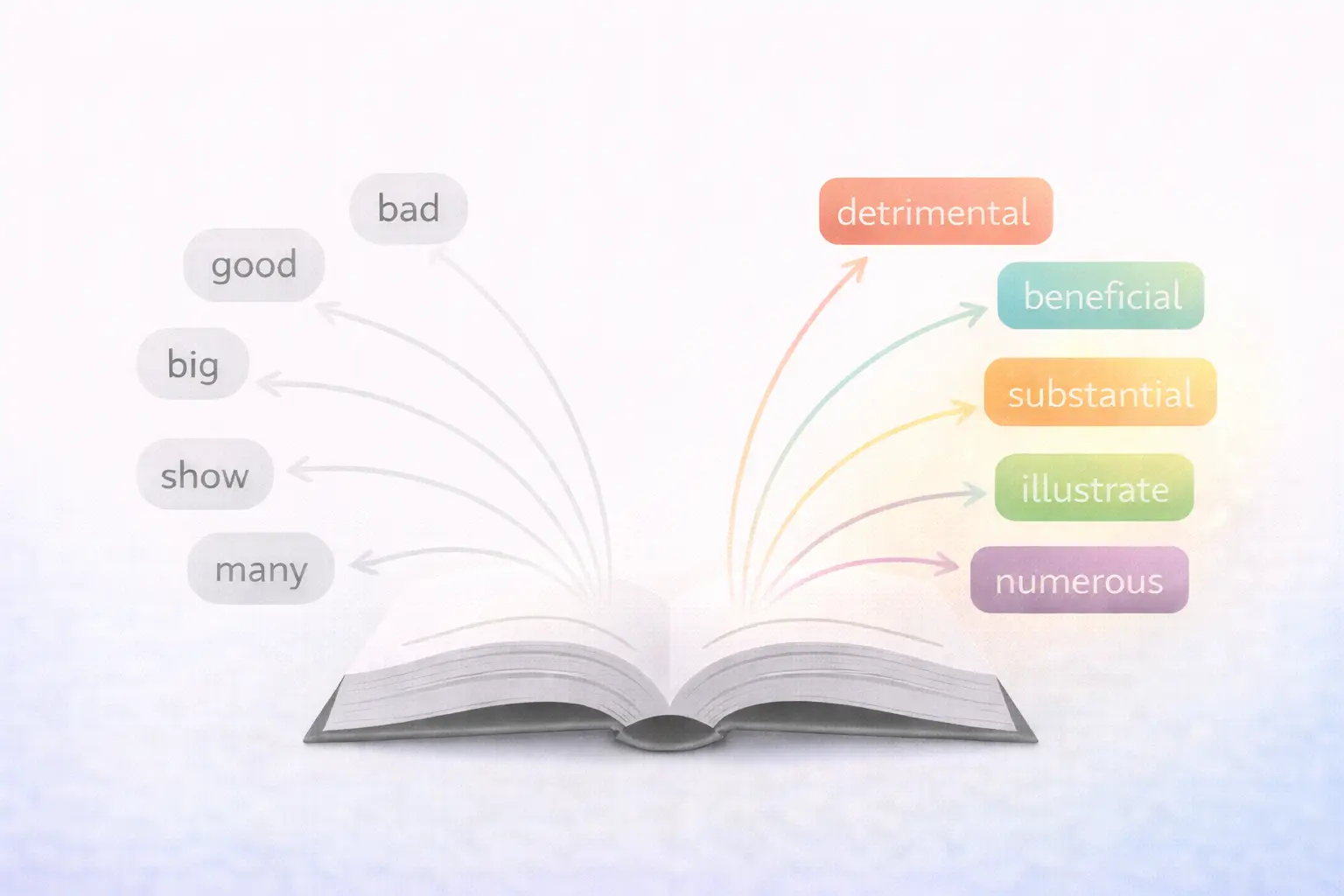
Conhecer sinônimos é apenas metade da habilidade. Você também precisa de estratégias para parafrasear frases inteiras.
Parafraseando no Writing Task 1
No Task 1, você deve parafrasear a pergunta na introdução. Nunca copie as palavras exatas.
Pergunta: The chart below shows the percentage of households with internet access in three countries between 2000 and 2020.
| Abordagem | Versão parafraseada |
|---|---|
| Troca de vocabulário | The chart illustrates the proportion of homes with internet connectivity in three nations over a twenty-year period. |
| Mudança de estrutura | Internet access rates in three countries from 2000 to 2020 are depicted in the chart. |
| Combinação | The given chart compares the share of households that had access to the internet in three different countries between 2000 and 2020. |
Substituições importantes: shows → illustrates/depicts, percentage → proportion/share, households → homes, countries → nations, between 2000 and 2020 → over a twenty-year period.
Parafraseando no Writing Task 2
No Task 2, parafraseie a pergunta da redação na introdução E use sinônimos ao longo do texto para evitar repetição.
Pergunta original: Some people think that governments should spend money on faster public transport. Others think money should be spent on other priorities like education and healthcare.
Introdução parafraseada: It is widely debated whether government funding should be directed toward improving public transport or allocated to other essential services such as education and healthcare. While both sides present valid arguments, I believe that investing in transport infrastructure yields the greatest long-term benefits.
Mudanças feitas: spend money → funding should be directed/allocated, faster → improving, other priorities → other essential services, think → present valid arguments/believe, should be spent → investing in.
Parafraseando no Speaking
No Speaking, o examinador avalia se você consegue reformular a pergunta na resposta sem repeti-la palavra por palavra.
Pergunta: Do you think technology has changed the way people communicate?
| Banda 6 (repete a pergunta) | Banda 7+ (parafraseia) |
|---|---|
| Yes, I think technology has changed the way people communicate because… | Absolutely. I think digital tools have completely transformed how we interact with one another. For instance… |
Principais mudanças: technology → digital tools, changed → transformed, the way people communicate → how we interact with one another.
Vocabulário para Praticar
Aqui estão 25 palavras acadêmicas de nível B2–C1 usadas com frequência como sinônimos no IELTS. Clique em qualquer palavra para ver sua definição, pronúncia e exemplos.
valid
adjetivo
válido, legítimo
Exemplos
- Valid argument supports logical reasoning and conclusion.
- Valid passport allows international travel without problems.
flexible
adjetivo
flexível
Exemplos
- Flexible working arrangements help employees balance work and family life.
- The flexible plastic tube can bend without breaking or cracking.
transmit
verbo
transmitir
Exemplos
- Disease may transmit through contact with surfaces.
- Satellites transmit signals across vast distances effectively.
executive
adjetivo
executivo, gestor
Exemplos
- Executive decisions require careful consideration of multiple factors and consequences.
- The executive branch of government is responsible for implementing laws.
finance
verbo
financiar, investir
Exemplos
- Many students need loans to finance their college education expenses.
- The bank agreed to finance the construction of the new shopping center.
culmination
substantivo
apogeu
Exemplos
- The graduation ceremony was the culmination of four years of hard study.
- Winning the championship represented the culmination of the team's efforts.
gulp
verbo
engolir
Exemplos
- She had to gulp nervously before giving her presentation to the board.
- The thirsty runner gulped down an entire bottle of cold water.
tribe
substantivo
tribo
Exemplos
- Ancient tribe lived in harmony with nature.
- Indigenous tribe preserves traditional customs and languages.
cherished
adjetivo
querido
Exemplos
- His cherished dream of becoming a pilot finally came true.
- The old photograph was her most cherished possession from childhood.
fate
substantivo
destino, sorte, fado
Exemplos
- She believes that fate brought them together at the right moment.
- The explorer's fate remained unknown after he disappeared in the jungle.
territory
substantivo
território
Exemplos
- Animal territory provides food and shelter resources.
- National territory requires protection from foreign invasion.
payable
adjetivo
pagável
Exemplos
- All dues are payable at the end of the month.
- The invoice is payable within 30 days.
serenity
substantivo
serenidade, calma, tranquilidade
Exemplos
- She maintained her serenity despite the chaos.
- The serenity of the lake was calming.
classy
adjetivo
elegante, refinado, sofisticado
Exemplos
- Classy restaurant serves gourmet food in elegant dining atmosphere.
- Her classy appearance impressed everyone at formal business meeting.
revolt
verbo
rebelar-se, revoltar, insurgir
Exemplos
- A revolt broke out in the city center last night.
- The workers decided to revolt against the unfair conditions.
rethink
verbo
repensar, reconsiderar, refletir
Exemplos
- He decided to rethink his position on the issue.
- We need to rethink our strategy for the project.
gypsy
substantivo
cigano, gitano
Exemplos
- Traditional gypsy music features violin and passionate vocals.
- Wandering gypsy caravan traveled through European countryside.
buffoon
substantivo
palhaço, bufão
Exemplos
- Court buffoon entertained royal family with silly performances.
- Don't act like buffoon during important business presentation.
execution
substantivo
execução, implementação
Exemplos
- Perfect execution of the dance routine impressed judges and audience members.
- The execution of the business plan requires careful coordination and timing.
spellbound
adjetivo
hipnotizado, encantado
Exemplos
- Audience sits spellbound during magical performance tonight.
- Children remain spellbound by storyteller's fascinating tales.
pet
adjetivo
adorável, fofo
Exemplos
- Pet project receives extra attention and resources.
- Pet theory explains professor's research focus area.
master
substantivo
mestre
Exemplos
- Apprentices learn traditional crafts from experienced master craftsmen.
- The chess master defeated opponents using brilliant strategic moves.
salvage
substantivo
resgate
Exemplos
- Antique dealer specializes in salvage from demolished buildings.
- Divers recovered valuable salvage from sunken merchant ship.
Erros Comuns com Sinônimos no IELTS
1. Usar sinônimos que mudam o significado. “Big” e “immense” são sinônimos, mas “immense pressure” funciona enquanto “big pressure” não. Sempre verifique as colocações: nem todo sinônimo combina com qualquer frase.
2. Usar sinônimos excessivamente informais no Writing. “Awesome” é sinônimo de “good”, mas não tem lugar em uma redação do IELTS. Prefira sinônimos neutros e formais no Writing; deixe os informais para o Speaking.
3. Forçar muitos sinônimos em um parágrafo. Se toda frase tiver uma palavra incomum, o texto soará artificial. Use 2–3 sinônimos fortes por parágrafo. O restante do vocabulário deve ser claro e natural.
4. Memorizar sinônimos sem contexto. Saber que “facilitate” significa “help” não basta. Você precisa saber que “facilitate” combina com “communication”, “learning” e “development” — mas não com “my friend” ou “my homework”.
5. Usar o mesmo sinônimo “avançado” repetidamente. Se você substituir todo “important” por “significant”, não demonstrou variedade — apenas trocou uma repetição por outra. Varie os sinônimos.
O Que Fazer a Seguir
- Domine os sinônimos de Writing primeiro. Foque nas 15 palavras mais usadas em excesso (important, increase, decrease, show, many, good, bad, think, problem, give, change, people, help, cause e about). Elas cobrem 80% das necessidades de vocabulário nas redações do IELTS.
- Pratique a paráfrase diariamente. Escolha uma pergunta de redação do IELTS por dia e escreva três introduções parafraseadas diferentes. Assim, você desenvolve o hábito de usar sinônimos automaticamente.
- Estude os guias relacionados do IELTS. Para vocabulário por seção, veja nosso vocabulário IELTS Writing Task 1, vocabulário IELTS Writing Task 2, vocabulário IELTS Speaking por tema e o guia completo de vocabulário IELTS.
- Construa seu vocabulário geral. Sinônimos exigem uma base sólida de vocabulário. Leia nosso guia sobre como melhorar seu vocabulário, com 10 métodos comprovados.
- Mire na Banda 8–9. Se seu objetivo é alcançar as notas mais altas, confira nosso vocabulário IELTS Banda 7 para listas de palavras específicas por banda.
FAQ
Quantos sinônimos preciso para o IELTS Banda 7?
Para a Banda 7, você precisa demonstrar uma “variedade suficiente para permitir flexibilidade e precisão”. Na prática, isso significa conhecer 3–4 sinônimos para as 15 palavras mais comuns do IELTS (important, increase, decrease etc.) e usar pelo menos 5–6 itens de vocabulário menos comuns em cada redação. Os mais de 200 sinônimos deste artigo são mais do que suficientes — concentre-se em aprender 50–60 que soem naturais para você.
Qual é a melhor forma de aprender sinônimos para o IELTS?
Aprenda em contexto, não como pares de palavras isolados. Para cada sinônimo, leia a frase de exemplo, observe a colocação e escreva sua própria frase. Depois, pratique reescrevendo perguntas do IELTS com sinônimos diferentes. O uso ativo é melhor do que a memorização passiva.
Posso usar o mesmo sinônimo duas vezes em uma redação?
Sim, mas evite usar o mesmo sinônimo menos comum mais de uma vez em uma redação de 250 palavras. Palavras comuns como “the”, “is” e “however” podem se repetir; mas, se você usar “significant” duas vezes, tente usar “crucial” ou “vital” na segunda ocorrência. O objetivo é justamente variar.
Esses sinônimos são adequados para o IELTS Acadêmico e Geral?
Sim. Todos os sinônimos deste artigo funcionam tanto para o IELTS Academic quanto para o General Training. Os sinônimos de Writing são essenciais para o Task 1 do Academic (gráficos e diagramas) e para o Task 2 em ambas as modalidades. Os sinônimos de Speaking funcionam da mesma forma nos dois tipos de prova.
Qual é a diferença entre sinônimos para Writing e Speaking?
Os sinônimos para Writing tendem a ser mais formais e acadêmicos: “significant”, “detrimental”, “facilitate”. Os sinônimos para Speaking devem soar naturais na conversa: “fascinating”, “challenging”, “passionate”. Usar palavras excessivamente acadêmicas no Speaking pode soar ensaiado e artificial, o que pode até diminuir sua nota.
Como parafrasear a pergunta do IELTS Writing Task 1?
Substitua substantivos e verbos importantes por sinônimos, sem alterar o sentido. “The chart shows” pode virar “The chart illustrates”. “The percentage of” pode virar “The proportion of”. “Between 2000 and 2020” pode virar “over a two-decade period”. Nunca altere números, nomes de países nem o tipo de gráfico — reformule apenas a linguagem descritiva ao redor deles.