Phrasal Verbs com MAKE: Lista Completa com Significados e Exemplos
MAKE é um dos verbos mais versáteis em inglês. Adicione uma preposição ou advérbio — up, out, off, for — e o significado muda completamente. “Make up” sozinho tem cinco significados diferentes dependendo do contexto, e isso é apenas uma combinação.
Este guia cobre todos os principais phrasal verbs com MAKE, organizados por grupos de significado. Cada entrada inclui uma definição clara, frases de exemplo da vida real e notas sobre formalidade. Seja você se preparando para o IELTS, estudando inglês para negócios ou simplesmente querendo soar mais natural — esta é a referência que você precisa.
- Phrasal verbs cobertos: 20+
- Nível: B1–B2 (intermediário a intermediário-avançado)
- Foco: significados, frases de exemplo, notas de uso, erros comuns
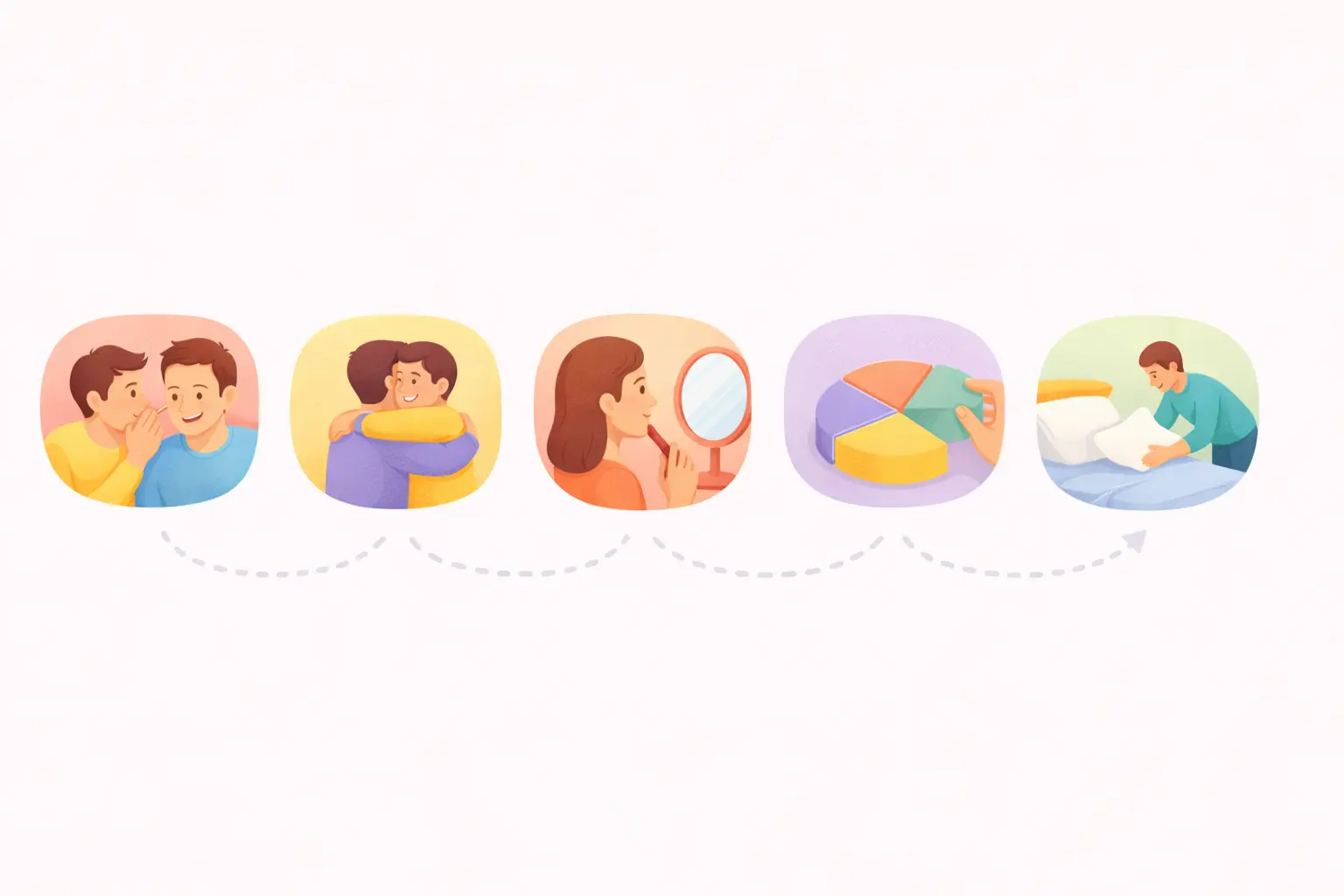
MAKE UP — O Mais Comum (5 Significados)
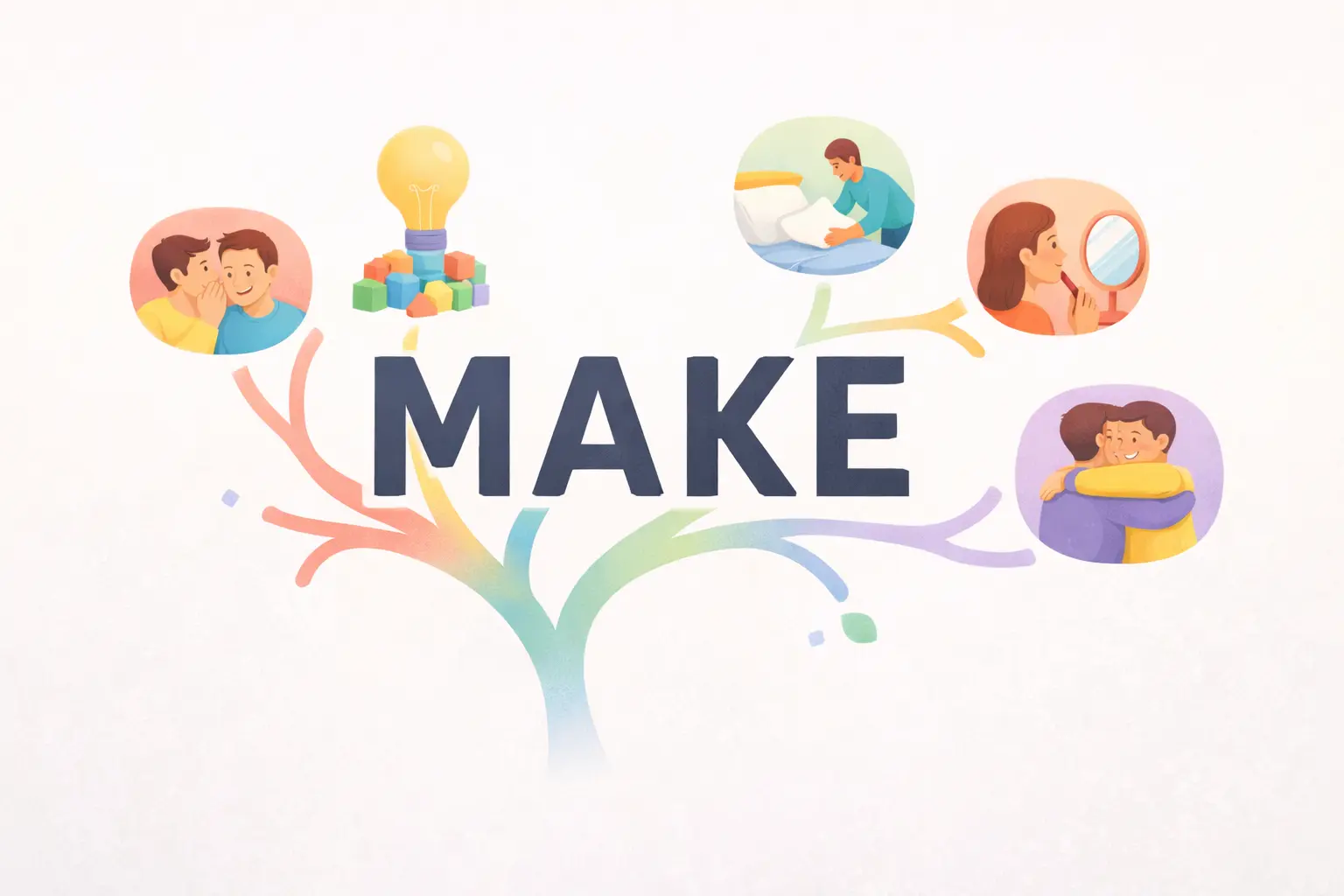
“Make up” é o phrasal verb com MAKE mais pesquisado — e por boa razão. Tem cinco significados distintos, e confundi-los é um dos erros mais comuns que os aprendizes cometem.
1. Inventar (uma história, desculpa ou mentira)
Criar algo falso ou fictício.
She made up an excuse for being late to the meeting. Children love making up stories about imaginary friends. Don’t believe him — he made the whole thing up.
2. Reconciliar após uma discussão
Tornar-se amigos novamente após uma discordância.
They argued about money but made up the next day. Life is short — make up with your sister before it is too late.
3. Aplicar cosméticos
Colocar maquiagem (cosméticos para o rosto).
She usually makes herself up before video calls. The actress was made up to look 20 years older for the role.
4. Compor ou formar um todo
Ser as partes que criam algo.
Women make up 52% of the company’s workforce. Three short stories make up the second part of the book.
5. Preparar ou organizar
Preparar algo (uma cama, um quarto, um pacote).
Could you make up the guest room? We have visitors arriving tonight. The pharmacist made up the prescription while I waited.
Dica de memória: O contexto sempre diz qual significado é pretendido. Olhe para o sujeito e o objeto: pessoa + desculpa = inventar, duas pessoas = reconciliar, porcentagem + grupo = compor.
MAKE OUT — 4 Significados
Outro phrasal verb muito pesquisado com múltiplos significados.
1. Ver, ouvir ou entender com dificuldade
Conseguir perceber ou compreender algo mal.
I could not make out what the sign said from that distance. The handwriting was so bad I could barely make out the words. Can you make out what he is saying? The audio is terrible.
2. Afirmar ou sugerir
Declarar algo, frequentemente implicando dúvida sobre se é verdadeiro.
He makes out that he is an expert, but he only started learning last month. The article makes out that the problem is simple, but it is not.
3. Preencher (um cheque, recibo ou documento)
Preencher ou escrever um documento formal.
Please make the cheque out to “Smith & Associates.” I will make out a receipt for your records.
4. Se sair ou ir bem
Dar-se ou agir de uma forma particular (informal, principalmente inglês americano).
How did you make out at the job interview? We made out pretty well on the sale — doubled our investment.
MAKE FOR — Mover em Direção a ou Contribuir Para
Dois significados relacionados, mas distintos.
1. Mover em direção a um lugar
When the fire alarm went off, everyone made for the exit. After lunch, we made for the coast and arrived by sunset.
2. Contribuir para ou resultar em
Good lighting and comfortable chairs make for a productive workspace. Mixing experienced and junior team members makes for better results.
MAKE OFF / MAKE OFF WITH — Escapar e Roubar
Make off
Sair rapidamente, especialmente para escapar.
The thieves made off before the police arrived. He made off through the back door when he heard the sirens.
Make off with
Roubar algo e escapar com ele.
Someone made off with my laptop while I was getting coffee. The hackers made off with millions in cryptocurrency.
MAKE UP FOR — Compensar
Compensar algo perdido, perdido ou feito de forma errada.
He worked overtime to make up for the days he missed. The beautiful scenery more than made up for the long drive. She bought him dinner to make up for forgetting his birthday.
Isso é diferente de “make up” (reconciliar). “Make up for” sempre envolve compensação — substituir algo negativo por algo positivo.
MAKE DO (WITH) — Se Virar com Menos
Se virar com o que está disponível, mesmo que não seja o ideal.
We do not have a projector, so we will have to make do with a laptop screen. During the crisis, families had to make do with very little. There is no fresh bread — we will have to make do with what is in the freezer.
Nota: Esta frase usa “do”, não “due”. Um erro de escrita comum é escrever “make due with.”
MAKE INTO — Transformação
Mudar ou transformar algo em algo diferente.
They made the old warehouse into a modern art gallery. The book was made into a film in 2024. With some paint and new furniture, we can make this room into a proper office.
MAKE OF — Interpretar ou Entender
Pensar sobre ou interpretar algo. Frequentemente usado em perguntas.
What do you make of the new proposal? I do not know what to make of his behavior lately. What did you make of the film? I thought it was brilliant.
Phrasal Verbs Completos com MAKE — Referência Rápida
| Phrasal Verb | Significado | Nível | Exemplo |
|---|---|---|---|
| make up | inventar (uma história/desculpa) | B1 | He made up the story. |
| make up | reconciliar | B1 | They made up after the fight. |
| make up | aplicar cosméticos | B1 | She made herself up for the party. |
| make up | compor / formar | B2 | Imports make up 60% of supply. |
| make up | preparar (uma cama/quarto) | B2 | Can you make up the spare room? |
| make out | perceber com dificuldade | B2 | I can’t make out the writing. |
| make out | afirmar / sugerir | B2 | He makes out he’s innocent. |
| make out | preencher (um cheque/recibo) | B2 | Make the cheque out to me. |
| make out | se sair / ir bem | B2 | How did you make out? |
| make for | mover em direção a | B2 | We made for the nearest exit. |
| make for | contribuir para / resultar em | B2 | This makes for good reading. |
| make off | escapar rapidamente | B2 | The thief made off on foot. |
| make off with | roubar e escapar | B2 | He made off with the cash. |
| make up for | compensar | B1 | She made up for lost time. |
| make do (with) | se virar com menos | B2 | We’ll make do with what we have. |
| make into | transformar | B2 | They made it into a museum. |
| make of | interpretar / pensar sobre | B2 | What do you make of this? |
| make over | renovar / transformar aparência | B2 | They made over the entire shop. |
| make towards | mover em direção a | B2 | She made towards the door. |
| make it | ter sucesso / chegar a tempo | B1 | We barely made it to the airport. |
Vocabulário para Praticar
worthless
adjetivo
sem valor
Exemplos
- Don't let anyone make you feel worthless or unimportant.
- The broken watch became completely worthless and couldn't be repaired.
formally
advérbio
formalmente
Exemplos
- Students must formally register for classes before the semester begins.
- The new president will be formally inaugurated next month in the capital.
border
substantivo
fronteira, borda
Exemplos
- The garden had a beautiful flower border along the path.
- They crossed the border between France and Germany.
unload
verbo
descarregar, esvaziar
Exemplos
- Ship crew must unload containers at port.
- Workers unload cargo from delivery truck efficiently.
stress
verbo
estressar, sobrecarregar, pressionar
Exemplos
- Heavy workload may stress employees beyond limits.
- Teacher will stress importance of homework completion.
willingly
advérbio
de forma voluntária
Exemplos
- He willingly shared his knowledge with younger students.
- The volunteers worked willingly without expecting any payment.
prospect
substantivo
perspectiva, possibilidade
Exemplos
- Economic prospect looks optimistic for next year.
- Job prospect improves with additional education training.
willingness
substantivo
disposição
Exemplos
- Her willingness to learn impressed all the teachers.
- The company values employees' willingness to work as a team.
timeliness
substantivo
pontualidade
Exemplos
- Project timeliness determines success in competitive business environment.
- Report timeliness affects decision making processes significantly.
calm
adjetivo
calmo
Exemplos
- She remained calm despite the stressful situation at work.
- The calm ocean reflected the beautiful colors of the sunset.
bewilderment
substantivo
confusão
Exemplos
- She stared in bewilderment at the unexpected test results.
- The tourist's bewilderment was obvious when he got lost downtown.
brick
substantivo
tijolo
Exemplos
- He's been a real brick during this crisis.
- The house was built with traditional red brick.
revise
verbo
revisar, estudar
Exemplos
- Author must revise manuscript before publication deadline.
- Student will revise lessons before final examination.
lap
substantivo
colo, região
Exemplos
- The cat curled up comfortably on her lap while reading.
- The runner completed another lap around the track successfully.
transfer
verbo
transferir
Exemplos
- Bank will transfer money between accounts quickly.
- Student may transfer to different university program.
max
substantivo
Max
Exemplos
- Students can borrow max of five books from library.
- The speed limit max on highway is seventy miles per hour.
exhausted
adjetivo
exausto, cansado
Exemplos
- After running the marathon, she felt completely exhausted and needed to rest.
- The exhausted workers finally finished their twelve-hour shift at the factory.
diligent
adjetivo
diligente, aplicado
Exemplos
- Diligent students typically achieve better grades through consistent hard work.
- The diligent researcher spent years collecting data for the scientific study.
independent
adjetivo
independente
Exemplos
- She's very independent and prefers to solve problems on her own.
- The independent research confirmed the results of the original study.
impolitely
advérbio
grosseiramente, de modo rude
Exemplos
- He spoke impolitely to the waiter and made everyone uncomfortable.
- She impolitely refused to answer the reporter's questions.
characterize
verbo
caracterizar
Exemplos
- Honesty and integrity characterize his approach to business dealings.
- The report characterizes the current economic situation as generally stable.
yell
verbo
gritar
Exemplos
- Don't yell at the children when they make innocent mistakes.
- The coach had to yell instructions over the crowd noise.
aggressive
adjetivo
agressivo, hostil
Exemplos
- Some drivers become aggressive when stuck in heavy traffic for hours.
- The aggressive marketing campaign helped increase sales by thirty percent last quarter.
alphabet
substantivo
alfabeto
Exemplos
- Children learn the alphabet before they can read complete sentences.
- The English alphabet has twenty-six letters from A to Z.
Como Praticar Phrasal Verbs com MAKE
1. Comece com os 5 principais. Não tente memorizar todos os 20 de uma vez. Comece com make up (inventar), make out (entender), make for (mover em direção a), make up for (compensar) e make do with (se virar). Esses cobrem 80% do uso no mundo real.
2. Escreva suas próprias frases. Para cada phrasal verb, escreva 2–3 frases sobre a sua própria vida. “I made up an excuse when I was late to work” é mais memorável do que ler o exemplo de outra pessoa.
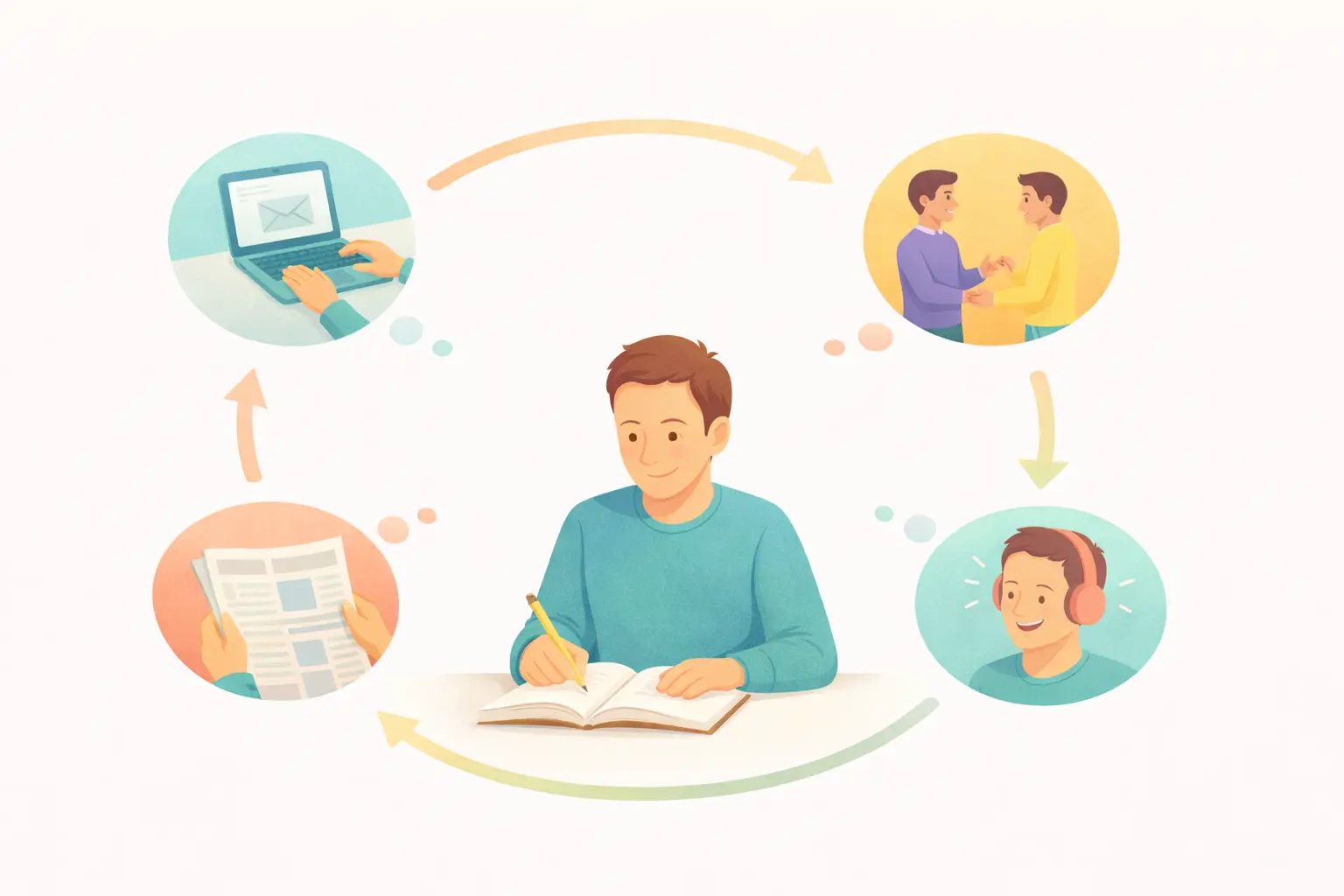
3. Fique atento ao contexto. Podcasts de negócios, programas de TV e artigos de notícias estão cheios de phrasal verbs com MAKE. Quando você ouvir um, pause e identifique qual significado está sendo usado.
4. Teste a si mesmo com pistas de contexto. Cubra a coluna “significado” na tabela acima e tente adivinhar a partir da frase de exemplo sozinha. Isso constrói a habilidade de entender phrasal verbs pelo contexto.
Erros Comuns com Phrasal Verbs com MAKE
1. Confundir os significados de “make up”. “We made up” (reconciliamos) vs. “We made it up” (inventamos). O pronome “it” muda completamente o significado. Sem um objeto, “make up” geralmente significa reconciliar. Com um objeto específico, significa inventar.
2. Escrever “make due” em vez de “make do”. Este é um dos erros de escrita mais comuns. A frase correta é “make do with” — nunca “make due with.”
3. Confundir “make out” e “find out”. “Make out” = perceber com dificuldade (“I can’t make out the text”). “Find out” = descobrir informações (“I found out the truth”). Não são intercambiáveis.
4. Esquecer “for” em “make up for”. “I’ll make up the lost time” (ambíguo — pode significar “compor”). “I’ll make up for the lost time” (claramente significa compensar). A preposição “for” é essencial.
5. Usar “make of” quando você quer dizer “make from”. “What do you make of this?” = Qual é a sua opinião? “What is this made from?” = De que material é feito? Estas são perguntas completamente diferentes.
O Que Ler a Seguir
-
Aprenda os 100 phrasal verbs essenciais. Para a lista completa dos phrasal verbs mais comuns em todos os tópicos, veja nosso guia de 100 phrasal verbs com significados e frases.
-
Mais phrasal verbs. Para phrasal verbs avançados C1–C2 em todos os contextos, veja nosso guia de phrasal verbs avançados.
-
Phrasal verbs para o trabalho. Se você usa inglês profissionalmente, nosso guia de phrasal verbs de negócios cobre 60+ frases específicas do ambiente de trabalho.
-
Pratique phrasal verbs. Navegue pela nossa biblioteca de phrasal verbs para prática interativa.
-
Melhore o seu vocabulário. Leia nosso guia sobre como melhorar o seu vocabulário com 10 métodos comprovados.
FAQ
Quantos phrasal verbs MAKE tem?
MAKE tem aproximadamente 20 phrasal verbs distintos, mas vários deles — especialmente “make up” e “make out” — têm múltiplos significados. No total, MAKE produz mais de 30 combinações de significado diferentes.
Qual é a diferença entre “make up” e “make up for”?
“Make up” significa reconciliar (“They made up after arguing”), inventar (“She made up a story”) ou compor (“Water makes up 70% of the body”). “Make up for” sempre significa compensar — substituir algo negativo por algo positivo: “He made up for his mistake by working extra hours.”
O que significa “make out”?
“Make out” tem quatro significados principais: (1) ver ou entender com dificuldade — “I can’t make out the writing on the sign”; (2) afirmar ou sugerir — “He makes out that he’s rich”; (3) preencher um documento formal — “Make the cheque out to my company”; (4) se sair ou ir bem — “How did you make out at the interview?”
Os phrasal verbs com MAKE são formais ou informais?
A maioria é neutra e adequada tanto para inglês falado quanto escrito. “Make for” (contribuir para), “make up” (compor) e “make out” (preencher um documento) funcionam bem na escrita formal. “Make off with” (roubar) e “make out” (ir bem) são mais informais.
Qual é a melhor maneira de memorizar phrasal verbs com MAKE?
Foque em um grupo de significado de cada vez. Comece com os cinco significados de “make up” pois é o mais comum. Escreva frases de exemplo sobre suas próprias experiências e pratique usá-las na conversa dentro de 24 horas. A repetição espaçada consolida na memória de longo prazo.