Từ đồng nghĩa và trái nghĩa tiếng Anh: Hướng dẫn đầy đủ với hơn 1.000 cặp từ
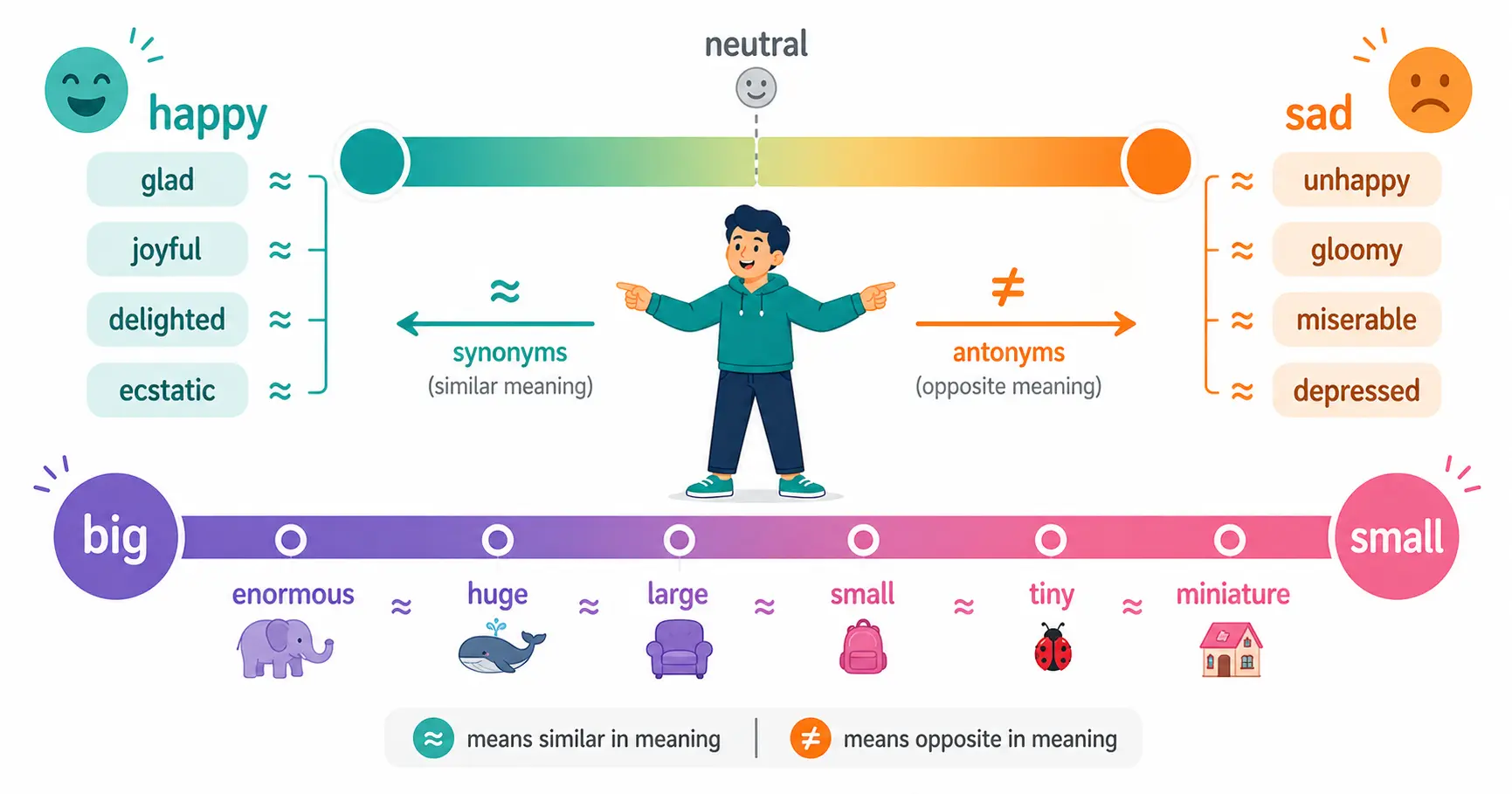
Mỗi từ tiếng Anh đều nằm trong một mạng lưới các mối quan hệ. “Happy” gắn với “joyful”, “content”, “elated” và “cheerful” — những từ có chung ý nghĩa. Từ này cũng liên quan đến “sad”, “miserable”, “unhappy” và “gloomy” — những từ mang nghĩa trái ngược. Nhóm đầu là các từ đồng nghĩa. Nhóm thứ hai là các từ trái nghĩa. Hai nhóm này tạo nên nền tảng cho khả năng sử dụng từ vựng linh hoạt — biết diễn đạt cùng một điều bằng nhiều cách và hiểu được toàn bộ sắc thái ý nghĩa giữa hai thái cực.
Điều này có ý nghĩa rất thực tế. Trong IELTS, tiêu chí “Vốn từ vựng” đánh giá cao việc dùng từ đồng nghĩa thay vì lặp lại cùng một từ. Trong văn viết học thuật, diễn đạt lại bằng từ đồng nghĩa cho thấy tư duy chín chắn. Trong hội thoại hằng ngày, biết các từ trái nghĩa giúp bạn diễn đạt sắc thái: “I’m not happy” (Tôi không vui) khác với “I’m unhappy” (Tôi không hạnh phúc), và lại khác với “I’m miserable” (Tôi khổ sở). Khoảng cách giữa những từ này cũng chính là khoảng cách giữa tiếng Anh cơ bản và thành thạo.
Hướng dẫn này bao gồm:
- từ đồng nghĩa và từ trái nghĩa là gì (kèm định nghĩa và ví dụ rõ ràng);
- hơn 1.000 cặp từ đồng nghĩa và trái nghĩa được sắp xếp theo chủ đề;
- sự khác biệt quan trọng giữa từ đồng nghĩa hoàn toàn và gần nghĩa;
- hơn 100 cặp từ đối nghĩa thông dụng nhất;
- cách dùng từ đồng nghĩa mà không làm thay đổi ý nghĩa;
- hệ thống học để mở rộng vốn từ đồng nghĩa và trái nghĩa.
Từ đồng nghĩa là gì?
Từ đồng nghĩa là một từ có nghĩa giống hoặc gần giống một từ khác. Từ này bắt nguồn từ tiếng Hy Lạp: syn- (cùng nhau) + onoma (tên gọi) — “cùng tên”.
| Từ | Từ đồng nghĩa |
|---|---|
| big | large, huge, enormous, massive, vast |
| happy | glad, joyful, content, pleased, delighted |
| smart | intelligent, clever, bright, sharp, brilliant |
| fast | quick, rapid, swift, speedy |
| important | significant, crucial, vital, essential, key |
Từ đồng nghĩa có hoàn toàn giống nhau không?
Hầu như không bao giờ. Phần lớn từ đồng nghĩa là từ gần nghĩa — chúng có chung nghĩa cốt lõi nhưng khác nhau về mức độ trang trọng, cường độ hoặc ngữ cảnh.
| Từ | Từ đồng nghĩa | Điểm khác biệt |
|---|---|---|
| big | enormous | “Enormous” có mức độ mạnh hơn nhiều so với “big” |
| ask | interrogate | “Interrogate” mang tính trang trọng hoặc gay gắt; “ask” trung tính |
| old | ancient | “Ancient” hàm ý hàng nghìn năm tuổi; “old” có nghĩa chung |
| thin | slim | “Slim” mang sắc thái tích cực; “thin” có thể trung tính hoặc tiêu cực |
| cheap | affordable | “Affordable” mang sắc thái tích cực; “cheap” có thể hàm ý chất lượng thấp |
Sự khác biệt này rất quan trọng. Thay từ đồng nghĩa mà không cân nhắc ngữ cảnh là một trong những lỗi từ vựng lớn nhất của người học. “The teacher interrogated the students” (Giáo viên thẩm vấn học sinh) mang ý nghĩa rất khác “The teacher asked the students” (Giáo viên hỏi học sinh).
Từ trái nghĩa là gì?
Từ trái nghĩa là từ mang nghĩa ngược lại với một từ khác. Từ này bắt nguồn từ tiếng Hy Lạp: anti- (đối lập) + onoma (tên gọi) — “tên gọi đối lập”.
| Từ | Từ trái nghĩa |
|---|---|
| hot | cold |
| big | small |
| happy | sad |
| fast | slow |
| buy | sell |
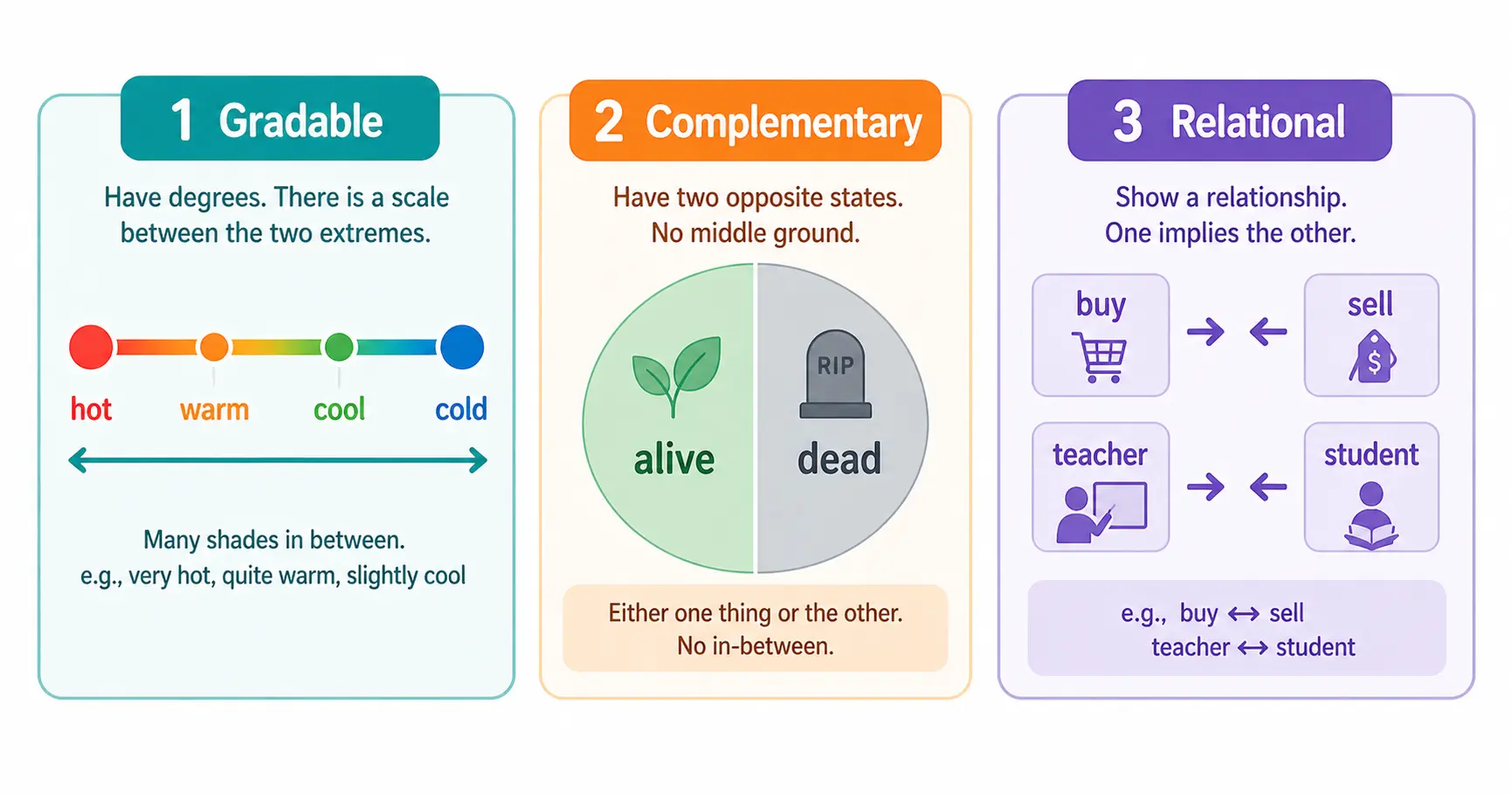
Ba loại từ trái nghĩa
1. Từ trái nghĩa theo mức độ — hai từ nằm ở hai đầu một thang đo, giữa chúng còn có các mức độ khác.
- hot ↔ cold (còn có warm, cool, lukewarm)
- big ↔ small (còn có large, medium, tiny)
- happy ↔ sad (còn có content, neutral, unhappy)
2. Từ trái nghĩa tuyệt đối — hai từ đối lập hoàn toàn, không có trạng thái trung gian.
- alive ↔ dead
- true ↔ false
- on ↔ off
- male ↔ female
3. Từ trái nghĩa tương quan — hai từ đối lập phụ thuộc lẫn nhau; thiếu bên này thì bên kia không thể tồn tại.
- buy ↔ sell
- teacher ↔ student
- parent ↔ child
- give ↔ receive
- husband ↔ wife
Từ đồng nghĩa thay thế cho 50 từ tiếng Anh bị dùng quá nhiều nhất
Đây là những từ mà người học thường dùng quá mức. Thay chúng bằng từ đồng nghĩa là cách nhanh nhất để tiếng Anh nghe thành thạo hơn.
Tính từ
Good — tốt
| Từ đồng nghĩa | Mức độ trang trọng | Ngữ cảnh phù hợp nhất | Ví dụ |
|---|---|---|---|
| excellent | trung tính–trang trọng | chất lượng, thành tích | The service was excellent. |
| outstanding | trang trọng | thành tựu, kết quả | She received outstanding reviews. |
| remarkable | trang trọng | sự việc đáng ngưỡng mộ | His recovery was remarkable. |
| superb | trung tính | chất lượng, trải nghiệm | The food was superb. |
| terrific | thân mật | thể hiện sự hào hứng | That’s a terrific idea! |
| wonderful | trung tính | trải nghiệm tích cực | We had a wonderful time. |
| fine | trung tính | chất lượng chấp nhận được | The weather looks fine today. |
| decent | trung tính–thân mật | chất lượng đạt yêu cầu | He makes a decent salary. |
| splendid | trang trọng/văn chương | chất lượng cao | The view from the top was splendid. |
Bad — tệ
| Từ đồng nghĩa | Mức độ trang trọng | Ngữ cảnh phù hợp nhất | Ví dụ |
|---|---|---|---|
| terrible | trung tính | sắc thái tiêu cực mạnh | The traffic was terrible. |
| awful | trung tính–thân mật | sắc thái tiêu cực mạnh | The movie was awful. |
| dreadful | trang trọng | tình huống rất tệ | The conditions were dreadful. |
| poor | trung tính | chất lượng, thành tích | The essay received a poor grade. |
| unacceptable | trang trọng | tiêu chuẩn, cách cư xử | This behavior is unacceptable. |
| inadequate | trang trọng | chất lượng không đủ | The funding was inadequate. |
| appalling | trang trọng | đáng kinh ngạc/kinh khủng | The hygiene standards were appalling. |
| mediocre | trung tính | ở mức trung bình đến thấp | The restaurant was mediocre. |
Important — quan trọng
| Từ đồng nghĩa | Mức độ trang trọng | Ngữ cảnh phù hợp nhất | Ví dụ |
|---|---|---|---|
| significant | trang trọng | dữ liệu, nghiên cứu | The results show a significant improvement. |
| crucial | trung tính–trang trọng | quyết định then chốt | Time management is crucial for success. |
| vital | trung tính–trang trọng | điều thiết yếu | Water is vital for survival. |
| essential | trung tính | điều cần thiết | Teamwork is essential in this job. |
| key | trung tính | yếu tố cốt lõi | Education is a key factor in economic growth. |
| paramount | rất trang trọng | ưu tiên hàng đầu | Safety is paramount in this industry. |
| pivotal | trang trọng | bước ngoặt | The election was a pivotal moment in history. |
| fundamental | trang trọng | nguyên tắc cơ bản | Trust is fundamental to any relationship. |
Big — lớn
| Từ đồng nghĩa | Mức độ trang trọng | Ngữ cảnh phù hợp nhất | Ví dụ |
|---|---|---|---|
| large | trung tính | kích thước, số lượng | They live in a large house. |
| huge | trung tính | rất lớn | There was a huge crowd at the concert. |
| enormous | trung tính | cực kỳ lớn | The project requires an enormous budget. |
| massive | trung tính–thân mật | rất lớn | The company made a massive profit. |
| vast | trang trọng | diện tích, số lượng | The Sahara is a vast desert. |
| substantial | trang trọng | số lượng, khoản tiền | There was a substantial increase in sales. |
| immense | trang trọng | quy mô, cảm xúc | She felt immense relief after the exam. |
| considerable | trang trọng | số lượng đáng kể | She has considerable experience in the field. |
Small — nhỏ
| Từ đồng nghĩa | Mức độ trang trọng | Ngữ cảnh phù hợp nhất | Ví dụ |
|---|---|---|---|
| tiny | trung tính | kích thước vật lý rất nhỏ | The apartment was tiny — only 20 square meters. |
| minor | trung tính–trang trọng | mức độ quan trọng, nghiêm trọng | It was a minor issue that we fixed quickly. |
| slight | trung tính–trang trọng | mức độ nhỏ | There was a slight delay in the schedule. |
| negligible | trang trọng | không đáng kể | The risk is negligible. |
| modest | trung tính | không lớn; khiêm tốn | They started with a modest investment. |
| minimal | trang trọng | số lượng rất ít | The impact was minimal. |
| compact | trung tính | nhỏ nhưng hiệu quả | The car has a compact design. |
Động từ
Think — nghĩ
| Từ đồng nghĩa | Mức độ trang trọng | Ngữ cảnh phù hợp nhất | Ví dụ |
|---|---|---|---|
| believe | trung tính | ý kiến | I believe education should be free. |
| consider | trang trọng | cân nhắc kỹ | We should consider all the options. |
| assume | trung tính | chưa có bằng chứng | I assumed you knew about the meeting. |
| suppose | trung tính | niềm tin chưa chắc chắn | I suppose you’re right. |
| reckon | thân mật (tiếng Anh Anh) | ý kiến thông thường | I reckon it’ll rain tomorrow. |
| contemplate | trang trọng | suy nghĩ sâu sắc | She contemplated the offer for days. |
| reflect (on) | trang trọng | nhìn lại | He reflected on his years at the company. |
| maintain | trang trọng | niềm tin vững chắc | She maintains that the decision was correct. |
| contend | rất trang trọng | lập luận bảo vệ một quan điểm | Critics contend that the policy is flawed. |
Say — nói
| Từ đồng nghĩa | Mức độ trang trọng | Ngữ cảnh phù hợp nhất | Ví dụ |
|---|---|---|---|
| state | trang trọng | phát biểu chính thức | The report states that crime has decreased. |
| claim | trung tính–trang trọng | khẳng định (có thể đáng ngờ) | He claims he was at home all evening. |
| argue | trung tính–trang trọng | đưa ra lập luận | She argued that the policy was unfair. |
| mention | trung tính | đề cập ngắn gọn | He mentioned the project in passing. |
| point out | trung tính | lưu ý; thu hút sự chú ý | She pointed out several errors in the report. |
| declare | trang trọng | thông báo chính thức | The government declared a state of emergency. |
| suggest | trung tính | đề xuất ý tưởng | I suggest we postpone the meeting. |
| assert | trang trọng | đưa ra khẳng định mạnh mẽ | The CEO asserted that the company was profitable. |
| remark | trung tính–trang trọng | nhận xét | He remarked on the quality of the presentation. |
Show — cho thấy
| Từ đồng nghĩa | Mức độ trang trọng | Ngữ cảnh phù hợp nhất | Ví dụ |
|---|---|---|---|
| demonstrate | trang trọng | bằng chứng, chứng cứ | The study demonstrates a clear link between sleep and performance. |
| illustrate | trang trọng | ví dụ, hình ảnh | The chart illustrates the trend over the last decade. |
| indicate | trang trọng | dữ liệu gợi ý | The results indicate a possible solution. |
| reveal | trung tính–trang trọng | thông tin bị che giấu | The investigation revealed widespread fraud. |
| display | trung tính | trưng bày công khai | The museum displays artifacts from ancient Egypt. |
| exhibit | trang trọng | biểu hiện đặc điểm, phẩm chất | He exhibited remarkable patience during the crisis. |
| highlight | trung tính | nhấn mạnh | The report highlights several key challenges. |
Make — tạo ra
| Từ đồng nghĩa | Mức độ trang trọng | Ngữ cảnh phù hợp nhất | Ví dụ |
|---|---|---|---|
| create | trung tính | tạo ra thứ mới | She created a beautiful sculpture. |
| produce | trung tính–trang trọng | sản xuất, tạo ra kết quả | The factory produces 10,000 units per day. |
| generate | trang trọng | tạo ra kết quả, năng lượng | The campaign generated significant interest. |
| construct | trang trọng | xây dựng | They constructed a bridge in just six months. |
| develop | trung tính–trang trọng | tạo ra theo thời gian | She developed a new training program. |
| establish | trang trọng | thành lập; xây dựng hệ thống | He established the company in 2010. |
| manufacture | trang trọng | sản xuất công nghiệp | The phone is manufactured in South Korea. |
Get — nhận được
| Từ đồng nghĩa | Mức độ trang trọng | Ngữ cảnh phù hợp nhất | Ví dụ |
|---|---|---|---|
| obtain | trang trọng | chính thức có được | She obtained a visa for Australia. |
| acquire | trang trọng | có được quyền sở hữu | He acquired the property in 2018. |
| receive | trung tính–trang trọng | được trao cho | We received your application. |
| gain | trung tính–trang trọng | đạt được | She gained valuable experience abroad. |
| earn | trung tính | thu nhập, sự tôn trọng | He earns a good salary. |
| secure | trang trọng | nỗ lực để đạt được | They secured funding for the project. |
Change — thay đổi
| Từ đồng nghĩa | Mức độ trang trọng | Ngữ cảnh phù hợp nhất | Ví dụ |
|---|---|---|---|
| modify | trang trọng | điều chỉnh | We need to modify the design slightly. |
| alter | trung tính–trang trọng | làm cho khác đi | The dress was altered to fit perfectly. |
| transform | trung tính–trang trọng | thay đổi lớn | Technology has transformed the education sector. |
| adjust | trung tính | thay đổi nhỏ | Adjust the temperature to your preference. |
| revise | trang trọng | cập nhật, sửa đổi | They revised the report after the review. |
| convert | trung tính | thay đổi hình thức hoặc công dụng | They converted the warehouse into apartments. |
| reshape | trang trọng | thay đổi căn bản | The pandemic reshaped how we work. |
Các cặp tính từ trái nghĩa thông dụng
| Từ | Từ trái nghĩa | Ví dụ (từ đầu) | Ví dụ (từ trái nghĩa) |
|---|---|---|---|
| hot | cold | It’s a hot summer day. | It’s a cold winter night. |
| happy | sad | She looked happy at the party. | He seemed sad after the news. |
| fast | slow | He’s a fast runner. | The traffic was painfully slow. |
| young | old | She’s too young to drive. | The building is very old. |
| rich | poor | They live in a rich neighborhood. | Many poor families need support. |
| easy | difficult | The first question was easy. | The final exam was very difficult. |
| early | late | She arrived early for the meeting. | He’s always late. |
| strong | weak | He has a strong grip. | The signal was too weak. |
| deep | shallow | The lake is very deep. | The river is shallow here. |
| wide | narrow | The road was wide enough for two lanes. | The alley was narrow and dark. |
| thick | thin | The walls are very thick. | The ice was dangerously thin. |
| heavy | light | The suitcase was too heavy. | The bag was surprisingly light. |
| loud | quiet | The music was too loud. | The library was quiet. |
| bright | dark | The room was bright and airy. | It was dark outside by 5 PM. |
| smooth | rough | The surface was smooth to the touch. | The road was rough and bumpy. |
| soft | hard | The pillow was wonderfully soft. | The mattress was too hard. |
| wet | dry | My shoes are still wet. | The climate here is hot and dry. |
| full | empty | The restaurant was full. | The parking lot was empty. |
| safe | dangerous | Is this neighborhood safe? | Driving in fog is dangerous. |
| clean | dirty | The kitchen was spotlessly clean. | His hands were dirty from gardening. |
| fresh | stale | The bread was fresh from the oven. | The crackers have gone stale. |
| sweet | bitter | The mango was perfectly sweet. | The coffee was too bitter. |
| simple | complex | The instructions were simple. | The issue is more complex than it seems. |
| modern | ancient | The building has a modern design. | We visited an ancient temple. |
| temporary | permanent | It’s a temporary solution. | They’re looking for a permanent home. |
Các cặp động từ trái nghĩa thông dụng
| Từ | Từ trái nghĩa | Ví dụ (từ đầu) | Ví dụ (từ trái nghĩa) |
|---|---|---|---|
| buy | sell | I bought a new laptop. | She sold her car last month. |
| start | finish | The concert starts at 8 PM. | We finished the project on time. |
| open | close | Open the window, please. | Close the door behind you. |
| arrive | leave | We arrived at 3 PM. | He left without saying goodbye. |
| win | lose | Our team won the match. | They lost the final game. |
| remember | forget | Do you remember her name? | I always forget my password. |
| accept | reject | She accepted the job offer. | The committee rejected the proposal. |
| allow | forbid | Pets are allowed in the park. | Photography is forbidden in the museum. |
| agree | disagree | I agree with your analysis. | We strongly disagree with that decision. |
| appear | disappear | A rainbow appeared after the storm. | The boat disappeared into the fog. |
| attack | defend | The army attacked at dawn. | They defended the city for months. |
| borrow | lend | Can I borrow your pen? | She lent me her umbrella. |
| create | destroy | She created a masterpiece. | The fire destroyed the building. |
| increase | decrease | Prices have increased this year. | The population has decreased slightly. |
| push | pull | Push the door to open it. | Pull the handle toward you. |
| raise | lower | They raised the minimum wage. | The company lowered its prices. |
| succeed | fail | She succeeded on her first attempt. | The experiment failed twice before working. |
| teach | learn | She teaches English at university. | I’m learning Japanese. |
Các cặp danh từ trái nghĩa thông dụng
| Từ | Từ trái nghĩa |
|---|---|
| advantage | disadvantage |
| beginning | end |
| cause | effect |
| question | answer |
| success | failure |
| strength | weakness |
| problem | solution |
| majority | minority |
| supply | demand |
| wealth | poverty |
| knowledge | ignorance |
| victory | defeat |
| benefit | drawback |
| progress | decline |
| similarity | difference |
Từ đồng nghĩa và trái nghĩa theo chủ đề
Cảm xúc
| Tích cực | Từ đồng nghĩa | Tiêu cực (trái nghĩa) | Từ đồng nghĩa |
|---|---|---|---|
| happy | glad, cheerful, joyful, delighted, content | sad | unhappy, sorrowful, gloomy, miserable, depressed |
| excited | thrilled, enthusiastic, eager, ecstatic | bored | uninterested, indifferent, apathetic, weary |
| calm | peaceful, serene, relaxed, tranquil | anxious | nervous, worried, tense, stressed, restless |
| confident | self-assured, certain, bold, poised | insecure | uncertain, doubtful, self-conscious, hesitant |
| proud | gratified, pleased, satisfied | ashamed | embarrassed, humiliated, mortified, guilty |
| grateful | thankful, appreciative, indebted | ungrateful | unappreciative, thankless |
| brave | courageous, fearless, bold, daring | afraid | scared, frightened, terrified, fearful, timid |
| hopeful | optimistic, positive, encouraged | hopeless | pessimistic, despairing, bleak |
Tính cách và cá tính
| Tích cực | Từ đồng nghĩa | Tiêu cực (trái nghĩa) | Từ đồng nghĩa |
|---|---|---|---|
| kind | generous, compassionate, thoughtful, considerate | cruel | harsh, ruthless, heartless, merciless, brutal |
| honest | truthful, sincere, genuine, frank, candid | dishonest | deceitful, deceptive, untruthful, insincere |
| hardworking | diligent, industrious, dedicated, committed | lazy | idle, inactive, lethargic, sluggish, slothful |
| intelligent | smart, clever, bright, brilliant, sharp | foolish | stupid, ignorant, unwise, senseless, dim |
| polite | courteous, respectful, well-mannered, civil | rude | impolite, disrespectful, ill-mannered, coarse |
| patient | tolerant, calm, composed, understanding | impatient | restless, irritable, agitated, hasty |
| humble | modest, unassuming, down-to-earth | arrogant | proud, conceited, vain, haughty, pompous |
Học thuật và chuyên nghiệp
| Trang trọng | Từ đồng nghĩa thân mật | Từ trái nghĩa | Các từ đồng nghĩa của từ trái nghĩa |
|---|---|---|---|
| analyze | look at, examine | overlook | ignore, disregard |
| demonstrate | show, prove | conceal | hide, cover up |
| significant | important, notable | insignificant | trivial, minor, negligible |
| comprehensive | complete, thorough | incomplete | partial, limited, insufficient |
| beneficial | helpful, useful, positive | harmful | damaging, detrimental, destructive |
| permanent | lasting, enduring, fixed | temporary | short-term, brief, provisional |
| complex | complicated, intricate | simple | easy, straightforward, basic |
| abundant | plentiful, ample, copious | scarce | rare, limited, insufficient |
| accurate | correct, precise, exact | inaccurate | incorrect, imprecise, wrong |
| frequent | common, regular, repeated | rare | uncommon, infrequent, occasional |
Kích thước và số lượng
| Từ | Từ đồng nghĩa (cùng chiều nghĩa) | Từ trái nghĩa | Từ đồng nghĩa của từ trái nghĩa |
|---|---|---|---|
| big | large, huge, enormous, massive, vast, immense | small | tiny, little, minute, miniature, compact |
| long | extended, lengthy, prolonged | short | brief, concise, compact |
| tall | high, towering, lofty | short | low, small, squat |
| wide | broad, expansive, extensive | narrow | thin, slim, tight |
| thick | dense, heavy, bulky | thin | slim, fine, slender, lean |
| many | numerous, several, countless, abundant | few | scarce, limited, sparse, rare |
| much | a lot, plenty, considerable, substantial | little | barely, hardly, scarcely, minimal |
Tốc độ và di chuyển
| Từ | Từ đồng nghĩa | Từ trái nghĩa | Từ đồng nghĩa của từ trái nghĩa |
|---|---|---|---|
| fast | quick, rapid, swift, speedy, brisk | slow | sluggish, gradual, unhurried, leisurely |
| increase | rise, grow, expand, escalate, surge | decrease | decline, drop, fall, diminish, shrink |
| arrive | reach, come, appear, show up | depart | leave, go, exit, set off |
| advance | progress, proceed, move forward | retreat | withdraw, go back, recede |
| accelerate | speed up, hasten, quicken | decelerate | slow down, brake |
Từ đồng nghĩa cho IELTS và văn viết học thuật
Trong IELTS, lặp lại cùng một từ sẽ làm giảm điểm tiêu chí “Vốn từ vựng”. Những nhóm từ đồng nghĩa dưới đây bao gồm các từ mà thí sinh thường dùng quá mức nhất.
Từ nên thay thế trong phần viết IELTS
| Từ bị dùng quá nhiều | Từ đồng nghĩa tốt hơn để đạt Band 7+ | Ví dụ |
|---|---|---|
| people | individuals, citizens, residents, the population, the public | Many individuals struggle to find affordable housing. |
| children | youngsters, minors, the younger generation, young people | The younger generation is more technologically literate. |
| problem | issue, concern, challenge, obstacle, dilemma, predicament | Air pollution is a growing concern in urban areas. |
| increase | rise, grow, escalate, surge, climb, expand | Housing prices have surged in the last decade. |
| decrease | decline, drop, fall, diminish, shrink, plummet | Newspaper readership has declined steadily since 2010. |
| important | significant, crucial, vital, essential, paramount | Education plays a crucial role in economic development. |
| good | beneficial, positive, advantageous, favorable | Regular exercise has beneficial effects on mental health. |
| bad | detrimental, harmful, adverse, negative, damaging | Pollution has detrimental effects on public health. |
| think | believe, argue, maintain, contend, assert | Many experts contend that renewable energy is the solution. |
| because | due to, owing to, as a result of, on account of, since | Attendance dropped due to the severe weather conditions. |
| very | highly, extremely, remarkably, considerably, significantly | The results were remarkably consistent across all groups. |
| many | numerous, a significant number of, a large proportion of | Numerous studies have confirmed these findings. |
Để xem hướng dẫn đầy đủ về từ đồng nghĩa dành cho IELTS với hơn 200 từ diễn đạt lại, hãy đọc Từ đồng nghĩa cho IELTS: Hơn 200 từ diễn đạt lại.
Từ trái nghĩa tạo bằng tiền tố
Nhiều từ trái nghĩa trong tiếng Anh được tạo thành bằng cách thêm tiền tố vào từ gốc. Học các mẫu tiền tố này giúp bạn dự đoán từ trái nghĩa của hàng trăm từ.
un-
| Từ | Từ trái nghĩa | Ví dụ |
|---|---|---|
| happy | unhappy | She seemed unhappy with the results. |
| usual | unusual | There was an unusual silence in the room. |
| fair | unfair | The decision was unfair to the younger students. |
| likely | unlikely | It’s unlikely to rain tomorrow. |
| comfortable | uncomfortable | The chair was uncomfortable. |
| certain | uncertain | The outcome remains uncertain. |
| aware | unaware | She was unaware of the problem. |
| expected | unexpected | The result was completely unexpected. |
| reliable | unreliable | The data source proved unreliable. |
| successful | unsuccessful | The first attempt was unsuccessful. |
in- / im- / il- / ir-
| Từ | Từ trái nghĩa | Ví dụ |
|---|---|---|
| possible | impossible | Nothing is impossible with hard work. |
| polite | impolite | It’s impolite to interrupt someone. |
| patient | impatient | He became impatient waiting in line. |
| legal | illegal | Downloading pirated software is illegal. |
| literate | illiterate | Millions of adults remain illiterate worldwide. |
| regular | irregular | The schedule is irregular — it changes every week. |
| responsible | irresponsible | Leaving children alone is irresponsible. |
| complete | incomplete | The application was rejected because it was incomplete. |
| dependent | independent | She became financially independent at 22. |
| accurate | inaccurate | The report contained several inaccurate figures. |
dis-
| Từ | Từ trái nghĩa | Ví dụ |
|---|---|---|
| agree | disagree | I disagree with that interpretation. |
| appear | disappear | The ship disappeared over the horizon. |
| honest | dishonest | It would be dishonest to hide the truth. |
| advantage | disadvantage | The main disadvantage is the high cost. |
| connect | disconnect | The phone was disconnected after non-payment. |
| approve | disapprove | Her parents disapproved of her career choice. |
| obey | disobey | The soldiers disobeyed the order. |
| like | dislike | I dislike crowded places. |
| respect | disrespect | Disrespecting your teachers is unacceptable. |
| satisfy | dissatisfy | Several customers were dissatisfied with the service. |
mis-
| Từ | Từ trái nghĩa | Ví dụ |
|---|---|---|
| understand | misunderstand | I think you misunderstood the instructions. |
| lead | mislead | The advertisement misled consumers about the product. |
| behave | misbehave | The children misbehaved during the assembly. |
| inform | misinform | The public was misinformed about the risks. |
| judge | misjudge | I misjudged the distance and missed the goal. |
over- / under-
| Từ | Từ trái nghĩa | Ví dụ (over-) | Ví dụ (under-) |
|---|---|---|---|
| estimate | overestimate / underestimate | They overestimated the costs. | Don’t underestimate the difficulty. |
| pay | overpay / underpay | He was overpaid for the work. | Workers are underpaid in many industries. |
| value | overvalue / undervalue | The stock was overvalued. | Her contribution was undervalued. |
| react | overreact | He overreacted to the news. | — |
| achieve | underachieve | — | The student underachieved despite high potential. |
Từ vựng để luyện tập
Thêm 25 từ có tần suất cao, xuất hiện trong các cặp từ đồng nghĩa và trái nghĩa quan trọng, vào từ điển Linglify để ôn tập ngắt quãng.
affordable
tính từ
giá phải chăng, vừa túi tiền
Ví dụ
- The government is working to provide affordable housing for low-income families.
- This restaurant offers delicious and affordable meals for college students.
commute
động từ
đi làm hằng ngày, đi lại thường xuyên
Ví dụ
- Public transportation helps people commute efficiently reducing traffic congestion.
- Workers commute daily between suburban homes and downtown offices.
conservation
danh từ
bảo tồn, bảo vệ môi trường
Ví dụ
- Water conservation becomes increasingly important during periods of severe drought.
- Wildlife conservation is essential for protecting endangered species from extinction.
demanding
tính từ
đòi hỏi cao, khó khăn
Ví dụ
- Medical school is very demanding and requires years of intensive study.
- She has a demanding boss who expects perfection in all tasks.
DJ
danh từ
DJ, người chơi nhạc
Ví dụ
- The DJ played my favorite song.
- The DJ took song requests all night.
heritage
danh từ
di sản, truyền thống
Ví dụ
- She inherited a rich heritage of family traditions from her grandparents.
- The ancient castle is an important part of our cultural heritage.
leisure
danh từ
thời gian rảnh, lúc nhàn rỗi
Ví dụ
- People enjoy various leisure activities during weekends and holidays.
- Reading books is popular leisure pursuit for many educated people.
luxurious
tính từ
sang trọng, xa hoa
Ví dụ
- She dreams of owning luxurious car with leather seats and sunroof.
- The luxurious hotel suite includes marble bathroom and ocean view.
memorable
tính từ
đáng nhớ, khó quên
Ví dụ
- Graduation day was memorable occasion for entire family.
- The memorable speech inspired students to pursue their dreams.
nutritious
tính từ
bổ dưỡng, giàu dinh dưỡng
Ví dụ
- Fresh vegetables are nutritious and support overall health.
- Nutritious breakfast provides energy for productive school day.
passionate
tính từ
đam mê, say mê
Ví dụ
- Passionate speech moves audience to take action.
- Passionate teacher inspires students to learn more.
pollution
danh từ
sự ô nhiễm, ô nhiễm
Ví dụ
- Air pollution affects public health in cities.
- Ocean pollution threatens marine life worldwide.
privacy
danh từ
quyền riêng tư, sự riêng tư
Ví dụ
- Hotel guests expect privacy during their stay.
- Internet privacy becomes increasingly important issue nowadays.
scenic
tính từ
đẹp như tranh, có phong cảnh đẹp
Ví dụ
- Scenic overlook provides perfect spot for photographs.
- Scenic route takes longer but offers beautiful.
traditional
tính từ
truyền thống, theo lối xưa
Ví dụ
- Traditional cooking methods preserve authentic flavors perfectly.
- Traditional music reflects cultural history and values.
uneven
tính từ
không bằng phẳng, gồ ghề
Ví dụ
- Uneven ground makes walking difficult and dangerous.
- Uneven performance shows inconsistent skill level development.
volunteer
động từ
tình nguyện, tự nguyện nhận
Ví dụ
- Citizens volunteer time for community improvement projects.
- Students volunteer at local charity organizations regularly.
substantially
trạng từ
đáng kể, ở mức độ lớn
Ví dụ
- Her performance substantially improved after additional training and practice.
- Prices have increased substantially over the past few months.
liaison
danh từ
mối liên hệ, sự liên lạc
Ví dụ
- Military liaison officers coordinate operations between allied forces.
- She serves as liaison between different departments.
sustainable
tính từ
bền vững
Ví dụ
- Company implements sustainable business model for long-term success.
- Sustainable farming practices protect soil and water resources.
acclaimed
tính từ
được ca ngợi, được tán dương
Ví dụ
- His performance was acclaimed by critics.
- The acclaimed author received many awards for her novel.
cancellation
danh từ
sự hủy bỏ
Ví dụ
- Due to weather, the flight cancellation was inevitable.
- The concert's cancellation disappointed many fans.
discretion
danh từ
sự suy xét, sự thận trọng
Ví dụ
- He exercised discretion in his decisions.
- Use your discretion when sharing information.
indication
danh từ
dấu hiệu, biểu hiện
Ví dụ
- The indication of his illness was clear after the tests.
- There was no indication that she was unhappy.
serenity
danh từ
sự thanh thản, sự bình yên
Ví dụ
- She maintained her serenity despite the chaos.
- The serenity of the lake was calming.
Cách học từ đồng nghĩa và trái nghĩa
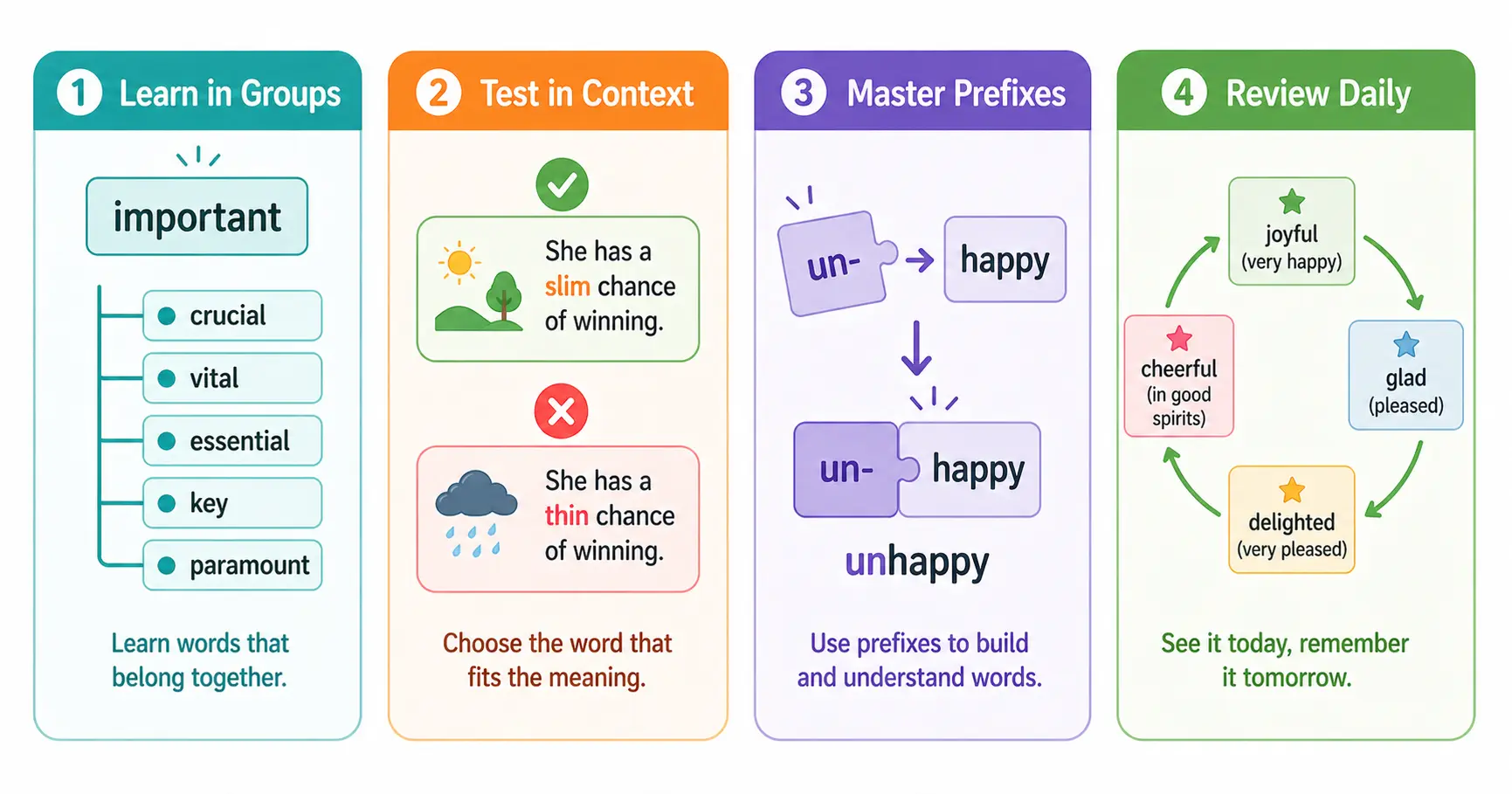
1. Học theo nhóm, không chỉ theo từng cặp
Đừng chỉ học “big = large”. Hãy học cả nhóm từ đồng nghĩa: big → large → huge → enormous → massive → vast → immense. Mỗi từ nằm ở một vị trí khác nhau trên thang mức độ trang trọng và cường độ. Hiểu cả nhóm giúp bạn có nhiều lựa chọn; chỉ học một cặp thì chẳng giúp được gì.
2. Luôn học trong ngữ cảnh
“Slim” và “thin” là từ đồng nghĩa, nhưng có thể nói “slim chance” (khả năng mong manh) chứ không nói “thin chance”. “Strong tea” (trà đậm) là đúng, nhưng “powerful tea” thì không. Luôn học từ đồng nghĩa kèm câu hoặc kết hợp từ có chứa nó. Để tìm hiểu sâu hơn về kết hợp từ, hãy đọc Hướng dẫn về kết hợp từ tiếng Anh.
3. Thử thay từ vào câu
Khi học một từ đồng nghĩa mới, hãy thử thay từ cơ bản bằng từ mới trong ba câu khác nhau. Nếu ở câu nào nghe không ổn, hãy ghi chú hạn chế đó. “Vast” dùng được trong “a vast desert” (sa mạc rộng lớn) nhưng không dùng trong “a vast cup of coffee” (một cốc cà phê rộng lớn). Cách này giúp bạn dần dùng từ chính xác hơn.
4. Học các mẫu tiền tố
Học các mẫu un-, in-, dis-, mis-, over-, under- giúp bạn biết từ trái nghĩa của hàng trăm từ cùng một lúc. Đây là một trong những kỹ năng từ vựng có giá trị nhất bạn có thể rèn luyện.
5. Ôn tập ngắt quãng
Thêm các nhóm từ đồng nghĩa và trái nghĩa vào Linglify hoặc một hệ thống ôn tập ngắt quãng bất kỳ. Học theo nhóm (toàn bộ tập hợp từ đồng nghĩa của “important”), thay vì học từng cặp rời rạc. Để xem các chiến lược ghi nhớ dựa trên khoa học, hãy đọc Cách ghi nhớ từ vựng.
6. Tìm từ đồng nghĩa khi đọc
Khi đọc bài trên Economist, BBC hoặc Guardian, hãy để ý cách người viết tránh lặp từ. Họ dùng “increase” trong một câu, “rise” ở câu tiếp theo rồi đến “surge” ở câu thứ ba. Cách luân phiên từ đồng nghĩa tự nhiên này chính là điều giám khảo IELTS và độc giả học thuật mong đợi.
Đọc gì tiếp theo
Hướng dẫn tổng quan này cung cấp nền tảng đầy đủ về từ đồng nghĩa và trái nghĩa. Dưới đây là các hướng dẫn chuyên sâu:
Danh sách từ đồng nghĩa:
- Từ đồng nghĩa cho các từ tiếng Anh thông dụng: Hơn 200 cách diễn đạt hay hơn — thay thế “good”, “bad”, “interesting” và nhiều từ khác
- Danh sách từ đồng nghĩa: 300 từ học thuật cho bài luận — dành cho bài viết ở trường đại học và kỳ thi
Danh sách từ trái nghĩa:
- Hơn 500 từ đối nghĩa trong tiếng Anh: Danh sách từ trái nghĩa A–Z — tài liệu tham khảo đầy đủ về từ trái nghĩa
Dành cho kỳ thi:
- Từ đồng nghĩa cho IELTS: Hơn 200 từ diễn đạt lại — các từ đồng nghĩa chuyên biệt giúp nâng điểm thi
- Từ vựng IELTS nâng cao: Từ vựng Band 8–9 — từ vựng chính xác dành cho điểm cao
Từ vựng liên quan:
- Hướng dẫn về kết hợp từ tiếng Anh — tìm hiểu những từ thường đi cùng nhau
- Thành ngữ tiếng Anh: Hơn 500 cách diễn đạt thông dụng — những cách diễn đạt cố định mang nghĩa bóng
- Từ vựng tiếng Anh nâng cao: Hơn 300 từ trình độ C1–C2 — những từ có thể dùng như các từ đồng nghĩa mạnh
- Cách cải thiện vốn từ vựng — chiến lược toàn diện để xây dựng vốn từ
Câu hỏi thường gặp
Tôi nên biết bao nhiêu từ đồng nghĩa cho mỗi từ?
Để giao tiếp thành thạo hằng ngày, biết 3–5 từ đồng nghĩa cho 100 tính từ, động từ và danh từ thông dụng nhất là đủ. Để đạt IELTS Band 7+, bạn cần ít nhất ba cách diễn đạt khác nhau cho mỗi từ mình thường lặp lại. Để đạt Band 8–9, bạn nên có từ năm lựa chọn trở lên và biết từ nào phù hợp với từng ngữ cảnh. Chất lượng (biết khi nào dùng từng từ đồng nghĩa) quan trọng hơn số lượng (biết 20 từ nhưng không hiểu điểm khác biệt).
Từ đồng nghĩa có nghĩa hoàn toàn giống nhau không?
Hầu như không bao giờ. Phần lớn từ đồng nghĩa trong tiếng Anh là “từ gần nghĩa” — chúng có chung nghĩa cốt lõi nhưng khác nhau về mức độ trang trọng, cường độ, sắc thái hoặc ngữ cảnh. “Slim” và “skinny” đều có nghĩa là gầy, nhưng “slim” mang nghĩa tích cực còn “skinny” có thể tiêu cực. “Home” và “residence” đều có nghĩa là nơi bạn sống, nhưng “residence” trang trọng hơn. Coi từ đồng nghĩa là những từ có thể thay thế cho nhau là một trong những lỗi từ vựng phổ biến nhất.
Cách tốt nhất để học từ trái nghĩa là gì?
Trước tiên hãy học các mẫu tiền tố (un-, dis-, in-/im-/il-/ir-, mis-, over-/under-). Sáu tiền tố này tạo ra từ trái nghĩa cho hàng trăm từ tiếng Anh. Sau khi nắm vững tiền tố, hãy học các từ trái nghĩa tuyệt đối (alive/dead, true/false) và từ trái nghĩa theo mức độ (hot/cold, big/small). Cuối cùng, học các từ trái nghĩa tương quan (buy/sell, teach/learn).
Từ đồng nghĩa có quan trọng với IELTS không?
Rất quan trọng. Tiêu chí “Vốn từ vựng” của IELTS đánh giá cụ thể việc dùng từ đồng nghĩa và diễn đạt lại. Thí sinh Band 6 “cố gắng dùng từ vựng ít phổ biến hơn nhưng đôi khi chưa chính xác”. Thí sinh Band 7 thể hiện “sự linh hoạt và chính xác” qua cách dùng từ đồng nghĩa tự nhiên. Thí sinh Band 8–9 sử dụng “nhiều loại từ vựng” cùng lựa chọn từ đồng nghĩa “khéo léo”. Hầu như chắc chắn bạn sẽ đạt điểm thấp ở tiêu chí Vốn từ vựng nếu không dùng từ đồng nghĩa.
Từ đồng nghĩa và định nghĩa khác nhau thế nào?
Từ đồng nghĩa là một từ khác có nghĩa giống hoặc tương tự: “happy” → “glad”. Định nghĩa giải thích nghĩa của từ bằng một cụm từ: “happy” = “cảm thấy vui vẻ hoặc hài lòng”. Trong IELTS, dùng từ đồng nghĩa là diễn đạt lại; dùng định nghĩa là giải thích — cả hai đều hữu ích, nhưng giám khảo đánh giá cao từ đồng nghĩa hơn vì chúng thể hiện vốn từ phong phú.
Tôi có thể dùng từ điển đồng nghĩa để tìm từ đồng nghĩa không?
Có, nhưng hãy thận trọng. Từ điển đồng nghĩa đưa ra các lựa chọn nhưng không cho biết từ nào phù hợp với ngữ cảnh cụ thể của bạn. Luôn kiểm tra: (1) Từ này có đúng mức độ trang trọng không? (2) Nó có phù hợp với kết hợp từ này không? (3) Nó có cùng sắc thái nghĩa không? Ví dụ, từ điển đồng nghĩa có thể gợi ý “interrogate” là từ đồng nghĩa của “ask”, nhưng bạn sẽ không nói “I interrogated my friend about her weekend” (Tôi thẩm vấn bạn mình về cuối tuần của cô ấy). Hãy dùng từ điển dành cho người học cùng với từ điển đồng nghĩa.
Trong các kỳ thi, từ đồng nghĩa và trái nghĩa được kiểm tra như thế nào?
Trong phần Đọc IELTS, bạn cần nhận ra khi một đoạn văn diễn đạt lại thông tin bằng từ đồng nghĩa — đây là kỹ năng cốt lõi cho dạng câu hỏi Đúng/Sai/Không có thông tin và câu hỏi nối ý. Trong phần Viết IELTS, bạn cần dùng từ đồng nghĩa để tránh lặp từ và thể hiện vốn từ đa dạng. Trong phần Đọc TOEFL, câu hỏi về từ đồng nghĩa được nêu trực tiếp: “Từ X ở đoạn 3 gần nghĩa nhất với từ nào?” Trong các bài kiểm tra từ vựng (Cambridge, Pearson), cả từ đồng nghĩa và trái nghĩa đều xuất hiện dưới dạng câu hỏi trắc nghiệm.