
Cụm từ kết hợp tiếng Anh: làm chủ cách kết hợp từ tự nhiên với hơn 300 ví dụ
Bạn có thể biết 10.000 từ tiếng Anh mà vẫn nói nghe không tự nhiên. Không phải sai ngữ pháp — chỉ là nghe không đúng cách người bản ngữ nói. Điều khiến người nghe khựng lại, nghiêng đầu rồi bảo “Tôi hiểu ý bạn, nhưng chúng tôi không nói như vậy.” Lý do hầu như luôn là cụm từ kết hợp.
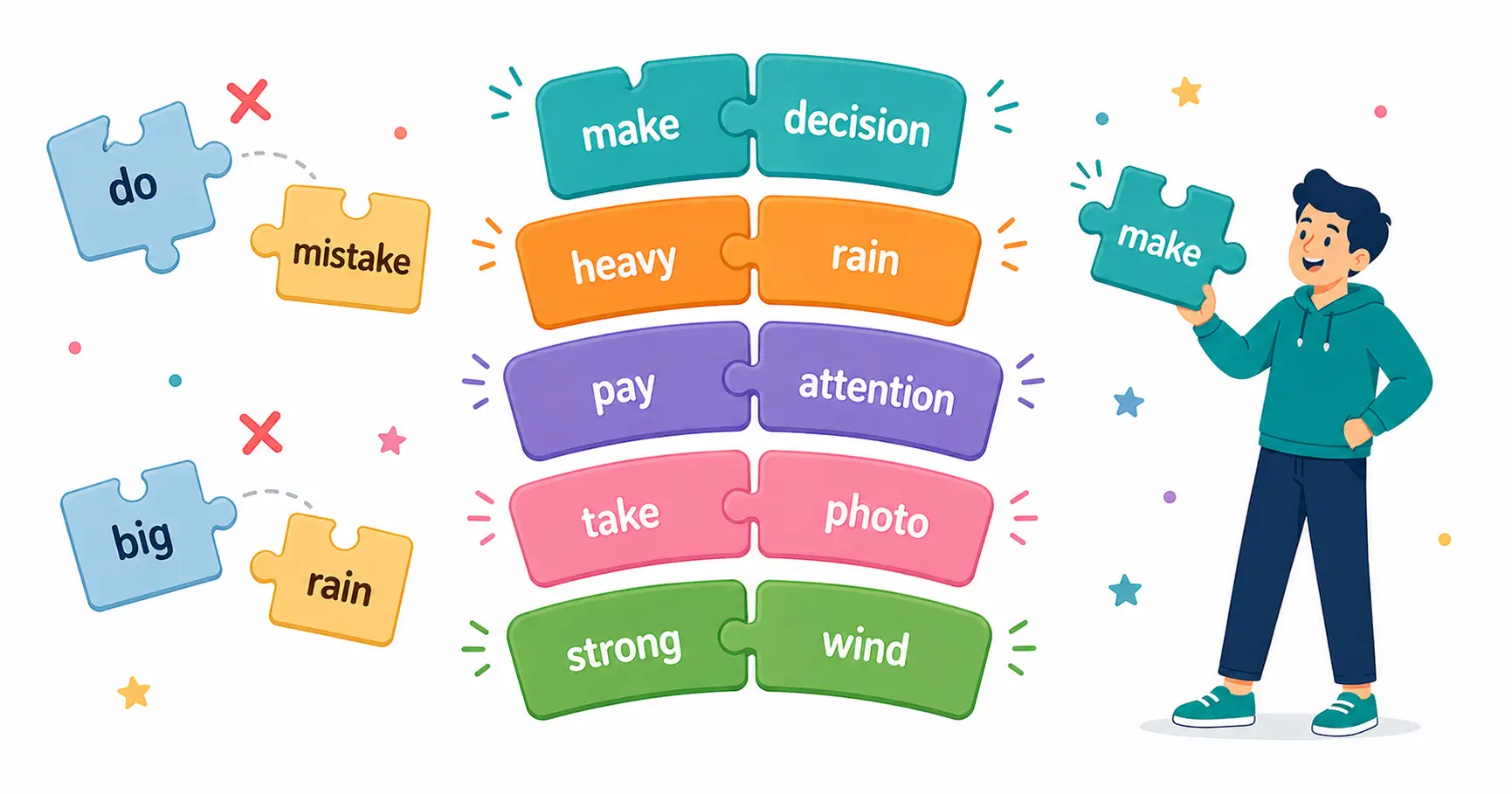
Cụm từ kết hợp là một cặp hoặc nhóm từ thường đi với nhau trong tiếng Anh. Người bản ngữ nói “make a decision” — không nói “do a decision”. Họ nói “heavy rain” — không nói “strong rain”. Họ nói “take a photo” — không nói “catch a photo”. Từng từ riêng lẻ đều đúng. Ngữ pháp cũng ổn. Nhưng cách kết hợp sai sẽ khiến người khác nhận ra ngay bạn không phải người bản ngữ.
Khác biệt giữa người học B2 và người nói trình độ C1 hiếm khi nằm ở ngữ pháp. Khác biệt nằm ở cụm từ kết hợp. Đây là kỹ năng từ vựng mà sách giáo khoa bỏ qua, các ứng dụng thường không chú trọng, nhưng lại tạo ra thay đổi lớn nhất giúp tiếng Anh của bạn nghe tự nhiên hơn.
Hướng dẫn này trình bày:
- cụm từ kết hợp là gì và vì sao chúng quan trọng,
- 6 loại cụm từ kết hợp kèm ví dụ rõ ràng,
- hơn 300 cụm từ thiết yếu được sắp xếp theo loại,
- những lỗi cụm từ kết hợp phổ biến nhất của người học,
- cách học cụm từ kết hợp hiệu quả.
Cụm từ kết hợp là gì?
Cụm từ kết hợp là nhóm từ thường xuất hiện cùng nhau và nghe tự nhiên với người bản ngữ. Từ collocation có nguồn gốc từ tiếng Latinh: co- (cùng nhau) + locare (đặt) — nghĩa đen là “được đặt cùng nhau”.
Đặc điểm chính: cụm từ kết hợp không phải quy tắc — chúng là thói quen ngôn ngữ. Không có quy tắc ngữ pháp nào nói rằng “heavy rain” đúng còn “strong rain” sai. Cả hai từ đều mang nghĩa “nhiều”. Nhưng người nói tiếng Anh chọn “heavy” để đi với mưa; qua nhiều thế kỷ, cách kết hợp ấy trở nên cố định. Bạn phải học chúng thành cặp, không thể suy ra chỉ bằng logic.
| Tự nhiên (Đúng) | Không tự nhiên (Sai) | Vì sao? |
|---|---|---|
| make a decision |
|
Trong tiếng Anh, MAKE đi với “decision”. |
| heavy rain |
|
“Heavy” thường kết hợp với “rain”. |
| take a photo |
|
Trong tiếng Anh, TAKE đi với “photo”. |
| fast food |
|
“Fast” là từ bổ nghĩa cố định cho loại đồ ăn này. |
| pay attention |
|
Trong tiếng Anh, cụm cố định dùng PAY với “attention”. |
| do homework |
|
Trong tiếng Anh, DO đi với “homework”. |
Vì sao cụm từ kết hợp quan trọng?
1. Chúng phân biệt người nói trôi chảy với người nói đúng ngữ pháp. Bạn có thể đúng ngữ pháp 100% mà vẫn nghe thiếu tự nhiên. Cụm từ kết hợp tạo nên khác biệt.
2. Chúng ảnh hưởng đến điểm thi. Trong IELTS, tiêu chí “Lexical Resource” (Vốn từ vựng) đánh giá cụ thể độ chính xác của cụm từ kết hợp. Band 7 đòi hỏi “nhận thức về văn phong và cách kết hợp từ”. Band 8 đòi hỏi “sử dụng khéo léo các từ vựng ít phổ biến” với “chỉ đôi khi chọn từ và kết hợp từ chưa chính xác”.
3. Chúng giúp giao tiếp nhanh hơn. Khi dùng đúng cụm từ kết hợp, người nghe xử lý lời nói nhanh hơn vì cách kết hợp từ phù hợp với kỳ vọng của họ. Cụm từ sai tạo ra những khoảng ngập ngừng nhỏ khi hiểu.
4. Chúng là nền tảng của lối viết tự nhiên. Bài luận học thuật, email công việc và văn viết sáng tạo đều dựa vào những cụm từ kết hợp thông dụng. “Conduct research” nghe chuyên nghiệp. “Do research” nghe tạm ổn. “Make research” nghe sai.
Cụm từ kết hợp, thành ngữ và cụm động từ khác nhau thế nào?
| Đặc điểm | Cụm từ kết hợp | Thành ngữ | Cụm động từ |
|---|---|---|---|
| Nghĩa | Có thể đoán từ các thành phần | Nghĩa bóng | Nghĩa bóng |
| Ví dụ | make a mistake | kick the bucket (= chết) | give up (= bỏ cuộc) |
| Mức độ cố định | Tương đối cố định (có chút linh hoạt) | Cố định hoàn toàn | Cố định |
| Có thể dịch không? | Thường là có | Thường là không | Thường là không |
| Kỹ năng chính | Biết từ nào đi với từ nào | Biết nghĩa ẩn | Biết nghĩa mới |
Có một phần giao nhau: một số cụm động từ cũng là cụm từ kết hợp (take off trong “the plane took off”), và một số thành ngữ có chứa cụm từ kết hợp (break the ice dùng “break” + “ice”). Nhưng khác biệt cốt lõi vẫn đúng: cụm từ kết hợp nói về từ nào đi cùng nhau, còn thành ngữ nói về nghĩa ẩn.
Để tra cứu thành ngữ đầy đủ, hãy đọc Thành ngữ tiếng Anh: hơn 500 cách diễn đạt thông dụng. Về cụm động từ, xem Cụm động từ tiếng Anh: hướng dẫn đầy đủ.
Các loại cụm từ kết hợp
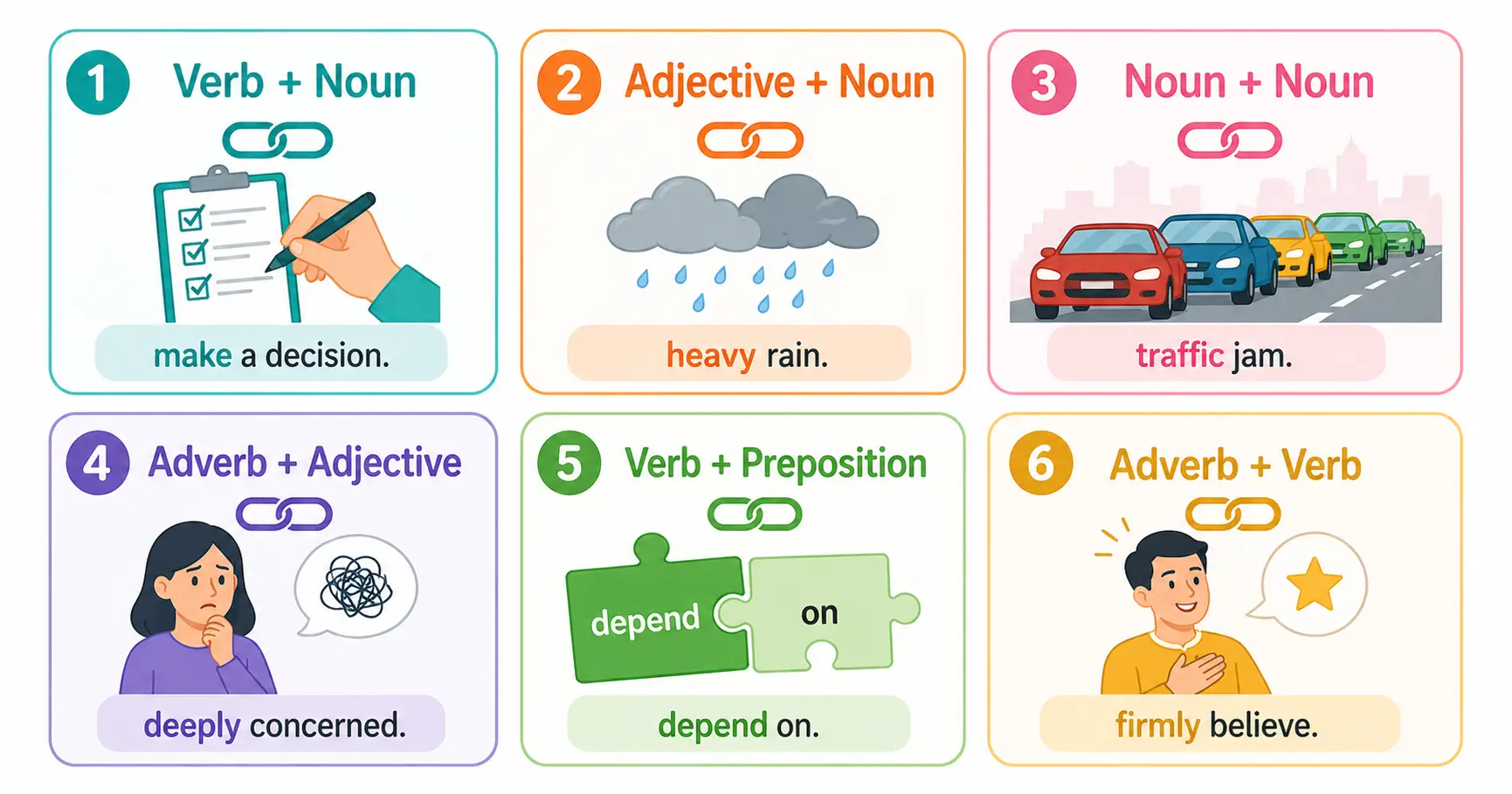
Cụm từ kết hợp tiếng Anh thuộc 6 loại chính. Hiểu từng loại giúp bạn dự đoán quy luật và học nhanh hơn.
Loại 1: Động từ + Danh từ
Đây là loại quan trọng nhất đối với người học. MAKE, DO, TAKE, GET, HAVE, PAY, GIVE, KEEP, BREAK và CATCH đều kết hợp cố định với hàng chục danh từ.
MAKE
| Cụm từ kết hợp | Ví dụ |
|---|---|
| make a decision | We need to make a decision by Friday. |
| make a mistake | Everyone makes mistakes — the key is learning from them. |
| make progress | The students are making good progress this term. |
| make an effort | He didn’t even make an effort to arrive on time. |
| make money | She makes good money as a software engineer. |
| make a difference | Small changes can make a big difference over time. |
| make a plan | Let’s make a plan before we start the project. |
| make an appointment | I need to make an appointment with the dentist. |
| make a complaint | She made a formal complaint about the noise. |
| make a promise | He made a promise to his daughter and kept it. |
| make an impression | First impressions matter — make a good one. |
| make a choice | You have to make a choice between the two options. |
| make sense | That explanation doesn’t make sense to me. |
| make room | Can you make room for one more person? |
| make a living | It’s hard to make a living as a freelance writer. |
| make a suggestion | Can I make a suggestion? |
| make an exception | I’ll make an exception this time, but don’t be late again. |
| make arrangements | We need to make arrangements for the conference. |
DO
| Cụm từ kết hợp | Ví dụ |
|---|---|
| do homework | Have you done your homework yet? |
| do the dishes | I’ll do the dishes after dinner. |
| do business (with) | We’ve been doing business with them for 10 years. |
| do research | She’s doing research on climate change. |
| do damage | The storm did significant damage to the coast. |
| do your best | Just do your best — that’s all anyone can ask. |
| do a favor | Could you do me a favor and check my email? |
| do the laundry | I need to do the laundry this weekend. |
| do a good job | She did a great job on the presentation. |
| do harm | The new policy may do more harm than good. |
| do exercise | I try to do some exercise every morning. |
| do an experiment | The students did an experiment to test the hypothesis. |
TAKE
| Cụm từ kết hợp | Ví dụ |
|---|---|
| take a photo / picture | Can you take a photo of us? |
| take a break | Let’s take a 10-minute break. |
| take action | The government must take action to reduce pollution. |
| take a risk | Starting a business means taking risks. |
| take a look | Take a look at this report. |
| take a seat | Please take a seat — the doctor will see you shortly. |
| take notes | She always takes detailed notes in class. |
| take responsibility | He took responsibility for the error. |
| take advice | I should have taken your advice. |
| take a chance | I took a chance and applied for the job. |
| take care (of) | Take care of yourself while I’m away. |
| take turns | The children took turns playing with the toy. |
| take part (in) | Over 200 people took part in the marathon. |
| take place | The meeting will take place on Monday at 3 PM. |
| take time | Learning a language takes time. |
GET, HAVE, PAY, GIVE
| Cụm từ kết hợp | Ví dụ |
|---|---|
| get permission | You need to get permission from the manager. |
| get a job | She got a job at a tech company after graduation. |
| get an idea | I’ve just got an idea for the project. |
| get the impression | I got the impression that he wasn’t happy. |
| have a meeting | We’re having a meeting at 2 PM. |
| have a conversation | Let’s have a conversation about your performance. |
| have an argument | They had an argument about money. |
| have a look | Have a look at this and tell me what you think. |
| have an effect (on) | Sleep has a huge effect on your concentration. |
| have access (to) | Students have access to the library 24/7. |
| pay attention | Pay attention — this will be on the exam. |
| pay a compliment | He paid her a compliment on her presentation. |
| pay a visit | I’ll pay you a visit when I’m in London. |
| give advice | She gave me some excellent advice. |
| give permission | The teacher gave them permission to leave early. |
| give a speech | The CEO gave a speech at the conference. |
| give priority (to) | We should give priority to urgent cases. |
KEEP, BREAK, CATCH, COME
| Cụm từ kết hợp | Ví dụ |
|---|---|
| keep a secret | Can you keep a secret? |
| keep a promise | Always keep your promises. |
| keep in touch | Let’s keep in touch after you move. |
| keep a record | Keep a record of all your expenses. |
| keep calm | Keep calm — panicking won’t help. |
| break the law | If you break the law, you face consequences. |
| break a record | She broke the world record in the 100m sprint. |
| break the rules | He’s always breaking the rules at school. |
| break the news | I had to break the news to her about the layoffs. |
| break a habit | Breaking a bad habit takes about 66 days on average. |
| catch a cold | I caught a cold from someone at the office. |
| catch fire | The building caught fire due to faulty wiring. |
| catch someone’s attention | The headline caught my attention immediately. |
| come to a conclusion | After reviewing the data, we came to a conclusion. |
| come to an agreement | Both parties came to an agreement after long negotiations. |
Loại 2: Tính từ + Danh từ
Những cụm từ này quyết định tính từ nào “đi với” danh từ nào. Dùng đúng nhóm này là một trong những cách nhanh nhất để tiếng Anh nghe tự nhiên hơn.
| Cụm từ kết hợp | KHÔNG dùng | Ví dụ |
|---|---|---|
| heavy rain |
|
There was heavy rain all weekend. |
| strong wind |
|
A strong wind blew the tent away. |
| heavy traffic |
|
We were stuck in heavy traffic for two hours. |
| fast food |
|
I try to avoid fast food as much as possible. |
| deep sleep |
|
She was in such a deep sleep that the alarm didn’t wake her. |
| high temperature |
|
The patient has a high temperature. |
| strong coffee |
|
I need a strong coffee this morning. |
| broad daylight |
|
The robbery happened in broad daylight. |
| close friend |
|
She’s one of my closest friends. |
| bitter cold |
|
We endured the bitter cold for three hours. |
| narrow escape |
|
We had a narrow escape — the car missed us by inches. |
| bright idea |
|
Whose bright idea was it to start at 5 AM? |
| keen interest |
|
She took a keen interest in the project. |
| blissful ignorance |
|
He lived in blissful ignorance of the company’s problems. |
| sharp increase |
|
There was a sharp increase in online sales. |
| slight problem |
|
There’s a slight problem with the schedule. |
| steady progress |
|
The team is making steady progress toward the deadline. |
| bitter disappointment |
|
The result was a bitter disappointment for the team. |
| golden opportunity |
|
This is a golden opportunity to expand the business. |
| overwhelming majority |
|
The overwhelming majority voted in favor. |
Loại 3: Danh từ + Danh từ
Một số danh từ thường được ghép với nhau theo quy ước.
| Cụm từ kết hợp | Ví dụ |
|---|---|
| traffic jam | We were stuck in a traffic jam for an hour. |
| road rage | Road rage incidents have increased this year. |
| blood pressure | The doctor checked my blood pressure. |
| cell phone | I left my cell phone at home. |
| greenhouse effect | The greenhouse effect is causing global warming. |
| heart attack | He suffered a heart attack at the age of 52. |
| job satisfaction | Job satisfaction is more important than a high salary to many people. |
| budget cuts | The university announced major budget cuts. |
| career change | She made a career change at 40 and became a teacher. |
| human rights | The organization campaigns for human rights worldwide. |
| climate change | Climate change is the defining issue of our time. |
| time management | Good time management is essential for university success. |
| brain drain | Brain drain is a serious problem for developing countries. |
| birth rate | The birth rate has been declining in many European countries. |
| action plan | We need a clear action plan for the next quarter. |
Loại 4: Trạng từ + Tính từ
Những cụm này tăng cường hoặc bổ nghĩa cho tính từ theo những cách cụ thể, cố định.
| Cụm từ kết hợp | KHÔNG dùng | Ví dụ |
|---|---|---|
| highly unlikely |
|
It’s highly unlikely that the project will finish on time. |
| deeply concerned |
|
I am deeply concerned about the recent test results. |
| bitterly disappointed |
|
She was bitterly disappointed with the outcome. |
| perfectly natural |
|
It’s perfectly natural to feel nervous before an interview. |
| fully aware |
|
I’m fully aware of the risks involved. |
| utterly ridiculous |
|
The suggestion was utterly ridiculous. |
| wildly popular |
|
The show became wildly popular overnight. |
| painfully obvious |
|
It was painfully obvious that he hadn’t prepared. |
| blissfully unaware |
|
She was blissfully unaware of the chaos behind her. |
| seriously injured |
|
Three people were seriously injured in the accident. |
| heavily influenced |
|
Her work was heavily influenced by Japanese art. |
| vitally important |
|
It is vitally important to follow the safety procedures. |
| strictly forbidden |
|
Smoking is strictly forbidden inside the building. |
| widely recognized |
|
She is widely recognized as a leading expert in the field. |
Loại 5: Động từ + Giới từ
Đây không phải cụm động từ — động từ vẫn giữ nghĩa cốt lõi nhưng cần đi cùng một giới từ cụ thể.
| Cụm từ kết hợp | KHÔNG dùng | Ví dụ |
|---|---|---|
| depend on |
|
The outcome depends on several factors. |
| believe in |
|
Do you believe in life after death? |
| succeed in |
|
She succeeded in passing the bar exam on her first try. |
| apologize for |
|
He apologized for being late. |
| insist on |
|
She insisted on paying for dinner. |
| complain about |
|
He always complains about the weather. |
| concentrate on |
|
I need to concentrate on my work. |
| consist of |
|
The team consists of five members. |
| refer to |
|
Are you referring to the report I sent yesterday? |
| belong to |
|
This book belongs to the library. |
| respond to |
|
She hasn’t responded to my email yet. |
| participate in |
|
Over 500 students participated in the competition. |
| result in |
|
The accident resulted in two injuries. |
| suffer from |
|
He suffers from chronic back pain. |
| invest in |
|
The company invested heavily in new technology. |
Loại 6: Trạng từ + Động từ
Những cụm này miêu tả cách một hành động thường được thực hiện.
| Cụm từ kết hợp | Ví dụ |
|---|---|
| firmly believe | I firmly believe that education changes lives. |
| strongly recommend | I strongly recommend this book to all language learners. |
| deeply regret | We deeply regret the inconvenience caused. |
| fully understand | I fully understand your concerns. |
| flatly refuse | He flatly refused to answer the question. |
| greatly appreciate | I would greatly appreciate your help. |
| seriously consider | You should seriously consider the offer before declining. |
| wholeheartedly agree | I wholeheartedly agree with your proposal. |
| categorically deny | The company categorically denied the allegations. |
| vaguely remember | I vaguely remember meeting her at a party years ago. |
| thoroughly enjoy | We thoroughly enjoyed the concert last night. |
| totally disagree | I totally disagree with that assessment. |
| readily available | The information is readily available online. |
| carefully consider | The committee carefully considered all options. |
Những lỗi cụm từ kết hợp thường gặp
Ngay cả người học trung cấp cũng thường mắc những lỗi sau. Học cách dùng đúng sẽ cải thiện tiếng Anh ngay lập tức.
MAKE và DO
Đây là lỗi cụm từ kết hợp phổ biến nhất của người không phải bản ngữ.
| Đúng | Sai |
|---|---|
| make a decision |
|
| make a mistake |
|
| make money |
|
| make progress |
|
| make a suggestion |
|
| do homework |
|
| do research |
|
| do business |
|
| do a favor |
|
| do exercise |
|
Quy luật: dùng MAKE khi tạo ra hoặc xây dựng thứ gì đó (make a plan, make a cake, make an effort). Dùng DO để thực hiện một hoạt động hoặc nhiệm vụ (do the laundry, do work, do an experiment).
Lỗi thường gặp với tính từ + danh từ
| Đúng | Sai | Vì sao? |
|---|---|---|
| heavy rain |
|
Trong tiếng Anh, mưa được miêu tả là “heavy”. |
| strong wind |
|
Gió “strong” (mạnh), không phải “heavy” (nặng). |
| fast food |
|
Cụm cố định là “fast food”. |
| high price |
|
Giá “high” (cao) hoặc “low” (thấp), chứ không “expensive” (đắt). |
| big mistake |
|
Lỗi thường được gọi là “big” (hoặc “huge”), không phải “large”. |
| do/cause damage |
|
Thiệt hại được “gây ra” (done hoặc caused). |
Lỗi thường gặp với động từ + danh từ
| Đúng | Sai | Vì sao? |
|---|---|---|
| take a photo |
|
Tiếng Anh dùng TAKE, không dùng MAKE. |
| pay attention |
|
Cụm cố định đi với PAY. |
| catch a cold |
|
“Catch” là cụm kết hợp tiêu chuẩn. |
| break the law |
|
“Break” là cách kết hợp thường ngày. |
| tell a lie |
|
Dùng “tell” (kể) với lời nói dối, không dùng “say” (nói). |
| tell the truth |
|
Cùng quy luật: dùng TELL, không dùng SAY. |
Cụm từ kết hợp theo trình độ
A2–B1 (Sơ cấp đến trung cấp)
Đây là những cụm từ đầu tiên nên học — chúng xuất hiện liên tục trong giao tiếp hằng ngày:
make a mistake, do homework, take a photo, have a meeting, pay attention, give advice, keep a secret, break the rules, catch a cold, fast food, heavy rain, strong wind, make a decision, do your best, take a break, have fun, get a job, close friend, big deal, traffic jam
B2 (Trung cấp cao)
Những cụm này xuất hiện trong ngữ cảnh học thuật, tin tức và giao tiếp chuyên nghiệp:
make progress, do research, take action, have an effect, pay a compliment, give priority, keep in touch, break a record, come to a conclusion, sharp increase, steady progress, golden opportunity, bitter disappointment, highly unlikely, deeply concerned, firmly believe, strongly recommend, career change, time management, budget cuts
C1–C2 (Nâng cao)
Những cụm này giúp người học gần trình độ bản ngữ nổi bật hơn:
make an allegation, do justice (to), take precedence, have ramifications, pay dividends, give rise to, keep abreast (of), break new ground, come to fruition, stark contrast, vested interest, sweeping changes, heightened awareness, categorically deny, flatly refuse, wholly inadequate, bitterly divided, disproportionately affected, inextricably linked, mutually exclusive
Để xem hướng dẫn đầy đủ về cụm từ kết hợp nâng cao, hãy đọc Cụm từ kết hợp tiếng Anh nâng cao: cách kết hợp từ C1–C2.
Cụm từ kết hợp cho IELTS và văn viết học thuật
Nếu bạn đang chuẩn bị cho IELTS, TOEFL hoặc viết học thuật, những cụm từ kết hợp sau rất cần thiết. Chúng thường xuyên xuất hiện trong các chủ đề thi và được đánh giá cao theo tiêu chí “Lexical Resource” (Vốn từ vựng).
Cụm từ kết hợp để mở bài luận
| Cụm từ kết hợp | Ví dụ |
|---|---|
| raise a question | This trend raises the question of whether traditional education is still relevant. |
| a growing concern | Air pollution is a growing concern in major cities. |
| play a significant role | Technology plays a significant role in modern education. |
| draw attention to | The report draws attention to the widening gap between rich and poor. |
| a matter of debate | Whether zoos should exist remains a matter of debate. |
Cụm từ kết hợp chỉ nguyên nhân và hệ quả
| Cụm từ kết hợp | Ví dụ |
|---|---|
| have a profound impact | Social media has had a profound impact on how we communicate. |
| lead to consequences | Deforestation can lead to devastating consequences for biodiversity. |
| pose a threat | Plastic waste poses a serious threat to marine ecosystems. |
| trigger a response | The crisis triggered an immediate government response. |
| face a challenge | Developing countries face unique challenges in combating climate change. |
Dữ liệu và xu hướng (IELTS Task 1)
| Cụm từ kết hợp | Ví dụ |
|---|---|
| show a steady increase | The graph shows a steady increase in renewable energy adoption. |
| reach a peak | Unemployment reached a peak of 12% in 2009. |
| undergo a dramatic change | The industry underwent a dramatic change between 2015 and 2020. |
| remain relatively stable | Consumer spending remained relatively stable throughout the period. |
| account for a significant proportion | Asia accounted for a significant proportion of global exports. |
Để xem chiến lược từ vựng IELTS toàn diện, hãy đọc Hướng dẫn đầy đủ về từ vựng IELTS. Để học cụm từ theo từng dạng đề thi, xem Cụm từ kết hợp cho PTE và IELTS.
Từ vựng cần luyện tập
Hãy thêm 25 từ xuất hiện trong các cụm từ kết hợp thiết yếu vào từ điển Linglify để ôn tập cách quãng.
affordable
tính từ
giá phải chăng, vừa túi tiền
Ví dụ
- The government is working to provide affordable housing for low-income families.
- This restaurant offers delicious and affordable meals for college students.
commute
động từ
đi làm hằng ngày, đi lại thường xuyên
Ví dụ
- Public transportation helps people commute efficiently reducing traffic congestion.
- Workers commute daily between suburban homes and downtown offices.
conservation
danh từ
bảo tồn, bảo vệ môi trường
Ví dụ
- Water conservation becomes increasingly important during periods of severe drought.
- Wildlife conservation is essential for protecting endangered species from extinction.
demanding
tính từ
đòi hỏi cao, khó khăn
Ví dụ
- Medical school is very demanding and requires years of intensive study.
- She has a demanding boss who expects perfection in all tasks.
DJ
danh từ
DJ, người chơi nhạc
Ví dụ
- The DJ played my favorite song.
- The DJ took song requests all night.
heritage
danh từ
di sản, truyền thống
Ví dụ
- She inherited a rich heritage of family traditions from her grandparents.
- The ancient castle is an important part of our cultural heritage.
leisure
danh từ
thời gian rảnh, lúc nhàn rỗi
Ví dụ
- People enjoy various leisure activities during weekends and holidays.
- Reading books is popular leisure pursuit for many educated people.
luxurious
tính từ
sang trọng, xa hoa
Ví dụ
- She dreams of owning luxurious car with leather seats and sunroof.
- The luxurious hotel suite includes marble bathroom and ocean view.
memorable
tính từ
đáng nhớ, khó quên
Ví dụ
- Graduation day was memorable occasion for entire family.
- The memorable speech inspired students to pursue their dreams.
nutritious
tính từ
bổ dưỡng, giàu dinh dưỡng
Ví dụ
- Fresh vegetables are nutritious and support overall health.
- Nutritious breakfast provides energy for productive school day.
passionate
tính từ
đam mê, say mê
Ví dụ
- Passionate speech moves audience to take action.
- Passionate teacher inspires students to learn more.
pollution
danh từ
sự ô nhiễm, ô nhiễm
Ví dụ
- Air pollution affects public health in cities.
- Ocean pollution threatens marine life worldwide.
privacy
danh từ
quyền riêng tư, sự riêng tư
Ví dụ
- Hotel guests expect privacy during their stay.
- Internet privacy becomes increasingly important issue nowadays.
scenic
tính từ
đẹp như tranh, có phong cảnh đẹp
Ví dụ
- Scenic overlook provides perfect spot for photographs.
- Scenic route takes longer but offers beautiful.
traditional
tính từ
truyền thống, theo lối xưa
Ví dụ
- Traditional cooking methods preserve authentic flavors perfectly.
- Traditional music reflects cultural history and values.
uneven
tính từ
không bằng phẳng, gồ ghề
Ví dụ
- Uneven ground makes walking difficult and dangerous.
- Uneven performance shows inconsistent skill level development.
volunteer
động từ
tình nguyện, tự nguyện nhận
Ví dụ
- Citizens volunteer time for community improvement projects.
- Students volunteer at local charity organizations regularly.
substantially
trạng từ
đáng kể, ở mức độ lớn
Ví dụ
- Her performance substantially improved after additional training and practice.
- Prices have increased substantially over the past few months.
liaison
danh từ
mối liên hệ, sự liên lạc
Ví dụ
- Military liaison officers coordinate operations between allied forces.
- She serves as liaison between different departments.
sustainable
tính từ
bền vững
Ví dụ
- Company implements sustainable business model for long-term success.
- Sustainable farming practices protect soil and water resources.
acclaimed
tính từ
được ca ngợi, được tán dương
Ví dụ
- His performance was acclaimed by critics.
- The acclaimed author received many awards for her novel.
cancellation
danh từ
sự hủy bỏ
Ví dụ
- Due to weather, the flight cancellation was inevitable.
- The concert's cancellation disappointed many fans.
discretion
danh từ
sự suy xét, sự thận trọng
Ví dụ
- He exercised discretion in his decisions.
- Use your discretion when sharing information.
indication
danh từ
dấu hiệu, biểu hiện
Ví dụ
- The indication of his illness was clear after the tests.
- There was no indication that she was unhappy.
serenity
danh từ
sự thanh thản, sự bình yên
Ví dụ
- She maintained her serenity despite the chaos.
- The serenity of the lake was calming.
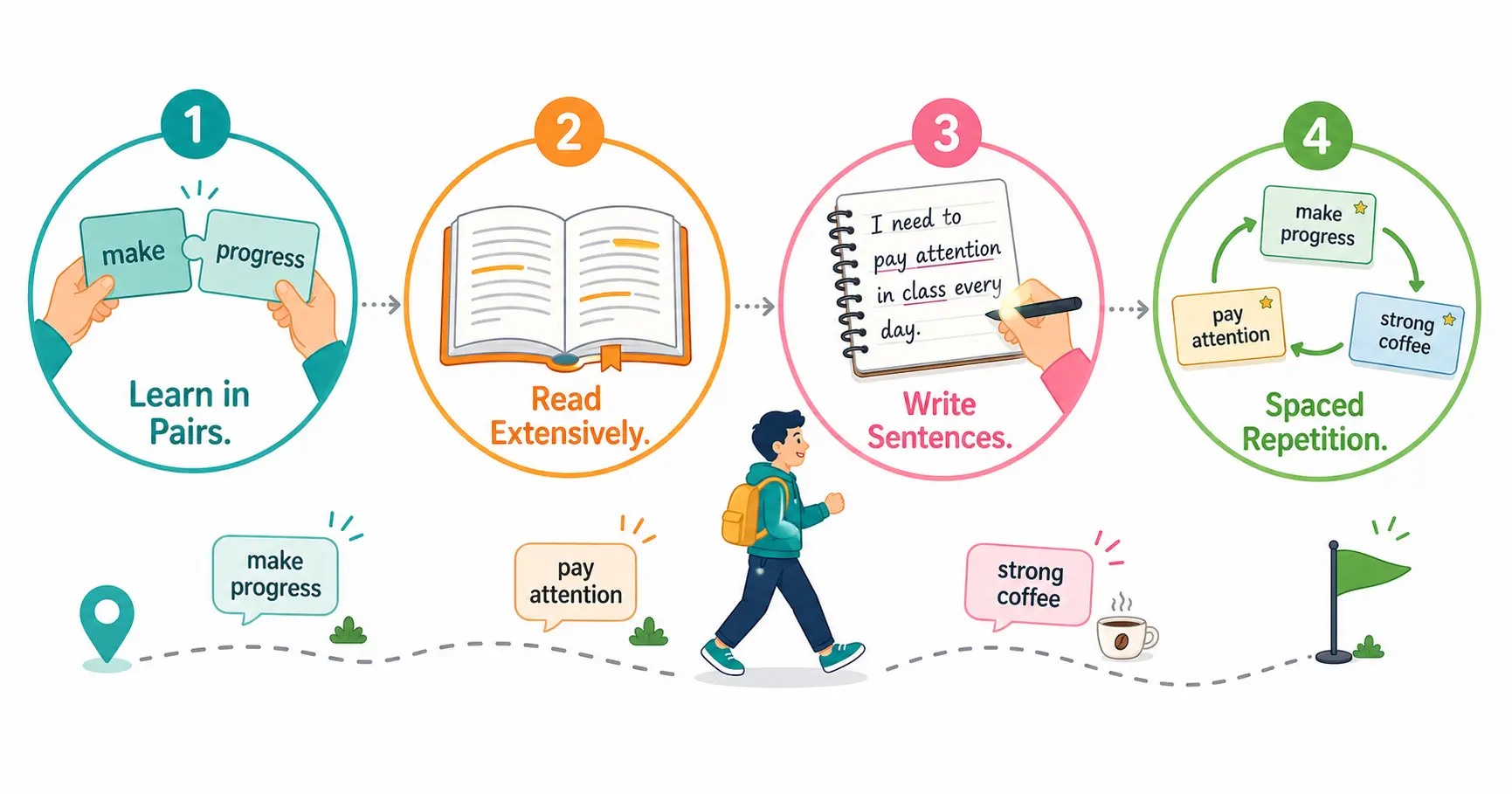
Cách học cụm từ kết hợp
1. Học từ theo cặp, không học riêng lẻ
Đừng bao giờ học một từ tách rời. Khi học “decision”, hãy học ngay “make a decision”. Khi học “rain”, hãy học “heavy rain”. Sổ từ vựng nên có hai cột: từ và những cụm từ kết hợp phổ biến nhất của từ đó.
2. Đọc rộng
Cụm từ kết hợp được tiếp thu chủ yếu qua tiếp xúc, hơn là học thuộc. Hãy đọc bài viết từ The Economist, BBC, The Guardian và các tạp chí học thuật. Khi nhận ra một cách kết hợp từ nghe tự nhiên, hãy ghi lại. Dần dần, cụm từ đúng sẽ bắt đầu “nghe thuận tai” dù bạn không giải thích được vì sao.
3. Dùng từ điển cụm từ kết hợp
Oxford Collocations Dictionary for Students of English là tài liệu chuyên sâu tốt nhất. Với mỗi từ tra cứu, sách cho bạn thấy các cụm từ kết hợp phổ biến được sắp xếp theo loại (động từ+, tính từ+, danh từ+ v.v.). Các công cụ trực tuyến như Ozdic.com cũng cho phép tra cụm từ miễn phí.
4. Học từ lỗi sai
Khi người bản ngữ hoặc giáo viên sửa cách dùng từ — “Chúng ta nói ‘heavy rain’, không nói ‘strong rain’” — hãy ghi lại cụm từ đúng. Lỗi mà bạn tự nhận ra và sửa sẽ lưu lại trong trí nhớ lâu hơn nhiều so với cụm từ chỉ đọc thụ động.
5. Dùng phương pháp lặp lại ngắt quãng
Thêm cụm từ kết hợp vào Linglify hoặc một hệ thống lặp lại ngắt quãng khác. Học chúng như một đơn vị hoàn chỉnh: “make + decision” trên cùng một thẻ học, không tách riêng “make” và “decision”. Để tìm hiểu cách học thuộc dựa trên cơ sở khoa học, đọc Cách ghi nhớ từ vựng.
6. Luyện đặt câu
Với mỗi cụm từ mới, hãy viết 3 câu dùng cụm đó trong những ngữ cảnh khác nhau. “Heavy rain” → (1) “We cancelled the picnic due to heavy rain.” (2) “Heavy rain is expected throughout the week.” (3) “The heavy rain caused flooding in low-lying areas.” Cách này xây dựng khả năng vận dụng linh hoạt, chứ không chỉ nhận biết.
Nên đọc gì tiếp theo
Hướng dẫn tổng quan này cung cấp khung đầy đủ để hiểu cụm từ kết hợp. Dưới đây là các hướng dẫn chuyên sâu cho từng nhu cầu:
Theo trình độ:
- Cụm từ kết hợp tiếng Anh qua thực hành: các cách kết hợp thiết yếu theo trình độ — cụm từ kết hợp từ A2 đến C2
- Cụm từ kết hợp tiếng Anh nâng cao: cách kết hợp từ C1–C2 — dành cho người học trung cấp cao và nâng cao
Theo loại:
- Cụm từ kết hợp theo loại: tính từ+danh từ, động từ+danh từ và nhiều nhóm khác — tìm hiểu chuyên sâu từng nhóm cụm từ kết hợp
Để ôn thi:
- Cụm từ kết hợp cho PTE và IELTS: danh sách luyện thi — cụm từ theo kỳ thi giúp tăng điểm Lexical Resource
- Từ vựng IELTS Writing Task 1 — cụm từ miêu tả dữ liệu cho Task 1
- Từ vựng IELTS Writing Task 2 — cụm từ dùng trong bài luận Task 2
Từ vựng liên quan:
- Thành ngữ tiếng Anh: hơn 500 cách diễn đạt thông dụng — cách diễn đạt cố định với nghĩa bóng
- Cụm động từ tiếng Anh: hướng dẫn đầy đủ — tổ hợp động từ + tiểu từ
- Cách cải thiện vốn từ vựng — chiến lược xây dựng vốn từ toàn diện
- Từ tiếng Anh nâng cao: hơn 300 từ vựng C1–C2 — các từ riêng lẻ thường kết hợp với những cụm này
Câu hỏi thường gặp
Nói đơn giản thì cụm từ kết hợp là gì?
Cụm từ kết hợp gồm hai từ trở lên thường đi cùng nhau trong tiếng Anh. “Make a decision” là một cụm từ kết hợp vì người nói tiếng Anh luôn dùng “make” với “decision” — không nói “do a decision” hay “take a decision”. Đây là những cặp từ gắn với nhau: có những từ vốn đi cùng nhau, và ghép sai vẫn nghe thiếu tự nhiên dù ngữ pháp đúng.
Trong tiếng Anh có bao nhiêu cụm từ kết hợp?
Có hàng chục nghìn cụm từ. Mỗi danh từ phổ biến kết hợp với nhiều động từ, tính từ và trạng từ. Oxford Collocations Dictionary liệt kê hơn 150.000 cụm từ kết hợp cho 9.000 từ đầu mục. Để giao tiếp thực tế trôi chảy, học các cụm từ kết hợp của 2.000 từ tiếng Anh thông dụng nhất sẽ bao quát phần lớn những gì bạn cần trong đời sống hằng ngày và các kỳ thi.
Cụm từ kết hợp khác từ ghép như thế nào?
Từ ghép là đơn vị cố định hoạt động như một từ duy nhất: “traffic jam”, “greenhouse”, “cell phone”. Cụm từ kết hợp là cách ghép từ linh hoạt hơn: “heavy rain”, “make a decision”, “strongly recommend”. Nhiều danh từ ghép bắt đầu là cụm từ kết hợp rồi gắn chặt với nhau thành một khái niệm. Khác biệt thực tế là danh từ ghép thường có mục từ riêng trong từ điển, còn cụm từ kết hợp được tra trong từ điển collocation hoặc học qua tiếp xúc.
Cụm từ kết hợp có khác nhau giữa tiếng Anh Anh và tiếng Anh Mỹ không?
Phần lớn cụm từ kết hợp giống nhau ở cả hai biến thể. Tuy nhiên, có một số khác biệt: người Mỹ nói “take a shower”, trong khi một số người Anh nói “have a shower”. Người Mỹ nói “do the math”, người Anh nói “do the maths”. Những khác biệt này nhỏ và cả hai cách đều được hiểu rộng rãi. Trong IELTS và TOEFL, cả hai biến thể đều được chấp nhận.
Cụm từ kết hợp quan trọng đến mức nào trong IELTS?
Rất quan trọng. Mô tả các mức điểm IELTS theo tiêu chí Lexical Resource nhắc đến cụm từ kết hợp ở mọi mức. Band 6 có “một số cách dùng từ ít phổ biến dù đôi lúc thiếu chính xác”. Band 7 thể hiện “nhận thức về văn phong và cách kết hợp từ”. Band 8 dùng “từ vựng ít phổ biến” cùng “khả năng kết hợp từ khéo léo”. Trên thực tế, dùng đúng cụm từ kết hợp là một trong những cách nhanh nhất để tăng từ Band 6.5 lên Band 7 trở lên.
Cách tốt nhất để học cụm từ kết hợp là gì?
Học chúng theo cặp (đừng học “decision” mà không học “make a decision”), đọc nhiều bằng tiếng Anh (cụm từ kết hợp được tiếp thu qua tiếp xúc), dùng từ điển collocation (Oxford Collocations Dictionary là tài liệu chuẩn) và ôn bằng phương pháp lặp lại ngắt quãng. Điều cốt yếu là cụm từ kết hợp không thể suy ra từ quy tắc ngữ pháp — bạn phải gặp, chú ý và luyện tập chúng.
Tôi có thể dùng từ điển từ đồng nghĩa để tìm cụm từ kết hợp không?
Không. Từ điển từ đồng nghĩa đưa ra các từ gần nghĩa (“big” → “large”, “huge”, “massive”) nhưng không cho biết từ nào kết hợp với danh từ nào. Từ điển có thể cho bạn biết “big” và “strong” đều là từ nhấn mạnh, nhưng không cho biết mưa là “heavy” (không phải “big” hay “strong”), còn gió là “strong” (không phải “heavy” hay “big”). Hãy dùng từ điển chuyên về cụm từ kết hợp.


