How to Memorize Vocabulary: Science-Backed Techniques That Stick
You study 20 new English words on Monday. By Friday, you remember 4. By next Monday, maybe 2. This is not a personal failure — it is how human memory works by default. The good news: there are specific techniques, backed by decades of cognitive science research, that can change those numbers dramatically.
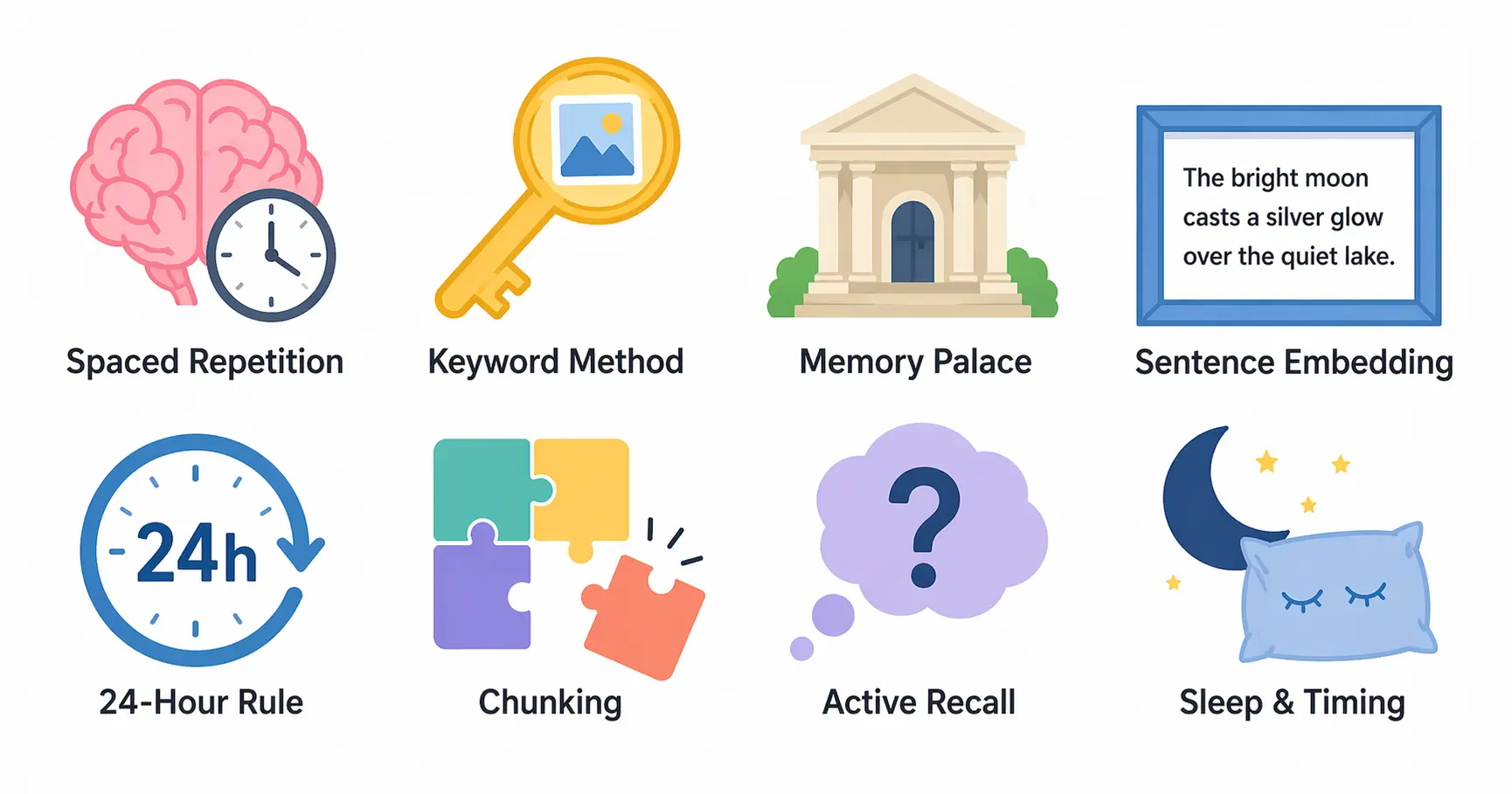
This guide covers 8 memorization techniques that are proven to work. These are not generic advice like “read more” or “practice daily.” Each technique targets a specific mechanism in your brain — and together, they form a system that makes vocabulary stick permanently.
Here is what you will learn:
- Why your brain forgets (and how to stop it)
- Spaced repetition — the most powerful technique
- The keyword method — visual anchors for new words
- The memory palace — ancient technique, modern proof
- Sentence embedding — context over definitions
- The 24-hour rule — use it or lose it
- Chunking — learning in groups, not isolation
- Active recall — test yourself, do not re-read
- Sleep and timing — when to study for maximum retention
Why Your Brain Forgets New Words
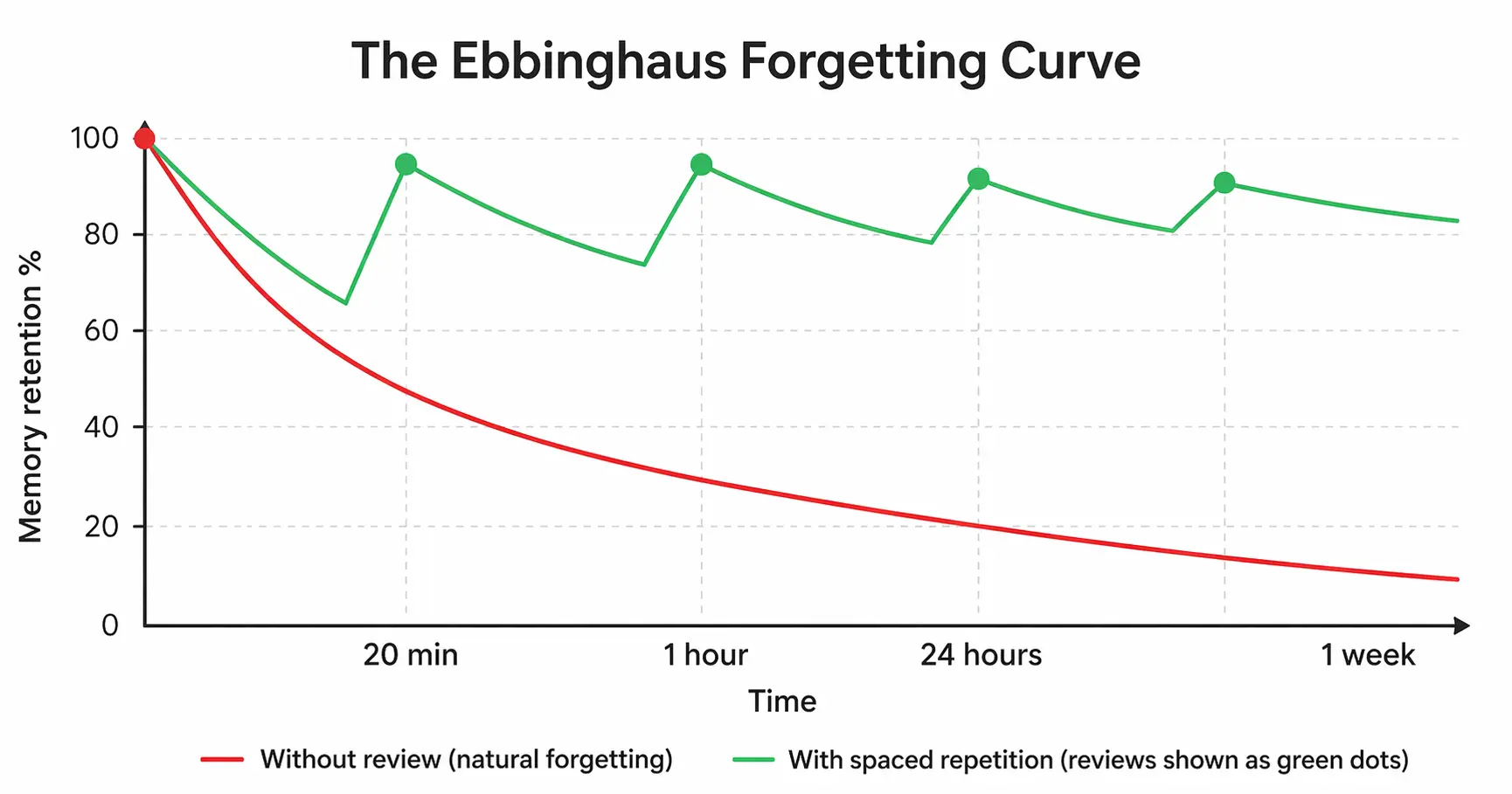
In 1885, German psychologist Hermann Ebbinghaus discovered the forgetting curve — a precise pattern showing how quickly the human brain loses new information. His findings, confirmed repeatedly by modern research, are both alarming and useful:
- After 20 minutes: you forget ~40% of new information
- After 1 hour: ~50% is gone
- After 24 hours: ~70% has disappeared
- After 1 week: ~90% is lost
This curve applies to every learner — beginners, advanced speakers, native speakers learning technical terms. The drop is steepest in the first 24 hours, which is why most vocabulary study sessions feel productive in the moment but lead to nothing a week later.
The critical insight: each time you successfully recall a word, the forgetting curve flattens. The word takes longer to fade. After 4–5 well-timed reviews, a word moves from fragile short-term memory into durable long-term storage.
Every technique in this article exploits this insight in a different way.
Technique 1: Spaced Repetition
What it is: Reviewing words at increasing intervals — right before you would forget them.
Why it works: Spaced repetition directly fights the forgetting curve. Instead of reviewing everything every day (inefficient) or reviewing once and hoping for the best (ineffective), you review each word at the exact moment your memory of it starts to weaken. Each successful recall strengthens the memory and pushes the next review further into the future.
The optimal review schedule:
| Review | When | What happens in your brain |
|---|---|---|
| 1st | 1 day after learning | Short-term memory refreshed; ~60% retained |
| 2nd | 3 days later | Neural pathway strengthens; ~80% retained |
| 3rd | 7 days later | Pattern recognition improves; recall becomes faster |
| 4th | 14 days later | Long-term consolidation begins |
| 5th | 30 days later | Word enters long-term memory; forgetting rate drops below 5% |
How to apply it:
- Automated: Add words to your Linglify dictionary — the app calculates review intervals for you and sends reminders at the right time.
- Manual: Use a three-box system. Box 1 = new words (review daily). Box 2 = words you got right once (review every 3 days). Box 3 = words you got right three times (review weekly). Words move forward when recalled correctly, backward when forgotten.
Spaced repetition is the single most impactful technique in this entire article. If you only adopt one method, make it this one.
Technique 2: The Keyword Method
What it is: Creating a vivid mental image that connects the sound of a new English word to its meaning.
Why it works: Your brain remembers images far better than abstract text. The keyword method creates a visual “bridge” between the unfamiliar sound and the meaning, giving your memory something concrete to hold onto. Studies show it can improve vocabulary retention by 50–75% compared to simple repetition.
How it works (3 steps):
- Find a keyword — a word in your native language (or any language you know) that sounds similar to the English word
- Create a mental image — a vivid, exaggerated, ideally absurd picture connecting the keyword to the meaning
- Recall the image — when you hear the English word, the image triggers the meaning
Examples:
| English Word | Meaning | Keyword | Mental Image |
|---|---|---|---|
| enormous | Very large | Think of “e-NOR-mous” — “Nor” sounds like “North” | A North Pole polar bear so enormous it blocks the entire horizon |
| reluctant | Unwilling to do something | “re-LUCK-tant” — “luck” | A person refusing to buy a lottery ticket because they feel unlucky |
| flourish | To grow or develop successfully | “FLOUR-ish” — “flour” | A bag of flour exploding into a beautiful garden of flowers |
| commence | To begin | “com-MENCE” — sounds like “comments” | A professor reading the first comment on their paper and starting to lecture |
The stranger, funnier, or more exaggerated the image, the better you remember it. Boring images do not stick. A polar bear wearing a top hat and blocking traffic? That sticks.
Technique 3: The Memory Palace
What it is: Placing vocabulary words in specific locations within a building or route you know well, then mentally “walking through” to recall them.
Why it works: This technique, also called the “method of loci,” exploits spatial memory — one of the strongest memory systems in the human brain. You already remember the layout of your home, your school, your commute. By attaching new words to familiar locations, you give each word a unique, stable address in your mind.
Memory champions use this technique to memorize hundreds of items in minutes. For vocabulary, it works exceptionally well for learning themed word groups.
How to build a memory palace:
- Choose a familiar place — your home, your workplace, your daily commute route
- Identify 10–15 specific locations — front door, kitchen table, couch, bathroom mirror, bed, etc.
- Place one word at each location — create a vivid scene linking the word’s meaning to that spot
- Walk through mentally — practice the route from start to finish, recalling each word
Example — 5 environment vocabulary words in your kitchen:
| Location | Word | Scene |
|---|---|---|
| Front door | carbon footprint | Giant muddy footprints made of black coal leading to your door |
| Kitchen table | sustainable | The table is made of growing tree branches — it sustains itself |
| Refrigerator | microplastic | You open the fridge and tiny plastic particles float out like snow |
| Sink | renewable | The faucet pours sunlight instead of water — solar energy, endlessly renewing |
| Window | biodegradable | A plastic bag on the windowsill slowly dissolving into soil and flowers |
Walk through this kitchen in your mind 3 times, and you will remember all 5 words. The technique scales — a full house gives you 20–30 locations. Your entire neighborhood gives you hundreds.
Technique 4: Sentence Embedding
What it is: Learning every new word inside a complete, meaningful sentence — never as an isolated definition.
Why it works: When you memorize “reluctant = unwilling,” you are storing one fragile connection. When you memorize “She was reluctant to speak at the meeting because she had not prepared,” you are storing the word’s meaning, grammar (adjective + “to” + verb), register (slightly formal), collocations (reluctant to + verb), and a relatable situation. Five connections instead of one.
Research in cognitive linguistics shows that words learned in context are recalled 2–3 times more reliably than words learned as isolated definitions.
How to apply it:
For every new word, follow this formula:
- Read the dictionary definition
- Read 2–3 example sentences from a dictionary or article
- Write your own sentence — this is the critical step
Your sentence should be personal and specific. Compare these two:
- Weak: The meeting was productive.
- Strong: Yesterday’s team meeting was surprisingly productive — we solved the budget problem in 20 minutes.
The second sentence connects “productive” to a real event in your life. Your brain treats it as a memory of something that happened, not just vocabulary homework.
For a detailed word study method that builds on this technique, see our step-by-step vocabulary learning system.
Technique 5: The 24-Hour Rule
What it is: Using every new word at least once in your own speech or writing within 24 hours of learning it.
Why it works: The forgetting curve is steepest in the first 24 hours — you lose 70% of new information during this window. Active use (producing the word yourself) creates a much stronger memory trace than passive review (re-reading). By forcing yourself to use the word within the critical window, you intercept the forgetting curve at its most dangerous point.
How to apply it:
| Method | Time needed | Best for |
|---|---|---|
| Write a text message or social media comment using the word | 1 minute | Casual practice |
| Write 3 sentences in your vocabulary journal | 3 minutes | Daily study routine |
| Use the word in a conversation (even with yourself) | 30 seconds | Speaking practice |
| Explain the word’s meaning out loud as if teaching someone | 1 minute | Deep processing |
The “teach someone” method is especially powerful. When you explain a word in your own words — define it, give an example, describe when you would use it — you process it at a much deeper level than simply reading and nodding.
Realistic daily workflow: Learn 5 words in the morning (15 minutes). Use each word once during the day — in a journal entry, a message, or a conversation. Review them the next morning before learning new ones. This simple loop captures 80% of the memorization benefit.
Technique 6: Chunking
What it is: Learning words in small, thematically connected groups instead of random lists.
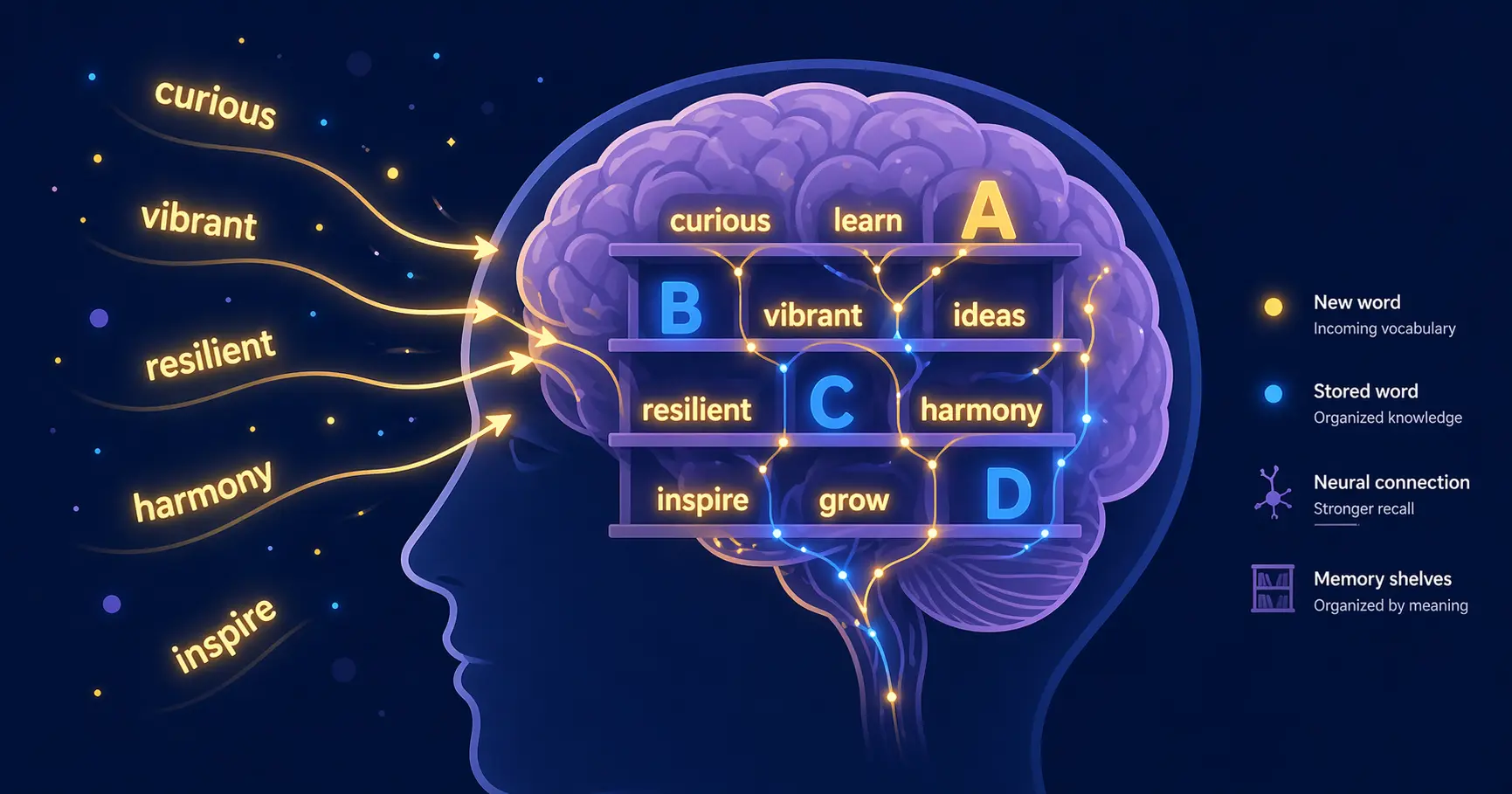
Why it works: Your brain does not store words as isolated entries — it organizes them in networks of related meanings. When you learn “salary,” “commute,” “deadline,” and “promotion” together, each word reinforces the others because they share a context: work. Recalling one word activates the whole cluster.
Cognitive psychologists call this the “schema effect” — new information sticks better when it connects to an existing mental framework.
How to chunk effectively:
- By topic: Learn 5–8 work words together, then 5–8 travel words, then 5–8 food words. Linglify’s library is organized by topic for exactly this reason — try technology, travel, or food and drink.
- By word family: Learn employ, employer, employee, employment, unemployment together. One root gives you five usable words.
- By collocation: Learn words that naturally appear together: make a decision, take responsibility, raise awareness, meet a deadline.
- By CEFR level: Study words at your level in batches. Browse B1 or B2 lists on Linglify.
Optimal chunk size: 5–7 words per group. This matches the capacity of working memory. Larger groups overwhelm your processing ability; smaller groups do not create enough connections.
Technique 7: Active Recall
What it is: Testing yourself by trying to remember a word from memory, rather than re-reading it.
Why it works: Cognitive scientists call this the “testing effect” — retrieving information from memory strengthens the memory more than re-reading the same information. Every time you struggle to recall a word and succeed, the neural pathway for that word gets stronger. Even failing to recall and then checking the answer improves retention more than never testing at all.
This is counterintuitive. Re-reading feels easy and productive. Testing feels hard and uncomfortable. But difficulty is the signal that your brain is actually working to build a lasting memory.
How to apply it:
- Cover and recall: Look at your word list, cover the definitions, try to remember each one. Check afterward.
- Blank sentence test: Write sentences with a blank where the target word goes. Fill them in from memory the next day.
- Reverse recall: Look at the definition and try to remember the English word (harder than word → definition).
- Rapid fire: Set a 2-minute timer. Write every word you studied this week from memory. No peeking.
- Teach-back: Explain 5 words to an imaginary student. If you can explain it clearly, you know it. If you stumble, you need to review.
Key rule: Do not re-read your word list as “review.” Always test yourself first, then check what you missed. The act of trying — even failing — is what builds memory.
Technique 8: Sleep and Timing
What it is: Strategically timing your study sessions to take advantage of how sleep consolidates memory.
Why it works: During sleep, your brain replays and consolidates new information, moving it from temporary hippocampal storage to permanent cortical storage. Studies consistently show that people who sleep between learning and testing remember 20–40% more than people who stay awake for the same period.
Practical rules:
- Study before bed. A 15-minute vocabulary session before sleep gives your brain fresh material to consolidate overnight. This single habit can improve retention by 20% or more.
- Review in the morning. A quick 5-minute recall session after waking up checks which words survived the night. The ones you remember are solidifying. The ones you forgot need another cycle.
- Never pull an all-nighter for vocabulary. Sleep deprivation destroys memory consolidation. Eight hours of sleep after a study session beats three extra hours of cramming.
- Nap strategically. A 20-minute afternoon nap after a study session improves recall of recently learned material. Longer naps (60–90 minutes, reaching deep sleep) are even better.
Optimal daily schedule for vocabulary memorization:
| Time | Activity | Duration |
|---|---|---|
| Morning (after waking) | Recall test: try to remember yesterday’s words | 5 min |
| Afternoon | Learn new words (5–10) using techniques 2–6 | 15 min |
| Evening (before bed) | Review today’s new words + use each in a sentence | 10 min |
This 30-minute daily routine, combined with proper sleep, maximizes the neuroscience of memory formation.
How Many Words Can You Realistically Memorize Per Day?
This depends on your technique, available time, and definition of “memorize.” Here are realistic numbers based on research:
| Method | Words per session | Retention after 30 days |
|---|---|---|
| Simple re-reading of word list | 20–30 | ~10–15% (2–4 words) |
| Flashcards without spaced repetition | 15–20 | ~25–30% (4–6 words) |
| Techniques from this article (combined) | 5–10 | ~80–90% (4–9 words) |
The paradox: Learning fewer words with better techniques produces more retained vocabulary than learning many words with weak methods. Studying 5 words properly (15 minutes) and remembering all 5 in a month beats studying 30 words casually (30 minutes) and remembering 3.
Recommended targets:
- Casual learners: 3–5 words/day (90–150 words/month retained)
- Serious learners: 5–10 words/day (150–270 words/month retained)
- Exam preparation: 8–12 words/day (200–300 words/month retained, with 45+ min daily study time)
At 5 words per day with 80% retention, you add ~1,400 words per year to your active vocabulary — enough to move up a full CEFR level.
How to Memorize Vocabulary for a Test
If you have an exam coming up — IELTS, TOEFL, a university test, or a school vocabulary quiz — here is an adapted strategy that combines the techniques above into an exam-focused plan:
2 weeks before the test:
- Identify the word list you need to know. For IELTS, use our IELTS vocabulary guide. For general English tests, use B2 vocabulary lists.
- Divide the total words by 10 (days of active study, leaving 4 days for review). That is your daily target.
- Study each daily batch using the keyword method (Technique 2) and sentence embedding (Technique 4).
Days 1–10: Learn
- Learn your daily batch in the afternoon.
- Use each word in a sentence before bed (Technique 5: 24-hour rule).
- Morning: active recall test on yesterday’s words (Technique 7).
Days 11–14: Review and test
- No new words. Full review mode.
- Day 11–12: Go through all words using active recall. Mark the ones you miss.
- Day 13: Focus only on missed words. Use the memory palace (Technique 3) for the hardest ones.
- Day 14 (test day): Light morning review. Trust the system.
The night before a test: Review your hardest words once, then sleep. Do not cram for hours — sleep consolidation (Technique 8) is more effective than an extra hour of reading.
How to Memorize Vocabulary in Another Language Fast
Everything in this article applies to any language, not just English. The techniques are based on how human memory works, not on any specific language. However, when learning vocabulary in a foreign language, these additional strategies help:
Use cognates as shortcuts. Many languages share words with English (or with each other). Spanish información, French important, German Kindergarten — if you already know one language, use the overlap.
Learn pronunciation first, meaning second. In languages with unfamiliar sounds (Japanese, Arabic, Mandarin), spend time on pronunciation before memorizing meanings. Your brain needs to “hear” the word before it can store it.
Create bilingual keyword bridges. The keyword method (Technique 2) is especially powerful for foreign languages. Connect the foreign word’s sound to a word you know, then link that to the meaning with a vivid image.
Adjust your daily target. Languages with different writing systems (Japanese, Korean, Arabic) require extra processing time. Start with 3 words/day instead of 5 and increase as you get comfortable.
Words to Practice These Techniques With
Here are 25 B1–B2 level words you can memorize using the techniques from this article. Add them to your dictionary and spaced repetition starts automatically.
candidate
noun
A person who is competing in an election or contest.
Examples
- Each presidential candidate presented their policy plans to voters.
- The job candidate impressed the interview panel with her experience.
evaluate
verb
To judge or measure the value, quality, or importance of something.
Examples
- Companies evaluate job candidates based on experience, skills, and personality.
- Teachers evaluate student progress through tests, projects, and classroom participation.
cooperate
verb
To work together with others towards a common goal.
humorous
adjective
Funny or amusing, often making people laugh.
Examples
- She writes humorous articles about everyday life and family experiences.
- The humorous speech made everyone laugh and lightened the serious mood.
motivated
adjective
Feeling driven or inspired to do something because of a reason or goal.
Examples
- Motivated employee seeks additional responsibilities and challenges at work.
- Success requires being motivated even when facing difficult obstacles.
tragedy
noun
An extremely sad or serious event that causes suffering or loss.
Examples
- Natural tragedy affects thousands of innocent people.
- Personal tragedy changes person's life perspective completely.
prejudice
noun
Preconceived opinions or feelings, often negative, about a person or group.
Examples
- Education helps overcome prejudice and promotes understanding.
- Racial prejudice damages communities and individuals alike.
donate
verb
To give something, especially money or goods, to help a cause or person.
Examples
- Many people donate money to charities that help homeless individuals.
- She decided to donate blood to help patients in emergency situations.
discourage
verb
To try to make someone feel less confident or hopeful about something.
Examples
- Don't let one failure discourage you from pursuing your dreams.
- High prices discourage many people from buying organic food products.
graduate
verb
To complete a course of study at a school or university.
Examples
- She will graduate from university next year with a degree in engineering.
- Students must complete all requirements before they can graduate from high school.
union
noun
A group of people or things joined together for a purpose.
Examples
- Labor union protects worker rights and interests.
- Marriage union joins two people in partnership.
horizon
noun
The line where the earth or the sky appears to meet in the distance.
Examples
- The sun disappeared behind the horizon as evening approached.
- Traveling broadens your horizon and exposes you to new cultures.
off
adjective
Describes something that is not fresh or is no longer suitable for eating, often used for food and drinks.
Examples
- Please turn off the lights before leaving the room.
- The dog ran off into the forest chasing wild rabbits.
lifelong
adjective
Continuing for a very long time or for the whole life.
Examples
- Learning is a lifelong process that never truly ends.
- Their lifelong friendship began during elementary school years.
boom
noun
A loud, deep sound or a sudden increase in activity or popularity.
Examples
- The boom of thunder echoed across the valley.
- The technology boom created many new millionaires.
stress
verb
To feel mental or emotional pressure or worry; to emphasize or give importance to something.
Examples
- Heavy workload may stress employees beyond limits.
- Teacher will stress importance of homework completion.
guide
verb
To show or direct someone how to do something.
Examples
- Parents should guide their children to make responsible decisions.
- The experienced hiker will guide the group through the mountain trail safely.
admission
noun
The process or fact of being allowed to enter or join.
Examples
- Her admission to the prestigious medical school was the result of hard work.
- The museum offers free admission on the first Sunday of every month.
jury
noun
A group of people who listen to evidence in a court and decide if someone is guilty.
Examples
- The jury deliberated for several hours before reaching a verdict.
- The talent show jury consisted of professional musicians and entertainers.
voyage
noun
A long journey to a distant place, often by sea or air.
Examples
- Space exploration represents humanity's greatest voyage into the unknown.
- The ocean voyage from Europe to America took several weeks in the past.
total
adjective
An adjective describing something that is complete or whole, not divided or broken.
Examples
- Total cost includes all fees and expenses.
- Total silence fills room during meditation session.
indispensable
adjective
Absolutely necessary; essential.
Examples
- Clean water is indispensable for human survival and good health.
- Her experience and skills make her indispensable to the research team.
firmly
adverb
An adverb indicating a way of doing something with certainty or stability.
Examples
- Hold the rope firmly while climbing down the steep mountain slope.
- The manager firmly believed in treating all employees with respect.
normally
adverb
Usually; under normal conditions.
Examples
- Heart normally beats between sixty and hundred times per minute.
- Students normally arrive at school before morning bell rings.
resolve
verb
To find a solution or answer to a problem or question.
Examples
- Mediator helps parties resolve dispute through negotiation.
- Technical team will resolve software problems quickly.
What to Do Right Now
-
Pick your top technique. Re-read the 8 techniques and choose the one that fits your learning style. Visual learners: try the memory palace. Logical learners: start with spaced repetition. Social learners: use the teach-back method.
-
Learn 5 words today. Use the snippet above or browse B1 or B2 vocabulary lists. Apply your chosen technique to all 5 words.
-
Set a review alarm. Schedule a 5-minute recall session for tomorrow morning. This single habit — morning recall — is worth more than any other study trick.
-
Build a complete system. Memorization is one piece of the puzzle. For the full vocabulary learning system — from choosing words to tracking progress — read our step-by-step vocabulary guide.
-
Expand your methods. For 10 broader vocabulary improvement strategies (including reading, topic-based study, and daily goal setting), see How to Improve Your Vocabulary.
FAQ
How to memorize vocabulary in English?
Use a combination of spaced repetition (reviewing at increasing intervals), the keyword method (visual associations), and sentence embedding (learning words in context). Study 5–10 words per day, use each word within 24 hours of learning it, and review before bed to take advantage of sleep consolidation. For the full system, follow the 8 techniques in this article.
How to remember vocabulary words for a test?
Start studying at least 2 weeks before the test. Divide your word list into daily batches of 10–15 words. Learn using the keyword method and sentence embedding for the first 10 days, then switch to pure active recall (self-testing) for the final 4 days. Focus your last review on missed words, and sleep well the night before — sleep consolidation is more effective than last-minute cramming.
How to memorize vocabulary in another language fast?
The same 8 techniques work for any language. Start with cognates (words that are similar to words you already know), use the keyword method to create sound-meaning bridges, and reduce your daily target to 3 words if the language has an unfamiliar writing system. Spaced repetition and active recall work regardless of which language you are learning.
How to memorize vocab words in one night?
Honestly, one night is not enough for lasting memorization. However, if you have no choice: focus on the 15–20 most important words (not the full list). Use the memory palace technique to place each word in a location in your home. Test yourself with active recall every 30 minutes. Sleep at least 5–6 hours — your brain needs sleep to consolidate memories. The next morning, do one final recall test before your exam. This approach maximizes what you can retain in a short window, but expect to forget most of these words within a week without follow-up review.
How many vocabulary words can you memorize in a day?
With proper techniques, most people can effectively memorize 5–10 words per day with 80–90% retention after 30 days. Serious students with 45+ minutes of study time can push to 12–15. Going above 15 per day almost always leads to lower retention — you spend so much time reviewing that new words get shortchanged. Quality beats quantity: 5 words remembered permanently are worth more than 30 words forgotten by Friday.
Does writing words down help you memorize them?
Yes, significantly. Writing by hand activates different motor and cognitive pathways than typing or reading. Studies show that handwritten notes lead to better recall than typed notes. For vocabulary specifically, writing your own sentence using the word (not just copying the definition) is one of the most effective memorization strategies. The act of constructing a sentence forces deep processing — you have to understand the word’s meaning, grammar, and context to write a correct sentence.
What is the fastest memorization technique for vocabulary?
The keyword method (Technique 2) produces the fastest initial memorization — you can learn a word in under 30 seconds by creating a vivid mental image. However, for long-term retention, spaced repetition (Technique 1) is the most effective. The optimal approach is combining both: use the keyword method to learn words quickly, then use spaced repetition to keep them in memory permanently.