

Contoh Phrasal Verb: 200 Kalimat untuk Setiap Level
Definisi memberi tahu arti suatu phrasal verb. Contoh menunjukkan cara kerjanya dalam penggunaan nyata. Ada alasan setiap buku tata bahasa memuat contoh kalimat—melihat phrasal verb dalam konteks memperlihatkan tata bahasanya (dapat dipisahkan atau tidak?), ragam bahasanya (formal atau santai?), dan kolokasi alaminya (nomina dan situasi mana yang cocok dengannya?).
Panduan ini memberi Anda 200 contoh phrasal verb dalam kalimat lengkap dan alami. Kalimat-kalimat disusun menurut level CEFR—dari dasar A2 seperti “wake up” dan “turn off” hingga ungkapan C1 seperti “play down” dan “phase out.” Setiap entri mencakup arti, kalimat jelas, serta catatan penggunaan jika diperlukan.
Gunakan ini sebagai referensi ketika menulis, daftar belajar untuk membangun kepercayaan diri, atau sumber pola alami yang dapat Anda serap. Semakin banyak contoh kalimat yang Anda baca dan ulangi, semakin alami phrasal verb akan muncul bagi Anda.
- Total contoh: 200 kalimat
- Level yang dibahas: A2, B1, B2, C1
- Format: Phrasal verb → arti → contoh kalimat
- Terbaik untuk: pelajar yang mengetahui definisi tetapi kesulitan menggunakan phrasal verb secara alami
Untuk definisi dan penjelasan terperinci tentang setiap phrasal verb, lihat Phrasal Verb Bahasa Inggris: Panduan Lengkap. Untuk phrasal verb yang dikelompokkan berdasarkan kata kerja dasar, lihat Phrasal Verb dengan GET atau Phrasal Verb dengan MAKE.
Cara Menggunakan Contoh-contoh Ini
Membaca contoh kalimat secara pasif membantu, tetapi latihan aktif membangun kelancaran nyata. Berikut cara memperoleh manfaat maksimal dari daftar ini:
- Baca kalimat dengan lantang. Pelafalan dan ritme penting. Phrasal verb terdengar berbeda dari kata-kata penyusunnya—“pick UP” memiliki tekanan berbeda daripada “pick” + “up” yang diucapkan terpisah.
- Tutup artinya, tebak dari konteks. Uji diri Anda. Jika Anda dapat memahami kalimat tanpa definisi, berarti Anda membuat kemajuan.
- Tulis versi Anda sendiri. Ganti nomina dan rincian dengan kehidupan Anda sendiri. “She turned down the job offer” → “I turned down the invitation to the party.” Kalimat pribadi lebih melekat dalam ingatan.
- Perhatikan tata bahasanya. Apakah objek berada di antara kata kerja dan partikel (dapat dipisahkan) atau setelahnya (tidak dapat dipisahkan)? Ini memberi tahu cara membentuk kalimat sendiri dengan benar.
Level A2: Phrasal Verb Dasar (50 Contoh)
Ini adalah phrasal verb yang pertama kali ditemui setiap pelajar. Kata-kata ini menggambarkan rutinitas harian, tindakan dasar, dan interaksi sederhana.
Rutinitas Harian
| # | Phrasal Verb | Arti | Contoh Kalimat |
|---|---|---|---|
| 1 | wake up | berhenti tidur | I wake up at 7 every morning, even on weekends. |
| 2 | get up | bangun dari tempat tidur | She got up immediately when the alarm rang. |
| 3 | put on | mengenakan pakaian di tubuh | He put on his coat and went outside. |
| 4 | take off | melepas pakaian | Please take off your shoes at the door. |
| 5 | turn on | menyalakan perangkat | Can you turn on the light? It’s getting dark. |
| 6 | turn off | mematikan perangkat | Turn off the TV — dinner is ready. |
| 7 | go out | keluar dari rumah | We usually go out on Friday evenings. |
| 8 | come back | kembali | She went to the store and came back in ten minutes. |
| 9 | sit down | duduk | Please sit down. The meeting will start soon. |
| 10 | stand up | berdiri | Everyone stood up when the teacher entered. |
Tindakan Dasar
| # | Phrasal Verb | Arti | Contoh Kalimat |
|---|---|---|---|
| 11 | pick up | mengangkat sesuatu dari permukaan | He picked up the phone and called his mother. |
| 12 | put down | meletakkan sesuatu di permukaan | She put down her bag and sat on the sofa. |
| 13 | throw away | membuang ke tempat sampah | Don’t throw away that box — I need it. |
| 14 | give back | mengembalikan sesuatu kepada seseorang | Can you give back my pen when you’re finished? |
| 15 | look for | mencoba menemukan | I’m looking for my keys. Have you seen them? |
| 16 | find out | menemukan informasi | I found out that the store closes at 9 PM. |
| 17 | write down | mencatat di kertas | Write down the address so you don’t forget it. |
| 18 | fill in | mengisi formulir | Please fill in your name and email address. |
| 19 | hand in | menyerahkan | Students must hand in their homework by Friday. |
| 20 | try on | mencoba pakaian dengan mengenakannya | She tried on three dresses before choosing one. |
Komunikasi dan Orang
| # | Phrasal Verb | Arti | Contoh Kalimat |
|---|---|---|---|
| 21 | call back | menelepon kembali | He’s busy right now. Can he call you back in an hour? |
| 22 | hang up | mengakhiri panggilan telepon | She said goodbye and hung up. |
| 23 | look after | merawat | My neighbor looks after our cat when we travel. |
| 24 | get along | memiliki hubungan baik | The new employee gets along with everyone in the office. |
| 25 | grow up | menjadi dewasa | She grew up in a small town near the coast. |
| 26 | ask for | meminta | He asked for a glass of water. |
| 27 | talk about | membahas | We talked about the problem for over an hour. |
| 28 | wait for | menunggu sampai seseorang/sesuatu tiba | I waited for the bus for twenty minutes in the rain. |
| 29 | listen to | memperhatikan suara | She listens to podcasts every morning on her commute. |
| 30 | belong to | menjadi milik | This laptop belongs to the company, not to me. |
Pergerakan dan Arah
| # | Phrasal Verb | Arti | Contoh Kalimat |
|---|---|---|---|
| 31 | come in | masuk | Come in! The door is open. |
| 32 | go away | pergi, meninggalkan | The headache went away after I took medicine. |
| 33 | get on | naik (bus, kereta, pesawat) | We got on the bus at the Central Station stop. |
| 34 | get off | turun dari kendaraan | Get off at the next stop — that’s the city center. |
| 35 | get in | masuk ke mobil atau taksi | She got in the taxi and told the driver the address. |
| 36 | get out | keluar dari mobil atau ruang kecil | He got out of the car and walked to the building. |
| 37 | run away | melarikan diri dengan berlari | The cat ran away when it heard the thunder. |
| 38 | fall down | jatuh ke tanah | The child fell down but got up without crying. |
| 39 | move in | mulai tinggal di tempat baru | They moved in last weekend and are still unpacking. |
| 40 | move out | meninggalkan rumah secara permanen | He moved out of his parents’ house at 18. |
Waktu dan Rutinitas
| # | Phrasal Verb | Arti | Contoh Kalimat |
|---|---|---|---|
| 41 | hurry up | melakukan sesuatu lebih cepat | Hurry up! The movie starts in five minutes. |
| 42 | slow down | mengurangi kecepatan | The driver slowed down when he saw the school. |
| 43 | carry on | melanjutkan | Carry on reading — I didn’t mean to interrupt. |
| 44 | go on | melanjutkan, terjadi | What’s going on? I heard a loud noise. |
| 45 | end up | akhirnya berada dalam suatu situasi | We got lost and ended up in the wrong part of town. |
| 46 | set up | menyiapkan, menata | They set up the chairs for the presentation. |
| 47 | clean up | merapikan suatu tempat | We need to clean up before the guests arrive. |
| 48 | use up | menghabiskan sepenuhnya | We used up all the milk — someone needs to buy more. |
| 49 | run out | tidak memiliki sesuatu lagi | We ran out of coffee, so I’m drinking tea today. |
| 50 | show up | tiba, muncul | He showed up 20 minutes late to the meeting. |
Level B1: Phrasal Verb Menengah (50 Contoh)
Pada B1, phrasal verb menjadi lebih abstrak. Artinya lebih sulit ditebak dari kata-kata penyusunnya, dan banyak yang memiliki beberapa makna.
Kerja dan Produktivitas
| # | Phrasal Verb | Arti | Contoh Kalimat |
|---|---|---|---|
| 51 | take over | mengambil alih kendali | She took over as team leader when Mark resigned. |
| 52 | set up | mendirikan, memulai (bisnis) | He set up his own company after years of working for others. |
| 53 | carry out | melaksanakan, menyelesaikan (tugas) | The researchers carried out experiments for six months. |
| 54 | deal with | menangani, mengelola | She deals with customer complaints every day. |
| 55 | put off | menunda | They put off the decision until next week. |
| 56 | come up with | memikirkan, menciptakan | He came up with a brilliant idea during the meeting. |
| 57 | figure out | memahami setelah berpikir | I can’t figure out how to use this software. |
| 58 | keep up with | mempertahankan kecepatan yang sama dengan | It’s hard to keep up with all the changes in technology. |
| 59 | work out | menghitung; berolahraga; berhasil | We need to work out the total cost before signing the contract. |
| 60 | take on | menerima (tanggung jawab) | She took on extra work to save money for the trip. |
Hubungan dan Kehidupan Sosial
| # | Phrasal Verb | Arti | Contoh Kalimat |
|---|---|---|---|
| 61 | break up | mengakhiri hubungan | They broke up after three years together. |
| 62 | make up | berdamai setelah bertengkar | They argued all morning but made up before dinner. |
| 63 | get together | bertemu secara sosial | Let’s get together for coffee this weekend. |
| 64 | look up to | mengagumi, menghormati | She looks up to her grandmother as a role model. |
| 65 | let down | mengecewakan | I trusted him, and he let me down. |
| 66 | put up with | menoleransi | I can’t put up with this noise anymore. |
| 67 | fall out | bertengkar, berhenti berteman | They fell out over money and haven’t spoken since. |
| 68 | bring up | menyebut suatu topik; membesarkan anak | Don’t bring up politics at the dinner table. |
| 69 | turn out | berakhir, terjadi pada akhirnya | The party turned out to be much better than I expected. |
| 70 | cheer up | menjadi lebih bahagia, membuat seseorang lebih bahagia | She bought him flowers to cheer him up after the bad news. |
Belajar dan Memahami
| # | Phrasal Verb | Arti | Contoh Kalimat |
|---|---|---|---|
| 71 | look up | mencari informasi | I looked up the word in the dictionary. |
| 72 | find out | menemukan | She found out that her flight was canceled only at the airport. |
| 73 | go over | meninjau, memeriksa | Let’s go over the plan one more time before we start. |
| 74 | point out | menarik perhatian pada sesuatu | My teacher pointed out several errors in my essay. |
| 75 | make sense | masuk akal, dapat dipahami | This explanation doesn’t make sense to me at all. |
| 76 | pick up | mempelajari secara informal | He picked up some Spanish while living in Barcelona. |
| 77 | catch on | mulai memahami | The new system is complex, but most people catch on quickly. |
| 78 | mix up | mencampuradukkan satu hal dengan hal lain | I always mix up “affect” and “effect.” |
| 79 | come across | menemukan secara kebetulan | I came across an interesting article while browsing online. |
| 80 | think over | mempertimbangkan dengan saksama | I need to think it over before making a decision. |
Perubahan Hidup dan Keputusan
| # | Phrasal Verb | Arti | Contoh Kalimat |
|---|---|---|---|
| 81 | give up | berhenti mencoba; menghentikan kebiasaan | He gave up smoking three years ago. |
| 82 | turn down | menolak | She turned down the job offer because the salary was too low. |
| 83 | take up | memulai hobi atau aktivitas baru | I took up running during the pandemic and still do it. |
| 84 | drop out | keluar dari sekolah atau kursus | He dropped out of university to start a business. |
| 85 | sign up | mendaftar | Over 500 people signed up for the online course. |
| 86 | go ahead | melanjutkan, memulai | The project was approved — we can go ahead with construction. |
| 87 | hold on | menunggu sebentar | Hold on — I’ll check the schedule and call you back. |
| 88 | come up | muncul, timbul tanpa diduga | Something came up at work, so I’ll be late tonight. |
| 89 | sort out | menata, menyelesaikan | We need to sort out the accommodation before the trip. |
| 90 | get over | pulih dari | It took her weeks to get over the flu this winter. |
Situasi Sehari-hari
| # | Phrasal Verb | Arti | Contoh Kalimat |
|---|---|---|---|
| 91 | run into | bertemu secara kebetulan | I ran into my old teacher at the supermarket yesterday. |
| 92 | look forward to | merasa antusias terhadap peristiwa masa depan | I’m looking forward to the holiday — I need a break. |
| 93 | cut down on | mengurangi jumlah | The doctor told him to cut down on sugar and salt. |
| 94 | get rid of | menyingkirkan, membuang | We got rid of the old sofa and bought a new one. |
| 95 | put away | menyimpan di tempat yang benar | Please put away your toys before dinner. |
| 96 | check in | mendaftar di hotel atau bandara | We checked in at the hotel at around 3 PM. |
| 97 | check out | meninggalkan hotel; memeriksa | We need to check out by 11 AM tomorrow. |
| 98 | come along | membuat kemajuan; menemani | How is your English coming along? |
| 99 | calm down | menjadi kurang kesal atau bersemangat | Calm down — getting angry won’t solve anything. |
| 100 | break down | berhenti berfungsi (mesin) | Our car broke down on the highway during the trip. |
Level B2: Phrasal Verb Menengah Atas (50 Contoh)
Pada B2, phrasal verb menjadi lebih idiomatis. Banyak di antaranya memiliki makna kiasan yang sangat berbeda dari kata literalnya.
Profesional dan Akademik
| # | Phrasal Verb | Arti | Contoh Kalimat |
|---|---|---|---|
| 101 | draw up | menyusun dokumen resmi | The lawyers drew up a new contract with revised terms. |
| 102 | lay off | mengakhiri pekerjaan | The company laid off 200 workers due to falling revenue. |
| 103 | take into account | mempertimbangkan sebagai faktor | You need to take into account the cost of shipping when pricing products. |
| 104 | rule out | mengesampingkan sebagai kemungkinan | The police have not ruled out foul play in the investigation. |
| 105 | account for | menjelaskan; mewakili suatu proporsi | Online sales account for 40% of the company’s revenue. |
| 106 | bring about | menyebabkan terjadi | The new policy brought about significant changes in working conditions. |
| 107 | follow up | melanjutkan penyelidikan atau tindak lanjut | I’ll follow up with the supplier next week about the delivery date. |
| 108 | come up against | menghadapi kesulitan | We came up against several technical problems during testing. |
| 109 | call off | membatalkan | They called off the outdoor event because of the storm warning. |
| 110 | hand over | menyerahkan kendali atau kepemilikan | She handed over her responsibilities to her replacement before leaving. |
Berpikir dan Mengambil Keputusan
| # | Phrasal Verb | Arti | Contoh Kalimat |
|---|---|---|---|
| 111 | narrow down | mempersempit pilihan menjadi daftar yang lebih kecil | We’ve narrowed down the candidates to three finalists. |
| 112 | weigh up | mempertimbangkan kelebihan dan kekurangan | He spent days weighing up whether to accept the transfer. |
| 113 | talk into | membujuk seseorang melakukan sesuatu | She talked me into running the marathon with her. |
| 114 | talk out of | membujuk seseorang agar tidak melakukan sesuatu | His friends talked him out of quitting his job impulsively. |
| 115 | go through with | menyelesaikan sesuatu walaupun sulit | She was nervous but went through with the presentation anyway. |
| 116 | back out of | menarik diri dari komitmen | They backed out of the deal at the last minute. |
| 117 | look into | menyelidiki | The manager promised to look into the customer’s complaint. |
| 118 | open up | mulai bersedia membagikan perasaan | He finally opened up about the stress he’d been feeling at work. |
| 119 | come around | berubah pikiran; sadar kembali | She was against the idea at first but eventually came around. |
| 120 | work through | menangani sesuatu secara sistematis | They worked through their disagreements with the help of a mediator. |
Komunikasi dan Ekspresi
| # | Phrasal Verb | Arti | Contoh Kalimat |
|---|---|---|---|
| 121 | speak up | berbicara lebih keras; mengungkapkan pendapat | If you disagree, you should speak up during the meeting. |
| 122 | bring up | mengangkat topik dalam percakapan | She brought up an interesting point about the budget. |
| 123 | get across | menyampaikan dengan berhasil | He tried to get his point across, but nobody was listening. |
| 124 | brush off | mengabaikan sebagai tidak penting | She brushed off the criticism and continued with her plan. |
| 125 | turn to | mencari bantuan dari | When things got difficult, she turned to her family for support. |
| 126 | pass on | meneruskan informasi kepada orang lain | Could you pass on the message to everyone in the team? |
| 127 | take back | menarik kembali pernyataan | I take back what I said — you were completely right. |
| 128 | cut in | menyela percakapan | He cut in before she could finish explaining her idea. |
| 129 | go into | membahas secara terperinci | I won’t go into all the reasons now — we can talk later. |
| 130 | sum up | merangkum | To sum up, we need to reduce costs and increase sales. |
Perubahan dan Perkembangan
| # | Phrasal Verb | Arti | Contoh Kalimat |
|---|---|---|---|
| 131 | build up | meningkat secara bertahap | She built up her savings over five years before buying the apartment. |
| 132 | break through | mencapai keberhasilan meski ada hambatan | After months of research, the team finally broke through with a solution. |
| 133 | set back | menunda kemajuan | The funding problem set the project back by three months. |
| 134 | cut back | mengurangi pengeluaran atau konsumsi | The government cut back on education funding this year. |
| 135 | branch out | berkembang ke bidang baru | The restaurant branched out into catering for corporate events. |
| 136 | phase in | memperkenalkan secara bertahap | The company is phasing in a new remote work policy over six months. |
| 137 | wind down | mengurangi kegiatan secara bertahap; bersantai | The conference was winding down, and people started leaving. |
| 138 | step down | mengundurkan diri dari jabatan | The CEO stepped down after 15 years leading the company. |
| 139 | scale up | meningkatkan ukuran atau cakupan | They scaled up production to meet the sudden demand. |
| 140 | hold back | menghambat kemajuan; menahan | Fear of failure held her back from applying for the promotion. |
Emosi dan Perilaku
| # | Phrasal Verb | Arti | Contoh Kalimat |
|---|---|---|---|
| 141 | bottle up | memendam emosi | He bottles up his feelings and never talks about what’s bothering him. |
| 142 | lash out | menyerang secara verbal atau fisik | She lashed out at her colleague after a stressful morning. |
| 143 | pull through | selamat dari situasi sulit | The patient was critical but pulled through after surgery. |
| 144 | burn out | menjadi lelah karena kerja berlebihan | She burned out after working 70-hour weeks for six months straight. |
| 145 | snap out of | memaksa diri keluar dari keadaan negatif | He told himself to snap out of it and focus on the solution. |
| 146 | live up to | memenuhi harapan | The film didn’t live up to the hype — it was disappointing. |
| 147 | own up to | mengakui tanggung jawab | Nobody owned up to breaking the window in the office. |
| 148 | play along | berpura-pura setuju atau bekerja sama | She didn’t believe his excuse but played along to avoid conflict. |
| 149 | wear off | berangsur-angsur menghilang (efek) | The excitement of the new job wore off after a few months. |
| 150 | get away with | lolos dari hukuman | He was late every day and somehow got away with it for months. |
Level C1: Phrasal Verb Lanjutan (50 Contoh)
Phrasal verb ini muncul dalam tulisan akademik, konteks profesional, dan percakapan yang canggih. Phrasal verb ini menandai Anda sebagai penutur bahasa Inggris yang percaya diri dan bernuansa.
Bisnis dan Strategi
| # | Phrasal Verb | Arti | Contoh Kalimat |
|---|---|---|---|
| 151 | buy out | membeli bagian kepemilikan seseorang dalam bisnis | The partners disagreed, so one bought the other out for $2 million. |
| 152 | bail out | menyelamatkan secara finansial | The government bailed out the failing bank to prevent economic collapse. |
| 153 | cash in on | mengambil keuntungan dari situasi | Competitors were quick to cash in on the company’s PR disaster. |
| 154 | ramp up | meningkatkan dengan cepat | They ramped up marketing spending ahead of the product launch. |
| 155 | phase out | menghentikan secara bertahap | The manufacturer is phasing out the old model by the end of the year. |
| 156 | pencil in | menjadwalkan sementara | Let’s pencil in Thursday for the review — we can confirm later. |
| 157 | hammer out | merundingkan dengan sulit | The two sides hammered out an agreement after twelve hours of talks. |
| 158 | sign off on | memberi persetujuan formal | The director still hasn’t signed off on the revised budget. |
| 159 | factor in | memasukkan sebagai pertimbangan | You need to factor in inflation when planning your retirement savings. |
| 160 | iron out | menyelesaikan masalah kecil | We need to iron out the details before presenting to the board. |
Komunikasi Bernuansa
| # | Phrasal Verb | Arti | Contoh Kalimat |
|---|---|---|---|
| 161 | play down | membuat sesuatu tampak kurang penting | The spokesperson played down the severity of the data breach. |
| 162 | talk down to | berbicara dengan merendahkan | She hated how her manager talked down to her in front of clients. |
| 163 | come out with | mengatakan sesuatu yang mengejutkan | He came out with the most bizarre excuse anyone had ever heard. |
| 164 | own up | mengakui kesalahan | After a week of denials, the politician finally owned up to the mistake. |
| 165 | water down | melemahkan, membuat kurang efektif | Critics accused the government of watering down the environmental regulations. |
| 166 | gloss over | menghindari pembahasan terperinci | The report glossed over the safety concerns raised by engineers. |
| 167 | spell out | menjelaskan dengan sangat jelas dan sederhana | Let me spell out exactly what will happen if we miss the deadline. |
| 168 | fend off | mempertahankan diri dari, menahan | The company fended off a hostile takeover attempt from a larger rival. |
| 169 | put forward | mengajukan, menyarankan secara formal | She put forward a radical plan to restructure the entire department. |
| 170 | touch on | menyebut secara singkat | The speaker touched on climate change but didn’t go into detail. |
Analisis dan Penalaran
| # | Phrasal Verb | Arti | Contoh Kalimat |
|---|---|---|---|
| 171 | boil down to | menyederhanakan menjadi pokok inti | The whole argument boils down to one question: who pays? |
| 172 | stem from | berasal dari, disebabkan oleh | Most of the delays stem from poor planning in the early stages. |
| 173 | hinge on | sepenuhnya bergantung pada | The success of the project hinges on securing funding by March. |
| 174 | pan out | berkembang, berakhir | We’ll have to wait and see how the new strategy pans out. |
| 175 | stack up | dibandingkan dengan sesuatu | How does our proposal stack up against the competition? |
| 176 | flesh out | menambahkan detail pada gagasan | The concept is good — now we need to flesh out the implementation plan. |
| 177 | zero in on | berfokus sangat dekat pada satu hal | The investigators zeroed in on a discrepancy in the financial records. |
| 178 | piece together | memahami dengan menggabungkan potongan-potongan | Detectives pieced together what happened from CCTV footage and witness statements. |
| 179 | rule out | mengecualikan sebagai kemungkinan | Doctors ruled out serious illness but ordered further tests. |
| 180 | map out | merencanakan secara terperinci | She mapped out her career goals for the next five years. |
Masyarakat dan Perubahan
| # | Phrasal Verb | Arti | Contoh Kalimat |
|---|---|---|---|
| 181 | crack down on | menegakkan aturan dengan lebih ketat | The authorities cracked down on illegal parking near schools. |
| 182 | clamp down on | mengambil tindakan tegas untuk menghentikan | The platform clamped down on fake accounts spreading misinformation. |
| 183 | stand for | mewakili; menoleransi | What does this abbreviation stand for? |
| 184 | stamp out | memberantas sepenuhnya | The campaign aims to stamp out bullying in schools. |
| 185 | cave in | menyerah di bawah tekanan | After weeks of protests, the council caved in and reversed the decision. |
| 186 | opt out of | memilih untuk tidak berpartisipasi | More families are opting out of traditional schooling. |
| 187 | usher in | memperkenalkan, menandai awal | The invention of the internet ushered in a new era of communication. |
| 188 | die down | berangsur-angsur menjadi kurang intens | The controversy eventually died down after the company issued an apology. |
| 189 | crop up | muncul tiba-tiba dan tak terduga | Problems keep cropping up whenever we try to launch the feature. |
| 190 | fall through | gagal terjadi sesuai rencana | The acquisition fell through because the two companies couldn’t agree on price. |
Pribadi dan Emosional (Lanjutan)
| # | Phrasal Verb | Arti | Contoh Kalimat |
|---|---|---|---|
| 191 | draw on | menggunakan sebagai sumber daya | She drew on her years of experience to handle the crisis calmly. |
| 192 | measure up | memenuhi standar yang diperlukan | He constantly felt he didn’t measure up to his parents’ expectations. |
| 193 | see through | mengenali penipuan | She saw through his apology immediately — it wasn’t sincere. |
| 194 | come to terms with | menerima sesuatu yang sulit | It took him months to come to terms with the loss. |
| 195 | dwell on | terlalu lama memikirkan sesuatu yang negatif | Don’t dwell on past mistakes — focus on what you can do now. |
| 196 | wear down | melemahkan ketahanan seiring waktu | Constant criticism from her boss gradually wore her down. |
| 197 | fall back on | mengandalkan ketika tidak ada yang lain berhasil | If the business fails, at least he has his engineering degree to fall back on. |
| 198 | write off | mengabaikan sebagai tidak penting atau tanpa harapan | Critics wrote off the startup, but it’s now worth $500 million. |
| 199 | turn around | berubah dari buruk menjadi baik | The new CEO managed to turn the company around in just two years. |
| 200 | pay off | menghasilkan hasil baik setelah usaha | All those late nights studying finally paid off — she got the highest score. |
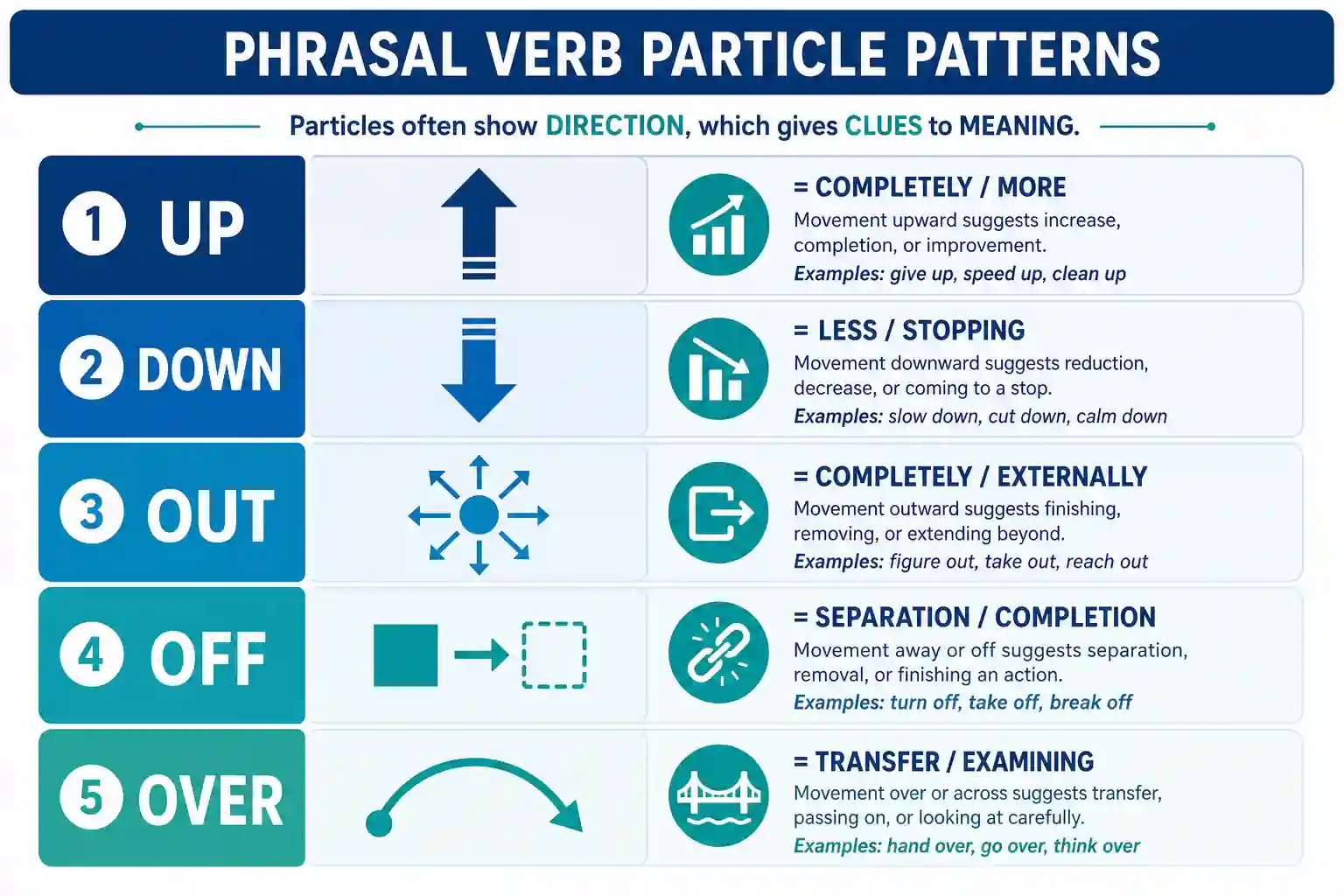
Pola yang Perlu Anda Perhatikan
Setelah membaca 200 contoh, pola tertentu menjadi jelas. Pola-pola ini membantu Anda memahami phrasal verb baru tanpa mencarinya di kamus.
UP Sering Berarti “Sepenuhnya” atau “Lebih”
| Phrasal Verb | Arti tambahan UP |
|---|---|
| clean up | membersihkan sepenuhnya |
| use up | menggunakan sepenuhnya (tidak ada yang tersisa) |
| build up | meningkat secara bertahap |
| hurry up | meningkatkan kecepatan |
| speak up | berbicara lebih keras / lebih berani |
DOWN Sering Berarti “Lebih Sedikit” atau “Berhenti Sepenuhnya”
| Phrasal Verb | Arti tambahan DOWN |
|---|---|
| slow down | mengurangi kecepatan |
| cut down | mengurangi jumlah |
| break down | berhenti berfungsi sepenuhnya |
| calm down | menjadi kurang gelisah |
| wind down | berhenti secara bertahap |
OUT Sering Berarti “Sepenuhnya” atau “Ke Luar”
| Phrasal Verb | Arti tambahan OUT |
|---|---|
| find out | menemukan (informasi keluar) |
| work out | menyelesaikan sepenuhnya |
| phase out | menghapus sepenuhnya (seiring waktu) |
| spell out | menjelaskan sepenuhnya, dengan jelas |
| burn out | melelahkan sepenuhnya |
OFF Sering Berarti “Pemisahan” atau “Penyelesaian”
| Phrasal Verb | Arti tambahan OFF |
|---|---|
| call off | membatalkan (dipisahkan dari rencana) |
| pay off | mencapai hasil (utang dilunasi) |
| brush off | mengabaikan (mendorong menjauh) |
| wear off | menghilang secara bertahap |
| lay off | memberhentikan dari pekerjaan |
OVER Sering Berarti “Perpindahan” atau “Pemeriksaan”
| Phrasal Verb | Arti tambahan OVER |
|---|---|
| take over | memindahkan kendali |
| hand over | memindahkan kepemilikan |
| go over | memeriksa dengan saksama |
| think over | mempertimbangkan secara menyeluruh |
| get over | melewati (pindah melampaui) |
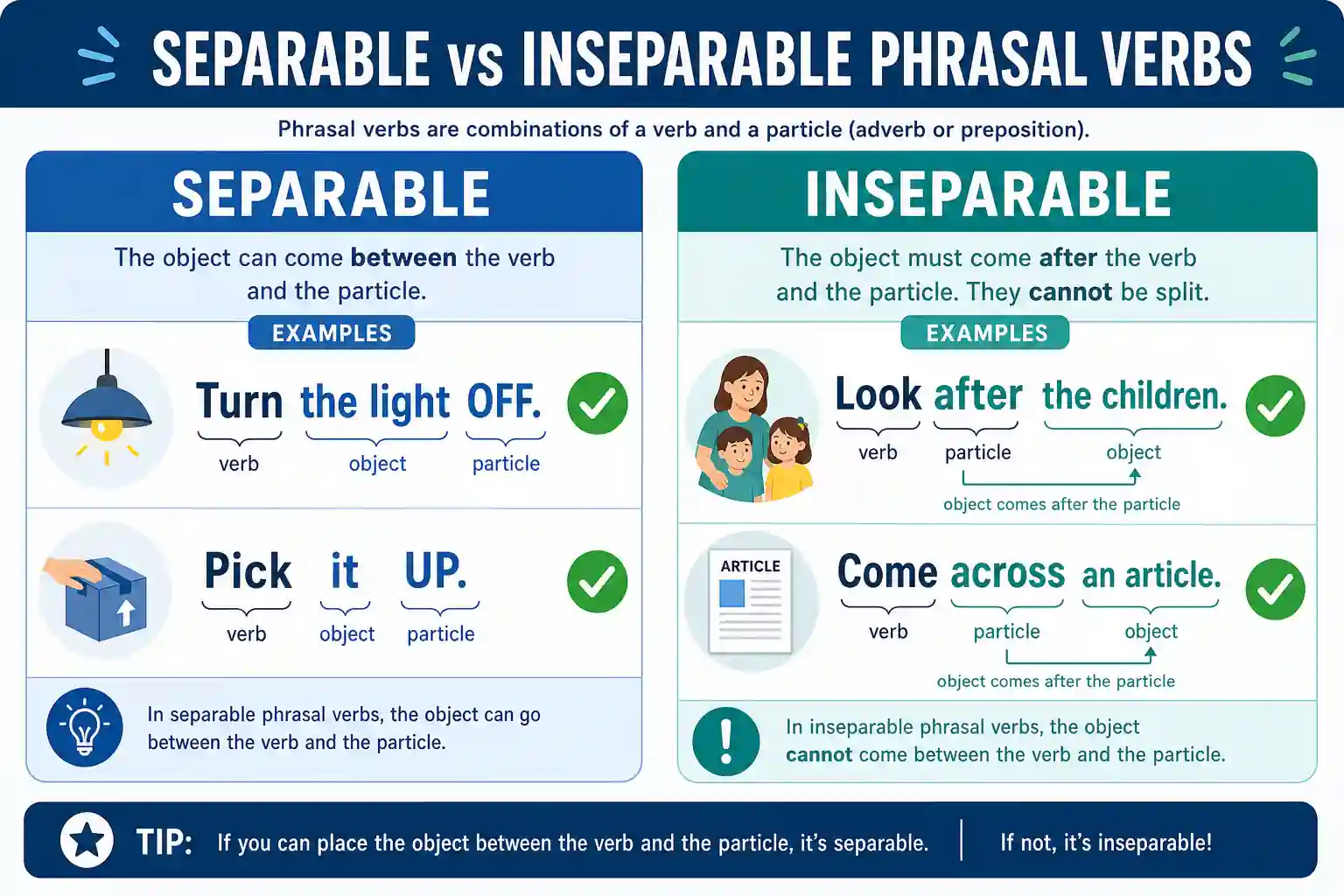
Dapat Dipisahkan vs. Tidak Dapat Dipisahkan: Referensi Cepat
Banyak pelajar kesulitan dengan urutan kata. Berikut cara memeriksa apakah suatu phrasal verb dapat dipisahkan:
Dapat dipisahkan — Anda dapat (dan kadang harus) menempatkan objek di antara kata kerja dan partikel:
- Turn off the light → Turn the light off → Turn it off (dengan kata ganti, pemisahan wajib dilakukan)
- Pick up the book → Pick the book up → Pick it up
Tidak dapat dipisahkan — kata kerja dan partikel harus tetap bersama:
-
Look after the children →
Look the children after(salah) -
Come across an article →
Come an article across(salah)
Phrasal verb tiga kata selalu tidak dapat dipisahkan:
- Look forward to → I look forward to the trip
- Put up with → She put up with the noise
- Come up with → He came up with a plan
Kata untuk Dilatih Bersama
Berikut 25 kata kerja berfrekuensi tinggi yang membentuk dasar sebagian besar phrasal verb dalam artikel ini. Tambahkan ke kamus Anda dan berlatihlah menggabungkannya dengan partikel yang berbeda.
artery
nomina
arteri, pembuluh nadi
Contoh
- The blocked artery required immediate surgical intervention to save his life.
- This highway is a major artery connecting the city to surrounding areas.
coastal
adjektiva
pesisir, pantai
Contoh
- Coastal towns often depend on fishing and tourism for their economy.
- The coastal erosion threatens many beachfront properties and buildings.
cooperate
verba
bekerja sama
donate
verba
menyumbangkan, mendonasikan
Contoh
- Many people donate money to charities that help homeless individuals.
- She decided to donate blood to help patients in emergency situations.
evaluate
verba
menilai, mengevaluasi
Contoh
- Companies evaluate job candidates based on experience, skills, and personality.
- Teachers evaluate student progress through tests, projects, and classroom participation.
graduate
verba
lulus
Contoh
- She will graduate from university next year with a degree in engineering.
- Students must complete all requirements before they can graduate from high school.
guide
verba
memandu, membimbing
Contoh
- Parents should guide their children to make responsible decisions.
- The experienced hiker will guide the group through the mountain trail safely.
implication
nomina
isyarat tersirat, petunjuk tersirat
Contoh
- Scientists are studying the implications of climate change for future generations.
- The implication of his statement was that he disagreed with the policy.
candidate
nomina
calon, kandidat
Contoh
- Each presidential candidate presented their policy plans to voters.
- The job candidate impressed the interview panel with her experience.
prejudice
nomina
prasangka
Contoh
- Education helps overcome prejudice and promotes understanding.
- Racial prejudice damages communities and individuals alike.
discourage
verba
mematahkan semangat, membuat kecil hati
Contoh
- Don't let one failure discourage you from pursuing your dreams.
- High prices discourage many people from buying organic food products.
resolve
verba
menyelesaikan, memecahkan
Contoh
- Mediator helps parties resolve dispute through negotiation.
- Technical team will resolve software problems quickly.
off
adjektiva
basi
Contoh
- Please turn off the lights before leaving the room.
- The dog ran off into the forest chasing wild rabbits.
tragedy
nomina
tragedi, musibah
Contoh
- Natural tragedy affects thousands of innocent people.
- Personal tragedy changes person's life perspective completely.
admission
nomina
penerimaan, izin masuk
Contoh
- Her admission to the prestigious medical school was the result of hard work.
- The museum offers free admission on the first Sunday of every month.
boom
nomina
dentuman, lonjakan
Contoh
- The boom of thunder echoed across the valley.
- The technology boom created many new millionaires.
horizon
nomina
cakrawala, horizon
Contoh
- The sun disappeared behind the horizon as evening approached.
- Traveling broadens your horizon and exposes you to new cultures.
jury
nomina
juri
Contoh
- The jury deliberated for several hours before reaching a verdict.
- The talent show jury consisted of professional musicians and entertainers.
lifelong
adjektiva
seumur hidup, sepanjang hidup
Contoh
- Learning is a lifelong process that never truly ends.
- Their lifelong friendship began during elementary school years.
motivated
adjektiva
termotivasi, terdorong
Contoh
- Motivated employee seeks additional responsibilities and challenges at work.
- Success requires being motivated even when facing difficult obstacles.
total
adjektiva
utuh, menyeluruh
Contoh
- Total cost includes all fees and expenses.
- Total silence fills room during meditation session.
humorous
adjektiva
lucu, jenaka
Contoh
- She writes humorous articles about everyday life and family experiences.
- The humorous speech made everyone laugh and lightened the serious mood.
indispensable
adjektiva
mutlak diperlukan, sangat penting
Contoh
- Clean water is indispensable for human survival and good health.
- Her experience and skills make her indispensable to the research team.
firmly
adverbia
dengan teguh, secara mantap
Contoh
- Hold the rope firmly while climbing down the steep mountain slope.
- The manager firmly believed in treating all employees with respect.
normally
adverbia
biasanya, secara normal
Contoh
- Heart normally beats between sixty and hundred times per minute.
- Students normally arrive at school before morning bell rings.
Yang Harus Dilakukan Selanjutnya
-
Pilih level Anda. Temukan bagian yang sesuai dengan kemampuan Anda saat ini dan berfokuslah pada 50 contoh itu terlebih dahulu.
-
Tulis 5 kalimat Anda sendiri. Pilih 5 phrasal verb dari level Anda, lalu tulis kalimat tentang kehidupan Anda sendiri dengan kata-kata tersebut. Kalimat pribadi diingat jauh lebih baik daripada contoh buku teks.
-
Belajar berdasarkan kata kerja dasar. Untuk penjelasan terperinci setiap arti, jelajahi panduan khusus kata kerja kami: GET, MAKE, atau 50 Paling Umum.
-
Berlatih dengan pengulangan berjarak. Tambahkan phrasal verb ke kamus Linglify dan tinjau pada interval optimal. Jelajahi perpustakaan phrasal verb lengkap untuk daftar menurut kategori.
-
Pelajari aturannya. Jika yang dapat dipisahkan vs. tidak dapat dipisahkan membingungkan Anda, baca Panduan Phrasal Verb Lengkap kami yang menjelaskan tata bahasanya secara terperinci.
FAQ
Apa itu phrasal verb dengan contoh?
Phrasal verb adalah gabungan kata kerja + preposisi atau kata keterangan yang menciptakan arti baru, berbeda dari kata kerja asalnya. Contohnya, “give up” berarti berhenti mencoba (bukan “give” + “up” secara harfiah), “run into” berarti bertemu secara kebetulan, dan “break down” berarti berhenti berfungsi. Bahasa Inggris memiliki ribuan phrasal verb, dan penutur asli menggunakannya terus-menerus dalam percakapan sehari-hari.
Bagaimana menggunakan phrasal verb dalam kalimat?
Gunakan phrasal verb tepat di tempat Anda akan menggunakan kata kerja biasa. “She gave up smoking” bekerja sama seperti “She quit smoking.” Aturan utama: dengan phrasal verb yang dapat dipisahkan, kata ganti harus berada di antara kata kerja dan partikel (“Turn it off,” bukan “Turn off it”). Dengan phrasal verb yang tidak dapat dipisahkan, objek selalu mengikuti frasa lengkap (“Look after the children,” bukan “Look the children after”).
Apa 10 contoh phrasal verb dalam kalimat?
Berikut 10 yang umum: (1) I wake up at 7 AM. (2) Please turn off the light. (3) She gave up her job. (4) We ran out of time. (5) He came up with a great idea. (6) They broke up last month. (7) I’m looking forward to the weekend. (8) She turned down the offer. (9) The car broke down on the highway. (10) He picked up Spanish while living abroad.
Berapa banyak phrasal verb dalam bahasa Inggris?
Perkiraan berkisar antara 5.000 hingga 10.000, tergantung cara menghitung arti yang berbeda. Namun, kebanyakan penutur asli secara rutin menggunakan sekitar 200–300 dalam percakapan harian. Bagi pelajar, mengetahui 100 phrasal verb paling umum (dibahas dalam panduan 100 Phrasal Verb kami) sudah mencakup sebagian besar situasi yang akan Anda hadapi.
Phrasal verb berada di level apa?
Phrasal verb mencakup semua level. Yang dasar seperti “wake up,” “turn on,” dan “sit down” berada di level A2. Yang paling umum seperti “give up,” “look forward to,” dan “find out” berada di B1. Yang lebih abstrak seperti “bring about,” “rule out,” dan “phase in” berada di B2. Yang sangat idiomatis seperti “cash in on,” “boil down to,” dan “play down” berada di C1. Artikel ini disusun menurut level untuk membantu Anda belajar secara sistematis.


