イディオム例文集:意味と例文で覚える200以上の英語イディオム
イディオムを最も効率よく覚える方法は、例文を通じて学ぶことです。定義は意味を教えてくれますが、例文は実際の使い方を見せてくれます — 自然な文の中で、具体的な場面とともに。この記事では、200以上の英語イディオムを意味と例文付きで紹介します。ネイティブスピーカーが実際にどう使っているかがわかります。
ここに収録されているのは珍しい文学的表現ではありません。すべてのイディオムが日常会話、映画、ニュース、ビジネス、学術英語で定期的に使われています。IELTS、TOEFL、TOEICの対策中なら、試験で多くに出会うでしょう。仕事や旅行のために英語を学んでいるなら、毎日耳にするものばかりです。
- 収録数: 200以上のイディオム例文
- 形式: イディオム → 意味 → 例文
- 整理方法: 10のトピックカテゴリー
- 対象レベル: A2〜C1
- こんな方に: 試験対策、流暢さの向上、ネイティブの英語理解
500以上のイディオムを網羅した完全版は、英語イディオム:完全ガイドをご覧ください。
日常生活
これらのイディオムは、日常会話で最も頻繁に使われます。
| # | イディオム | 意味 | 例文 |
|---|---|---|---|
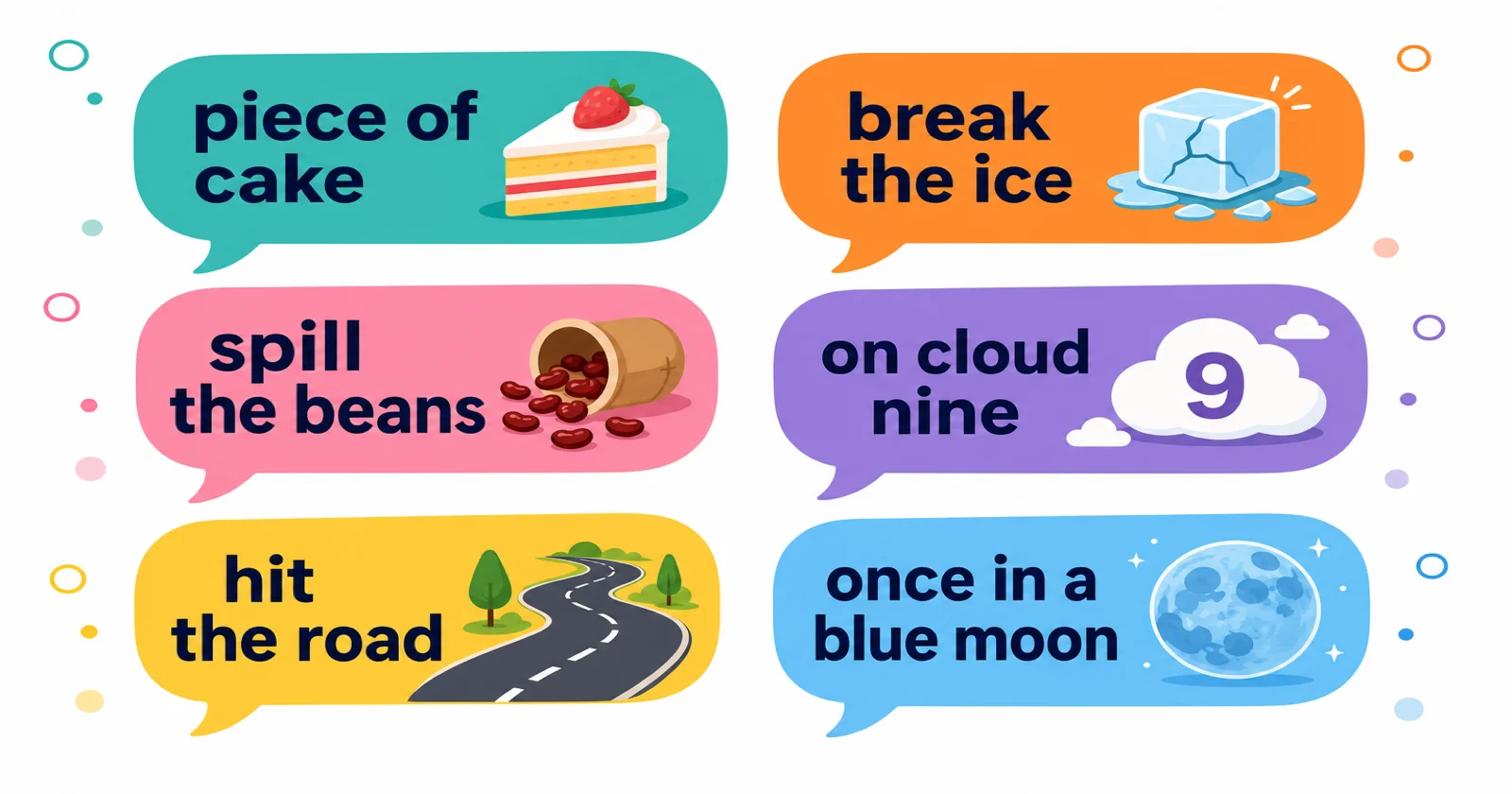
| 1 | a piece of cake | とても簡単なこと | The driving test was a piece of cake — I passed on the first try. |
| 2 | break the ice | 気まずい場で会話のきっかけを作る | The team-building exercise helped break the ice on the first day. |
| 3 | hit the nail on the head | 的を射る;まさにその通り | You hit the nail on the head — that is exactly the problem. |
| 4 | under the weather | 少し体調が悪い | I’m feeling a bit under the weather today, so I’ll work from home. |
| 5 | once in a blue moon | めったにない;ごくまれに | We only eat out once in a blue moon — maybe twice a year. |
| 6 | call it a day | 今日の仕事を終わりにする | We’ve been at this for eight hours — let’s call it a day. |
| 7 | the last straw | 堪忍袋の緒が切れるきっかけ | Being late again was the last straw — they fired him. |
| 8 | get out of hand | 手に負えなくなる | The party got out of hand after midnight. |
| 9 | in the long run | 長期的に見れば | Learning English is hard now, but it will pay off in the long run. |
| 10 | at the end of the day | 結局のところ | At the end of the day, your health is more important than your job. |
| 11 | give it a shot | やってみる;試してみる | I’ve never tried skiing, but I’ll give it a shot. |
| 12 | a blessing in disguise | 災い転じて福となる | Losing that job was a blessing in disguise — I found a much better one. |
| 13 | better late than never | 遅くてもやらないよりまし | You finally finished the report? Well, better late than never. |
| 14 | bite off more than you can chew | 自分の能力を超えることを引き受ける | She bit off more than she could chew by signing up for five courses. |
| 15 | burn the midnight oil | 夜遅くまで働く・勉強する | I’ve been burning the midnight oil to finish this project. |
| 16 | hit the road | 出発する | It’s getting late — we should hit the road. |
| 17 | on the same page | 同じ認識を持っている | Let’s make sure we’re all on the same page before the meeting. |
| 18 | the tip of the iceberg | 氷山の一角 | The complaints we received are just the tip of the iceberg. |
| 19 | go the extra mile | 期待以上の努力をする | She always goes the extra mile for her clients. |
| 20 | a no-brainer | 考えるまでもない明らかな選択 | Taking the promotion was a no-brainer — better pay, better hours. |
感情と気持ち
感情を表すイディオムは特に表現が豊かです。
| # | イディオム | 意味 | 例文 |
|---|---|---|---|
| 21 | on cloud nine | 有頂天;最高に幸せ | She’s been on cloud nine since she got the job offer. |
| 22 | over the moon | 大喜びで | They were over the moon when they heard about the baby. |
| 23 | down in the dumps | 落ち込んでいる | He’s been down in the dumps since his girlfriend left. |
| 24 | have butterflies in your stomach | 緊張でそわそわする | I always have butterflies in my stomach before interviews. |
| 25 | get cold feet | 直前になって怖気づく | He got cold feet and cancelled the presentation. |
| 26 | blow off steam | ストレスを発散する | After a tough week, I blow off steam by going to the gym. |
| 27 | keep your chin up | 落ち込まずに頑張る | I know you didn’t get the job, but keep your chin up. |
| 28 | on edge | ピリピリしている;緊張状態 | Everyone has been on edge since the layoff announcements. |
| 29 | sick and tired | うんざりしている | I’m sick and tired of hearing excuses. |
| 30 | lose your temper | 怒りを爆発させる | She rarely loses her temper, but today was an exception. |
| 31 | have a change of heart | 気持ちが変わる;考え直す | He was going to sell the house, but he had a change of heart. |
| 32 | get something off your chest | 胸のつかえを取る;言いたいことを打ち明ける | I need to get this off my chest — I disagree with the plan. |
| 33 | bite your tongue | 言いたいことをぐっとこらえる | I wanted to argue, but I bit my tongue. |
| 34 | cry over spilled milk | 覆水盆に返らず(起きたことを嘆いても仕方ない) | The deadline passed — there’s no point crying over spilled milk. |
| 35 | drive someone up the wall | イライラさせる | That constant noise is driving me up the wall. |
| 36 | have a soft spot for | ~に弱い;特別な好意を持つ | She has a soft spot for stray animals. |
| 37 | wear your heart on your sleeve | 感情をあからさまに出す | He wears his heart on his sleeve — you always know how he feels. |
| 38 | a weight off your shoulders | 肩の荷が下りる | Finishing the thesis was a huge weight off my shoulders. |
| 39 | jump for joy | 飛び上がって喜ぶ | When she heard the news, she literally jumped for joy. |
| 40 | scared stiff | 恐怖で身動きできない | I was scared stiff during the horror movie. |
仕事とビジネス
ビジネスの場面やTOEICなどの試験に不可欠です。
| # | イディオム | 意味 | 例文 |
|---|---|---|---|
| 41 | back to square one | 振り出しに戻る | The client rejected our proposal, so it’s back to square one. |
| 42 | think outside the box | 型にはまらない発想をする | We need to think outside the box to solve this problem. |
| 43 | get the ball rolling | 物事を始める;動き出す | Let’s get the ball rolling on the new marketing campaign. |
| 44 | cut corners | 手を抜く;品質を犠牲にする | The builder cut corners on materials, and the roof leaked within a year. |
| 45 | in the loop | 情報を共有されている | Please keep me in the loop about any changes to the schedule. |
| 46 | pull strings | コネを使う | He pulled some strings to get his son the internship. |
| 47 | a game changer | 状況を一変させるもの | Remote work was a game changer for employee satisfaction. |
| 48 | bring to the table | 貢献できるものを持ってくる | What skills do you bring to the table? |
| 49 | up in the air | 未定;はっきりしない | The project timeline is still up in the air. |
| 50 | a win-win situation | 双方にとって有益な状況 | The deal was a win-win — both companies increased their market share. |
| 51 | the bottom line | 要点;最も重要なこと | The bottom line is that we need to cut costs by 15%. |
| 52 | go back to the drawing board | 計画をやり直す | That approach failed completely — time to go back to the drawing board. |
| 53 | ahead of the curve | 時代の先を行く | Their use of AI puts them ahead of the curve in the industry. |
| 54 | call the shots | 決定権を持つ;仕切る | As team lead, you’ll be calling the shots on this project. |
| 55 | on the same wavelength | 気が合う;考え方が同じ | We finished each other’s sentences — we were on the same wavelength. |
| 56 | raise the bar | 基準を引き上げる | The new CEO raised the bar for product quality. |
| 57 | a steep learning curve | 習得が難しい時期 | The new software has a steep learning curve, but it’s worth it. |
| 58 | touch base | 簡単に連絡を取る | Let’s touch base next week to check progress. |
| 59 | play it by ear | 臨機応変にやる | We don’t have a fixed agenda — let’s just play it by ear. |
| 60 | burn bridges | 関係を断ち切る(後戻りできなくする) | Don’t burn bridges when you leave a job — you may need those contacts later. |
時間とスピード
| # | イディオム | 意味 | 例文 |
|---|---|---|---|
| 61 | in the nick of time | 間一髪で;ギリギリ間に合って | The ambulance arrived in the nick of time. |
| 62 | time flies | 時が経つのは早い | I can’t believe it’s December already — time flies. |
| 63 | around the clock | 24時間休みなく | The team worked around the clock to meet the deadline. |
| 64 | in a heartbeat | 即座に;迷わず | I’d move to Japan in a heartbeat if I got the chance. |
| 65 | against the clock | 時間との勝負 | We’re working against the clock to finish before Friday. |
| 66 | behind the times | 時代遅れの | Their marketing strategy is behind the times. |
| 67 | a matter of time | 時間の問題 | It’s only a matter of time before they find out. |
| 68 | from time to time | ときどき | I still think about my old school friends from time to time. |
| 69 | kill time | 時間をつぶす | I was just killing time at the airport, browsing the shops. |
| 70 | at the eleventh hour | 土壇場で | The agreement was reached at the eleventh hour. |

お金と価値
| # | イディオム | 意味 | 例文 |
|---|---|---|---|
| 71 | cost an arm and a leg | 非常に高くつく | The car repair cost an arm and a leg. |
| 72 | break the bank | 財布を空にする;大金を使う | A weekend trip doesn’t have to break the bank. |
| 73 | a rip-off | ぼったくり | $15 for a cup of coffee? That’s a rip-off. |
| 74 | make ends meet | なんとか生計を立てる | After losing her job, she struggled to make ends meet. |
| 75 | save for a rainy day | まさかの時のために貯金する | My grandmother always told me to save for a rainy day. |
| 76 | worth its weight in gold | 非常に価値がある | A good mentor is worth their weight in gold. |
| 77 | penny for your thoughts | 何を考えているの? | You’ve been quiet all evening — penny for your thoughts? |
| 78 | pay through the nose | 法外な金額を払う | We paid through the nose for those concert tickets. |
| 79 | tighten your belt | 倹約する;出費を切り詰める | After the pay cut, the whole family had to tighten their belts. |
| 80 | money talks | 金がものを言う | He got the best lawyer — money talks. |
| 81 | foot the bill | 費用を負担する | The company will foot the bill for the team dinner. |
| 82 | bring home the bacon | 一家の稼ぎ手となる | Both parents bring home the bacon in most families today. |
| 83 | go Dutch | 割り勘にする | We always go Dutch when we eat out together. |
| 84 | put your money where your mouth is | 言葉だけでなく行動で示す | If you really believe in the idea, put your money where your mouth is. |
| 85 | a dime a dozen | ありふれている;価値がない | Business ideas are a dime a dozen — execution is what matters. |
成功と失敗
| # | イディオム | 意味 | 例文 |
|---|---|---|---|
| 86 | hit the jackpot | 大当たりする | We hit the jackpot with our new hire — she’s brilliant. |
| 87 | back to the drawing board | やり直し | The experiment failed, so it’s back to the drawing board. |
| 88 | miss the boat | 機会を逃す | If you don’t apply this week, you’ll miss the boat. |
| 89 | a long shot | 可能性が低いこと | Getting into Harvard is a long shot, but worth trying. |
| 90 | break new ground | 新境地を開く | The research team broke new ground in renewable energy. |
| 91 | on a roll | 絶好調 | She’s won three games in a row — she’s on a roll. |
| 92 | the sky’s the limit | 可能性は無限大 | With your talent, the sky’s the limit. |
| 93 | throw in the towel | あきらめる;降参する | After three failed attempts, he threw in the towel. |
| 94 | come up short | 目標に届かない | We came up short of our sales target by just 2%. |
| 95 | fall flat | 完全に失敗する | The joke fell flat — nobody laughed. |
| 96 | have the upper hand | 優位に立つ | With more experience, she has the upper hand in negotiations. |
| 97 | make or break | 成否を分ける;一か八か | This presentation is make or break for the entire project. |
| 98 | from rags to riches | 無一文から大成功へ | Her from-rags-to-riches story inspired millions. |
| 99 | a hard nut to crack | 難問;手ごわい相手 | Getting planning permission was a hard nut to crack. |
| 100 | learn the ropes | コツを覚える;仕事を覚える | It took me a few weeks to learn the ropes at the new office. |
人間関係
| # | イディオム | 意味 | 例文 |
|---|---|---|---|
| 101 | see eye to eye | 意見が完全に一致する | My sister and I rarely see eye to eye on politics. |
| 102 | stab someone in the back | 裏切る | I trusted him, and he stabbed me in the back. |
| 103 | give someone the cold shoulder | 冷たくあしらう | After the argument, she gave me the cold shoulder for a week. |
| 104 | let someone off the hook | 責任を免れさせる | The teacher let him off the hook for missing the deadline. |
| 105 | break the ice | 場の雰囲気を和らげる | A simple joke can break the ice at a networking event. |
| 106 | hit it off | すぐに意気投合する | We hit it off the moment we met at the conference. |
| 107 | go behind someone’s back | 陰でこそこそする | He went behind my back and complained to the manager. |
| 108 | the apple of someone’s eye | 目に入れても痛くない存在 | Their granddaughter is the apple of their eye. |
| 109 | be on thin ice | 危険な状況にある | You’re on thin ice with the boss after missing two deadlines. |
| 110 | bend over backwards | 全力を尽くす | She bent over backwards to make the guests feel welcome. |
| 111 | birds of a feather | 類は友を呼ぶ | They’re both data nerds — birds of a feather. |
| 112 | bury the hatchet | 争いを終わらせる;和解する | After years of rivalry, they finally buried the hatchet. |
| 113 | get on someone’s nerves | 神経に障る;イライラさせる | His constant humming really gets on my nerves. |
| 114 | pull someone’s leg | からかう;冗談を言う | Relax, I’m just pulling your leg — of course you passed. |
| 115 | a shoulder to cry on | 頼りになる相談相手 | Everyone needs a shoulder to cry on sometimes. |
知識と学習
学術的な場面や試験で特に役立ちます。
| # | イディオム | 意味 | 例文 |
|---|---|---|---|
| 116 | know something inside out | 隅から隅まで知っている | She knows the company’s policies inside out. |
| 117 | pick someone’s brain | 知恵を借りる | Can I pick your brain about investing? |
| 118 | a steep learning curve | 覚えることが多く大変な時期 | Starting a new programming language is always a steep learning curve. |
| 119 | ring a bell | 聞き覚えがある | The name rings a bell, but I can’t remember where I heard it. |
| 120 | the penny dropped | やっとわかった;ピンときた | I stared at the puzzle for an hour, and then the penny dropped. |
| 121 | do your homework | 事前にしっかり調べる | Before the interview, do your homework on the company. |
| 122 | learn by heart | 暗記する | She learned the entire poem by heart. |
| 123 | a quick study | 飲み込みが早い人 | He’s a quick study — he picked up the software in one day. |
| 124 | have a lot on your plate | やることが山積みである | She has a lot on her plate between work and evening classes. |
| 125 | food for thought | 考えさせられること | The lecture was food for thought — I’m reconsidering my approach. |
| 126 | think on your feet | その場で素早く判断する | Good managers need to think on their feet. |
| 127 | know the ropes | 要領を心得ている | After six months, I finally know the ropes. |
| 128 | back to basics | 基本に立ち返る | The team needs to go back to basics and focus on quality. |
| 129 | read between the lines | 行間を読む | If you read between the lines, the email is actually a warning. |
| 130 | on the right track | 正しい方向に進んでいる | Your essay is on the right track — just needs a stronger conclusion. |
自然と天気
| # | イディオム | 意味 | 例文 |
|---|---|---|---|
| 131 | raining cats and dogs | 土砂降り | We can’t go out — it’s raining cats and dogs. |
| 132 | under the weather | 体調が優れない | I’m a bit under the weather — I think I caught a cold. |
| 133 | a storm in a teacup | コップの中の嵐(些細なことでの大騒ぎ) | The argument at the meeting was a storm in a teacup. |
| 134 | every cloud has a silver lining | 災い転じて福となす;悪いことにも良い面がある | I lost my job, but I found a better one — every cloud has a silver lining. |
| 135 | break the ice | 場の空気を和ませる | His joke broke the ice and everyone relaxed. |
| 136 | tip of the iceberg | 氷山の一角 | The accounting errors are just the tip of the iceberg. |
| 137 | when it rains, it pours | 泣きっ面に蜂;悪いことは重なる | First the car broke down, then I lost my wallet — when it rains, it pours. |
| 138 | get wind of | ~の噂を耳にする | The press got wind of the merger before the official announcement. |
| 139 | a breath of fresh air | 新鮮な風;リフレッシュされるもの | Her creative approach was a breath of fresh air for the team. |
| 140 | calm before the storm | 嵐の前の静けさ | The office was quiet on Friday — it was the calm before the storm. |
| 141 | snowed under | 仕事に埋もれている | I’m completely snowed under this week — can we meet next Monday? |
| 142 | nip something in the bud | 芽のうちに摘む;早期に対処する | We need to nip this issue in the bud before it affects other departments. |
| 143 | come rain or shine | 何があっても;どんな状況でも | I walk to work every day, come rain or shine. |
| 144 | twist someone’s arm | 無理に説得する | I didn’t want to go, but she twisted my arm. |
| 145 | beat around the bush | 遠回しに言う;核心を避ける | Stop beating around the bush and tell me what happened. |
行動と決断
| # | イディオム | 意味 | 例文 |
|---|---|---|---|
| 146 | take the plunge | 思い切ってやる | After years of planning, she finally took the plunge and started her own business. |
| 147 | go the extra mile | 求められる以上の努力をする | He always goes the extra mile to satisfy customers. |
| 148 | cross that bridge when you come to it | そのときになったら考える | We might not get rejected — let’s cross that bridge when we come to it. |
| 149 | sleep on it | 一晩考える | That’s a big commitment — why don’t you sleep on it? |
| 150 | jump on the bandwagon | 流行に乗る | Every company is jumping on the AI bandwagon right now. |
| 151 | turn over a new leaf | 心機一転する | After the warning, he promised to turn over a new leaf. |
| 152 | sit on the fence | 態度を決めかねる | Stop sitting on the fence and choose a direction. |
| 153 | take it with a grain of salt | 話半分に聞く | He exaggerates — take everything he says with a grain of salt. |
| 154 | put all your eggs in one basket | 一つのことに全てを賭ける | Don’t put all your eggs in one basket — apply to several companies. |
| 155 | let the cat out of the bag | うっかり秘密を漏らす | I was planning a surprise, but my brother let the cat out of the bag. |
| 156 | face the music | 結果を受け入れる | You made the mistake — now you have to face the music. |
| 157 | get your act together | しっかりする | If you want to pass the exam, you need to get your act together. |
| 158 | take the bull by the horns | 困難に正面から立ち向かう | Instead of waiting, she took the bull by the horns and spoke to the director. |
| 159 | a taste of your own medicine | 自分がしたことと同じ目に遭う | He’s always late, so we left without him — a taste of his own medicine. |
| 160 | cut to the chase | 本題に入る | Let’s cut to the chase — how much will it cost? |
健康と体
| # | イディオム | 意味 | 例文 |
|---|---|---|---|
| 161 | in good shape | 良い状態;健康 | The economy is in good shape despite recent challenges. |
| 162 | a clean bill of health | 健康のお墨付き | The doctor gave her a clean bill of health. |
| 163 | feel on top of the world | 最高の気分 | After the vacation, I feel on top of the world. |
| 164 | keep body and soul together | どうにか生き延びる | During the recession, many families struggled to keep body and soul together. |
| 165 | back on your feet | 回復する;立ち直る | After six months of treatment, she’s back on her feet. |
| 166 | an apple a day keeps the doctor away | 健康的な習慣が病気を防ぐ | I eat fruit every morning — an apple a day keeps the doctor away. |
| 167 | burn the candle at both ends | 無理をしすぎる | You’re burning the candle at both ends — you need to slow down. |
| 168 | alive and kicking | 元気いっぱい | She’s 90 years old and still alive and kicking. |
| 169 | at death’s door | 瀕死の状態 | He looked like he was at death’s door, but he recovered completely. |
| 170 | break a leg | 頑張って!(舞台前の激励) | You’re going on stage? Break a leg! |
イディオムを効率よく覚える方法
200のイディオムを一度に暗記するのは現実的ではありません。実践的なアプローチを紹介します。
ステップ1:5〜10個ずつグループで学ぶ
このリストから1つのトピックカテゴリー(感情、仕事、お金など)を選び、その中から5〜10個のイディオムを学びましょう。意味を理解し、例文を読み、自分のオリジナル文を書いてみてください。
ステップ2:間隔反復を活用する
イディオムをLinglifyの辞書に追加して、自動レビューを活用しましょう。イディオムは通常の語彙パターンに従わないため忘れやすく、間隔反復が欠かせません。
ステップ3:聞いて認識する
英語の映画やドラマを観ながら、イディオムを聞き取る練習をしましょう。聞こえたら一時停止し、意味がわかるか確認します。これにより自然な会話の中での認識力が鍛えられます。
ステップ4:会話で使う
週に2〜3個のイディオムを選び、意識的にスピーキングやライティングで使いましょう。文脈の中で正しく使えるイディオム1つは、使わないまま覚えた50個の定義より価値があります。
よくある間違い
- イディオムを直訳する。「Break a leg」を他の言語にそのまま訳しても意味が通じません。表現を一つのまとまりとして覚えましょう。
- 似たイディオムを混同する。「Hit the road」(出発する)と「hit the books」(猛勉強する)。少しの違いで、意味はまったく異なります。
- イディオムの使いすぎ。 1段落に1〜2個が自然です。5個も入れると不自然に聞こえます。IELTS Speakingでは1回の回答につき最大1〜2個にしましょう。
- レジスターの間違い。 「no-brainer」「rip-off」などはカジュアルな表現で、フォーマルな文章には不向きです。一方、「in the long run」「the bottom line」はフォーマル・インフォーマルの両方で使えます。
試験でのイディオム活用については、IELTS Speakingのためのイディオムガイドをご覧ください。
練習用の単語
以下の25語は、英語のイディオムと一緒に頻出する単語です。Linglifyの辞書に追加して、間隔反復で覚えましょう。
boom
名詞
急増, ブーム, 爆発
例
- The boom of thunder echoed across the valley.
- The technology boom created many new millionaires.
cooperate
動詞
協力する, 協働する
evaluate
動詞
評価する, 査定する
例
- Companies evaluate job candidates based on experience, skills, and personality.
- Teachers evaluate student progress through tests, projects, and classroom participation.
graduate
動詞
卒業する
例
- She will graduate from university next year with a degree in engineering.
- Students must complete all requirements before they can graduate from high school.
horizon
名詞
地平線
例
- The sun disappeared behind the horizon as evening approached.
- Traveling broadens your horizon and exposes you to new cultures.
indispensable
形容詞
不可欠な
例
- Clean water is indispensable for human survival and good health.
- Her experience and skills make her indispensable to the research team.
jury
名詞
陪審団, 陪審
例
- The jury deliberated for several hours before reaching a verdict.
- The talent show jury consisted of professional musicians and entertainers.
lifelong
形容詞
一生の, 生涯の
例
- Learning is a lifelong process that never truly ends.
- Their lifelong friendship began during elementary school years.
motivated
形容詞
やる気のある
例
- Motivated employee seeks additional responsibilities and challenges at work.
- Success requires being motivated even when facing difficult obstacles.
normally
副詞
通常は, 普通は, ふつうは
例
- Heart normally beats between sixty and hundred times per minute.
- Students normally arrive at school before morning bell rings.
off
副詞
離れて, 切れて, 休みの
例
- Please turn off the lights before leaving the room.
- The dog ran off into the forest chasing wild rabbits.
prejudice
名詞
偏見, 先入観, 差別
例
- Education helps overcome prejudice and promotes understanding.
- Racial prejudice damages communities and individuals alike.
resolve
動詞
解決する, 決意する
例
- Mediator helps parties resolve dispute through negotiation.
- Technical team will resolve software problems quickly.
stress
動詞
強調する, 緊張させる
例
- Heavy workload may stress employees beyond limits.
- Teacher will stress importance of homework completion.
total
形容詞
全体の, 総合的な, 完全な
例
- Total cost includes all fees and expenses.
- Total silence fills room during meditation session.
tragedy
名詞
悲劇
例
- Natural tragedy affects thousands of innocent people.
- Personal tragedy changes person's life perspective completely.
union
名詞
連合, 結合, 協会
例
- Labor union protects worker rights and interests.
- Marriage union joins two people in partnership.
voyage
名詞
航海, 旅行
例
- Space exploration represents humanity's greatest voyage into the unknown.
- The ocean voyage from Europe to America took several weeks in the past.
candidate
名詞
候補者, 志願者
例
- Each presidential candidate presented their policy plans to voters.
- The job candidate impressed the interview panel with her experience.
discourage
動詞
落胆させる, 思いとどまらせる, 意欲をなくさせる
例
- Don't let one failure discourage you from pursuing your dreams.
- High prices discourage many people from buying organic food products.
donate
動詞
寄付する
例
- Many people donate money to charities that help homeless individuals.
- She decided to donate blood to help patients in emergency situations.
firmly
副詞
しっかりと, 堅く
例
- Hold the rope firmly while climbing down the steep mountain slope.
- The manager firmly believed in treating all employees with respect.
guide
動詞
案内する
例
- Parents should guide their children to make responsible decisions.
- The experienced hiker will guide the group through the mountain trail safely.
humorous
形容詞
ユーモラスな, 面白い, 滑稽な
例
- She writes humorous articles about everyday life and family experiences.
- The humorous speech made everyone laugh and lightened the serious mood.
admission
名詞
入場, 入学, 認めること
例
- Her admission to the prestigious medical school was the result of hard work.
- The museum offers free admission on the first Sunday of every month.
次のステップ
-
1つのカテゴリーを選び、今週10個のイディオムを覚えましょう。それぞれについて自分のオリジナル例文を書いてください。
-
お気に入りをLinglifyに追加して、間隔反復で定着させましょう。「idioms」タグを付ければ、カテゴリーごとにまとめて復習できます。
-
完全版リファレンスを確認 — 英語イディオム:500以上の頻出表現ガイドで、すべての主要カテゴリーを網羅しています。
-
試験対策に活用 — IELTSを受験予定なら、IELTS Speakingイディオムガイドでスコアアップのための使い方を学びましょう。
-
関連する語彙も学ぶ — イディオムは自然な英語の一要素です。句動詞、コロケーション、類義語・対義語のガイドもご覧ください。
FAQ
イディオムとは何ですか?例を教えてください。
イディオムとは、個々の単語の意味からは全体の意味を推測できない固定表現です。例えば「break the ice」は物理的に氷を割ることではなく、「気まずい場面で会話のきっかけを作る」という意味です。例文:「The host told a joke to break the ice at the party.」イディオムの最大の特徴は、フレーズ全体が字義通りの意味とは異なる意味を持つことです。
英語で最も使われるイディオム10選は?
日常英語で最も頻繁に使われるイディオムは次の通りです:(1) a piece of cake(簡単なこと)、(2) break the ice(場を和ませる)、(3) hit the nail on the head(的を射る)、(4) under the weather(体調不良)、(5) once in a blue moon(めったにない)、(6) call it a day(今日は終わり)、(7) in the long run(長期的に)、(8) the last straw(最後の一線)、(9) on the same page(認識が一致)、(10) a no-brainer(明らかな選択)。
英語にはイディオムがいくつありますか?
英語には推定25,000以上のイディオム表現があるとされています。ただし、ネイティブスピーカーが日常的に使うのは200〜500程度です。学習者にとっては、100〜200の頻出イディオムを知っていれば、ほとんどの会話を理解でき、試験でも十分対応できます。500以上を網羅した完全ガイドもご活用ください。
イディオムを効率よく覚えるには?
最も効果的なアプローチは3つのテクニックの組み合わせです:(1) トピック別にグループで学ぶ(お金のイディオムはまとめて、仕事のイディオムはまとめて)— これにより連想記憶が作られます。(2) 間隔反復で定期的に復習する。(3) 毎週2〜3個のイディオムを自分のスピーキングやライティングで実際に使う。文脈での学習は、定義を読むだけの学習より3〜4倍効果的です。
IELTSのライティングでイディオムを使うべきですか?
IELTS Writingではイディオムは控えめに — 1エッセイにつき最大1〜2個、自然に馴染む場合のみ使いましょう。IELTS Writingはフォーマルな学術的言語を評価するため、カジュアルすぎるイディオム(「a piece of cake」「go bananas」)は不適切です。「in the long run」「the tip of the iceberg」「a double-edged sword」などは学術的文脈でも使えます。IELTS Speakingではイディオムはより適切で、1回の回答につき1〜2個使うと自然な英語力を示せます。
イディオムと句動詞の違いは?
イディオムは非字義的な意味を持つ固定表現です(「kick the bucket」= 死ぬ)。句動詞は動詞+助詞の組み合わせで新しい意味を作ります(「give up」= やめる)。これら2つのカテゴリーは重なります — 句動詞がイディオム的なもの(「come across」= 偶然見つける)もあれば、イディオムの中に句動詞が含まれるものもあります。実用的な違いは、句動詞は文法規則に従って活用できる(「gave up」「giving up」)のに対し、イディオムは通常変更できない固定フレーズであるという点です。