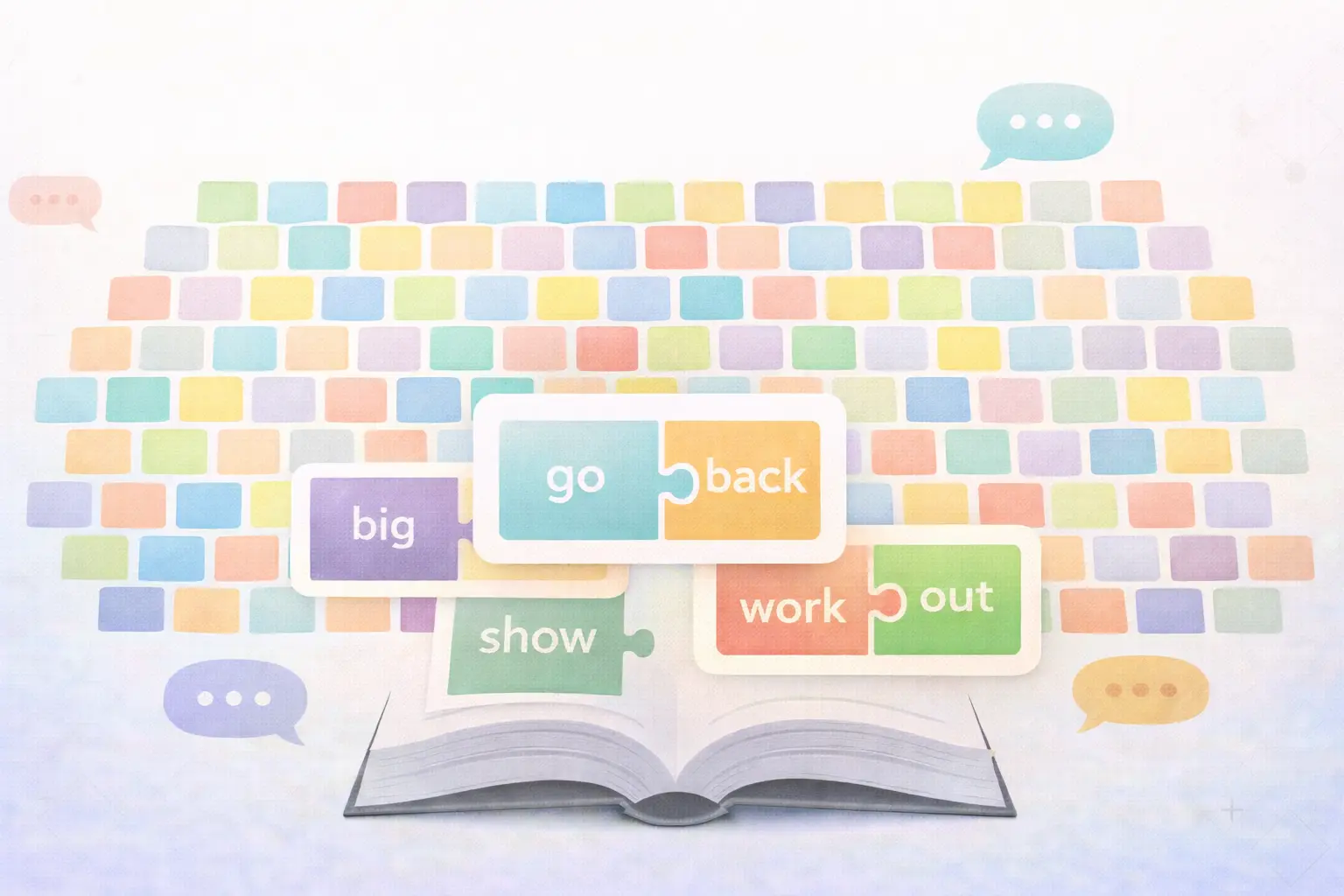
英語コロケーション:300以上の自然な語の組み合わせをマスターしよう
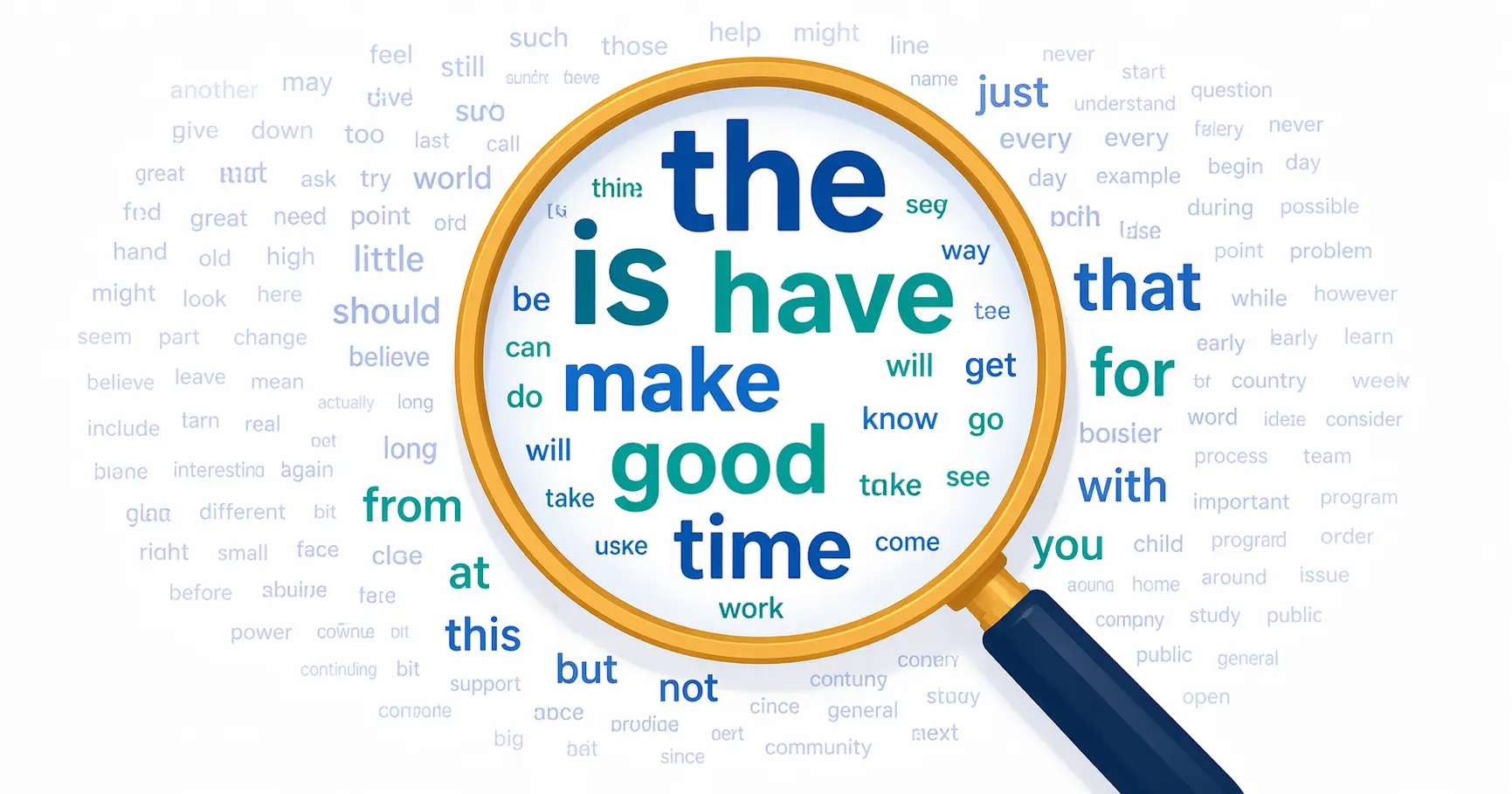
英単語を1万語知っていても、不自然に聞こえることがあります。文法は正しいのに、なぜかおかしい——ネイティブが首をかしげて「言いたいことはわかるけど、そうは言わないんだよね」と言うあの感覚。その原因は、ほぼ確実にコロケーションです。
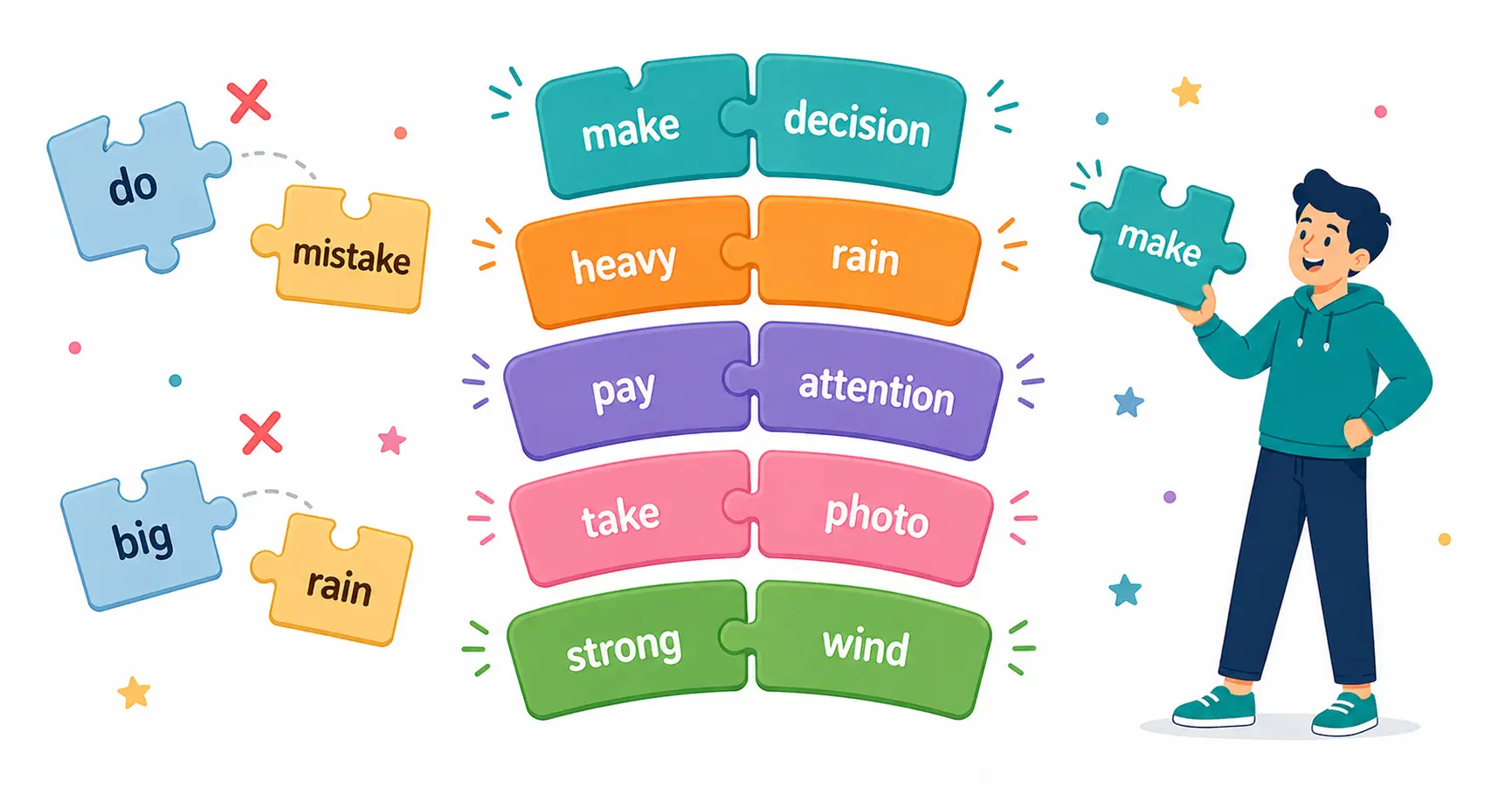
コロケーションとは、英語で自然に一緒に使われる単語の組み合わせのことです。ネイティブは “make a decision”(決定を下す)と言い、”do a decision” とは言いません。”heavy rain”(大雨)と言い、”strong rain” とは言いません。”take a photo”(写真を撮る)と言い、”catch a photo” とは言いません。一つ一つの単語は正しく、文法にも問題ありません。でも組み合わせが間違っていて、それだけで非ネイティブだとわかってしまうのです。
B2レベルとC1レベルの違いは、文法力の差ではありません。コロケーション力の差です。これは教科書が飛ばし、アプリが無視する語彙スキルでありながら、英語の自然さに最も大きな影響を与えるものです。
このガイドの内容:
- コロケーションとは何か、なぜ重要なのか
- 6つのタイプのコロケーションと具体例
- 300以上の必須コロケーション(タイプ別に整理)
- 学習者が最もよく犯すコロケーションの間違い
- コロケーションを効果的に覚える方法
コロケーションとは?
コロケーションとは、頻繁に一緒に使われ、ネイティブにとって自然に聞こえる単語の組み合わせです。語源はラテン語の co-(一緒に)+ locare(置く)——つまり「一緒に置かれたもの」という意味です。
最大のポイント: コロケーションはルールではなく、習慣です。”heavy rain” が正しく “strong rain” が間違いだという文法規則はありません。どちらも「たくさんの」という意味です。しかし英語話者は雨には “heavy” を選び、何世紀もかけてその組み合わせが定着しました。論理で導き出すのではなく、ペアとして覚える必要があるのです。
| 自然な表現(正しい) | 不自然な表現(間違い) | 理由 |
|---|---|---|
| make a decision |
|
英語では “decision” に MAKE を使う |
| heavy rain |
|
“heavy” が rain とコロケーションする |
| take a photo |
|
英語では “photo” に TAKE を使う |
| fast food |
|
“fast” がこの食べ物の固定修飾語 |
| pay attention |
|
英語では “attention” に PAY を使う |
| do homework |
|
英語では “homework” に DO を使う |
コロケーションが重要な理由
1. 流暢さと正確さを分ける。 文法が100%正しくても不自然に聞こえることがあります。その差を生むのがコロケーションです。
2. 試験のスコアに影響する。 IELTSの「Lexical Resource(語彙の豊富さ)」の評価基準では、コロケーションの正確さが明確に評価されます。バンド7では「スタイルとコロケーションへの意識」が求められ、バンド8では「珍しい語彙の巧みな使用」と「語の選択とコロケーションにおける誤りがほとんどないこと」が要件です。
3. コミュニケーションを速くする。 正しいコロケーションを使うと、相手はあなたの発話を素早く処理できます。語の組み合わせが相手の予測と一致するからです。間違ったコロケーションは理解のわずかな遅延を生みます。
4. 自然なライティングの土台になる。 アカデミックエッセイ、ビジネスメール、クリエイティブライティング——どれも標準的なコロケーションに依存しています。”Conduct research” はプロフェッショナルに聞こえ、”Do research” はまあまあ、”Make research” は明らかに間違いです。
コロケーション vs. イディオム vs. 句動詞
| 特徴 | コロケーション | イディオム | 句動詞 |
|---|---|---|---|
| 意味 | 各語から推測可能 | 字面どおりではない | 字面どおりではない |
| 例 | make a mistake | kick the bucket(= 死ぬ) | give up(= やめる) |
| 固定度 | 半固定(多少の柔軟性あり) | 完全に固定 | 固定 |
| 翻訳可能? | 多くの場合は可能 | 通常は不可 | 通常は不可 |
| 重要なスキル | どの語が一緒に使われるかを知ること | 隠された意味を知ること | 新しい意味を知ること |
補足:一部の句動詞はコロケーションでもあり(”take off” → “the plane took off”)、一部のイディオムにはコロケーションが含まれています(”break the ice” は “break” + “ice” のコロケーション)。しかし基本的な区別は明確です。コロケーションはどの語が一緒に使われるか、イディオムは隠された意味に関するものです。
イディオムの完全なリファレンスは英語のイディオム:500以上の頻出表現をご覧ください。句動詞については英語の句動詞:完全ガイドを参照してください。
コロケーションのタイプ
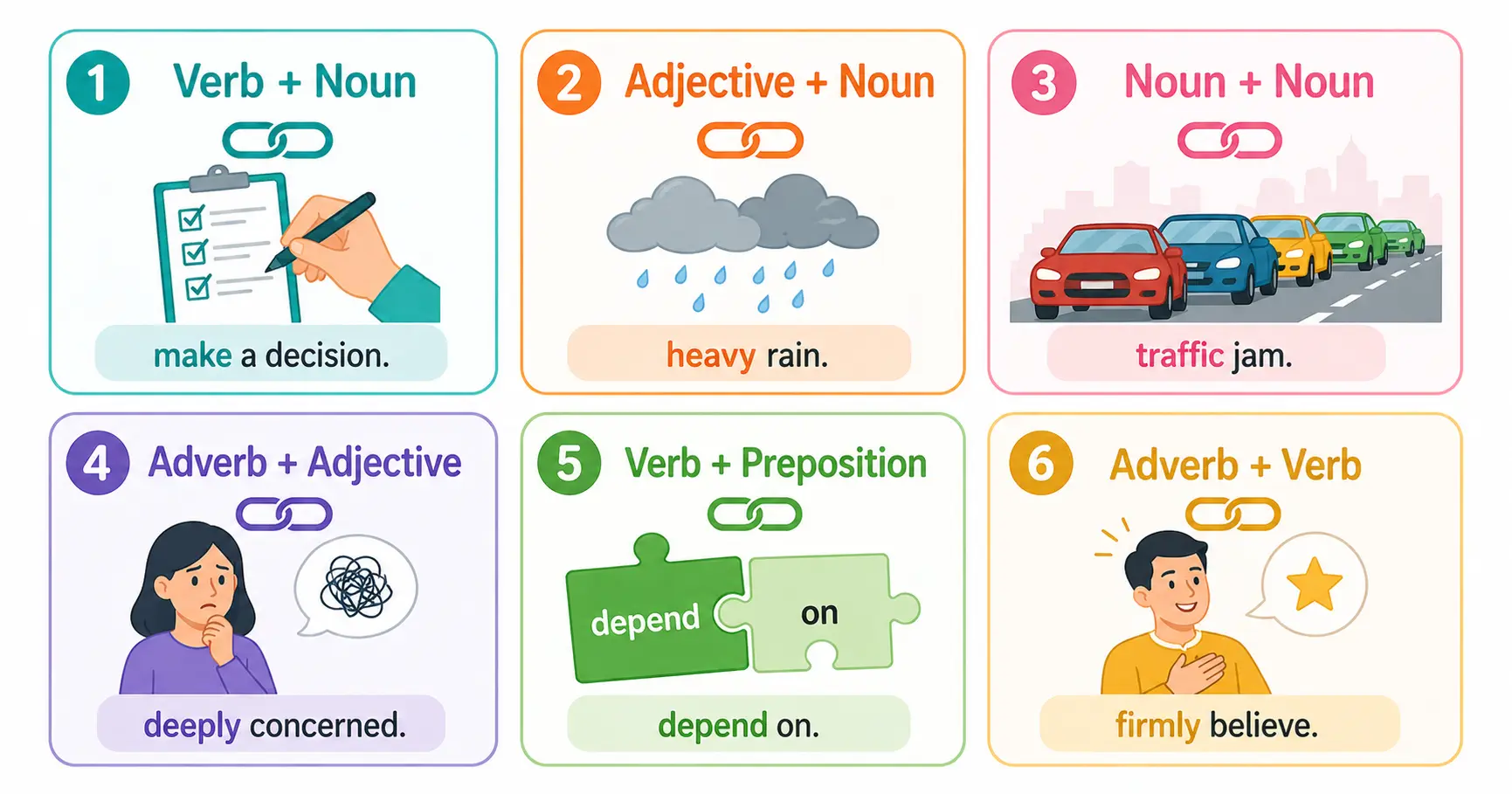
英語のコロケーションは主に6つのタイプに分かれます。タイプを理解するとパターンが見えてきて、より速く学べます。
タイプ1:動詞+名詞
学習者にとって最も重要なタイプです。MAKE、DO、TAKE、GET、HAVE、PAY、GIVE、KEEP、BREAK、CATCH にはそれぞれ数十の固定された名詞パートナーがあります。
日本語話者にとって特に難しいのが MAKE と DO の使い分けです。日本語では「する」一語で幅広い動作を表現できますが、英語ではそれが MAKE と DO に分かれ、どちらを使うかは名詞ごとに決まっています。
MAKE
| コロケーション | 例文 |
|---|---|
| make a decision | We need to make a decision by Friday. |
| make a mistake | Everyone makes mistakes — the key is learning from them. |
| make progress | The students are making good progress this term. |
| make an effort | He didn’t even make an effort to arrive on time. |
| make money | She makes good money as a software engineer. |
| make a difference | Small changes can make a big difference over time. |
| make a plan | Let’s make a plan before we start the project. |
| make an appointment | I need to make an appointment with the dentist. |
| make a complaint | She made a formal complaint about the noise. |
| make a promise | He made a promise to his daughter and kept it. |
| make an impression | First impressions matter — make a good one. |
| make a choice | You have to make a choice between the two options. |
| make sense | That explanation doesn’t make sense to me. |
| make room | Can you make room for one more person? |
| make a living | It’s hard to make a living as a freelance writer. |
| make a suggestion | Can I make a suggestion? |
| make an exception | I’ll make an exception this time, but don’t be late again. |
| make arrangements | We need to make arrangements for the conference. |
DO
| コロケーション | 例文 |
|---|---|
| do homework | Have you done your homework yet? |
| do the dishes | I’ll do the dishes after dinner. |
| do business (with) | We’ve been doing business with them for 10 years. |
| do research | She’s doing research on climate change. |
| do damage | The storm did significant damage to the coast. |
| do your best | Just do your best — that’s all anyone can ask. |
| do a favor | Could you do me a favor and check my email? |
| do the laundry | I need to do the laundry this weekend. |
| do a good job | She did a great job on the presentation. |
| do harm | The new policy may do more harm than good. |
| do exercise | I try to do some exercise every morning. |
| do an experiment | The students did an experiment to test the hypothesis. |
TAKE
| コロケーション | 例文 |
|---|---|
| take a photo / picture | Can you take a photo of us? |
| take a break | Let’s take a 10-minute break. |
| take action | The government must take action to reduce pollution. |
| take a risk | Starting a business means taking risks. |
| take a look | Take a look at this report. |
| take a seat | Please take a seat — the doctor will see you shortly. |
| take notes | She always takes detailed notes in class. |
| take responsibility | He took responsibility for the error. |
| take advice | I should have taken your advice. |
| take a chance | I took a chance and applied for the job. |
| take care (of) | Take care of yourself while I’m away. |
| take turns | The children took turns playing with the toy. |
| take part (in) | Over 200 people took part in the marathon. |
| take place | The meeting will take place on Monday at 3 PM. |
| take time | Learning a language takes time. |
GET、HAVE、PAY、GIVE
| コロケーション | 例文 |
|---|---|
| get permission | You need to get permission from the manager. |
| get a job | She got a job at a tech company after graduation. |
| get an idea | I’ve just got an idea for the project. |
| get the impression | I got the impression that he wasn’t happy. |
| have a meeting | We’re having a meeting at 2 PM. |
| have a conversation | Let’s have a conversation about your performance. |
| have an argument | They had an argument about money. |
| have a look | Have a look at this and tell me what you think. |
| have an effect (on) | Sleep has a huge effect on your concentration. |
| have access (to) | Students have access to the library 24/7. |
| pay attention | Pay attention — this will be on the exam. |
| pay a compliment | He paid her a compliment on her presentation. |
| pay a visit | I’ll pay you a visit when I’m in London. |
| give advice | She gave me some excellent advice. |
| give permission | The teacher gave them permission to leave early. |
| give a speech | The CEO gave a speech at the conference. |
| give priority (to) | We should give priority to urgent cases. |
KEEP、BREAK、CATCH、COME
| コロケーション | 例文 |
|---|---|
| keep a secret | Can you keep a secret? |
| keep a promise | Always keep your promises. |
| keep in touch | Let’s keep in touch after you move. |
| keep a record | Keep a record of all your expenses. |
| keep calm | Keep calm — panicking won’t help. |
| break the law | If you break the law, you face consequences. |
| break a record | She broke the world record in the 100m sprint. |
| break the rules | He’s always breaking the rules at school. |
| break the news | I had to break the news to her about the layoffs. |
| break a habit | Breaking a bad habit takes about 66 days on average. |
| catch a cold | I caught a cold from someone at the office. |
| catch fire | The building caught fire due to faulty wiring. |
| catch someone’s attention | The headline caught my attention immediately. |
| come to a conclusion | After reviewing the data, we came to a conclusion. |
| come to an agreement | Both parties came to an agreement after long negotiations. |
タイプ2:形容詞+名詞
どの形容詞がどの名詞と「相性がいいか」を決めるコロケーションです。これを正しく使うことは、自然な英語に聞こえるための最も手軽な方法の一つです。
| コロケーション | 不自然な表現 | 例文 |
|---|---|---|
| heavy rain |
|
There was heavy rain all weekend. |
| strong wind |
|
A strong wind blew the tent away. |
| heavy traffic |
|
We were stuck in heavy traffic for two hours. |
| fast food |
|
I try to avoid fast food as much as possible. |
| deep sleep |
|
She was in such a deep sleep that the alarm didn’t wake her. |
| high temperature |
|
The patient has a high temperature. |
| strong coffee |
|
I need a strong coffee this morning. |
| broad daylight |
|
The robbery happened in broad daylight. |
| close friend |
|
She’s one of my closest friends. |
| bitter cold |
|
We endured the bitter cold for three hours. |
| narrow escape |
|
We had a narrow escape — the car missed us by inches. |
| bright idea |
|
Whose bright idea was it to start at 5 AM? |
| keen interest |
|
She took a keen interest in the project. |
| blissful ignorance |
|
He lived in blissful ignorance of the company’s problems. |
| sharp increase |
|
There was a sharp increase in online sales. |
| slight problem |
|
There’s a slight problem with the schedule. |
| steady progress |
|
The team is making steady progress toward the deadline. |
| bitter disappointment |
|
The result was a bitter disappointment for the team. |
| golden opportunity |
|
This is a golden opportunity to expand the business. |
| overwhelming majority |
|
The overwhelming majority voted in favor. |
タイプ3:名詞+名詞
特定の名詞同士が慣習的にペアで使われるパターンです。
| コロケーション | 例文 |
|---|---|
| traffic jam | We were stuck in a traffic jam for an hour. |
| road rage | Road rage incidents have increased this year. |
| blood pressure | The doctor checked my blood pressure. |
| cell phone | I left my cell phone at home. |
| greenhouse effect | The greenhouse effect is causing global warming. |
| heart attack | He suffered a heart attack at the age of 52. |
| job satisfaction | Job satisfaction is more important than a high salary to many people. |
| budget cuts | The university announced major budget cuts. |
| career change | She made a career change at 40 and became a teacher. |
| human rights | The organization campaigns for human rights worldwide. |
| climate change | Climate change is the defining issue of our time. |
| time management | Good time management is essential for university success. |
| brain drain | Brain drain is a serious problem for developing countries. |
| birth rate | The birth rate has been declining in many European countries. |
| action plan | We need a clear action plan for the next quarter. |
タイプ4:副詞+形容詞
形容詞を特定の決まった方法で強調・修飾するコロケーションです。
| コロケーション | 不自然な表現 | 例文 |
|---|---|---|
| highly unlikely |
|
It’s highly unlikely that the project will finish on time. |
| deeply concerned |
|
I am deeply concerned about the recent test results. |
| bitterly disappointed |
|
She was bitterly disappointed with the outcome. |
| perfectly natural |
|
It’s perfectly natural to feel nervous before an interview. |
| fully aware |
|
I’m fully aware of the risks involved. |
| utterly ridiculous |
|
The suggestion was utterly ridiculous. |
| wildly popular |
|
The show became wildly popular overnight. |
| painfully obvious |
|
It was painfully obvious that he hadn’t prepared. |
| blissfully unaware |
|
She was blissfully unaware of the chaos behind her. |
| seriously injured |
|
Three people were seriously injured in the accident. |
| heavily influenced |
|
Her work was heavily influenced by Japanese art. |
| vitally important |
|
It is vitally important to follow the safety procedures. |
| strictly forbidden |
|
Smoking is strictly forbidden inside the building. |
| widely recognized |
|
She is widely recognized as a leading expert in the field. |
タイプ5:動詞+前置詞
これらは句動詞ではありません。動詞本来の意味は変わりませんが、特定の前置詞と結びつきます。日本語話者は前置詞の選択に迷うことが多いため、特に注意が必要です。
| コロケーション | 不自然な表現 | 例文 |
|---|---|---|
| depend on |
|
The outcome depends on several factors. |
| believe in |
|
Do you believe in life after death? |
| succeed in |
|
She succeeded in passing the bar exam on her first try. |
| apologize for |
|
He apologized for being late. |
| insist on |
|
She insisted on paying for dinner. |
| complain about |
|
He always complains about the weather. |
| concentrate on |
|
I need to concentrate on my work. |
| consist of |
|
The team consists of five members. |
| refer to |
|
Are you referring to the report I sent yesterday? |
| belong to |
|
This book belongs to the library. |
| respond to |
|
She hasn’t responded to my email yet. |
| participate in |
|
Over 500 students participated in the competition. |
| result in |
|
The accident resulted in two injuries. |
| suffer from |
|
He suffers from chronic back pain. |
| invest in |
|
The company invested heavily in new technology. |
タイプ6:副詞+動詞
動作がどのように行われるかを表す、固定的な副詞と動詞の組み合わせです。
| コロケーション | 例文 |
|---|---|
| firmly believe | I firmly believe that education changes lives. |
| strongly recommend | I strongly recommend this book to all language learners. |
| deeply regret | We deeply regret the inconvenience caused. |
| fully understand | I fully understand your concerns. |
| flatly refuse | He flatly refused to answer the question. |
| greatly appreciate | I would greatly appreciate your help. |
| seriously consider | You should seriously consider the offer before declining. |
| wholeheartedly agree | I wholeheartedly agree with your proposal. |
| categorically deny | The company categorically denied the allegations. |
| vaguely remember | I vaguely remember meeting her at a party years ago. |
| thoroughly enjoy | We thoroughly enjoyed the concert last night. |
| totally disagree | I totally disagree with that assessment. |
| readily available | The information is readily available online. |
| carefully consider | The committee carefully considered all options. |
よくあるコロケーションの間違い
中級レベルの学習者でも常にやってしまう間違いです。正しいバージョンを覚えるだけで、英語力がすぐに向上します。
MAKE vs. DO
非ネイティブスピーカーにとって最もよくあるコロケーション・ミスです。日本語では「宿題をする」「決定をする」とどちらも「する」で表現できるため、英語の MAKE と DO の使い分けは日本語話者にとって特に混乱しやすいポイントです。
| 正しい表現 | 間違った表現 |
|---|---|
| make a decision |
|
| make a mistake |
|
| make money |
|
| make progress |
|
| make a suggestion |
|
| do homework |
|
| do research |
|
| do business |
|
| do a favor |
|
| do exercise |
|
パターン: MAKE は何かを作り出す・生み出す場合に使います(make a plan, make a cake, make an effort)。DO は活動やタスクを遂行する場合に使います(do the laundry, do work, do an experiment)。
よくある形容詞+名詞の間違い
| 正しい表現 | 間違った表現 | 理由 |
|---|---|---|
| heavy rain |
|
英語で雨は “heavy” |
| strong wind |
|
風は “strong” であり “heavy” ではない |
| fast food |
|
固定複合語:”fast food” |
| high price |
|
価格は “high” または “low” であり、expensive ではない |
| big mistake |
|
間違いは “big”(または “huge”)であり “large” ではない |
| do/cause damage |
|
ダメージは “done” または “caused” |
よくある動詞+名詞の間違い
| 正しい表現 | 間違った表現 | 理由 |
|---|---|---|
| take a photo |
|
英語では MAKE ではなく TAKE を使う |
| pay attention |
|
PAY との固定コロケーション |
| catch a cold |
|
“catch” が標準的なコロケーション |
| break the law |
|
“break” が日常的なコロケーション |
| tell a lie |
|
嘘は “told” であり “said” ではない |
| tell the truth |
|
同じパターン:SAY ではなく TELL |
レベル別コロケーション
A2–B1(初級〜中級)
まず最初に覚えるべきコロケーションです。日常会話に頻出します:
make a mistake, do homework, take a photo, have a meeting, pay attention, give advice, keep a secret, break the rules, catch a cold, fast food, heavy rain, strong wind, make a decision, do your best, take a break, have fun, get a job, close friend, big deal, traffic jam
B2(中上級)
アカデミックな文脈やニュース、ビジネスコミュニケーションに登場します:
make progress, do research, take action, have an effect, pay a compliment, give priority, keep in touch, break a record, come to a conclusion, sharp increase, steady progress, golden opportunity, bitter disappointment, highly unlikely, deeply concerned, firmly believe, strongly recommend, career change, time management, budget cuts
C1–C2(上級)
ネイティブに近い話者とそうでない人を分けるコロケーションです:
make an allegation, do justice (to), take precedence, have ramifications, pay dividends, give rise to, keep abreast (of), break new ground, come to fruition, stark contrast, vested interest, sweeping changes, heightened awareness, categorically deny, flatly refuse, wholly inadequate, bitterly divided, disproportionately affected, inextricably linked, mutually exclusive
上級コロケーションの完全ガイドは上級英語コロケーション:C1–C2の語の組み合わせをご覧ください。
IELTS・アカデミックライティングのためのコロケーション
IELTS、TOEFL、アカデミックライティングの対策をしている方にとって、以下のコロケーションは必須です。試験のトピックに頻出し、「Lexical Resource」の評価基準で高得点につながります。
エッセイ導入部のコロケーション
| コロケーション | 例文 |
|---|---|
| raise a question | This trend raises the question of whether traditional education is still relevant. |
| a growing concern | Air pollution is a growing concern in major cities. |
| play a significant role | Technology plays a significant role in modern education. |
| draw attention to | The report draws attention to the widening gap between rich and poor. |
| a matter of debate | Whether zoos should exist remains a matter of debate. |
原因と結果のコロケーション
| コロケーション | 例文 |
|---|---|
| have a profound impact | Social media has had a profound impact on how we communicate. |
| lead to consequences | Deforestation can lead to devastating consequences for biodiversity. |
| pose a threat | Plastic waste poses a serious threat to marine ecosystems. |
| trigger a response | The crisis triggered an immediate government response. |
| face a challenge | Developing countries face unique challenges in combating climate change. |
データと傾向(IELTS Task 1)
| コロケーション | 例文 |
|---|---|
| show a steady increase | The graph shows a steady increase in renewable energy adoption. |
| reach a peak | Unemployment reached a peak of 12% in 2009. |
| undergo a dramatic change | The industry underwent a dramatic change between 2015 and 2020. |
| remain relatively stable | Consumer spending remained relatively stable throughout the period. |
| account for a significant proportion | Asia accounted for a significant proportion of global exports. |
IELTSの語彙戦略について詳しくは、IELTS語彙 完全ガイドをご覧ください。試験対策に特化したコロケーションはPTEとIELTSのためのコロケーションを参照してください。
練習する語彙
必須コロケーションに登場する以下の25語をLinglifyの辞書に追加して、スペースドリピティション(間隔反復学習)で練習しましょう。
affordable
形容詞
手頃な, 買いやすい
例
- The government is working to provide affordable housing for low-income families.
- This restaurant offers delicious and affordable meals for college students.
commute
動詞
通勤する, 通学する
例
- Public transportation helps people commute efficiently reducing traffic congestion.
- Workers commute daily between suburban homes and downtown offices.
conservation
名詞
保存, 保護, 省エネ
例
- Water conservation becomes increasingly important during periods of severe drought.
- Wildlife conservation is essential for protecting endangered species from extinction.
demanding
形容詞
要求の多い, 厳しい
例
- Medical school is very demanding and requires years of intensive study.
- She has a demanding boss who expects perfection in all tasks.
DJ
名詞
DJ(ディージェイ), ディスクジョッキー
例
- The DJ played my favorite song.
- The DJ took song requests all night.
heritage
名詞
遺産, 文化遺産
例
- She inherited a rich heritage of family traditions from her grandparents.
- The ancient castle is an important part of our cultural heritage.
leisure
名詞
余暇
例
- People enjoy various leisure activities during weekends and holidays.
- Reading books is popular leisure pursuit for many educated people.
luxurious
形容詞
豪華な, 贅沢な
例
- She dreams of owning luxurious car with leather seats and sunroof.
- The luxurious hotel suite includes marble bathroom and ocean view.
memorable
形容詞
記憶に残る, 忘れられない, 印象的な
例
- Graduation day was memorable occasion for entire family.
- The memorable speech inspired students to pursue their dreams.
nutritious
形容詞
栄養のある
例
- Fresh vegetables are nutritious and support overall health.
- Nutritious breakfast provides energy for productive school day.
passionate
形容詞
情熱的な, 熱烈な
例
- Passionate speech moves audience to take action.
- Passionate teacher inspires students to learn more.
pollution
名詞
汚染
例
- Air pollution affects public health in cities.
- Ocean pollution threatens marine life worldwide.
privacy
名詞
プライバシー, 私生活
例
- Hotel guests expect privacy during their stay.
- Internet privacy becomes increasingly important issue nowadays.
scenic
形容詞
景色の良い
例
- Scenic overlook provides perfect spot for photographs.
- Scenic route takes longer but offers beautiful.
traditional
形容詞
伝統的な
例
- Traditional cooking methods preserve authentic flavors perfectly.
- Traditional music reflects cultural history and values.
uneven
形容詞
不均一な, でこぼこした
例
- Uneven ground makes walking difficult and dangerous.
- Uneven performance shows inconsistent skill level development.
volunteer
動詞
志願する
例
- Citizens volunteer time for community improvement projects.
- Students volunteer at local charity organizations regularly.
substantially
副詞
実質的に, かなり, 大幅に
例
- Her performance substantially improved after additional training and practice.
- Prices have increased substantially over the past few months.
liaison
名詞
連絡, 連携, 調整役
例
- Military liaison officers coordinate operations between allied forces.
- She serves as liaison between different departments.
sustainable
形容詞
持続可能な, 持続的な
例
- Company implements sustainable business model for long-term success.
- Sustainable farming practices protect soil and water resources.
acclaimed
形容詞
称賛された, 絶賛された, 高く評価された
例
- His performance was acclaimed by critics.
- The acclaimed author received many awards for her novel.
cancellation
名詞
キャンセル, 取り消し, 中止
例
- Due to weather, the flight cancellation was inevitable.
- The concert's cancellation disappointed many fans.
discretion
名詞
判断力, 裁量, 慎重さ
例
- He exercised discretion in his decisions.
- Use your discretion when sharing information.
indication
名詞
兆候, 指示, サイン
例
- The indication of his illness was clear after the tests.
- There was no indication that she was unhappy.
serenity
名詞
平静, 静けさ, 落ち着き
例
- She maintained her serenity despite the chaos.
- The serenity of the lake was calming.
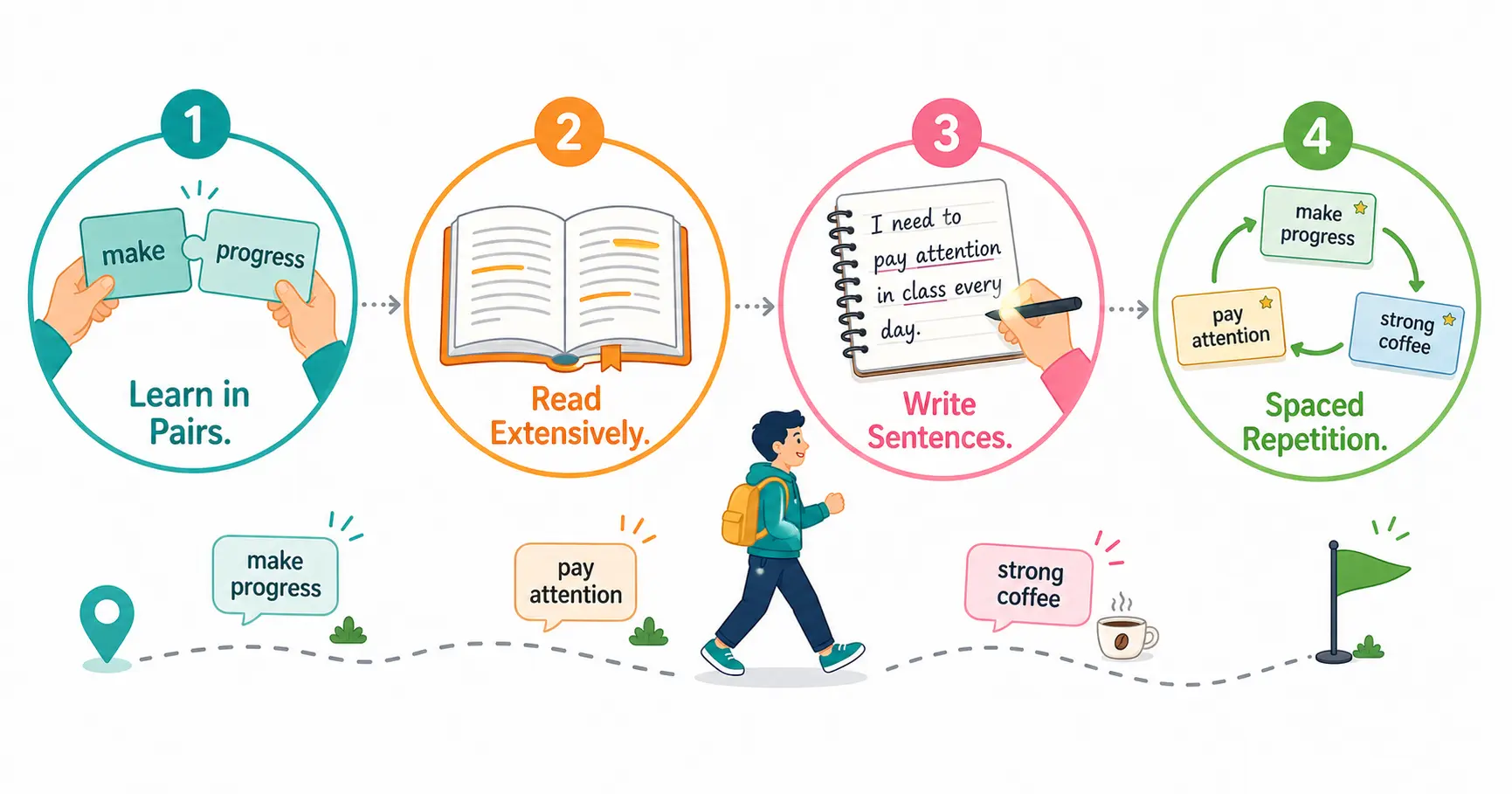
コロケーションの覚え方
1. 単語はペアで覚える
単語を単独で覚えてはいけません。”decision” を覚えるときは、すぐに “make a decision” もセットで覚えてください。”rain” を覚えるなら “heavy rain” も一緒に。語彙ノートは「単語」と「その単語の主要なコロケーション」の2列構成にしましょう。
2. 大量に読む
コロケーションは暗記よりも、大量の英文に触れることで身につきます。Economist、BBC、Guardian、学術論文の記事を読みましょう。自然に聞こえる語の組み合わせに気づいたら書き留める。そうすると次第に、理由を説明できなくても正しいコロケーションが「しっくりくる」ようになります。
3. コロケーション辞典を使う
Oxford Collocations Dictionary for Students of English が最良の専門リソースです。任意の単語を調べると、タイプ別(動詞+、形容詞+、名詞+など)にすべての一般的なコロケーションが表示されます。オンラインツールの Ozdic.com では無料でコロケーションを検索できます。
4. 間違いから学ぶ
ネイティブスピーカーや先生に語の選択を直されたら—「”heavy rain” であって “strong rain” じゃないよ」—正しいコロケーションを書き留めましょう。自分で気づいて修正したコロケーションは、受動的に読んだだけのものよりはるかに長く記憶に残ります。
5. スペースドリピティション(間隔反復)を使う
コロケーションをLinglifyなどのスペースドリピティションシステムに追加しましょう。完全なユニットとして学習してください。”make + decision” を1枚のフラッシュカードに。”make” と “decision” を別々にしてはいけません。科学的な暗記法については、語彙の暗記法を参照してください。
6. 文を作って練習する
新しいコロケーションを覚えるたびに、異なる文脈で3つの文を作りましょう。”Heavy rain” → (1) “We cancelled the picnic due to heavy rain.” (2) “Heavy rain is expected throughout the week.” (3) “The heavy rain caused flooding in low-lying areas.” こうすることで、認識力だけでなく運用力が身につきます。
次に読むべき記事
この総合ガイドでコロケーションの全体像を把握できました。ここからは、目的に合わせた詳細ガイドに進みましょう。
レベル別:
- 英語コロケーション活用法:レベル別の必須組み合わせ — A2からC2までレベル別に整理されたコロケーション
- 上級英語コロケーション:C1–C2の語の組み合わせ — 中上級・上級者向け
タイプ別:
- タイプ別コロケーション:形容詞+名詞、動詞+名詞など — 各コロケーションカテゴリの詳細解説
試験対策:
- PTEとIELTSのためのコロケーション一覧 — Lexical Resourceのスコアアップに直結する試験対策コロケーション
- IELTS Writing Task 1 語彙 — Task 1のデータ描写に使うコロケーション
- IELTS Writing Task 2 語彙 — Task 2のエッセイに使うコロケーション
関連する語彙ガイド:
- 英語のイディオム:500以上の頻出表現 — 比喩的な意味を持つ慣用表現
- 英語の句動詞:完全ガイド — 動詞+小辞の組み合わせ
- 語彙力を伸ばす方法 — 総合的な語彙構築戦略
- 上級英語単語:300以上のC1–C2語彙 — これらのコロケーションと組み合わせる単語
FAQ
コロケーションとは、簡単に言うと何ですか?
コロケーションとは、英語で自然に一緒に使われる2つ以上の単語の組み合わせです。”Make a decision” はコロケーションです。英語話者は “decision” には必ず “make” を使い、”do a decision” や “take a decision” とは言いません。コロケーションは単語のパートナーシップです。特定の単語同士が自然に結びつき、間違ったパートナーを使うと、文法的に正しくても不自然に聞こえます。
英語にはコロケーションがいくつありますか?
数万以上あります。一般的な名詞にはそれぞれ複数の動詞・形容詞・副詞コロケーションがあります。Oxford Collocations Dictionary には9,000の見出し語に対して15万以上のコロケーションが掲載されています。実用的な流暢さを目指すなら、最も頻出する2,000語のコロケーションを覚えれば、日常生活や試験で必要な大部分をカバーできます。
コロケーションと複合語の違いは何ですか?
複合語は一つの単語として機能する固定された単位です:”traffic jam”、”greenhouse”、”cell phone”。コロケーションはもう少し緩やかな単語のパートナーシップです:”heavy rain”、”make a decision”、”strongly recommend”。多くの複合名詞はコロケーションとして始まり、定着して一つの概念に融合しました。実用上の違い:複合名詞は辞書に単独の項目として載っていますが、コロケーションはコロケーション辞典で調べるか、実際の使用を通じて学ぶ必要があります。
コロケーションはイギリス英語とアメリカ英語で異なりますか?
ほとんどのコロケーションは両方で共通です。ただし、いくつか違いがあります。アメリカでは “take a shower” ですが、イギリスでは “have a shower” と言う人もいます。アメリカでは “do the math” ですが、イギリスでは “do the maths” です。これらの違いは軽微であり、どちらも広く理解されます。IELTSやTOEFLでは、どちらの形式も認められています。
IELTSにとってコロケーションはどれくらい重要ですか?
非常に重要です。IELTSのLexical Resourceのバンドディスクリプター(評価基準)では、すべてのバンドレベルでコロケーションに言及しています。バンド6は「やや一般的でない語彙も使用するが、不正確さが見られる」。バンド7は「スタイルとコロケーションへの意識がある」。バンド8は「珍しい語彙の使用」と「コロケーションの巧みな使用」。実際のところ、正しいコロケーションの使用は、バンド6.5からバンド7以上への最速の方法の一つです。
コロケーションを学ぶ最良の方法は何ですか?
ペアで覚える(”decision” 単独ではなく “make a decision” として学ぶ)、英語を大量に読む(コロケーションは触れることで身につく)、コロケーション辞典を使う(Oxford Collocations Dictionary が最高のリソース)、スペースドリピティションで学習する。重要な原則:コロケーションは文法規則から推測することができません。実際に出会い、気づき、練習するしかないのです。
シソーラス(類語辞典)でコロケーションを見つけられますか?
いいえ。シソーラスは同義語を教えてくれます(”big” → “large”、”huge”、”massive”)が、どの同義語がどの名詞と組み合わさるかは教えてくれません。シソーラスは “big” と “strong” がどちらも強調語であることを教えますが、雨は “heavy”(”big” でも “strong” でもなく)、風は “strong”(”heavy” でも “big” でもなく)であることは教えてくれません。コロケーション専用の辞典を使いましょう。