英語の類義語と対義語:1000以上の単語ペア完全ガイド
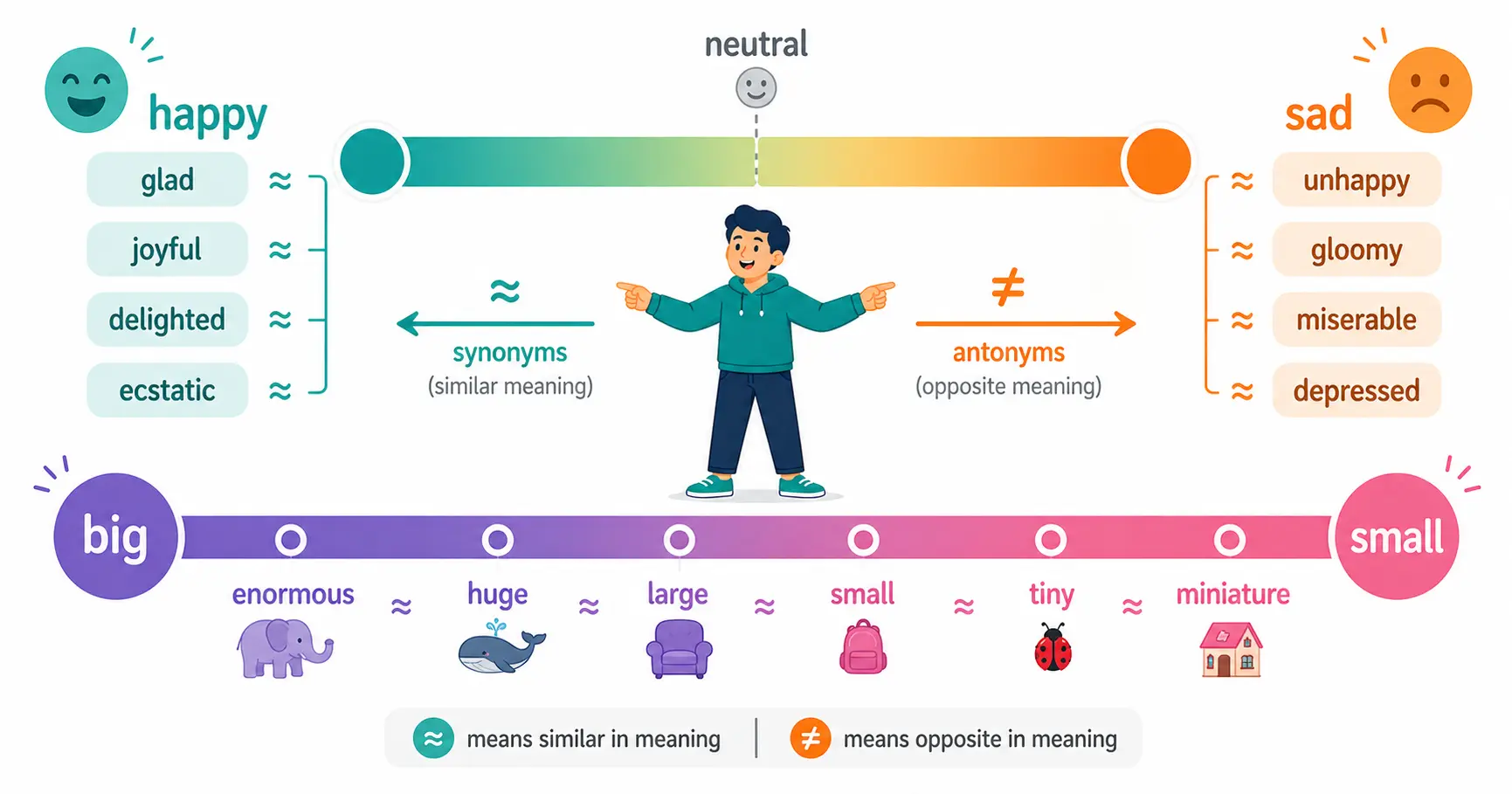
英語のあらゆる単語は、意味のネットワークの中に存在しています。たとえば “happy” は “joyful”、”content”、”elated”、”cheerful” といった同じ意味を共有する単語とつながっています。同時に、”sad”、”miserable”、”unhappy”、”gloomy” といった反対の意味を持つ単語ともつながっています。前者が類義語(synonyms=シノニム)、後者が対義語(antonyms=アントニム)です。この2つを理解することが、語彙の柔軟性——つまり同じことを異なる表現で伝え、2つの意味の極の間にある微妙なニュアンスを把握する力——の基盤となります。
これは実用的にも重要です。IELTS では「Lexical Resource(語彙の豊富さ)」の評価基準で、類義語の活用が求められます。同じ単語を繰り返さないことがスコアアップのカギです。アカデミックライティングでは、類義語を使ったパラフレーズが知的な文章力の証拠になります。日常会話でも、対義語を知っていれば微妙なニュアンスを表現できます。”I’m not happy” と “I’m unhappy”、さらに “I’m miserable” ではそれぞれ意味が異なります。こうした単語間の距離こそが、基礎的な英語と流暢な英語の違いなのです。
このガイドでは次の内容を扱います。
- 類義語と対義語とは何か(明確な定義と例)
- トピック別に整理した1000以上の類義語・対義語ペア
- 完全な同義語と近似同義語の重要な違い
- 100以上の頻出反対語ペア
- 意味を変えずに類義語を使う方法
- 類義語・対義語の知識を定着させる学習法
類義語(Synonym)とは?
類義語とは、別の単語と同じか非常に近い意味を持つ単語のことです。英語の “synonym” はギリシャ語の syn-(一緒に)+ onoma(名前)に由来し、「同じ名前」という意味です。日本語の「類義語」に相当します。
| 単語 | 類義語 |
|---|---|
| big | large, huge, enormous, massive, vast |
| happy | glad, joyful, content, pleased, delighted |
| smart | intelligent, clever, bright, sharp, brilliant |
| fast | quick, rapid, swift, speedy |
| important | significant, crucial, vital, essential, key |
類義語はまったく同じ意味なのか?
ほとんどの場合、同じではありません。英語の類義語の大半は近似同義語(near synonyms)です。中心的な意味は共有していますが、フォーマル度、強さ、使われる場面が異なります。
| 単語 | 類義語 | 違い |
|---|---|---|
| big | enormous | “enormous” は “big” よりはるかに強い意味 |
| ask | interrogate | “interrogate” はフォーマルで攻撃的、”ask” は中立的 |
| old | ancient | “ancient” は何千年という古さ、”old” は一般的 |
| thin | slim | “slim” はポジティブ、”thin” は中立〜ネガティブ |
| cheap | affordable | “affordable” はポジティブ、”cheap” は品質が低い印象を与えることがある |
この区別は非常に重要です。文脈を考えずに類義語を入れ替えることは、学習者がよく犯す語彙ミスの一つです。”The teacher interrogated the students”(教師が生徒を尋問した)は “The teacher asked the students”(教師が生徒に質問した)とはまったく違う意味になります。
対義語(Antonym)とは?
対義語とは、別の単語と反対の意味を持つ単語のことです。英語の “antonym” はギリシャ語の anti-(反対の)+ onoma(名前)に由来し、「反対の名前」という意味です。日本語の「対義語」「反意語」に相当します。
| 単語 | 対義語 |
|---|---|
| hot | cold |
| big | small |
| happy | sad |
| fast | slow |
| buy | sell |
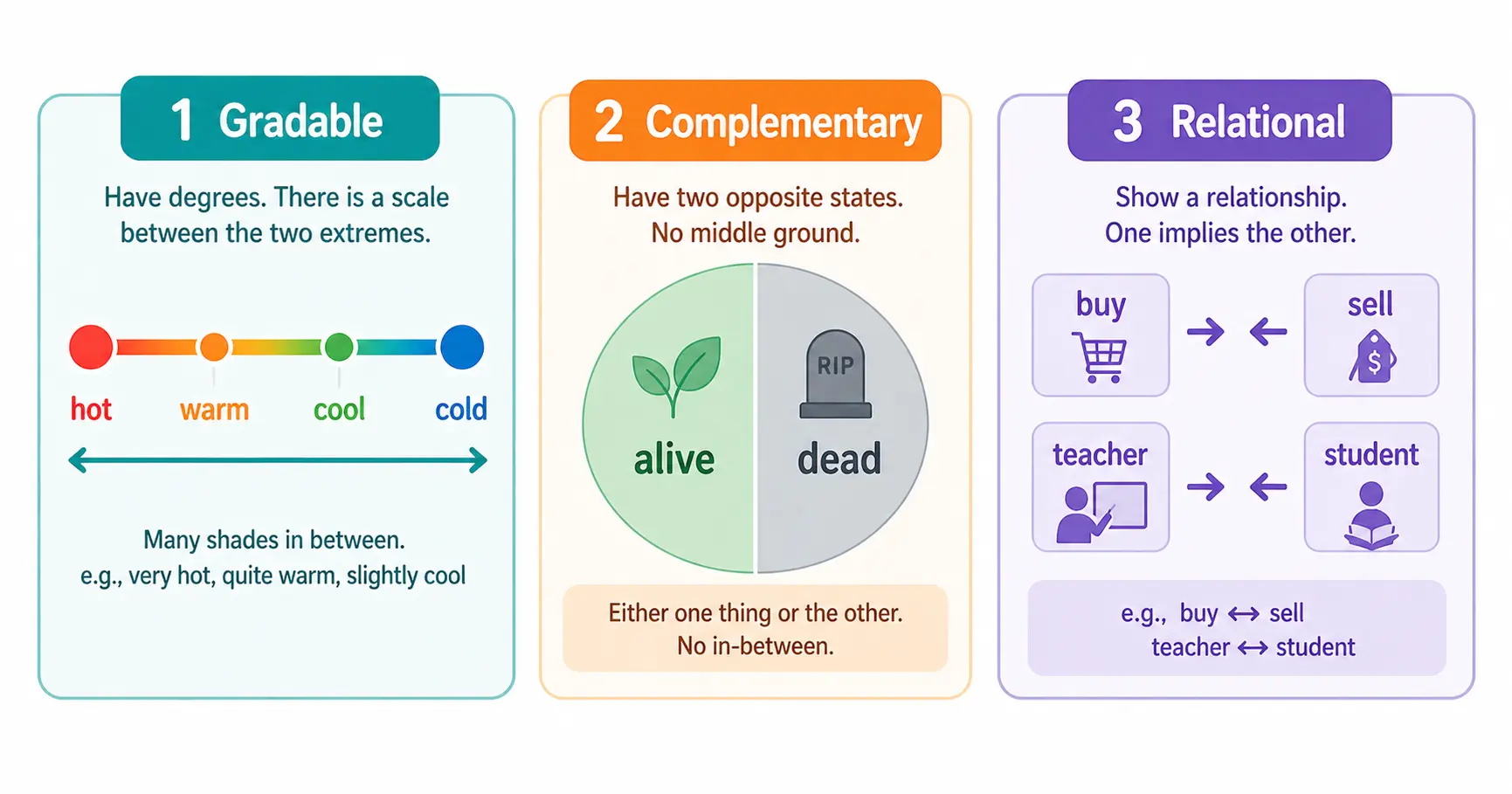
対義語の3つのタイプ
1. 段階的対義語(Gradable antonyms) — 度合いのある対義語で、その間に段階が存在します。
- hot ↔ cold(間に warm, cool, lukewarm がある)
- big ↔ small(間に large, medium, tiny がある)
- happy ↔ sad(間に content, neutral, unhappy がある)
2. 相補的対義語(Complementary antonyms) — 中間のない絶対的な対義語です。
- alive ↔ dead
- true ↔ false
- on ↔ off
- male ↔ female
3. 関係的対義語(Relational antonyms) — 互いに依存し合う対義語で、片方がなければもう片方も存在しません。
- buy ↔ sell
- teacher ↔ student
- parent ↔ child
- give ↔ receive
- husband ↔ wife
よく使いすぎる英単語50語の類義語
英語学習者が使いすぎてしまう単語を集めました。これらを類義語に置き換えることが、より流暢に聞こえるための最短ルートです。
形容詞
Good
| 類義語 | フォーマル度 | 最適な場面 | 例文 |
|---|---|---|---|
| excellent | 中立〜フォーマル | 品質、パフォーマンス | The service was excellent. |
| outstanding | フォーマル | 成果、結果 | She received outstanding reviews. |
| remarkable | フォーマル | 印象的な出来事 | His recovery was remarkable. |
| superb | 中立 | 品質、体験 | The food was superb. |
| terrific | インフォーマル | 熱意を込めて | That’s a terrific idea! |
| wonderful | 中立 | ポジティブな体験 | We had a wonderful time. |
| fine | 中立 | 許容できる品質 | The weather looks fine today. |
| decent | 中立〜インフォーマル | 十分な品質 | He makes a decent salary. |
| splendid | フォーマル/文語的 | 高い品質 | The view from the top was splendid. |
Bad
| 類義語 | フォーマル度 | 最適な場面 | 例文 |
|---|---|---|---|
| terrible | 中立 | 強い否定 | The traffic was terrible. |
| awful | 中立〜インフォーマル | 強い否定 | The movie was awful. |
| dreadful | フォーマル | 非常に悪い状況 | The conditions were dreadful. |
| poor | 中立 | 品質、パフォーマンス | The essay received a poor grade. |
| unacceptable | フォーマル | 基準、行動 | This behavior is unacceptable. |
| inadequate | フォーマル | 不十分な品質 | The funding was inadequate. |
| appalling | フォーマル | 衝撃的に悪い | The hygiene standards were appalling. |
| mediocre | 中立 | 平均〜低レベル | The restaurant was mediocre. |
Important
| 類義語 | フォーマル度 | 最適な場面 | 例文 |
|---|---|---|---|
| significant | フォーマル | データ、研究 | The results show a significant improvement. |
| crucial | 中立〜フォーマル | 重大な決定 | Time management is crucial for success. |
| vital | 中立〜フォーマル | 不可欠なもの | Water is vital for survival. |
| essential | 中立 | 必要なもの | Teamwork is essential in this job. |
| key | 中立 | 中心的な要素 | Education is a key factor in economic growth. |
| paramount | 非常にフォーマル | 最優先事項 | Safety is paramount in this industry. |
| pivotal | フォーマル | 転換点 | The election was a pivotal moment in history. |
| fundamental | フォーマル | 基本原則 | Trust is fundamental to any relationship. |
Big
| 類義語 | フォーマル度 | 最適な場面 | 例文 |
|---|---|---|---|
| large | 中立 | サイズ、数量 | They live in a large house. |
| huge | 中立 | とても大きい | There was a huge crowd at the concert. |
| enormous | 中立 | 非常に大きい | The project requires an enormous budget. |
| massive | 中立〜インフォーマル | 非常に大きい | The company made a massive profit. |
| vast | フォーマル | 面積、数量 | The Sahara is a vast desert. |
| substantial | フォーマル | 数量、金額 | There was a substantial increase in sales. |
| immense | フォーマル | 規模、感情 | She felt immense relief after the exam. |
| considerable | フォーマル | かなりの量 | She has considerable experience in the field. |
Small
| 類義語 | フォーマル度 | 最適な場面 | 例文 |
|---|---|---|---|
| tiny | 中立 | とても小さい物理的サイズ | The apartment was tiny — only 20 square meters. |
| minor | 中立〜フォーマル | 重要性、深刻度 | It was a minor issue that we fixed quickly. |
| slight | 中立〜フォーマル | わずかな程度 | There was a slight delay in the schedule. |
| negligible | フォーマル | 取るに足りない | The risk is negligible. |
| modest | 中立 | 大きくない、控えめな | They started with a modest investment. |
| minimal | フォーマル | ごくわずかな量 | The impact was minimal. |
| compact | 中立 | 小さくても効率的 | The car has a compact design. |
動詞
Think
| 類義語 | フォーマル度 | 最適な場面 | 例文 |
|---|---|---|---|
| believe | 中立 | 意見 | I believe education should be free. |
| consider | フォーマル | 慎重な検討 | We should consider all the options. |
| assume | 中立 | 根拠なしに | I assumed you knew about the meeting. |
| suppose | 中立 | 不確かな考え | I suppose you’re right. |
| reckon | インフォーマル(英国英語) | カジュアルな意見 | I reckon it’ll rain tomorrow. |
| contemplate | フォーマル | 深い思考 | She contemplated the offer for days. |
| reflect (on) | フォーマル | 振り返り | He reflected on his years at the company. |
| maintain | フォーマル | 強い確信 | She maintains that the decision was correct. |
| contend | 非常にフォーマル | 主張として論じる | Critics contend that the policy is flawed. |
Say
| 類義語 | フォーマル度 | 最適な場面 | 例文 |
|---|---|---|---|
| state | フォーマル | 公式な声明 | The report states that crime has decreased. |
| claim | 中立〜フォーマル | 主張(疑わしい場合も) | He claims he was at home all evening. |
| argue | 中立〜フォーマル | 論点を述べる | She argued that the policy was unfair. |
| mention | 中立 | 簡単に触れる | He mentioned the project in passing. |
| point out | 中立 | 注意を引く | She pointed out several errors in the report. |
| declare | フォーマル | 公式な発表 | The government declared a state of emergency. |
| suggest | 中立 | 提案する | I suggest we postpone the meeting. |
| assert | フォーマル | 強い主張 | The CEO asserted that the company was profitable. |
| remark | 中立〜フォーマル | コメントする | He remarked on the quality of the presentation. |
Show
| 類義語 | フォーマル度 | 最適な場面 | 例文 |
|---|---|---|---|
| demonstrate | フォーマル | 証明、根拠 | The study demonstrates a clear link between sleep and performance. |
| illustrate | フォーマル | 例、ビジュアル | The chart illustrates the trend over the last decade. |
| indicate | フォーマル | データが示す | The results indicate a possible solution. |
| reveal | 中立〜フォーマル | 隠れた情報 | The investigation revealed widespread fraud. |
| display | 中立 | 見せる | The museum displays artifacts from ancient Egypt. |
| exhibit | フォーマル | 特性、性質 | He exhibited remarkable patience during the crisis. |
| highlight | 中立 | 強調する | The report highlights several key challenges. |
Make
| 類義語 | フォーマル度 | 最適な場面 | 例文 |
|---|---|---|---|
| create | 中立 | 新しいものを作る | She created a beautiful sculpture. |
| produce | 中立〜フォーマル | 製造、結果 | The factory produces 10,000 units per day. |
| generate | フォーマル | 結果やエネルギーを生む | The campaign generated significant interest. |
| construct | フォーマル | 建設する | They constructed a bridge in just six months. |
| develop | 中立〜フォーマル | 時間をかけて作る | She developed a new training program. |
| establish | フォーマル | 設立、システム構築 | He established the company in 2010. |
| manufacture | フォーマル | 工業生産 | The phone is manufactured in South Korea. |
Get
| 類義語 | フォーマル度 | 最適な場面 | 例文 |
|---|---|---|---|
| obtain | フォーマル | 公式に取得する | She obtained a visa for Australia. |
| acquire | フォーマル | 所有権を得る | He acquired the property in 2018. |
| receive | 中立〜フォーマル | 受け取る | We received your application. |
| gain | 中立〜フォーマル | 獲得する | She gained valuable experience abroad. |
| earn | 中立 | 収入、尊敬 | He earns a good salary. |
| secure | フォーマル | 努力して獲得する | They secured funding for the project. |
Change
| 類義語 | フォーマル度 | 最適な場面 | 例文 |
|---|---|---|---|
| modify | フォーマル | 調整する | We need to modify the design slightly. |
| alter | 中立〜フォーマル | 変更する | The dress was altered to fit perfectly. |
| transform | 中立〜フォーマル | 大きな変化 | Technology has transformed the education sector. |
| adjust | 中立 | 小さな変更 | Adjust the temperature to your preference. |
| revise | フォーマル | 更新、修正 | They revised the report after the review. |
| convert | 中立 | 形態や用途の変更 | They converted the warehouse into apartments. |
| reshape | フォーマル | 根本的な変化 | The pandemic reshaped how we work. |
頻出形容詞の対義語ペア
| 単語 | 対義語 | 例文(単語) | 例文(対義語) |
|---|---|---|---|
| hot | cold | It’s a hot summer day. | It’s a cold winter night. |
| happy | sad | She looked happy at the party. | He seemed sad after the news. |
| fast | slow | He’s a fast runner. | The traffic was painfully slow. |
| young | old | She’s too young to drive. | The building is very old. |
| rich | poor | They live in a rich neighborhood. | Many poor families need support. |
| easy | difficult | The first question was easy. | The final exam was very difficult. |
| early | late | She arrived early for the meeting. | He’s always late. |
| strong | weak | He has a strong grip. | The signal was too weak. |
| deep | shallow | The lake is very deep. | The river is shallow here. |
| wide | narrow | The road was wide enough for two lanes. | The alley was narrow and dark. |
| thick | thin | The walls are very thick. | The ice was dangerously thin. |
| heavy | light | The suitcase was too heavy. | The bag was surprisingly light. |
| loud | quiet | The music was too loud. | The library was quiet. |
| bright | dark | The room was bright and airy. | It was dark outside by 5 PM. |
| smooth | rough | The surface was smooth to the touch. | The road was rough and bumpy. |
| soft | hard | The pillow was wonderfully soft. | The mattress was too hard. |
| wet | dry | My shoes are still wet. | The climate here is hot and dry. |
| full | empty | The restaurant was full. | The parking lot was empty. |
| safe | dangerous | Is this neighborhood safe? | Driving in fog is dangerous. |
| clean | dirty | The kitchen was spotlessly clean. | His hands were dirty from gardening. |
| fresh | stale | The bread was fresh from the oven. | The crackers have gone stale. |
| sweet | bitter | The mango was perfectly sweet. | The coffee was too bitter. |
| simple | complex | The instructions were simple. | The issue is more complex than it seems. |
| modern | ancient | The building has a modern design. | We visited an ancient temple. |
| temporary | permanent | It’s a temporary solution. | They’re looking for a permanent home. |
頻出動詞の対義語ペア
| 単語 | 対義語 | 例文(単語) | 例文(対義語) |
|---|---|---|---|
| buy | sell | I bought a new laptop. | She sold her car last month. |
| start | finish | The concert starts at 8 PM. | We finished the project on time. |
| open | close | Open the window, please. | Close the door behind you. |
| arrive | leave | We arrived at 3 PM. | He left without saying goodbye. |
| win | lose | Our team won the match. | They lost the final game. |
| remember | forget | Do you remember her name? | I always forget my password. |
| accept | reject | She accepted the job offer. | The committee rejected the proposal. |
| allow | forbid | Pets are allowed in the park. | Photography is forbidden in the museum. |
| agree | disagree | I agree with your analysis. | We strongly disagree with that decision. |
| appear | disappear | A rainbow appeared after the storm. | The boat disappeared into the fog. |
| attack | defend | The army attacked at dawn. | They defended the city for months. |
| borrow | lend | Can I borrow your pen? | She lent me her umbrella. |
| create | destroy | She created a masterpiece. | The fire destroyed the building. |
| increase | decrease | Prices have increased this year. | The population has decreased slightly. |
| push | pull | Push the door to open it. | Pull the handle toward you. |
| raise | lower | They raised the minimum wage. | The company lowered its prices. |
| succeed | fail | She succeeded on her first attempt. | The experiment failed twice before working. |
| teach | learn | She teaches English at university. | I’m learning Japanese. |
頻出名詞の対義語ペア
| 単語 | 対義語 |
|---|---|
| advantage | disadvantage |
| beginning | end |
| cause | effect |
| question | answer |
| success | failure |
| strength | weakness |
| problem | solution |
| majority | minority |
| supply | demand |
| wealth | poverty |
| knowledge | ignorance |
| victory | defeat |
| benefit | drawback |
| progress | decline |
| similarity | difference |
トピック別 類義語・対義語
感情
| ポジティブ | 類義語 | ネガティブ(対義語) | 類義語 |
|---|---|---|---|
| happy | glad, cheerful, joyful, delighted, content | sad | unhappy, sorrowful, gloomy, miserable, depressed |
| excited | thrilled, enthusiastic, eager, ecstatic | bored | uninterested, indifferent, apathetic, weary |
| calm | peaceful, serene, relaxed, tranquil | anxious | nervous, worried, tense, stressed, restless |
| confident | self-assured, certain, bold, poised | insecure | uncertain, doubtful, self-conscious, hesitant |
| proud | gratified, pleased, satisfied | ashamed | embarrassed, humiliated, mortified, guilty |
| grateful | thankful, appreciative, indebted | ungrateful | unappreciative, thankless |
| brave | courageous, fearless, bold, daring | afraid | scared, frightened, terrified, fearful, timid |
| hopeful | optimistic, positive, encouraged | hopeless | pessimistic, despairing, bleak |
性格と人格
| ポジティブ | 類義語 | ネガティブ(対義語) | 類義語 |
|---|---|---|---|
| kind | generous, compassionate, thoughtful, considerate | cruel | harsh, ruthless, heartless, merciless, brutal |
| honest | truthful, sincere, genuine, frank, candid | dishonest | deceitful, deceptive, untruthful, insincere |
| hardworking | diligent, industrious, dedicated, committed | lazy | idle, inactive, lethargic, sluggish, slothful |
| intelligent | smart, clever, bright, brilliant, sharp | foolish | stupid, ignorant, unwise, senseless, dim |
| polite | courteous, respectful, well-mannered, civil | rude | impolite, disrespectful, ill-mannered, coarse |
| patient | tolerant, calm, composed, understanding | impatient | restless, irritable, agitated, hasty |
| humble | modest, unassuming, down-to-earth | arrogant | proud, conceited, vain, haughty, pompous |
アカデミック・ビジネス
| フォーマル | インフォーマルな類義語 | 対義語 | 対義語の類義語 |
|---|---|---|---|
| analyze | look at, examine | overlook | ignore, disregard |
| demonstrate | show, prove | conceal | hide, cover up |
| significant | important, notable | insignificant | trivial, minor, negligible |
| comprehensive | complete, thorough | incomplete | partial, limited, insufficient |
| beneficial | helpful, useful, positive | harmful | damaging, detrimental, destructive |
| permanent | lasting, enduring, fixed | temporary | short-term, brief, provisional |
| complex | complicated, intricate | simple | easy, straightforward, basic |
| abundant | plentiful, ample, copious | scarce | rare, limited, insufficient |
| accurate | correct, precise, exact | inaccurate | incorrect, imprecise, wrong |
| frequent | common, regular, repeated | rare | uncommon, infrequent, occasional |
サイズと数量
| 単語 | 類義語(同方向) | 対義語 | 対義語の類義語 |
|---|---|---|---|
| big | large, huge, enormous, massive, vast, immense | small | tiny, little, minute, miniature, compact |
| long | extended, lengthy, prolonged | short | brief, concise, compact |
| tall | high, towering, lofty | short | low, small, squat |
| wide | broad, expansive, extensive | narrow | thin, slim, tight |
| thick | dense, heavy, bulky | thin | slim, fine, slender, lean |
| many | numerous, several, countless, abundant | few | scarce, limited, sparse, rare |
| much | a lot, plenty, considerable, substantial | little | barely, hardly, scarcely, minimal |
速度と動き
| 単語 | 類義語 | 対義語 | 対義語の類義語 |
|---|---|---|---|
| fast | quick, rapid, swift, speedy, brisk | slow | sluggish, gradual, unhurried, leisurely |
| increase | rise, grow, expand, escalate, surge | decrease | decline, drop, fall, diminish, shrink |
| arrive | reach, come, appear, show up | depart | leave, go, exit, set off |
| advance | progress, proceed, move forward | retreat | withdraw, go back, recede |
| accelerate | speed up, hasten, quicken | decelerate | slow down, brake |
IELTS・アカデミックライティングのための類義語
IELTS では同じ単語を繰り返すと Lexical Resource のスコアが下がります。ここでは、受験者が最も使いすぎてしまう単語の類義語グループを紹介します。
IELTS ライティングで置き換えるべき単語
| 使いすぎの単語 | Band 7以上の類義語 | 例文 |
|---|---|---|
| people | individuals, citizens, residents, the population, the public | Many individuals struggle to find affordable housing. |
| children | youngsters, minors, the younger generation, young people | The younger generation is more technologically literate. |
| problem | issue, concern, challenge, obstacle, dilemma, predicament | Air pollution is a growing concern in urban areas. |
| increase | rise, grow, escalate, surge, climb, expand | Housing prices have surged in the last decade. |
| decrease | decline, drop, fall, diminish, shrink, plummet | Newspaper readership has declined steadily since 2010. |
| important | significant, crucial, vital, essential, paramount | Education plays a crucial role in economic development. |
| good | beneficial, positive, advantageous, favorable | Regular exercise has beneficial effects on mental health. |
| bad | detrimental, harmful, adverse, negative, damaging | Pollution has detrimental effects on public health. |
| think | believe, argue, maintain, contend, assert | Many experts contend that renewable energy is the solution. |
| because | due to, owing to, as a result of, on account of, since | Attendance dropped due to the severe weather conditions. |
| very | highly, extremely, remarkably, considerably, significantly | The results were remarkably consistent across all groups. |
| many | numerous, a significant number of, a large proportion of | Numerous studies have confirmed these findings. |
IELTS のパラフレーズに特化した200以上の類義語については、IELTS パラフレーズ用類義語:200以上の言い換え表現をご覧ください。
接頭辞で作る対義語
英語の対義語の多くは、元の単語に接頭辞を付けることで作られます。これらの接頭辞パターンを覚えれば、何百もの単語の対義語を予測できるようになります。
un-
| 単語 | 対義語 | 例文 |
|---|---|---|
| happy | unhappy | She seemed unhappy with the results. |
| usual | unusual | There was an unusual silence in the room. |
| fair | unfair | The decision was unfair to the younger students. |
| likely | unlikely | It’s unlikely to rain tomorrow. |
| comfortable | uncomfortable | The chair was uncomfortable. |
| certain | uncertain | The outcome remains uncertain. |
| aware | unaware | She was unaware of the problem. |
| expected | unexpected | The result was completely unexpected. |
| reliable | unreliable | The data source proved unreliable. |
| successful | unsuccessful | The first attempt was unsuccessful. |
in- / im- / il- / ir-
| 単語 | 対義語 | 例文 |
|---|---|---|
| possible | impossible | Nothing is impossible with hard work. |
| polite | impolite | It’s impolite to interrupt someone. |
| patient | impatient | He became impatient waiting in line. |
| legal | illegal | Downloading pirated software is illegal. |
| literate | illiterate | Millions of adults remain illiterate worldwide. |
| regular | irregular | The schedule is irregular — it changes every week. |
| responsible | irresponsible | Leaving children alone is irresponsible. |
| complete | incomplete | The application was rejected because it was incomplete. |
| dependent | independent | She became financially independent at 22. |
| accurate | inaccurate | The report contained several inaccurate figures. |
dis-
| 単語 | 対義語 | 例文 |
|---|---|---|
| agree | disagree | I disagree with that interpretation. |
| appear | disappear | The ship disappeared over the horizon. |
| honest | dishonest | It would be dishonest to hide the truth. |
| advantage | disadvantage | The main disadvantage is the high cost. |
| connect | disconnect | The phone was disconnected after non-payment. |
| approve | disapprove | Her parents disapproved of her career choice. |
| obey | disobey | The soldiers disobeyed the order. |
| like | dislike | I dislike crowded places. |
| respect | disrespect | Disrespecting your teachers is unacceptable. |
| satisfy | dissatisfy | Several customers were dissatisfied with the service. |
mis-
| 単語 | 対義語 | 例文 |
|---|---|---|
| understand | misunderstand | I think you misunderstood the instructions. |
| lead | mislead | The advertisement misled consumers about the product. |
| behave | misbehave | The children misbehaved during the assembly. |
| inform | misinform | The public was misinformed about the risks. |
| judge | misjudge | I misjudged the distance and missed the goal. |
over- / under-
| 単語 | 対義語 | 例文(over-) | 例文(under-) |
|---|---|---|---|
| estimate | overestimate / underestimate | They overestimated the costs. | Don’t underestimate the difficulty. |
| pay | overpay / underpay | He was overpaid for the work. | Workers are underpaid in many industries. |
| value | overvalue / undervalue | The stock was overvalued. | Her contribution was undervalued. |
| react | overreact | He overreacted to the news. | — |
| achieve | underachieve | — | The student underachieved despite high potential. |
練習用語彙
以下の高頻出25語は、類義語・対義語の主要ペアに登場する重要な単語です。Linglify の辞書に追加して、間隔反復学習で定着させましょう。
affordable
形容詞
手頃な, 買いやすい
例
- The government is working to provide affordable housing for low-income families.
- This restaurant offers delicious and affordable meals for college students.
commute
動詞
通勤する, 通学する
例
- Public transportation helps people commute efficiently reducing traffic congestion.
- Workers commute daily between suburban homes and downtown offices.
conservation
名詞
保存, 保護, 省エネ
例
- Water conservation becomes increasingly important during periods of severe drought.
- Wildlife conservation is essential for protecting endangered species from extinction.
demanding
形容詞
要求の多い, 厳しい
例
- Medical school is very demanding and requires years of intensive study.
- She has a demanding boss who expects perfection in all tasks.
DJ
名詞
DJ(ディージェイ), ディスクジョッキー
例
- The DJ played my favorite song.
- The DJ took song requests all night.
heritage
名詞
遺産, 文化遺産
例
- She inherited a rich heritage of family traditions from her grandparents.
- The ancient castle is an important part of our cultural heritage.
leisure
名詞
余暇
例
- People enjoy various leisure activities during weekends and holidays.
- Reading books is popular leisure pursuit for many educated people.
luxurious
形容詞
豪華な, 贅沢な
例
- She dreams of owning luxurious car with leather seats and sunroof.
- The luxurious hotel suite includes marble bathroom and ocean view.
memorable
形容詞
記憶に残る, 忘れられない, 印象的な
例
- Graduation day was memorable occasion for entire family.
- The memorable speech inspired students to pursue their dreams.
nutritious
形容詞
栄養のある
例
- Fresh vegetables are nutritious and support overall health.
- Nutritious breakfast provides energy for productive school day.
passionate
形容詞
情熱的な, 熱烈な
例
- Passionate speech moves audience to take action.
- Passionate teacher inspires students to learn more.
pollution
名詞
汚染
例
- Air pollution affects public health in cities.
- Ocean pollution threatens marine life worldwide.
privacy
名詞
プライバシー, 私生活
例
- Hotel guests expect privacy during their stay.
- Internet privacy becomes increasingly important issue nowadays.
scenic
形容詞
景色の良い
例
- Scenic overlook provides perfect spot for photographs.
- Scenic route takes longer but offers beautiful.
traditional
形容詞
伝統的な
例
- Traditional cooking methods preserve authentic flavors perfectly.
- Traditional music reflects cultural history and values.
uneven
形容詞
不均一な, でこぼこした
例
- Uneven ground makes walking difficult and dangerous.
- Uneven performance shows inconsistent skill level development.
volunteer
動詞
志願する
例
- Citizens volunteer time for community improvement projects.
- Students volunteer at local charity organizations regularly.
substantially
副詞
実質的に, かなり, 大幅に
例
- Her performance substantially improved after additional training and practice.
- Prices have increased substantially over the past few months.
liaison
名詞
連絡, 連携, 調整役
例
- Military liaison officers coordinate operations between allied forces.
- She serves as liaison between different departments.
sustainable
形容詞
持続可能な, 持続的な
例
- Company implements sustainable business model for long-term success.
- Sustainable farming practices protect soil and water resources.
acclaimed
形容詞
称賛された, 絶賛された, 高く評価された
例
- His performance was acclaimed by critics.
- The acclaimed author received many awards for her novel.
cancellation
名詞
キャンセル, 取り消し, 中止
例
- Due to weather, the flight cancellation was inevitable.
- The concert's cancellation disappointed many fans.
discretion
名詞
判断力, 裁量, 慎重さ
例
- He exercised discretion in his decisions.
- Use your discretion when sharing information.
indication
名詞
兆候, 指示, サイン
例
- The indication of his illness was clear after the tests.
- There was no indication that she was unhappy.
serenity
名詞
平静, 静けさ, 落ち着き
例
- She maintained her serenity despite the chaos.
- The serenity of the lake was calming.
類義語・対義語の学習法
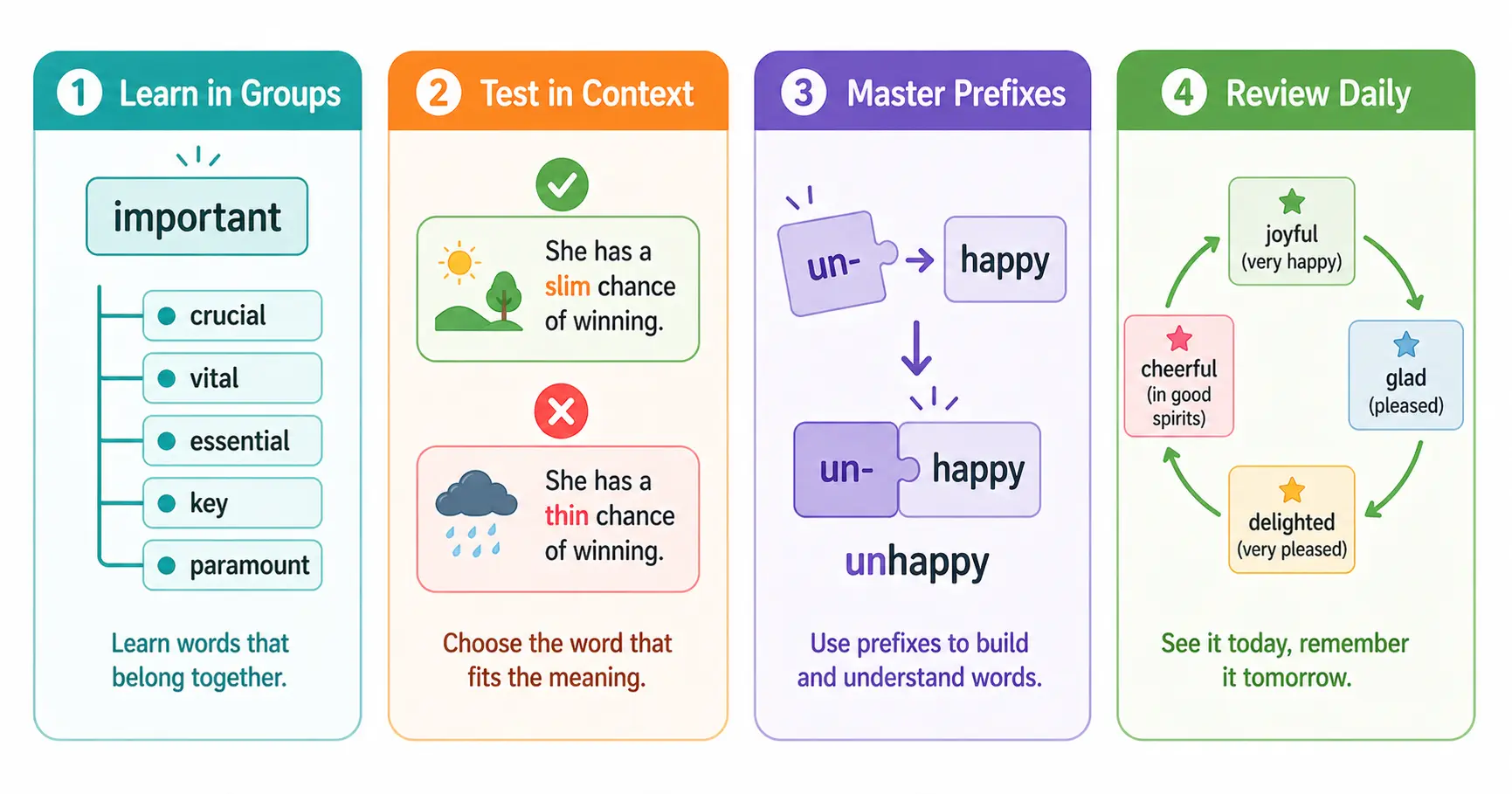
1. ペアではなくグループで覚える
“big = large” のペアだけを覚えても不十分です。類義語グループ全体を学びましょう。big → large → huge → enormous → massive → vast → immense のように、各単語はフォーマル度と強さのスケール上で異なる位置を占めています。グループを理解すれば選択肢が広がりますが、一組のペアだけでは実践で役立ちません。
2. 必ず文脈とセットで覚える
“slim” と “thin” は類義語ですが、”slim chance” は自然でも “thin chance” は不自然です。”strong tea” は正しくても “powerful tea” は間違いです。類義語は必ず、それが使われる文やコロケーションとセットで覚えましょう。コロケーションについて詳しくは、英語コロケーションガイドをご覧ください。
3. 「入れ替えテスト」を活用する
新しい類義語を覚えたら、普段その基本単語を使う3つの異なる文に入れ替えてみましょう。どれかで不自然に感じたら、その制限をメモしておきます。”vast” は “a vast desert” では使えますが、”a vast cup of coffee” では使えません。この練習を繰り返すことで、精密な語彙力が身につきます。
4. 接頭辞のパターンを学ぶ
un-、in-、dis-、mis-、over-、under- のパターンを覚えれば、一度に何百もの単語の対義語を把握できます。これは最も効率の良い語彙スキルの一つです。
5. 間隔反復を活用する
類義語・対義語のグループを Linglify などの間隔反復システムに追加しましょう。”important” の類義語セット全体のように、グループ単位で学習してください。孤立したペアではなく、グループで学ぶことが大切です。科学的に裏付けされた暗記法については、英単語の覚え方をご覧ください。
6. 読書で類義語を意識する
Economist、BBC、Guardian などの記事を読むとき、ライターがどのように同じ単語の繰り返しを避けているか注目しましょう。ある文では “increase”、次の文では “rise”、その次では “surge” と使い分けています。この自然な類義語の使い回しこそ、IELTS の試験官やアカデミックな読者が期待しているものです。
次に読むべき記事
このガイドは類義語と対義語の全体像をカバーしています。各テーマの詳細ガイドも合わせてご活用ください。
類義語リスト:
- よく使う英単語の類義語:200以上の言い換え表現 — “good”、”bad”、”interesting” などの置き換え
- アカデミック類義語リスト:エッセイ用300語 — 大学やテスト用のライティング向け
対義語リスト:
- 英語の反対語500以上:対義語一覧 A–Z — 対義語の完全リファレンス
試験対策:
- IELTS パラフレーズ用類義語:200以上の言い換え表現 — スコアアップのための試験特化の類義語
- IELTS 上級語彙:Band 8–9 の単語 — 高得点を狙う精密な語彙
関連する語彙ガイド:
- 英語コロケーションガイド — 自然な単語の組み合わせを知る
- 英語イディオム:500以上の頻出表現 — 比喩的な意味を持つ定型表現
- 上級英単語:C1–C2 レベル300語以上 — 強力な類義語として使える語彙
- 語彙力を伸ばす方法 — 語彙構築の総合戦略
FAQ
各単語でいくつの類義語を知っておくべきですか?
日常の流暢さには、頻出の形容詞・動詞・名詞100語に対して3〜5個の類義語を知っていれば十分です。IELTS Band 7以上を目指すなら、繰り返しがちな単語ごとに少なくとも3つの代替表現が必要です。Band 8〜9では、文脈に合った使い分けができる5つ以上の選択肢が求められます。量(20個の類義語を知っていること)よりも質(各類義語をいつ使うか理解していること)が重要です。
類義語はまったく同じ意味ですか?
ほぼ確実に「同じではない」と言えます。英語の類義語のほとんどは「近似同義語」です。中心的な意味は共通していますが、フォーマル度、強さ、ニュアンス、使われる場面が異なります。”slim” と “skinny” はどちらも「やせている」という意味ですが、”slim” はポジティブで “skinny” はネガティブな印象を与えることがあります。”home” と “residence” はどちらも住む場所を指しますが、”residence” はフォーマルです。類義語を自由に入れ替えられるものと考えるのは、最もよくある語彙ミスの一つです。
対義語を学ぶ最良の方法は?
まず接頭辞のパターンを覚えましょう(un-、dis-、in-/im-/il-/ir-、mis-、over-/under-)。この6つの接頭辞だけで何百もの英単語の対義語を作れます。接頭辞をマスターしたら、相補的対義語(alive/dead, true/false)と段階的対義語(hot/cold, big/small)を学びましょう。最後に関係的対義語(buy/sell, teach/learn)を学びます。
IELTS で類義語は重要ですか?
非常に重要です。IELTS の Lexical Resource の評価基準は、類義語の使用とパラフレーズ力を明確に評価しています。Band 6 の受験者は「あまり一般的でない語彙を使おうとするが、やや不正確」です。Band 7 では類義語を自然に使い、「柔軟性と正確さ」を見せます。Band 8〜9 では「幅広い語彙」を「巧みに」使いこなします。類義語を使わなければ、Lexical Resource のスコアは低くなるのがほぼ確実です。
類義語と定義の違いは何ですか?
類義語は同じまたは似た意味を持つ別の単語です。”happy” → “glad” のように。定義はフレーズで単語の意味を説明するものです。”happy” =「喜びや満足を感じている状態」のように。IELTS では、類義語を使うのがパラフレーズ、定義を使うのが説明です。どちらも有用ですが、試験官は類義語の使用をより評価します。語彙の幅を示す証拠になるからです。
シソーラス(類語辞典)を使って類義語を探してもよいですか?
はい、ただし注意が必要です。シソーラスは類義語の選択肢を示しますが、特定の文脈にどれが合うかは教えてくれません。常に次の点を確認しましょう。(1) この類義語のフォーマル度は適切か? (2) このコロケーションで使えるか? (3) 同じニュアンスを持っているか? たとえば、シソーラスは “ask” の類義語として “interrogate” を提案するかもしれませんが、”I interrogated my friend about her weekend”(友人の週末について尋問した)とは言いません。シソーラスと一緒に学習者用辞書も併用しましょう。
試験で類義語と対義語はどう問われますか?
IELTS Reading では、パッセージが類義語を使って情報をパラフレーズしている箇所を見抜く力が問われます。これは True/False/Not Given やマッチング問題の核となるスキルです。IELTS Writing では、繰り返しを避け語彙の幅を示すために類義語の使用が必須です。TOEFL Reading では、類義語の問題が明示的に出題されます。「第3段落の X という単語に最も意味が近いのは…」という形式です。語彙テスト(Cambridge、Pearson)では、類義語と対義語の両方が選択式で出題されます。