Gramática e Vocabulário C1–C2: Um Guia de Estudos Avançado
É melhor estudar gramática e vocabulário C1–C2 juntos. A gramática avançada dá forma às suas ideias: contraste, ênfase, distanciamento, cautela e conexão lógica. O vocabulário avançado dá precisão a essas ideias. Se você estudar apenas listas de palavras, suas frases ainda podem soar básicas; se estudar apenas regras gramaticais, talvez não tenha nada específico a dizer.
Este guia é um plano de estudos gratuito e estruturado para quem procura exercícios de gramática e vocabulário C1–C2 ou uma alternativa digital a um curso baseado em livro didático. Ele não copia nenhum livro. Em vez disso, apresenta os sistemas linguísticos de que estudantes avançados precisam, o vocabulário que combina com eles e uma rotina de quatro semanas para praticar ambos. Use a biblioteca C1 e a biblioteca C2 para revisar o vocabulário em grupos fáceis de estudar.
- Nível: C1 a C2, do uso avançado confiante à proficiência flexível
- Foco: escolhas gramaticais complexas, vocabulário preciso e produção ativa
- Ideal para: estudantes se preparando para exames avançados, estudo ou comunicação profissional
- Objetivo de estudo: escrever e falar com precisão sem traduzir uma regra palavra por palavra
Para um banco de palavras focado, leia Vocabulário C2 de Proficiência. Para uma base C1, comece com Vocabulário C1 em Inglês.
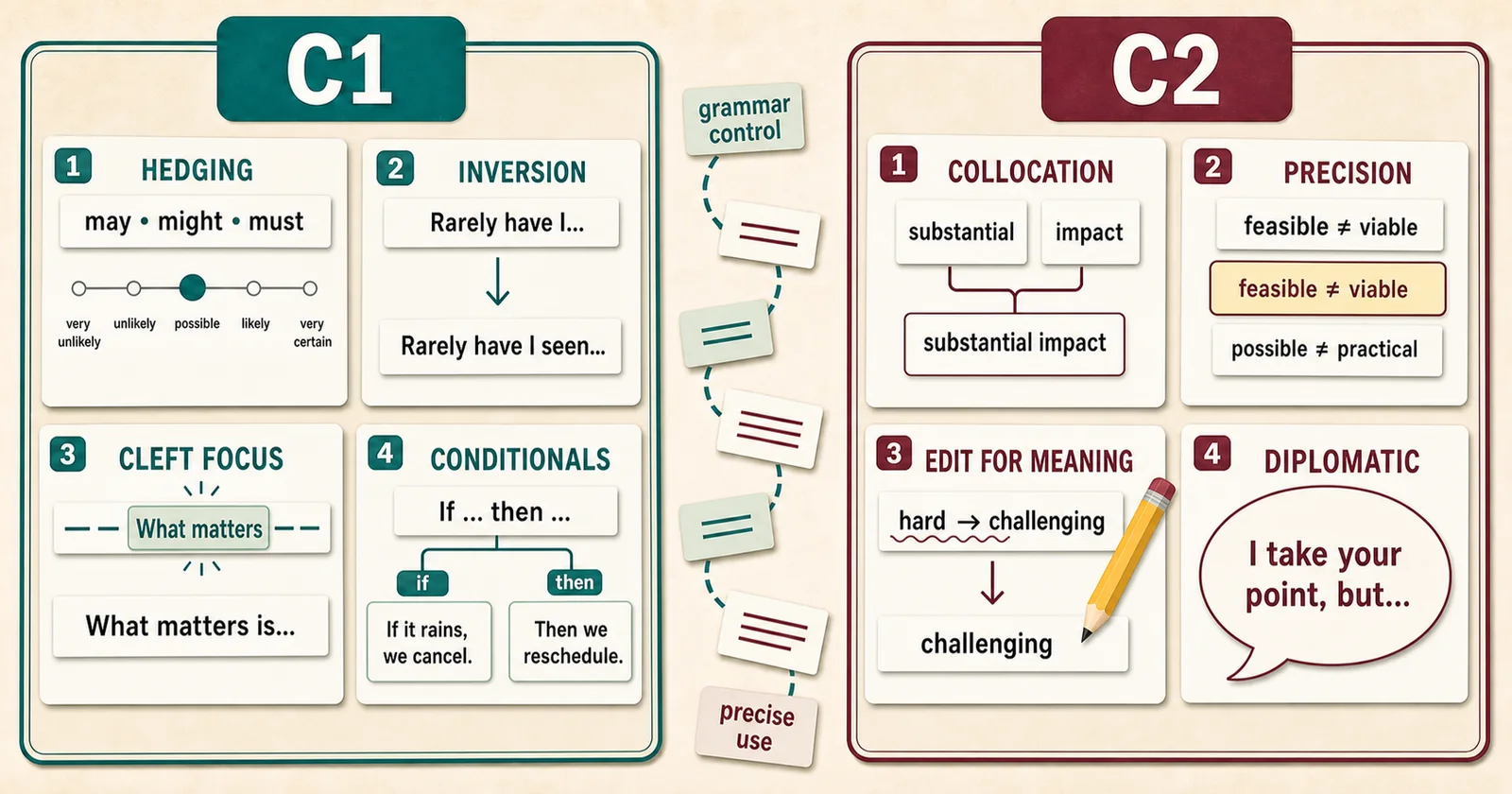
A Diferença Entre Controle C1 e C2
No C1, você normalmente consegue explicar ideias complexas, usar uma ampla variedade de linguagem e corrigir muitos dos próprios erros. No C2, você escolhe entre esses recursos com mais rapidez, precisão e flexibilidade. Consegue adaptar a mesma mensagem para um relatório formal, uma discussão cuidadosa ou uma conversa informal sem perder o fio da ideia.
| Área | Controle C1 | Controle C2 |
|---|---|---|
| gramática | usa estruturas complexas com precisão na maioria das vezes | escolhe estruturas para ênfase, tom e significado sutil |
| vocabulário | usa palavras avançadas e colocações | distingue significados próximos e muda de registro naturalmente |
| escrita | desenvolve um argumento claro | gerencia nuances, exceções e uma linha de raciocínio altamente coerente |
| fala | explica e defende uma opinião | responde com flexibilidade, qualifica afirmações e reformula suavemente |
O objetivo não é eliminar todas as palavras simples. É ter alternativas à mão quando uma expressão simples não é precisa o bastante. “The plan is bad” pode ser perfeito numa conversa rápida. Em um relatório, talvez seja melhor dizer “The plan is not financially viable” ou “The plan may be counterproductive in the long term.”
Gramática 1: Cautela (Hedging), Modalidade e Graus de Certeza
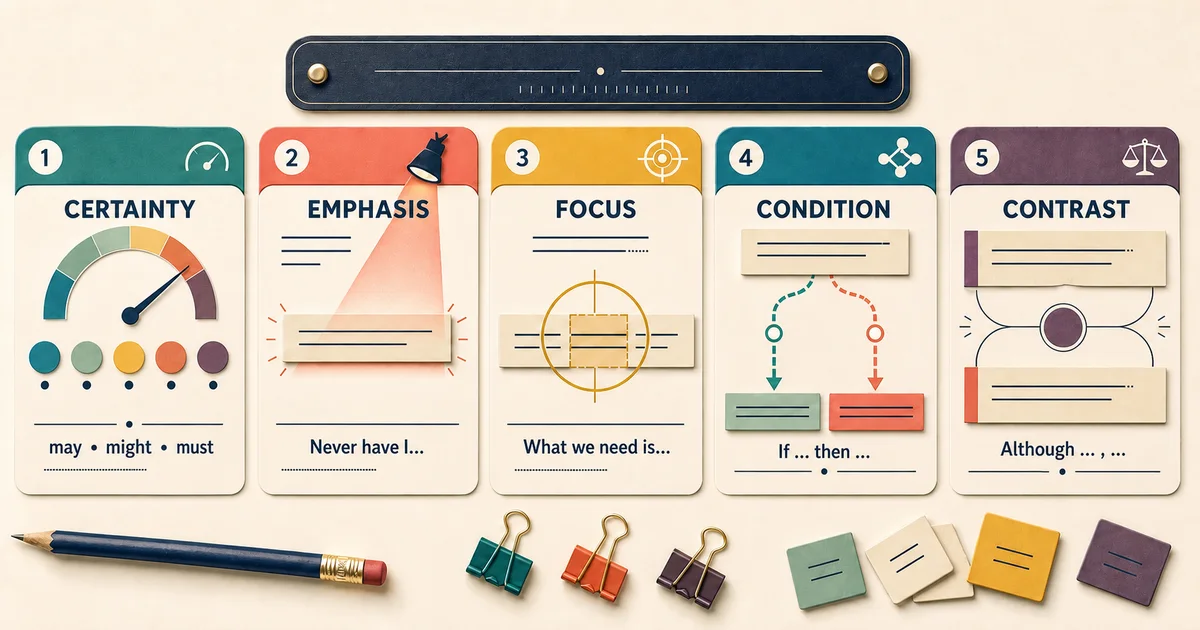
O inglês avançado muitas vezes exige afirmações cuidadosas. Verbos modais e verbos de relato ajudam a mostrar o grau de certeza e a força que sua recomendação deve transmitir.
| Propósito | Padrão útil | Exemplo |
|---|---|---|
| conclusão forte | must have + particípio passado | They must have overlooked the message. |
| possibilidade fraca | may / might well + verbo | The change might well affect demand. |
| afirmação cuidadosa | tend to + verbo | Small errors tend to accumulate over time. |
| visão baseada em evidências | appear / seem to + verbo | The results appear to support the proposal. |
| recomendação cautelosa | it would be advisable to + verbo | It would be advisable to review the policy. |
| certeza limitada | there is likely to be + substantivo | There is likely to be some resistance. |
Essas estruturas gramaticais mudam a relação com o leitor. “This will fail” é absoluto. “This may prove unworkable unless…” continua claro, mas deixa espaço para evidências e condições. Combine essas estruturas com palavras como plausible, tentative, inherent e likely.
Gramática 2: Inversão e Ênfase
A inversão é útil quando você quer um estilo formal ou enfático. É comum na escrita bem elaborada e em discursos preparados, mas deve ser usada com moderação em conversas informais.
| Frase padrão | Ênfase avançada | Quando usar |
|---|---|---|
| We rarely see such a result. | Rarely do we see such a result. | ênfase forte na escrita formal |
| We understood the scale only then. | Only then did we understand the scale. | um momento decisivo |
| The plan will work only if funding continues. | Only if funding continues will the plan work. | uma condição estrita |
| I had never felt so prepared. | Never had I felt so prepared. | um ponto pessoal ou narrativo forte |
| The team not only reduced costs; it also improved quality. | Not only did the team reduce costs, but it also improved quality. | contraste equilibrado |
Verifique o auxiliar cuidadosamente: Rarely do we see, não “Rarely we see”. Inversão é uma escolha gramatical, não um enfeite. Uma estrutura bem colocada pode dar ênfase; cinco em um parágrafo curto podem soar artificiais.
Gramática 3: Frases Clivadas e Foco Controlado
Frases clivadas permitem que você coloque a parte mais importante da mensagem no início. Elas são especialmente úteis para corrigir uma suposição ou estabelecer uma distinção.
| Padrão | Exemplo | Efeito |
|---|---|---|
| What + oração + be … | What we need is a realistic timetable. | destaca o resultado ou a necessidade |
| It is/was + foco + that/who … | It was the final review that revealed the error. | destaca uma causa ou pessoa |
| The thing that … is … | The thing that concerns me is the lack of evidence. | torna uma preocupação abstrata clara |
| All + oração + be … | All I am asking for is a clear answer. | cria um tom controlado e educado |
Compare “We need a realistic timetable” com “What we need is a realistic timetable.” A segunda versão é útil quando há várias soluções possíveis em discussão e você quer deixar clara a prioridade.
Gramática 4: Condicionais, Concessões e Distância Hipotética
Estudantes avançados precisam ir além dos padrões básicos com if. Estas estruturas ajudam a falar sobre decisões passadas irreais, consequências presentes e contrastes inesperados.
| Propósito | Padrão | Exemplo |
|---|---|---|
| causa passada, resultado presente | If + past perfect, would + infinitivo | If we had planned earlier, we would have more time now. |
| estado presente, resultado passado | If + past simple, would have + particípio passado | If I were more confident, I would have applied. |
| condição formal | Were + sujeito + to + verbo | Were demand to fall, we would revise the forecast. |
| condição negativa formal | Had + sujeito + particípio passado | Had they known, they might have acted differently. |
| concessão | much as / however + adjetivo | Much as I value speed, accuracy matters more. |
| resultado inesperado | even if / even though | The policy may help even if costs remain high. |
Não escolha um condicional complexo só porque ele é avançado. Use-o quando a relação temporal realmente for mista. “If I had left earlier, I would be there now” conecta uma decisão passada a um resultado presente — por isso essa forma mista faz sentido.
Gramática 5: Cláusulas de Particípio e Densidade de Informação
Cláusulas de particípio podem deixar o texto mais conciso ao conectar ações e ideias. São úteis em relatórios, resumos e explicações formais.
| Cláusula completa | Versão mais compacta | Significado |
|---|---|---|
| Because the team had reviewed the data, it noticed an error. | Having reviewed the data, the team noticed an error. | ação anterior explica ação posterior |
| The device was designed for beginners, so it is easy to use. | Designed for beginners, the device is easy to use. | descrição dá contexto |
| The proposal affects several teams and requires further discussion. | Affecting several teams, the proposal requires further discussion. | fato ou razão simultânea |
| If it is used carefully, the method can be effective. | Used carefully, the method can be effective. | condição |
O sujeito deve estar claro. “Having reviewed the data, the error was noticed” está errado porque o erro não analisou os dados. Diga “Having reviewed the data, the team noticed the error.”
Vocabulário 1: Aprimore o Significado, Não Apenas a Dificuldade
O vocabulário avançado mais útil transmite um significado mais exato. Monte pequenos grupos de palavras contrastantes em vez de uma lista longa.
| Palavra básica | Escolhas precisas | Diferença de significado |
|---|---|---|
| important | crucial, substantial, indispensable | crucial = necessário para o sucesso; substantial = grande ou significativo; indispensable = impossível de dispensar |
| problem | issue, obstacle, drawback, discrepancy | cada uma nomeia um tipo diferente de dificuldade |
| change | shift, transition, fluctuation, deterioration | descreve direção, processo ou padrão |
| show | demonstrate, indicate, reveal, corroborate | muda a força e a fonte da evidência |
| possible | feasible, viable, plausible, conceivable | prático, viável, razoável ou imaginável |
| bad | detrimental, counterproductive, flawed, unsustainable | dano, resultado oposto, raciocínio fraco ou má adequação a longo prazo |
Crie frases que deixem claras as diferenças. “The idea is plausible” significa que a ideia parece razoável. “The idea is viable” significa que ela realmente pode funcionar. Essas palavras nem sempre são intercambiáveis.
Vocabulário 2: Colocações para um Argumento Avançado
As colocações fazem com que a escrita e a fala avançadas soem naturais. Aprenda a expressão completa, incluindo a gramática que a acompanha.
| Função | Colocação | Exemplo |
|---|---|---|
| declarar uma afirmação | put forward an argument | The article puts forward a convincing argument. |
| adicionar cautela | acknowledge a limitation | We should acknowledge a limitation in the sample. |
| examinar evidências | draw a conclusion | It is too early to draw a conclusion. |
| discutir efeitos | have far-reaching implications | The decision may have far-reaching implications. |
| explicar causa | give rise to concerns | The delay has given rise to concerns. |
| comparar objetivos | reconcile competing priorities | Leaders must reconcile competing priorities. |
| fazer uma recomendação | warrant further investigation | The findings warrant further investigation. |
| descrever um risco | pose a significant risk | Weak security can pose a significant risk. |
| mostrar melhoria | make tangible progress | The team has made tangible progress. |
| expressar contraste | on balance, … | On balance, the benefits outweigh the cost. |
Para uma coleção mais ampla de combinações naturais, use Colocações Avançadas em Inglês. Uma colocação não é uma expressão para inserir aleatoriamente; é uma combinação habitual de palavras que torna sua mensagem mais precisa e natural.
Um Plano de Estudos C1–C2 de Quatro Semanas
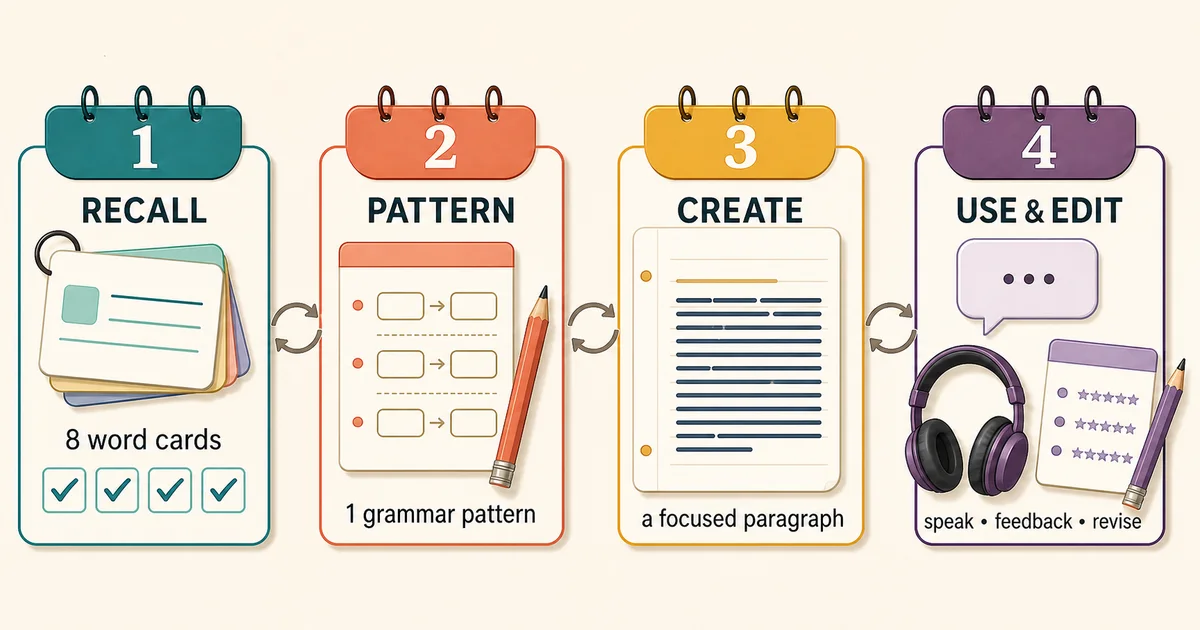
Praticar um pouco com regularidade é mais útil do que ler regras de vez em quando. Este ciclo de quatro semanas dá a mesma atenção à gramática e ao vocabulário.
| Semana | Foco de gramática | Foco de vocabulário | Tarefa ativa |
|---|---|---|---|
| 1 | hedging e modalidade | certeza, evidência e avaliação | escrever uma opinião equilibrada de 150 palavras |
| 2 | inversão e frases clivadas | colocações de contraste e ênfase | gravar a abertura de uma apresentação de dois minutos |
| 3 | condicionais mistos e concessões | mudança, risco e consequências | reescrever um parágrafo básico usando conectores precisos |
| 4 | cláusulas de particípio e edição | revisar as palavras que ainda precisa dominar | editar um texto antigo e explicar cada mudança |
Em cada dia de estudo, passe dez minutos relembrando um pequeno conjunto de vocabulário no Linglify, dez minutos estudando um padrão gramatical e dez minutos produzindo linguagem. Você pode escrever uma mensagem ou um parágrafo, gravar uma nota de voz ou responder a uma pergunta. O importante é perceber se a escolha gramatical muda o significado que você queria transmitir.
Erros Comuns de Estudantes Avançados
- Usar todos os padrões de frases ao mesmo tempo. Escolha uma estrutura para um propósito comunicativo.
- Tratar formal e avançado como a mesma coisa. Uma palavra pode ser avançada mas ainda soar errada num contexto informal.
- Memorizar uma regra sem produzi-la. Após estudar um padrão, escreva ou diga três frases verdadeiras para você.
- Ignorar colocações. Aprenda pose a risk, não apenas pose; aprenda substantial evidence, não apenas substantial.
- Corrigir apenas a gramática. Depois de editar uma frase, pergunte também se um verbo, substantivo ou conector mais preciso melhoraria a ideia.
Vocabulário para Praticar
Adicione ao Linglify um conjunto avançado e seletivo. Depois, use-o com um dos padrões gramaticais deste guia em uma resposta curta e significativa.
alleviate
verbo
aliviar, amenizar
Exemplos
- Government programs aim to alleviate poverty in rural communities.
- The medication will alleviate pain and reduce inflammation significantly.
ambiguous
adjetivo
ambíguo, duvidoso, incerto
Exemplos
- The politician's ambiguous statement confused voters about his actual position.
- The test question was ambiguous and could be interpreted in multiple ways.
coherent
adjetivo
coerente
Exemplos
- After the accident, he wasn't coherent enough to answer police questions.
- The professor gave a coherent explanation of the complex scientific theory.
concede
verbo
conceder, admitir
Exemplos
- He had to concede that his opponent made some valid points during the debate.
- The candidate decided to concede defeat after losing the election clearly.
tycoon
substantivo
magnata
Exemplos
- Media tycoon owns newspapers and television stations worldwide.
- Oil tycoon donated millions to educational and charitable causes.
detest
verbo
detestar, odiar
Exemplos
- Many people detest the sound of nails scratching on chalkboard.
- She absolutely detests dishonesty and deception in any form.
portrayal
substantivo
retrato
Exemplos
- Critic praised actor's nuanced portrayal of troubled protagonist.
- Film's portrayal of war emphasizes human cost over glory.
fury
substantivo
fúria, raiva, indignação
Exemplos
- His fury was evident after hearing the news.
- She lost her fury when she saw the damage.
grumpy
adjetivo
rabugento, mal-humorado
Exemplos
- His grumpy attitude made it hard to work with him.
- She looked grumpy after waking up late.
superficial
adjetivo
superficial, fútil
Exemplos
- His knowledge of the subject was superficial and incomplete.
- The wound appeared serious but was actually quite superficial.
impeccable
adjetivo
impecável, perfeito
Exemplos
- Hotel provides impeccable service ensuring guest satisfaction and comfort.
- Professional maintains impeccable reputation for honesty and integrity.
precaution
substantivo
precaução, advertência, medida
Exemplos
- Take the necessary precautions before starting.
- Wearing a helmet is a safety precaution.
insular
adjetivo
insular, fechado
Exemplos
- His insular thinking prevents him from considering alternative perspectives.
- Insular community rarely interacts with outside world effectively.
plausible
adjetivo
plausível, provável, crível
Exemplos
- His explanation sounds plausible but lacks supporting evidence.
- Scientists seek plausible theories to explain observed phenomena.
reconstruction
substantivo
reconstrução, restauro
Exemplos
- Historical reconstruction helps us understand the past.
- The reconstruction of the building took two years.
enterprising
adjetivo
empreendedor
Exemplos
- Enterprising entrepreneur identified market gap and created innovative solution.
- Enterprising students organize fundraising events for school improvement projects.
substantial
adjetivo
substancial, considerável, importante
Exemplos
- Substantial improvement shows in student test scores.
- Substantial investment creates new business opportunities today.
subtle
adjetivo
sutil, delicado, discreto
Exemplos
- Subtle flavor enhances dish without overpowering taste.
- Subtle hint suggests solution without direct statement.
verify
verbo
verificar, confirmar, checar
Exemplos
- Please verify the information before publishing.
- They need to verify the results of the experiment.
occupant
substantivo
morador, ocupante
Exemplos
- Building occupant reported strange noises during night hours.
- Car crash injured both driver and passenger occupants.
tell sb/sth apart
phrasal verb
diferenciar
Exemplos
- It's hard to tell the twins apart.
- Can you tell the difference between these two paintings?
O Que Fazer a Seguir
- Construa uma base C1 na biblioteca de vocabulário C1, depois avance para a biblioteca C2.
- Use Vocabulário C2 de Proficiência para aprender palavras precisas e nuances da língua.
- Pratique expressões avançadas e naturais com Colocações Avançadas em Inglês.
- Retome Gramática e Vocabulário B2 se alguma estrutura básica ainda não estiver firme.
Perguntas Frequentes
A gramática C1–C2 é principalmente sobre regras difíceis?
Não. Trata-se principalmente de escolha e controle. Primeiro, você precisa conhecer bem a gramática para se expressar com precisão; depois, padrões avançados ajudam a indicar ênfase, distanciamento, condições, contraste e relações mais precisas entre as ideias.
Posso alcançar C2 memorizando listas de vocabulário avançado?
Listas de vocabulário ajudam, mas não são suficientes. O C2 exige uso flexível: escolher o registro certo, formar colocações naturais e combinar vocabulário com gramática precisa em situações reais de leitura, escrita, compreensão oral e fala.
O que devo estudar primeiro: gramática C1 ou vocabulário C2?
Estude os dois juntos, mas comece pelo seu ponto mais fraco. Se a gramática deixa sua escrita pouco clara, escolha um padrão gramatical e um pequeno grupo de palavras para praticá-lo. Se suas frases estão corretas, mas são repetitivas, concentre-se em verbos, substantivos e colocações mais precisos.
Este guia substitui um livro didático de C1–C2?
É um guia de estudo online independente, não uma cópia nem um substituto de um livro específico. Use-o como um roteiro estruturado de prática, junto com qualquer curso, professor ou material de preparação para exames que você já utilize.
Com que frequência devo praticar gramática avançada?
Três sessões curtas por semana são suficientes se cada uma incluir produção e revisão. Escrever, falar e revisar regularmente usando um padrão é mais eficaz do que ler muitas regras uma vez por mês.