
Vocabulário C2 de Proficiência: Dominando as Nuances do Inglês
O vocabulário de proficiência C2 não é uma lista de palavras obscuras para usar em toda parte. No nível mais alto do CEFR, você precisa entender distinções sutis, ajustar o registro e escolher palavras que expressem exatamente o grau de certeza, crítica, cautela ou diplomacia desejado. A mesma ideia pode exigir uma frase direta numa reunião, uma afirmação ponderada em um ensaio ou uma explicação acolhedora numa conversa.
Este guia organiza vocabulário avançado por objetivo comunicativo. As palavras e estruturas são úteis para leitura analítica, escrita formal, apresentações, negociações e discussões complexas. Use a biblioteca de vocabulário C2 para transformar uma pequena seleção em vocabulário ativo, em vez de tentar soar avançado em todas as frases.
- Nível: C2 de proficiência, com uma ponte a partir do C1 sólido
- Foco: nuance, evidência, avaliação, argumento e tom preciso
- Ideal para: estudantes avançados, estudo universitário, trabalho exigente e exames de alto nível
- Objetivo de estudo: escolher a palavra, a colocação e o registro exatos para cada situação
Se sua base C1 ainda não está bem consolidada, comece com Vocabulário C1 de Inglês. O C2 funciona melhor quando você já consegue recuperar com facilidade o vocabulário avançado mais familiar.
O Que o Vocabulário C2 Realmente Significa
No C2, o domínio do vocabulário tem quatro componentes:
| Habilidade | Versão básica | Versão C2 com maior domínio |
|---|---|---|
| grau | The effect was big. | The effect was substantial, but not uniform. |
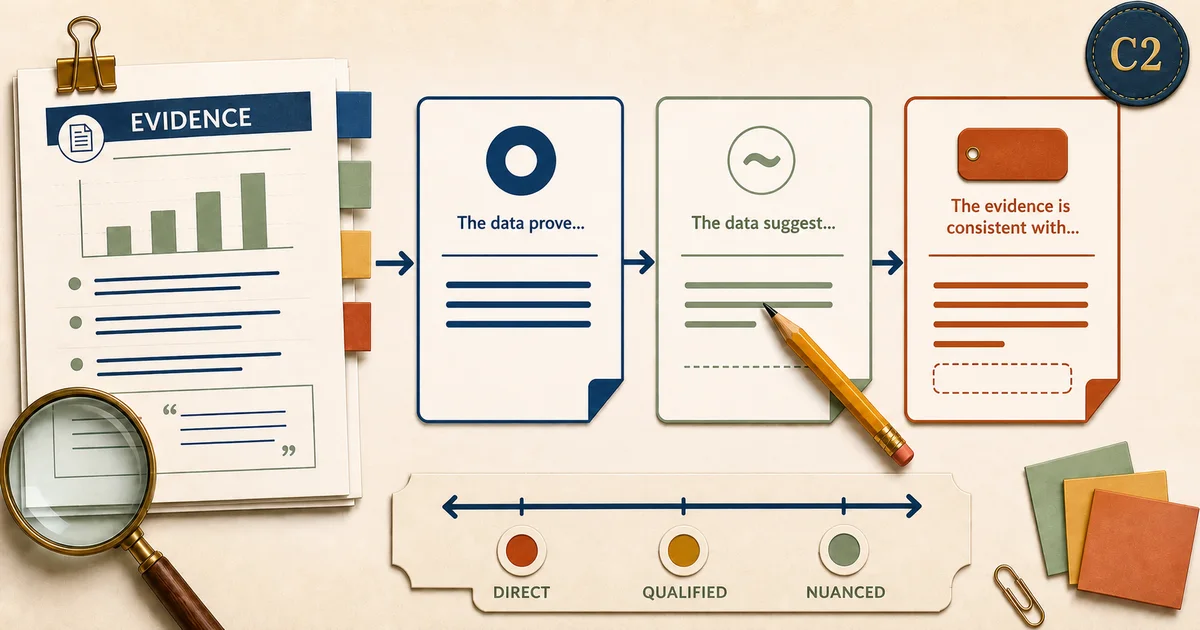
| certeza | This is true. | The evidence strongly suggests this, although it is not conclusive. |
| avaliação | The plan is bad. | The plan is impractical and may prove counterproductive. |
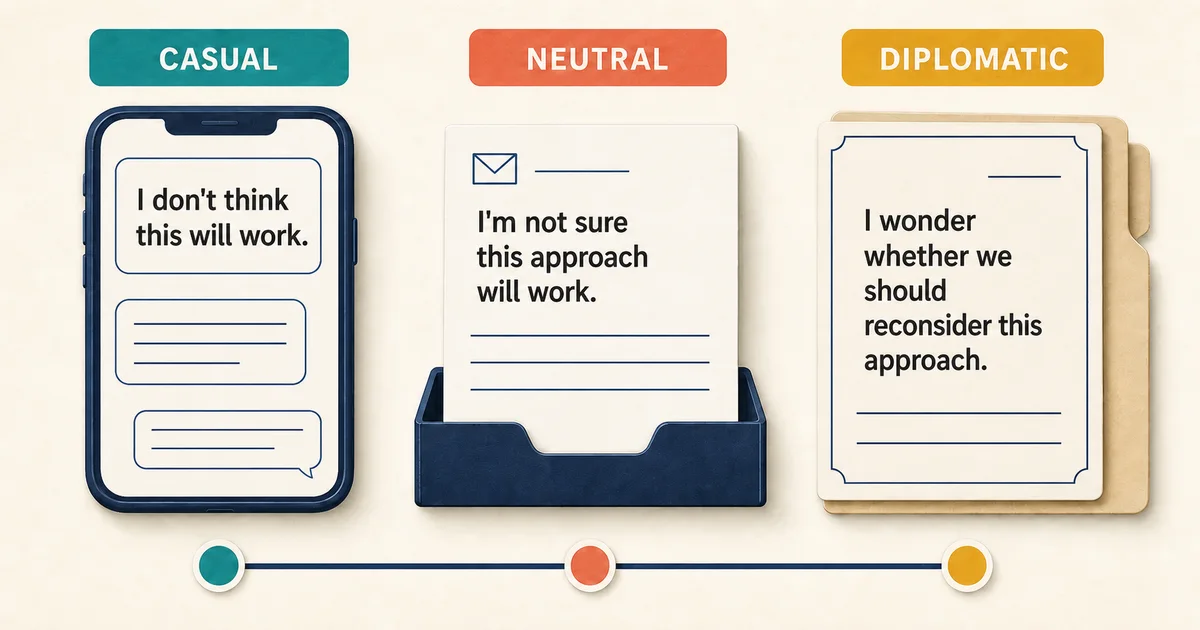
| tom | You are wrong. | I see the point, but I would challenge the assumption. |
A coluna da direita não é “melhor” por ser mais longa. Ela é melhor quando a situação exige essa precisão extra. Quem domina o C2 consegue percorrer essa escala de propósito: usar linguagem simples quando a clareza importa, formal quando o contexto pede e matizada quando as evidências são ambíguas.
Uma regra útil: não aprenda uma palavra C2 até conseguir explicar quando não usá-la. Meticulous é excelente para pesquisas cuidadosas ou trabalhos detalhados; soa pouco natural em uma mensagem rápida sobre o que escolher para o almoço. O registro também faz parte do conhecimento de uma palavra.
Qualifique Ideias Sem Se Tornar Vago
Falantes e escritores cuidadosos precisam de maneiras de expressar diferentes graus de certeza. Estas palavras ajudam a evitar afirmações absolutas quando os fatos são mais complexos.
| Palavra ou frase | Significado | Frase natural | Exemplo |
|---|---|---|---|
| apparently | de acordo com o que parece verdadeiro | apparently minor | The change was apparently minor but affected many users. |
| arguably | pode razoavelmente ser afirmado | arguably the best | This is arguably the most practical option. |
| inherently | como parte natural de algo | inherently difficult | The task is inherently difficult, not impossible. |
| ostensibly | aparecendo ou afirmando ser de certa forma | ostensibly simple | The rule is ostensibly simple but hard to apply. |
| presumably | acredita-se ser verdade, embora não certo | presumably aware | They were presumably aware of the risk. |
| relatively | comparado com outra coisa | relatively limited | The evidence is relatively limited so far. |
| seemingly | parecendo ser verdade | seemingly unrelated | Two seemingly unrelated events may share a cause. |
| tentative | não final ou certo | tentative conclusion | We can draw only a tentative conclusion. |
| unprecedented | nunca conhecido ou feito antes | unprecedented demand | The service faced unprecedented demand. |
| virtually | quase completamente | virtually impossible | Without access, the task is virtually impossible. |
A atenuação (hedging) não é sinal de fraqueza. Ela mostra que você consegue ajustar a força de uma afirmação à força das evidências. Na escrita formal, arguably, relatively e tentative muitas vezes tornam o argumento mais convincente do que uma afirmação confiante, mas sem sustentação.
Analise Evidências e Relações Complexas
Estas palavras são úteis quando você precisa ir além de “isto causou aquilo”. Elas ajudam a descrever padrões, sustentar uma afirmação e identificar uma conexão oculta.
| Palavra | Significado | Frase natural | Exemplo |
|---|---|---|---|
| attribute | dizer que algo é causado por algo | attribute success to | The team attributes its success to clear priorities. |
| corroborate | fornecer informações que apoiam uma afirmação | corroborate the findings | A second survey corroborates the findings. |
| discern | reconhecer algo que não é óbvio | discern a trend | It is difficult to discern a trend in one week of data. |
| discrepancy | uma diferença que não deveria existir | a discrepancy between | We found a discrepancy between the two figures. |
| implication | um possível efeito ou significado | far-reaching implications | The decision has far-reaching implications. |
| inference | uma conclusão baseada em evidências | draw an inference | We should not draw an inference from one case. |
| premise | uma ideia usada como base de um argumento | a flawed premise | The proposal rests on a flawed premise. |
| rationale | a razão ou lógica por trás de uma decisão | the rationale for | Please explain the rationale for the change. |
| substantiate | apoiar com evidências | substantiate a claim | The author fails to substantiate the claim. |
| underlying | que existe por trás do que é visível | an underlying cause | We need to address the underlying cause, not only the result. |
Experimente construir uma cadeia de evidências: “The data suggest a discrepancy. Before we draw an inference, we need to identify the underlying cause and substantiate the conclusion.” Cadeias assim são mais úteis do que aprender um grupo de substantivos avançados separadamente.
Avalie Opções e Antecipe Consequências
O vocabulário C2 costuma ajudar a avaliar um plano sem simplificar demais. O objetivo é descrever as vantagens e desvantagens com precisão.
| Palavra | Significado | Frase natural | Exemplo |
|---|---|---|---|
| beneficial | que produz um efeito positivo | mutually beneficial | The partnership could be mutually beneficial. |
| counterproductive | que produz o efeito oposto ao pretendido | prove counterproductive | Constant reminders may prove counterproductive. |
| detrimental | causando dano | detrimental to trust | The delay was detrimental to public trust. |
| feasible | possível e prático | financially feasible | Is the project financially feasible? |
| futile | incapaz de alcançar um resultado útil | a futile attempt | Without agreement, further discussion is futile. |
| indispensable | completamente necessário | an indispensable role | Clear feedback plays an indispensable role in learning. |
| marginal | pequeno ou não muito importante | marginal improvement | The update produced only a marginal improvement. |
| pragmatic | prático e realista | a pragmatic compromise | We reached a pragmatic compromise. |
| sustainable | capaz de continuar a longo prazo | sustainable solution | A sustainable solution must fit the team’s capacity. |
| viable | capaz de funcionar com sucesso | commercially viable | The plan is not commercially viable yet. |
Feasible, viable e sustainable formam um trio C2 útil. Uma solução pode ser feasible neste mês, viable no próximo ano e sustainable por muitos anos. Escolher o termo certo mostra ao interlocutor exatamente qual critério você está aplicando.
Discorde, Conceda e Negocie com Precisão
Na comunicação avançada, muitas vezes é preciso responder à ideia de outra pessoa sem tornar a discussão pessoal. Estas estruturas ajudam a discordar com respeito e fazer a conversa avançar.
| Padrão | Propósito | Exemplo |
|---|---|---|
| I concede that … | aceitar uma parte de um ponto de vista oposto | I concede that the first option is faster. |
| That said, … | introduzir um ponto contrastante | That said, it may create a larger problem later. |
| I would question whether … | desafiar uma suposição educadamente | I would question whether the evidence is strong enough. |
| The caveat is that … | declarar um limite importante | The caveat is that the sample is very small. |
| We should distinguish between … | separar duas ideias que estão sendo confundidas | We should distinguish between cost and value. |
| It would be premature to … | dizer que ainda é cedo para agir | It would be premature to announce a result. |
| The proposal warrants … | dizer que merece atenção | The proposal warrants further discussion. |
| There is scope for … | dizer que melhoria é possível | There is scope for improvement in the process. |
| The priority should be … | indicar a ação mais importante | The priority should be to protect users. |
| Weigh up the trade-offs | comparar vantagens e desvantagens | We need to weigh up the trade-offs carefully. |
Estas estruturas são formais o bastante para um seminário, relatório ou reunião, mas não são frases vazias. Use cada uma somente quando puder explicar o raciocínio que vem em seguida. Uma resposta C2 exige tanto linguagem sofisticada quanto uma ideia clara.
Descreva Processo, Mudança e Distinções Finas
Trabalhos complexos costumam envolver mudanças graduais, não apenas sucesso ou fracasso. Estas palavras ajudam a descrevê-las com precisão.
| Palavra | Significado | Frase natural | Exemplo |
|---|---|---|---|
| alleviate | tornar um problema menos grave | alleviate a burden | The new tool should alleviate the administrative burden. |
| consolidate | combinar ou tornar mais forte | consolidate gains | The team needs time to consolidate its gains. |
| deteriorate | tornar-se pior | deteriorate rapidly | Conditions deteriorated rapidly after the outage. |
| exacerbate | piorar um problema | exacerbate inequality | The policy may exacerbate inequality. |
| fluctuate | subir e cair irregularmente | fluctuate considerably | Prices fluctuate considerably during the year. |
| gradual | acontecendo lentamente ao longo do tempo | gradual shift | We observed a gradual shift in behaviour. |
| pervasive | que se espalha por muitas áreas | pervasive influence | Social media has a pervasive influence on language. |
| preliminary | vindo antes de uma versão final | preliminary results | These are preliminary results, not final findings. |
| reconcile | encontrar uma forma de fazer duas coisas concordar | reconcile two aims | We must reconcile speed with accuracy. |
| subtle | sutil, mas importante ou difícil de perceber | subtle distinction | There is a subtle distinction between the terms. |
Preste atenção à forma das palavras. Subtle é um adjetivo, enquanto subtly descreve como algo acontece. O domínio C2 inclui flexionar as palavras corretamente: “The policy subtly changed expectations.”
Incorpore Vocabulário C2 em um Sistema Confiável
Neste nível, uma longa lista em ordem alfabética raramente é eficiente. Organize o vocabulário em torno de funções às quais você sempre volta: avaliar evidências, ponderar uma afirmação, discordar diplomaticamente ou descrever mudanças. Cada sessão de estudo deve gerar uma pequena produção, como um parágrafo, uma resposta curta para uma apresentação ou um resumo de um artigo complexo.
Use esta rotina de 20 minutos duas ou três vezes por semana:
- Escolha seis palavras de um grupo funcional e leia as frases de exemplo em voz alta.
- Escreva uma resposta curta a uma pergunta que exige uma opinião equilibrada. Use apenas duas ou três palavras-alvo; a precisão importa mais do que a quantidade.
- Reformule a resposta para um público diferente: um colega, um tutor ou um amigo. Decida quais palavras ficam e quais se tornam muito formais.
- Revise as palavras no Linglify nos dias seguintes. Quando uma palavra soar natural em um novo contexto, passe para a próxima; se ainda parecer forçada, mantenha-a no vocabulário de reconhecimento.
Para aprender colocações avançadas que dão naturalidade a essas palavras, leia Colocações Avançadas em Inglês. Para seguir um plano parecido com um curso que combine gramática e vocabulário, continue com Gramática e Vocabulário C1–C2.
Vocabulário para Praticar
Adicione ao Linglify um conjunto selecionado de palavras C2. Revise os cartões e depois formule um argumento ou uma recomendação cuidadosa usando apenas as palavras que realmente se encaixam.
alleviate
verbo
aliviar, amenizar
Exemplos
- Government programs aim to alleviate poverty in rural communities.
- The medication will alleviate pain and reduce inflammation significantly.
tycoon
substantivo
magnata
Exemplos
- Media tycoon owns newspapers and television stations worldwide.
- Oil tycoon donated millions to educational and charitable causes.
detest
verbo
detestar, odiar
Exemplos
- Many people detest the sound of nails scratching on chalkboard.
- She absolutely detests dishonesty and deception in any form.
portrayal
substantivo
retrato
Exemplos
- Critic praised actor's nuanced portrayal of troubled protagonist.
- Film's portrayal of war emphasizes human cost over glory.
fury
substantivo
fúria, raiva, indignação
Exemplos
- His fury was evident after hearing the news.
- She lost her fury when she saw the damage.
grumpy
adjetivo
rabugento, mal-humorado
Exemplos
- His grumpy attitude made it hard to work with him.
- She looked grumpy after waking up late.
superficial
adjetivo
superficial, fútil
Exemplos
- His knowledge of the subject was superficial and incomplete.
- The wound appeared serious but was actually quite superficial.
impeccable
adjetivo
impecável, perfeito
Exemplos
- Hotel provides impeccable service ensuring guest satisfaction and comfort.
- Professional maintains impeccable reputation for honesty and integrity.
precaution
substantivo
precaução, advertência, medida
Exemplos
- Take the necessary precautions before starting.
- Wearing a helmet is a safety precaution.
insular
adjetivo
insular, fechado
Exemplos
- His insular thinking prevents him from considering alternative perspectives.
- Insular community rarely interacts with outside world effectively.
plausible
adjetivo
plausível, provável, crível
Exemplos
- His explanation sounds plausible but lacks supporting evidence.
- Scientists seek plausible theories to explain observed phenomena.
reconstruction
substantivo
reconstrução, restauro
Exemplos
- Historical reconstruction helps us understand the past.
- The reconstruction of the building took two years.
enterprising
adjetivo
empreendedor
Exemplos
- Enterprising entrepreneur identified market gap and created innovative solution.
- Enterprising students organize fundraising events for school improvement projects.
subtle
adjetivo
sutil, delicado, discreto
Exemplos
- Subtle flavor enhances dish without overpowering taste.
- Subtle hint suggests solution without direct statement.
verify
verbo
verificar, confirmar, checar
Exemplos
- Please verify the information before publishing.
- They need to verify the results of the experiment.
occupant
substantivo
morador, ocupante
Exemplos
- Building occupant reported strange noises during night hours.
- Car crash injured both driver and passenger occupants.
tell sb/sth apart
phrasal verb
diferenciar
Exemplos
- It's hard to tell the twins apart.
- Can you tell the difference between these two paintings?
concede
verbo
conceder, admitir
Exemplos
- He had to concede that his opponent made some valid points during the debate.
- The candidate decided to concede defeat after losing the election clearly.
coherent
adjetivo
coerente
Exemplos
- After the accident, he wasn't coherent enough to answer police questions.
- The professor gave a coherent explanation of the complex scientific theory.
substantial
adjetivo
substancial, considerável, importante
Exemplos
- Substantial improvement shows in student test scores.
- Substantial investment creates new business opportunities today.
inevitable
adjetivo
inevitável
Exemplos
- Change is inevitable in life, and we must learn to adapt.
- The inevitable result of poor planning is confusion and failure.
O Que Fazer a Seguir
- Pratique um pequeno conjunto C2 na biblioteca de vocabulário C2.
- Revise Palavras Desconhecidas em Inglês se precisar de uma ponte mais clara entre reconhecer uma palavra e usá-la ativamente.
- Combine seu estudo de vocabulário com Gramática e Vocabulário C1–C2.
- Use Colocações em Inglês em Uso para manter palavras avançadas conectadas a expressões naturais.
Perguntas Frequentes
Quantas palavras preciso para o inglês C2?
Não existe um número mágico único. O C2 é definido mais pelo uso flexível e preciso do que pela contagem de palavras: é preciso compreender uma ampla variedade de vocabulário e escolher rapidamente as palavras exatas em diferentes temas e registros.
Palavras raras são necessárias para a proficiência C2?
Geralmente não. Você precisa entender algumas palavras raras em contexto, mas a linguagem C2 ativa é frequentemente feita de palavras avançadas comuns, colocações precisas e forte controle de nuance.
Como posso tornar meu inglês mais matizado?
Pratique os graus de certeza e as ressalvas: compare always com generally, proves com suggests e bad com uma avaliação precisa, como counterproductive ou detrimental. Depois, verifique se a palavra mais forte realmente muda o significado.
O vocabulário C2 serve apenas para a escrita formal?
Não. Quem domina o C2 consegue ajustar o vocabulário a situações informais, profissionais e acadêmicas. A habilidade está em saber quando uma palavra formal traz clareza e quando uma expressão simples soa mais acolhedora e natural.
Como devo revisar palavras avançadas?
Use repetição espaçada, mas também pratique a produção: escreva um argumento curto, resuma um artigo ou explique uma escolha difícil em voz alta. Reutilize cada palavra em um contexto novo, em vez de memorizar para sempre o exemplo original.