
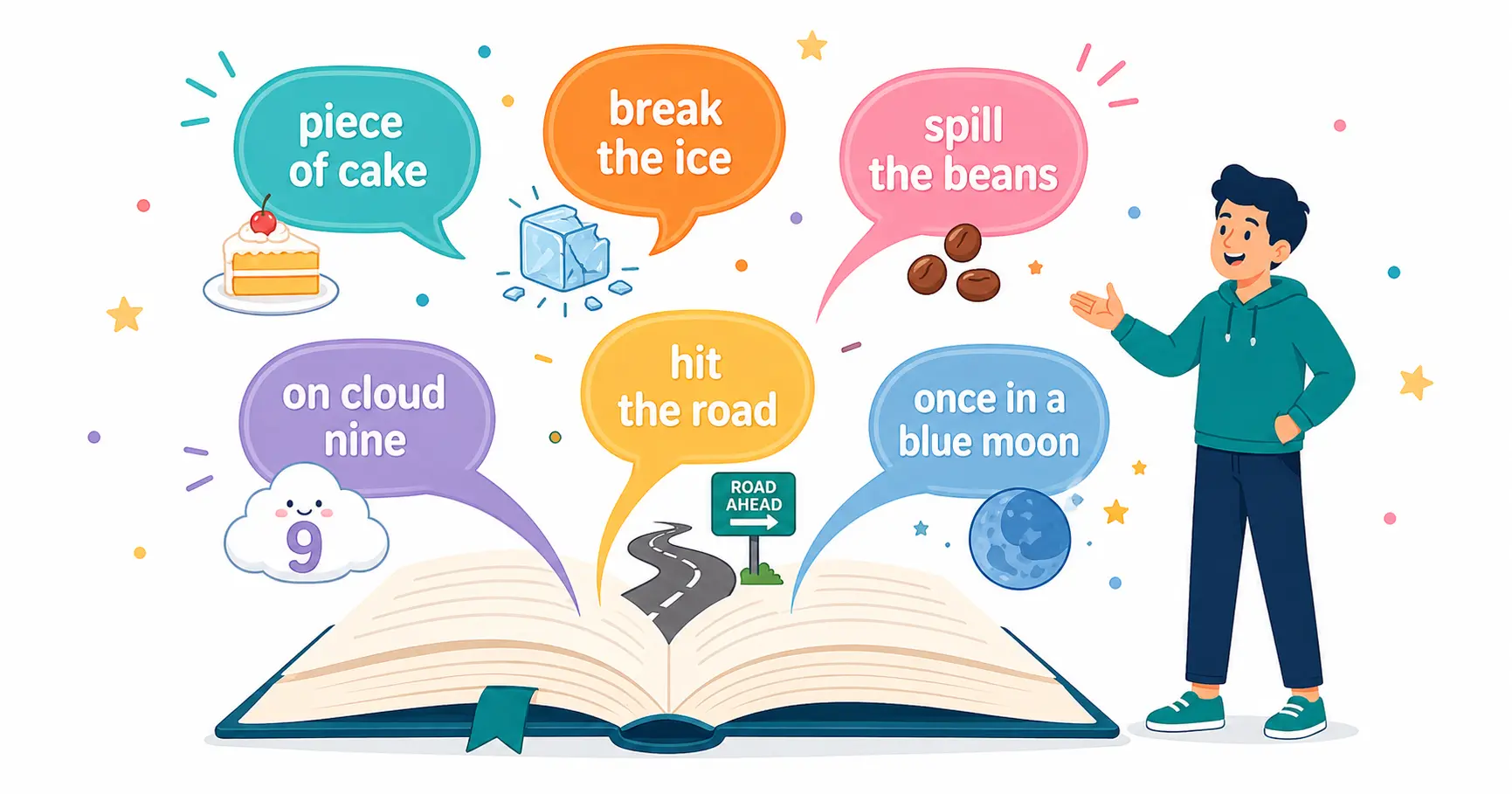
Expressões Idiomáticas em Inglês: 500+ Expressões Comuns com Significados e Exemplos
Todo idioma tem expressões que não fazem sentido se você as traduzir literalmente. O inglês tem milhares. “It’s raining cats and dogs” não tem nada a ver com animais. “Break a leg” não é uma ameaça — significa “boa sorte.” “Spill the beans” não é sobre comida — significa revelar um segredo.
Essas expressões são chamadas de expressões idiomáticas (idioms), e estão em todo lugar no inglês — em conversas, filmes, músicas, notícias, negócios e literatura. Falantes nativos as usam tão naturalmente que raramente percebem que são expressões idiomáticas. Para quem está aprendendo, porém, elas são um dos maiores obstáculos à fluência. Você pode ter gramática perfeita, vocabulário amplo e pronúncia clara e, ainda assim, não entender metade das frases que ouve por causa dos idioms.
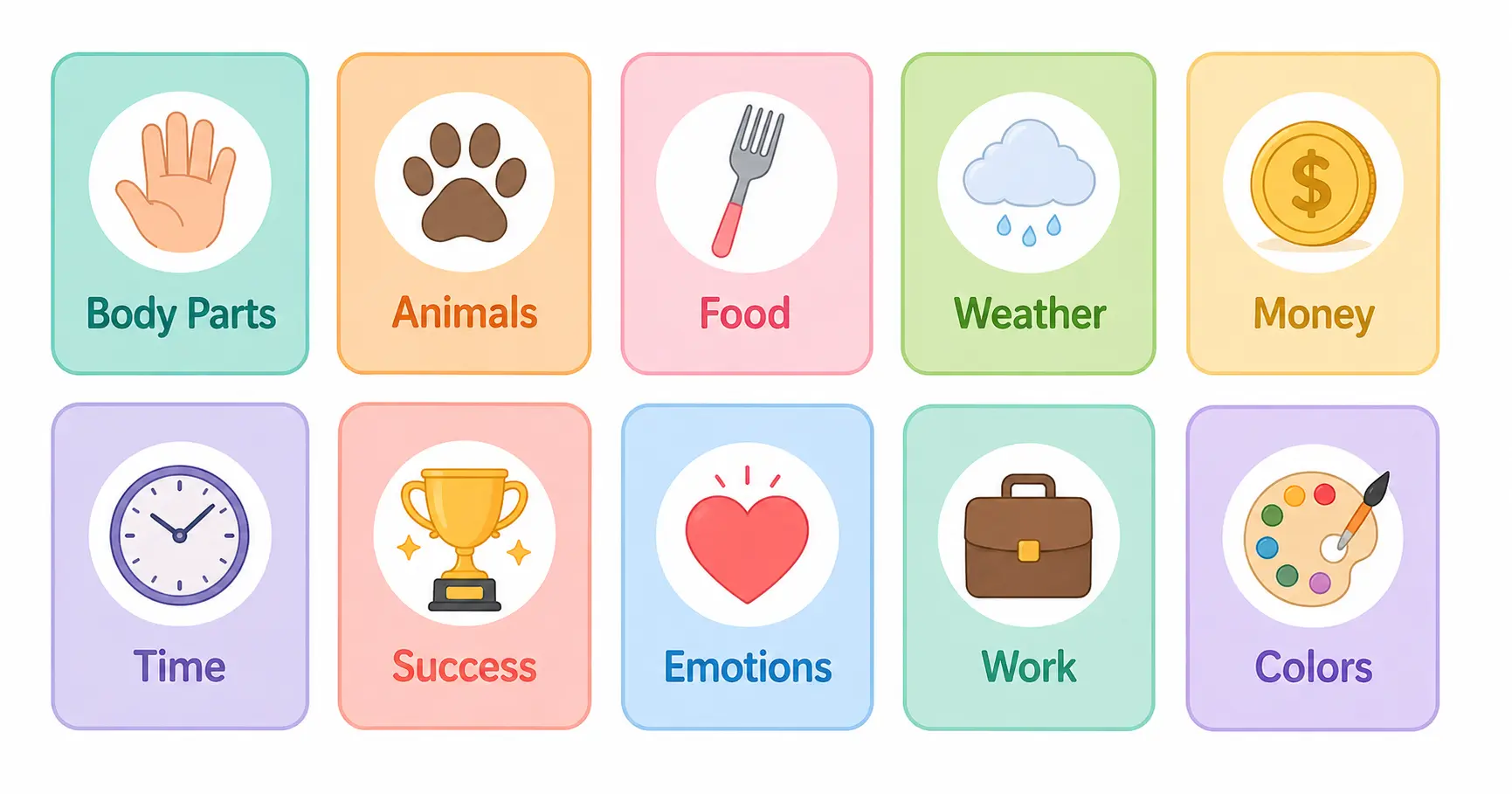
Este guia reúne mais de 500 das expressões idiomáticas mais comuns do inglês, organizadas por tema para que você as aprenda em grupos relacionados. Cada expressão inclui um significado claro e uma frase de exemplo natural. Seja para se preparar para o IELTS, estudar para uma graduação ou simplesmente entender como os falantes nativos realmente usam o inglês, este é o guia de referência de que você precisa.
- Total de expressões: 500+
- Organizado por: 20 categorias temáticas
- Nível: A2–C2
- Ideal para: fluência geral, preparação para IELTS/TOEFL, compreensão de falantes nativos e conversas do dia a dia
O Que É uma Expressão Idiomática?
Uma expressão idiomática é uma expressão fixa cujo significado não pode ser entendido pelas palavras individuais. A característica principal: a frase inteira significa algo diferente de suas partes.
| Expressão | Significado Literal | Significado Real (Idiomático) |
|---|---|---|
| break the ice | quebrar o gelo congelado | iniciar uma conversa numa situação constrangedora |
| hit the nail on the head | acertar um prego com um martelo | estar exatamente certo sobre algo |
| under the weather | abaixo do clima | sentindo-se ligeiramente mal |
| piece of cake | uma porção de bolo | algo muito fácil |
Expressões Idiomáticas vs. Phrasal Verbs vs. Colocações
Essas três categorias se sobrepõem, o que causa confusão. Veja a diferença:
| Categoria | Definição | Exemplo |
|---|---|---|
| Expressão idiomática | expressão fixa com significado não literal | kick the bucket (= morrer) |
| Phrasal verb | verbo + partícula com um novo significado | give up (= desistir) |
| Colocação | combinação habitual de palavras | make a decision (e não do a decision) |
Alguns phrasal verbs têm sentido idiomático (come across = encontrar por acaso), e algumas expressões idiomáticas incluem phrasal verbs (give someone the cold shoulder). As fronteiras entre essas categorias não são muito nítidas — o importante é aprender as expressões em si.
Para conhecer o guia completo, veja phrasal verbs em inglês.
Partes do Corpo
Expressões idiomáticas relacionadas ao corpo estão entre as mais antigas e universais do inglês. Muitas têm equivalentes parecidos em outros idiomas.
| # | Expressão | Significado | Exemplo |
|---|---|---|---|
| 1 | keep an eye on | vigiar cuidadosamente | Keep an eye on the soup — don’t let it boil over. |
| 2 | turn a blind eye | ignorar deliberadamente | The manager turned a blind eye to the late arrivals. |
| 3 | see eye to eye | concordar completamente | We don’t always see eye to eye, but we respect each other. |
| 4 | in the blink of an eye | muito rapidamente | The accident happened in the blink of an eye. |
| 5 | catch someone’s eye | atrair atenção | The red dress in the window caught my eye. |
| 6 | play it by ear | improvisar; decidir conforme acontece | I don’t have a plan — let’s just play it by ear. |
| 7 | turn a deaf ear | recusar-se a ouvir | He turned a deaf ear to all our warnings. |
| 8 | keep your chin up | manter-se positivo | I know things are tough, but keep your chin up. |
| 9 | bite your tongue | se impedir de dizer algo | I wanted to argue, but I bit my tongue. |
| 10 | on the tip of my tongue | quase conseguindo lembrar | His name is on the tip of my tongue — give me a second. |
| 11 | by the skin of your teeth | por pouco | We passed the exam by the skin of our teeth. |
| 12 | give someone the cold shoulder | ignorar alguém deliberadamente | After the argument, she gave me the cold shoulder for a week. |
| 13 | cost an arm and a leg | ser muito caro | That car repair cost an arm and a leg. |
| 14 | get something off your chest | falar sobre algo que incomodava | I need to get this off my chest — I lied about the deadline. |
| 15 | have a heart of gold | ser muito gentil e generoso | She has a heart of gold — she’d help anyone. |
| 16 | stab someone in the back | trair alguém | He stabbed me in the back by telling the boss about my mistake. |
| 17 | break someone’s heart | deixar alguém muito triste, geralmente em um contexto romântico | Leaving the country broke his mother’s heart. |
| 18 | get cold feet | ficar nervoso e hesitante | She got cold feet the night before the wedding. |
| 19 | put your foot in your mouth | dizer algo embaraçoso por acidente | I put my foot in my mouth when I asked about her ex. |
| 20 | have butterflies in your stomach | sentir-se nervoso | I always have butterflies in my stomach before presentations. |
| 21 | a pain in the neck | uma pessoa ou coisa irritante | This paperwork is a real pain in the neck. |
| 22 | keep your fingers crossed | torcer pela boa sorte | Keep your fingers crossed — the results come out tomorrow. |
| 23 | point the finger at | culpar alguém | Don’t point the finger at me — it wasn’t my fault. |
| 24 | pull someone’s leg | brincar com alguém | Are you serious, or are you pulling my leg? |
| 25 | give a hand | ajudar | Could you give me a hand with these boxes? |
| 26 | an old hand | uma pessoa experiente | She’s an old hand at negotiations — she’s been doing it for 20 years. |
| 27 | wash your hands of | recusar-se a assumir responsabilidade | After years of trying, he washed his hands of the project. |
| 28 | the apple of someone’s eye | a pessoa favorita de alguém | Their youngest daughter is the apple of their eye. |
| 29 | a head start | uma vantagem inicial | Being bilingual gave her a head start in her career. |
| 30 | head over heels | profundamente apaixonado | He fell head over heels for her on the first date. |
Animais
Expressões idiomáticas com animais são vívidas e fáceis de lembrar justamente por criarem imagens marcantes.
| # | Expressão | Significado | Exemplo |
|---|---|---|---|
| 31 | let the cat out of the bag | revelar um segredo acidentalmente | I was planning a surprise party, but Tom let the cat out of the bag. |
| 32 | raining cats and dogs | chovendo muito forte | Take an umbrella — it’s raining cats and dogs outside. |
| 33 | the elephant in the room | problema óbvio que ninguém quer discutir | Nobody mentioned the budget cut — it was the elephant in the room. |
| 34 | kill two birds with one stone | conseguir duas coisas com uma ação | By cycling to work, I kill two birds with one stone — exercise and transportation. |
| 35 | a little bird told me | alguém me contou (mas não direi quem) | A little bird told me you’re getting promoted. |
| 36 | the early bird catches the worm | o sucesso vem para quem começa cedo | I always arrive at the office at 7 AM — the early bird catches the worm. |
| 37 | when pigs fly | nunca (algo impossível) | He’ll clean his room when pigs fly. |
| 38 | hold your horses | espere; tenha paciência | Hold your horses — we haven’t even started yet. |
| 39 | straight from the horse’s mouth | diretamente da fonte original | I heard the news straight from the horse’s mouth — the CEO told me herself. |
| 40 | a wild goose chase | uma busca sem sentido | Looking for that document was a wild goose chase — it never existed. |
| 41 | monkey around | fazer bobagem; brincar sem seriedade | Stop monkeying around and finish your homework. |
| 42 | have a whale of a time | se divertir enormemente | We had a whale of a time at the festival. |
| 43 | the black sheep | o diferente numa família ou grupo | He’s the black sheep of the family — the only one who didn’t go to university. |
| 44 | a fish out of water | alguém desconfortável no seu ambiente | At the fashion show, I felt like a fish out of water. |
| 45 | open a can of worms | criar novos problemas | If you bring up the budget, you’ll open a whole can of worms. |
| 46 | take the bull by the horns | enfrentar uma situação difícil corajosamente | Instead of avoiding the problem, she took the bull by the horns. |
| 47 | have ants in your pants | não conseguir ficar parado | The kids have ants in their pants today — they can’t focus at all. |
| 48 | the lion’s share | a maior parte | The lion’s share of the budget goes to marketing. |
| 49 | a wolf in sheep’s clothing | alguém que parece inofensivo, mas é perigoso | Be careful with that salesman — he’s a wolf in sheep’s clothing. |
| 50 | every dog has its day | todo mundo tem sua chance | Don’t worry about losing today — every dog has its day. |
Comida e Bebida
| # | Expressão | Significado | Exemplo |
|---|---|---|---|
| 51 | a piece of cake | algo muito fácil | The exam was a piece of cake — I finished in 30 minutes. |
| 52 | spill the beans | revelar um segredo | Come on, spill the beans — what did she say? |
| 53 | have your cake and eat it too | querer duas coisas incompatíveis ao mesmo tempo | You can’t work part-time and earn a full salary — you can’t have your cake and eat it too. |
| 54 | go bananas | ficar louco ou muito animado | The crowd went bananas when the band came on stage. |
| 55 | bring home the bacon | sustentar a família com a própria renda | Both parents bring home the bacon in most families today. |
| 56 | butter someone up | bajular alguém para conseguir algo | He’s just buttering up the boss to get a promotion. |
| 57 | cry over spilled milk | perder tempo lamentando algo feito | The project failed, but there’s no point crying over spilled milk. |
| 58 | in a nutshell | em resumo; brevemente | In a nutshell, we need more funding and fewer deadlines. |
| 59 | take something with a grain of salt | não acreditar totalmente em algo | Take his promises with a grain of salt — he never follows through. |
| 60 | the cream of the crop | o melhor de um grupo | These students are the cream of the crop — all straight-A scholars. |
| 61 | egg someone on | incentivar alguém a fazer algo (geralmente arriscado) | His friends egged him on to jump off the bridge. |
| 62 | walk on eggshells | ser muito cuidadoso para não ofender alguém | I walk on eggshells around my boss — she gets angry about everything. |
| 63 | a tough cookie | uma pessoa forte e resiliente | She’s a tough cookie — nothing gets her down. |
| 64 | a hot potato | assunto polêmico que ninguém quer enfrentar | Immigration is a hot potato in most Western democracies. |
| 65 | full of beans | cheio de energia e entusiasmo | The kids are full of beans today after their nap. |
| 66 | cool as a cucumber | muito calmo, especialmente sob pressão | She was cool as a cucumber during the interview. |
| 67 | use your noodle | pensar; usar a cabeça | Come on, use your noodle — the answer is obvious. |
| 68 | in hot water | em apuros | He’s in hot water for missing the deadline again. |
| 69 | a recipe for disaster | situação com grande chance de dar errado | Mixing inexperienced drivers with icy roads is a recipe for disaster. |
| 70 | bite off more than you can chew | assumir mais do que pode lidar | I bit off more than I could chew with four courses this semester. |
Clima e Natureza
| # | Expressão | Significado | Exemplo |
|---|---|---|---|
| 71 | under the weather | sentindo-se ligeiramente mal | I’m a bit under the weather today — I think it’s a cold. |
| 72 | a storm in a teacup | grande alvoroço por algo trivial | The controversy over the new logo was just a storm in a teacup. |
| 73 | break the ice | iniciar conversa em situação constrangedora | He told a joke to break the ice at the meeting. |
| 74 | tip of the iceberg | pequena parte visível de um problema maior | The cases we see are just the tip of the iceberg. |
| 75 | on cloud nine | extremamente feliz | She’s been on cloud nine since she got the job offer. |
| 76 | every cloud has a silver lining | algo positivo vem de toda situação ruim | I lost my job, but every cloud has a silver lining — I found a better one. |
| 77 | save it for a rainy day | poupar dinheiro para quando precisar | Don’t spend everything — save some for a rainy day. |
| 78 | take a rain check | recusar educadamente mas sugerir fazer depois | I can’t make dinner tonight — can I take a rain check? |
| 79 | a breath of fresh air | algo refrescantemente novo | The new teacher was a breath of fresh air after years of boring lectures. |
| 80 | weather the storm | sobreviver a um período difícil | The company weathered the storm of the recession and came back stronger. |
| 81 | lightning never strikes twice | a mesma coisa improvável não acontece duas vezes | I’m not worried about another earthquake — lightning never strikes twice. |
| 82 | steal someone’s thunder | levar o crédito pela conquista de outra pessoa | She stole my thunder by announcing the results before I could. |
| 83 | chase rainbows | perseguir objetivos irrealistas | You can’t chase rainbows forever — you need a practical plan. |
| 84 | come rain or shine | aconteça o que acontecer | I go running every morning, come rain or shine. |
| 85 | the calm before the storm | período tranquilo que antecede problemas | Everything seems quiet now, but this could be the calm before the storm. |
Dinheiro e Negócios
| # | Expressão | Significado | Exemplo |
|---|---|---|---|
| 86 | break the bank | ser muito caro | The new phone is nice, but it won’t break the bank — it’s quite affordable. |
| 87 | make ends meet | ganhar apenas o suficiente para cobrir despesas | Many families struggle to make ends meet in this economy. |
| 88 | go broke | perder todo o dinheiro | The restaurant went broke after only six months. |
| 89 | penny-wise, pound-foolish | economizar em coisas pequenas, mas desperdiçar em coisas grandes | Buying cheap shoes that wear out in a month is penny-wise, pound-foolish. |
| 90 | worth every penny | justificando totalmente o preço | That cooking class was worth every penny. |
| 91 | a dime a dozen | muito comum e sem valor | MBAs are a dime a dozen — you need real experience. |
| 92 | money doesn’t grow on trees | o dinheiro é limitado e precisa ser ganho | I can’t buy you a new phone every year — money doesn’t grow on trees. |
| 93 | from rags to riches | sair da pobreza e chegar à riqueza | Her story is a classic rags-to-riches tale. |
| 94 | cut corners | fazer algo barato pulando etapas | The builder cut corners and now the roof leaks. |
| 95 | the bottom line | o fato mais importante; o lucro/prejuízo | The bottom line is that we need to increase revenue by 20%. |
| 96 | ballpark figure | valor aproximado | Can you give me a ballpark figure for the renovation costs? |
| 97 | get the ball rolling | iniciar um processo | Let’s get the ball rolling on this project today. |
| 98 | think outside the box | pensar criativamente | We need to think outside the box to solve this problem. |
| 99 | back to the drawing board | começar novamente do zero | The plan was rejected, so it’s back to the drawing board. |
| 100 | on the same page | em acordo; entendendo a mesma coisa | Let’s have a meeting to make sure we’re all on the same page. |
| 101 | in the red / in the black | no prejuízo / com lucro | The company has been in the red for three quarters. |
| 102 | burn the midnight oil | trabalhar tarde da noite | We burned the midnight oil to finish the proposal. |
| 103 | a golden opportunity | uma chance perfeita | This job offer is a golden opportunity you shouldn’t miss. |
| 104 | throw money down the drain | desperdiçar dinheiro | Buying that cheap laptop was throwing money down the drain. |
| 105 | strike while the iron is hot | agir rapidamente quando a oportunidade surge | Interest rates are low — strike while the iron is hot. |
Tempo
| # | Expressão | Significado | Exemplo |
|---|---|---|---|
| 106 | in the nick of time | bem a tempo; no último momento possível | The ambulance arrived in the nick of time. |
| 107 | once in a blue moon | muito raramente | I eat fast food once in a blue moon — maybe twice a year. |
| 108 | around the clock | 24 horas por dia | The hospital operates around the clock. |
| 109 | time flies | o tempo passa rapidamente | Time flies when you’re having fun. |
| 110 | better late than never | fazer algo tarde é melhor do que não fazer | You finally apologized — better late than never. |
| 111 | kill time | fazer algo para passar o tempo enquanto espera | I killed time at the airport by reading a book. |
| 112 | against the clock | com muita pressa para terminar antes do prazo | We’re working against the clock to launch by Friday. |
| 113 | at the drop of a hat | imediatamente; sem hesitação | She’ll help you at the drop of a hat. |
| 114 | a matter of time | algo que inevitavelmente vai acontecer | It’s only a matter of time before they find out the truth. |
| 115 | the moment of truth | momento em que algo é testado ou revelado | The moment of truth came when the grades were posted. |
| 116 | live on borrowed time | continuar existindo além do tempo esperado | That old computer is living on borrowed time. |
| 117 | make up for lost time | fazer algo a mais para compensar o tempo perdido | After being away for a year, she made up for lost time with her family. |
| 118 | on the spur of the moment | de forma espontânea; por impulso | We decided on the spur of the moment to go to Paris. |
| 119 | ahead of time | antes do esperado | She always finishes her work ahead of time. |
| 120 | behind the times | ultrapassado; desatualizado | His teaching methods are behind the times. |
Sucesso e Fracasso
| # | Expressão | Significado | Exemplo |
|---|---|---|---|
| 121 | hit the nail on the head | estar exatamente certo | You hit the nail on the head — that’s exactly the problem. |
| 122 | miss the boat | perder uma oportunidade | I missed the boat on buying Bitcoin in 2015. |
| 123 | back to square one | começar novamente do início | The experiment failed, so we’re back to square one. |
| 124 | go the extra mile | fazer mais do que esperado | Good employees always go the extra mile. |
| 125 | learn the ropes | aprender como fazer um novo trabalho | It took me a few weeks to learn the ropes at the new company. |
| 126 | pass with flying colors | ter sucesso brilhantemente | She passed the final exam with flying colors. |
| 127 | a blessing in disguise | algo ruim que acaba sendo bom | Losing that job was a blessing in disguise — it led me to my dream career. |
| 128 | from scratch | do início absoluto | He built the website from scratch without any templates. |
| 129 | the last straw | a última coisa que causa uma reação | Arriving late again was the last straw — they fired him. |
| 130 | burn bridges | arruinar um relacionamento permanentemente | Don’t burn bridges when you leave a job — you might need a reference. |
| 131 | fall flat | fracassar completamente | His joke fell flat — nobody laughed. |
| 132 | up in the air | indefinido; incerto | Our vacation plans are still up in the air. |
| 133 | nip it in the bud | impedir que um problema cresça | If you notice bullying, nip it in the bud immediately. |
| 134 | at the end of the day | no fim das contas; considerando tudo | At the end of the day, family is what matters most. |
| 135 | pull it off | conseguir realizar algo difícil | Nobody thought she could run a marathon, but she pulled it off. |
Emoções e Sentimentos
| # | Expressão | Significado | Exemplo |
|---|---|---|---|
| 136 | over the moon | extremamente feliz | She was over the moon when she got accepted to Harvard. |
| 137 | down in the dumps | sentindo-se triste e deprimido | He’s been down in the dumps since his girlfriend left. |
| 138 | on edge | nervoso e tenso | Everyone’s been on edge since the layoffs were announced. |
| 139 | lose your cool | ficar com raiva | He lost his cool when the waiter spilled wine on his suit. |
| 140 | have mixed feelings | sentir tanto positivo quanto negativo | I have mixed feelings about moving abroad. |
| 141 | blow off steam | liberar estresse ou frustração | I go to the gym to blow off steam after a long day. |
| 142 | get on someone’s nerves | irritar alguém | His constant humming gets on my nerves. |
| 143 | be over the hill | já ter passado do auge (em relação à idade) | At 40, she proved she was far from over the hill by running a marathon. |
| 144 | wear your heart on your sleeve | mostrar emoções abertamente | She wears her heart on her sleeve — you always know how she feels. |
| 145 | have a change of heart | mudar de opinião ou de decisão | He was going to reject the offer, but he had a change of heart. |
| 146 | sick and tired | extremamente irritado; de saco cheio | I’m sick and tired of repeating myself. |
| 147 | a gut feeling | um pressentimento; uma intuição | I had a gut feeling that something was wrong. |
| 148 | drive someone up the wall | deixar alguém muito irritado | That dripping tap is driving me up the wall. |
| 149 | lose sleep over | preocupar-se excessivamente com algo | Don’t lose sleep over it — the problem will sort itself out. |
| 150 | feel blue | sentir-se triste | She’s been feeling blue since the holidays ended. |
Relacionamentos e Pessoas
| # | Expressão | Significado | Exemplo |
|---|---|---|---|
| 151 | get along like a house on fire | fazer amizade rapidamente | We met at a conference and got along like a house on fire. |
| 152 | birds of a feather flock together | pessoas semelhantes passam tempo juntas | They both love hiking and cooking — birds of a feather flock together. |
| 153 | keep someone at arm’s length | evitar se aproximar de alguém | She keeps her colleagues at arm’s length — she never socializes outside work. |
| 154 | be in someone’s shoes | imaginar-se na situação de outra pessoa | If I were in your shoes, I’d accept the job offer. |
| 155 | blood is thicker than water | os laços familiares são os mais importantes | He always sides with his brother — blood is thicker than water. |
| 156 | speak your mind | dizer exatamente o que pensa | I admire people who speak their mind respectfully. |
| 157 | bury the hatchet | fazer as pazes; encerrar um conflito | After years of fighting, the two families buried the hatchet. |
| 158 | hit it off | entender-se imediatamente muito bem | We hit it off at the party and have been friends ever since. |
| 159 | see through someone | perceber que alguém está sendo desonesto | She saw through his lies immediately. |
| 160 | tie the knot | se casar | They tied the knot in a small ceremony last June. |
| 161 | two-faced | desonesto; que diz coisas diferentes para pessoas diferentes | Be careful — she’s two-faced and will talk about you behind your back. |
| 162 | give someone the benefit of the doubt | confiar em alguém apesar das dúvidas | I’ll give him the benefit of the doubt — maybe he really was stuck in traffic. |
| 163 | down to earth | prático e amigável; não arrogante | Despite her fame, she’s very down to earth. |
| 164 | a shoulder to cry on | alguém que ouve seus problemas | She’s always been a shoulder to cry on when things get tough. |
| 165 | people person | alguém que gosta de interagir com outras pessoas | He’s a real people person — he can talk to anyone. |
Trabalho e Esforço
| # | Expressão | Significado | Exemplo |
|---|---|---|---|
| 166 | pull your weight | fazer sua parte justa | Everyone needs to pull their weight on this project. |
| 167 | a dead-end job | um emprego sem perspectivas de crescimento | She quit her dead-end job and went back to school. |
| 168 | climb the career ladder | avançar profissionalmente | She climbed the career ladder faster than anyone in the company. |
| 169 | call it a day | parar de trabalhar pelo dia | We’ve done enough — let’s call it a day. |
| 170 | throw in the towel | desistir | After three failed attempts, he threw in the towel. |
| 171 | keep your nose to the grindstone | trabalhar muito e sem parar | She kept her nose to the grindstone and graduated top of her class. |
| 172 | the daily grind | a rotina do trabalho cotidiano | The daily grind of commuting and working 9-to-5 can wear you down. |
| 173 | bite the bullet | enfrentar uma situação difícil corajosamente | I bit the bullet and told my boss I was leaving. |
| 174 | jack of all trades | alguém que sabe fazer muitas coisas | He’s a jack of all trades — he can fix anything. |
| 175 | put all your eggs in one basket | arriscar tudo em um único plano | Don’t put all your eggs in one basket — apply to several companies. |
| 176 | a steep learning curve | situação em que é preciso aprender muito em pouco tempo | The first month was a steep learning curve. |
| 177 | work around the clock | trabalhar dia e noite | Nurses work around the clock during emergencies. |
| 178 | cut to the chase | ir direto ao ponto principal | Let’s cut to the chase — how much will it cost? |
| 179 | in a rut | preso numa rotina entediante | I feel like I’m in a rut — every day is the same. |
| 180 | run the show | estar no comando; comandar | She basically runs the show around here. |
Conhecimento e Aprendizado
| # | Expressão | Significado | Exemplo |
|---|---|---|---|
| 181 | learn the hard way | aprender com experiência dolorosa | I learned the hard way not to skip backups. |
| 182 | hit the books | estudar muito | Finals are next week — time to hit the books. |
| 183 | pick someone’s brain | pedir a opinião especializada de alguém | Can I pick your brain about the marketing strategy? |
| 184 | ring a bell | parecer vagamente familiar | That name rings a bell, but I can’t remember where I heard it. |
| 185 | know something inside out | conhecer algo profundamente | She knows the tax code inside out. |
| 186 | it’s not rocket science | não é complicado | Making pasta isn’t rocket science — anyone can do it. |
| 187 | wrap your head around | entender algo complicado | I can’t wrap my head around quantum physics. |
| 188 | a bookworm | alguém que lê muito | My sister is a bookworm — she reads two novels a week. |
| 189 | food for thought | algo que vale a pena pensar | The documentary gave me a lot of food for thought. |
| 190 | read between the lines | entender um significado oculto | If you read between the lines, the email is clearly a rejection. |
| 191 | the bigger picture | o quadro geral; a situação como um todo | Don’t focus on small details — look at the bigger picture. |
| 192 | back to basics | voltar aos princípios fundamentais | After the failed launch, we went back to basics. |
| 193 | a wake-up call | acontecimento que faz alguém perceber algo | Failing the exam was a wake-up call to study harder. |
| 194 | a no-brainer | uma decisão que não precisa de pensamento | Taking the higher-paying job was a no-brainer. |
| 195 | trial and error | aprender experimentando e errando | I learned to cook by trial and error. |
Comunicação e Fala
| # | Expressão | Significado | Exemplo |
|---|---|---|---|
| 196 | beat around the bush | evitar dizer algo diretamente | Stop beating around the bush and tell me what happened. |
| 197 | get to the point | dizer o que é mais importante | Could you please get to the point? |
| 198 | a word of mouth | informação transmitida de boca em boca | The restaurant became popular through word of mouth. |
| 199 | actions speak louder than words | o que você faz importa mais do que o que diz | He promised to change, but actions speak louder than words. |
| 200 | easier said than done | difícil de fazer na prática | Losing weight is easier said than done. |
| 201 | go without saying | ser óbvio; nem precisar ser dito | It goes without saying that hard work is essential. |
| 202 | on the tip of my tongue | estar quase lembrando uma palavra | The answer is on the tip of my tongue. |
| 203 | have the last word | dar a palavra final numa discussão | She always has to have the last word. |
| 204 | keep someone in the loop | manter alguém informado | Please keep me in the loop about any changes. |
| 205 | off the record | não para conhecimento público | Off the record, I think the CEO is going to resign. |
| 206 | a slip of the tongue | algo dito sem querer | I called my teacher “Mom” — it was a slip of the tongue. |
| 207 | speak volumes | expressar muito sem palavras | Her silence spoke volumes about how she felt. |
| 208 | put it mildly | descrever algo como menos grave do que realmente é | The project was a disaster, to put it mildly. |
| 209 | take someone’s word for it | acreditar em alguém sem provas | You don’t need to check — take my word for it. |
| 210 | long story short | para resumir | Long story short, we missed the flight and had to stay overnight. |
Cores
| # | Expressão | Significado | Exemplo |
|---|---|---|---|
| 211 | once in a blue moon | muito raramente | He visits his parents once in a blue moon. |
| 212 | out of the blue | inesperadamente | She called me out of the blue after 10 years. |
| 213 | see red | ficar muito com raiva | I saw red when I found out they’d lied. |
| 214 | a red flag | um sinal de alerta | His lack of references was a major red flag. |
| 215 | red tape | burocracia excessiva | The project was delayed by government red tape. |
| 216 | caught red-handed | pego em flagrante ao fazer algo errado | The thief was caught red-handed. |
| 217 | green with envy | muito ciumento | She was green with envy when her colleague got promoted. |
| 218 | give the green light | dar permissão | The council gave the green light for the new building. |
| 219 | grey area | situação pouco clara ou ambígua | The law on this issue is a grey area. |
| 220 | paint the town red | sair e comemorar | It’s your birthday — let’s paint the town red! |
| 221 | black and white | muito claro; sem ambiguidades | The rules are black and white — there’s no room for interpretation. |
| 222 | a white lie | uma mentira inofensiva para evitar magoar alguém | I told her the dress looked nice — it was just a white lie. |
| 223 | in the pink | com boa saúde | After the surgery, she was back in the pink within weeks. |
| 224 | tickled pink | muito satisfeito | She was tickled pink by the surprise party. |
| 225 | golden rule | o princípio mais importante | The golden rule of cooking: taste as you go. |
Viagens e Deslocamento
| # | Expressão | Significado | Exemplo |
|---|---|---|---|
| 226 | hit the road | partir; pegar a estrada | It’s getting late — time to hit the road. |
| 227 | off the beaten track | longe dos pontos turísticos mais populares | We found an amazing restaurant off the beaten track. |
| 228 | at a crossroads | diante de uma decisão importante | I’m at a crossroads in my career — stay or change fields. |
| 229 | go the distance | completar algo até o fim | She trained hard and went the distance in the marathon. |
| 230 | jump on the bandwagon | aderir a uma tendência popular | Everyone’s jumping on the AI bandwagon. |
| 231 | off to a flying start | começar muito bem | The new business is off to a flying start. |
| 232 | on the right track | estar progredindo na direção certa | Your essay is on the right track — just needs more examples. |
| 233 | go around in circles | discutir sem chegar a lugar nenhum | We’ve been going around in circles — let’s make a decision. |
| 234 | a bumpy ride | uma experiência difícil | The first year of marriage can be a bumpy ride. |
| 235 | pave the way | criar condições para que algo aconteça | Her research paved the way for modern vaccines. |
| 236 | bridge the gap | diminuir uma diferença | Education can bridge the gap between rich and poor. |
| 237 | in the fast lane | levar uma vida agitada e de alta pressão | Working on Wall Street is life in the fast lane. |
| 238 | a dead end | situação sem possibilidade de avançar | The investigation reached a dead end. |
| 239 | take a detour | seguir outro caminho; fazer algo inesperado | My career took a detour when I moved to Japan. |
| 240 | the road to recovery | o processo de recuperação | After the accident, it was a long road to recovery. |
Esportes e Competição
| # | Expressão | Significado | Exemplo |
|---|---|---|---|
| 241 | a level playing field | condições iguais para todos | We need a level playing field so small businesses can compete. |
| 242 | drop the ball | cometer um erro ou deixar de fazer algo | The marketing team really dropped the ball on this campaign. |
| 243 | move the goalposts | mudar as regras depois que alguém já começou | Every time I meet their requirements, they move the goalposts. |
| 244 | a whole new ball game | uma situação completamente diferente | Working from home is a whole new ball game compared to the office. |
| 245 | the ball is in your court | agora cabe a você agir | I’ve made my offer — the ball is in your court now. |
| 246 | keep the ball rolling | manter o ritmo ou o progresso | Good — now let’s keep the ball rolling with the next phase. |
| 247 | throw a curveball | surpreender alguém com algo inesperado | The interview threw me a curveball with a question about coding. |
| 248 | step up your game | melhorar seu desempenho | If you want the promotion, you need to step up your game. |
| 249 | neck and neck | muito próximos numa competição | The two candidates are neck and neck in the polls. |
| 250 | take the lead | passar à frente | Our team took the lead in the third quarter. |
Casa e Conforto
| # | Expressão | Significado | Exemplo |
|---|---|---|---|
| 251 | make yourself at home | fique à vontade | Come in and make yourself at home. |
| 252 | hit home | causar um forte impacto emocional | The documentary about poverty really hit home. |
| 253 | nothing to write home about | nada de impressionante ou especial | The food was nothing to write home about. |
| 254 | close to home | algo pessoalmente relevante ou doloroso | Her comments about bad parenting were a bit close to home. |
| 255 | bring the house down | levar a plateia a rir ou aplaudir com entusiasmo | The comedian brought the house down with his final joke. |
| 256 | on the house | por conta da casa; grátis | Your drinks tonight are on the house. |
| 257 | a homebody | pessoa que prefere ficar em casa | I’m a real homebody — I’d rather watch a movie than go out. |
| 258 | set the table | preparar o terreno para algo (sentido figurado) | This research sets the table for future clinical trials. |
| 259 | a couch potato | pessoa sedentária que passa o tempo vendo TV | He turned into a couch potato after he retired. |
| 260 | skeleton in the closet | segredo do passado | Every family has a few skeletons in the closet. |
Saúde e Bem-Estar
| # | Expressão | Significado | Exemplo |
|---|---|---|---|
| 261 | fit as a fiddle | com ótima saúde | My grandfather is 85 and fit as a fiddle. |
| 262 | alive and kicking | ainda ativo e indo bem | The rumor that the company is failing? It’s alive and kicking. |
| 263 | on its last legs | prestes a quebrar ou parar de funcionar | My laptop is on its last legs — I need a new one. |
| 264 | go under the knife | passar por uma cirurgia | She went under the knife to repair a torn ligament. |
| 265 | a clean bill of health | confirmação de que alguém está saudável | The doctor gave me a clean bill of health. |
| 266 | run down | esgotado e com a saúde debilitada | I’ve been so run down from working double shifts. |
| 267 | keep in shape | manter a forma física | I try to keep in shape by swimming three times a week. |
| 268 | take it easy | descansar; não se esforçar demais | The doctor told him to take it easy for a week. |
| 269 | an ounce of prevention | um pequeno cuidado agora evita problemas maiores depois | An ounce of prevention is worth a pound of cure — get vaccinated. |
| 270 | in the long run | ao longo do tempo; a longo prazo | Exercise seems boring now, but in the long run it adds years to your life. |
Honestidade e Engano
| # | Expressão | Significado | Exemplo |
|---|---|---|---|
| 271 | let the cat out of the bag | revelar um segredo | She accidentally let the cat out of the bag about the surprise party. |
| 272 | pull the wool over someone’s eyes | enganar alguém | He tried to pull the wool over my eyes, but I wasn’t fooled. |
| 273 | take at face value | aceitar algo exatamente como parece | You can’t take everything politicians say at face value. |
| 274 | come clean | admitir a verdade | She came clean about her mistake and apologized. |
| 275 | keep a straight face | não rir quando algo é engraçado | I tried to keep a straight face during his ridiculous excuse. |
| 276 | through the grapevine | saber de algo por meio de um boato | I heard through the grapevine that the company is being sold. |
| 277 | bend the truth | dizer algo enganoso sem mentir completamente | He didn’t lie exactly — he just bent the truth a little. |
| 278 | an open book | alguém sem segredos; transparente | She’s an open book — what you see is what you get. |
| 279 | the naked truth | a verdade completa, ainda que desagradável | The naked truth is that we can’t afford the project. |
| 280 | honest to a fault | tão honesto que isso às vezes causa problemas | He’s honest to a fault — he told the client the product wasn’t ready. |
Risco e Perigo
| # | Expressão | Significado | Exemplo |
|---|---|---|---|
| 281 | play with fire | fazer algo perigoso | Investing all your savings in one stock is playing with fire. |
| 282 | a double-edged sword | algo com vantagens e desvantagens | Social media is a double-edged sword for businesses. |
| 283 | walk on thin ice | estar numa situação arriscada | You’re walking on thin ice by ignoring the safety rules. |
| 284 | jump in at the deep end | começar algo difícil sem preparo | My first day as a teacher was jumping in at the deep end — I had no training. |
| 285 | out of the frying pan into the fire | sair de uma situação ruim e entrar numa pior | He left his stressful job for an even more stressful one — out of the frying pan into the fire. |
| 286 | take a gamble | correr um risco | She took a gamble and quit her job to start a business. |
| 287 | on the line | em risco | His reputation is on the line with this decision. |
| 288 | touch and go | incerto; que pode terminar de qualquer maneira | After the operation, it was touch and go for a few hours. |
| 289 | skating on thin ice | estar numa situação perigosa | You’re skating on thin ice if you keep missing deadlines. |
| 290 | in deep water | estar em sérios apuros | The company is in deep water after the data breach. |
Atitude e Caráter
| # | Expressão | Significado | Exemplo |
|---|---|---|---|
| 291 | take it with a grain of salt | não acreditar completamente em algo | I take celebrity health advice with a grain of salt. |
| 292 | the best of both worlds | as vantagens de duas coisas ao mesmo tempo | Remote work gives me the best of both worlds — flexibility and income. |
| 293 | a chip on your shoulder | ressentimento por algo que aconteceu no passado | He’s had a chip on his shoulder ever since he was passed over for the promotion. |
| 294 | keep your cool | manter a calma | She kept her cool even when the customer was shouting. |
| 295 | go with the flow | aceitar as coisas como elas acontecem | I don’t plan too much — I just go with the flow. |
| 296 | set in your ways | não querer mudar os próprios hábitos | My father is set in his ways — he won’t try anything new. |
| 297 | look on the bright side | concentrar-se no lado positivo | Look on the bright side — at least you have your health. |
| 298 | a tough nut to crack | pessoa difícil de lidar ou compreender | The new client is a tough nut to crack. |
| 299 | the glass is half full / half empty | visão otimista / pessimista | I try to see the glass as half full, even in tough situations. |
| 300 | turn over a new leaf | começar a agir melhor | He turned over a new leaf and stopped smoking. |
Expressões Idiomáticas do Dia a Dia
| # | Expressão | Significado | Exemplo |
|---|---|---|---|
| 301 | 24/7 | o tempo todo; sem parar | The convenience store is open 24/7. |
| 302 | a change of pace | uma pausa bem-vinda da rotina | Hiking after months of desk work was a nice change of pace. |
| 303 | a creature of habit | alguém que gosta de rotina | I’m a creature of habit — same coffee, same time, same café. |
| 304 | burn the candle at both ends | trabalhar demais e não descansar | She’s burning the candle at both ends with two jobs and night school. |
| 305 | the last resort | a opção final quando tudo mais falhou | Surgery is the last resort — let’s try physical therapy first. |
| 306 | sleep on it | adiar uma decisão até o próximo dia | It’s a big decision — why don’t you sleep on it? |
| 307 | a blessing in disguise | algo ruim que acaba tendo um bom resultado | Getting fired was a blessing in disguise — I started a much better career. |
| 308 | once in a lifetime | extremamente raro; que acontece uma vez na vida | A solar eclipse is a once-in-a-lifetime experience. |
| 309 | leave no stone unturned | procurar minuciosamente | The police left no stone unturned in the investigation. |
| 310 | the time of my life | um período de enorme diversão | I had the time of my life at that music festival. |
| 311 | a far cry from | muito diferente de | This luxury hotel is a far cry from the hostel I stayed in last year. |
| 312 | the whole nine yards | tudo; o valor total | She decorated the house for Christmas — lights, tree, stockings, the whole nine yards. |
| 313 | add insult to injury | piorar ainda mais uma situação ruim | To add insult to injury, they charged me for the damaged product. |
| 314 | read the room | perceber o humor de um grupo | He told a joke at the funeral — he clearly couldn’t read the room. |
| 315 | the writing on the wall | sinais claros de que algo ruim vai acontecer | The writing was on the wall — the company was going to close. |
Tecnologia e Vida Moderna
| # | Expressão | Significado | Exemplo |
|---|---|---|---|
| 316 | at your fingertips | facilmente acessível; ao seu alcance | All the information is at your fingertips with a smartphone. |
| 317 | go viral | espalhar-se rapidamente pela internet | The video went viral and reached 50 million views. |
| 318 | pull the plug | encerrar algo; desligar | They pulled the plug on the project after the budget was cut. |
| 319 | get the hang of | aprender a fazer algo; pegar o jeito | It took me a week to get the hang of the new software. |
| 320 | keep up with | acompanhar as novidades ou mudanças | It’s hard to keep up with all the changes in technology. |
| 321 | the cutting edge | o estágio mais avançado | Their research is on the cutting edge of artificial intelligence. |
| 322 | reinvent the wheel | perder tempo refazendo algo que já existe | We don’t need to reinvent the wheel — let’s use the existing template. |
| 323 | bells and whistles | recursos extras agradáveis, mas desnecessários | The basic model works fine — I don’t need all the bells and whistles. |
| 324 | back to the drawing board | recomeçar depois de um fracasso | The prototype broke, so it’s back to the drawing board. |
| 325 | a game changer | algo que muda uma situação de forma significativa | AI has been a game changer for the medical industry. |
Poder e Controle
| # | Expressão | Significado | Exemplo |
|---|---|---|---|
| 326 | call the shots | tomar as decisões; estar no comando | In this company, the CEO calls the shots. |
| 327 | have the upper hand | estar em vantagem | In negotiations, the buyer usually has the upper hand. |
| 328 | turn the tables | inverter a situação | The underdog team turned the tables in the second half. |
| 329 | wrap someone around your finger | exercer influência total sobre alguém | The baby has her father wrapped around her finger. |
| 330 | pull strings | usar influência para conseguir algo | She pulled some strings to get her son into the school. |
| 331 | rule of thumb | regra geral; orientação prática | As a rule of thumb, save 20% of your income. |
| 332 | the powers that be | as pessoas que estão no poder | The powers that be decided to close the department. |
| 333 | throw your weight around | usar a própria autoridade de forma agressiva | He loves throwing his weight around in meetings. |
| 334 | give someone free rein | dar liberdade total a alguém | The manager gave the team free rein to redesign the app. |
| 335 | hold all the cards | ter todas as vantagens | In this negotiation, the landlord holds all the cards. |
Quantidade e Grau
| # | Expressão | Significado | Exemplo |
|---|---|---|---|
| 336 | the tip of the iceberg | pequena parte visível de um problema muito maior | What we discovered is just the tip of the iceberg. |
| 337 | a drop in the ocean | uma quantidade minúscula diante do que é necessário | A $100 donation is just a drop in the ocean for this charity. |
| 338 | through the roof | extremamente alto; nas alturas | House prices have gone through the roof. |
| 339 | over the top | exagerado; excessivo | The wedding decorations were a bit over the top. |
| 340 | few and far between | raro; pouco frequente | Opportunities like this are few and far between. |
| 341 | the whole shebang | tudo; o pacote completo | She organized the entire event — decorations, catering, music, the whole shebang. |
| 342 | in droves | em grande quantidade; aos montes | Tourists come in droves during the summer. |
| 343 | a handful | um pequeno número; também, alguém difícil de controlar | The children are a real handful when they’re tired. |
| 344 | scratch the surface | abordar apenas uma pequena parte | This article only scratches the surface of the problem. |
| 345 | in leaps and bounds | muito rapidamente; progredindo bastante | Her English has improved in leaps and bounds this year. |
Decisões e Escolhas
| # | Expressão | Significado | Exemplo |
|---|---|---|---|
| 346 | on the fence | indeciso | I’m still on the fence about which university to choose. |
| 347 | the lesser of two evils | a opção menos ruim | Neither candidate was great — I voted for the lesser of two evils. |
| 348 | take the plunge | tomar uma decisão ousada | After years of thinking about it, she took the plunge and moved abroad. |
| 349 | sit on the fence | evitar tomar uma decisão | You can’t sit on the fence forever — make a choice. |
| 350 | cross that bridge when you come to it | lidar com um problema quando ele surgir | I’ll cross that bridge when I come to it. |
| 351 | play it safe | evitar correr riscos | He played it safe and chose the stable job. |
| 352 | weigh the pros and cons | avaliar as vantagens e desvantagens | I need to weigh the pros and cons before deciding. |
| 353 | burn your boats | comprometer-se com um caminho sem possibilidade de voltar atrás | She burned her boats by resigning before finding a new job. |
| 354 | think twice | reconsiderar com cuidado | Think twice before posting personal information online. |
| 355 | a tough call | uma decisão difícil | Choosing between the two job offers was a tough call. |
Começos e Finais
| # | Expressão | Significado | Exemplo |
|---|---|---|---|
| 356 | from the get-go | desde o começo | I knew from the get-go that this project would be challenging. |
| 357 | start from scratch | começar do zero | We lost all our data and had to start from scratch. |
| 358 | at the end of the day | no fim das contas; considerando tudo | At the end of the day, your health is what matters most. |
| 359 | turn a new page | recomeçar; virar a página | After the divorce, she turned a new page in her life. |
| 360 | the light at the end of the tunnel | esperança depois de um período difícil | After months of treatment, she could finally see the light at the end of the tunnel. |
| 361 | come full circle | voltar à situação ou ao ponto de partida | His career has come full circle — he started and ended in the same company. |
| 362 | wrap up | terminar; concluir | Let’s wrap up this meeting — we’ve covered everything. |
| 363 | back to the drawing board | recomeçar depois de um fracasso | The app crashed on launch day — back to the drawing board. |
| 364 | the end of an era | fim de um período marcante | Her retirement marked the end of an era for the company. |
| 365 | kick off | começar (um evento ou projeto) | The conference kicks off at 9 AM on Monday. |
Segredos e Privacidade
| # | Expressão | Significado | Exemplo |
|---|---|---|---|
| 366 | keep it under wraps | manter algo em segredo | The product launch was kept under wraps until the announcement. |
| 367 | behind closed doors | em particular; às escondidas | Negotiations took place behind closed doors. |
| 368 | sweep it under the rug | esconder um problema em vez de resolvê-lo | The company tried to sweep the scandal under the rug. |
| 369 | mum’s the word | segredo; não conte a ninguém | I’ll tell you, but mum’s the word — don’t tell anyone. |
| 370 | an inside job | algo feito por alguém de dentro da organização | The robbery was an inside job — an employee gave them the code. |
Paciência e Espera
| # | Expressão | Significado | Exemplo |
|---|---|---|---|
| 371 | hold your horses | tenha paciência; espere | Hold your horses — we’re not ready yet. |
| 372 | keep your shirt on | acalmar-se; ter paciência | Keep your shirt on — your order will be ready in five minutes. |
| 373 | cool your heels | esperar, especialmente sem vontade | The doctor made us cool our heels in the waiting room for an hour. |
| 374 | Rome wasn’t built in a day | coisas importantes levam tempo | Learning a language is slow — Rome wasn’t built in a day. |
| 375 | good things come to those who wait | a paciência é recompensada | Don’t rush the process — good things come to those who wait. |
Natureza e Meio Ambiente
| # | Expressão | Significado | Exemplo |
|---|---|---|---|
| 376 | can’t see the forest for the trees | estar tão focado nos detalhes que não se enxerga o todo | You’re so worried about formatting that you can’t see the forest for the trees. |
| 377 | barking up the wrong tree | procurar ou acusar a pessoa errada | If you think I stole it, you’re barking up the wrong tree. |
| 378 | make hay while the sun shines | aproveitar uma situação favorável | Interest rates are low — make hay while the sun shines. |
| 379 | beat around the bush | evitar o assunto principal | Stop beating around the bush and tell me the truth. |
| 380 | turn over a new leaf | recomeçar; mudar de comportamento | He turned over a new leaf and started exercising daily. |
| 381 | nip it in the bud | cortar um problema pela raiz | If you see signs of bullying, nip it in the bud. |
| 382 | come up roses | terminar bem; dar certo | Despite the setbacks, everything came up roses in the end. |
| 383 | dig your own grave | provocar a própria ruína | By lying to the board, he was digging his own grave. |
| 384 | the grass is always greener | achar que a situação dos outros é sempre melhor | She quit to join a startup but realized the grass isn’t always greener. |
| 385 | go out on a limb | arriscar-se ao expressar uma opinião | I’ll go out on a limb and say this product will fail. |
Expressões Idiomáticas Comuns Variadas
Estas expressões são usadas em muitos contextos e estão entre as mais frequentes no inglês cotidiano.
| # | Expressão | Significado | Exemplo |
|---|---|---|---|
| 386 | break a leg | boa sorte (dito antes de uma apresentação) | You’re on stage in five minutes — break a leg! |
| 387 | the ball is in your court | agora a decisão é sua | I’ve said my piece — the ball is in your court. |
| 388 | a breath of fresh air | algo novo e revigorante | The new employee is a breath of fresh air. |
| 389 | hang in there | não desista; aguente firme | I know it’s hard, but hang in there — it will get better. |
| 390 | get the show on the road | começar a fazer algo | Enough talking — let’s get the show on the road. |
| 391 | take a back seat | assumir um papel menos ativo | After 30 years of leading the company, she took a back seat. |
| 392 | a shot in the dark | um palpite com pouca chance de dar certo | Asking him was a shot in the dark, but it worked. |
| 393 | leave someone high and dry | abandonar alguém numa situação difícil | He left the team high and dry by quitting the day before the presentation. |
| 394 | one in a million | extremamente raro ou especial | A friendship like ours is one in a million. |
| 395 | you can’t judge a book by its cover | as aparências enganam | She looks shy, but she’s actually hilarious — you can’t judge a book by its cover. |
| 396 | sit tight | esperar com paciência | Sit tight — I’ll be there in 10 minutes. |
| 397 | the whole package | alguém que reúne todas as qualidades desejáveis | She’s the whole package — smart, hardworking, and creative. |
| 398 | in someone else’s shoes | imaginar como é estar na situação de outra pessoa | Before you criticize, try putting yourself in someone else’s shoes. |
| 399 | not all it’s cracked up to be | não ser tão bom quanto dizem | The job sounded amazing, but it’s not all it’s cracked up to be. |
| 400 | have a lot on your plate | estar muito ocupado | I can’t help right now — I have a lot on my plate. |
| 401 | make a mountain out of a molehill | exagerar um problema pequeno | You lost one mark on the test — don’t make a mountain out of a molehill. |
| 402 | two sides of the same coin | dois aspectos da mesma coisa | Fear and excitement are two sides of the same coin. |
| 403 | cut someone some slack | ser menos crítico com alguém | She’s new to the job — cut her some slack. |
| 404 | go back to the drawing board | recomeçar com um plano novo | The design was rejected, so we went back to the drawing board. |
| 405 | read someone like a book | entender facilmente o que alguém sente | She can read me like a book — I can never hide anything from her. |
| 406 | let sleeping dogs lie | não mexer numa situação que pode causar problemas | Don’t bring up the old argument — let sleeping dogs lie. |
| 407 | at the end of your rope | no limite da paciência | After months of problems, I was at the end of my rope. |
| 408 | hit the ground running | começar algo com muita energia e rapidez | She hit the ground running on her first day and finished three tasks. |
| 409 | water under the bridge | acontecimentos passados que já não importam | We argued years ago, but that’s water under the bridge now. |
| 410 | keep your eye on the ball | manter o foco no objetivo | Don’t get distracted by side projects — keep your eye on the ball. |
| 411 | cut to the chase | ir direto ao ponto principal | I don’t have much time — let’s cut to the chase. |
| 412 | the best thing since sliced bread | algo excelente e inovador | My new coffee machine is the best thing since sliced bread. |
| 413 | when push comes to shove | quando a situação fica crítica | When push comes to shove, you’ll find out who your real friends are. |
| 414 | a taste of your own medicine | receber o mesmo tratamento ruim que você deu a alguém | He was rude to everyone — and finally got a taste of his own medicine. |
| 415 | leave a lasting impression | causar um efeito marcante e duradouro | Her kindness left a lasting impression on everyone she met. |
| 416 | take with a pinch of salt | não acreditar completamente em algo | Health advice on TikTok should be taken with a pinch of salt. |
| 417 | a penny for your thoughts | o que você está pensando? | You look worried — a penny for your thoughts? |
| 418 | there’s no such thing as a free lunch | tudo tem um custo | The “free” app sells your data — there’s no such thing as a free lunch. |
| 419 | the bigger they are, the harder they fall | pessoas poderosas fracassam de forma mais dramática | The scandal destroyed his career — the bigger they are, the harder they fall. |
| 420 | Rome wasn’t built in a day | coisas importantes levam tempo | Don’t expect results immediately — Rome wasn’t built in a day. |
Expressões Idiomáticas por Nível de Dificuldade
Se você está aprendendo expressões idiomáticas passo a passo, veja por onde começar:
Amigável para Iniciantes (A2–B1)
Comece com estas — são as mais usadas e fáceis de entender:
a piece of cake, break the ice, in a nutshell, hit the road, once in a blue moon, under the weather, 24/7, keep your fingers crossed, the bigger picture, time flies, better late than never, a no-brainer, from scratch, call it a day, the last straw, on cloud nine, go viral, get the hang of, the ball is in your court, hang in there
Intermediário (B1–B2)
Estas exigem mais contexto para serem usadas corretamente:
a blessing in disguise, the elephant in the room, hit the nail on the head, kill two birds with one stone, bite the bullet, burn the midnight oil, on the same page, cut corners, think outside the box, a double-edged sword, back to square one, cost an arm and a leg, go the extra mile, spill the beans, the tip of the iceberg, a red flag, make ends meet, on the fence, the early bird catches the worm, actions speak louder than words
Avançado (B2–C1)
Estas são menos frequentes, mas demonstram um domínio sofisticado do inglês:
a wolf in sheep’s clothing, penny-wise pound-foolish, out of the frying pan into the fire, live on borrowed time, can’t see the forest for the trees, pull the wool over someone’s eyes, have your cake and eat it too, barking up the wrong tree, throw someone under the bus, move the goalposts, burn your boats, leave no stone unturned, come full circle, a paradigm shift, go out on a limb
Vocabulário para Praticar
Vale a pena adicionar estas 25 palavras, frequentemente associadas a expressões idiomáticas, ao seu dicionário do Linglify para revisá-las com repetição espaçada.
affordable
adjetivo
acessível, barato
Exemplos
- The government is working to provide affordable housing for low-income families.
- This restaurant offers delicious and affordable meals for college students.
commute
verbo
deslocar-se, morar
Exemplos
- Public transportation helps people commute efficiently reducing traffic congestion.
- Workers commute daily between suburban homes and downtown offices.
conservation
substantivo
conservação, proteção, preservação
Exemplos
- Water conservation becomes increasingly important during periods of severe drought.
- Wildlife conservation is essential for protecting endangered species from extinction.
demanding
adjetivo
exigente, difícil
Exemplos
- Medical school is very demanding and requires years of intensive study.
- She has a demanding boss who expects perfection in all tasks.
DJ
substantivo
DJ
Exemplos
- The DJ played my favorite song.
- The DJ took song requests all night.
heritage
substantivo
patrimônio
Exemplos
- She inherited a rich heritage of family traditions from her grandparents.
- The ancient castle is an important part of our cultural heritage.
leisure
substantivo
lazer
Exemplos
- People enjoy various leisure activities during weekends and holidays.
- Reading books is popular leisure pursuit for many educated people.
luxurious
adjetivo
luxuoso, requintado
Exemplos
- She dreams of owning luxurious car with leather seats and sunroof.
- The luxurious hotel suite includes marble bathroom and ocean view.
memorable
adjetivo
memorável
Exemplos
- Graduation day was memorable occasion for entire family.
- The memorable speech inspired students to pursue their dreams.
nutritious
adjetivo
nutritivo
Exemplos
- Fresh vegetables are nutritious and support overall health.
- Nutritious breakfast provides energy for productive school day.
passionate
adjetivo
apaixonado
Exemplos
- Passionate speech moves audience to take action.
- Passionate teacher inspires students to learn more.
pollution
substantivo
poluição
Exemplos
- Air pollution affects public health in cities.
- Ocean pollution threatens marine life worldwide.
privacy
substantivo
privacidade
Exemplos
- Hotel guests expect privacy during their stay.
- Internet privacy becomes increasingly important issue nowadays.
scenic
adjetivo
cênico
Exemplos
- Scenic overlook provides perfect spot for photographs.
- Scenic route takes longer but offers beautiful.
traditional
adjetivo
tradicional
Exemplos
- Traditional cooking methods preserve authentic flavors perfectly.
- Traditional music reflects cultural history and values.
uneven
adjetivo
desigual
Exemplos
- Uneven ground makes walking difficult and dangerous.
- Uneven performance shows inconsistent skill level development.
volunteer
verbo
voluntariar-se
Exemplos
- Citizens volunteer time for community improvement projects.
- Students volunteer at local charity organizations regularly.
substantially
advérbio
substancialmente, consideravelmente
Exemplos
- Her performance substantially improved after additional training and practice.
- Prices have increased substantially over the past few months.
liaison
substantivo
ligação, contato
Exemplos
- Military liaison officers coordinate operations between allied forces.
- She serves as liaison between different departments.
sustainable
adjetivo
sustentável, viável, ecológico
Exemplos
- Company implements sustainable business model for long-term success.
- Sustainable farming practices protect soil and water resources.
acclaimed
adjetivo
reconhecido
Exemplos
- His performance was acclaimed by critics.
- The acclaimed author received many awards for her novel.
cancellation
substantivo
cancelamento, anulação, interrupção
Exemplos
- Due to weather, the flight cancellation was inevitable.
- The concert's cancellation disappointed many fans.
discretion
substantivo
discrição, cautela, moderação
Exemplos
- He exercised discretion in his decisions.
- Use your discretion when sharing information.
indication
substantivo
indicação, sinal, pista
Exemplos
- The indication of his illness was clear after the tests.
- There was no indication that she was unhappy.
serenity
substantivo
serenidade, calma, tranquilidade
Exemplos
- She maintained her serenity despite the chaos.
- The serenity of the lake was calming.
Como Aprender Expressões Idiomáticas de Forma Eficaz
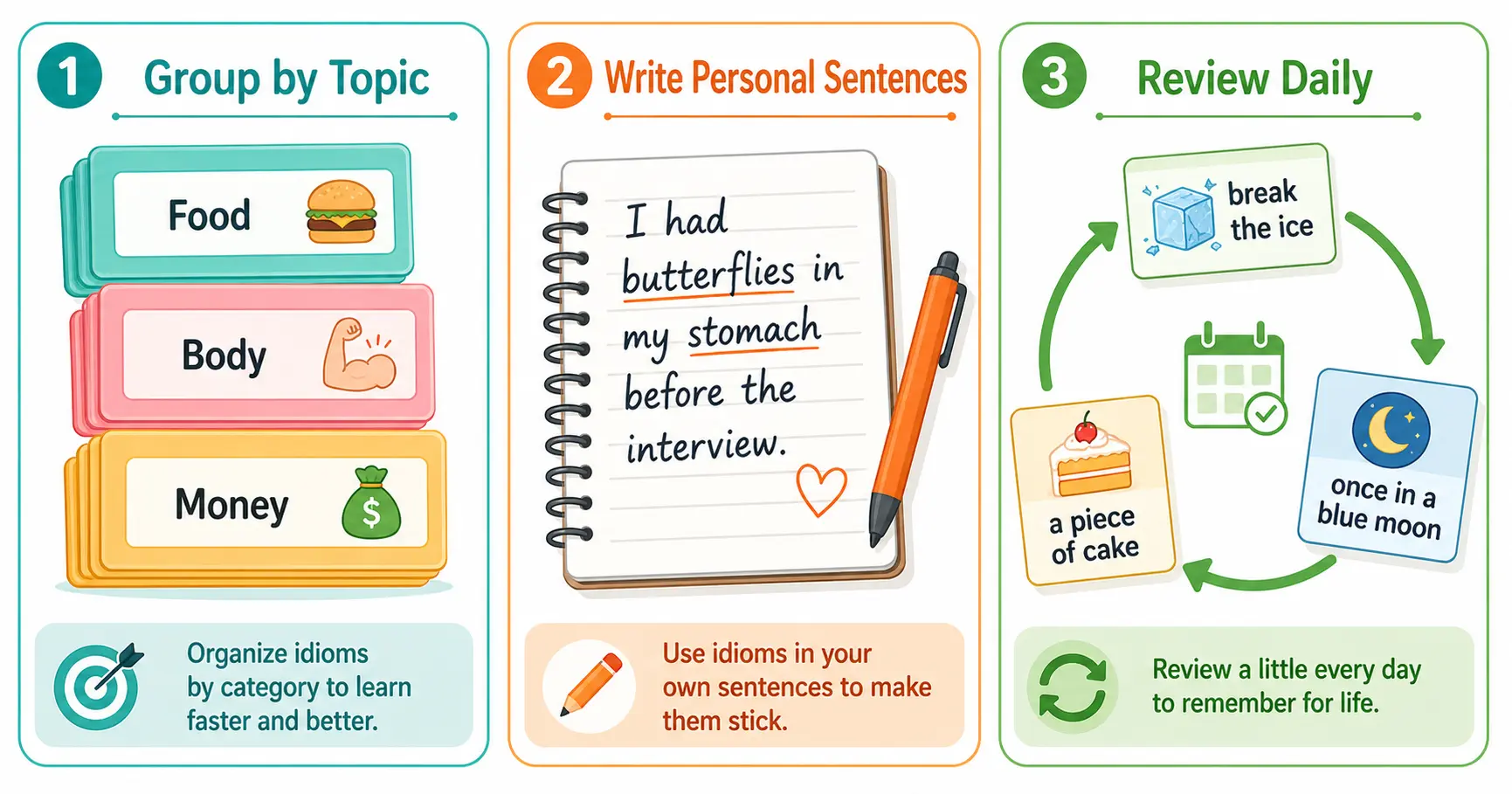
1. Aprenda em grupos temáticos, não em listas aleatórias
As 20 categorias temáticas acima existem por uma razão. Quando você aprende “spill the beans”, “in a nutshell” e “a recipe for disaster” juntos (todas expressões relacionadas à comida), seu cérebro cria conexões mais fortes do que se você memorizasse expressões aleatórias em ordem alfabética.
2. Aprenda ativamente: use-as em frases sobre sua vida
Para cada expressão que aprender, escreva uma frase sobre uma situação real da sua própria vida. “I had butterflies in my stomach before my driving test” (fiquei nervoso antes do meu teste de direção) é muito mais fácil de lembrar do que um exemplo genérico de livro didático.
3. Comece com 50, não com 500
Não tente memorizar esta lista inteira. Escolha 50 expressões que pareçam naturais para os assuntos de que você realmente fala. Se nunca conversa sobre esportes, pule as expressões desse tema. Se trabalha com negócios, priorize as expressões ligadas a dinheiro e trabalho.
4. Observe expressões idiomáticas na mídia
Filmes, séries, podcasts e músicas em inglês estão cheios de expressões idiomáticas. Quando ouvir uma, pare e confira o significado. Encontrá-la num contexto real ensina mais sobre o uso do que qualquer definição isolada.
5. Use repetição espaçada
Adicione as expressões que quer aprender ao Linglify ou a qualquer sistema de repetição espaçada. Pesquisas mostram que você precisa ter de 8 a 12 contatos com uma palavra ou expressão antes que ela passe a fazer parte do seu vocabulário ativo. Revisões diárias de cinco minutos são mais eficazes do que uma sessão semanal de 30 minutos.
Para conhecer um método de memorização baseado em evidências, veja como memorizar vocabulário.
6. Não force expressões idiomáticas
O maior erro de quem está aprendendo é usar expressões idiomáticas em excesso. Uma ou duas por conversa soam naturais; cinco num parágrafo parecem ensaiadas. Falantes nativos também usam idioms com moderação — faça o mesmo.
O Que Ler a Seguir
Este guia de referência cobre as expressões idiomáticas em detalhes. Veja também estes guias específicos:
Por quantidade:
- 100 Expressões Idiomáticas em Inglês com Significados: A Lista Essencial — uma seleção das 100 principais.
- 20 Expressões Idiomáticas Comuns com Significados e Exemplos — ideal para iniciantes.
Para provas:
- Idioms para o IELTS Speaking: 50 Expressões Naturais — expressões idiomáticas úteis no contexto da prova.
Vocabulário relacionado:
- Phrasal Verbs em Inglês: O Guia Completo — verbos que podem acompanhar expressões idiomáticas.
- Palavras Avançadas em Inglês: 300+ Vocabulário C1–C2 com Significados — palavras que complementam o vocabulário idiomático.
- Como Melhorar seu Vocabulário — um método completo para ampliar seu vocabulário.
FAQ
Quantas expressões idiomáticas existem em inglês?
As estimativas variam de 10.000 a 25.000, dependendo de como são contadas. Muitas são regionais (usadas apenas no inglês britânico ou americano), arcaicas (já não são comuns) ou específicas de determinadas áreas, como direito, medicina e finanças. Para ter fluência geral, conhecer de 200 a 300 expressões idiomáticas comuns cobre a maior parte do que você encontrará no inglês cotidiano.
Qual é a diferença entre uma expressão idiomática e um provérbio?
Um provérbio é um ditado curto e conhecido que expressa uma verdade geral ou um conselho: “The early bird catches the worm” (Deus ajuda quem cedo madruga). Uma expressão idiomática é uma expressão fixa com significado não literal: “kick the bucket” (= morrer). Alguns provérbios também são idioms, pois têm sentido figurado, mas muitos expressam conselhos de forma literal. Uma boa forma de distinguir os dois é perguntar: a expressão dá um conselho ou apresenta uma verdade geral? Provavelmente é um provérbio. Ela é uma frase usada dentro de uma oração para descrever uma situação específica? Provavelmente é um idiom.
Posso usar expressões idiomáticas na escrita formal?
Use expressões idiomáticas com muita moderação na escrita formal. Em redações acadêmicas, relatórios de negócios e correspondência oficial, elas podem parecer pouco profissionais ou informais demais. Em contextos semiformais — como posts de blog, artigos de opinião e slides de apresentação — uma ou duas expressões bem escolhidas podem dar personalidade ao texto. A regra é simples: quanto mais formal o contexto, menos idioms devem ser usados.
Expressões idiomáticas se traduzem entre idiomas?
Algumas expressões têm equivalentes em outros idiomas (“break the ice”, por exemplo, tem equivalentes em várias línguas europeias), mas a maioria não pode ser traduzida literalmente. “It’s raining cats and dogs” não faz sentido em muitos idiomas. É justamente por isso que idioms são difíceis para quem está aprendendo: não dá para usar a língua materna como atalho. Aprenda cada expressão em inglês como uma unidade completa e fixa.
Quais expressões idiomáticas devo aprender primeiro?
Comece pelas 20 expressões para iniciantes listadas acima, na seção “Expressões Idiomáticas por Nível de Dificuldade”. Elas estão entre as mais usadas e são compreendidas por praticamente todos. Depois, avance para a lista intermediária. Dê prioridade às expressões relacionadas aos assuntos sobre os quais você realmente conversa — não adianta memorizar expressões de negócios se você nunca fala sobre trabalho.
Há diferenças entre os idioms britânicos e americanos?
A maioria dos idioms comuns é compartilhada pelo inglês britânico e pelo americano. Alguns, porém, são regionais: “Bob’s your uncle” (britânico), “knock on wood” e “touch wood” (americano e britânico, respectivamente) e “a home run” (americano, do beisebol). As 420 expressões deste guia são amplamente compreendidas nas duas variedades.
Quantas expressões idiomáticas preciso para o IELTS?
Para tirar 7 no IELTS, é preciso usar algumas expressões idiomáticas de forma “natural e apropriada” na prova de Speaking. Na prática, de 10 a 15 expressões bem praticadas são suficientes. Para a Banda 8–9, elas devem aparecer naturalmente ao longo da sua fala. Veja nosso guia de idioms para o IELTS Speaking com 50 expressões adequadas para a prova.


