
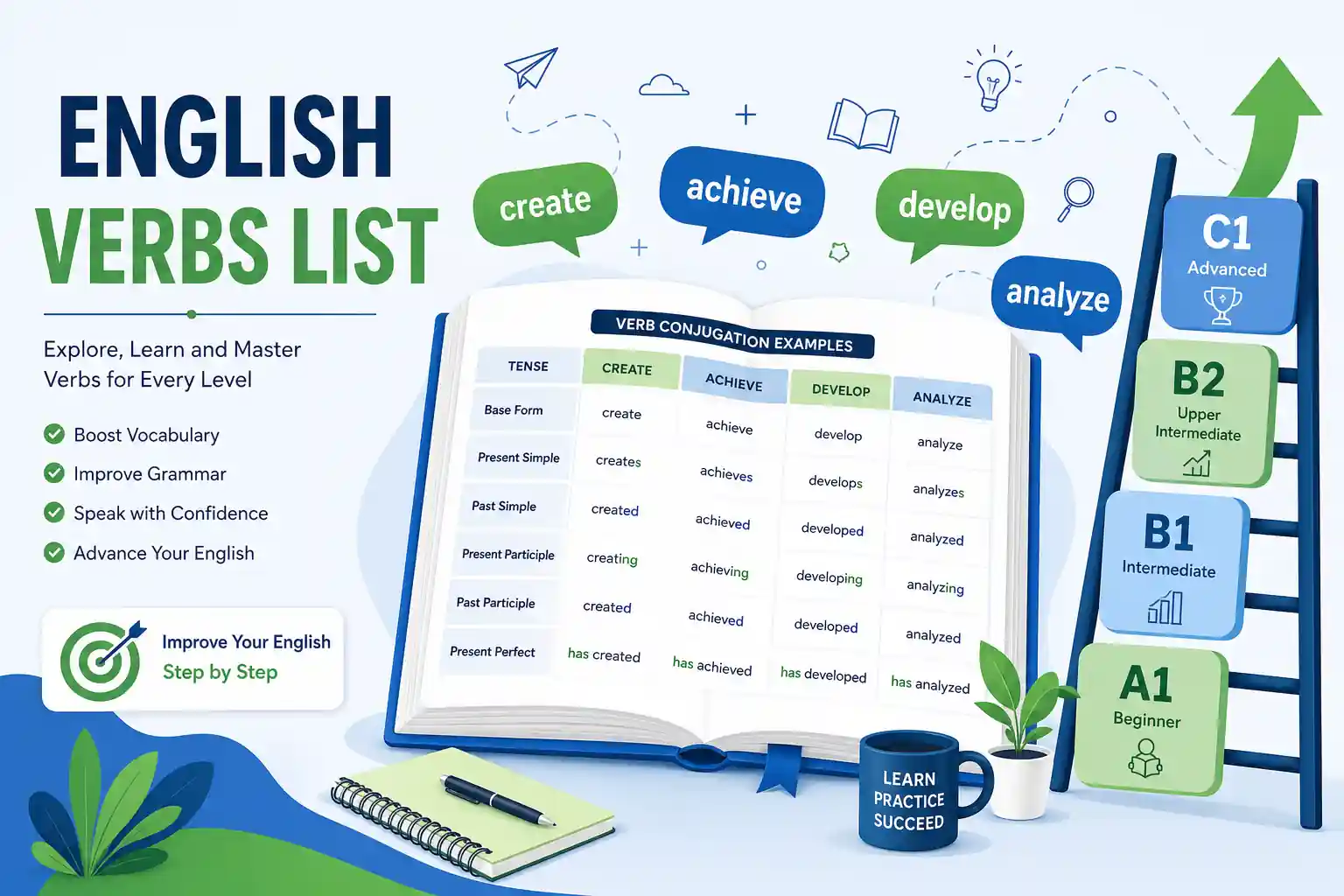
Lista de Verbos em Inglês: 300 Verbos Mais Importantes por Nível
Os verbos são o motor de cada frase em inglês. Sem um verbo, nada acontece — ninguém faz nada, se torna nada ou experimenta nada. Os substantivos nomeiam o mundo; os adjetivos o descrevem; mas os verbos o fazem mover.
O inglês tem aproximadamente 25.000 verbos, mas você não precisa aprender a maioria deles. Pesquisas sobre o inglês falado e escrito mostram que os 300 verbos mais frequentes cobrem cerca de 90% de todos os verbos usados na comunicação cotidiana. Dominando esses 300, você conseguirá expressar quase tudo o que precisa.
Esta lista reúne esses 300 verbos, organizados por nível CEFR (A1–C1) e por categoria de uso. Cada verbo vem com seu significado, uma frase de exemplo e padrões comuns que mostram como falantes nativos realmente o usam. Use o conteúdo como lista de estudo, material de consulta ou autoavaliação para identificar lacunas no seu vocabulário.
- Total de verbos: 300
- Organizado por: nível CEFR (A1–C1) e categoria semântica
- Formato: Verbo → Significado → Padrão → Exemplo
- Ideal para: construção de vocabulário, referência gramatical, preparação para exames
Para consultar as formas irregulares (passado e particípio passado), veja a Lista de Verbos Irregulares: 200 Verbos com Formas do Passado. Para verbos que se combinam com preposições, consulte o Guia Completo de Phrasal Verbs em Inglês.
Como os Verbos em Inglês Funcionam: Visão Geral Rápida
Antes da lista, veja algumas características importantes dos verbos em inglês.
Formas Verbais
Todo verbo regular em inglês tem cinco formas; os irregulares podem ter até cinco formas diferentes:
| Forma | Regular (work) | Irregular (go) | Usado Para |
|---|---|---|---|
| Base | work | go | Presente simples, infinitivo |
| 3ª pessoa -s | works | goes | He/she/it presente |
| Passado simples | worked | went | Eventos passados |
| Particípio passado | worked | gone | Tempos perfeitos, voz passiva |
| Forma -ing | working | going | Tempos contínuos, gerúndios |
Transitivo vs. Intransitivo
| Tipo | Definição | Exemplo |
|---|---|---|
| Transitivo | Precisa de objeto | She wrote a letter. (escreveu o quê?) |
| Intransitivo | Não precisa de objeto | He arrived late. (arrived what? — nada) |
| Ambos | Pode ser usado das duas formas | She runs a company. (transitivo) / She runs every morning. (intransitivo) |
Padrões Verbais
Conhecer o significado do verbo não basta — você também precisa saber o que vem depois dele:
| Padrão | Exemplo |
|---|---|
| verbo + infinitivo (to + verbo) | I want to learn English. |
| verbo + -ing | I enjoy reading books. |
| verbo + objeto | She made a decision. |
| verbo + objeto + infinitivo | He asked me to help. |
| verbo + preposição | She depends on her family. |
A lista abaixo inclui o padrão mais comum de cada verbo, para você aprender não só o que ele significa, mas também como usá-lo.
Nível A1: Verbos Essenciais (75 Verbos)
Estes verbos são a base de tudo. Todo estudante de inglês precisa aprendê-los desde o início.
Ser e Ter
| # | Verbo | Significado | Padrão | Exemplo |
|---|---|---|---|---|
| 1 | be | existir; igual | be + adjetivo/substantivo | She is happy. / He is a teacher. |
| 2 | have | possuir; experimentar | have + substantivo | I have two children. / She had a great time. |
| 3 | do | realizar uma ação | do + substantivo | He does his homework every evening. |
| 4 | become | transformar-se em | become + adjetivo/substantivo | She became a doctor. / It became clear. |
| 5 | seem | parecer ser | seem + adjetivo/to + verbo | He seems tired. / It seems to work. |
Movimento
| # | Verbo | Significado | Padrão | Exemplo |
|---|---|---|---|---|
| 6 | go | mover-se para um lugar | go + to + lugar | I go to work at 8 AM. |
| 7 | come | mover-se em direção ao falante | come + to/from | Come to my office after lunch. |
| 8 | get | obter; chegar; tornar-se | get + substantivo/adj/to | I got a message. / She got angry. |
| 9 | run | mover-se rápido a pé | run + direção | He runs every morning in the park. |
| 10 | walk | mover-se a pé | walk + to/along | We walked to the station in ten minutes. |
| 11 | move | mudar de posição/lugar | move + to/from | They moved to London last year. |
| 12 | leave | partir de | leave + lugar/tempo | She leaves the office at 6 PM. |
| 13 | arrive | chegar a um destino | arrive + at/in | We arrived at the airport two hours early. |
| 14 | return | voltar | return + to | He returned to his hometown after 10 years. |
| 15 | follow | ir atrás/depois de | follow + substantivo | Follow this road until you reach the bridge. |
Comunicação
| # | Verbo | Significado | Padrão | Exemplo |
|---|---|---|---|---|
| 16 | say | falar palavras | say + that/citação | She said she was busy. |
| 17 | tell | dar informação a alguém | tell + pessoa + that/to | Tell me what happened. |
| 18 | ask | pedir informação/ajuda | ask + pessoa + pergunta/to | He asked me to wait outside. |
| 19 | speak | usar a voz; conhecer um idioma | speak + idioma/to pessoa | She speaks three languages fluently. |
| 20 | talk | ter uma conversa | talk + to/about | We talked about the project for an hour. |
| 21 | call | telefonar; nomear | call + pessoa/substantivo | I’ll call you tomorrow morning. |
| 22 | answer | responder | answer + substantivo/that | She didn’t answer my question. |
| 23 | write | colocar palavras no papel/tela | write + substantivo/to pessoa | He wrote a long email to the team. |
| 24 | read | entender palavras escritas | read + substantivo | She reads the newspaper every morning. |
| 25 | listen | prestar atenção ao som | listen + to | Listen to this song — it’s beautiful. |
Ações e Trabalho
| # | Verbo | Significado | Padrão | Exemplo |
|---|---|---|---|---|
| 26 | make | criar; causar | make + substantivo/adj | She made a cake for his birthday. |
| 27 | take | pegar; carregar; exigir tempo | take + substantivo/tempo | Take your keys. / It takes 20 minutes. |
| 28 | give | entregar a alguém | give + pessoa + coisa | He gave her a beautiful gift. |
| 29 | put | colocar em uma posição | put + coisa + lugar | Put the book on the table. |
| 30 | use | empregar para um propósito | use + substantivo + to/for | I use this app to learn vocabulary. |
| 31 | work | fazer um trabalho; funcionar | work + at/for/as | She works for a tech company. |
| 32 | play | participar de um jogo/esporte | play + esporte/música | The children play in the park every afternoon. |
| 33 | help | ajudar alguém | help + pessoa + (to) verbo | Can you help me carry these boxes? |
| 34 | try | tentar | try + to verbo / -ing | I’m trying to learn 5 new words every day. |
| 35 | start | começar | start + -ing/to verbo | She started learning English two years ago. |
| 36 | stop | parar | stop + -ing | Stop talking and listen. |
| 37 | open | tornar acessível | open + substantivo | He opened the door and invited us in. |
| 38 | close | fechar | close + substantivo | Please close the window — it’s cold. |
| 39 | turn | girar; mudar de direção | turn + direção | Turn left at the traffic light. |
| 40 | pay | dar dinheiro | pay + for/valor | She paid $50 for the ticket. |
Pensamento e Sentimento
| # | Verbo | Significado | Padrão | Exemplo |
|---|---|---|---|---|
| 41 | think | usar a mente; acreditar | think + about/that | I think this is a good idea. |
| 42 | know | ter informação/habilidade | know + that/how/substantivo | I know how to cook Italian food. |
| 43 | want | desejar | want + to verbo/substantivo | She wants to travel the world. |
| 44 | need | precisar | need + to verbo/substantivo | You need to study more before the exam. |
| 45 | like | gostar; achar agradável | like + -ing/substantivo | I like reading before bed. |
| 46 | love | sentir forte afeto | love + -ing/substantivo/pessoa | She loves her job. |
| 47 | feel | experimentar emoção/sensação | feel + adjetivo | I feel tired after a long day. |
| 48 | believe | achar que algo é verdade | believe + that/in | I believe this plan will work. |
| 49 | understand | compreender o significado | understand + substantivo/that | I don’t understand this question. |
| 50 | remember | guardar na memória | remember + -ing/to verbo | I remember meeting her at the conference. |
| 51 | forget | não conseguir lembrar | forget + to verbo/about | Don’t forget to lock the door. |
| 52 | hope | desejar algo | hope + to verbo/that | I hope to see you again soon. |
| 53 | worry | sentir-se ansioso | worry + about | Don’t worry about the exam — you’ll be fine. |
Vida Diária
| # | Verbo | Significado | Padrão | Exemplo |
|---|---|---|---|---|
| 54 | live | ter seu lar; estar vivo | live + in/at | She lives in a small apartment downtown. |
| 55 | eat | consumir comida | eat + substantivo | We usually eat dinner at 7 PM. |
| 56 | drink | consumir líquido | drink + substantivo | He drinks three cups of coffee a day. |
| 57 | sleep | descansar inconscientemente | sleep + tempo/lugar | I slept for ten hours last night. |
| 58 | buy | comprar | buy + substantivo + for | She bought a new laptop for work. |
| 59 | sell | trocar por dinheiro | sell + substantivo + to/for | They sold their house for a good price. |
| 60 | bring | carregar em direção a alguém ou algum lugar | bring + substantivo + to | Bring your book to class tomorrow. |
| 61 | carry | segurar e transportar | carry + substantivo | He carried the bags to the car. |
| 62 | send | fazer chegar; enviar | send + substantivo + to | I sent the document to your email. |
| 63 | wait | esperar que algo aconteça | wait + for | We waited for the bus in the rain. |
| 64 | look | direcionar os olhos | look + at/for | Look at this photo — isn’t it beautiful? |
| 65 | see | perceber com os olhos | see + substantivo/that | I can see the mountains from my window. |
| 66 | watch | observar intencionalmente | watch + substantivo/-ing | She watches the news every evening. |
| 67 | hear | perceber com os ouvidos | hear + substantivo/that | I heard a strange noise outside. |
| 68 | find | descobrir; localizar | find + substantivo + adjetivo | I found the exercise difficult. |
| 69 | keep | continuar tendo; manter | keep + -ing/substantivo | Keep studying — you’re making progress. |
| 70 | hold | ter na mão | hold + substantivo | She held the baby carefully. |
| 71 | sit | estar sentado | sit + down/on | Please sit down and make yourself comfortable. |
| 72 | stand | ficar de pé | stand + up/place | He stood at the window and looked out. |
| 73 | learn | adquirir conhecimento/habilidade | learn + to verbo/substantivo | She learned to drive when she was 17. |
| 74 | teach | dar conhecimento a outros | teach + pessoa + substantivo/to | He teaches English to beginners. |
| 75 | change | fazer/tornar-se diferente | change + substantivo/into | The city has changed a lot in ten years. |
Nível B1: Verbos Intermediários (75 Verbos)
No nível B1, os verbos ficam mais específicos e expressivos. Você passa de ações básicas a processos, opiniões e conceitos abstratos.
Trabalho e Conquista
| # | Verbo | Significado | Padrão | Exemplo |
|---|---|---|---|---|
| 76 | manage | estar no comando; conseguir | manage + to verbo/substantivo | She manages a team of 15 people. |
| 77 | achieve | alcançar uma meta com esforço | achieve + substantivo | He achieved his target of saving $10,000. |
| 78 | develop | crescer; criar | develop + substantivo/into | The company developed a new product line. |
| 79 | improve | fazer ou tornar-se melhor | improve + substantivo/at | Her English has improved significantly this year. |
| 80 | produce | fazer; criar resultado | produce + substantivo | The factory produces 10,000 units per day. |
| 81 | provide | dar; fornecer | provide + substantivo + for/to | The school provides lunch for all students. |
| 82 | create | fazer algo novo | create + substantivo | She created a website for her small business. |
| 83 | build | construir | build + substantivo | They built the house in just four months. |
| 84 | support | ajudar; apoiar | support + substantivo/pessoa | I support your decision completely. |
| 85 | lead | guiar; estar na frente | lead + substantivo/to | She leads the marketing department. |
| 86 | serve | trabalhar para; servir comida | serve + substantivo/as | He served as president for two terms. |
| 87 | complete | terminar por completo | complete + substantivo | She completed her degree in three years. |
| 88 | continue | continuar | continue + -ing/to verbo | They continued working despite the difficulty. |
| 89 | increase | fazer ou tornar-se maior | increase + substantivo/by | Sales increased by 20% this quarter. |
| 90 | reduce | fazer menor/menos | reduce + substantivo + by/to | We reduced costs by eliminating waste. |
Decisão e Controle
| # | Verbo | Significado | Padrão | Exemplo |
|---|---|---|---|---|
| 91 | decide | fazer uma escolha | decide + to verbo/that | She decided to accept the job offer. |
| 92 | choose | selecionar entre opções | choose + substantivo/to verbo | I chose the cheaper option to save money. |
| 93 | allow | permitir | allow + pessoa + to verbo | The company allows employees to work from home. |
| 94 | prevent | impedir de acontecer | prevent + substantivo + from -ing | The barrier prevents cars from entering the area. |
| 95 | control | ter poder sobre | control + substantivo | The software controls the temperature automatically. |
| 96 | avoid | ficar longe de | avoid + -ing/substantivo | She avoids eating sugar during the week. |
| 97 | accept | concordar em receber/acreditar | accept + substantivo/that | He accepted the invitation to speak at the conference. |
| 98 | refuse | dizer não; recusar | refuse + to verbo/substantivo | She refused to sign the contract without changes. |
| 99 | offer | apresentar para aceitação | offer + to verbo/substantivo | They offered her a promotion with a higher salary. |
| 100 | suggest | propor uma ideia | suggest + -ing/that | I suggest taking a break before continuing. |
Comunicação (Avançada)
| # | Verbo | Significado | Padrão | Exemplo |
|---|---|---|---|---|
| 101 | explain | tornar claro | explain + substantivo/that/how | Can you explain how this works? |
| 102 | describe | dizer como algo é | describe + substantivo + as | She described the experience as life-changing. |
| 103 | discuss | falar em detalhes sobre | discuss + substantivo/with | We discussed the plan with the whole team. |
| 104 | mention | dizer brevemente | mention + substantivo/that | He mentioned that he was planning to leave. |
| 105 | argue | dar razões para; discordar | argue + that/with/about | They argued about politics for hours. |
| 106 | complain | expressar insatisfação | complain + about/that | Customers complained about the long waiting times. |
| 107 | admit | confessar; aceitar como verdade | admit + -ing/that | She admitted that she had made a mistake. |
| 108 | promise | comprometer-se a fazer | promise + to verbo/that | He promised to call her every day. |
| 109 | warn | alertar sobre um perigo | warn + pessoa + about/not to | The sign warns visitors not to feed the animals. |
| 110 | encourage | dar confiança/apoio | encourage + pessoa + to verbo | His teacher encouraged him to apply to university. |
Experiência e Emoção
| # | Verbo | Significado | Padrão | Exemplo |
|---|---|---|---|---|
| 111 | enjoy | encontrar prazer em | enjoy + -ing/substantivo | I really enjoy traveling to new countries. |
| 112 | prefer | gostar mais de uma coisa | prefer + substantivo/-ing + to | She prefers working from home to commuting. |
| 113 | miss | sentir falta da ausência | miss + -ing/substantivo | I miss living near the sea. |
| 114 | expect | achar que algo vai acontecer | expect + to verbo/that | I didn’t expect to win — it was a surprise. |
| 115 | notice | tornar-se consciente de | notice + substantivo/that | I noticed a change in his behavior recently. |
| 116 | realize | tornar-se consciente; entender | realize + that | She realized she had left her keys at home. |
| 117 | wonder | querer saber | wonder + if/why/what | I wonder why he didn’t come to the meeting. |
| 118 | suppose | achar provável; supor | suppose + that | I suppose you’re right — we should wait. |
| 119 | consider | pensar cuidadosamente sobre | consider + -ing/substantivo | Have you considered changing jobs? |
| 120 | imagine | formar uma imagem na mente | imagine + -ing/substantivo | Imagine living in a city with no cars. |
Físicos e Mudança
| # | Verbo | Significado | Padrão | Exemplo |
|---|---|---|---|---|
| 121 | grow | crescer; cultivar | grow + adjetivo/substantivo | The company has grown rapidly this year. |
| 122 | fall | cair | fall + down/off | The temperature fell to minus 10 last night. |
| 123 | rise | subir; aumentar | rise + by/to | Prices have risen by 15% since January. |
| 124 | drop | cair; deixar cair; diminuir | drop + substantivo/by | She dropped her phone and cracked the screen. |
| 125 | push | empurrar para longe | push + substantivo/direção | He pushed the door open with one hand. |
| 126 | pull | puxar em sua direção | pull + substantivo/direção | She pulled the curtains shut. |
| 127 | throw | lançar pelo ar | throw + substantivo + to/at | He threw the ball to his son in the garden. |
| 128 | catch | pegar um objeto em movimento | catch + substantivo | She caught the bus just in time. |
| 129 | hit | atingir com força | hit + substantivo | The car hit a tree and stopped. |
| 130 | break | quebrar em pedaços | break + substantivo | Who broke the window? |
| 131 | cut | cortar com uma lâmina | cut + substantivo + into | Cut the pizza into eight slices. |
| 132 | connect | unir; conectar | connect + substantivo + to/with | Connect your phone to the Wi-Fi network. |
| 133 | fill | encher | fill + substantivo + with | She filled the glass with water. |
| 134 | contain | ter dentro; conter | contain + substantivo | This box contains all my old photos. |
| 135 | mix | combinar; misturar | mix + substantivo + with | Mix the flour with water to make the dough. |
Sociedade e Interação
| # | Verbo | Significado | Padrão | Exemplo |
|---|---|---|---|---|
| 136 | share | dividir com outras pessoas; usar em conjunto | share + substantivo + with | She shared her experience with the audience. |
| 137 | join | tornar-se parte de; conectar-se | join + substantivo/pessoa | He joined the company straight after university. |
| 138 | introduce | apresentar pela primeira vez | introduce + pessoa + to | Let me introduce you to my colleague. |
| 139 | invite | convidar alguém a vir | invite + pessoa + to | She invited everyone to her birthday party. |
| 140 | visit | ir ver alguém ou algum lugar | visit + substantivo | We visited the museum during our trip. |
| 141 | meet | conhecer pela primeira vez; reunir-se | meet + pessoa/at | I’m meeting my friend at 3 PM. |
| 142 | agree | ter a mesma opinião | agree + with/to/that | I agree with your suggestion completely. |
| 143 | compare | examinar semelhanças e diferenças | compare + substantivo + with/to | Compare these two options and choose the better one. |
| 144 | depend | ser afetado por; contar com | depend + on | The result depends on how hard you work. |
| 145 | belong | ser propriedade de; fazer parte | belong + to | This book belongs to the library. |
| 146 | include | ter como parte | include + substantivo | The price includes breakfast and parking. |
| 147 | involve | exigir participação; incluir | involve + -ing/substantivo | The job involves traveling twice a month. |
| 148 | represent | representar; agir em nome de alguém | represent + substantivo | She represents the company at international conferences. |
| 149 | remain | continuar no mesmo estado | remain + adjetivo/substantivo | He remained calm during the emergency. |
| 150 | appear | tornar-se visível; parecer | appear + adjetivo/to verbo | She appeared confident but was actually nervous. |
Nível B2: Verbos Intermediários-Avançados (75 Verbos)
No nível B2, os verbos expressam nuances, competência profissional e pensamento abstrato. São eles que diferenciam um inglês “bom” de um inglês fluente.
Análise e Pesquisa
| # | Verbo | Significado | Padrão | Exemplo |
|---|---|---|---|---|
| 151 | analyze | examinar em detalhes | analyze + substantivo | The team analyzed the data and found three trends. |
| 152 | examine | olhar cuidadosamente | examine + substantivo | The doctor examined the patient thoroughly. |
| 153 | investigate | buscar fatos | investigate + substantivo/whether | Police are investigating the cause of the fire. |
| 154 | determine | descobrir; decidir oficialmente | determine + substantivo/that | Scientists determined that the drug was effective. |
| 155 | identify | reconhecer; estabelecer o quê | identify + substantivo + as | Researchers identified stress as the main factor. |
| 156 | assess | avaliar qualidade ou importância | assess + substantivo | We need to assess the risks before proceeding. |
| 157 | evaluate | julgar o valor de | evaluate + substantivo | The committee evaluated all applications carefully. |
| 158 | measure | medir tamanho ou quantidade | measure + substantivo + in/by | Success cannot be measured by money alone. |
| 159 | observe | observar atentamente; notar | observe + substantivo/that | I observed that he always arrives early on Mondays. |
| 160 | indicate | mostrar; apontar para | indicate + that/substantivo | Studies indicate that exercise reduces anxiety. |
Influência e Controle
| # | Verbo | Significado | Padrão | Exemplo |
|---|---|---|---|---|
| 161 | influence | afetar como algo se desenvolve | influence + substantivo | Social media strongly influences consumer behavior. |
| 162 | affect | ter impacto em | affect + substantivo | The new policy will affect all employees. |
| 163 | determine | decidir o resultado de algo | determine + substantivo | Your preparation determines your exam result. |
| 164 | establish | fundar; provar | establish + substantivo/that | The company established a new office in Berlin. |
| 165 | maintain | manter em boa condição; afirmar | maintain + substantivo/that | It’s expensive to maintain an old building. |
| 166 | ensure | garantir | ensure + that | Double-check to ensure that everything is correct. |
| 167 | require | precisar; exigir oficialmente | require + substantivo/-ing | The position requires five years of experience. |
| 168 | impose | impor regras ou condições | impose + substantivo + on | The government imposed new regulations on banks. |
| 169 | restrict | limitar | restrict + substantivo + to | Access is restricted to authorized personnel only. |
| 170 | enable | tornar possível | enable + pessoa + to verbo | Technology enables us to work from anywhere. |
Negócios e Estratégia
| # | Verbo | Significado | Padrão | Exemplo |
|---|---|---|---|---|
| 171 | invest | colocar dinheiro para lucro | invest + in + substantivo | She invested heavily in renewable energy stocks. |
| 172 | acquire | obter; comprar uma empresa | acquire + substantivo | The tech giant acquired three startups last year. |
| 173 | generate | produzir; criar | generate + substantivo | The campaign generated significant media coverage. |
| 174 | launch | iniciar algo novo publicamente | launch + substantivo | They launched the product with a global marketing campaign. |
| 175 | expand | crescer; adicionar a | expand + substantivo/into | The company expanded into Asian markets in 2024. |
| 176 | implement | colocar um plano em ação | implement + substantivo | The school implemented a new attendance policy. |
| 177 | negotiate | discutir para chegar a acordo | negotiate + substantivo/with | She negotiated a better salary before accepting. |
| 178 | estimate | calcular aproximadamente | estimate + that/substantivo | Engineers estimated the cost at $2 million. |
| 179 | fund | fornecer dinheiro para | fund + substantivo | The project is funded by private donations. |
| 180 | distribute | distribuir a várias pessoas | distribute + substantivo + to | The charity distributed food to 500 families. |
Comunicação (Sofisticada)
| # | Verbo | Significado | Padrão | Exemplo |
|---|---|---|---|---|
| 181 | acknowledge | reconhecer; admitir publicamente | acknowledge + substantivo/that | The CEO acknowledged that mistakes were made. |
| 182 | clarify | tornar mais claro | clarify + substantivo/that | Could you clarify what you mean by “soon”? |
| 183 | emphasize | enfatizar importância | emphasize + substantivo/that | She emphasized the need for better communication. |
| 184 | imply | sugerir sem dizer diretamente | imply + that | Are you implying that I was wrong? |
| 185 | convince | persuadir a acreditar/agir | convince + pessoa + to verbo/that | She convinced me to apply for the position. |
| 186 | confirm | verificar como verdade | confirm + substantivo/that | Can you confirm that the meeting is at 3 PM? |
| 187 | deny | dizer que algo não é verdade | deny + -ing/that | He denied taking the money from the register. |
| 188 | reveal | tornar conhecido; mostrar | reveal + substantivo/that | The report revealed that costs had doubled. |
| 189 | propose | sugerir formalmente | propose + -ing/that/substantivo | She proposed a new approach to the problem. |
| 190 | respond | responder; reagir | respond + to + substantivo | The company responded to criticism by changing its policy. |
Sociedade e Sistemas
| # | Verbo | Significado | Padrão | Exemplo |
|---|---|---|---|---|
| 191 | contribute | contribuir; ajudar a causar | contribute + to + substantivo | Everyone contributed to the success of the project. |
| 192 | participate | participar | participate + in | Over 200 people participated in the survey. |
| 193 | promote | apoiar; divulgar; promover alguém | promote + substantivo/pessoa | She was promoted to senior manager after two years. |
| 194 | operate | funcionar; administrar uma empresa | operate + substantivo/in | The airline operates flights to 40 countries. |
| 195 | regulate | controlar por meio de regras | regulate + substantivo | The industry is heavily regulated by the government. |
| 196 | transform | transformar completamente | transform + substantivo + into | Technology has transformed how we communicate. |
| 197 | demonstrate | demonstrar claramente; protestar | demonstrate + substantivo/that/how | The experiment demonstrates that the theory is correct. |
| 198 | illustrate | esclarecer com exemplos | illustrate + substantivo/how | This chart illustrates the growth in revenue. |
| 199 | interpret | explicar o sentido; traduzir | interpret + substantivo + as | Some people interpreted his silence as agreement. |
| 200 | apply | aplicar; candidatar-se | apply + substantivo + to / apply + for | These rules apply to all employees equally. |
Abstratos e Acadêmicos
| # | Verbo | Significado | Padrão | Exemplo |
|---|---|---|---|---|
| 201 | assume | supor sem provas | assume + that | I assumed you already knew about the change. |
| 202 | conclude | chegar a uma conclusão; terminar | conclude + that/substantivo | The study concluded that diet affects concentration. |
| 203 | define | declarar o significado de | define + substantivo + as | The dictionary defines “resilience” as the ability to recover quickly. |
| 204 | justify | apresentar boas razões para | justify + -ing/substantivo | How can you justify spending so much money? |
| 205 | distinguish | perceber a diferença entre | distinguish + between | It’s important to distinguish between facts and opinions. |
| 206 | recognize | identificar; reconhecer oficialmente | recognize + substantivo/that | She recognized his voice immediately on the phone. |
| 207 | reflect | refletir; demonstrar | reflect + on/substantivo | Take some time to reflect on what you’ve learned this year. |
| 208 | occur | acontecer; vir à mente | occur + to pessoa/in lugar | It suddenly occurred to me that I had forgotten her birthday. |
| 209 | consist | ser composto de | consist + of | The team consists of five engineers and two designers. |
| 210 | relate | relacionar; contar uma história | relate + to/substantivo | This chapter relates to what we discussed last week. |
| 211 | vary | variar; ser diferente | vary + from/by | Prices vary depending on the season. |
| 212 | arise | surgir; acontecer | arise + from | Several problems arose from the misunderstanding. |
| 213 | involve | incluir como parte necessária | involve + -ing/substantivo | The project involves working with international teams. |
| 214 | obtain | obter por meio de esforço | obtain + substantivo + from | She obtained permission from the director. |
| 215 | replace | substituir | replace + substantivo + with | They replaced the old system with a modern one. |
| 216 | remove | remover; retirar | remove + substantivo + from | Please remove your personal items from the locker. |
| 217 | eliminate | eliminar por completo | eliminate + substantivo | The new process eliminates unnecessary paperwork. |
| 218 | solve | encontrar a solução de | solve + substantivo | We need to solve this problem before it gets worse. |
| 219 | handle | lidar com; administrar | handle + substantivo | She handled the situation with impressive calm. |
| 220 | commit | dedicar-se; comprometer-se; cometer | commit + to -ing/substantivo | He committed to studying for one hour every day. |
| 221 | engage | envolver; captar a atenção | engage + in/with | The students were fully engaged in the discussion. |
| 222 | seek | procurar; tentar obter | seek + substantivo/to verbo | She is seeking a new job in marketing. |
| 223 | adapt | adaptar-se a novas condições | adapt + to + substantivo | It took time to adapt to the new work environment. |
| 224 | overcome | superar; lidar com sucesso | overcome + substantivo | She overcame her fear of public speaking with practice. |
| 225 | recover | recuperar-se; voltar ao normal | recover + from | He fully recovered from the surgery within a month. |
Nível C1: Verbos Avançados (75 Verbos)
Os verbos C1 são precisos e sofisticados e demonstram alto domínio do inglês. Eles permitem expressar nuances que verbos mais simples não alcançam.
Pensamento Crítico
| # | Verbo | Significado | Padrão | Exemplo |
|---|---|---|---|---|
| 226 | perceive | notar; entender de uma forma particular | perceive + substantivo + as | The public perceived the decision as unfair. |
| 227 | anticipate | esperar e se preparar para | anticipate + substantivo/that | We anticipated strong demand and increased production. |
| 228 | speculate | formar teorias sem evidência | speculate + about/that | Analysts speculated that the company might be sold. |
| 229 | infer | concluir a partir de evidências | infer + that/substantivo + from | From his tone, I inferred that he was not happy. |
| 230 | deduce | chegar a uma conclusão por lógica | deduce + that/substantivo | She deduced the answer from the clues available. |
| 231 | contemplate | pensar profundamente sobre | contemplate + -ing/substantivo | He contemplated leaving his career for a year of travel. |
| 232 | scrutinize | examinar muito cuidadosamente | scrutinize + substantivo | The auditors scrutinized every transaction from the past year. |
| 233 | validate | confirmar como correto | validate + substantivo | The experiment validated the original hypothesis. |
| 234 | undermine | enfraquecer gradualmente | undermine + substantivo | Constant criticism undermines a person’s confidence. |
| 235 | contradict | dizer o oposto; conflitar com | contradict + substantivo/pessoa | The new evidence contradicts earlier findings. |
Causalidade e Mudança
| # | Verbo | Significado | Padrão | Exemplo |
|---|---|---|---|---|
| 236 | trigger | causar o início de algo repentinamente | trigger + substantivo | The announcement triggered widespread protests. |
| 237 | provoke | provocar uma reação; irritar | provoke + substantivo/pessoa | His comments provoked an angry response from the audience. |
| 238 | facilitate | tornar mais fácil; habilitar | facilitate + substantivo | Good infrastructure facilitates economic growth. |
| 239 | accelerate | tornar mais rápido; acelerar | accelerate + substantivo | The pandemic accelerated the shift to remote work. |
| 240 | diminish | fazer ou tornar-se menor/menos | diminish + substantivo | His influence has diminished over the past decade. |
| 241 | intensify | tornar-se ou ficar mais intenso | intensify + substantivo | Competition in the sector has intensified significantly. |
| 242 | exacerbate | piorar | exacerbate + substantivo | Poor communication exacerbated the conflict between teams. |
| 243 | sustain | manter ao longo do tempo; sofrer | sustain + substantivo | The economy cannot sustain this level of growth indefinitely. |
| 244 | erode | destruir/enfraquecer gradualmente | erode + substantivo | Years of neglect eroded public trust in the institution. |
| 245 | disrupt | interromper; mudar radicalmente | disrupt + substantivo | Streaming services disrupted the traditional TV industry. |
Profissional e Institucional
| # | Verbo | Significado | Padrão | Exemplo |
|---|---|---|---|---|
| 246 | allocate | destinar ou distribuir para um fim | allocate + substantivo + to/for | The government allocated additional funds for healthcare. |
| 247 | authorize | dar permissão oficial | authorize + substantivo/pessoa + to | Only the manager is authorized to approve refunds over $500. |
| 248 | oversee | supervisionar | oversee + substantivo | She oversees the operations of three regional offices. |
| 249 | enforce | fazer cumprir regras | enforce + substantivo | The new parking rules will be strictly enforced. |
| 250 | comply | agir de acordo com regras | comply + with | All companies must comply with the new data protection law. |
| 251 | mandate | exigir oficialmente | mandate + that/substantivo | The law mandates that all buildings have fire exits. |
| 252 | consolidate | fortalecer; combinar | consolidate + substantivo | The merger consolidated their position as market leader. |
| 253 | delegate | delegar tarefas | delegate + substantivo + to | Good managers delegate tasks instead of doing everything themselves. |
| 254 | terminate | encerrar formalmente | terminate + substantivo | The company terminated his contract due to repeated absences. |
| 255 | stipulate | estabelecer como requisito | stipulate + that/substantivo | The agreement stipulates that payment must be received within 30 days. |
Comunicação Precisa
| # | Verbo | Significado | Padrão | Exemplo |
|---|---|---|---|---|
| 256 | articulate | expressar claramente | articulate + substantivo | She articulated her vision for the company with impressive clarity. |
| 257 | convey | comunicar (significado/sentimento) | convey + substantivo + to | The painting conveys a sense of loneliness and isolation. |
| 258 | elaborate | explicar com mais detalhes | elaborate + on | Could you elaborate on your second point? |
| 259 | reiterate | repetir para enfatizar | reiterate + that/substantivo | I want to reiterate that safety is our top priority. |
| 260 | dispute | discordar de; contestar | dispute + substantivo/that | Scientists dispute the claim that the product is safe. |
| 261 | denounce | criticar publicamente com veemência | denounce + substantivo/pessoa + as | Human rights organizations denounced the policy as inhumane. |
| 262 | advocate | apoiar publicamente | advocate + for/substantivo/-ing | She advocates for better working conditions in factories. |
| 263 | endorse | aprovar ou apoiar publicamente | endorse + substantivo | Several celebrities endorsed the environmental campaign. |
| 264 | assert | afirmar com firmeza e confiança | assert + that/substantivo | He asserted that the project would be finished on schedule. |
| 265 | concede | admitir relutantemente; ceder | concede + that/substantivo | She conceded that the opposing argument had some merit. |
Social e Psicológico
| # | Verbo | Significado | Padrão | Exemplo |
|---|---|---|---|---|
| 266 | empathize | compreender e compartilhar sentimentos | empathize + with | I empathize with anyone trying to learn a new language as an adult. |
| 267 | resent | sentir ressentimento por | resent + -ing/substantivo | He resented being passed over for promotion twice. |
| 268 | cherish | valorizar e proteger muito | cherish + substantivo | She cherishes the memories from that summer in Italy. |
| 269 | endure | suportar com paciência; durar | endure + substantivo | The team endured months of setbacks before succeeding. |
| 270 | yearn | desejar intensamente | yearn + for/to verbo | After years abroad, she yearned to return home. |
| 271 | nurture | cuidar e estimular o crescimento | nurture + substantivo | Good teachers nurture curiosity in their students. |
| 272 | alienate | fazer alguém se sentir excluído | alienate + pessoa/substantivo | His arrogant behavior alienated his colleagues. |
| 273 | captivate | atrair e prender a atenção | captivate + pessoa | The speaker captivated the audience for a full hour. |
| 274 | compel | forçar; tornar necessário | compel + pessoa + to verbo | The evidence compelled them to change their conclusion. |
| 275 | inhibit | impedir; dificultar | inhibit + substantivo | Fear of making mistakes inhibits many learners from speaking. |
Precisão Abstrata
| # | Verbo | Significado | Padrão | Exemplo |
|---|---|---|---|---|
| 276 | constitute | compor; ser equivalente a | constitute + substantivo | Women constitute 60% of the university’s graduates. |
| 277 | encompass | incluir uma ampla variedade | encompass + substantivo | The study encompasses data from 30 countries over 20 years. |
| 278 | entail | necessariamente envolver | entail + -ing/substantivo | The role entails extensive international travel. |
| 279 | warrant | justificar; tornar necessário | warrant + substantivo/-ing | The situation warrants immediate action. |
| 280 | preclude | tornar impossível; impedir | preclude + substantivo/-ing | Heavy rain precluded any outdoor activities that weekend. |
| 281 | transcend | ir além dos limites | transcend + substantivo | Good music transcends language and cultural barriers. |
| 282 | epitomize | ser um exemplo perfeito de | epitomize + substantivo | She epitomizes dedication — 15 years without missing a single day. |
| 283 | manifest | mostrar claramente; manifestar-se | manifest + itself + in/as | His anxiety manifests itself as insomnia and irritability. |
| 284 | fluctuate | mudar frequentemente | fluctuate + between | Oil prices fluctuate between $60 and $80 per barrel. |
| 285 | correlate | ter uma relação mútua | correlate + with | Research shows that exercise correlates with better sleep quality. |
| 286 | deviate | afastar-se da norma | deviate + from | The results deviated significantly from our predictions. |
| 287 | converge | convergir; chegar ao mesmo ponto | converge + on | Several lines of evidence converge on the same conclusion. |
| 288 | diverge | afastar-se; diferir | diverge + from | Opinions on the issue diverge sharply along political lines. |
| 289 | proliferate | aumentar rapidamente em número | proliferate + across/in | Misinformation has proliferated across social media platforms. |
| 290 | stagnate | parar de se desenvolver | stagnate | Wages have stagnated while the cost of living continues to rise. |
| 291 | deteriorate | tornar-se pior | deteriorate | His health deteriorated rapidly after the diagnosis. |
| 292 | alleviate | tornar menos severo | alleviate + substantivo | The new measures aim to alleviate traffic congestion in the city center. |
| 293 | mitigate | reduzir os efeitos prejudiciais de | mitigate + substantivo | Steps were taken to mitigate the environmental impact of the construction. |
| 294 | perpetuate | fazer continuar indefinidamente | perpetuate + substantivo | The media perpetuates harmful stereotypes about certain groups. |
| 295 | supersede | substituir algo mais antigo | supersede + substantivo | The new guidelines supersede all previous versions. |
| 296 | relinquish | abrir mão de poder ou posse | relinquish + substantivo | He relinquished control of the company to his daughter. |
| 297 | withhold | recusar-se a fornecer | withhold + substantivo + from | The company withheld information from investors. |
| 298 | invoke | usar como justificativa; invocar | invoke + substantivo | The lawyer invoked the right to remain silent. |
| 299 | elucidate | tornar claro; explicar | elucidate + substantivo | The professor elucidated the theory with a series of examples. |
| 300 | synthesize | combinar elementos num todo | synthesize + substantivo | The essay synthesizes ideas from multiple fields into a coherent argument. |
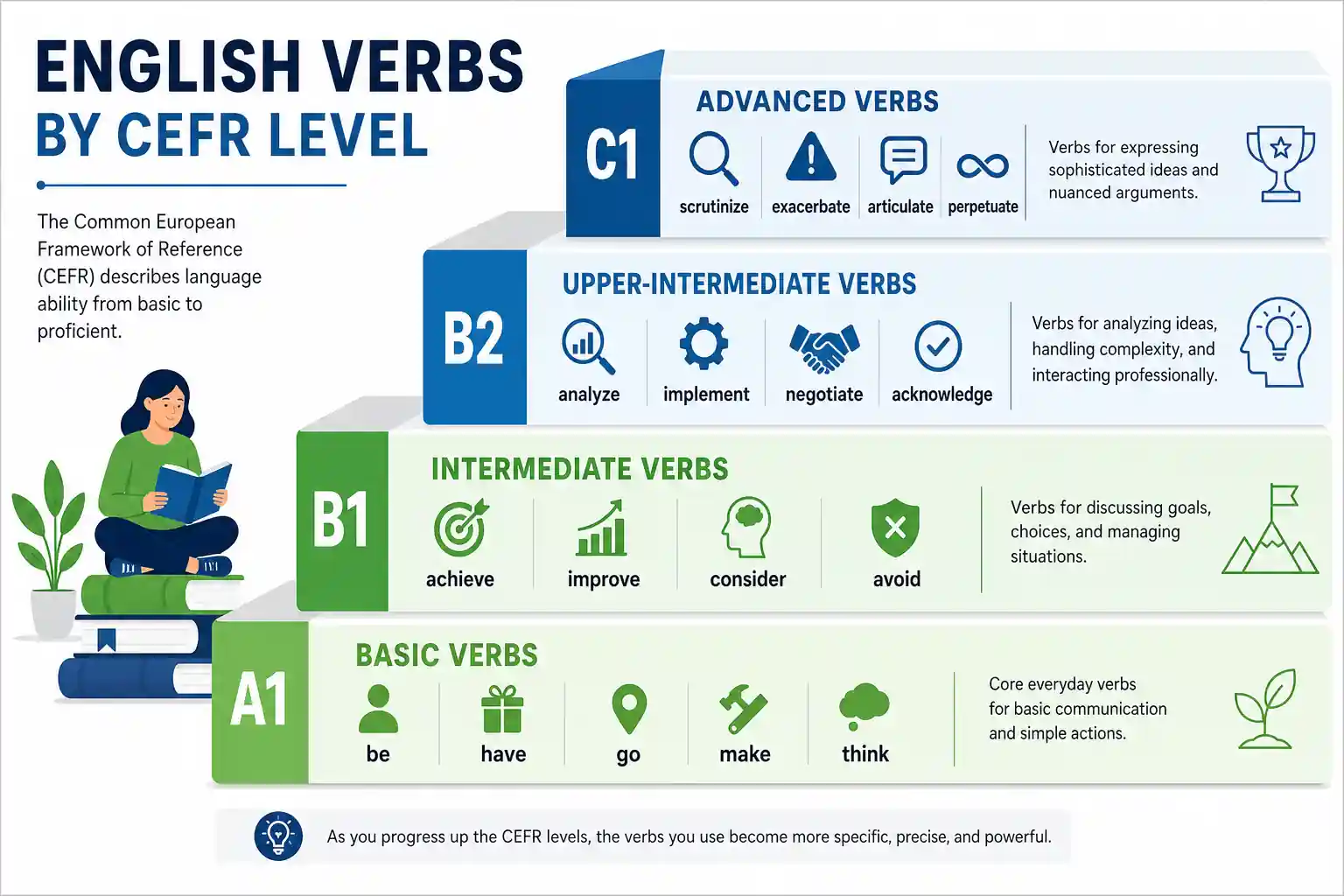
Verificação Rápida de Progresso
Use esta tabela para avaliar com honestidade seu conhecimento de verbos. Para cada nível, conte quantos verbos você:
- Consegue usar — emprega na fala ou na escrita sem pensar
- Reconhece — entende ao ler ou ouvir
- Ainda não conhece — não sabe o que significam
| Nível | Total | Consigo Usar | Reconheço | Não Conheço | Seu Nível |
|---|---|---|---|---|---|
| A1 | 75 | _ | _ | _ | 60+ em “Consigo usar” → pronto para B1 |
| B1 | 75 | _ | _ | _ | 60+ em “Consigo usar” → pronto para B2 |
| B2 | 75 | _ | _ | _ | 60+ em “Consigo usar” → pronto para C1 |
| C1 | 75 | _ | _ | _ | 50+ em “Consigo usar” → nível avançado |
Objetivo: passar os verbos de “Reconheço” para “Consigo usar”. Essa é a diferença entre vocabulário passivo e ativo. Escreva frases, use os verbos em conversas e revise com repetição espaçada.
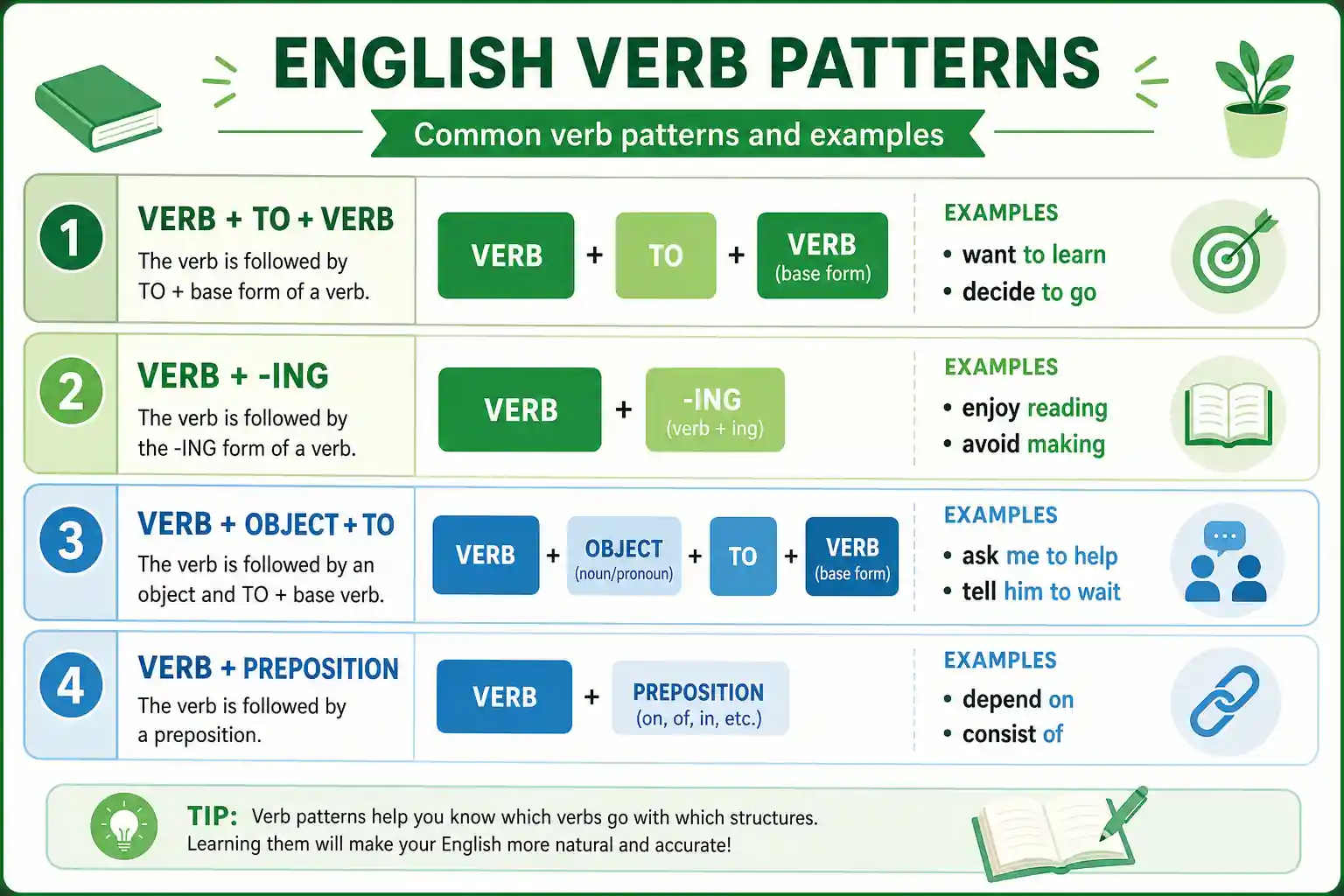
Padrões Verbais: Referência Principal
A origem mais comum dos erros não é o significado do verbo, mas o que vem depois dele. Veja aqui uma referência dos principais padrões:
Verbo + TO + Infinitivo
Estes verbos são seguidos de “to + verbo”:
want, need, decide, hope, plan, offer, refuse, promise, agree, learn, seem, appear, tend, manage, fail, afford, attempt, expect, intend, pretend
She decided to leave early. / They agreed to pay the full amount.
Verbo + -ING (Gerúndio)
Estes verbos são seguidos da forma terminada em -ing:
enjoy, avoid, consider, suggest, finish, mind, keep, practice, deny, admit, imagine, involve, risk, miss, delay, recommend, appreciate
I enjoy reading before bed. / She avoided answering the question.
Verbo + Objeto + TO + Infinitivo
Estes verbos precisam de um objeto seguido de “to + verbo”:
ask, tell, want, expect, allow, encourage, invite, force, remind, persuade, advise, warn, convince, enable, require
He asked me to help. / They encouraged her to apply.
Verbo + Preposição
Estas combinações de verbo + preposição costumam causar erros quando o estudante usa a preposição incorreta:
| Verbo | Preposição Correta | Exemplo |
|---|---|---|
| depend | on | It depends on the weather. |
| consist | of | The team consists of ten people. |
| belong | to | This belongs to me. |
| apply | for (emprego) / to (regra) | She applied for a visa. |
| suffer | from | He suffers from allergies. |
| contribute | to | Exercise contributes to good health. |
| result | in / from | The error resulted in delays. |
| comply | with | You must comply with the rules. |
| object | to | She objected to the proposal. |
| cope | with | He couldn’t cope with the pressure. |
Vocabulário para Praticar
Aqui estão 25 verbos versáteis das seções B1–B2. Adicione-os ao seu vocabulário e pratique usá-los em frases com os padrões corretos.
cooperate
verbo
cooperar, colaborar
evaluate
verbo
avaliar, julgar
Exemplos
- Companies evaluate job candidates based on experience, skills, and personality.
- Teachers evaluate student progress through tests, projects, and classroom participation.
donate
verbo
doar
Exemplos
- Many people donate money to charities that help homeless individuals.
- She decided to donate blood to help patients in emergency situations.
discourage
verbo
desencorajar
Exemplos
- Don't let one failure discourage you from pursuing your dreams.
- High prices discourage many people from buying organic food products.
graduate
verbo
se formar
Exemplos
- She will graduate from university next year with a degree in engineering.
- Students must complete all requirements before they can graduate from high school.
resolve
verbo
resolver
Exemplos
- Mediator helps parties resolve dispute through negotiation.
- Technical team will resolve software problems quickly.
off
adjetivo
fora, desligado, apagado
Exemplos
- Please turn off the lights before leaving the room.
- The dog ran off into the forest chasing wild rabbits.
stress
verbo
estressar, sobrecarregar, pressionar
Exemplos
- Heavy workload may stress employees beyond limits.
- Teacher will stress importance of homework completion.
guide
verbo
orientar
Exemplos
- Parents should guide their children to make responsible decisions.
- The experienced hiker will guide the group through the mountain trail safely.
artery
substantivo
artéria
Exemplos
- The blocked artery required immediate surgical intervention to save his life.
- This highway is a major artery connecting the city to surrounding areas.
coastal
adjetivo
costeiro
Exemplos
- Coastal towns often depend on fishing and tourism for their economy.
- The coastal erosion threatens many beachfront properties and buildings.
candidate
substantivo
candidato
Exemplos
- Each presidential candidate presented their policy plans to voters.
- The job candidate impressed the interview panel with her experience.
horizon
substantivo
horizonte
Exemplos
- The sun disappeared behind the horizon as evening approached.
- Traveling broadens your horizon and exposes you to new cultures.
jury
substantivo
juri
Exemplos
- The jury deliberated for several hours before reaching a verdict.
- The talent show jury consisted of professional musicians and entertainers.
prejudice
substantivo
preconceito
Exemplos
- Education helps overcome prejudice and promotes understanding.
- Racial prejudice damages communities and individuals alike.
tragedy
substantivo
tragédia
Exemplos
- Natural tragedy affects thousands of innocent people.
- Personal tragedy changes person's life perspective completely.
boom
substantivo
explosão, auge
Exemplos
- The boom of thunder echoed across the valley.
- The technology boom created many new millionaires.
admission
substantivo
admissão
Exemplos
- Her admission to the prestigious medical school was the result of hard work.
- The museum offers free admission on the first Sunday of every month.
union
substantivo
união, associação
Exemplos
- Labor union protects worker rights and interests.
- Marriage union joins two people in partnership.
voyage
substantivo
viagem
Exemplos
- Space exploration represents humanity's greatest voyage into the unknown.
- The ocean voyage from Europe to America took several weeks in the past.
humorous
adjetivo
engraçado, divertido, cômico
Exemplos
- She writes humorous articles about everyday life and family experiences.
- The humorous speech made everyone laugh and lightened the serious mood.
lifelong
adjetivo
para toda a vida
Exemplos
- Learning is a lifelong process that never truly ends.
- Their lifelong friendship began during elementary school years.
motivated
adjetivo
motivado
Exemplos
- Motivated employee seeks additional responsibilities and challenges at work.
- Success requires being motivated even when facing difficult obstacles.
indispensable
adjetivo
indispensável, essencial, fundamental
Exemplos
- Clean water is indispensable for human survival and good health.
- Her experience and skills make her indispensable to the research team.
total
adjetivo
total
Exemplos
- Total cost includes all fees and expenses.
- Total silence fills room during meditation session.
O Que Fazer a Seguir
-
Encontre seu nível. Verifique a lista no seu nível CEFR atual. Marque os verbos que você consegue entender mas não usa ativamente.
-
Aprenda 5 verbos por dia. Para cada verbo, aprenda seu significado, padrão principal (o que o segue) e uma frase de exemplo.
-
Foque nos padrões. Saber que “suggest” vem seguido de -ing (não “to + verbo”) evita erros que até estudantes avançados cometem.
-
Leia conteúdo rico em verbos. Notícias, textos acadêmicos e artigos de negócios são cheios de verbos B2–C1. Os artigos do nosso blog ajudam você a encontrar esses verbos em contextos naturais.
-
Estude palavras da mesma família. Cada verbo está ligado a outras palavras. Analyze → analysis (substantivo), analytical (adjetivo), analytically (advérbio). Aprender a família toda a partir de um verbo amplia seu vocabulário com eficiência. Consulte também a biblioteca organizada por nível CEFR.
FAQ
Quais são os verbos mais comuns em inglês?
Os 10 verbos mais frequentes são: be, have, do, say, go, get, make, know, think e take. Juntos, eles correspondem a aproximadamente 25% de todos os verbos usados na fala. Com os próximos 40 mais comuns, cobrem cerca de 70% do uso cotidiano de verbos. Os 30% restantes se distribuem entre milhares de verbos menos frequentes, mas ainda importantes.
Quantos verbos existem em inglês?
O inglês tem aproximadamente 25.000 verbos, mas a maioria é rara ou muito especializada. Cerca de 5.000 aparece em dicionários gerais. Para a fluência prática, conhecer 300–500 verbos — com seus padrões e colocações — é suficiente para se expressar em quase todas as situações cotidianas. Em contextos acadêmicos ou profissionais, acrescente mais 200–300 verbos especializados.
Qual é a diferença entre verbos regulares e irregulares?
Verbos regulares formam o passado adicionando “-ed” (work → worked, play → played). Verbos irregulares têm formas imprevisíveis que precisam ser memorizadas (go → went, think → thought, be → was). Cerca de 200 verbos irregulares são usados com frequência, e muitos estão entre os verbos mais comuns. Consulte o guia completo de verbos irregulares para ver todas as formas.
O que são padrões verbais e por que eles importam?
Padrões verbais são as estruturas gramaticais que vêm depois de verbos específicos. Por exemplo, “enjoy” é seguido de -ing (enjoy reading), enquanto “want” é seguido de “to + verbo” (want to read). Usar a estrutura errada — enjoy to read ou want reading — é um erro gramatical que falantes nativos percebem imediatamente. Aprender os padrões junto com os significados ajuda a evitar esses erros e faz seu inglês soar natural.
Como posso aprender verbos em inglês mais rapidamente?
Aprenda verbos em contexto, não isoladamente. Para cada verbo novo: (1) estude o significado; (2) aprenda seu padrão principal, ou seja, o que vem depois dele; (3) leia de duas a três frases de exemplo; (4) escreva uma frase própria. Use repetição espaçada para revisar. Agrupe verbos por tema — por exemplo, verbos de comunicação — em vez de organizá-los em ordem alfabética: o cérebro memoriza melhor palavras relacionadas.