Phrasal Verbs com GET: Todos os Significados e Exemplos
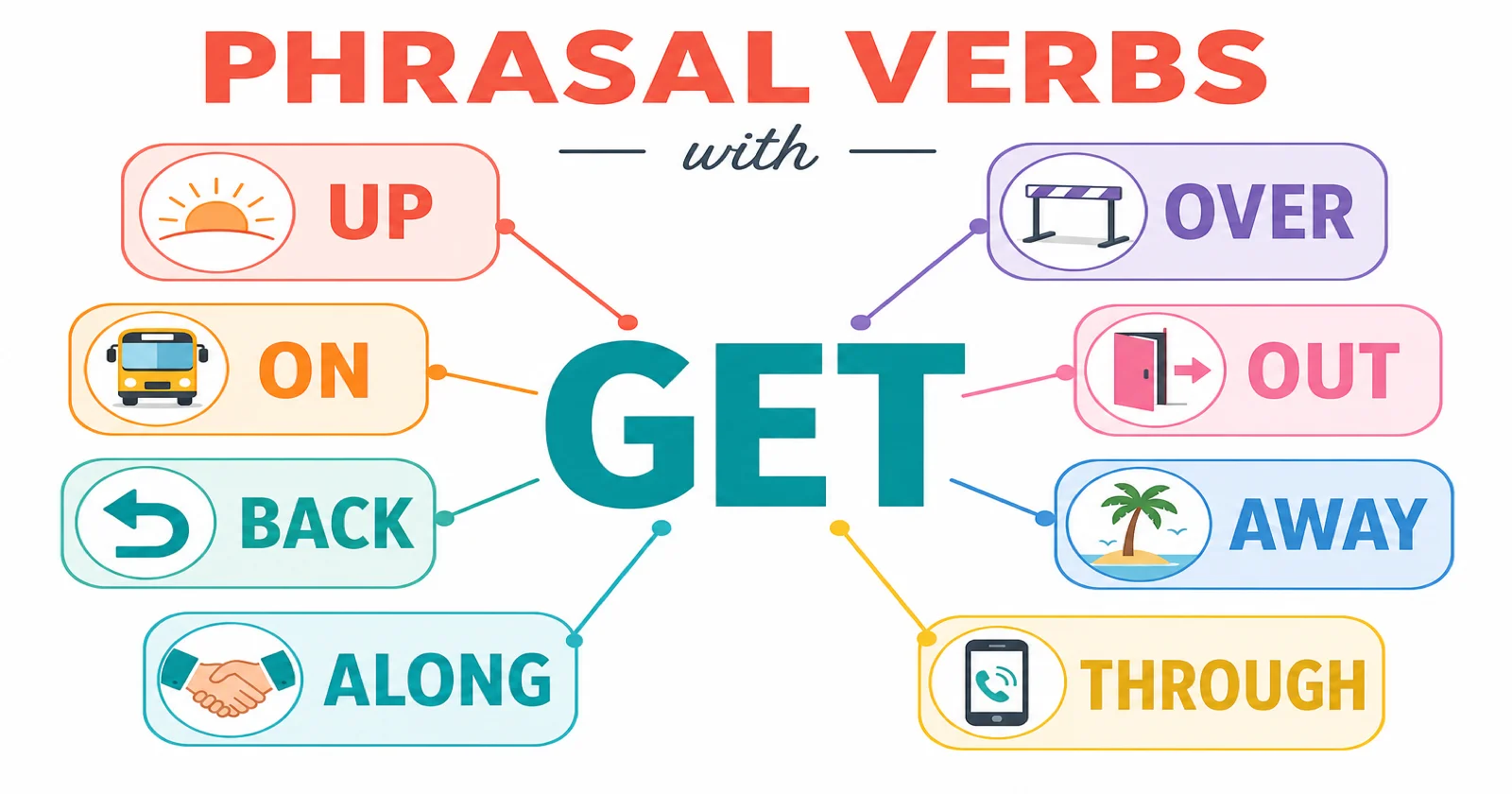
GET é o verbo mais versátil do inglês. Sozinho, significa “obter” ou “tornar-se”. Mas adicione uma preposição — up, over, on, away, through, out, along, by — e o significado muda completamente. “Get over” pode significar se recuperar de uma doença, subir por cima de um muro ou superar um término de relacionamento. “Get out” pode significar sair de um lugar, escapar de um perigo ou se tornar de conhecimento público.
Falantes nativos usam phrasal verbs com GET dezenas de vezes por dia, frequentemente sem perceber. Para aprendizes, isso cria uma lacuna: você entende cada palavra em “She couldn’t get through to him”, mas a frase significa algo completamente diferente do que as palavras individuais sugerem.
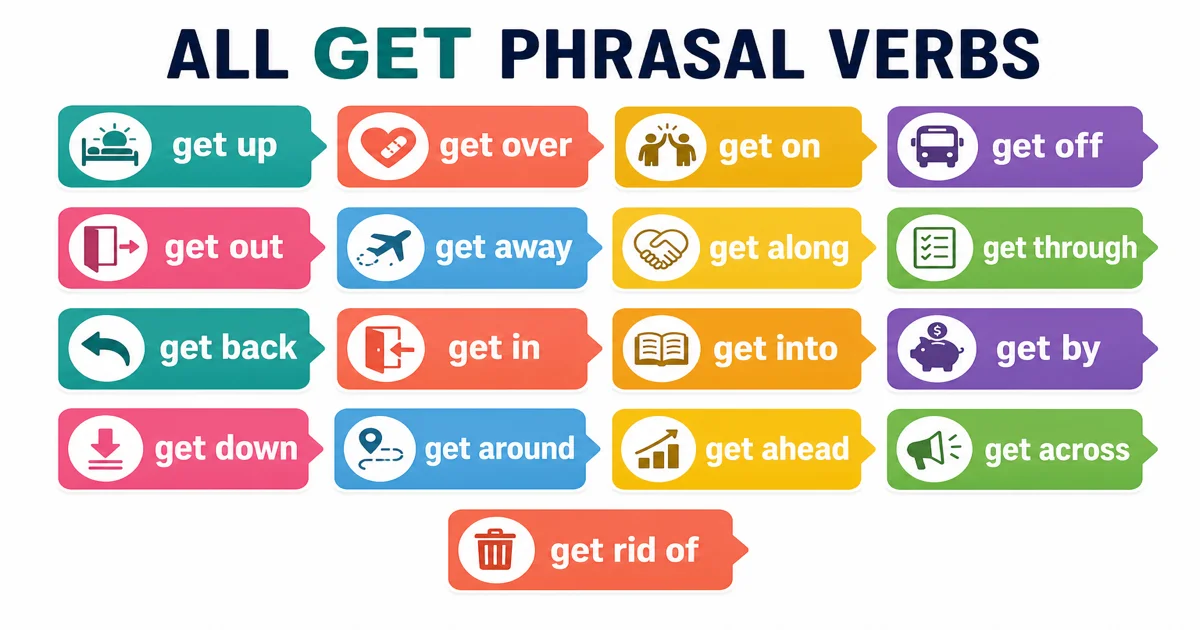
Este guia cobre todos os principais phrasal verbs com GET, organizados pela partícula (up, over, on, etc.). Cada entrada inclui todos os significados, exemplos da vida real, notas de formalidade e erros comuns.
- Phrasal verbs cobertos: 25+
- Significados explicados: 60+
- Nível: B1–C1 (intermediário a avançado)
- Foco: significados, frases de exemplo, notas de uso, erros comuns
Para o guia completo de phrasal verbs em inglês, veja o Guia Completo de Phrasal Verbs em Inglês.
GET UP — 3 Significados
1. Levantar da cama; acordar
O significado mais comum. Usado todos os dias por todos.
I get up at 6:30 every morning. She got up early to catch the first train. What time do you usually get up on weekends?
2. Levantar-se de uma posição sentada ou deitada
He fell on the ice but got up quickly. The audience got up and applauded. She got up from her desk and stretched.
3. Organizar ou preparar (inglês britânico, informal)
They got up a petition to save the park. We should get up a group to visit the museum.
Erro comum: Diga “I got up” ou “I got out of bed” — não misture os dois.
GET OVER — 4 Significados
1. Se recuperar de (doença, choque ou dor emocional)
O significado mais comum. A recuperação leva tempo, e “get over” implica que o processo está completo.
It took her months to get over the flu. He still hasn’t gotten over his breakup. You need time to get over the shock.
2. Superar (um problema ou dificuldade)
We need to get over this obstacle before moving forward. Once you get over the initial confusion, the software is easy to use.
3. Aceitar algo surpreendente ou difícil de acreditar
Frequentemente usado no negativo ou com “can’t.”
I can’t get over how much the city has changed! She couldn’t get over the fact that she had actually won.
4. Cruzar ou subir por cima de uma barreira física
The cat managed to get over the fence. We need to get over this hill before sunset.
Erro comum: “Get over it” soa dismissivo na conversa. Use com cuidado — implica que a pessoa deveria parar de reclamar.
GET ON — 5 Significados
1. Embarcar (ônibus, trem, avião ou veículo grande)
We got on the bus at the wrong stop. Hurry — we need to get on the plane before they close the gate. She got on the train to London at 8 a.m.
2. Ter um bom relacionamento (inglês britânico: get on; americano: get along)
Do you get on with your colleagues? They don’t get on very well — they argue constantly. I’ve always gotten on well with my neighbors.
3. Continuar com uma tarefa; progredir
Stop talking and get on with your work. Let’s get on with the meeting — we’re behind schedule. How are you getting on with the project?
4. Se virar ou lidar (inglês britânico)
How’s your mother getting on these days? He’s getting on well after the surgery.
5. Ficar mais velho (informal)
She’s getting on in years, but she’s still very active. He’s getting on a bit — he’ll be 70 next month.
Erro comum: “Get on” para veículos depende do tamanho. Suba ON em ônibus/trem/avião (grande). Entre IN em carro/táxi (pequeno).
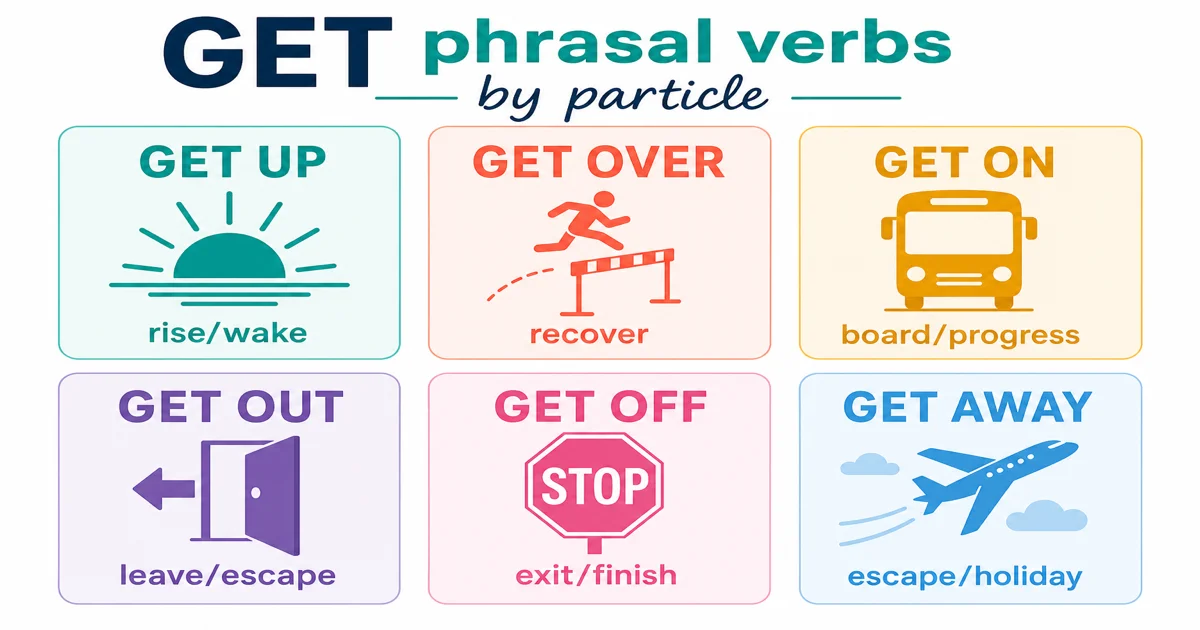
GET OFF — 4 Significados
1. Sair ou descer (de ônibus, trem ou veículo grande)
O oposto de “get on.”
We get off at the next stop. She got off the train and walked to the office. Don’t forget to get off at Central Station.
2. Sair do trabalho; terminar o dia
What time do you get off work today? I get off at 5, so I can meet you at 5:30.
3. Evitar punição ou receber sentença leve
He got off with just a warning. The lawyer helped her get off the charges. He committed fraud but somehow got off scot-free.
4. Parar de tocar ou segurar (imperativo)
Get off my phone! The sign said “Get off the grass.”
Erro comum: “Get off FROM the bus” — não é necessário “from”. Diga “get off the bus.”
GET OUT — 4 Significados
1. Sair de um lugar
Get out of my house! We should get out of here before the storm hits. She got out of the car and slammed the door.
2. Escapar
The prisoners tried to get out through a tunnel. How did the dog get out of the yard?
3. Tornar-se conhecido (de informações ou segredos)
If this information gets out, there will be a scandal. Word got out that the company was closing.
4. Remover ou extrair algo
I can’t get this stain out of my shirt. She got out her wallet and paid the bill.
GET AWAY — 3 Significados
1. Escapar ou fugir
The thieves got away before the police arrived. The bird got away from the cat.
2. Ir de férias; sair para uma pausa
We need to get away for a few days — I’m exhausted. They got away to the mountains for the weekend.
3. Evitar consequências (get away with)
He cheated on the test and got away with it. You can’t get away with lying to your boss forever. She always gets away with coming to work late.
Nota: “Get away!” como exclamação significa “Não acredito!” (inglês britânico informal) ou “Saia!” (imperativo).
GET ALONG — 2 Significados
1. Ter um relacionamento amigável
O equivalente americano do britânico “get on.” Muito comum na fala cotidiana.
Do you get along with your sister? The new employee gets along well with everyone. They didn’t get along at first, but now they’re good friends.
2. Se virar ou sobreviver
How do you get along on such a small salary? We get along fine without a car.
GET THROUGH — 4 Significados
1. Terminar ou completar (uma tarefa, período ou quantidade)
I got through all 500 pages in three days. How are we going to get through all this work by Friday? She finally got through the exam preparation.
2. Sobreviver a um período difícil
It was a tough year, but we got through it. Music helped me get through the lockdown.
3. Alcançar alguém por telefone
I’ve been trying to call her all day, but I can’t get through. I finally got through to customer service after 40 minutes.
4. Fazer alguém entender
I tried to explain, but I couldn’t get through to him. How can I get through to my teenager about the importance of studying?
GET BACK — 3 Significados
1. Retornar
What time did you get back from vacation? I’ll get back to London by Friday. She got back home late last night.
2. Recuperar ou reaver algo
I got my money back after returning the product. Did you ever get back the book you lent him?
3. Se vingar (get back at)
He’s trying to get back at his ex-partner. She got back at him by revealing his secret.
GET IN — 3 Significados
1. Entrar em um veículo pequeno (carro, táxi)
O oposto de “get out of.”
Get in the car — we’re late! She got in a taxi and headed to the airport.
2. Chegar
What time does your flight get in? The train gets in at 9:15. He got in late last night.
3. Ser aceito (em uma escola, programa ou evento)
She applied to five universities and got in to three. It’s a popular club — it’s hard to get in. Did you get in? I heard the competition was fierce.
GET INTO — 3 Significados
1. Tornar-se interessado ou envolvido em
She’s really getting into photography lately. He got into cooking during the pandemic. I can’t get into this book — it’s too slow.
2. Entrar (em uma escola, programa ou profissão)
Getting into medical school is extremely competitive. How did you get into marketing?
3. Entrar em apuros
He keeps getting into fights at school. Don’t get into an argument with her — you won’t win. What has gotten into you today? You’re acting strange.
GET BY — 2 Significados
1. Conseguir sobreviver com recursos limitados
It’s hard to get by on minimum wage. We don’t have much, but we get by. She gets by with a little help from her family.
2. Passar (mover-se fisicamente por alguém)
Excuse me, could I get by? I need to reach the exit. The hallway is so narrow, it’s hard to get by.
GET DOWN — 3 Significados
1. Fazer alguém se sentir deprimido ou infeliz
The constant rain is really getting me down. Don’t let the criticism get you down.
2. Descer fisicamente ou se abaixar
Get down from that tree before you fall! She got down on her knees to search under the sofa.
3. Anotar ou registrar
Let me get that down before I forget. Did you get down her phone number?
GET AROUND — 3 Significados
1. Viajar de lugar em lugar
It’s easy to get around São Paulo by metro. How do you get around without a car?
2. Evitar ou encontrar uma forma de contornar (uma regra ou problema)
There’s no way to get around this regulation. She always finds a way to get around the rules.
3. Tornar-se amplamente conhecido (de notícias ou informações)
News gets around fast in a small town. Word got around that the company was being sold.
GET AHEAD — 1 Significado
Progredir, especialmente na carreira ou vida
You need to work hard to get ahead in this industry. She’s determined to get ahead in her career. It’s difficult to get ahead when you’re always playing catch-up.
GET ACROSS — 1 Significado
Comunicar uma ideia com sucesso
I’m trying to get my point across, but nobody seems to understand. The teacher got the concept across using simple examples. How can I get this message across to the team?
GET RID OF — 1 Significado
Remover, descartar ou eliminar
Uma das frases mais úteis em inglês — usada constantemente na vida diária.
We need to get rid of this old furniture. How do I get rid of these ants in the kitchen? She finally got rid of her cold after a week of rest.
Tabela de Referência Rápida
| Phrasal Verb | Significado Principal | Exemplo |
|---|---|---|
| get up | levantar da cama | I get up at 7 every day. |
| get over | se recuperar de | She got over the illness quickly. |
| get on | embarcar; ter um bom relacionamento | Get on the bus. / We get on well. |
| get off | sair de veículo; terminar o trabalho | Get off at the next stop. |
| get out | sair; escapar | Get out of here! |
| get away | escapar; ir de férias | The thieves got away. |
| get along | ter um relacionamento amigável | Do you get along with your boss? |
| get through | terminar; sobreviver; alcançar por telefone | I can’t get through to her. |
| get back | retornar; recuperar | When did you get back? |
| get in | entrar (carro); chegar; ser aceito | Get in the car. |
| get into | tornar-se interessado em | She’s getting into yoga. |
| get by | conseguir sobreviver | We get by on a small budget. |
| get down | sentir-se deprimido; descer; anotar | The news got me down. |
| get around | viajar; evitar uma regra | It’s easy to get around by bus. |
| get ahead | progredir | Work hard to get ahead. |
| get across | comunicar uma ideia | I couldn’t get my point across. |
| get rid of | remover ou descartar | Get rid of the old files. |
GET IN vs. GET ON: Quais Veículos?
Isso confunde quase todo aprendiz. A regra é baseada no tamanho do veículo:
| Use GET ON | Use GET IN |
|---|---|
| ônibus | carro |
| trem | táxi |
| avião | van (pequena) |
| navio | caminhão (cabine) |
| bicicleta | canoa |
| motocicleta | helicóptero |
Padrão: GET ON = você pode ficar em pé ou andar dentro. GET IN = você senta em um espaço fechado pequeno.
Oposto: GET OFF (ônibus, trem) / GET OUT OF (carro, táxi).
Erros Comuns com Phrasal Verbs com GET
| Erro | Forma Correta | Por quê |
|---|---|---|
|
|
get on the bus | Sem preposição depois de “get on” |
|
|
get off the train | Sem “from” necessário |
|
|
I got up / I got out of bed | Descarte “bed” ou use “get out of” |
|
|
get over an illness | Sem “from” depois de “get over” |
|
|
I can’t get through to her | Precisa de “to” para telefone/comunicação |
Palavras para Praticar
boom
substantivo
explosão, auge
Exemplos
- The boom of thunder echoed across the valley.
- The technology boom created many new millionaires.
cooperate
verbo
cooperar, colaborar
evaluate
verbo
avaliar, julgar
Exemplos
- Companies evaluate job candidates based on experience, skills, and personality.
- Teachers evaluate student progress through tests, projects, and classroom participation.
graduate
verbo
se formar
Exemplos
- She will graduate from university next year with a degree in engineering.
- Students must complete all requirements before they can graduate from high school.
horizon
substantivo
horizonte
Exemplos
- The sun disappeared behind the horizon as evening approached.
- Traveling broadens your horizon and exposes you to new cultures.
indispensable
adjetivo
indispensável, essencial, fundamental
Exemplos
- Clean water is indispensable for human survival and good health.
- Her experience and skills make her indispensable to the research team.
jury
substantivo
juri
Exemplos
- The jury deliberated for several hours before reaching a verdict.
- The talent show jury consisted of professional musicians and entertainers.
lifelong
adjetivo
para toda a vida
Exemplos
- Learning is a lifelong process that never truly ends.
- Their lifelong friendship began during elementary school years.
motivated
adjetivo
motivado
Exemplos
- Motivated employee seeks additional responsibilities and challenges at work.
- Success requires being motivated even when facing difficult obstacles.
normally
advérbio
normalmente
Exemplos
- Heart normally beats between sixty and hundred times per minute.
- Students normally arrive at school before morning bell rings.
off
adjetivo
fora, desligado, apagado
Exemplos
- Please turn off the lights before leaving the room.
- The dog ran off into the forest chasing wild rabbits.
prejudice
substantivo
preconceito
Exemplos
- Education helps overcome prejudice and promotes understanding.
- Racial prejudice damages communities and individuals alike.
resolve
verbo
resolver
Exemplos
- Mediator helps parties resolve dispute through negotiation.
- Technical team will resolve software problems quickly.
stress
verbo
estressar, sobrecarregar, pressionar
Exemplos
- Heavy workload may stress employees beyond limits.
- Teacher will stress importance of homework completion.
total
adjetivo
total
Exemplos
- Total cost includes all fees and expenses.
- Total silence fills room during meditation session.
tragedy
substantivo
tragédia
Exemplos
- Natural tragedy affects thousands of innocent people.
- Personal tragedy changes person's life perspective completely.
union
substantivo
união, associação
Exemplos
- Labor union protects worker rights and interests.
- Marriage union joins two people in partnership.
voyage
substantivo
viagem
Exemplos
- Space exploration represents humanity's greatest voyage into the unknown.
- The ocean voyage from Europe to America took several weeks in the past.
candidate
substantivo
candidato
Exemplos
- Each presidential candidate presented their policy plans to voters.
- The job candidate impressed the interview panel with her experience.
discourage
verbo
desencorajar
Exemplos
- Don't let one failure discourage you from pursuing your dreams.
- High prices discourage many people from buying organic food products.
donate
verbo
doar
Exemplos
- Many people donate money to charities that help homeless individuals.
- She decided to donate blood to help patients in emergency situations.
firmly
advérbio
firmemente, com firmeza
Exemplos
- Hold the rope firmly while climbing down the steep mountain slope.
- The manager firmly believed in treating all employees with respect.
guide
verbo
orientar
Exemplos
- Parents should guide their children to make responsible decisions.
- The experienced hiker will guide the group through the mountain trail safely.
humorous
adjetivo
engraçado, divertido, cômico
Exemplos
- She writes humorous articles about everyday life and family experiences.
- The humorous speech made everyone laugh and lightened the serious mood.
admission
substantivo
admissão
Exemplos
- Her admission to the prestigious medical school was the result of hard work.
- The museum offers free admission on the first Sunday of every month.
O Que Fazer a Seguir
-
Identifique sua área mais fraca. Leia a lista acima e identifique quais phrasal verbs com GET você confunde ou nunca usa. Foque neles primeiro.
-
Crie frases. Para cada phrasal verb, escreva 2–3 frases sobre a sua própria vida. Conexões pessoais fazem o vocabulário ficar.
-
Adicione ao Linglify para repetição espaçada. O sistema testará você em intervalos ótimos até que esses phrasal verbs se tornem automáticos.
-
Leia o guia completo de phrasal verbs — o Guia Completo de Phrasal Verbs em Inglês cobre 200+ phrasal verbs por todos os verbos base.
-
Aprenda phrasal verbs com MAKE — o guia Phrasal Verbs com MAKE segue o mesmo formato para outro verbo essencial.
FAQ
Quais são os phrasal verbs mais comuns com GET?
Os cinco mais usados frequentemente são: get up (levantar da cama), get on/along (ter um bom relacionamento), get over (se recuperar de), get through (terminar/sobreviver) e get rid of (remover/descartar). Esses aparecem na conversa cotidiana dezenas de vezes por dia.
Por que GET tem tantos phrasal verbs?
GET é um dos verbos ingleses mais antigos e fundamentais. Seu significado principal — “obter” ou “tornar-se” — é extremamente flexível, o que lhe permite combinar com quase qualquer preposição para criar novos significados.
Como sei quando usar GET IN vs. GET ON?
Use GET ON para veículos grandes onde você pode ficar em pé e andar (ônibus, trem, avião, navio). Use GET IN para veículos pequenos onde você senta em um espaço fechado (carro, táxi). O mesmo padrão se aplica ao contrário: GET OFF do ônibus, GET OUT OF do carro.
Os phrasal verbs com GET são formais ou informais?
A maioria dos phrasal verbs com GET é de registro neutro a informal e perfeitamente adequado para fala cotidiana, e-mails e escrita geral. Em escrita muito formal, verbos de origem latina são preferidos: recover em vez de “get over”, eliminate em vez de “get rid of”.
Quantos significados pode ter um phrasal verb com GET?
Alguns têm até cinco significados distintos. “Get on” pode significar embarcar num veículo, ter um relacionamento, progredir, se virar ou ficar mais velho. O contexto sempre determina o significado.