
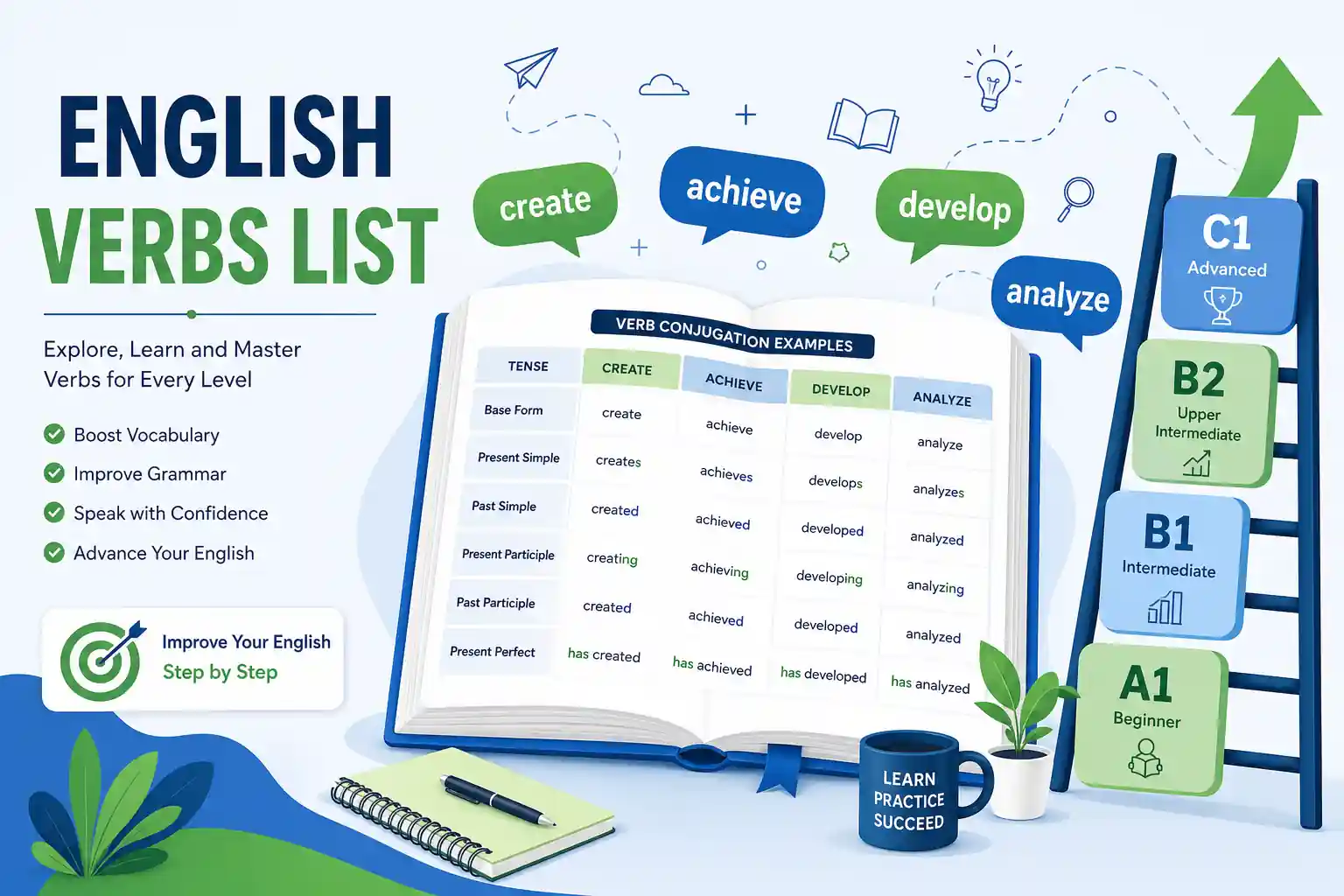
Английские глаголы: список 300 самых важных глаголов по уровням
Глаголы — это двигатель каждого английского предложения. Без глагола ничего не происходит: никто ничего не делает, не становится кем-то и не переживает никаких ощущений. Существительные дают названия миру, прилагательные его описывают, но именно глаголы приводят его в движение.
В английском языке насчитывается около 25 000 глаголов, но большинство из них вам не понадобятся. Исследования устной и письменной английской речи показывают, что 300 самых частотных глаголов покрывают примерно 90% всего употребления глаголов в повседневном общении. Освойте эти 300 — и вы сможете выразить практически всё, что хотите сказать.
В этом руководстве представлены 300 глаголов, организованных по уровню CEFR (A1–C1) и тематическим категориям. Для каждого глагола указано значение, пример предложения и наиболее типичная конструкция, показывающая, как носители языка используют его на практике. Используйте этот список для изучения лексики, в качестве справочника или инструмента самооценки, чтобы найти пробелы в своём словарном запасе.
- Всего глаголов: 300
- Организация: по уровню CEFR (A1–C1) и смысловым категориям
- Формат: Глагол → Значение → Конструкция → Пример
- Подходит для: расширения словарного запаса, грамматического справочника, подготовки к экзаменам
Неправильные формы глаголов (прошедшее время и причастие прошедшего времени) смотрите в статье Неправильные глаголы: 200 глаголов с формами. О глаголах с предлогами читайте в статье Фразовые глаголы английского языка: полное руководство.
Как работают английские глаголы: краткий обзор
Прежде чем перейти к списку, вот что отличает английские глаголы:
Формы глагола
Каждый английский глагол имеет 5 форм (правильные глаголы) или до 5 неправильных форм:
| Форма | Правильный (work) | Неправильный (go) | Использование |
|---|---|---|---|
| Базовая | work | go | Present simple, инфинитив |
| 3-е лицо -s | works | goes | He/she/it present |
| Past simple | worked | went | Прошедшие события |
| Past participle | worked | gone | Perfect, пассив |
| Форма -ing | working | going | Continuous, герундий |
Переходные и непереходные глаголы
| Тип | Определение | Пример |
|---|---|---|
| Переходный | Требует дополнения | She wrote a letter. (написала что?) |
| Непереходный | Дополнение не нужно | He arrived late. (прибыл что? — ничего) |
| Оба варианта | Используется и так, и так | She runs a company. (переходный) / She runs every morning. (непереходный) |
Глагольные конструкции
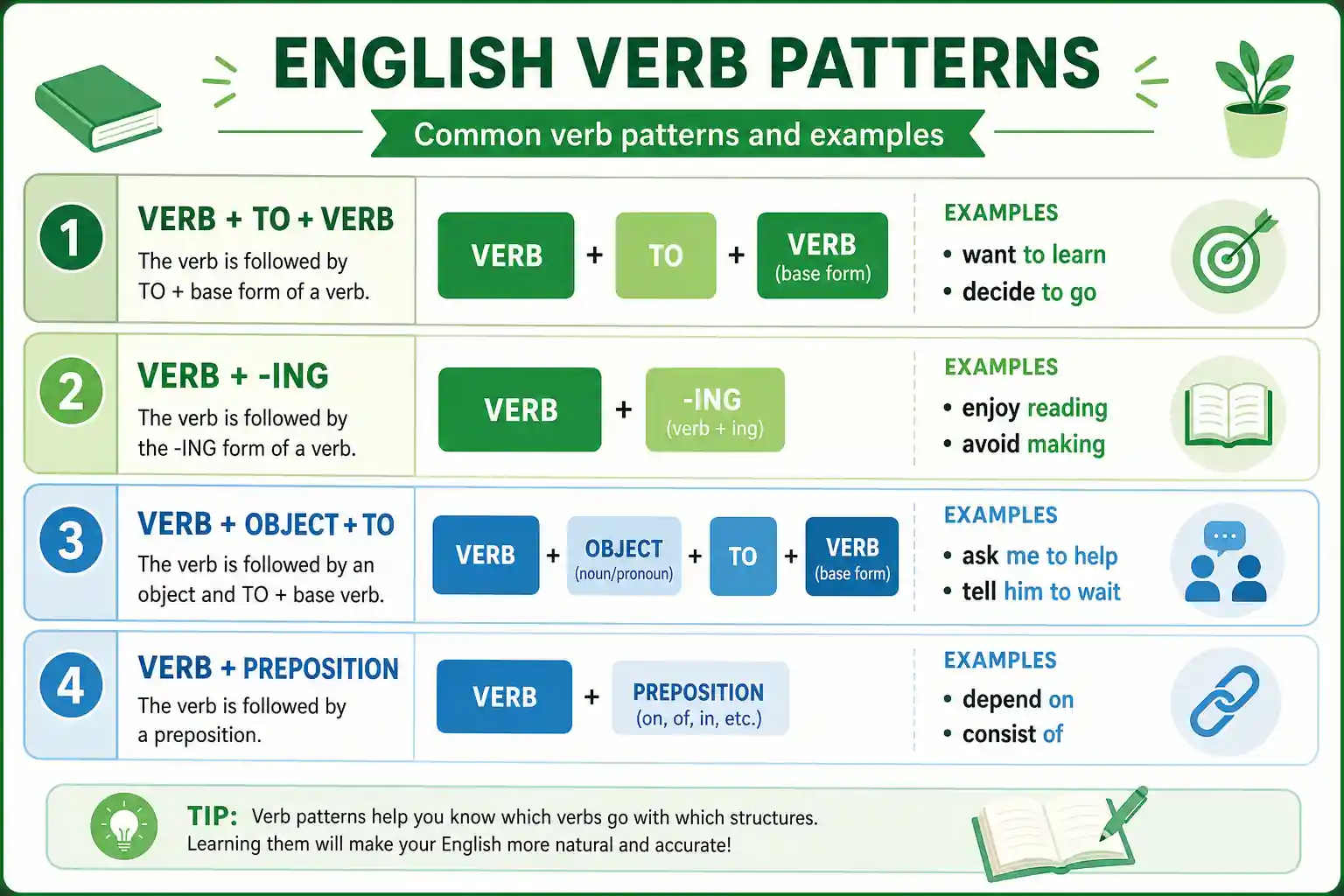
Знать значение глагола недостаточно — нужно знать, что за ним следует:
| Конструкция | Пример |
|---|---|
| verb + infinitive (to + verb) | I want to learn English. |
| verb + -ing | I enjoy reading books. |
| verb + object | She made a decision. |
| verb + object + infinitive | He asked me to help. |
| verb + preposition | She depends on her family. |
В приведённом ниже списке для каждого глагола указана наиболее типичная конструкция, чтобы вы знали, как его использовать, а не только что он означает.
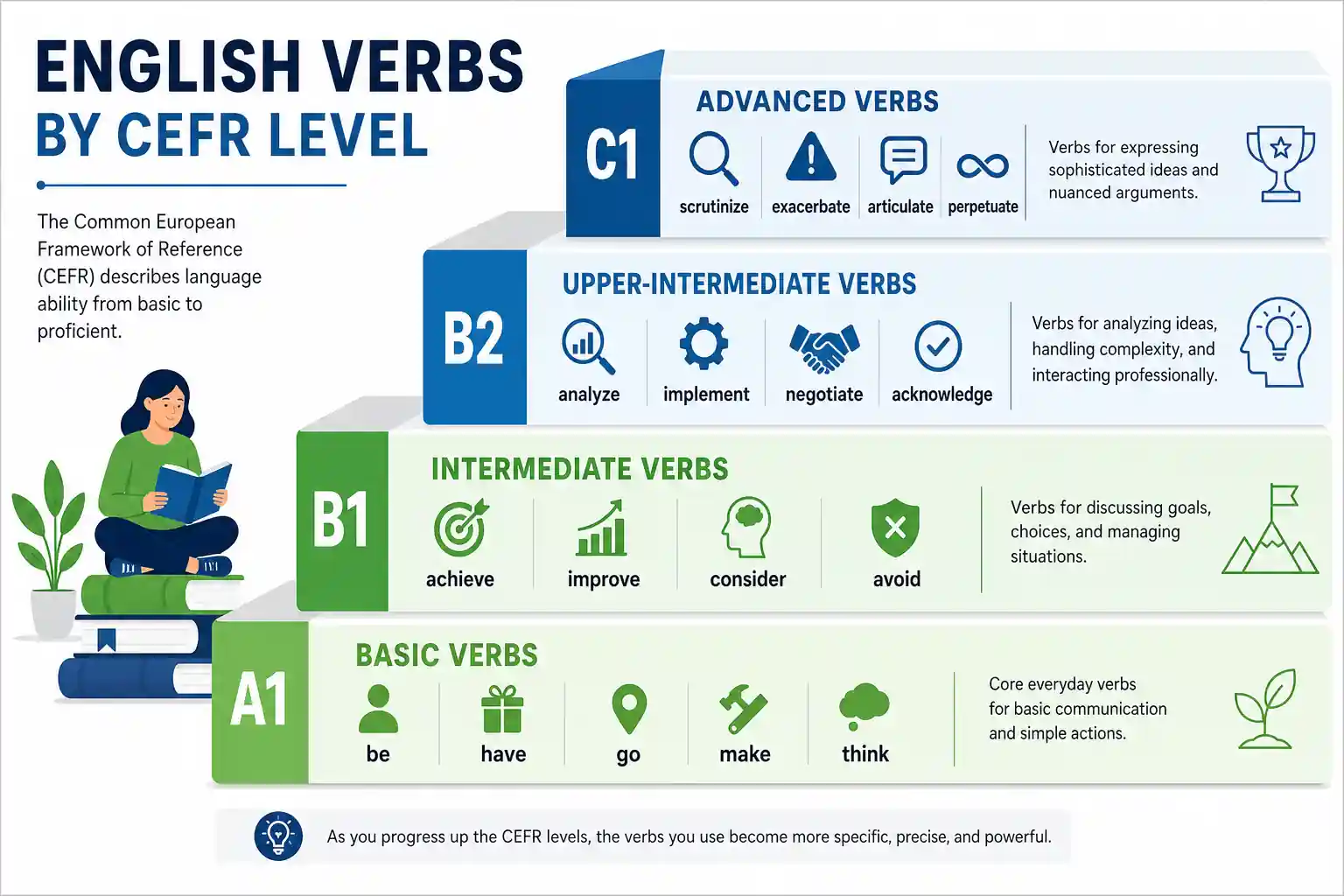
Уровень A1: Базовые глаголы (75 глаголов)
Эти глаголы — абсолютный фундамент. Каждому изучающему английский они нужны с первого дня.
Бытие и обладание
| # | Verb | Meaning | Pattern | Example |
|---|---|---|---|---|
| 1 | be | exist; equal (существовать; быть равным) | be + adjective/noun | She is happy. / He is a teacher. |
| 2 | have | possess; experience (иметь; испытывать) | have + noun | I have two children. / She had a great time. |
| 3 | do | perform an action (выполнять действие) | do + noun | He does his homework every evening. |
| 4 | become | change into (становиться) | become + adjective/noun | She became a doctor. / It became clear. |
| 5 | seem | appear to be (казаться) | seem + adjective/to + verb | He seems tired. / It seems to work. |
Движение
| # | Verb | Meaning | Pattern | Example |
|---|---|---|---|---|
| 6 | go | move to a place (идти; ехать) | go + to + place | I go to work at 8 AM. |
| 7 | come | move toward speaker (приходить) | come + to/from | Come to my office after lunch. |
| 8 | get | obtain; arrive; become (получать; добираться; становиться) | get + noun/adj/to | I got a message. / She got angry. |
| 9 | run | move fast on foot (бежать) | run + direction | He runs every morning in the park. |
| 10 | walk | move on foot (идти пешком) | walk + to/along | We walked to the station in ten minutes. |
| 11 | move | change position/place (двигаться; переезжать) | move + to/from | They moved to London last year. |
| 12 | leave | go away from (уходить; покидать) | leave + place/time | She leaves the office at 6 PM. |
| 13 | arrive | reach a destination (прибывать) | arrive + at/in | We arrived at the airport two hours early. |
| 14 | return | come/go back (возвращаться) | return + to | He returned to his hometown after 10 years. |
| 15 | follow | go after/behind (следовать) | follow + noun | Follow this road until you reach the bridge. |
Общение
| # | Verb | Meaning | Pattern | Example |
|---|---|---|---|---|
| 16 | say | speak words (говорить; сказать) | say + that/quote | She said she was busy. |
| 17 | tell | give information to someone (рассказывать; сообщать) | tell + person + that/to | Tell me what happened. |
| 18 | ask | request information/help (спрашивать; просить) | ask + person + question/to | He asked me to wait outside. |
| 19 | speak | use voice; know a language (говорить; владеть языком) | speak + language/to person | She speaks three languages fluently. |
| 20 | talk | have a conversation (разговаривать) | talk + to/about | We talked about the project for an hour. |
| 21 | call | phone; name (звонить; называть) | call + person/noun | I’ll call you tomorrow morning. |
| 22 | answer | respond (отвечать) | answer + noun/that | She didn’t answer my question. |
| 23 | write | put words on paper/screen (писать) | write + noun/to person | He wrote a long email to the team. |
| 24 | read | understand written words (читать) | read + noun | She reads the newspaper every morning. |
| 25 | listen | pay attention to sound (слушать) | listen + to | Listen to this song — it’s beautiful. |
Действия и работа
| # | Verb | Meaning | Pattern | Example |
|---|---|---|---|---|
| 26 | make | create; cause (делать; создавать) | make + noun/adj | She made a cake for his birthday. |
| 27 | take | get; carry; require time (брать; занимать время) | take + noun/time | Take your keys. / It takes 20 minutes. |
| 28 | give | hand to someone (давать) | give + person + thing | He gave her a beautiful gift. |
| 29 | put | place in a position (класть; ставить) | put + thing + place | Put the book on the table. |
| 30 | use | employ for a purpose (использовать) | use + noun + to/for | I use this app to learn vocabulary. |
| 31 | work | do a job; function (работать) | work + at/for/as | She works for a tech company. |
| 32 | play | engage in a game/sport (играть) | play + sport/music | The children play in the park every afternoon. |
| 33 | help | assist someone (помогать) | help + person + (to) verb | Can you help me carry these boxes? |
| 34 | try | attempt (пытаться; пробовать) | try + to verb / -ing | I’m trying to learn 5 new words every day. |
| 35 | start | begin (начинать) | start + -ing/to verb | She started learning English two years ago. |
| 36 | stop | cease (останавливать; прекращать) | stop + -ing | Stop talking and listen. |
| 37 | open | make accessible (открывать) | open + noun | He opened the door and invited us in. |
| 38 | close | shut (закрывать) | close + noun | Please close the window — it’s cold. |
| 39 | turn | rotate; change direction (поворачивать) | turn + direction | Turn left at the traffic light. |
| 40 | pay | give money (платить) | pay + for/amount | She paid $50 for the ticket. |
Мышление и чувства
| # | Verb | Meaning | Pattern | Example |
|---|---|---|---|---|
| 41 | think | use your mind; believe (думать; считать) | think + about/that | I think this is a good idea. |
| 42 | know | have information/skill (знать) | know + that/how/noun | I know how to cook Italian food. |
| 43 | want | desire (хотеть) | want + to verb/noun | She wants to travel the world. |
| 44 | need | require (нуждаться) | need + to verb/noun | You need to study more before the exam. |
| 45 | like | enjoy; find pleasant (нравиться; любить) | like + -ing/noun | I like reading before bed. |
| 46 | love | feel strong affection (любить) | love + -ing/noun/person | She loves her job. |
| 47 | feel | experience emotion/sensation (чувствовать) | feel + adjective | I feel tired after a long day. |
| 48 | believe | think something is true (верить; полагать) | believe + that/in | I believe this plan will work. |
| 49 | understand | comprehend meaning (понимать) | understand + noun/that | I don’t understand this question. |
| 50 | remember | keep in memory (помнить) | remember + -ing/to verb | I remember meeting her at the conference. |
| 51 | forget | fail to remember (забывать) | forget + to verb/about | Don’t forget to lock the door. |
| 52 | hope | wish for something (надеяться) | hope + to verb/that | I hope to see you again soon. |
| 53 | worry | feel anxious (беспокоиться; волноваться) | worry + about | Don’t worry about the exam — you’ll be fine. |
Повседневная жизнь
| # | Verb | Meaning | Pattern | Example |
|---|---|---|---|---|
| 54 | live | have your home; be alive (жить) | live + in/at | She lives in a small apartment downtown. |
| 55 | eat | consume food (есть) | eat + noun | We usually eat dinner at 7 PM. |
| 56 | drink | consume liquid (пить) | drink + noun | He drinks three cups of coffee a day. |
| 57 | sleep | rest unconsciously (спать) | sleep + time/place | I slept for ten hours last night. |
| 58 | buy | purchase (покупать) | buy + noun + for | She bought a new laptop for work. |
| 59 | sell | exchange for money (продавать) | sell + noun + to/for | They sold their house for a good price. |
| 60 | bring | carry toward (приносить) | bring + noun + to | Bring your book to class tomorrow. |
| 61 | carry | hold and move (нести) | carry + noun | He carried the bags to the car. |
| 62 | send | cause to go/be delivered (отправлять) | send + noun + to | I sent the document to your email. |
| 63 | wait | stay until something happens (ждать) | wait + for | We waited for the bus in the rain. |
| 64 | look | direct your eyes (смотреть) | look + at/for | Look at this photo — isn’t it beautiful? |
| 65 | see | perceive with eyes (видеть) | see + noun/that | I can see the mountains from my window. |
| 66 | watch | observe intentionally (смотреть; наблюдать) | watch + noun/-ing | She watches the news every evening. |
| 67 | hear | perceive with ears (слышать) | hear + noun/that | I heard a strange noise outside. |
| 68 | find | discover; locate (находить) | find + noun + adjective | I found the exercise difficult. |
| 69 | keep | continue to have; maintain (хранить; продолжать) | keep + -ing/noun | Keep studying — you’re making progress. |
| 70 | hold | have in your hand (держать) | hold + noun | She held the baby carefully. |
| 71 | sit | be in a seated position (сидеть) | sit + down/on | Please sit down and make yourself comfortable. |
| 72 | stand | be in an upright position (стоять) | stand + up/place | He stood at the window and looked out. |
| 73 | learn | gain knowledge/skill (учить; изучать) | learn + to verb/noun | She learned to drive when she was 17. |
| 74 | teach | give knowledge to others (преподавать; учить) | teach + person + noun/to | He teaches English to beginners. |
| 75 | change | make/become different (менять; меняться) | change + noun/into | The city has changed a lot in ten years. |
Уровень B1: Глаголы среднего уровня (75 глаголов)
На уровне B1 глаголы становятся более конкретными и выразительными. Вы переходите от базовых действий к описанию процессов, мнений и абстрактных понятий.
Работа и достижения
| # | Verb | Meaning | Pattern | Example |
|---|---|---|---|---|
| 76 | manage | be in charge; succeed in (управлять; справляться) | manage + to verb/noun | She manages a team of 15 people. |
| 77 | achieve | reach a goal through effort (достигать) | achieve + noun | He achieved his target of saving $10,000. |
| 78 | develop | grow; create (развивать; разрабатывать) | develop + noun/into | The company developed a new product line. |
| 79 | improve | make or become better (улучшать; улучшаться) | improve + noun/at | Her English has improved significantly this year. |
| 80 | produce | make; create output (производить) | produce + noun | The factory produces 10,000 units per day. |
| 81 | provide | give; supply (предоставлять; обеспечивать) | provide + noun + for/to | The school provides lunch for all students. |
| 82 | create | make something new (создавать) | create + noun | She created a website for her small business. |
| 83 | build | construct (строить) | build + noun | They built the house in just four months. |
| 84 | support | help; hold up (поддерживать) | support + noun/person | I support your decision completely. |
| 85 | lead | guide; be in front (руководить; вести) | lead + noun/to | She leads the marketing department. |
| 86 | serve | work for; provide food (служить; обслуживать) | serve + noun/as | He served as president for two terms. |
| 87 | complete | finish entirely (завершать) | complete + noun | She completed her degree in three years. |
| 88 | continue | keep going (продолжать) | continue + -ing/to verb | They continued working despite the difficulty. |
| 89 | increase | make or become larger (увеличивать; увеличиваться) | increase + noun/by | Sales increased by 20% this quarter. |
| 90 | reduce | make smaller/less (уменьшать; сокращать) | reduce + noun + by/to | We reduced costs by eliminating waste. |
Решения и контроль
| # | Verb | Meaning | Pattern | Example |
|---|---|---|---|---|
| 91 | decide | make a choice (решать) | decide + to verb/that | She decided to accept the job offer. |
| 92 | choose | select from options (выбирать) | choose + noun/to verb | I chose the cheaper option to save money. |
| 93 | allow | permit (позволять; разрешать) | allow + person + to verb | The company allows employees to work from home. |
| 94 | prevent | stop from happening (предотвращать) | prevent + noun + from -ing | The barrier prevents cars from entering the area. |
| 95 | control | have power over (контролировать; управлять) | control + noun | The software controls the temperature automatically. |
| 96 | avoid | stay away from (избегать) | avoid + -ing/noun | She avoids eating sugar during the week. |
| 97 | accept | agree to receive/believe (принимать; соглашаться) | accept + noun/that | He accepted the invitation to speak at the conference. |
| 98 | refuse | say no; decline (отказываться) | refuse + to verb/noun | She refused to sign the contract without changes. |
| 99 | offer | present for acceptance (предлагать) | offer + to verb/noun | They offered her a promotion with a higher salary. |
| 100 | suggest | propose an idea (предлагать; советовать) | suggest + -ing/that | I suggest taking a break before continuing. |
Общение (продвинутый уровень)
| # | Verb | Meaning | Pattern | Example |
|---|---|---|---|---|
| 101 | explain | make clear (объяснять) | explain + noun/that/how | Can you explain how this works? |
| 102 | describe | say what something is like (описывать) | describe + noun + as | She described the experience as life-changing. |
| 103 | discuss | talk about in detail (обсуждать) | discuss + noun/with | We discussed the plan with the whole team. |
| 104 | mention | say briefly (упоминать) | mention + noun/that | He mentioned that he was planning to leave. |
| 105 | argue | give reasons for; disagree (спорить; аргументировать) | argue + that/with/about | They argued about politics for hours. |
| 106 | complain | express dissatisfaction (жаловаться) | complain + about/that | Customers complained about the long waiting times. |
| 107 | admit | confess; accept as true (признавать) | admit + -ing/that | She admitted that she had made a mistake. |
| 108 | promise | commit to doing (обещать) | promise + to verb/that | He promised to call her every day. |
| 109 | warn | alert to danger (предупреждать) | warn + person + about/not to | The sign warns visitors not to feed the animals. |
| 110 | encourage | give confidence/support (поощрять; воодушевлять) | encourage + person + to verb | His teacher encouraged him to apply to university. |
Опыт и эмоции
| # | Verb | Meaning | Pattern | Example |
|---|---|---|---|---|
| 111 | enjoy | find pleasure in (наслаждаться; получать удовольствие) | enjoy + -ing/noun | I really enjoy traveling to new countries. |
| 112 | prefer | like one thing more (предпочитать) | prefer + noun/-ing + to | She prefers working from home to commuting. |
| 113 | miss | feel sad about absence (скучать; пропускать) | miss + -ing/noun | I miss living near the sea. |
| 114 | expect | think something will happen (ожидать) | expect + to verb/that | I didn’t expect to win — it was a surprise. |
| 115 | notice | become aware of (замечать) | notice + noun/that | I noticed a change in his behavior recently. |
| 116 | realize | become aware; understand (осознавать; понимать) | realize + that | She realized she had left her keys at home. |
| 117 | wonder | want to know (интересоваться; задаваться вопросом) | wonder + if/why/what | I wonder why he didn’t come to the meeting. |
| 118 | suppose | think probably; assume (полагать; предполагать) | suppose + that | I suppose you’re right — we should wait. |
| 119 | consider | think carefully about (рассматривать; обдумывать) | consider + -ing/noun | Have you considered changing jobs? |
| 120 | imagine | form a picture in mind (представлять; воображать) | imagine + -ing/noun | Imagine living in a city with no cars. |
Физические действия и изменения
| # | Verb | Meaning | Pattern | Example |
|---|---|---|---|---|
| 121 | grow | increase in size; cultivate (расти; выращивать) | grow + adjective/noun | The company has grown rapidly this year. |
| 122 | fall | drop downward (падать; снижаться) | fall + down/off | The temperature fell to minus 10 last night. |
| 123 | rise | move upward (подниматься; расти) | rise + by/to | Prices have risen by 15% since January. |
| 124 | drop | fall; let fall; decrease (ронять; падать; снижаться) | drop + noun/by | She dropped her phone and cracked the screen. |
| 125 | push | apply force away from you (толкать) | push + noun/direction | He pushed the door open with one hand. |
| 126 | pull | apply force toward you (тянуть) | pull + noun/direction | She pulled the curtains shut. |
| 127 | throw | send through the air (бросать; кидать) | throw + noun + to/at | He threw the ball to his son in the garden. |
| 128 | catch | grab a moving object (ловить; успевать) | catch + noun | She caught the bus just in time. |
| 129 | hit | strike with force (ударять) | hit + noun | The car hit a tree and stopped. |
| 130 | break | separate into pieces (ломать; разбивать) | break + noun | Who broke the window? |
| 131 | cut | divide with blade (резать) | cut + noun + into | Cut the pizza into eight slices. |
| 132 | connect | join together (соединять; подключать) | connect + noun + to/with | Connect your phone to the Wi-Fi network. |
| 133 | fill | make full (наполнять) | fill + noun + with | She filled the glass with water. |
| 134 | contain | have inside (содержать; вмещать) | contain + noun | This box contains all my old photos. |
| 135 | mix | combine (смешивать) | mix + noun + with | Mix the flour with water to make the dough. |
Общество и взаимодействие
| # | Verb | Meaning | Pattern | Example |
|---|---|---|---|---|
| 136 | share | give part to others; use together (делиться) | share + noun + with | She shared her experience with the audience. |
| 137 | join | become part of; connect (присоединяться; вступать) | join + noun/person | He joined the company straight after university. |
| 138 | introduce | present for the first time (представлять; знакомить) | introduce + person + to | Let me introduce you to my colleague. |
| 139 | invite | ask to come (приглашать) | invite + person + to | She invited everyone to her birthday party. |
| 140 | visit | go to see a person/place (посещать; навещать) | visit + noun | We visited the museum during our trip. |
| 141 | meet | see for the first time; gather (встречать; знакомиться) | meet + person/at | I’m meeting my friend at 3 PM. |
| 142 | agree | have the same opinion (соглашаться) | agree + with/to/that | I agree with your suggestion completely. |
| 143 | compare | examine similarities/differences (сравнивать) | compare + noun + with/to | Compare these two options and choose the better one. |
| 144 | depend | be affected by; rely on (зависеть; полагаться) | depend + on | The result depends on how hard you work. |
| 145 | belong | be property of; be a member (принадлежать) | belong + to | This book belongs to the library. |
| 146 | include | have as a part (включать; содержать) | include + noun | The price includes breakfast and parking. |
| 147 | involve | require participation/include (включать; подразумевать) | involve + -ing/noun | The job involves traveling twice a month. |
| 148 | represent | stand for; act for (представлять) | represent + noun | She represents the company at international conferences. |
| 149 | remain | stay in same state (оставаться) | remain + adjective/noun | He remained calm during the emergency. |
| 150 | appear | become visible; seem (появляться; казаться) | appear + adjective/to verb | She appeared confident but was actually nervous. |
Уровень B2: Глаголы выше среднего (75 глаголов)
На уровне B2 глаголы передают нюансы, профессиональную компетентность и абстрактное мышление. Именно эти глаголы отличают «хороший» английский от «свободного».
Анализ и исследование
| # | Verb | Meaning | Pattern | Example |
|---|---|---|---|---|
| 151 | analyze | examine in detail (анализировать) | analyze + noun | The team analyzed the data and found three trends. |
| 152 | examine | look at carefully (исследовать; изучать) | examine + noun | The doctor examined the patient thoroughly. |
| 153 | investigate | search for facts (расследовать; исследовать) | investigate + noun/whether | Police are investigating the cause of the fire. |
| 154 | determine | find out; decide officially (определять; устанавливать) | determine + noun/that/whether | Scientists determined that the drug was effective. |
| 155 | identify | recognize; establish what (определять; выявлять) | identify + noun + as | Researchers identified stress as the main factor. |
| 156 | assess | evaluate quality or importance (оценивать) | assess + noun | We need to assess the risks before proceeding. |
| 157 | evaluate | judge the value of (оценивать; давать оценку) | evaluate + noun | The committee evaluated all applications carefully. |
| 158 | measure | find the size/amount of (измерять) | measure + noun + in/by | Success cannot be measured by money alone. |
| 159 | observe | watch carefully; notice (наблюдать; отмечать) | observe + noun/that | I observed that he always arrives early on Mondays. |
| 160 | indicate | show; point to (указывать; свидетельствовать) | indicate + that/noun | Studies indicate that exercise reduces anxiety. |
Влияние и контроль
| # | Verb | Meaning | Pattern | Example |
|---|---|---|---|---|
| 161 | influence | affect how something develops (влиять) | influence + noun | Social media strongly influences consumer behavior. |
| 162 | affect | have an impact on (воздействовать; влиять) | affect + noun | The new policy will affect all employees. |
| 163 | determine | decide the outcome of (определять; обуславливать) | determine + noun | Your preparation determines your exam result. |
| 164 | establish | set up; prove (учреждать; устанавливать) | establish + noun/that | The company established a new office in Berlin. |
| 165 | maintain | keep in good condition; claim (поддерживать; утверждать) | maintain + noun/that | It’s expensive to maintain an old building. |
| 166 | ensure | make certain (обеспечивать; гарантировать) | ensure + that | Double-check to ensure that everything is correct. |
| 167 | require | need; demand officially (требовать) | require + noun/-ing | The position requires five years of experience. |
| 168 | impose | force rules/conditions (вводить; навязывать) | impose + noun + on | The government imposed new regulations on banks. |
| 169 | restrict | limit (ограничивать) | restrict + noun + to | Access is restricted to authorized personnel only. |
| 170 | enable | make possible (позволять; давать возможность) | enable + person + to verb | Technology enables us to work from anywhere. |
Бизнес и стратегия
| # | Verb | Meaning | Pattern | Example |
|---|---|---|---|---|
| 171 | invest | put money into for profit (инвестировать; вкладывать) | invest + in + noun | She invested heavily in renewable energy stocks. |
| 172 | acquire | obtain; buy (a company) (приобретать) | acquire + noun | The tech giant acquired three startups last year. |
| 173 | generate | produce; create (генерировать; создавать) | generate + noun | The campaign generated significant media coverage. |
| 174 | launch | start something new publicly (запускать) | launch + noun | They launched the product with a global marketing campaign. |
| 175 | expand | grow larger; add to (расширять; расширяться) | expand + noun/into | The company expanded into Asian markets in 2024. |
| 176 | implement | put a plan into action (внедрять; реализовывать) | implement + noun | The school implemented a new attendance policy. |
| 177 | negotiate | discuss to reach agreement (вести переговоры) | negotiate + noun/with | She negotiated a better salary before accepting. |
| 178 | estimate | calculate approximately (оценивать; подсчитывать) | estimate + that/noun | Engineers estimated the cost at $2 million. |
| 179 | fund | provide money for (финансировать) | fund + noun | The project is funded by private donations. |
| 180 | distribute | give out to many (распределять; раздавать) | distribute + noun + to | The charity distributed food to 500 families. |
Общение (продвинутый уровень)
| # | Verb | Meaning | Pattern | Example |
|---|---|---|---|---|
| 181 | acknowledge | recognize; admit publicly (признавать; подтверждать) | acknowledge + noun/that | The CEO acknowledged that mistakes were made. |
| 182 | clarify | make clearer (прояснять; уточнять) | clarify + noun/that | Could you clarify what you mean by “soon”? |
| 183 | emphasize | stress importance (подчёркивать; акцентировать) | emphasize + noun/that | She emphasized the need for better communication. |
| 184 | imply | suggest without saying directly (подразумевать; намекать) | imply + that | Are you implying that I was wrong? |
| 185 | convince | persuade to believe/act (убеждать) | convince + person + to verb/that | She convinced me to apply for the position. |
| 186 | confirm | verify as true (подтверждать) | confirm + noun/that | Can you confirm that the meeting is at 3 PM? |
| 187 | deny | say something is not true (отрицать) | deny + -ing/that | He denied taking the money from the register. |
| 188 | reveal | make known; show (раскрывать; обнаруживать) | reveal + noun/that | The report revealed that costs had doubled. |
| 189 | propose | suggest formally (предлагать) | propose + -ing/that/noun | She proposed a new approach to the problem. |
| 190 | respond | reply; react (отвечать; реагировать) | respond + to + noun | The company responded to criticism by changing its policy. |
Общество и системы
| # | Verb | Meaning | Pattern | Example |
|---|---|---|---|---|
| 191 | contribute | give; help to cause (вносить вклад; способствовать) | contribute + to + noun | Everyone contributed to the success of the project. |
| 192 | participate | take part (участвовать) | participate + in | Over 200 people participated in the survey. |
| 193 | promote | support; advertise; give higher role (продвигать; повышать) | promote + noun/person | She was promoted to senior manager after two years. |
| 194 | operate | function; run a business (работать; управлять) | operate + noun/in | The airline operates flights to 40 countries. |
| 195 | regulate | control by rules (регулировать) | regulate + noun | The industry is heavily regulated by the government. |
| 196 | transform | change completely (трансформировать; преобразовывать) | transform + noun + into | Technology has transformed how we communicate. |
| 197 | demonstrate | show clearly; protest (демонстрировать; показывать) | demonstrate + noun/that/how | The experiment demonstrates that the theory is correct. |
| 198 | illustrate | make clear with examples (иллюстрировать) | illustrate + noun/how | This chart illustrates the growth in revenue. |
| 199 | interpret | explain meaning; translate (интерпретировать; толковать) | interpret + noun + as | Some people interpreted his silence as agreement. |
| 200 | apply | use for a purpose; request (применять; подавать заявку) | apply + noun + to / apply + for | These rules apply to all employees equally. |
Абстрактные и академические глаголы
| # | Verb | Meaning | Pattern | Example |
|---|---|---|---|---|
| 201 | assume | suppose without proof (предполагать; допускать) | assume + that | I assumed you already knew about the change. |
| 202 | conclude | reach a decision; finish (делать вывод; заключать) | conclude + that/noun | The study concluded that diet affects concentration. |
| 203 | define | state the meaning of (определять; давать определение) | define + noun + as | The dictionary defines “resilience” as the ability to recover quickly. |
| 204 | justify | give good reasons for (оправдывать; обосновывать) | justify + -ing/noun | How can you justify spending so much money? |
| 205 | distinguish | see the difference between (различать; отличать) | distinguish + between | It’s important to distinguish between facts and opinions. |
| 206 | recognize | identify; accept officially (узнавать; признавать) | recognize + noun/that | She recognized his voice immediately on the phone. |
| 207 | reflect | think deeply; show (размышлять; отражать) | reflect + on/noun | Take some time to reflect on what you’ve learned this year. |
| 208 | occur | happen; come to mind (происходить; приходить на ум) | occur + to person/in place | It suddenly occurred to me that I had forgotten her birthday. |
| 209 | consist | be made up of (состоять) | consist + of | The team consists of five engineers and two designers. |
| 210 | relate | connect; tell a story (относиться; связывать) | relate + to/noun | This chapter relates to what we discussed last week. |
| 211 | vary | differ; change (различаться; варьироваться) | vary + from/by | Prices vary depending on the season. |
| 212 | arise | come into existence; happen (возникать) | arise + from | Several problems arose from the misunderstanding. |
| 213 | involve | include as necessary part (включать; подразумевать) | involve + -ing/noun | The project involves working with international teams. |
| 214 | obtain | get through effort (получать; добиваться) | obtain + noun + from | She obtained permission from the director. |
| 215 | replace | take the place of (заменять) | replace + noun + with | They replaced the old system with a modern one. |
| 216 | remove | take away (удалять; убирать) | remove + noun + from | Please remove your personal items from the locker. |
| 217 | eliminate | get rid of completely (устранять; ликвидировать) | eliminate + noun | The new process eliminates unnecessary paperwork. |
| 218 | solve | find the answer to (решать) | solve + noun | We need to solve this problem before it gets worse. |
| 219 | handle | deal with; manage (справляться; управлять) | handle + noun | She handled the situation with impressive calm. |
| 220 | commit | dedicate; promise; do (crime) (посвящать; брать обязательство) | commit + to -ing/noun | He committed to studying for one hour every day. |
| 221 | engage | involve; attract attention (вовлекать; привлекать) | engage + in/with | The students were fully engaged in the discussion. |
| 222 | seek | look for; try to get (искать; стремиться) | seek + noun/to verb | She is seeking a new job in marketing. |
| 223 | adapt | change for new conditions (адаптироваться; приспосабливаться) | adapt + to + noun | It took time to adapt to the new work environment. |
| 224 | overcome | defeat; deal successfully with (преодолевать) | overcome + noun | She overcame her fear of public speaking with practice. |
| 225 | recover | get back to normal (восстанавливаться; выздоравливать) | recover + from | He fully recovered from the surgery within a month. |
Уровень C1: Продвинутые глаголы (75 глаголов)
Глаголы уровня C1 — точные, изысканные. Они выделяют вас как высококомпетентного носителя английского языка и позволяют выражать тонкие оттенки значения, недоступные более простым глаголам.
Критическое мышление
| # | Verb | Meaning | Pattern | Example |
|---|---|---|---|---|
| 226 | perceive | notice; understand in a particular way (воспринимать; осознавать) | perceive + noun + as | The public perceived the decision as unfair. |
| 227 | anticipate | expect and prepare for (предвидеть; ожидать) | anticipate + noun/that | We anticipated strong demand and increased production. |
| 228 | speculate | form theories without evidence (строить предположения) | speculate + about/that | Analysts speculated that the company might be sold. |
| 229 | infer | conclude from evidence (делать вывод; заключать) | infer + that/noun + from | From his tone, I inferred that he was not happy. |
| 230 | deduce | reach conclusion by logic (выводить логически; дедуцировать) | deduce + that/noun | She deduced the answer from the clues available. |
| 231 | contemplate | think about deeply (размышлять; обдумывать) | contemplate + -ing/noun | He contemplated leaving his career for a year of travel. |
| 232 | scrutinize | examine very carefully (тщательно изучать; проверять) | scrutinize + noun | The auditors scrutinized every transaction from the past year. |
| 233 | validate | confirm as correct/worthwhile (подтверждать; валидировать) | validate + noun | The experiment validated the original hypothesis. |
| 234 | undermine | gradually weaken (подрывать) | undermine + noun | Constant criticism undermines a person’s confidence. |
| 235 | contradict | say the opposite; conflict with (противоречить) | contradict + noun/person | The new evidence contradicts earlier findings. |
Причинно-следственная связь и изменения
| # | Verb | Meaning | Pattern | Example |
|---|---|---|---|---|
| 236 | trigger | cause to start suddenly (вызывать; провоцировать) | trigger + noun | The announcement triggered widespread protests. |
| 237 | provoke | cause a reaction; anger (провоцировать; вызывать) | provoke + noun/person | His comments provoked an angry response from the audience. |
| 238 | facilitate | make easier; enable (содействовать; облегчать) | facilitate + noun | Good infrastructure facilitates economic growth. |
| 239 | accelerate | make faster; speed up (ускорять) | accelerate + noun | The pandemic accelerated the shift to remote work. |
| 240 | diminish | make or become smaller/less (уменьшать; ослабевать) | diminish + noun | His influence has diminished over the past decade. |
| 241 | intensify | become or make stronger (усиливать; обострять) | intensify + noun | Competition in the sector has intensified significantly. |
| 242 | exacerbate | make worse (усугублять; обострять) | exacerbate + noun | Poor communication exacerbated the conflict between teams. |
| 243 | sustain | maintain over time; suffer (поддерживать; выдерживать) | sustain + noun | The economy cannot sustain this level of growth indefinitely. |
| 244 | erode | gradually destroy/weaken (подтачивать; разрушать) | erode + noun | Years of neglect eroded public trust in the institution. |
| 245 | disrupt | interrupt; radically change (нарушать; подрывать) | disrupt + noun | Streaming services disrupted the traditional TV industry. |
Профессиональные и институциональные
| # | Verb | Meaning | Pattern | Example |
|---|---|---|---|---|
| 246 | allocate | distribute for a purpose (распределять; выделять) | allocate + noun + to/for | The government allocated additional funds for healthcare. |
| 247 | authorize | give official permission (разрешать; уполномочивать) | authorize + noun/person + to | Only the manager is authorized to approve refunds over $500. |
| 248 | oversee | supervise (контролировать; курировать) | oversee + noun | She oversees the operations of three regional offices. |
| 249 | enforce | make people obey rules (обеспечивать соблюдение) | enforce + noun | The new parking rules will be strictly enforced. |
| 250 | comply | act according to rules (соблюдать; выполнять требования) | comply + with | All companies must comply with the new data protection law. |
| 251 | mandate | officially require (предписывать; обязывать) | mandate + that/noun | The law mandates that all buildings have fire exits. |
| 252 | consolidate | strengthen; combine (укреплять; консолидировать) | consolidate + noun | The merger consolidated their position as market leader. |
| 253 | delegate | give tasks to others (делегировать) | delegate + noun + to | Good managers delegate tasks instead of doing everything themselves. |
| 254 | terminate | end formally (прекращать; расторгать) | terminate + noun | The company terminated his contract due to repeated absences. |
| 255 | stipulate | state as a requirement (оговаривать; предусматривать) | stipulate + that/noun | The agreement stipulates that payment must be received within 30 days. |
Точное общение
| # | Verb | Meaning | Pattern | Example |
|---|---|---|---|---|
| 256 | articulate | express clearly (чётко выражать; формулировать) | articulate + noun | She articulated her vision for the company with impressive clarity. |
| 257 | convey | communicate (meaning/feeling) (передавать; выражать) | convey + noun + to | The painting conveys a sense of loneliness and isolation. |
| 258 | elaborate | explain in more detail (подробно излагать) | elaborate + on | Could you elaborate on your second point? |
| 259 | reiterate | say again for emphasis (повторять; подтверждать) | reiterate + that/noun | I want to reiterate that safety is our top priority. |
| 260 | dispute | disagree with; challenge (оспаривать) | dispute + noun/that | Scientists dispute the claim that the product is safe. |
| 261 | denounce | publicly criticize strongly (осуждать; обличать) | denounce + noun/person + as | Human rights organizations denounced the policy as inhumane. |
| 262 | advocate | publicly support (выступать за; отстаивать) | advocate + for/noun/-ing | She advocates for better working conditions in factories. |
| 263 | endorse | publicly approve; support (одобрять; поддерживать) | endorse + noun | Several celebrities endorsed the environmental campaign. |
| 264 | assert | state firmly and confidently (утверждать; заявлять) | assert + that/noun | He asserted that the project would be finished on schedule. |
| 265 | concede | admit reluctantly; give up (признавать нехотя; уступать) | concede + that/noun | She conceded that the opposing argument had some merit. |
Социальные и психологические
| # | Verb | Meaning | Pattern | Example |
|---|---|---|---|---|
| 266 | empathize | understand and share feelings (сочувствовать; проявлять эмпатию) | empathize + with | I empathize with anyone trying to learn a new language as an adult. |
| 267 | resent | feel bitter about (обижаться; негодовать) | resent + -ing/noun | He resented being passed over for promotion twice. |
| 268 | cherish | value highly and protect (дорожить; лелеять) | cherish + noun | She cherishes the memories from that summer in Italy. |
| 269 | endure | suffer patiently; last (выдерживать; переносить) | endure + noun | The team endured months of setbacks before succeeding. |
| 270 | yearn | desire strongly (тосковать; страстно желать) | yearn + for/to verb | After years abroad, she yearned to return home. |
| 271 | nurture | care for and encourage growth (воспитывать; взращивать) | nurture + noun | Good teachers nurture curiosity in their students. |
| 272 | alienate | make someone feel excluded (отчуждать; отталкивать) | alienate + person/noun | His arrogant behavior alienated his colleagues. |
| 273 | captivate | attract and hold attention (очаровывать; пленять) | captivate + person | The speaker captivated the audience for a full hour. |
| 274 | compel | force; make it necessary (вынуждать; заставлять) | compel + person + to verb | The evidence compelled them to change their conclusion. |
| 275 | inhibit | prevent; make difficult (сдерживать; препятствовать) | inhibit + noun | Fear of making mistakes inhibits many learners from speaking. |
Абстрактная точность
| # | Verb | Meaning | Pattern | Example |
|---|---|---|---|---|
| 276 | constitute | make up; be equivalent to (составлять; являться) | constitute + noun | Women constitute 60% of the university’s graduates. |
| 277 | encompass | include a wide range (охватывать; включать) | encompass + noun | The study encompasses data from 30 countries over 20 years. |
| 278 | entail | necessarily involve (влечь за собой; подразумевать) | entail + -ing/noun | The role entails extensive international travel. |
| 279 | warrant | justify; make necessary (оправдывать; требовать) | warrant + noun/-ing | The situation warrants immediate action. |
| 280 | preclude | make impossible; prevent (исключать; препятствовать) | preclude + noun/-ing | Heavy rain precluded any outdoor activities that weekend. |
| 281 | transcend | go beyond limits (выходить за пределы; превосходить) | transcend + noun | Good music transcends language and cultural barriers. |
| 282 | epitomize | be a perfect example of (олицетворять; быть воплощением) | epitomize + noun | She epitomizes dedication — 15 years without missing a single day. |
| 283 | manifest | show clearly; appear (проявлять; обнаруживать) | manifest + itself + in/as | His anxiety manifests itself as insomnia and irritability. |
| 284 | fluctuate | change frequently and irregularly (колебаться; изменяться) | fluctuate + between | Oil prices fluctuate between $60 and $80 per barrel. |
| 285 | correlate | have a mutual relationship (коррелировать; соотноситься) | correlate + with | Research shows that exercise correlates with better sleep quality. |
| 286 | deviate | differ from the norm (отклоняться) | deviate + from | The results deviated significantly from our predictions. |
| 287 | converge | come together to one point (сходиться) | converge + on | Several lines of evidence converge on the same conclusion. |
| 288 | diverge | move apart; differ (расходиться; отличаться) | diverge + from | Opinions on the issue diverge sharply along political lines. |
| 289 | proliferate | increase rapidly in number (распространяться; множиться) | proliferate + across/in | Misinformation has proliferated across social media platforms. |
| 290 | stagnate | stop developing; not grow (застаиваться; стагнировать) | stagnate + — | Wages have stagnated while the cost of living continues to rise. |
| 291 | deteriorate | become worse (ухудшаться) | deteriorate + — | His health deteriorated rapidly after the diagnosis. |
| 292 | alleviate | make less severe (облегчать; смягчать) | alleviate + noun | The new measures aim to alleviate traffic congestion in the city center. |
| 293 | mitigate | reduce the harmful effects of (смягчать; уменьшать последствия) | mitigate + noun | Steps were taken to mitigate the environmental impact of the construction. |
| 294 | perpetuate | make continue indefinitely (увековечивать; поддерживать) | perpetuate + noun | The media perpetuates harmful stereotypes about certain groups. |
| 295 | supersede | replace something older (заменять; вытеснять) | supersede + noun | The new guidelines supersede all previous versions. |
| 296 | relinquish | give up power or possession (отказываться; уступать) | relinquish + noun | He relinquished control of the company to his daughter. |
| 297 | withhold | refuse to give (утаивать; удерживать) | withhold + noun + from | The company withheld information from investors. |
| 298 | invoke | use as a reason; call upon (ссылаться; взывать) | invoke + noun | The lawyer invoked the right to remain silent. |
| 299 | elucidate | make clear; explain (прояснять; разъяснять) | elucidate + noun | The professor elucidated the theory with a series of examples. |
| 300 | synthesize | combine elements into a whole (синтезировать; обобщать) | synthesize + noun | The essay synthesizes ideas from multiple fields into a coherent argument. |
Быстрая проверка прогресса
Используйте эту таблицу для честной оценки ваших знаний глаголов. Для каждого уровня подсчитайте, сколько глаголов вы можете:
- Использовать — активно употреблять в речи или на письме, не задумываясь
- Узнать — понять при чтении или на слух
- Не знаю — совершенно незнакомые
| Уровень | Всего | Использую | Узнаю | Не знаю | Ваш уровень |
|---|---|---|---|---|---|
| A1 | 75 | _ | _ | _ | Если 60+ «Использую» → готовы к B1 |
| B1 | 75 | _ | _ | _ | Если 60+ «Использую» → готовы к B2 |
| B2 | 75 | _ | _ | _ | Если 60+ «Использую» → готовы к C1 |
| C1 | 75 | _ | _ | _ | Если 50+ «Использую» → продвинутый уровень |
Цель: Переводите глаголы из «Узнаю» в «Использую». Именно в этом разница между пассивным и активным словарным запасом. Составляйте предложения, используйте глаголы в разговоре и повторяйте с помощью интервального повторения.
Глагольные конструкции: справочник
Самый распространённый источник ошибок — не значение глагола, а то, что за ним следует. Вот справочник по ключевым конструкциям:
Verb + TO + Infinitive (глагол + to + инфинитив)
Эти глаголы требуют после себя «to + глагол»:
want, need, decide, hope, plan, offer, refuse, promise, agree, learn, seem, appear, tend, manage, fail, afford, attempt, expect, intend, pretend
She decided to leave early. / They agreed to pay the full amount.
Verb + -ING (глагол + герундий)
Эти глаголы требуют после себя формы на -ing:
enjoy, avoid, consider, suggest, finish, mind, keep, practice, deny, admit, imagine, involve, risk, miss, delay, recommend, appreciate
I enjoy reading before bed. / She avoided answering the question.
Verb + Object + TO + Infinitive (глагол + дополнение + to + инфинитив)
Эти глаголы требуют дополнения, а затем «to + глагол»:
ask, tell, want, expect, allow, encourage, invite, force, remind, persuade, advise, warn, convince, enable, require
He asked me to help. / They encouraged her to apply.
Verb + Preposition (глагол + предлог)
Распространённые сочетания глагола с предлогом, в которых учащиеся часто допускают ошибки:
| Verb | Correct Preposition | Example |
|---|---|---|
| depend | on | It depends on the weather. |
| consist | of | The team consists of ten people. |
| belong | to | This belongs to me. |
| apply | for (a job) / to (a rule) | She applied for a visa. |
| suffer | from | He suffers from allergies. |
| contribute | to | Exercise contributes to good health. |
| result | in / from | The error resulted in delays. |
| comply | with | You must comply with the rules. |
| object | to | She objected to the proposal. |
| cope | with | He couldn’t cope with the pressure. |
Слова для практики
Вот 25 универсальных глаголов из разделов B1–B2. Добавьте их в свой словарный запас и тренируйтесь составлять предложения с правильными конструкциями.
cooperate
глагол
сотрудничать, кооперироваться, содействовать
evaluate
глагол
оценивать, анализировать
Примеры
- Companies evaluate job candidates based on experience, skills, and personality.
- Teachers evaluate student progress through tests, projects, and classroom participation.
donate
глагол
жертвовать, дарить, передавать
Примеры
- Many people donate money to charities that help homeless individuals.
- She decided to donate blood to help patients in emergency situations.
discourage
глагол
обескураживать, отговаривать
Примеры
- Don't let one failure discourage you from pursuing your dreams.
- High prices discourage many people from buying organic food products.
graduate
глагол
оканчивать, выпускаться
Примеры
- She will graduate from university next year with a degree in engineering.
- Students must complete all requirements before they can graduate from high school.
resolve
глагол
решать, разрешать
Примеры
- Mediator helps parties resolve dispute through negotiation.
- Technical team will resolve software problems quickly.
off
наречие
выключен, прочь
Примеры
- Please turn off the lights before leaving the room.
- The dog ran off into the forest chasing wild rabbits.
stress
глагол
подчёркивать
Примеры
- Heavy workload may stress employees beyond limits.
- Teacher will stress importance of homework completion.
guide
глагол
направлять, руководить, вести
Примеры
- Parents should guide their children to make responsible decisions.
- The experienced hiker will guide the group through the mountain trail safely.
artery
существительное
артерия, магистраль
Примеры
- The blocked artery required immediate surgical intervention to save his life.
- This highway is a major artery connecting the city to surrounding areas.
coastal
прилагательное
прибрежный, береговой, морской
Примеры
- Coastal towns often depend on fishing and tourism for their economy.
- The coastal erosion threatens many beachfront properties and buildings.
candidate
существительное
кандидат, претендент, соискатель
Примеры
- Each presidential candidate presented their policy plans to voters.
- The job candidate impressed the interview panel with her experience.
horizon
существительное
горизонт, кругозор
Примеры
- The sun disappeared behind the horizon as evening approached.
- Traveling broadens your horizon and exposes you to new cultures.
jury
существительное
жюри, суд присяжных
Примеры
- The jury deliberated for several hours before reaching a verdict.
- The talent show jury consisted of professional musicians and entertainers.
prejudice
существительное
предрассудок, предубеждение
Примеры
- Education helps overcome prejudice and promotes understanding.
- Racial prejudice damages communities and individuals alike.
tragedy
существительное
трагедия
Примеры
- Natural tragedy affects thousands of innocent people.
- Personal tragedy changes person's life perspective completely.
boom
существительное
бум, взрыв, процветание, грохот
Примеры
- The boom of thunder echoed across the valley.
- The technology boom created many new millionaires.
admission
существительное
поступление, вход, признание
Примеры
- Her admission to the prestigious medical school was the result of hard work.
- The museum offers free admission on the first Sunday of every month.
union
существительное
союз
Примеры
- Labor union protects worker rights and interests.
- Marriage union joins two people in partnership.
voyage
существительное
путешествие, плавание, рейс
Примеры
- Space exploration represents humanity's greatest voyage into the unknown.
- The ocean voyage from Europe to America took several weeks in the past.
humorous
прилагательное
юмористический, смешной
Примеры
- She writes humorous articles about everyday life and family experiences.
- The humorous speech made everyone laugh and lightened the serious mood.
lifelong
прилагательное
пожизненный, на всю жизнь
Примеры
- Learning is a lifelong process that never truly ends.
- Their lifelong friendship began during elementary school years.
motivated
прилагательное
мотивированный
Примеры
- Motivated employee seeks additional responsibilities and challenges at work.
- Success requires being motivated even when facing difficult obstacles.
indispensable
прилагательное
незаменимый, необходимый
Примеры
- Clean water is indispensable for human survival and good health.
- Her experience and skills make her indispensable to the research team.
total
прилагательное
полный
Примеры
- Total cost includes all fees and expenses.
- Total silence fills room during meditation session.
Что делать дальше
-
Определите свой уровень. Просмотрите список на вашем текущем уровне CEFR. Отметьте глаголы, которые вы понимаете, но не можете активно использовать — это ваши приоритетные цели.
-
Учите по 5 глаголов в день. Для каждого глагола запомните его значение, основную конструкцию (что за ним следует) и один пример предложения. Составьте собственное предложение по той же модели.
-
Сосредоточьтесь на конструкциях. Знание того, что после «suggest» идёт -ing (а не «to + глагол»), предотвращает ошибки, которые допускают даже продвинутые учащиеся. Уделяйте конструкциям столько же внимания, сколько и значениям.
-
Читайте тексты с большим количеством глаголов. Новостные статьи, академические тексты и деловая переписка насыщены глаголами уровней B2–C1. Наши статьи в блоге написаны так, чтобы знакомить вас с этими глаголами естественным образом.
-
Изучайте родственные формы. Каждый глагол связан с целым семейством слов. Analyze → analysis (существительное), analytical (прилагательное), analytically (наречие). Изучение всего семейства от одного глагола эффективно умножает ваш словарный запас. Смотрите библиотеку по уровням CEFR для организованных списков слов.
Часто задаваемые вопросы
Какие глаголы в английском языке самые распространённые?
10 самых частотных английских глаголов: be, have, do, say, go, get, make, know, think, take. На их долю приходится примерно 25% всего использования глаголов в устной английской речи. В сочетании со следующими 40 наиболее распространёнными глаголами (см. раздел A1 выше) они покрывают около 70% повседневного употребления глаголов. Оставшиеся 30% распределены между тысячами менее частотных, но всё же важных глаголов.
Сколько глаголов в английском языке?
В английском языке насчитывается около 25 000 глаголов, но большинство из них редкие или узкоспециализированные. В словарях общего назначения представлено около 5 000 глаголов. Для практического владения языком достаточно знать 300–500 глаголов (с их конструкциями и сочетаниями), чтобы выразить практически всё в повседневном общении. Для академического или профессионального контекста добавьте ещё 200–300 специализированных глаголов.
В чём разница между правильными и неправильными глаголами?
Правильные глаголы образуют прошедшее время с помощью окончания «-ed» (work → worked, play → played). Неправильные глаголы имеют непредсказуемые формы прошедшего времени, которые нужно запоминать (go → went, think → thought, be → was). Около 200 часто используемых английских глаголов являются неправильными, и как раз они — самые частотные. Полный список неправильных глаголов со всеми формами смотрите в нашем руководстве по неправильным глаголам.
Что такое глагольные конструкции и почему они важны?
Глагольные конструкции — это грамматические структуры, которые следуют за конкретными глаголами. Например, после «enjoy» всегда идёт -ing (enjoy reading), а после «want» — «to + глагол» (want to read). Неправильная конструкция (enjoy to read или want reading) — это грамматическая ошибка, которую носители языка сразу замечают. Изучение глагольных конструкций вместе со значениями предотвращает эти ошибки и делает вашу речь естественной.
Как быстрее выучить английские глаголы?
Учите глаголы в контексте, а не изолированно. Для каждого нового глагола: (1) выучите его значение, (2) запомните основную конструкцию (что за ним следует), (3) прочитайте 2–3 примера предложений, (4) составьте собственное предложение. Используйте интервальное повторение для закрепления. Группируйте глаголы по темам (все глаголы «общения» вместе), а не по алфавиту — тематические группы запоминаются лучше, потому что мозг хранит родственные слова в сетях.