50 New English Words with Meanings and Sentences
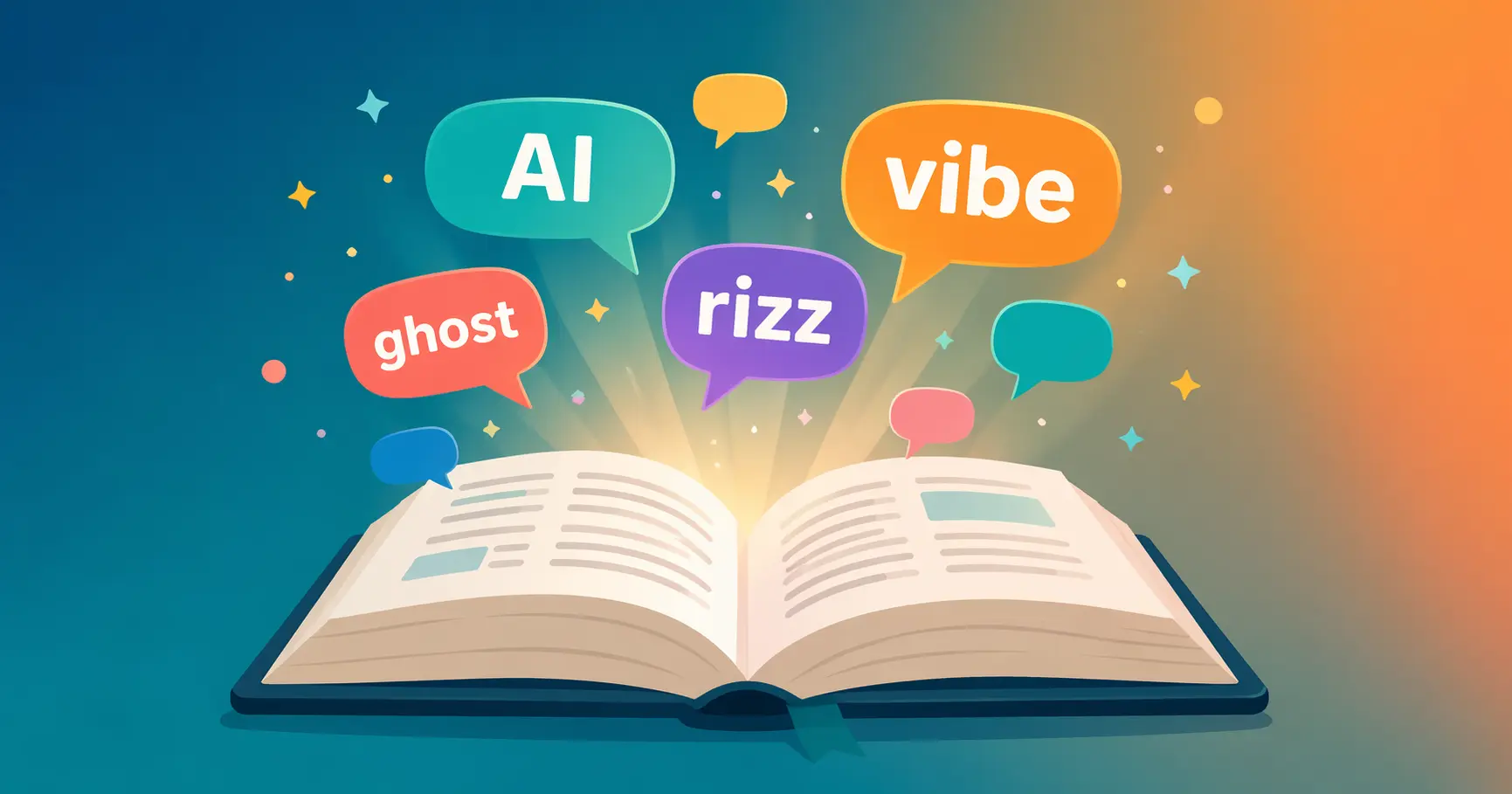
English never stops growing. Every year, dictionaries add hundreds of new entries — words that reflect changes in technology, work culture, social media, and daily life. If you want your English to sound current, you need to keep up.
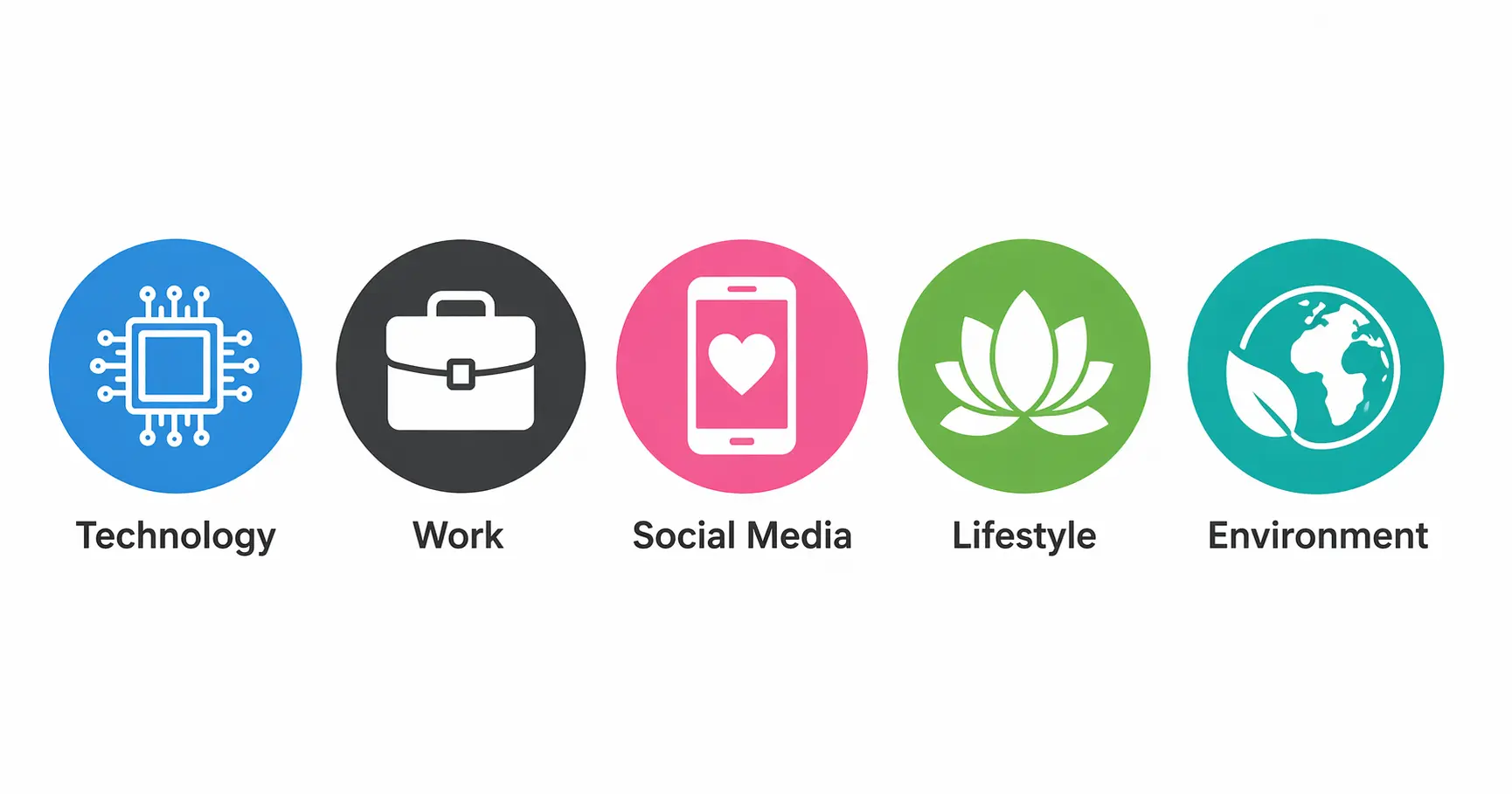
This article gives you exactly 50 new English words with meanings and example sentences. Each word is one you will actually hear in conversations, read in news articles, or see on social media in 2026. The words are organized into five practical categories:
- Technology and digital life (10 words)
- Work and career (10 words)
- Social media and culture (10 words)
- Lifestyle and wellness (10 words)
- Environment and society (10 words)
For each word, you get the part of speech, a clear definition, and a real-world example sentence showing how native speakers actually use it.
Technology and Digital Life
Technology is the biggest source of new English vocabulary. These 10 words cover AI, digital tools, and online behavior that have become part of everyday language.
| # | Word | Part of Speech | Meaning | Example Sentence |
|---|---|---|---|---|
| 1 | AI-washing | noun | Falsely claiming that a product uses artificial intelligence when it does not | The startup was accused of AI-washing — their “AI-powered” tool was just a basic spreadsheet formula. |
| 2 | deepfake | noun | A fake video, image, or audio clip created by artificial intelligence to look or sound real | A deepfake of the CEO nearly tricked the finance team into transferring money. |
| 3 | doomscroll | verb | To keep scrolling through negative or distressing news on your phone without stopping | I doomscrolled for two hours last night and then could not sleep. |
| 4 | hallucinate | verb (new sense) | When an AI system confidently generates false or invented information | The chatbot hallucinated an entire research paper — the title, authors, and journal were all fake. |
| 5 | prompt engineering | noun | The skill of writing effective instructions for AI tools to get better results | Prompt engineering is now a real job title at some technology companies. |
| 6 | fintech | noun | Technology designed for financial services such as banking, payments, and investing | Fintech apps let you split bills, send money abroad, and invest — all from your phone. |
| 7 | algorithm | noun (cultural sense) | The invisible system that decides what content you see on social media platforms | The algorithm figured out I like cooking videos and now my entire feed is recipes. |
| 8 | paywall | noun | A system that blocks access to online content unless you pay for a subscription | The article looked interesting, but it was behind a paywall. |
| 9 | digital detox | noun | A period of time when you deliberately stop using electronic devices and the internet | I did a weekend digital detox — no phone, no laptop, no notifications. |
| 10 | phishing | noun | A type of online fraud where criminals send fake emails or messages to steal personal information | That email asking you to “verify your account” is a phishing attempt — do not click the link. |
Work and Career
The way people work has changed dramatically since 2020, and the vocabulary has changed with it. These 10 words describe modern workplace realities.
| # | Word | Part of Speech | Meaning | Example Sentence |
|---|---|---|---|---|
| 11 | quiet quitting | noun | Doing only the minimum requirements of your job and nothing more | Quiet quitting is not laziness — for many workers, it is about setting healthy boundaries. |
| 12 | rage applying | noun/verb | Angrily applying to many jobs at once after a frustrating experience at your current workplace | After my boss rejected my vacation request, I spent the whole evening rage applying. |
| 13 | hybrid work | noun | A work model that combines days in the office with days working from home | Our company does hybrid work — Tuesday to Thursday in the office, Monday and Friday from home. |
| 14 | upskill | verb | To learn new skills or improve existing ones to advance in your career | Many professionals are upskilling in data analysis and AI tools to stay competitive. |
| 15 | gig economy | noun | A labor market based on short-term contracts, freelance work, and temporary jobs rather than permanent employment | The gig economy offers flexibility, but it comes with no job security or benefits. |
| 16 | side hustle | noun | A job, project, or small business you do in addition to your main employment to earn extra money | Her side hustle making custom phone cases now earns more than her full-time salary. |
| 17 | burnout | noun | A state of physical and emotional exhaustion caused by prolonged stress or overwork | She took a three-month break from work because of severe burnout. |
| 18 | monk mode | noun | A period of intense focus where you remove all distractions to accomplish a specific goal | I went into monk mode for two weeks — no social media, no meetings, just deep work on my thesis. |
| 19 | moonlighting | noun/verb | Having a second job secretly while still employed full-time somewhere else | The company fired three employees for moonlighting at a competitor. |
| 20 | hustle culture | noun | The belief that you should always be working, producing, and maximizing your time | Hustle culture glorifies 80-hour weeks, but the result is often just burnout. |
Strengthen your professional vocabulary with our work-related word lists.
Social Media and Culture
These words started online but are now used in everyday conversation, news articles, and even academic research.
| # | Word | Part of Speech | Meaning | Example Sentence |
|---|---|---|---|---|
| 21 | rage bait | noun | Online content deliberately designed to make people angry so they comment, share, or engage | That headline about banning coffee is obvious rage bait — do not fall for it. |
| 22 | slop | noun (new sense) | Low-quality, mass-produced content, often generated by AI with no human editing | My search results are full of AI slop — ten articles saying the same thing with no real information. |
| 23 | deinfluencing | noun/verb | A social media trend where creators tell their followers NOT to buy certain products | She built a huge following by deinfluencing expensive skincare that does not actually work. |
| 24 | ghosting | noun/verb | Suddenly cutting off all communication with someone without any explanation | He ghosted me after five dates — just disappeared, no text, no call, nothing. |
| 25 | stan | verb/noun | To be an extremely devoted fan of someone; also the person who is such a fan | She stans that K-pop group so hard she flew to Seoul for their concert. |
| 26 | echo chamber | noun | An environment where you only encounter opinions and information that confirm what you already believe | Social media algorithms can turn your feed into an echo chamber without you realizing it. |
| 27 | dox | verb | To publicly reveal someone’s private personal information online without their permission | The journalist was doxed after writing a controversial opinion piece. |
| 28 | go viral | verb phrase | To spread extremely quickly across the internet, reaching millions of people in a short time | Her 30-second video about learning English went viral and got 12 million views in three days. |
| 29 | catfish | verb/noun | To create a fake identity online to deceive someone, usually in a romantic context | She discovered that her online boyfriend had been catfishing her — the photos were stolen from someone else. |
| 30 | parasocial | adjective | Describing a one-sided emotional connection with a media figure, celebrity, or online creator who does not know you exist | Parasocial relationships with YouTubers can feel very real, even though the person has never met you. |
Lifestyle and Wellness
Health, self-improvement, and mindfulness culture have added a wave of new vocabulary to English.
| # | Word | Part of Speech | Meaning | Example Sentence |
|---|---|---|---|---|
| 31 | bed rotting | noun | Intentionally spending an entire day in bed doing nothing as a form of rest | After working 60 hours this week, Saturday is officially a bed rotting day. |
| 32 | doom spending | noun | Spending money impulsively to cope with stress, anxiety, or uncertainty about the future | Doom spending on things I do not need has become my worst financial habit. |
| 33 | dopamine detox | noun | Deliberately avoiding all stimulating activities — social media, junk food, entertainment — to reset your brain’s reward system | I tried a 48-hour dopamine detox: no phone, no sugar, no television. |
| 34 | biohacking | noun | Using science, technology, and self-experimentation to improve your body’s performance and health | Biohacking can mean anything from taking cold showers to tracking your sleep with wearable sensors. |
| 35 | cold plunge | noun | Immersing your body in very cold water for a short time, believed to reduce inflammation and boost energy | The gym added a cold plunge pool next to the sauna, and there is always a line for it. |
| 36 | breathwork | noun | Controlled breathing exercises used for stress relief, mental clarity, or emotional regulation | She starts every morning with 10 minutes of breathwork before checking her phone. |
| 37 | clean eating | noun | A diet philosophy focused on eating whole, unprocessed, natural foods and avoiding artificial ingredients | Clean eating does not have to be expensive — rice, beans, vegetables, and fruit all count. |
| 38 | plant-based | adjective | Made entirely from plants, containing no animal products | The restaurant launched a full plant-based menu, and it is now their most popular option. |
| 39 | adaptogen | noun | A natural substance, usually a herb or mushroom, believed to help the body manage stress | Ashwagandha is one of the most popular adaptogens — people add it to smoothies and coffee. |
| 40 | mindfulness | noun | The practice of being fully present and aware in the current moment without judgment | Even five minutes of mindfulness in the morning helps me stay focused for the rest of the day. |
Environment and Society
Climate change, sustainability, and global social trends are creating vocabulary that every English learner should know.
| # | Word | Part of Speech | Meaning | Example Sentence |
|---|---|---|---|---|
| 41 | polycrisis | noun | A situation where multiple global crises — economic, environmental, political — happen simultaneously and make each other worse | Economists warn we are entering a polycrisis: climate change, inflation, and geopolitical conflict all at once. |
| 42 | greenwashing | noun | The practice of making misleading claims about how environmentally friendly a product or company is | The brand was fined for greenwashing — their “100% eco” packaging turned out to be non-recyclable. |
| 43 | microplastic | noun | Extremely small pieces of plastic (under 5mm) that pollute water, soil, food, and even the human body | Scientists have found microplastics in drinking water, table salt, and human blood samples. |
| 44 | net zero | adjective/noun | A target where the amount of greenhouse gases produced equals the amount removed from the atmosphere | The UK aims to reach net zero emissions by 2050, but progress has been slow. |
| 45 | upcycling | noun/verb | Transforming waste materials or old objects into something new, useful, and often more valuable | She turned old denim jeans into a beautiful upcycled tote bag and sold it online. |
| 46 | rewilding | noun | The practice of restoring natural ecosystems by reintroducing native plants, animals, and natural processes | The rewilding project brought beavers back to the river for the first time in 400 years. |
| 47 | circular economy | noun | An economic system designed to eliminate waste by reusing, repairing, and recycling materials instead of throwing them away | In a circular economy, your old smartphone gets recycled into components for a new one. |
| 48 | carbon footprint | noun | The total amount of greenhouse gases produced by a person, company, event, or product | A single round-trip flight from London to New York adds about 1.6 tons to your carbon footprint. |
| 49 | flight shaming | noun | Criticizing people for flying — or feeling guilty about flying yourself — because of its environmental impact | Flight shaming has made some travelers choose trains over planes for shorter European trips. |
| 50 | solarpunk | noun/adjective | An optimistic vision of the future based on renewable energy, sustainable technology, and harmony with nature | Solarpunk imagines cities covered in vertical gardens, powered entirely by solar and wind energy. |
How to Actually Learn These 50 Words
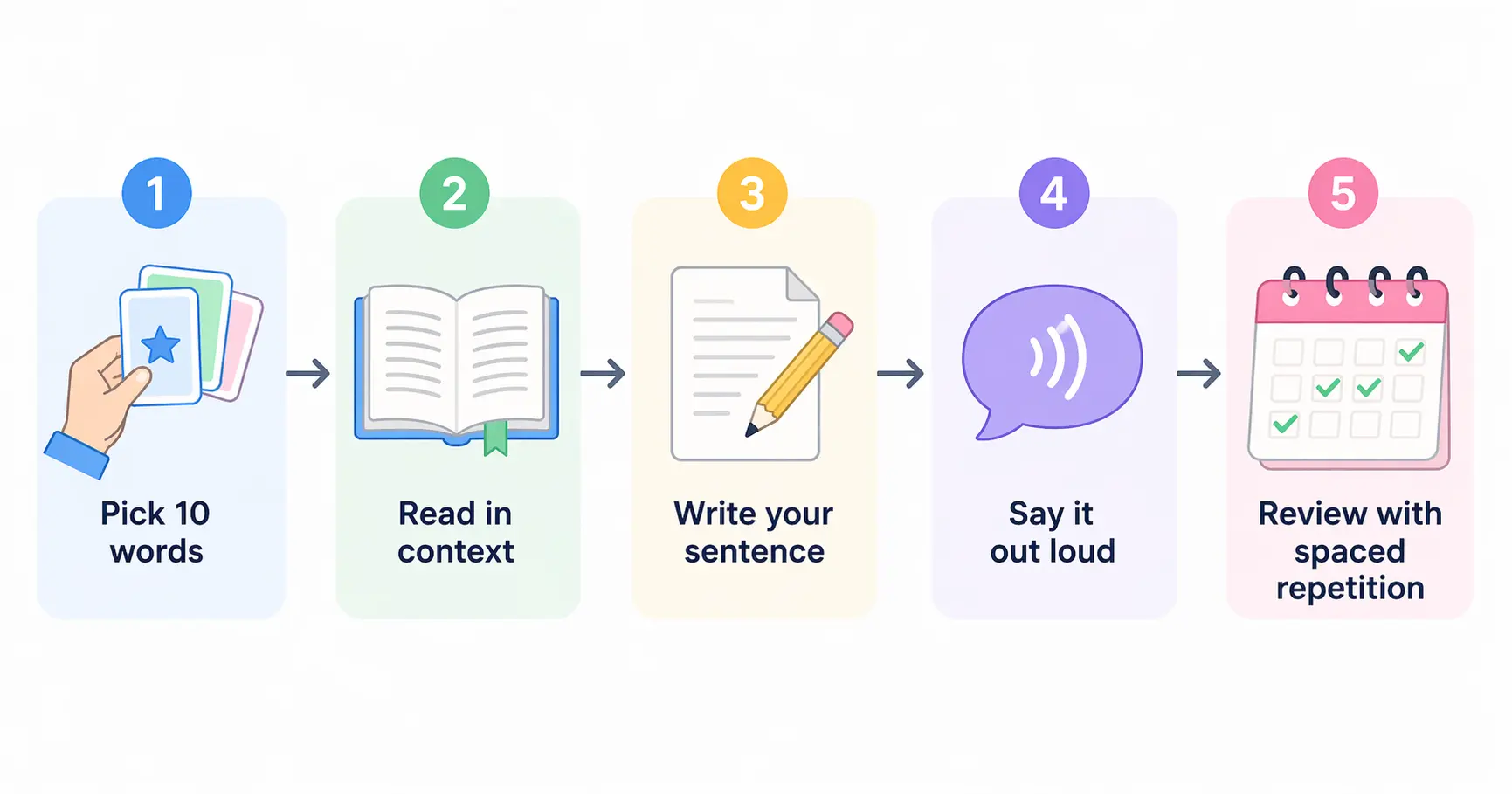
Reading a list once is not learning. To move these words from “I recognize this” to “I can use this in conversation,” you need a system. Here is what works:
Pick 10 words per week, not all 50 at once. Your brain can process about 5–10 new vocabulary items per study session effectively. Trying to memorize everything in one sitting guarantees you will forget most of it within days.
Learn each word in three steps. First, read the definition and example sentence above. Second, find 1–2 more real sentences using the word — search for it in news articles or on social media. Third, write your own sentence using the word in a situation from your life.
Use spaced repetition. Add your target words to your Linglify dictionary. The app schedules reviews at the optimal intervals — 1 day, 3 days, 7 days, 14 days — so words move into your long-term memory without cramming.
Say the words out loud. Many of these words have tricky pronunciation: algorithm (AL-guh-rith-uhm), phishing (FISH-ing, same as “fishing”), parasocial (pair-uh-SOH-shul). Hearing yourself say a word is one of the strongest memory anchors.
Group by topic. Notice that the words in this article are organized by category. That is intentional — your brain stores vocabulary in semantic clusters. When you learn “burnout” and “hustle culture” together, they reinforce each other.
For a complete vocabulary learning system with 10 research-backed methods, read our guide on how to improve your vocabulary.
Words to Practice Right Now
Here are 25 B1–B2 level words you can add to your personal dictionary with one click. Each word includes definitions, example sentences, and pronunciation.
inflation
noun
An increase in prices or the general rise in the cost of goods and services.
Examples
- High inflation makes it difficult for families to afford basic necessities.
- The government is taking measures to control inflation and stabilize prices.
setback
noun
An obstacle or problem that delays progress or success.
Examples
- Financial setback delays family vacation plans unfortunately.
- Medical setback requires additional treatment and recovery.
prestige
noun
The respect and admiration that a person or thing earns because of their achievements or qualities.
Examples
- Professional prestige comes from expertise and experience.
- University degree brings prestige and career opportunities.
solo
noun
A musical or theatrical performance by one person alone.
Examples
- Guitar solo highlights rock song's dramatic climax.
- Singer performs beautiful solo during wedding ceremony.
speculative
adjective
Based on conjecture rather than knowledge; not certain.
Examples
- His theory remains speculative without concrete experimental evidence supporting it.
- The speculative investment carried high risks but potential rewards.
fanatically
adverb
In a way that shows intense enthusiasm or zeal.
Examples
- Collector fanatically pursued rare stamps for decades.
- She exercises fanatically every single day without exception.
rider
noun
A person who rides a bicycle, motorcycle, or horse.
Examples
- Experienced rider controls horse with gentle commands.
- Motorcycle rider wears protective helmet for safety.
bookish
adjective
Having a strong interest in books, reading, or literature.
Examples
- His bookish interests included philosophy and literature.
- The professor had a bookish appearance with thick glasses.
dispense
verb
To distribute or give out, often in a controlled manner.
Examples
- Good leaders know when to dispense with unnecessary formalities.
- The machine dispenses hot coffee and tea throughout day.
catalog
noun
A book or list that shows items, often with descriptions or prices.
Examples
- She browsed through the fashion catalog to choose new clothes.
- The library catalog helps students find books and research materials quickly.
superintendent
noun
A person who manages or oversees a place or organization.
Examples
- Building superintendent maintains property and handles repairs.
- School superintendent oversees district educational policies daily.
index
noun
A list showing the order or importance of items or topics.
Examples
- The stock market index shows the overall performance of major companies.
- Use the index at the back of the book to find specific topics quickly.
content
noun
The information or feelings that are inside or expressed by someone or something.
sprint
noun
A quick run over a short distance.
Examples
- Final sprint determines race winner at finish.
- Olympic sprint requires explosive speed and power.
decay
verb
To break down or rot gradually over time, often referring to organic matter or structures.
Examples
- Fallen leaves decay naturally and enrich the forest soil.
- Without proper maintenance, buildings will decay over time.
ban
verb
To officially prohibit or forbid something by law or authority.
Examples
- Many countries ban certain chemicals in food production for safety.
- The city decided to ban smoking in all public places.
export
verb
To send goods to another country for sale.
Examples
- Many companies export their products to international markets for profit.
- The country exports large quantities of oil to neighboring nations.
unfamiliar
adjective
Not familiar or well known; strange.
Examples
- Unfamiliar language creates communication barriers between people.
- Unfamiliar place makes tourist feel lost confused.
rally
verb
To come together in a large group to support or protest for a cause.
Examples
- Community members rally to help flood victims.
- Patient begins to rally after serious surgery.
console
verb
To comfort or soothe someone who is upset or sad.
Examples
- The new gaming console offers incredible graphics and immersive sound effects.
- The pilot checked all instruments on the control console before takeoff.
effectively
adverb
In a way that produces the desired result or with skill.
Examples
- Technology helps teachers communicate more effectively with their students daily.
- The medicine works effectively to reduce pain and inflammation quickly.
laser
noun
A device that produces a concentrated beam of light for cutting or measuring.
Examples
- Laser surgery provides precise treatment with minimal invasive procedures.
- The laser pointer helps teachers highlight important information on screens.
metric
adjective
Relating to measurement or a system of measurement.
Examples
- Metric measurements are based on units of ten for convenience.
- Most countries use metric system for measuring distance and weight.
justifiable
adjective
Able to be justified or shown to be reasonable or right.
Examples
- His actions were justifiable given the circumstances.
- There is no justifiable reason to delay the project.
Which Words Should You Learn First?
Not all 50 words are equally useful for every learner. Here is a priority guide based on your goals:
For everyday conversation: Start with the Lifestyle and Social Media categories. Words like ghosting, burnout, go viral, mindfulness, and side hustle come up constantly in casual English.
For academic English and exams: Focus on the Environment and Technology categories. Words like carbon footprint, algorithm, net zero, circular economy, and microplastic appear frequently in IELTS and TOEFL reading passages and speaking topics. See our IELTS vocabulary guide for exam-specific word lists.
For professional English: The Work and Career category is your priority. Hybrid work, upskill, gig economy, and burnout are standard vocabulary in business English. Browse our B2 Upper-Intermediate vocabulary for more workplace language.
For social media fluency: The Social Media section covers the words you need to understand online conversations. Rage bait, slop, stan, and echo chamber will help you follow English-language internet culture.
Common Mistakes with New Vocabulary
Using slang in formal contexts. Words like stan, doomscroll, and bed rotting are informal. They work in social media posts and casual conversation, but not in IELTS essays, business emails, or academic papers. Always check the register before using a word.
Learning definitions without collocations. Knowing that “carbon footprint” means “total greenhouse gases” is not enough. You need to know you reduce your carbon footprint (not “decrease” or “lower” — although those work technically, “reduce” is the natural collocation).
Ignoring part of speech shifts. Many new words function as multiple parts of speech. Ghost is a noun but also a verb (to ghost someone). Catfish is a noun, a verb, and an adjective (a catfish account). Learn how each word behaves grammatically.
Assuming new words are temporary slang. Some internet slang fades quickly, but words like algorithm, burnout, ghosting, and carbon footprint are permanent additions to English. They appear in dictionaries, newspapers, academic research, and job descriptions. Treat them as real vocabulary.
What to Read Next
-
Explore the full list. This article covers 50 words. For 100+ new words organized by 10 categories, read New English Words in 2026: 100+ Latest Additions.
-
Build a vocabulary system. Learn how to retain these words long-term with our step-by-step vocabulary learning guide.
-
Study by level. If you want vocabulary organized by proficiency level, browse B1 Intermediate or B2 Upper-Intermediate word lists.
-
Prepare for exams. Many of these 50 words appear in IELTS and TOEFL topics. Check our IELTS vocabulary guide for exam-focused preparation.
-
Strengthen your method. Read How to Improve Your Vocabulary: 10 Proven Methods for a complete study strategy.
FAQ
What are 50 new words with meaning?
The 50 words in this article are recent additions to everyday English, drawn from technology (AI-washing, deepfake, doomscroll), work culture (quiet quitting, hybrid work, burnout), social media (ghosting, rage bait, stan), lifestyle (dopamine detox, bed rotting, mindfulness), and environment (net zero, microplastic, greenwashing). Each word includes a clear definition and a real-world example sentence showing how native speakers use it.
How can I memorize 50 new English words quickly?
Do not try to learn all 50 at once. Pick 10 words per week and learn each one in context — read the definition, study 2–3 example sentences, and write your own. Use spaced repetition (reviewing at increasing intervals: 1 day, 3 days, 7 days, 14 days) to move words into long-term memory. For the full method, read our guide on how to improve your vocabulary.
Are these words used in IELTS and TOEFL?
Yes. Words from the Technology and Environment categories — algorithm, carbon footprint, net zero, microplastic, circular economy — regularly appear in IELTS Reading passages and Speaking topics. Work vocabulary like burnout, hybrid work, and gig economy is common in TOEFL integrated tasks. However, avoid slang (bed rotting, stan, doomscroll) in formal exam writing. For exam-specific vocabulary, see our IELTS vocabulary guide.
What is the difference between slang and new vocabulary?
Slang is informal language used within specific groups (stan, doomscroll, bed rotting). New vocabulary includes words that have entered standard English and are used in formal contexts too (algorithm, burnout, carbon footprint, hybrid work). Both are real English, but slang has a limited register — you can use it in casual conversation and social media but not in academic writing or business communication.
Where do new English words come from?
New words enter English from five main sources: technology (deepfake, phishing, fintech), blending existing words (situationship = situation + relationship), borrowing from other languages (hygge from Danish, kaizen from Japanese), semantic shift where old words gain new meanings (ghost, cloud, stream), and social media communities that create slang which spreads globally. For a deeper look, read New English Words in 2026.
How many new words does English add each year?
Major dictionaries (Oxford, Merriam-Webster, Cambridge) add between 500 and 1,500 new entries annually. Beyond official dictionary additions, linguists estimate that roughly 5,000 new English words enter general usage every year, though most never get a formal dictionary entry. The 50 words in this article are all either already in major dictionaries or in widespread active use across English-speaking media.