English Homophones: The Complete Guide with 300+ Examples
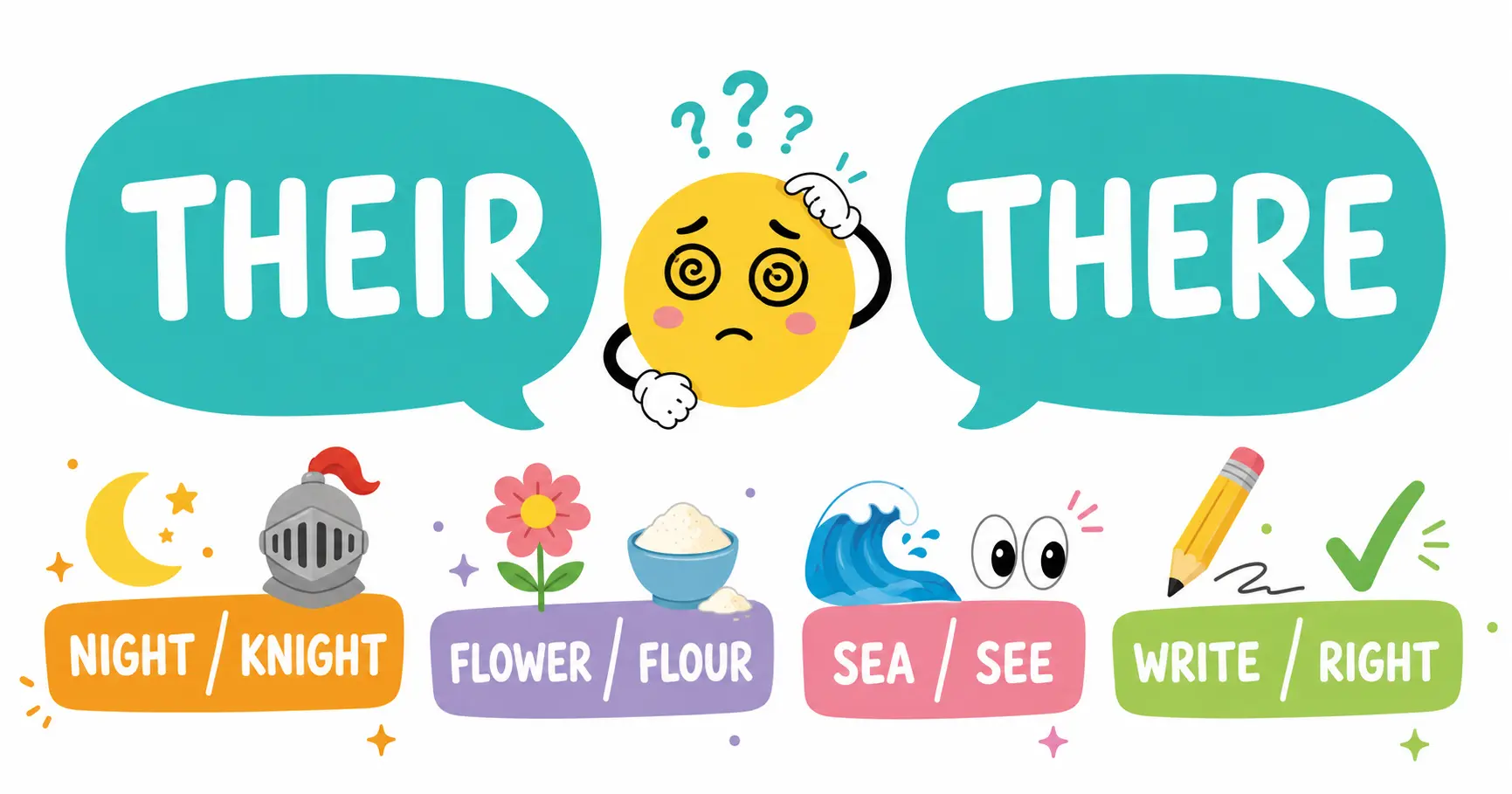
English is full of words that sound identical but mean completely different things. “Their,” “there,” and “they’re” all sound exactly the same. “Knight” and “night” are pronounced identically. “Flower” and “flour” are indistinguishable in speech. These words are called homophones, and they are responsible for more spelling mistakes, writing errors, and embarrassing mix-ups than any other feature of the English language.
The problem is not pronunciation — it is knowing which spelling matches which meaning. Native speakers get these wrong constantly (your/you’re is the most corrected error on the internet), and for English learners the challenge is even greater because many homophones have no logical pattern. You simply have to learn them.
This guide covers:
- what homophones are and why English has so many,
- 300+ homophone pairs and groups with meanings and examples,
- organized from basic (A2) to advanced (C1) difficulty,
- the difference between homophones, homonyms, and homographs,
- the most common homophone mistakes and how to avoid them.
What Are Homophones?
A homophone is a word that sounds the same as another word but has a different meaning and usually a different spelling. The word comes from Greek: homo- (same) + phone (sound) — “same sound.”
| Homophone Pair | Pronunciation | Word 1 Meaning | Word 2 Meaning |
|---|---|---|---|
| their / there / they’re | /ðɛr/ | belonging to them | in that place / they are |
| to / too / two | /tuː/ | direction | also / excessive / the number 2 |
| know / no | /noʊ/ | to be aware of | negative |
| write / right | /raɪt/ | to put words on paper | correct / direction |
| sea / see | /siː/ | body of water | to perceive with eyes |
Why Does English Have So Many Homophones?
English spelling froze in the 15th–16th century when the printing press arrived, but pronunciation kept changing. The word “knight” used to be pronounced with the K and the GH, but over centuries those sounds disappeared while the spelling stayed. English also borrowed heavily from French, Latin, Norse, and German — importing multiple words that evolved to sound alike despite different origins.
The result: English has more homophones than almost any other language. Estimates range from 400 to over 7,000 homophone sets depending on dialect.
Homophones vs. Homonyms vs. Homographs
These three terms are often confused. Here is the difference:
| Term | Same Sound? | Same Spelling? | Same Meaning? | Example |
|---|---|---|---|---|
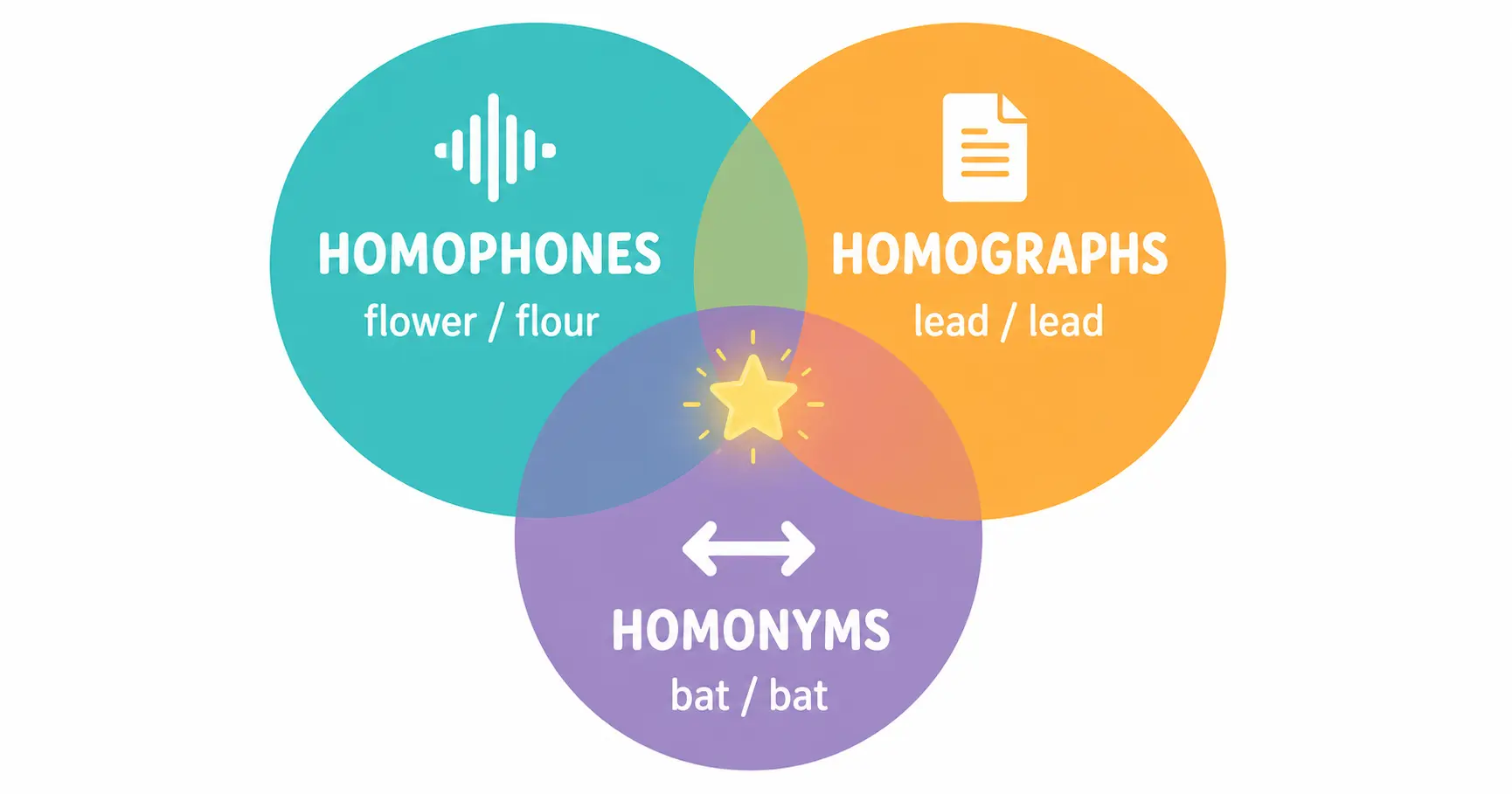
| Homophone | ✓ Yes | ✗ Usually no | ✗ No | flower / flour |
| Homonym | ✓ Yes | ✓ Yes | ✗ No | bank (river) / bank (financial) |
| Homograph | Sometimes | ✓ Yes | ✗ No | lead (to guide) / lead (metal) |
- Homophones sound the same but are spelled differently: sea / see
- Homonyms are spelled and pronounced the same but have different meanings: bat (animal) / bat (sports equipment)
- Homographs are spelled the same but may be pronounced differently: tear (to rip) / tear (from eyes)
There is overlap: all homonyms are homophones (they sound the same), but not all homophones are homonyms (most homophones have different spellings). For a detailed guide, see Homophones vs Homonyms vs Homographs.
300+ Homophones by Difficulty Level
Beginner Homophones (A2–B1)
These are the pairs every English learner encounters first. Getting these right eliminates the most common mistakes.
The Big Five (Most Commonly Confused)
1. their / there / they’re
| Word | Meaning | Example |
|---|---|---|
| their | possessive — belonging to them | Their house is on the corner. |
| there | a place; also used to introduce a sentence | The book is over there. / There are 30 students in the class. |
| they’re | contraction of “they are” | They’re coming to the party tonight. |
Tip: If you can replace the word with “they are,” use they’re. If it shows possession, use their. Otherwise, use there.
2. your / you’re
| Word | Meaning | Example |
|---|---|---|
| your | possessive — belonging to you | Is this your bag? |
| you’re | contraction of “you are” | You’re going to love this restaurant. |
Tip: If you can say “you are,” use you’re. Otherwise, use your.
3. its / it’s
| Word | Meaning | Example |
|---|---|---|
| its | possessive — belonging to it | The cat licked its paw. |
| it’s | contraction of “it is” or “it has” | It’s raining again. / It’s been a long day. |
Tip: If “it is” or “it has” works, use it’s. Otherwise, use its (no apostrophe for possessive “its”).
4. to / too / two
| Word | Meaning | Example |
|---|---|---|
| to | direction; part of an infinitive | I’m going to the store. / I want to learn English. |
| too | also; excessively | I want to come too. / The coffee is too hot. |
| two | the number 2 | I have two brothers. |
5. than / then
| Word | Meaning | Example |
|---|---|---|
| than | comparison | She is taller than me. |
| then | time (next, after that) | We had dinner, then watched a movie. |
Basic Pairs (A2–B1)
| Word 1 | Meaning | Word 2 | Meaning |
|---|---|---|---|
| here | in this place | hear | to perceive sound |
| no | negative | know | to be aware of |
| write | to put words on paper | right | correct; direction |
| see | to perceive with eyes | sea | body of water |
| one | the number 1 | won | past tense of “win” |
| son | male child | sun | the star in our sky |
| be | to exist | bee | flying insect |
| buy | to purchase | by | near; through |
| eye | organ of sight | I | first-person pronoun |
| our | belonging to us | hour | 60 minutes |
| for | purpose; directed at | four | the number 4 |
| new | not old | knew | past tense of “know” |
| so | therefore; to that degree | sew | to stitch fabric |
| would | conditional | wood | material from trees |
| where | in what place | wear | to have clothing on |
| which | what one | witch | magical person |
| pair | a set of two | pear | a fruit |
| peace | absence of war | piece | a part of something |
| break | to damage | brake | to slow/stop a vehicle |
| weather | atmospheric conditions | whether | if |
| wait | to stay | weight | heaviness |
| week | seven days | weak | not strong |
| meet | to encounter | meat | animal flesh (food) |
| flower | a bloom | flour | powder for baking |
| night | after sunset | knight | medieval warrior |
| road | a street | rode | past tense of “ride” |
| whole | complete; entire | hole | an opening |
| tail | animal appendage | tale | a story |
| dear | beloved; expensive | deer | an animal |
| blue | a color | blew | past tense of “blow” |
| red | a color | read | past tense of “read” |
| made | past tense of “make” | maid | a servant |
| male | masculine | letters/packages | |
| sail | fabric on a boat | sale | selling at reduced price |
| ate | past tense of “eat” | eight | the number 8 |
| bare | naked; uncovered | bear | large animal |
| die | to stop living | dye | to color fabric |
| heal | to recover | heel | back of the foot |
| plain | simple; flat area | plane | aircraft |
| steel | strong metal | steal | to take illegally |
| stare | to look intently | stair | a step |
| waist | middle of the body | waste | to use carelessly |
Intermediate Homophones (B1–B2)
These pairs are less common but still appear regularly in everyday English and on standardized tests.
| Word 1 | Meaning | Word 2 | Meaning |
|---|---|---|---|
| accept | to receive | except | excluding |
| affect | to influence (verb) | effect | a result (noun) |
| allowed | permitted | aloud | out loud |
| board | flat piece of wood; a group | bored | uninterested |
| born | brought into life | borne | carried; past participle of “bear” |
| brake | to slow down | break | to damage |
| capital | city; uppercase; money | capitol | government building (US) |
| cell | small room; biological unit | sell | to exchange for money |
| cereal | breakfast food | serial | in a series |
| cite | to reference | sight | vision |
| site | a location | cite | to reference |
| coarse | rough; not fine | course | a path; a class |
| complement | to complete | compliment | to praise |
| council | a governing group | counsel | advice; to advise |
| desert | dry sandy area (noun) | dessert | sweet food after dinner |
| fair | just; a festival | fare | price of a ticket |
| feat | an achievement | feet | plural of foot |
| forth | forward | fourth | the number 4th |
| grate | to shred; a metal frame | great | excellent; large |
| groan | a low sound of pain | grown | past participle of “grow” |
| guessed | estimated | guest | a visitor |
| idle | inactive | idol | object of worship; a hero |
| knead | to press dough | need | to require |
| knot | a tied loop | not | negative |
| lesson | a class; something learned | lessen | to reduce |
| loan | something lent | lone | single; solitary |
| morning | early part of the day | mourning | grieving |
| naval | related to the navy | navel | belly button |
| passed | past tense of “pass” | past | previous time |
| patience | ability to wait | patients | people under medical care |
| principal | main; head of a school | principle | a fundamental belief |
| profit | financial gain | prophet | a person who predicts |
| rain | water from clouds | reign | period of rule |
| role | a part in a play; a function | roll | to turn over; a bread roll |
| scene | a part of a play; a view | seen | past participle of “see” |
| sole | only; bottom of shoe | soul | spirit |
| stake | a pointed post; a share | steak | a cut of meat |
| stationary | not moving | stationery | paper and writing supplies |
| threw | past tense of “throw” | through | from one side to another |
| throne | royal seat | thrown | past participle of “throw” |
| tied | fastened; equal score | tide | ocean rise and fall |
| vain | excessively proud | vein | blood vessel |
| wander | to roam | wonder | to be curious |
| warn | to alert to danger | worn | past participle of “wear” |
Advanced Homophones (B2–C1)
These pairs appear in academic, literary, and professional contexts. Knowing them demonstrates sophisticated English.
| Word 1 | Meaning | Word 2 | Meaning |
|---|---|---|---|
| aisle | passage between seats | isle | a small island |
| altar | sacred table in a church | alter | to change |
| ascent | a climb upward | assent | agreement |
| bail | security payment; to scoop water | bale | a large bundle |
| bazaar | a market | bizarre | very strange |
| berth | a sleeping place (ship/train) | birth | being born |
| borough | an administrative district | burrow | an animal’s tunnel |
| canvas | heavy fabric | canvass | to survey opinions |
| chord | musical notes together | cord | a rope or string |
| cue | a signal | queue | a line of waiting people |
| currant | a small dried fruit | current | present; flow of water/electricity |
| descent | going downward | dissent | disagreement |
| discreet | careful, not drawing attention | discrete | separate; distinct |
| dual | double | duel | a formal fight |
| elicit | to draw out | illicit | illegal |
| emigrate | to leave a country | immigrate | to enter a country |
| ensure | to make certain | insure | to provide insurance |
| flair | a natural talent | flare | a burst of light |
| foreword | introduction to a book | forward | toward the front |
| gorilla | a large ape | guerrilla | a rebel fighter |
| hangar | a building for aircraft | hanger | a device for hanging clothes |
| heroin | an illegal drug | heroine | a female hero |
| hoard | to stockpile | horde | a large crowd |
| incite | to provoke | insight | deep understanding |
| lightning | flash in a storm | lightening | becoming lighter |
| marshal | a law officer; to organize | martial | related to war |
| mettle | courage and strength | metal | a hard material |
| miner | a person who mines | minor | small; a young person |
| palate | roof of the mouth; taste | palette | a board for paints |
| pedal | foot-operated lever | peddle | to sell goods |
| peer | an equal; to look closely | pier | a structure extending into water |
| pour | to flow liquid | pore | a tiny opening; to study intently |
| pray | to speak to God | prey | an animal hunted for food |
| precedence | priority | precedents | previous examples |
| racket | a noise; a sports bat | racquet | variant spelling (tennis) |
| review | to evaluate | revue | a musical show |
| sore | painful | soar | to fly high |
| suite | a set of rooms; a series | sweet | sugary taste |
| vale | a valley | veil | a face covering |
| wave | moving water; to gesture | waive | to give up a right |
| wreak | to cause damage | reek | to smell terrible |
The 20 Most Commonly Confused Homophones
These are the pairs that cause the most errors — even for native speakers.
| Rank | Pair | The Error | How to Remember |
|---|---|---|---|
| 1 | your / you’re | “Your welcome” → You’re welcome | You’re = you are. Always. |
| 2 | their / there / they’re | Mixing all three | They’re = they are. Their = possession. There = place. |
| 3 | its / it’s | “The dog wagged it’s tail” → its tail | It’s = it is. Its = possessive (like his, hers). |
| 4 | to / too | “Me to!” → Me too! | Too = also / excessive. Everything else = to. |
| 5 | than / then | “Better then ever” → Better than ever | Than = comparison. Then = time. |
| 6 | affect / effect | Swapping verb and noun | Affect = verb (to influence). Effect = noun (a result). |
| 7 | accept / except | “Everyone accept me” → except me | Accept = receive. Except = exclude. |
| 8 | lose / loose | “Don’t loose your keys” → Don’t lose your keys | Lose = to misplace (rhymes with “choose”). Loose = not tight. |
| 9 | complement / compliment | Mixing the two | Complement = completes. Compliment = praises. |
| 10 | principal / principle | “The principle of the school” → principal | The principal is your pal. A principle is a rule. |
| 11 | stationary / stationery | Mixing them | Stationery = paper (both have “e” for “envelope”). |
| 12 | who’s / whose | “Whose coming?” → Who’s coming? | Who’s = who is. Whose = possession. |
| 13 | passed / past | “I walked passed the shop” → past the shop | Passed = verb. Past = preposition/adjective/noun. |
| 14 | brake / break | “Take a brake” → Take a break | Brake = stopping. Break = pause or damage. |
| 15 | weather / whether | “I don’t know weather to go” → whether | Weather = rain, sun, etc. Whether = if. |
| 16 | piece / peace | “A peace of cake” → piece | Piece = a part. Peace = no war. |
| 17 | patience / patients | “Have some patients” → patience | Patience = waiting calmly. Patients = hospital. |
| 18 | site / sight / cite | Mixing all three | Site = location. Sight = vision. Cite = reference. |
| 19 | discreet / discrete | Interchanging them | Discreet = subtle. Discrete = separate. |
| 20 | emigrate / immigrate | “He emigrated to Canada” → immigrated | Emigrate = exit. Immigrate = in. |
Vocabulary to Practice
These 25 words from commonly confused homophone pairs are worth adding to your Linglify dictionary for spaced repetition.
affordable
adjective
Able to be bought or reached at a reasonable price.
Examples
- The government is working to provide affordable housing for low-income families.
- This restaurant offers delicious and affordable meals for college students.
commute
verb
To travel regularly between two places, especially to work.
Examples
- Public transportation helps people commute efficiently reducing traffic congestion.
- Workers commute daily between suburban homes and downtown offices.
conservation
noun
The protection and preservation of natural resources or the environment.
Examples
- Water conservation becomes increasingly important during periods of severe drought.
- Wildlife conservation is essential for protecting endangered species from extinction.
demanding
adjective
Requiring a lot of effort, patience, or skill; often demanding more than expected.
Examples
- Medical school is very demanding and requires years of intensive study.
- She has a demanding boss who expects perfection in all tasks.
DJ
noun
A person who plays and mixes recorded music, A person who plays music or mixes sounds on a radio or at events.
Examples
- The DJ played my favorite song.
- The DJ took song requests all night.
heritage
noun
The traditions, achievements, and qualities of a particular group or nation.
Examples
- She inherited a rich heritage of family traditions from her grandparents.
- The ancient castle is an important part of our cultural heritage.
leisure
noun
Free time when someone can relax or do leisure activities.
Examples
- People enjoy various leisure activities during weekends and holidays.
- Reading books is popular leisure pursuit for many educated people.
luxurious
adjective
Extremely comfortable, elegant, or opulent; very fancy.
Examples
- She dreams of owning luxurious car with leather seats and sunroof.
- The luxurious hotel suite includes marble bathroom and ocean view.
memorable
adjective
Causing a strong impression or worth remembering.
Examples
- Graduation day was memorable occasion for entire family.
- The memorable speech inspired students to pursue their dreams.
nutritious
adjective
Providing good health benefits and nutrition.
Examples
- Fresh vegetables are nutritious and support overall health.
- Nutritious breakfast provides energy for productive school day.
passionate
adjective
Having or showing strong feelings or enthusiasm.
Examples
- Passionate speech moves audience to take action.
- Passionate teacher inspires students to learn more.
pollution
noun
The introduction of harmful substances into the environment.
Examples
- Air pollution affects public health in cities.
- Ocean pollution threatens marine life worldwide.
privacy
noun
The right or ability to keep personal matters or information secret.
Examples
- Hotel guests expect privacy during their stay.
- Internet privacy becomes increasingly important issue nowadays.
scenic
adjective
Related to beautiful natural views or landscapes.
Examples
- Scenic overlook provides perfect spot for photographs.
- Scenic route takes longer but offers beautiful.
traditional
adjective
Following the customs or ways of the past; not new or different.
Examples
- Traditional cooking methods preserve authentic flavors perfectly.
- Traditional music reflects cultural history and values.
uneven
adjective
Not level or smooth; uneven.
Examples
- Uneven ground makes walking difficult and dangerous.
- Uneven performance shows inconsistent skill level development.
volunteer
verb
To offer to do a service or task willingly, often without being asked.
Examples
- Citizens volunteer time for community improvement projects.
- Students volunteer at local charity organizations regularly.
substantially
adverb
To a large extent or degree; significantly.
Examples
- Her performance substantially improved after additional training and practice.
- Prices have increased substantially over the past few months.
liaison
noun
A close working relationship or communication link between people or organizations.
Examples
- Military liaison officers coordinate operations between allied forces.
- She serves as liaison between different departments.
sustainable
adjective
This adjective describes something that can be maintained or continued without depleting resources.
Examples
- Company implements sustainable business model for long-term success.
- Sustainable farming practices protect soil and water resources.
acclaimed
adjective
Describing someone or something that has been publicly praised or recognized.
Examples
- His performance was acclaimed by critics.
- The acclaimed author received many awards for her novel.
cancellation
noun
The act of stopping or calling off an event, activity, or arrangement.
Examples
- Due to weather, the flight cancellation was inevitable.
- The concert's cancellation disappointed many fans.
discretion
noun
The ability to judge what is appropriate or prudent in a particular situation.
Examples
- He exercised discretion in his decisions.
- Use your discretion when sharing information.
indication
noun
A sign or signal that points to or suggests something.
Examples
- The indication of his illness was clear after the tests.
- There was no indication that she was unhappy.
serenity
noun
A state of calm, peacefulness, and mental clarity.
Examples
- She maintained her serenity despite the chaos.
- The serenity of the lake was calming.
How to Master Homophones
1. Learn the meaning, not just the spelling
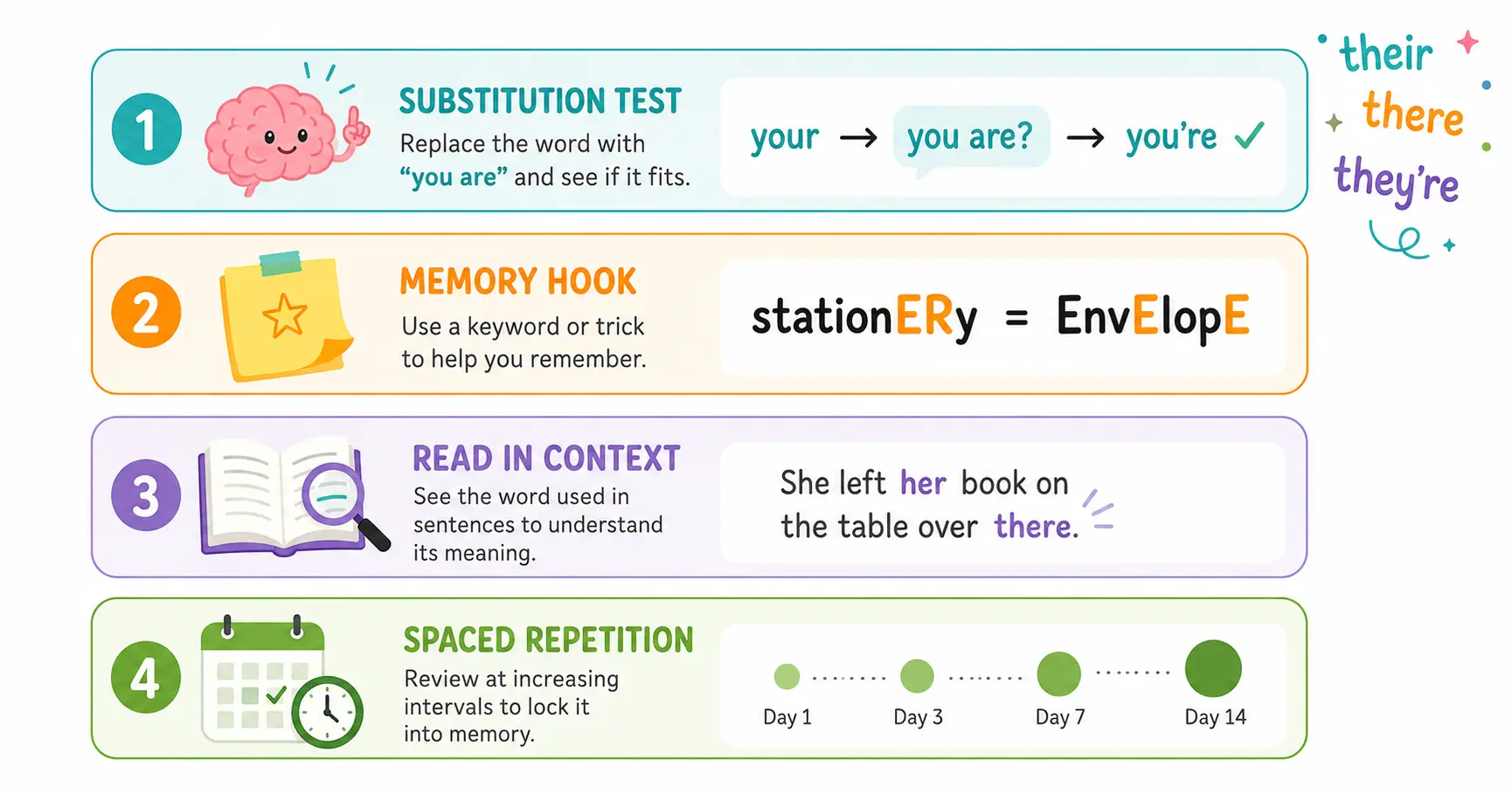
Memorizing that “there” and “their” are spelled differently is useless unless you know instantly which one means “belonging to them.” Always learn homophones with their definitions and example sentences.
2. Use the substitution test for contractions
Most of the “Big Five” errors involve contractions. The test is simple:
- they’re → try replacing with “they are.” If the sentence works, use they’re.
- you’re → try “you are.”
- it’s → try “it is” or “it has.”
- who’s → try “who is.”
If the substitution does not work, use the non-contraction version (their, your, its, whose).
3. Create memory hooks
- stationery has an “e” like “envelope” → paper and envelopes
- principal ends in “pal” → the principal is your pal
- dessert has two S’s → you always want seconds of dessert
- affect starts with “A” → Action (verb). Effect starts with “E” → End result (noun)
4. Practice in context
Reading extensively exposes you to homophones used correctly. When you encounter a homophone pair in a book or article, pause and confirm you understand which word is being used and why. Over time, the correct spelling becomes automatic.
5. Use spaced repetition
Add the 20 most confusing pairs to Linglify or any spaced repetition system. Test yourself with sentences, not just definitions. For science-backed memorization strategies, see How to Memorize Vocabulary.
What to Read Next
This pillar guide covers homophones comprehensively. For related deep dives:
Homophones & related:
- Homophones vs Homonyms vs Homographs: The Difference — a detailed comparison
- Homonyms in English: 200+ Examples — words with same spelling, different meanings
- 50 Most Confusing Homophones Every Learner Gets Wrong — the pairs that trip everyone up
Spelling & vocabulary:
- English Synonyms and Antonyms — words with similar and opposite meanings
- Advanced English Words: 300+ C1–C2 Vocabulary — expand beyond basic homophones
- How to Improve Your Vocabulary — a complete vocabulary building strategy
- How to Learn English Vocabulary — step-by-step system
FAQ
How many homophones are there in English?
Depending on dialect and how strictly you define them, English has between 400 and 7,000 homophone sets. In standard American and British English, there are approximately 400–600 commonly encountered homophone pairs. Many additional homophones only occur in specific regional accents (for example, “cot” and “caught” are homophones in most American accents but not in British English).
Why does English have so many homophones?
Two main reasons: (1) English spelling was standardized in the 15th–16th century, but pronunciation continued to change for centuries afterwards, creating words that look different but sound the same; (2) English borrowed extensively from French, Latin, Norse, and German, importing words from different languages that converged in pronunciation while keeping their original spellings.
Do homophones exist in other languages?
Yes, but English has far more than most languages because of its complex spelling system and diverse linguistic origins. Languages with more phonetic spelling systems (like Spanish or Italian) have fewer homophones because their spelling closely matches pronunciation. Mandarin Chinese has many homophones due to its limited number of syllables, but they are distinguished by tone.
Are homophones tested in IELTS?
Homophones are not tested directly in IELTS, but homophone errors affect your Writing score. If you write “there” when you mean “their,” or “weather” when you mean “whether,” it counts as a spelling or word choice error under the Lexical Resource criterion. In the Listening test, understanding homophones helps you select the correct answer when speakers use words that sound like other words.
What is the difference between homophones and near-homophones?
True homophones sound exactly the same: “sea” and “see” are identical in pronunciation. Near-homophones (also called “close homophones”) sound very similar but not identical: “accept” /əkˈsɛpt/ and “except” /ɪkˈsɛpt/ differ slightly in their first syllable but are commonly confused. Many lists include near-homophones alongside true homophones because they cause the same practical confusion.
What is the easiest way to remember which homophone to use?
For contraction pairs (your/you’re, their/they’re, its/it’s), always use the substitution test: expand the contraction and see if the sentence still makes sense. For other pairs, create visual memory hooks: “stationery” has an “e” like “envelope,” “dessert” has two S’s because you want seconds. For academic pairs (affect/effect, principal/principle), learn a short rule and practice with sentences.
Can spell checkers catch homophone errors?
Standard spell checkers often miss homophone errors because both spellings are valid English words. If you write “I went their” instead of “I went there,” the spell checker sees a correctly spelled word and does not flag it. Grammar checkers (like Grammarly or Word’s grammar check) are better at catching these context-dependent errors, but they are not perfect. The best protection is understanding the meanings yourself.