
Ejemplos de Modismos del Inglés: 200+ con Significados y Oraciones
La forma más rápida de aprender modismos es a través de ejemplos. Las definiciones te dicen qué significa un modismo, pero los ejemplos te muestran cómo funciona realmente — en oraciones reales, con contexto real. Eso es lo que te ofrece este artículo: más de 200 ejemplos de modismos, cada uno con un significado claro y una oración natural que muestra exactamente cómo los usan los hablantes nativos.
No son expresiones literarias raras. Todos los modismos aquí aparecen regularmente en conversaciones, películas, noticias, negocios e inglés académico. Si te preparas para el IELTS, TOEFL o TOEIC, muchos de estos los encontrarás en el examen. Si aprendes inglés para el trabajo o los viajes, los escucharás cada día.
- Total: 200+ ejemplos de modismos
- Formato: Modismo → Significado → Oración de ejemplo
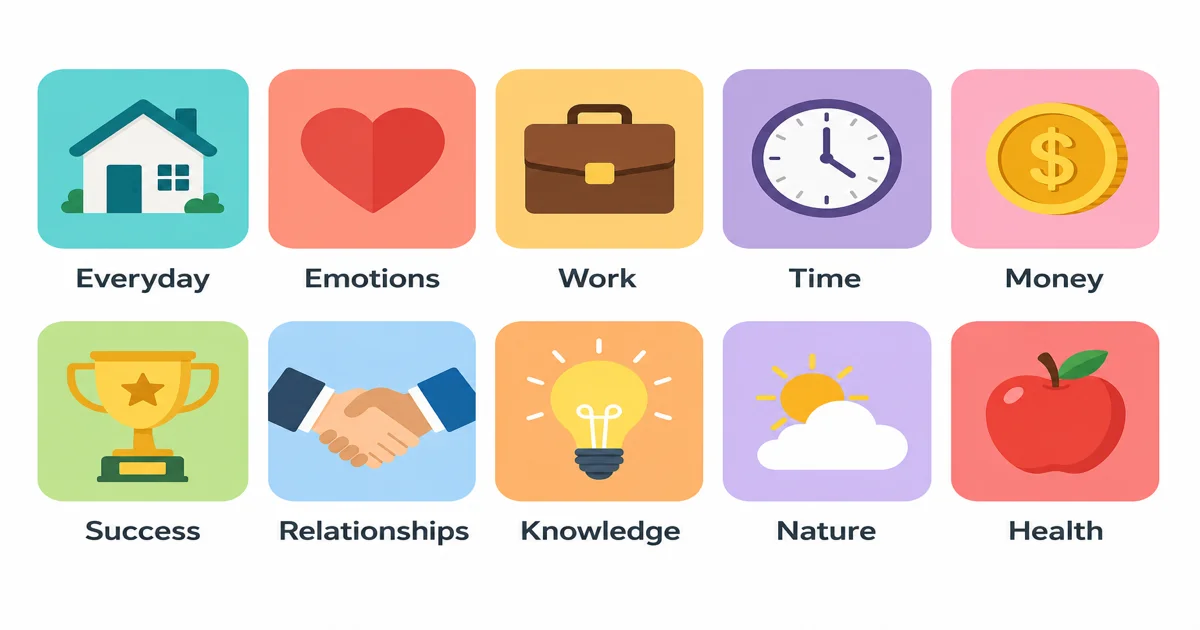
- Organizados por: 10 categorías temáticas
- Nivel: A2–C1
- Para: preparación de exámenes, fluidez, entender a los hablantes nativos
Para la referencia completa de 500+ modismos, consulta nuestra Guía completa de modismos del inglés.
Vida cotidiana
Estos modismos aparecen en la conversación diaria más que ningunos otros.
| # | Modismo | Significado | Ejemplo |
|---|---|---|---|
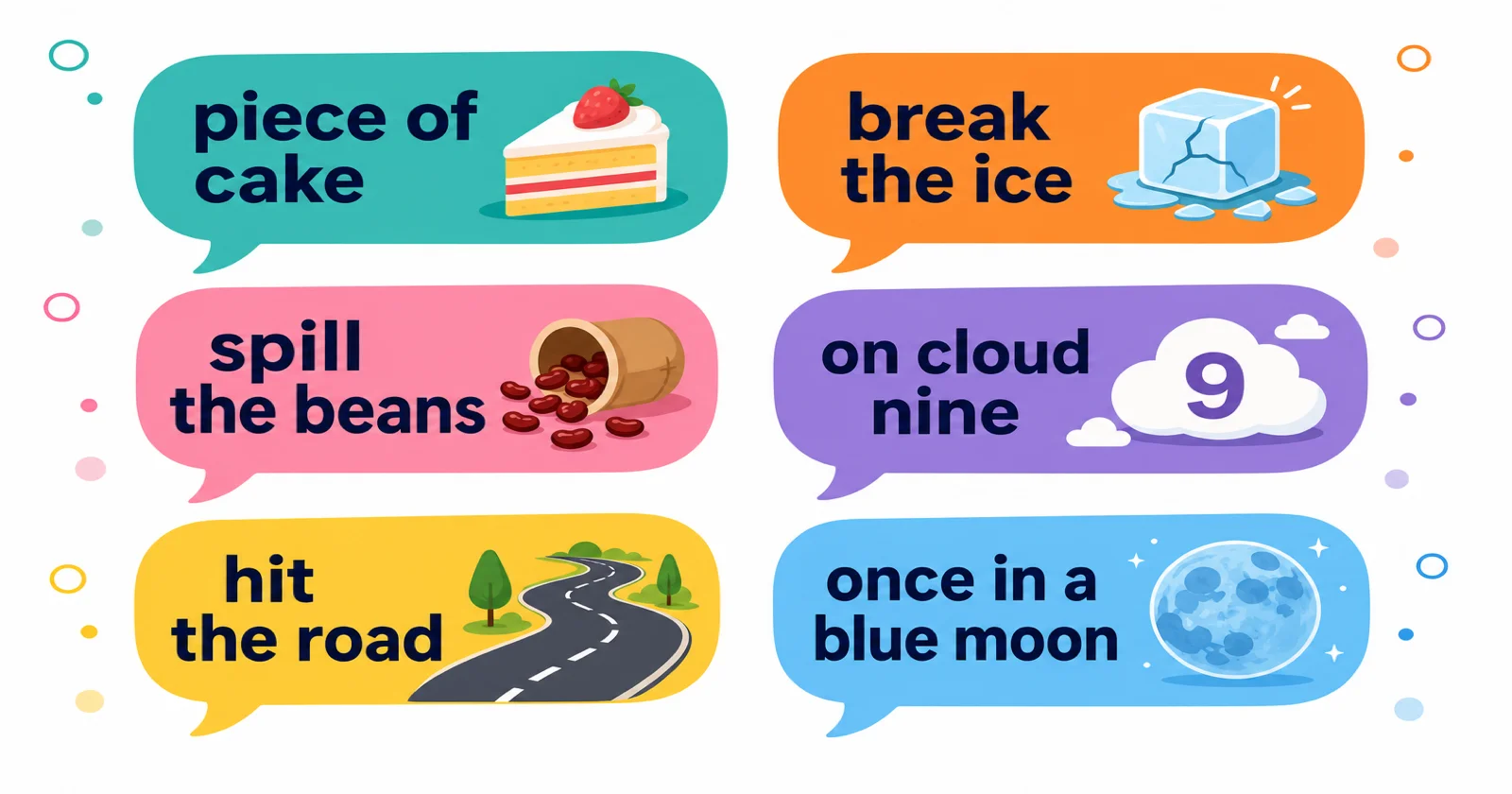
| 1 | a piece of cake | algo muy fácil | The driving test was a piece of cake — I passed on the first try. (El examen de conducir estaba chupado; lo aprobé al primer intento.) |
| 2 | break the ice | iniciar una conversación en una situación incómoda | The team-building exercise helped break the ice on the first day. (El ejercicio de team building ayudó a romper el hielo el primer día.) |
| 3 | hit the nail on the head | dar exactamente en el clavo | You hit the nail on the head — that is exactly the problem. (Has dado en el clavo; ese es exactamente el problema.) |
| 4 | under the weather | sentirse un poco mal | I’m feeling a bit under the weather today, so I’ll work from home. (Hoy no me encuentro muy bien, así que trabajaré desde casa.) |
| 5 | once in a blue moon | muy raramente | We only eat out once in a blue moon — maybe twice a year. (Solo salimos a cenar de pascuas a ramos; quizás dos veces al año.) |
| 6 | call it a day | dejar de trabajar por hoy | We’ve been at this for eight hours — let’s call it a day. (Llevamos ocho horas con esto; dejémoslo por hoy.) |
| 7 | the last straw | el último problema que desencadena una reacción | Being late again was the last straw — they fired him. (Llegar tarde otra vez fue la gota que colmó el vaso; lo despidieron.) |
| 8 | get out of hand | volverse incontrolable | The party got out of hand after midnight. (La fiesta se desmadró después de medianoche.) |
| 9 | in the long run | a largo plazo | Learning English is hard now, but it will pay off in the long run. (Aprender inglés es difícil ahora, pero a la larga valdrá la pena.) |
| 10 | at the end of the day | en última instancia; considerando todo | At the end of the day, your health is more important than your job. (Al fin y al cabo, tu salud es más importante que tu trabajo.) |
| 11 | give it a shot | intentar algo | I’ve never tried skiing, but I’ll give it a shot. (Nunca he esquiado, pero le daré una oportunidad.) |
| 12 | a blessing in disguise | algo malo que resulta ser bueno | Losing that job was a blessing in disguise — I found a much better one. (Perder ese trabajo fue una bendición disfrazada; encontré uno mucho mejor.) |
| 13 | better late than never | es mejor hacer algo tarde que no hacerlo | You finally finished the report? Well, better late than never. (¿Por fin terminaste el informe? Bueno, más vale tarde que nunca.) |
| 14 | bite off more than you can chew | asumir demasiado | She bit off more than she could chew by signing up for five courses. (Se metió en más de lo que podía abarcar apuntándose a cinco cursos.) |
| 15 | burn the midnight oil | trabajar hasta muy tarde | I’ve been burning the midnight oil to finish this project. (He estado quemándome las cejas para terminar este proyecto.) |
| 16 | hit the road | marcharse; emprender un viaje | It’s getting late — we should hit the road. (Se está haciendo tarde; deberíamos ponernos en marcha.) |
| 17 | on the same page | de acuerdo | Let’s make sure we’re all on the same page before the meeting. (Asegurémonos de que todos estamos en sintonía antes de la reunión.) |
| 18 | the tip of the iceberg | la parte visible pequeña de un problema mucho mayor | The complaints we received are just the tip of the iceberg. (Las quejas que recibimos son solo la punta del iceberg.) |
| 19 | go the extra mile | hacer más de lo que se espera | She always goes the extra mile for her clients. (Siempre da un paso más por sus clientes.) |
| 20 | a no-brainer | una decisión fácil | Taking the promotion was a no-brainer — better pay, better hours. (Aceptar el ascenso fue coser y cantar: mejor sueldo y mejor horario.) |
Emociones y sentimientos
Los modismos son especialmente ricos para describir cómo se siente la gente.
| # | Modismo | Significado | Ejemplo |
|---|---|---|---|
| 21 | on cloud nine | extremadamente feliz | She’s been on cloud nine since she got the job offer. (Está en las nubes desde que le llegó la oferta de trabajo.) |
| 22 | over the moon | encantado; eufórico | They were over the moon when they heard about the baby. (Estaban como locos de alegría cuando se enteraron del bebé.) |
| 23 | down in the dumps | triste o deprimido | He’s been down in the dumps since his girlfriend left. (Desde que lo dejó su novia está muy deprimido.) |
| 24 | have butterflies in your stomach | estar nervioso | I always have butterflies in my stomach before interviews. (Siempre me entra el pánico antes de las entrevistas.) |
| 25 | get cold feet | echarse atrás por nervios | He got cold feet and cancelled the presentation. (Le entró el canguelo y canceló la presentación.) |
| 26 | blow off steam | descargar el estrés o la rabia | After a tough week, I blow off steam by going to the gym. (Después de una semana dura, me desahogo yendo al gimnasio.) |
| 27 | keep your chin up | mantener el ánimo en una situación difícil | I know you didn’t get the job, but keep your chin up. (Sé que no conseguiste el trabajo, pero no te desanimes.) |
| 28 | on edge | nervioso y ansioso | Everyone has been on edge since the layoff announcements. (Todo el mundo está con los nervios de punta desde que anunciaron los despidos.) |
| 29 | sick and tired | harto; hasta las narices | I’m sick and tired of hearing excuses. (Estoy harto de escuchar excusas.) |
| 30 | lose your temper | perder los estribos | She rarely loses her temper, but today was an exception. (Rara vez pierde la paciencia, pero hoy fue una excepción.) |
| 31 | have a change of heart | cambiar de opinión o decisión | He was going to sell the house, but he had a change of heart. (Iba a vender la casa, pero cambió de opinión.) |
| 32 | get something off your chest | hablar de algo que te ha estado molestando | I need to get this off my chest — I disagree with the plan. (Necesito desahogarme: no estoy de acuerdo con el plan.) |
| 33 | bite your tongue | contenerse para no decir algo | I wanted to argue, but I bit my tongue. (Quería discutir, pero me mordí la lengua.) |
| 34 | cry over spilled milk | lamentarse por algo que ya no tiene remedio | The deadline passed — there’s no point crying over spilled milk. (El plazo ya pasó; no tiene sentido lamentarse por lo que ya no tiene remedio.) |
| 35 | drive someone up the wall | sacar a alguien de quicio | That constant noise is driving me up the wall. (Ese ruido constante me está volviendo loco.) |
| 36 | wear your heart on your sleeve | mostrar las emociones abiertamente | He wears his heart on his sleeve — you always know how he feels. (Lleva el corazón en la mano; siempre sabes cómo se siente.) |
| 37 | a weight off your shoulders | un alivio al quitarse un peso de encima | Finishing the thesis was a huge weight off my shoulders. (Terminar la tesis fue un enorme alivio.) |
| 38 | jump for joy | estar extremadamente contento | When she heard the news, she literally jumped for joy. (Cuando escuchó la noticia, literalmente saltó de alegría.) |
| 39 | scared stiff | aterrorizado | I was scared stiff during the horror movie. (Me quedé paralizado de miedo durante la película de terror.) |
Trabajo y negocios
Imprescindible para entornos profesionales y exámenes de inglés de negocios como el TOEIC.
| # | Modismo | Significado | Ejemplo |
|---|---|---|---|
| 40 | back to square one | volver a empezar desde el principio | The client rejected our proposal, so it’s back to square one. (El cliente rechazó nuestra propuesta, así que volvemos a empezar desde cero.) |
| 41 | think outside the box | pensar de forma creativa | We need to think outside the box to solve this problem. (Tenemos que pensar fuera de los moldes para resolver este problema.) |
| 42 | get the ball rolling | poner en marcha un proceso | Let’s get the ball rolling on the new marketing campaign. (Pongamos en marcha la nueva campaña de marketing.) |
| 43 | cut corners | hacer algo de forma fácil sacrificando la calidad | The builder cut corners on materials, and the roof leaked. (El constructor ahorró en materiales y el techo empezó a gotear.) |
| 44 | in the loop | informado de algo | Please keep me in the loop about any changes. (Por favor, mantenme al tanto de cualquier cambio.) |
| 45 | a game changer | algo que cambia significativamente una situación | Remote work was a game changer for employee satisfaction. (El trabajo remoto fue un cambio de juego para la satisfacción de los empleados.) |
| 46 | bring to the table | aportar algo de valor | What skills do you bring to the table? (¿Qué habilidades aportas?) |
| 47 | up in the air | incierto; sin decidir todavía | The project timeline is still up in the air. (El calendario del proyecto todavía está en el aire.) |
| 48 | a win-win situation | un resultado que beneficia a todos | The deal was a win-win — both companies increased their market share. (El acuerdo fue beneficioso para ambas partes; las dos empresas aumentaron su cuota de mercado.) |
| 49 | the bottom line | el hecho más importante | The bottom line is that we need to cut costs by 15%. (La cuestión fundamental es que necesitamos recortar costos un 15%.) |
| 50 | ahead of the curve | más avanzado que los demás | Their use of AI puts them ahead of the curve. (Su uso de la IA les pone por delante del resto.) |
| 51 | call the shots | tomar las decisiones | As team lead, you’ll be calling the shots on this project. (Como responsable del equipo, tomarás las decisiones en este proyecto.) |
| 52 | a steep learning curve | algo difícil de aprender al principio | The new software has a steep learning curve. (El nuevo software tiene una curva de aprendizaje muy empinada.) |
| 53 | touch base | hacer un breve contacto | Let’s touch base next week to check progress. (Quedemos la próxima semana para revisar el avance.) |
| 54 | play it by ear | improvisar; decidir sobre la marcha | We don’t have a fixed agenda — let’s just play it by ear. (No tenemos un orden del día fijo; improvisemos.) |
| 55 | burn bridges | destruir relaciones u oportunidades | Don’t burn bridges when you leave a job. (No te pelees con nadie cuando dejes un trabajo.) |
Tiempo y velocidad
| # | Modismo | Significado | Ejemplo |
|---|---|---|---|
| 56 | in the nick of time | justo a tiempo | The ambulance arrived in the nick of time. (La ambulancia llegó en el momento justo.) |
| 57 | time flies | el tiempo pasa rápido | I can’t believe it’s December already — time flies. (No me puedo creer que ya sea diciembre; el tiempo vuela.) |
| 58 | around the clock | 24 horas al día; constantemente | The team worked around the clock to meet the deadline. (El equipo trabajó sin parar para cumplir el plazo.) |
| 59 | in a heartbeat | de inmediato; sin dudarlo | I’d move to Japan in a heartbeat if I got the chance. (Me iría a vivir a Japón sin pensarlo dos veces si tuviera la oportunidad.) |
| 60 | against the clock | con prisa; con tiempo limitado | We’re working against the clock to finish before Friday. (Estamos trabajando contrarreloj para terminar antes del viernes.) |
| 61 | a matter of time | algo que inevitablemente ocurrirá | It’s only a matter of time before they find out. (Es solo cuestión de tiempo que se enteren.) |
| 62 | kill time | hacer algo sin importancia mientras se espera | I was just killing time at the airport, browsing the shops. (Estaba matando el tiempo en el aeropuerto mirando las tiendas.) |
| 63 | at the eleventh hour | en el último momento | The agreement was reached at the eleventh hour. (El acuerdo se alcanzó en el último momento.) |
Dinero y valor
| # | Modismo | Significado | Ejemplo |
|---|---|---|---|
| 64 | cost an arm and a leg | ser muy caro | The car repair cost an arm and a leg. (La reparación del coche costó un ojo de la cara.) |
| 65 | break the bank | gastar más de lo que te puedes permitir | A weekend trip doesn’t have to break the bank. (Un viaje de fin de semana no tiene por qué arruinarte.) |
| 66 | make ends meet | ganar justo lo suficiente para cubrir los gastos | After losing her job, she struggled to make ends meet. (Después de perder el trabajo, le costaba llegar a fin de mes.) |
| 67 | save for a rainy day | ahorrar para emergencias futuras | My grandmother always told me to save for a rainy day. (Mi abuela siempre me decía que guardara para cuando las cosas se pusieran difíciles.) |
| 68 | worth its weight in gold | extremadamente valioso | A good mentor is worth their weight in gold. (Un buen mentor vale su peso en oro.) |
| 69 | pay through the nose | pagar muchísimo más de lo debido | We paid through the nose for those concert tickets. (Pagamos un dineral por esas entradas del concierto.) |
| 70 | tighten your belt | gastar menos | After the pay cut, the whole family had to tighten their belts. (Tras la reducción de sueldo, toda la familia tuvo que apretarse el cinturón.) |
| 71 | foot the bill | pagar por algo | The company will foot the bill for the team dinner. (La empresa pagará la cena del equipo.) |
| 72 | go Dutch | dividir la cuenta a partes iguales | We always go Dutch when we eat out together. (Cuando salimos a comer siempre pagamos a escote.) |
| 73 | a dime a dozen | muy común y sin valor especial | Business ideas are a dime a dozen — execution is what matters. (Las ideas de negocio abundan; lo que importa es la ejecución.) |
Éxito y fracaso
| # | Modismo | Significado | Ejemplo |
|---|---|---|---|
| 74 | hit the jackpot | tener un gran éxito inesperado | We hit the jackpot with our new hire — she’s brilliant. (Nos sacamos la lotería con la nueva contratación; es brillante.) |
| 75 | miss the boat | perder una oportunidad | If you don’t apply this week, you’ll miss the boat. (Si no solicitas esta semana, perderás el tren.) |
| 76 | a long shot | algo que tiene pocas probabilidades de éxito | Getting into Harvard is a long shot, but worth trying. (Entrar en Harvard es muy difícil, pero vale la pena intentarlo.) |
| 77 | on a roll | en racha de éxitos | She’s won three games in a row — she’s on a roll. (Ha ganado tres partidos seguidos; está en racha.) |
| 78 | the sky’s the limit | no hay límite para lo que se puede lograr | With your talent, the sky’s the limit. (Con tu talento, el cielo es el límite.) |
| 79 | throw in the towel | rendirse | After three failed attempts, he threw in the towel. (Después de tres intentos fallidos, tiró la toalla.) |
| 80 | fall flat | fracasar por completo | The joke fell flat — nobody laughed. (El chiste no tuvo ninguna gracia; nadie se rió.) |
| 81 | make or break | algo que determina el éxito o el fracaso | This presentation is make or break for the entire project. (Esta presentación es decisiva para todo el proyecto.) |
| 82 | learn the ropes | aprender los fundamentos de un trabajo o actividad | It took me a few weeks to learn the ropes. (Tardé unas semanas en aprender los entresijos del puesto.) |
Relaciones y personas
| # | Modismo | Significado | Ejemplo |
|---|---|---|---|
| 83 | see eye to eye | estar completamente de acuerdo | My sister and I rarely see eye to eye on politics. (Mi hermana y yo rara vez estamos de acuerdo en política.) |
| 84 | stab someone in the back | traicionar a alguien | I trusted him, and he stabbed me in the back. (Confiaba en él y me apuñaló por la espalda.) |
| 85 | give someone the cold shoulder | ignorar deliberadamente a alguien | After the argument, she gave me the cold shoulder. (Después de la discusión, me hizo el vacío durante una semana.) |
| 86 | hit it off | llevarse bien desde el primer momento | We hit it off the moment we met at the conference. (Nos caímos bien en el momento en que nos conocimos en la conferencia.) |
| 87 | the apple of someone’s eye | la persona favorita de alguien | Their granddaughter is the apple of their eye. (Su nieta es la niña de sus ojos.) |
| 88 | be on thin ice | estar en una situación arriesgada | You’re on thin ice with the boss after missing two deadlines. (Estás en terreno resbaladizo con el jefe después de fallar dos plazos.) |
| 89 | bury the hatchet | poner fin a un conflicto; hacer las paces | After years of rivalry, they finally buried the hatchet. (Después de años de rivalidad, por fin enterraron el hacha de guerra.) |
| 90 | get on someone’s nerves | poner a alguien de los nervios | His constant humming really gets on my nerves. (Su tarareado constante realmente me pone de los nervios.) |
| 91 | pull someone’s leg | gastarle una broma a alguien | Relax, I’m just pulling your leg — of course you passed. (Tranquilo, solo estoy tomándote el pelo; claro que aprobaste.) |
Conocimiento y aprendizaje
Especialmente útil para contextos académicos y exámenes.
| # | Modismo | Significado | Ejemplo |
|---|---|---|---|
| 92 | know something inside out | conocer algo extremadamente bien | She knows the company’s policies inside out. (Se sabe las políticas de la empresa al dedillo.) |
| 93 | pick someone’s brain | pedir a alguien sus conocimientos o consejo | Can I pick your brain about investing? (¿Puedo aprovechar tu experiencia en inversión?) |
| 94 | ring a bell | sonar familiar | The name rings a bell, but I can’t remember where I heard it. (El nombre me suena, pero no recuerdo dónde lo oí.) |
| 95 | the penny dropped | entender algo de repente | I stared at the puzzle for an hour, and then the penny dropped. (Estuve mirando el rompecabezas una hora y de repente caí en la cuenta.) |
| 96 | do your homework | investigar y prepararse a fondo | Before the interview, do your homework on the company. (Antes de la entrevista, investiga bien la empresa.) |
| 97 | learn by heart | memorizar completamente | She learned the entire poem by heart. (Se aprendió el poema entero de memoria.) |
| 98 | food for thought | algo que merece reflexión seria | The lecture was food for thought — I’m reconsidering my approach. (La conferencia me dio mucho en qué pensar; estoy reconsiderando mi enfoque.) |
| 99 | read between the lines | entender el significado oculto | If you read between the lines, the email is actually a warning. (Si lees entre líneas, el correo es en realidad una advertencia.) |
| 100 | on the right track | progresando en la dirección correcta | Your essay is on the right track — just needs a stronger conclusion. (Tu ensayo va por buen camino; solo necesita una conclusión más sólida.) |
Naturaleza y tiempo atmosférico
| # | Modismo | Significado | Ejemplo |
|---|---|---|---|
| 101 | raining cats and dogs | lloviendo a cántaros | We can’t go out — it’s raining cats and dogs. (No podemos salir; está lloviendo a cántaros.) |
| 102 | a storm in a teacup | mucho alboroto por algo sin importancia | The argument at the meeting was a storm in a teacup. (La discusión en la reunión fue una tormenta en un vaso de agua.) |
| 103 | every cloud has a silver lining | de algo malo siempre se saca algo bueno | I lost my job, but I found a better one — every cloud has a silver lining. (Perdí el trabajo pero encontré uno mejor; no hay mal que por bien no venga.) |
| 104 | when it rains, it pours | los problemas tienden a venir todos a la vez | First the car broke down, then I lost my wallet — when it rains, it pours. (Primero se averió el coche, luego perdí la cartera; las desgracias nunca vienen solas.) |
| 105 | get wind of | enterarse de algo, a menudo un secreto | The press got wind of the merger before the announcement. (La prensa se enteró de la fusión antes del anuncio oficial.) |
| 106 | a breath of fresh air | algo refrescantemente nuevo o diferente | Her creative approach was a breath of fresh air for the team. (Su enfoque creativo fue un soplo de aire fresco para el equipo.) |
| 107 | calm before the storm | período tranquilo antes de algo caótico | The office was quiet on Friday — it was the calm before the storm. (La oficina estaba tranquila el viernes; era la calma que precede a la tormenta.) |
| 108 | snowed under | agobiado de trabajo | I’m completely snowed under this week. (Esta semana estoy completamente desbordado de trabajo.) |
| 109 | nip something in the bud | cortar un problema antes de que crezca | We need to nip this issue in the bud. (Necesitamos cortar este problema de raíz antes de que afecte a otros departamentos.) |
| 110 | beat around the bush | evitar hablar del tema principal | Stop beating around the bush and tell me what happened. (Deja de andarte por las ramas y dime qué pasó.) |
Acciones y decisiones
| # | Modismo | Significado | Ejemplo |
|---|---|---|---|
| 111 | take the plunge | hacer algo arriesgado o decisivo | After years of planning, she finally took the plunge and started her own business. (Después de años planeándolo, por fin se lanzó al vacío y montó su propio negocio.) |
| 112 | cross that bridge when you come to it | afrontar un problema cuando llegue | We might not get rejected — let’s cross that bridge when we come to it. (Puede que no nos rechacen; ya cruzaremos ese puente cuando lleguemos a él.) |
| 113 | sleep on it | esperar hasta el día siguiente para tomar una decisión | That’s a big commitment — why don’t you sleep on it? (Es un compromiso importante; ¿por qué no te lo piensas hasta mañana?) |
| 114 | turn over a new leaf | empezar a comportarse mejor | After the warning, he promised to turn over a new leaf. (Después de la advertencia, prometió pasar página y empezar de nuevo.) |
| 115 | sit on the fence | evitar tomar una decisión | Stop sitting on the fence and choose a direction. (Deja de nadar entre dos aguas y toma una dirección.) |
| 116 | put all your eggs in one basket | arriesgarlo todo en un solo plan | Don’t put all your eggs in one basket — apply to several companies. (No pongas todos los huevos en una sola cesta; solicita a varias empresas.) |
| 117 | let the cat out of the bag | revelar accidentalmente un secreto | I was planning a surprise, but my brother let the cat out of the bag. (Estaba planeando una sorpresa, pero mi hermano la fastidió.) |
| 118 | face the music | aceptar las consecuencias de tus actos | You made the mistake — now you have to face the music. (Cometiste el error; ahora tienes que asumir las consecuencias.) |
| 119 | take the bull by the horns | afrontar una dificultad directamente | Instead of waiting, she took the bull by the horns and spoke to the director. (En vez de esperar, agarró el toro por los cuernos y habló con el director.) |
| 120 | cut to the chase | ir al grano sin demora | Let’s cut to the chase — how much will it cost? (Vayamos al grano: ¿cuánto costará?) |
Salud y cuerpo
| # | Modismo | Significado | Ejemplo |
|---|---|---|---|
| 121 | in good shape | en buena forma física; funcionando bien | The economy is in good shape despite recent challenges. (La economía está en buena forma a pesar de los retos recientes.) |
| 122 | a clean bill of health | confirmación de que alguien está sano | The doctor gave her a clean bill of health. (El médico le dio el alta sin ningún problema.) |
| 123 | feel on top of the world | sentirse extremadamente bien y feliz | After the vacation, I feel on top of the world. (Después de las vacaciones, me siento en la cima del mundo.) |
| 124 | back on your feet | recuperado de una enfermedad o dificultad | After six months of treatment, she’s back on her feet. (Después de seis meses de tratamiento, está de nuevo en pie.) |
| 125 | burn the candle at both ends | trabajar demasiado con muy poco descanso | You’re burning the candle at both ends — you need to slow down. (Estás quemando la vela por los dos extremos; necesitas ir más despacio.) |
| 126 | alive and kicking | con buena salud y activo | She’s 90 years old and still alive and kicking. (Tiene 90 años y sigue siendo viva como un cohete.) |
| 127 | break a leg | buena suerte (antes de una actuación) | You’re going on stage? Break a leg! (¿Sales al escenario? ¡Mucha mierda!) |
Cómo aprender modismos de forma eficaz
Memorizar 200 modismos de golpe no es realista. Aquí tienes un enfoque práctico:
Paso 1: Aprende en grupos de 5–10
Elige una categoría temática de esta lista (emociones, trabajo, dinero) y estudia 5–10 modismos de ella. Aprende el significado, lee el ejemplo y escribe tu propia oración.
Paso 2: Usa la repetición espaciada
Añade modismos a tu diccionario de Linglify para el repaso automático. Los modismos son fáciles de olvidar porque no siguen los patrones normales de vocabulario — la repetición espaciada es esencial.
Paso 3: Escúchalos
Mira una película o serie en inglés e intenta captar modismos. Cuando oigas uno, pausa y comprueba si sabes el significado. Esto entrena el reconocimiento en el habla natural.
Paso 4: Úsalos en la conversación
Elige 2–3 modismos por semana y úsalos deliberadamente en tu habla o escritura. Usar un modismo correctamente en contexto vale más que conocer la definición de 50 modismos que nunca usas.
Errores comunes con los modismos
- Traducir los modismos literalmente. «Break a leg» no se traduce palabra por palabra a otros idiomas. Aprende la expresión como una unidad.
- Confundir modismos similares. «Hit the road» (marcharse) vs «hit the books» (ponerse a estudiar). Pequeñas diferencias, significados muy distintos.
- Usar demasiados modismos. Uno o dos por párrafo es natural. Cinco en un párrafo suena forzado. En el IELTS Speaking, usa 1–2 por respuesta como máximo.
- Usar el registro equivocado. Algunos modismos son informales («no-brainer», «rip-off») y no deben aparecer en la escritura académica formal. Otros («in the long run», «the bottom line») funcionan tanto en contextos formales como informales.
Para más sobre los modismos en los exámenes, consulta nuestra guía de modismos para el IELTS Speaking.
Palabras para practicar
Estas 25 palabras aparecen frecuentemente junto a los modismos en el inglés natural. Añádelas a tu diccionario de Linglify para la repetición espaciada.
boom
sustantivo
auge, explosión
Ejemplos
- The boom of thunder echoed across the valley.
- The technology boom created many new millionaires.
cooperate
verbo
colaborar, trabajar juntos
evaluate
verbo
evaluar, valor, valoración
Ejemplos
- Companies evaluate job candidates based on experience, skills, and personality.
- Teachers evaluate student progress through tests, projects, and classroom participation.
graduate
verbo
graduar
Ejemplos
- She will graduate from university next year with a degree in engineering.
- Students must complete all requirements before they can graduate from high school.
horizon
sustantivo
horizonte, línea de visión, línea de horizonte
Ejemplos
- The sun disappeared behind the horizon as evening approached.
- Traveling broadens your horizon and exposes you to new cultures.
indispensable
adjetivo
indispensable, esencial, necesario
Ejemplos
- Clean water is indispensable for human survival and good health.
- Her experience and skills make her indispensable to the research team.
jury
sustantivo
jurado
Ejemplos
- The jury deliberated for several hours before reaching a verdict.
- The talent show jury consisted of professional musicians and entertainers.
lifelong
adjetivo
de por vida, para siempre
Ejemplos
- Learning is a lifelong process that never truly ends.
- Their lifelong friendship began during elementary school years.
motivated
adjetivo
motivado, inspirado, entusiasmado
Ejemplos
- Motivated employee seeks additional responsibilities and challenges at work.
- Success requires being motivated even when facing difficult obstacles.
normally
adverbio
normalmente
Ejemplos
- Heart normally beats between sixty and hundred times per minute.
- Students normally arrive at school before morning bell rings.
off
adjetivo
fuera, apagado, desactivado
Ejemplos
- Please turn off the lights before leaving the room.
- The dog ran off into the forest chasing wild rabbits.
prejudice
sustantivo
prejuicio, sesgo
Ejemplos
- Education helps overcome prejudice and promotes understanding.
- Racial prejudice damages communities and individuals alike.
resolve
verbo
resolver, solucionar, determinar
Ejemplos
- Mediator helps parties resolve dispute through negotiation.
- Technical team will resolve software problems quickly.
stress
verbo
estresar, tensar, presionar
Ejemplos
- Heavy workload may stress employees beyond limits.
- Teacher will stress importance of homework completion.
total
adjetivo
total, completo, global
Ejemplos
- Total cost includes all fees and expenses.
- Total silence fills room during meditation session.
tragedy
sustantivo
tragedia, catástrofe, desgracia
Ejemplos
- Natural tragedy affects thousands of innocent people.
- Personal tragedy changes person's life perspective completely.
union
sustantivo
sindicato, asociación, alianza
Ejemplos
- Labor union protects worker rights and interests.
- Marriage union joins two people in partnership.
voyage
sustantivo
viaje, excursión, trayecto
Ejemplos
- Space exploration represents humanity's greatest voyage into the unknown.
- The ocean voyage from Europe to America took several weeks in the past.
candidate
sustantivo
candidato
Ejemplos
- Each presidential candidate presented their policy plans to voters.
- The job candidate impressed the interview panel with her experience.
discourage
verbo
desalentar
Ejemplos
- Don't let one failure discourage you from pursuing your dreams.
- High prices discourage many people from buying organic food products.
donate
verbo
donar, contribuir
Ejemplos
- Many people donate money to charities that help homeless individuals.
- She decided to donate blood to help patients in emergency situations.
firmly
adverbio
firmemente, con firmeza
Ejemplos
- Hold the rope firmly while climbing down the steep mountain slope.
- The manager firmly believed in treating all employees with respect.
guide
verbo
guiar, dirigir, orientar
Ejemplos
- Parents should guide their children to make responsible decisions.
- The experienced hiker will guide the group through the mountain trail safely.
humorous
adjetivo
gracioso, humorístico, cómico
Ejemplos
- She writes humorous articles about everyday life and family experiences.
- The humorous speech made everyone laugh and lightened the serious mood.
admission
sustantivo
admisión, entrada
Ejemplos
- Her admission to the prestigious medical school was the result of hard work.
- The museum offers free admission on the first Sunday of every month.
Qué hacer a continuación
-
Elige una categoría de arriba y aprende 10 modismos de ella esta semana. Escribe tu propia oración de ejemplo para cada uno.
-
Añade tus favoritos a Linglify para la repetición espaciada. Etiquétalos como «modismos» para poder repasar la categoría junta.
-
Lee la referencia completa de modismos — nuestra Guía completa de modismos del inglés: 500+ expresiones comunes cubre todas las categorías principales en profundidad.
-
Practica con contenido de exámenes — si te preparas para el IELTS, nuestra guía de modismos para el IELTS Speaking muestra exactamente cómo usar los modismos para obtener puntuaciones más altas.
-
Explora vocabulario relacionado — los modismos son una pieza del inglés natural. Consulta nuestras guías sobre verbos frasales, colocaciones y sinónimos y antónimos.
Preguntas frecuentes
¿Qué es un modismo con un ejemplo?
Un modismo es una expresión fija cuyo significado no se puede entender a partir de sus palabras individuales. Por ejemplo, «break the ice» no significa romper el hielo físicamente — significa iniciar una conversación en una situación incómoda. Ejemplo: «The host told a joke to break the ice at the party» (El anfitrión contó un chiste para romper el hielo en la fiesta). La característica clave de los modismos es que toda la frase lleva un significado diferente al de sus partes literales.
¿Cuáles son los 10 modismos más comunes del inglés?
Los modismos más utilizados en el inglés cotidiano incluyen: (1) a piece of cake (algo fácil), (2) break the ice (romper el hielo), (3) hit the nail on the head (dar en el clavo), (4) under the weather (sentirse mal), (5) once in a blue moon (muy raramente), (6) call it a day (dejar de trabajar), (7) in the long run (a la larga), (8) the last straw (la gota que colma el vaso), (9) on the same page (de acuerdo), (10) a no-brainer (algo evidente).
¿Cuántos modismos hay en inglés?
Se estima que el inglés tiene más de 25.000 expresiones idiomáticas. Sin embargo, la mayoría de los hablantes nativos usan activamente solo entre 200 y 500 en la vida cotidiana. Para los estudiantes, conocer entre 100 y 200 modismos comunes es suficiente para entender la mayoría de las conversaciones y obtener buenas puntuaciones en los exámenes. Nuestra guía completa de modismos cubre más de 500 de los más importantes.
¿Cómo aprendo modismos rápidamente?
El enfoque más rápido combina tres técnicas: (1) Aprende los modismos en grupos temáticos (todos los modismos de dinero juntos, todos los de trabajo juntos) — esto crea asociaciones mentales. (2) Usa la repetición espaciada para repasar los modismos a intervalos crecientes. (3) Practica usando 2–3 modismos por semana en tu propio habla o escritura. El aprendizaje basado en el contexto es 3–4 veces más efectivo que simplemente leer definiciones.
¿Debo usar modismos en la Redacción del IELTS?
Usa modismos con moderación en la Redacción del IELTS — 1–2 por ensayo como máximo, y solo si encajan de forma natural. La Redacción del IELTS recompensa el lenguaje académico formal, y muchos modismos son demasiado informales. Las opciones más seguras incluyen «in the long run», «the tip of the iceberg» y «a double-edged sword», que funcionan en contextos académicos. En el IELTS Speaking, los modismos son más apropiados — usa 1–2 por respuesta para demostrar un lenguaje natural.
¿Cuál es la diferencia entre modismos y verbos frasales?
Los modismos son expresiones fijas con significados no literales («kick the bucket» = morir). Los verbos frasales son combinaciones de verbo + partícula con nuevos significados («give up» = rendirse). Las categorías se solapan: algunos verbos frasales son idiomáticos («come across» = encontrar por casualidad), y algunos modismos contienen verbos frasales. La diferencia práctica: los verbos frasales siguen reglas gramaticales (puedes conjugarlos: «gave up», «giving up»), mientras que los modismos suelen ser frases fijas que no se pueden modificar.


