Palavras em Inglês para Uso Diário: O Guia Completo de Vocabulário Cotidiano
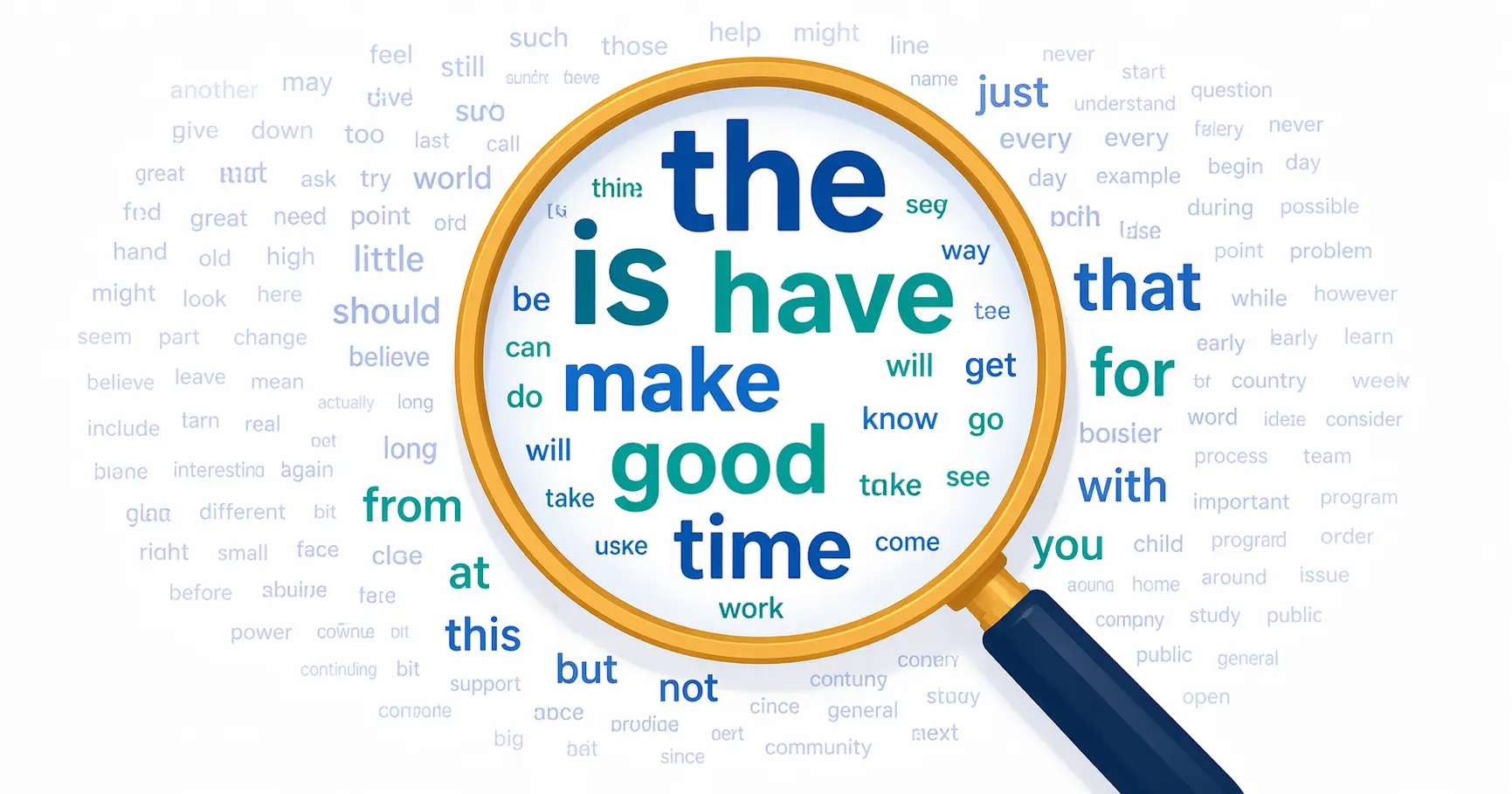
Você não precisa conhecer 50.000 palavras em inglês para ter uma conversa real. Pesquisas mostram consistentemente que as 2.000–3.000 palavras mais comuns cobrem cerca de 90–95% do inglês falado cotidiano. Os 5–10% restantes são palavras que você pode aprender à medida que as encontra.
A questão real não é “quantas palavras eu preciso?” mas “quais palavras eu preciso?” Um estudante que conhece 500 palavras práticas e de alta frequência — e consegue realmente usá-las em frases — vai se comunicar melhor do que alguém que memorizou 5.000 palavras de listas aleatórias mas não consegue juntá-las.
Este guia oferece exatamente isso: 500+ palavras em inglês para uso diário, organizadas pelas situações onde você realmente precisa delas. Cada palavra inclui seu significado, classe gramatical e uma frase que você poderia ouvir ou dizer na vida real.
Como Este Guia É Organizado
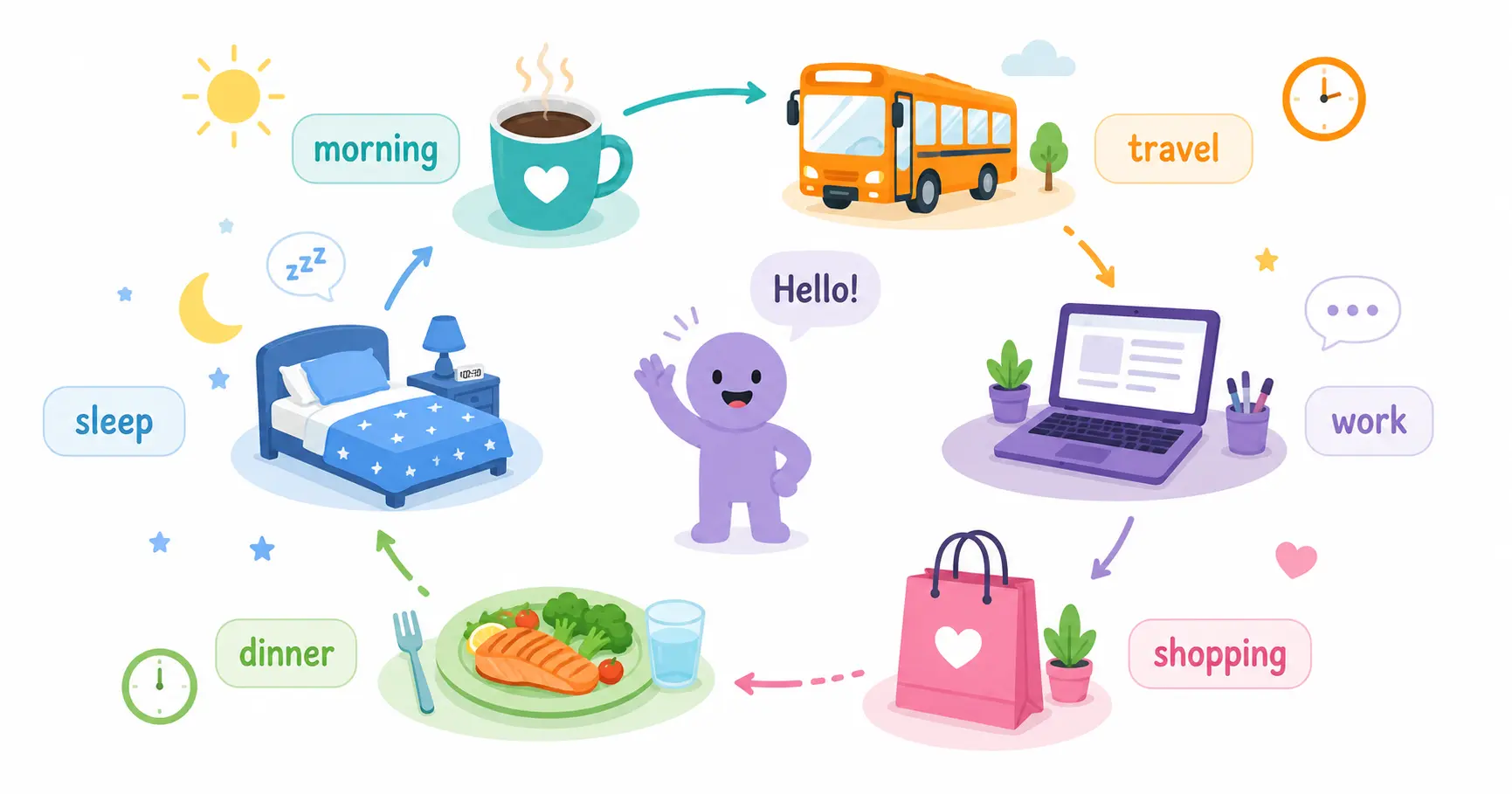
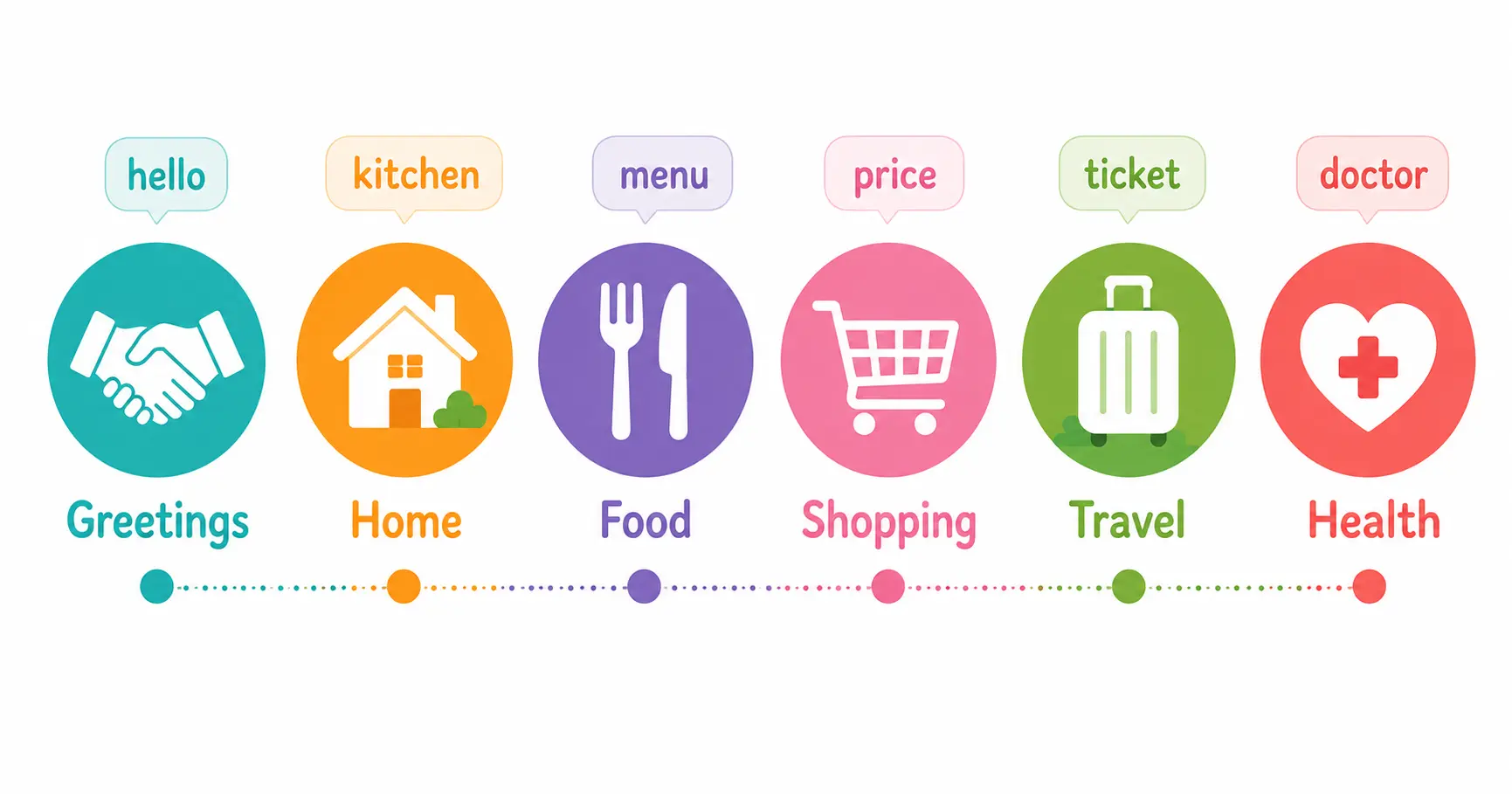
Em vez de uma lista alfabética (difícil de usar na prática), organizamos as palavras por situações do dia a dia — os contextos em que você realmente vai precisar delas:
| Seção | O Que Cobre | Palavras |
|---|---|---|
| Saudações e Conversa | Conhecer pessoas, apresentações | ~40 palavras |
| Casa e Família | Lar, rotina diária, parentes | ~50 palavras |
| Comida e Culinária | Refeições, ingredientes, restaurantes | ~60 palavras |
| Compras e Dinheiro | Lojas, preços, transações | ~40 palavras |
| Trabalho e Escritório | Empregos, reuniões, e-mails | ~50 palavras |
| Viagem e Transporte | Direções, transporte, hotéis | ~50 palavras |
| Saúde e Corpo | Partes do corpo, sintomas, médicos | ~50 palavras |
| Emoções e Opiniões | Sentimentos, concordar/discordar | ~40 palavras |
| Tempo e Números | Dias, meses, quantidades | ~40 palavras |
| Tecnologia e Comunicação | Dispositivos, internet, redes sociais | ~40 palavras |
| Clima e Natureza | Clima, estações, ao ar livre | ~30 palavras |
| Educação e Aprendizado | Escola, estudo, exames | ~40 palavras |
Seção 1: Saudações e Conversa
Estas são as primeiras palavras que usamos todos os dias — para conhecer pessoas, começar conversas e interagir em situações sociais básicas.
Saudações Essenciais
| Palavra / Frase | Significado | Exemplo |
|---|---|---|
| hello / hi | uma saudação | Hi, how are you? |
| good morning | saudação antes do meio-dia | Good morning, everyone. |
| good afternoon | saudação após o meio-dia | Good afternoon, may I help you? |
| good evening | saudação à noite | Good evening, welcome to the restaurant. |
| goodbye / bye | despedida | Goodbye, see you tomorrow! |
| see you later | despedida casual | See you later, have a good day! |
| how are you? | perguntando sobre o estado de alguém | How are you doing today? |
| fine | bem; satisfatório | I’m fine, thanks for asking. |
| nice to meet you | primeira apresentação | Nice to meet you, I’m Alex. |
| thank you / thanks | expressando gratidão | Thank you for your help. |
| please | palavra de pedido educado | Can I have some water, please? |
| sorry | pedido de desculpa; chamando atenção | Sorry, could you repeat that? |
| excuse me | chamando atenção; passando por alguém | Excuse me, where is the bathroom? |
Essenciais de Conversa
| Palavra | Classe Gramatical | Significado | Exemplo |
|---|---|---|---|
| name | substantivo | como alguém é chamado | What’s your name? |
| from | preposição | lugar de origem | Where are you from? |
| live | verbo | residir | I live in Tokyo. |
| work | verbo / substantivo | ter um emprego; emprego | I work at a tech company. |
| like | verbo | gostar | I like reading and cooking. |
| friend | substantivo | alguém que você conhece e confia | She’s my best friend. |
| family | substantivo | um grupo de parentes | My family lives in Brazil. |
| busy | adjetivo | tendo muito para fazer | Sorry, I’ve been really busy. |
| free | adjetivo | disponível; sem custo | Are you free this weekend? |
| enjoy | verbo | ter prazer em | I enjoy walking in the park. |
| favorite | adjetivo | preferido acima de todos | What’s your favorite movie? |
| hobby | substantivo | atividade feita por prazer | My hobby is photography. |
| weekend | substantivo | sábado e domingo | What are your plans for the weekend? |
| holiday | substantivo | dia de folga; férias | We’re going on holiday next month. |
| fun | substantivo / adjetivo | diversão; divertido | The party was really fun. |
| interesting | adjetivo | prendendo a atenção | That’s a very interesting idea. |
Seção 2: Casa e Família
Membros da Família
| Palavra | Significado | Exemplo |
|---|---|---|
| mother / mom | mãe | My mom is a teacher. |
| father / dad | pai | My dad works from home. |
| parents | mãe e pai | My parents live in London. |
| brother | irmão | I have an older brother. |
| sister | irmã | My sister is 12 years old. |
| husband | marido | Her husband is a doctor. |
| wife | esposa | His wife works at a bank. |
| children / kids | filhos e filhas | They have three children. |
| son | filho | Their son starts school this year. |
| daughter | filha | Our daughter loves music. |
| grandparents | avós | I visit my grandparents every Sunday. |
| uncle | tio | My uncle lives in Canada. |
| aunt | tia | My aunt is coming to visit. |
| cousin | primo/prima | I have 10 cousins. |
| neighbor | pessoa que mora perto | Our neighbor is very friendly. |
Casa e Rotina Diária
| Palavra | Classe Gramatical | Significado | Exemplo |
|---|---|---|---|
| house / home | substantivo | onde você mora | I’ll be home by 6 PM. |
| apartment | substantivo | um apartamento | We rent a small apartment downtown. |
| room | substantivo | um espaço num edifício | The living room is downstairs. |
| kitchen | substantivo | onde a comida é preparada | She’s cooking in the kitchen. |
| bedroom | substantivo | onde você dorme | The apartment has two bedrooms. |
| bathroom | substantivo | quarto com vaso e chuveiro | The bathroom is on the left. |
| door | substantivo | entrada de um cômodo | Please close the door. |
| window | substantivo | abertura para a entrada de luz e ar | Open the window — it’s hot. |
| key | substantivo | ferramenta para abrir uma fechadura | I forgot my keys at home. |
| clean | verbo / adjetivo | remover sujeira; livre de sujeira | I clean the house every Saturday. |
| cook | verbo | preparar comida | I usually cook dinner at 7. |
| wake up | verbo | parar de dormir | I wake up at 6:30 every morning. |
| sleep | verbo / substantivo | descansar inconscientemente | I need at least 7 hours of sleep. |
| shower | substantivo / verbo | lavar com água | I take a shower after the gym. |
| breakfast | substantivo | a primeira refeição do dia | What did you have for breakfast? |
| lunch | substantivo | a refeição do meio-dia | Let’s go out for lunch. |
| dinner | substantivo | a refeição da noite | Dinner is ready! |
Seção 3: Comida e Culinária
Alimentos Comuns
| Palavra | Categoria | Exemplo |
|---|---|---|
| bread | grão | I buy fresh bread every morning. |
| rice | grão | Rice is the main dish in many countries. |
| pasta | grão | She made pasta with tomato sauce. |
| chicken | carne | We’re having chicken for dinner. |
| beef | carne | This beef stew is delicious. |
| fish | frutos do mar | I eat fish twice a week. |
| egg | proteína | I’ll have two eggs for breakfast. |
| milk | laticínio | Do you want milk in your coffee? |
| cheese | laticínio | This cheese is from France. |
| butter | laticínio | Spread some butter on the bread. |
| apple | fruta | An apple a day keeps the doctor away. |
| banana | fruta | I had a banana for a snack. |
| orange | fruta | Would you like some orange juice? |
| tomato | vegetal | Add the tomatoes to the salad. |
| potato | vegetal | Baked potatoes are easy to make. |
| onion | vegetal | Chop the onion into small pieces. |
| salad | prato | I’ll have a salad for lunch. |
| soup | prato | Hot soup is perfect on cold days. |
| sugar | tempero | How much sugar do you take? |
| salt | tempero | The soup needs a little more salt. |
Saindo para Comer
| Palavra / Frase | Significado | Exemplo |
|---|---|---|
| menu | lista de opções de comida | Can I see the menu, please? |
| order | pedir comida/bebidas | Are you ready to order? |
| waiter | servidor do restaurante | The waiter brought our drinks. |
| bill / check | pedido de pagamento | Could we have the bill, please? |
| tip | dinheiro extra pelo serviço | We left a 15% tip. |
| reservation | mesa reservada | I’d like to make a reservation for two. |
| delicious | muito saboroso | The food was absolutely delicious. |
| spicy | com sabor forte e picante | Is this dish very spicy? |
| fresh | recentemente feito ou colhido | The vegetables are very fresh today. |
| hungry | precisando de comida | I’m really hungry — let’s eat. |
| thirsty | precisando de bebida | I’m thirsty. Can I have some water? |
| full | tendo comido o suficiente | I’m full, I can’t eat any more. |
Seção 4: Compras e Dinheiro
| Palavra | Classe Gramatical | Significado | Exemplo |
|---|---|---|---|
| buy | verbo | comprar | I need to buy some groceries. |
| sell | verbo | trocar por dinheiro | They sell handmade jewelry. |
| pay | verbo | dar dinheiro por algo | Can I pay by card? |
| price | substantivo | a quantidade de dinheiro necessária | What’s the price of this jacket? |
| cost | verbo / substantivo | requerer pagamento; a despesa | How much does this cost? |
| cheap | adjetivo | baixo preço | The food there is cheap and good. |
| expensive | adjetivo | preço alto | This restaurant is too expensive. |
| free | adjetivo | sem custo | Admission to the museum is free. |
| discount | substantivo | uma redução de preço | There’s a 20% discount this week. |
| sale | substantivo | período de preços reduzidos | The store is having a big sale. |
| cash | substantivo | dinheiro físico | Do you accept cash? |
| card | substantivo | cartão de crédito/débito | I’ll pay by card, please. |
| change | substantivo | dinheiro devolvido; moedas | Keep the change. |
| receipt | substantivo | comprovante de compra | Can I have a receipt, please? |
| size | substantivo | o tamanho de algo | What size do you wear? |
| try on | verbo frasal | experimentar roupas | Can I try on this shirt? |
| return | verbo | devolver para reembolso | I’d like to return this item. |
| shop / store | substantivo | um lugar para comprar coisas | There’s a bookshop on the corner. |
| customer | substantivo | uma pessoa que compra | The customer is always right. |
| bag | substantivo | um recipiente para carregar coisas | Do you need a bag? |
Seção 5: Trabalho e Escritório
| Palavra | Classe Gramatical | Significado | Exemplo |
|---|---|---|---|
| job | substantivo | trabalho remunerado | She got a new job at Google. |
| career | substantivo | um caminho profissional de longo prazo | He’s building a career in finance. |
| company | substantivo | uma organização empresarial | The company has 500 employees. |
| office | substantivo | um local de trabalho | I go to the office three days a week. |
| boss | substantivo | pessoa responsável | My boss is very supportive. |
| colleague | substantivo | um colega de trabalho | I’m having lunch with a colleague. |
| meeting | substantivo | uma discussão em grupo | We have a meeting at 10 AM. |
| deadline | substantivo | um prazo limite | The deadline is next Friday. |
| project | substantivo | um trabalho planejado | I’m working on a big project. |
| task | substantivo | um trabalho a ser feito | I have three tasks to finish today. |
| schedule | substantivo / verbo | uma agenda; planejar | Check my schedule for tomorrow. |
| salary | substantivo | pagamento mensal/anual | The salary is competitive. |
| hire | verbo | empregar | They plan to hire 20 people. |
| resign / quit | verbo | deixar um emprego voluntariamente | She resigned last week. |
| promote | verbo | dar uma posição mais alta | He was promoted to manager. |
| apply | verbo | solicitar formalmente (um emprego) | I applied for three positions. |
| interview | substantivo / verbo | uma conversa formal para emprego | The interview went really well. |
| experience | substantivo | conhecimento de fazer algo | She has 10 years of experience. |
| team | substantivo | um grupo trabalhando junto | Our team has eight members. |
| substantivo / verbo | mensagem eletrônica | I’ll send you an email tonight. | |
| report | substantivo / verbo | um documento formal; informar | The report is due tomorrow. |
| client | substantivo | um cliente (profissional) | We’re meeting an important client. |
Seção 6: Viagem e Transporte
| Palavra | Classe Gramatical | Significado | Exemplo |
|---|---|---|---|
| airport | substantivo | onde os aviões partem/chegam | We need to be at the airport by 5 AM. |
| flight | substantivo | uma viagem de avião | The flight to London takes 7 hours. |
| ticket | substantivo | comprovante de pagamento de viagem | I booked a round-trip ticket. |
| passport | substantivo | documento de identidade internacional | Don’t forget your passport. |
| luggage / baggage | substantivo | malas de viagem | My luggage is too heavy. |
| hotel | substantivo | um lugar para ficar viajando | We booked a hotel near the beach. |
| reservation | substantivo | uma reserva | I have a reservation under Smith. |
| check in | verbo frasal | registrar-se num hotel/aeroporto | You can check in from 3 PM. |
| check out | verbo frasal | sair de um hotel; olhar | We need to check out by 11 AM. |
| train | substantivo | um veículo ferroviário | The train leaves at 8:15. |
| bus | substantivo | um grande veículo rodoviário | Take bus number 42 to the center. |
| taxi / cab | substantivo | um carro de aluguel | Let’s take a taxi to the restaurant. |
| subway / metro | substantivo | ferrovia subterrânea | The subway is faster than the bus. |
| station | substantivo | lugar onde trens e ônibus param | The train station is nearby. |
| map | substantivo | um guia visual de um lugar | Can you show me on the map? |
| direction | substantivo | o caminho a seguir | Can you give me directions? |
| left / right | direção | direção para a esquerda ou a direita | Turn left at the traffic light. |
| straight | advérbio | sem virar | Go straight for two blocks. |
| near / far | adjetivo / advérbio | perto / distante | Is the hotel far from here? |
| arrival | substantivo | o ato de chegar | Our arrival time is 3 PM. |
| departure | substantivo | o ato de partir | Check the departure board. |
| delay | substantivo / verbo | estar atrasado; atrasar | The flight has a 2-hour delay. |
| cancel | verbo | cancelar | They cancelled the train due to weather. |
| border | substantivo | a fronteira entre países | We crossed the border at noon. |
Seção 7: Saúde e Corpo
Partes do Corpo
| Palavra | Significado | Exemplo |
|---|---|---|
| head | topo do corpo | I have a headache. |
| face | frente da cabeça | She has a kind face. |
| eye | órgão da visão | My eyes are tired from the screen. |
| ear | órgão da audição | I have an earache. |
| nose | órgão do olfato | My nose is running. |
| mouth | abertura para comer/falar | Open your mouth, please. |
| tooth / teeth | usados para morder | I brush my teeth twice a day. |
| neck | conecta a cabeça ao corpo | My neck is stiff. |
| shoulder | topo do braço | He hurt his shoulder. |
| arm | membro superior | She broke her arm skiing. |
| hand | no final do braço | Wash your hands before eating. |
| finger | dedo da mão | I cut my finger chopping vegetables. |
| back | parte traseira do corpo | My back hurts from sitting all day. |
| stomach | órgão digestivo; área da barriga | I have a stomachache. |
| leg | membro inferior | My legs are tired from running. |
| knee | articulação no meio da perna | He injured his knee playing football. |
| foot / feet | no final da perna | My feet are sore from walking. |
Saúde e Medicina
| Palavra | Classe Gramatical | Significado | Exemplo |
|---|---|---|---|
| sick / ill | adjetivo | não bem | I feel sick today — I can’t go to work. |
| pain | substantivo | sofrimento físico | I have a sharp pain in my chest. |
| fever | substantivo | temperatura corporal alta | She has a high fever. |
| cold | substantivo | doença comum | I caught a cold last week. |
| cough | substantivo / verbo | forçar ar dos pulmões | I’ve had this cough for a week. |
| medicine | substantivo | substância para tratar doenças | Take this medicine twice a day. |
| doctor | substantivo | um profissional médico | I need to see a doctor. |
| hospital | substantivo | uma instalação médica | He was taken to the hospital. |
| appointment | substantivo | uma visita agendada | I have a doctor’s appointment at 3. |
| prescription | substantivo | ordem escrita do médico | The doctor gave me a prescription. |
| allergy | substantivo | uma reação ruim a algo | I have an allergy to peanuts. |
| rest | substantivo / verbo | descanso; descansar | You need rest — stay in bed. |
| healthy | adjetivo | com boa saúde | Eating vegetables keeps you healthy. |
| exercise | substantivo / verbo | atividade física | Regular exercise is important. |
Seção 8: Emoções e Opiniões
| Palavra | Classe Gramatical | Significado | Exemplo |
|---|---|---|---|
| happy | adjetivo | sentindo alegria | I’m happy to see you. |
| sad | adjetivo | sentindo tristeza | The movie made me sad. |
| angry | adjetivo | sentindo forte descontentamento | She was angry about the delay. |
| afraid / scared | adjetivo | sentindo medo | I’m afraid of spiders. |
| surprised | adjetivo | sentindo choque inesperado | I was surprised by the news. |
| tired | adjetivo | precisando de descanso | I’m so tired after work. |
| excited | adjetivo | sentindo entusiasmo | I’m excited about the trip! |
| worried | adjetivo | sentindo ansiedade | I’m worried about the exam. |
| bored | adjetivo | sem interesse | I’m bored — let’s do something. |
| confused | adjetivo | incapaz de entender | I’m confused by these instructions. |
| proud | adjetivo | sentindo satisfação | She’s proud of her daughter. |
| nervous | adjetivo | sentindo ansiedade | I’m nervous about the presentation. |
| grateful | adjetivo | sentindo gratidão | I’m grateful for your help. |
| lonely | adjetivo | sentindo solidão | He felt lonely in the new city. |
| hope | verbo / substantivo | desejar; um desejo | I hope you feel better soon. |
| agree | verbo | ter a mesma opinião | I agree with you completely. |
| disagree | verbo | ter opinião diferente | I respectfully disagree. |
| believe | verbo | aceitar como verdade | I believe you’re making the right choice. |
| prefer | verbo | gostar mais de uma coisa | I prefer coffee to tea. |
| recommend | verbo | sugerir como bom | I recommend the seafood pasta. |
| suggest | verbo | propor uma ideia | I suggest we leave early. |
| opinion | substantivo | uma visão pessoal | In my opinion, this plan is better. |
Seção 9: Tempo e Números
Expressões de Tempo
| Palavra / Frase | Significado | Exemplo |
|---|---|---|
| today | este dia | I have a meeting today. |
| tomorrow | o próximo dia | Let’s talk tomorrow. |
| yesterday | o dia anterior | I saw her yesterday. |
| now | no momento presente | I’m busy right now. |
| later | num momento futuro | I’ll call you later. |
| soon | num futuro próximo | The bus should arrive soon. |
| already | antes de agora | I’ve already eaten. |
| still | continuando | Are you still at work? |
| yet | até agora (em negativas e perguntas) | I haven’t finished yet. |
| always | em todos os momentos | She always arrives on time. |
| usually | na maioria do tempo | I usually wake up at 7. |
| sometimes | ocasionalmente | Sometimes I work from home. |
| never | nunca | I never drink coffee after 6 PM. |
| early | antes do esperado | We arrived early for the show. |
| late | depois do esperado | Sorry I’m late — traffic was bad. |
| ago | no passado | I moved here two years ago. |
Números e Quantidades
| Palavra | Significado | Exemplo |
|---|---|---|
| many | um grande número (contável) | How many people are coming? |
| much | uma grande quantidade (incontável) | How much time do we have? |
| few | um número pequeno | Only a few seats are left. |
| little | uma pequena quantidade | There’s very little milk left. |
| some | uma quantidade não especificada | Would you like some water? |
| any | usado em perguntas e negativas | Do you have any questions? |
| every / each | todos individualmente | Every student passed the exam. |
| all | a quantidade total | All the tickets are sold out. |
| enough | tanto quanto necessário | We have enough food for everyone. |
| half | 50% de algo | Half the class was absent. |
| both | duas coisas juntas | Both options are good. |
| another | mais um; um diferente | Can I have another cup of coffee? |
Seção 10: Tecnologia e Comunicação
| Palavra | Classe Gramatical | Significado | Exemplo |
|---|---|---|---|
| phone | substantivo | um dispositivo telefônico | I left my phone at home. |
| call | verbo / substantivo | contatar por telefone | I’ll call you after work. |
| message | substantivo | uma comunicação escrita/falada | I sent you a message. |
| internet | substantivo | a rede global | The internet is down again. |
| website | substantivo | um conjunto de páginas web | Check our website for details. |
| app | substantivo | um aplicativo móvel | Download the app for free. |
| password | substantivo | um código secreto de acesso | I forgot my password. |
| search | verbo / substantivo | procurar online | Search for “English vocabulary” on Google. |
| download | verbo | salvar da internet | Download the file from your email. |
| upload | verbo | enviar para a internet | Upload the photo to the cloud. |
| screen | substantivo | a tela | My screen is cracked. |
| charge | verbo | adicionar energia a uma bateria | I need to charge my phone. |
| update | verbo / substantivo | atualizar; uma atualização | Update the app to the latest version. |
| share | verbo | dar acesso a outros | Share the link with your team. |
| connect | verbo | conectar ou ligar | I can’t connect to the Wi-Fi. |
| post | verbo / substantivo | publicar online | She posted a photo on Instagram. |
| follow | verbo | acompanhar conteúdo | Follow us on social media. |
| online / offline | adjetivo/advérbio | conectado / não conectado | The store is available both online and offline. |
Seção 11: Clima e Natureza
| Palavra | Classe Gramatical | Significado | Exemplo |
|---|---|---|---|
| weather | substantivo | condições atmosféricas | What’s the weather like today? |
| hot | adjetivo | temperatura alta | It’s very hot outside — over 35°C. |
| cold | adjetivo | temperatura baixa | Dress warmly — it’s cold. |
| warm | adjetivo | agradavelmente quente | It’s warm and sunny today. |
| cool | adjetivo | levemente frio | The evenings are getting cooler. |
| rain | substantivo / verbo | água das nuvens | It’s going to rain this afternoon. |
| snow | substantivo / verbo | precipitação congelada | It snowed all night. |
| wind | substantivo | ar em movimento | The wind is very strong today. |
| cloudy | adjetivo | coberto de nuvens | It’s cloudy but not raining. |
| sunny | adjetivo | brilhante com luz solar | It’s a beautiful sunny day. |
| storm | substantivo | clima severo | A big storm is coming tonight. |
| temperature | substantivo | grau de calor ou frio | The temperature dropped to –5°C. |
| season | substantivo | uma época do ano | My favorite season is autumn. |
| spring | substantivo | a estação depois do inverno | The flowers bloom in spring. |
| summer | substantivo | a estação mais quente | We’re going to the beach this summer. |
| autumn / fall | substantivo | a estação depois do verão | The leaves change color in autumn. |
| winter | substantivo | a estação mais fria | Winters here are long and cold. |
| sky | substantivo | o espaço acima da Terra | The sky is perfectly clear tonight. |
Seção 12: Educação e Aprendizado
| Palavra | Classe Gramatical | Significado | Exemplo |
|---|---|---|---|
| school | substantivo | um lugar de educação | My kids go to school nearby. |
| university | substantivo | uma instituição de ensino superior | She studied medicine at university. |
| student | substantivo | uma pessoa que estuda | There are 30 students in the class. |
| teacher | substantivo | uma pessoa que ensina | Our English teacher is from Australia. |
| class / lesson | substantivo | uma sessão de ensino | English class starts at 9 AM. |
| course | substantivo | uma série de aulas | I’m taking an online course. |
| study | verbo | aprender lendo/praticando | I study English every day. |
| learn | verbo | adquirir conhecimento | I want to learn Japanese next. |
| practice | verbo / substantivo | fazer repetidamente para melhorar | Practice makes perfect. |
| read | verbo | olhar para palavras escritas | I read for 30 minutes before bed. |
| write | verbo | colocar palavras no papel ou na tela | Write your name at the top. |
| speak | verbo | falar | Can you speak more slowly? |
| listen | verbo | prestar atenção aos sons | Listen to the recording carefully. |
| understand | verbo | compreender | I don’t understand this question. |
| exam / test | substantivo | uma avaliação formal | The final exam is next Monday. |
| homework | substantivo | trabalho atribuído para casa | I have a lot of homework tonight. |
| mistake | substantivo | um erro | Don’t be afraid of making mistakes. |
| improve | verbo | melhorar | My English has improved a lot. |
| vocabulary | substantivo | o conjunto de palavras que você conhece | Building your vocabulary takes time. |
| grammar | substantivo | regras de um idioma | English grammar can be confusing. |
| pronounce | verbo | dizer uma palavra | How do you pronounce this word? |
| translate | verbo | converter entre idiomas | Can you translate this for me? |
| dictionary | substantivo | um livro de definições de palavras | Look it up in the dictionary. |
Vocabulário para Praticar
Adicione estas 25 palavras cotidianas de alta frequência ao seu dicionário Linglify para revisá-las com repetição espaçada.
academy
substantivo
academia
Exemplos
- She graduated from the military academy with honors last spring.
- The film academy recognizes outstanding achievements in cinema each year.
achievable
adjetivo
alcançável, viável
Exemplos
- Setting achievable goals is important for maintaining motivation and confidence.
- The project timeline seems achievable if we work efficiently together.
adjective
substantivo
adjetivo
Exemplos
- In English grammar, an adjective describes or modifies a noun.
- The adjective 'beautiful' comes before the noun 'garden' in this sentence.
affordable
adjetivo
acessível, barato
Exemplos
- The government is working to provide affordable housing for low-income families.
- This restaurant offers delicious and affordable meals for college students.
amount
substantivo
quantidade, volume, valor
Exemplos
- A small amount of sugar is needed to balance the acidity.
- The amount of homework assigned seems excessive for elementary school children.
assault
substantivo
ataque
Exemplos
- The army launched a fierce assault on the enemy fortress.
- The police arrested the man for assault and battery charges.
audience
substantivo
público
Exemplos
- Television shows depend on audience ratings to determine their success.
- The speaker engaged the audience with humor and interesting stories.
beam
substantivo
viga
Exemplos
- A beam of sunlight streamed through the window brightening the room.
- The wooden beam supports the weight of the ceiling above.
biotechnology
substantivo
biotecnologia
Exemplos
- Agricultural biotechnology helps create disease-resistant crop varieties.
- Biotechnology companies develop new medical treatments and therapies.
brewery
substantivo
cervejaria
Exemplos
- She works as a quality control manager at brewery.
- The local brewery offers tours every Saturday afternoon.
carelessness
substantivo
negligência, descuido
Exemplos
- Her carelessness with money led to serious financial problems.
- The accident was caused by the pilot's carelessness during takeoff.
choose
verbo
escolher
Exemplos
- She will choose the dress that looks best for the wedding ceremony.
- Students must choose their courses carefully for next semester's schedule.
come
verbo
vir
Exemplos
- Please come to the meeting at three o'clock this afternoon.
- Spring will come early this year according to weather predictions.
continent
substantivo
continente, mundo
curry
substantivo
caril
Exemplos
- Indian curry dishes use many different spices to create complex flavors.
- She prepared a delicious chicken curry with rice for dinner.
department store
substantivo
grande loja, centro de compras, hipermercado
Exemplos
- Holiday shopping at the department store can be crowded and stressful.
- The department store sells everything from clothing to electronics.
disco
substantivo
disco
Exemplos
- Disco music became extremely popular during the nineteen seventies era.
- The disco was crowded with young people dancing to energetic music.
earth
substantivo
Terra
Exemplos
- Earth is the third planet from the sun in our solar system.
- Farmers plant seeds in rich earth to grow healthy crops.
exactly
advérbio
exatamente, precisamente
Exemplos
- That's exactly what I was thinking about this important situation too.
- The train arrived exactly on time at nine fifteen this morning.
firearm
substantivo
arma de fogo, revólver
Exemplos
- Police officers receive extensive training in firearm safety and usage.
- The museum displays historical firearms from different time periods.
generous
adjetivo
generoso
Exemplos
- She gave a generous portion of food to everyone at the dinner table.
- The generous donation will help fund scholarships for deserving students.
have to
verbo
precisar
Exemplos
- She doesn't have to work on weekends unless there's an emergency.
- Students have to complete their homework before coming to class tomorrow.
indirect
adjetivo
indireto, mediato, secundário
Exemplos
- His indirect criticism was subtle but everyone understood his meaning.
- The indirect route takes longer but avoids the heavy traffic areas.
know
verbo
saber, conhecer, ter conhecimento
Exemplos
- Do you know anyone who speaks fluent Spanish or Portuguese?
- I know the answer to that difficult mathematical question.
manner
substantivo
maneira, jeito
Exemplos
- Children learn proper table manners through family guidance and practice.
- She speaks in confident manner that commands attention and respect.
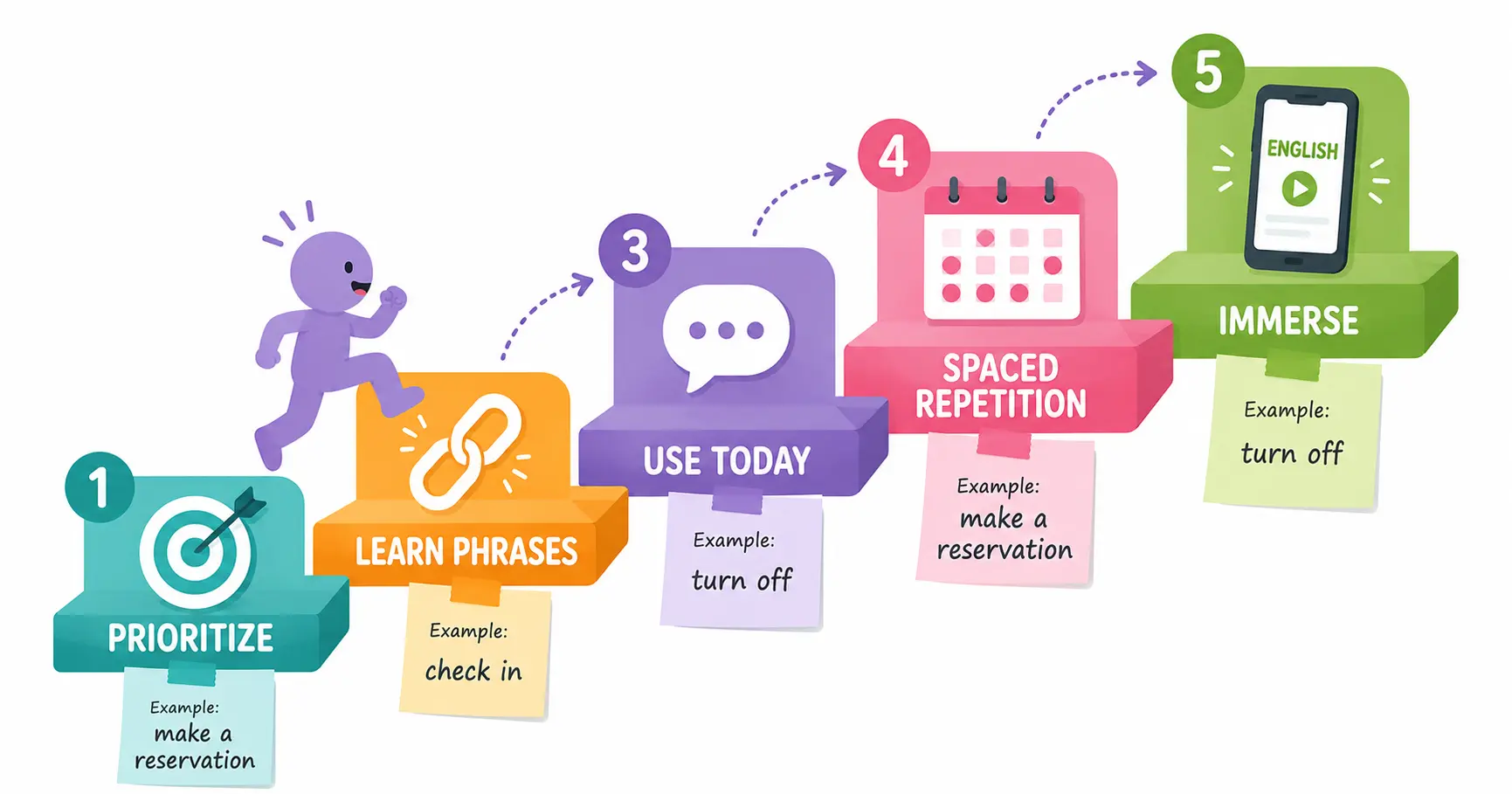
Como Aprender Vocabulário Diário Efetivamente
1. Comece com as palavras que você realmente precisa
Se você trabalha num escritório, a Seção 5 é sua prioridade. Se está viajando, a Seção 6 vem primeiro. Não há sentido em memorizar vocabulário sobre o clima se você ainda não consegue pedir comida num restaurante. Deixe que sua vida real determine a ordem.
2. Aprenda em frases, não palavras isoladas
“Make a reservation” é mais útil do que “reservation” sozinha. As palavras aparecem em combinações naturais chamadas colocações; aprendê-las juntas ajuda tanto a memória quanto a fluência. Para saber mais, leia nosso guia de colocações em inglês: como combinar palavras naturalmente.
3. Use cada nova palavra no mesmo dia
Diga-a numa frase, escreva-a numa mensagem ou use-a no seu monólogo interno. Pesquisas mostram que usar uma palavra dentro de 24 horas após aprendê-la melhora muito a retenção. Para conhecer a ciência por trás disso, veja nossas técnicas para memorizar vocabulário.
4. Use repetição espaçada
Adicione palavras ao Linglify e deixe o sistema agendar revisões em intervalos ideais. Comece com 10–15 palavras por dia, escolhidas na seção mais relevante para a sua vida.
5. Rotule seu mundo
Coloque post-its nos objetos da sua casa com seus nomes em inglês. Mude o idioma do celular para inglês e siga nas redes sociais perfis em inglês sobre assuntos que interessam a você. Quanto mais você encontrar palavras em contexto, mais rápido vai memorizá-las.
O Que Ler a Seguir
Vocabulário por nível:
- 1000 Palavras em Inglês Mais Comuns — a base essencial
- 4.000 Palavras Essenciais em Inglês — um repertório completo para o nível intermediário
- Palavras Avançadas em Inglês: Mais de 300 Termos C1–C2 — para dar o próximo passo
- Vocabulário em Inglês por Nível CEFR: A1 ao C2 — palavras organizadas por nível de proficiência
Habilidades para o inglês do dia a dia:
- Phrasal Verbs em Inglês: Guia Completo — essenciais para uma conversa natural
- Expressões Idiomáticas em Inglês: 500+ Expressões Comuns — para entender falantes nativos
- Guia de Colocações em Inglês — para falar de forma mais natural
Estratégias de aprendizagem:
- Como Melhorar seu Vocabulário — o método completo
- Como Memorizar Vocabulário — técnicas apoiadas pela ciência
FAQ
Quantas palavras em inglês eu preciso para conversa diária?
Pesquisas linguísticas mostram que as 2.000–3.000 famílias de palavras mais comuns cobrem aproximadamente 90–95% do inglês falado cotidiano. Para se virar num país de língua inglesa, 500–1.000 palavras geralmente bastam para situações comuns, como fazer compras, pedir comida, perguntar como chegar a algum lugar e manter conversas simples. Para conversar com desenvoltura, a meta prática é de 3.000–5.000 palavras.
Quais são as palavras mais importantes em inglês para aprender primeiro?
Comece pelas palavras funcionais (the, is, are, have, do, will, can) e pelos substantivos e verbos básicos de que você precisa no dia a dia: saudações (hello, thank you, sorry), pessoas (friend, family, name), ações (go, come, want, need, like, have), tempo (today, tomorrow, now) e adjetivos básicos (good, bad, big, small, new, old). Essas 100–200 palavras formam a estrutura da maioria das frases em inglês.
Como posso praticar palavras em inglês para uso diário?
Os métodos mais eficazes são: (1) coloque post-its em objetos da sua casa com seus nomes em inglês; (2) mude o idioma do celular e das redes sociais para inglês; (3) mantenha um diário de vocabulário e escreva nele de 3 a 5 frases por dia com palavras novas; (4) fale sozinho em inglês, narrando sua rotina; e (5) use aplicativos de repetição espaçada, como o Linglify, para revisar as palavras nos intervalos ideais.
Qual é a diferença entre “palavras comuns” e “palavras para uso diário”?
“Palavras comuns” são definidas pela frequência: quantas vezes aparecem, em geral, no inglês escrito e falado. Já as “palavras para uso diário” são termos práticos de que você precisa em situações específicas da vida real, como fazer compras, viajar ou falar sobre saúde. Há bastante sobreposição, mas algumas palavras muito frequentes são abstratas (como “however” e “therefore”) e não são imediatamente úteis numa conversa cotidiana. Por outro lado, palavras como “luggage” e “prescription” talvez não apareçam nas listas de maior frequência, mas são essenciais em determinadas situações.
Devo aprender palavras do inglês britânico ou americano?
No dia a dia, a grande maioria das palavras é igual. As diferenças se concentram em algumas dezenas de termos cotidianos: flat (inglês britânico) e apartment (americano), boot e trunk, queue e line, chemist e pharmacy. Escolha a variante de acordo com o lugar onde pretende morar, trabalhar ou estudar. Se não tiver preferência, o vocabulário americano tende a ser mais reconhecido internacionalmente por causa da influência da mídia. O mais importante é manter a consistência e não misturar as variantes sem critério.
Quanto tempo leva para aprender 500 palavras em inglês?
No ritmo de 10 palavras novas por dia, com revisões regulares, você pode aprender 500 palavras em cerca de 7–8 semanas. Mas aprender uma palavra acontece em etapas: primeiro vem o reconhecimento — entendê-la ao ler ou ouvir —, que costuma ser rápido; depois vem o uso ativo, isto é, empregá-la corretamente nas próprias frases, o que leva mais tempo. Com repetição espaçada, a maioria dos estudantes consegue reconhecer 500 palavras em um mês e usar boa parte delas ativamente em 2–3 meses.