Colocações em Inglês: Domine Combinações Naturais de Palavras com 300+ Exemplos
Você pode conhecer 10.000 palavras em inglês e ainda soar estranho — não por errar a gramática, mas por usar combinações que não parecem naturais. É o tipo de coisa que faz falantes nativos pararem, inclinarem a cabeça e dizerem: “Entendi o que você quis dizer, mas não falamos assim.” Quase sempre, o problema está nas colocações.
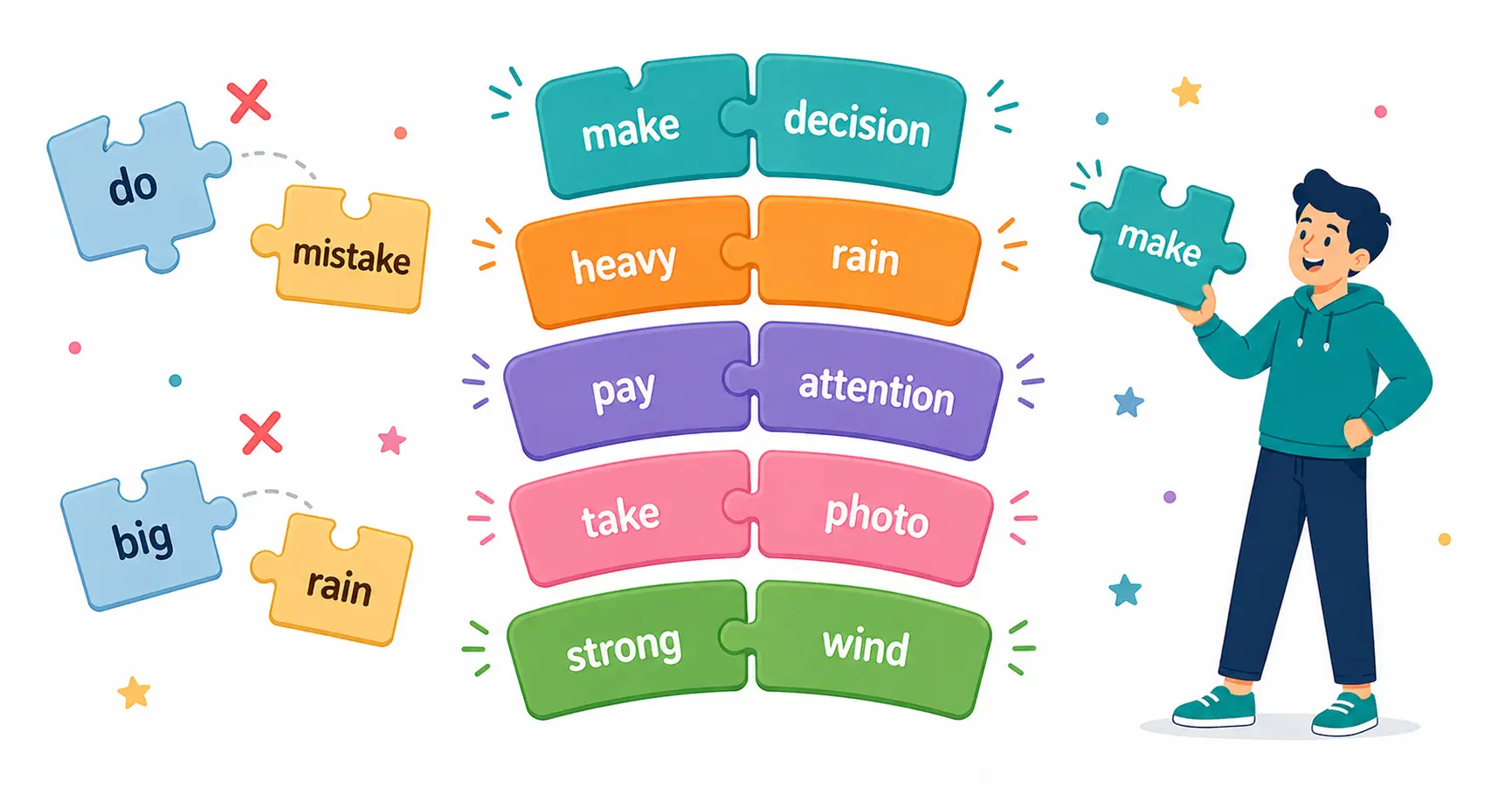
Uma colocação é um par ou grupo de palavras que naturalmente aparecem juntas em inglês. Falantes nativos dizem “make a decision” — não “do a decision”. Dizem “heavy rain” — não “strong rain”. Dizem “take a photo” — não “catch a photo”. Cada palavra, isoladamente, está correta. A gramática também. Mas a combinação não é natural e denuncia imediatamente que você não é falante nativo.
A diferença entre um estudante B2 e um falante C1 raramente está na gramática: está nas colocações. Essa é a habilidade de vocabulário que os livros didáticos ignoram, que os aplicativos negligenciam e que mais contribui para a naturalidade do seu inglês.
Este guia cobre:
- o que são colocações e por que são importantes,
- os 6 tipos de colocações com exemplos claros,
- 300+ colocações essenciais organizadas por tipo,
- os erros de colocação mais comuns que os estudantes cometem,
- como aprender colocações de forma eficaz.
O Que É uma Colocação?
Uma colocação é uma combinação de palavras que costuma aparecer junta e soar natural para falantes nativos. A palavra vem do latim: co- (juntos) + locare (colocar) — literalmente, “colocar junto”.
A característica principal: colocações não são regras — são hábitos. Não há regra gramatical que diga que “heavy rain” está correto e “strong rain” está errado. Ambas as palavras significam “muito.” Mas falantes de inglês escolheram “heavy” para chuva, e ao longo dos séculos, essa combinação ficou fixada. Você deve aprendê-las em pares, não deduzi-las pela lógica.
| Natural (Correto) | Não natural (Errado) | Por quê? |
|---|---|---|
| make a decision |
|
O inglês usa MAKE com “decision” |
| heavy rain |
|
“Heavy” combina com rain |
| take a photo |
|
O inglês usa TAKE com “photo” |
| fast food |
|
“Fast” é o modificador fixo para esse tipo de comida |
| pay attention |
|
O inglês usa PAY com “attention” |
| do homework |
|
O inglês usa DO com “homework” |
Por Que as Colocações São Importantes
1. Elas separam falantes fluentes de falantes precisos. Você pode ser 100% gramaticalmente correto e ainda soar não natural. As colocações são o que fazem a diferença.
2. Elas afetam suas pontuações em exames. No IELTS, o critério “Lexical Resource” avalia especificamente a precisão das colocações. A Banda 7 exige “awareness of style and collocation” (consciência de estilo e colocação). A Banda 8 exige “skilful use of uncommon lexical items” (uso habilidoso de itens lexicais incomuns), com “only occasional inaccuracies in word choice and collocation” (apenas imprecisões ocasionais na escolha de palavras e nas colocações).
3. Elas aceleram a comunicação. Quando você usa colocações corretas, os ouvintes processam sua fala mais rapidamente porque as combinações de palavras correspondem às suas expectativas. Colocações inadequadas criam pequenas pausas na compreensão.
4. Elas são a base da escrita natural. Redações acadêmicas, e-mails profissionais e textos criativos dependem de colocações convencionais. “Conduct research” soa profissional. “Do research” soa aceitável. “Make research” soa errado.
Colocações vs. Expressões Idiomáticas vs. Phrasal Verbs
| Característica | Colocação | Expressão Idiomática | Phrasal Verb |
|---|---|---|---|
| Significado | Previsível pelas partes | Não literal | Não literal |
| Exemplo | make a mistake | kick the bucket (= morrer) | give up (= desistir) |
| Fixo? | Semi-fixo (alguma flexibilidade) | Completamente fixo | Fixo |
| Traduzível? | Muitas vezes, sim | Geralmente, não | Geralmente, não |
| Habilidade-chave | Saber quais palavras ficam juntas | Conhecer o significado oculto | Conhecer o novo significado |
Há sobreposições: alguns phrasal verbs também são colocações (“take off” em “the plane took off”), e algumas expressões idiomáticas contêm colocações (“break the ice” combina “break” + “ice”). Mas a distinção principal permanece: colocações dizem respeito a quais palavras combinam entre si; expressões idiomáticas, a significados ocultos.
Para consultar uma lista completa de expressões idiomáticas, veja Expressões Idiomáticas em Inglês: 500+ Expressões Comuns. Para phrasal verbs, consulte Phrasal Verbs em Inglês: O Guia Completo.
Tipos de Colocações
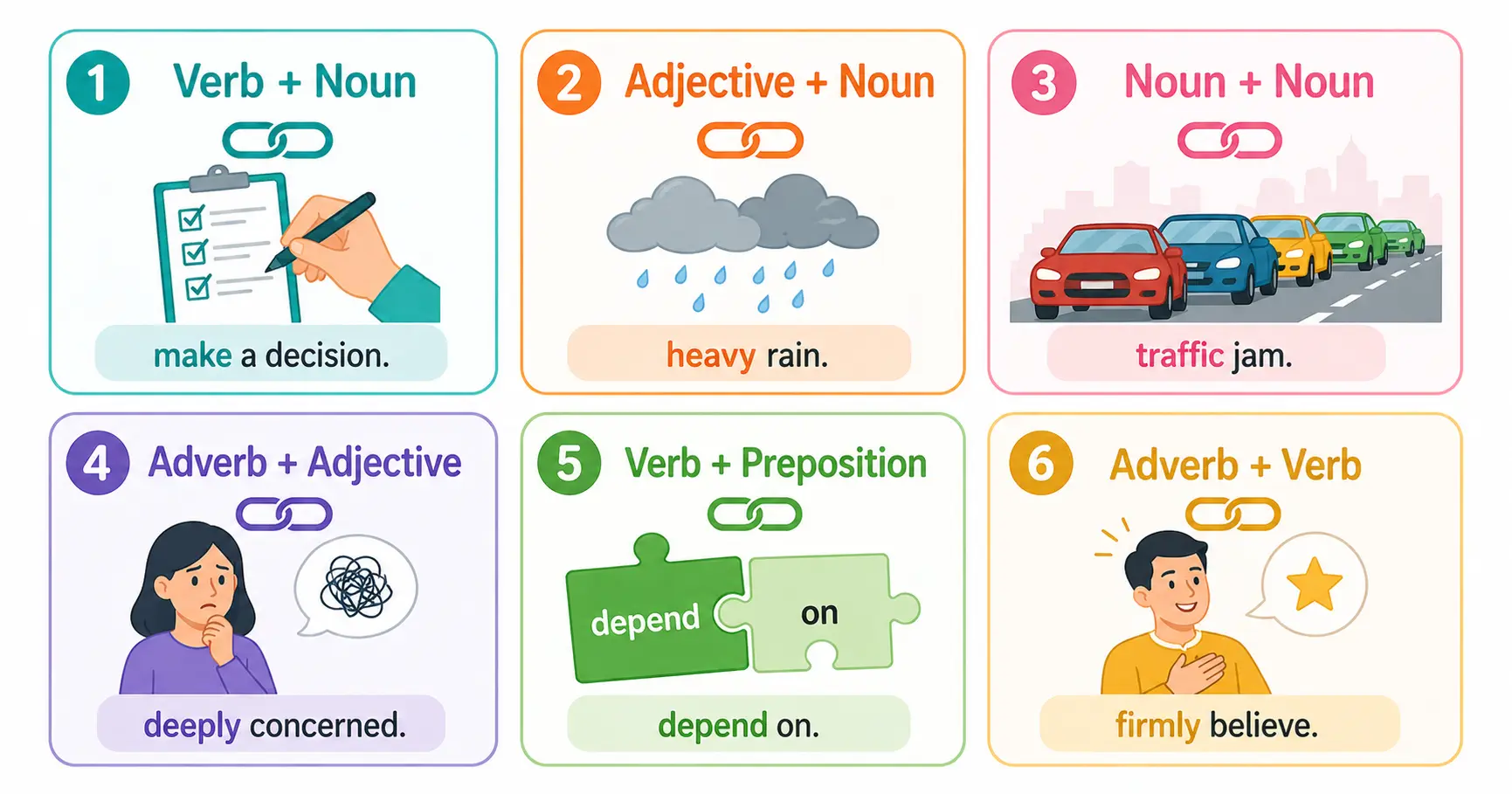
As colocações em inglês se agrupam em seis tipos principais. Entender cada tipo ajuda a prever padrões e aprender mais rápido.
Tipo 1: Verbo + Substantivo
Este é o tipo mais importante para quem está aprendendo. Cada um destes verbos — MAKE, DO, TAKE, GET, HAVE, PAY, GIVE, KEEP, BREAK e CATCH — combina com dezenas de substantivos específicos.
MAKE
| Colocação | Exemplo |
|---|---|
| make a decision | We need to make a decision by Friday. |
| make a mistake | Everyone makes mistakes — the key is learning from them. |
| make progress | The students are making good progress this term. |
| make an effort | He didn’t even make an effort to arrive on time. |
| make money | She makes good money as a software engineer. |
| make a difference | Small changes can make a big difference over time. |
| make a plan | Let’s make a plan before we start the project. |
| make an appointment | I need to make an appointment with the dentist. |
| make a complaint | She made a formal complaint about the noise. |
| make a promise | He made a promise to his daughter and kept it. |
| make an impression | First impressions matter — make a good one. |
| make a choice | You have to make a choice between the two options. |
| make sense | That explanation doesn’t make sense to me. |
| make room | Can you make room for one more person? |
| make a living | It’s hard to make a living as a freelance writer. |
| make a suggestion | Can I make a suggestion? |
| make an exception | I’ll make an exception this time, but don’t be late again. |
| make arrangements | We need to make arrangements for the conference. |
DO
| Colocação | Exemplo |
|---|---|
| do homework | Have you done your homework yet? |
| do the dishes | I’ll do the dishes after dinner. |
| do business (with) | We’ve been doing business with them for 10 years. |
| do research | She’s doing research on climate change. |
| do damage | The storm did significant damage to the coast. |
| do your best | Just do your best — that’s all anyone can ask. |
| do a favor | Could you do me a favor and check my email? |
| do the laundry | I need to do the laundry this weekend. |
| do a good job | She did a great job on the presentation. |
| do harm | The new policy may do more harm than good. |
| do exercise | I try to do some exercise every morning. |
| do an experiment | The students did an experiment to test the hypothesis. |
TAKE
| Colocação | Exemplo |
|---|---|
| take a photo / picture | Can you take a photo of us? |
| take a break | Let’s take a 10-minute break. |
| take action | The government must take action to reduce pollution. |
| take a risk | Starting a business means taking risks. |
| take a look | Take a look at this report. |
| take a seat | Please take a seat — the doctor will see you shortly. |
| take notes | She always takes detailed notes in class. |
| take responsibility | He took responsibility for the error. |
| take advice | I should have taken your advice. |
| take a chance | I took a chance and applied for the job. |
| take care (of) | Take care of yourself while I’m away. |
| take turns | The children took turns playing with the toy. |
| take part (in) | Over 200 people took part in the marathon. |
| take place | The meeting will take place on Monday at 3 PM. |
| take time | Learning a language takes time. |
GET, HAVE, PAY, GIVE
| Colocação | Exemplo |
|---|---|
| get permission | You need to get permission from the manager. |
| get a job | She got a job at a tech company after graduation. |
| get an idea | I’ve just got an idea for the project. |
| get the impression | I got the impression that he wasn’t happy. |
| have a meeting | We’re having a meeting at 2 PM. |
| have a conversation | Let’s have a conversation about your performance. |
| have an argument | They had an argument about money. |
| have a look | Have a look at this and tell me what you think. |
| have an effect (on) | Sleep has a huge effect on your concentration. |
| have access (to) | Students have access to the library 24/7. |
| pay attention | Pay attention — this will be on the exam. |
| pay a compliment | He paid her a compliment on her presentation. |
| pay a visit | I’ll pay you a visit when I’m in London. |
| give advice | She gave me some excellent advice. |
| give permission | The teacher gave them permission to leave early. |
| give a speech | The CEO gave a speech at the conference. |
| give priority (to) | We should give priority to urgent cases. |
KEEP, BREAK, CATCH, COME
| Colocação | Exemplo |
|---|---|
| keep a secret | Can you keep a secret? |
| keep a promise | Always keep your promises. |
| keep in touch | Let’s keep in touch after you move. |
| keep a record | Keep a record of all your expenses. |
| keep calm | Keep calm — panicking won’t help. |
| break the law | If you break the law, you face consequences. |
| break a record | She broke the world record in the 100m sprint. |
| break the rules | He’s always breaking the rules at school. |
| break the news | I had to break the news to her about the layoffs. |
| break a habit | Breaking a bad habit takes about 66 days on average. |
| catch a cold | I caught a cold from someone at the office. |
| catch fire | The building caught fire due to faulty wiring. |
| catch someone’s attention | The headline caught my attention immediately. |
| come to a conclusion | After reviewing the data, we came to a conclusion. |
| come to an agreement | Both parties came to an agreement after long negotiations. |
Tipo 2: Adjetivo + Substantivo
Essas colocações determinam quais adjetivos combinam com cada substantivo. Acertá-las é uma das maneiras mais rápidas de soar mais natural em inglês.
| Colocação | NÃO | Exemplo |
|---|---|---|
| heavy rain |
|
There was heavy rain all weekend. |
| strong wind |
|
A strong wind blew the tent away. |
| heavy traffic |
|
We were stuck in heavy traffic for two hours. |
| fast food |
|
I try to avoid fast food as much as possible. |
| deep sleep |
|
She was in such a deep sleep that the alarm didn’t wake her. |
| high temperature |
|
The patient has a high temperature. |
| strong coffee |
|
I need a strong coffee this morning. |
| broad daylight |
|
The robbery happened in broad daylight. |
| close friend |
|
She’s one of my closest friends. |
| bitter cold |
|
We endured the bitter cold for three hours. |
| narrow escape |
|
We had a narrow escape — the car missed us by inches. |
| bright idea |
|
Whose bright idea was it to start at 5 AM? |
| keen interest |
|
She took a keen interest in the project. |
| blissful ignorance |
|
He lived in blissful ignorance of the company’s problems. |
| sharp increase |
|
There was a sharp increase in online sales. |
| slight problem |
|
There’s a slight problem with the schedule. |
| steady progress |
|
The team is making steady progress toward the deadline. |
| bitter disappointment |
|
The result was a bitter disappointment for the team. |
| golden opportunity |
|
This is a golden opportunity to expand the business. |
| overwhelming majority |
|
The overwhelming majority voted in favor. |
Tipo 3: Substantivo + Substantivo
Alguns substantivos são convencionalmente emparelhados juntos.
| Colocação | Exemplo |
|---|---|
| traffic jam | We were stuck in a traffic jam for an hour. |
| road rage | Road rage incidents have increased this year. |
| blood pressure | The doctor checked my blood pressure. |
| cell phone | I left my cell phone at home. |
| greenhouse effect | The greenhouse effect is causing global warming. |
| heart attack | He suffered a heart attack at the age of 52. |
| job satisfaction | Job satisfaction is more important than a high salary to many people. |
| budget cuts | The university announced major budget cuts. |
| career change | She made a career change at 40 and became a teacher. |
| human rights | The organization campaigns for human rights worldwide. |
| climate change | Climate change is the defining issue of our time. |
| time management | Good time management is essential for university success. |
| brain drain | Brain drain is a serious problem for developing countries. |
| birth rate | The birth rate has been declining in many European countries. |
| action plan | We need a clear action plan for the next quarter. |
Tipo 4: Advérbio + Adjetivo
Essas colocações intensificam ou modificam adjetivos de maneiras específicas e fixas.
| Colocação | NÃO | Exemplo |
|---|---|---|
| highly unlikely |
|
It’s highly unlikely that the project will finish on time. |
| deeply concerned |
|
I am deeply concerned about the recent test results. |
| bitterly disappointed |
|
She was bitterly disappointed with the outcome. |
| perfectly natural |
|
It’s perfectly natural to feel nervous before an interview. |
| fully aware |
|
I’m fully aware of the risks involved. |
| utterly ridiculous |
|
The suggestion was utterly ridiculous. |
| wildly popular |
|
The show became wildly popular overnight. |
| painfully obvious |
|
It was painfully obvious that he hadn’t prepared. |
| blissfully unaware |
|
She was blissfully unaware of the chaos behind her. |
| seriously injured |
|
Three people were seriously injured in the accident. |
| heavily influenced |
|
Her work was heavily influenced by Japanese art. |
| vitally important |
|
It is vitally important to follow the safety procedures. |
| strictly forbidden |
|
Smoking is strictly forbidden inside the building. |
| widely recognized |
|
She is widely recognized as a leading expert in the field. |
Tipo 5: Verbo + Preposição
Esses não são phrasal verbs — o verbo mantém seu significado principal, mas requer uma preposição específica.
| Colocação | NÃO | Exemplo |
|---|---|---|
| depend on |
|
The outcome depends on several factors. |
| believe in |
|
Do you believe in life after death? |
| succeed in |
|
She succeeded in passing the bar exam on her first try. |
| apologize for |
|
He apologized for being late. |
| insist on |
|
She insisted on paying for dinner. |
| complain about |
|
He always complains about the weather. |
| concentrate on |
|
I need to concentrate on my work. |
| consist of |
|
The team consists of five members. |
| refer to |
|
Are you referring to the report I sent yesterday? |
| belong to |
|
This book belongs to the library. |
| respond to |
|
She hasn’t responded to my email yet. |
| participate in |
|
Over 500 students participated in the competition. |
| result in |
|
The accident resulted in two injuries. |
| suffer from |
|
He suffers from chronic back pain. |
| invest in |
|
The company invested heavily in new technology. |
Tipo 6: Advérbio + Verbo
Essas colocações descrevem como as ações são tipicamente realizadas.
| Colocação | Exemplo |
|---|---|
| firmly believe | I firmly believe that education changes lives. |
| strongly recommend | I strongly recommend this book to all language learners. |
| deeply regret | We deeply regret the inconvenience caused. |
| fully understand | I fully understand your concerns. |
| flatly refuse | He flatly refused to answer the question. |
| greatly appreciate | I would greatly appreciate your help. |
| seriously consider | You should seriously consider the offer before declining. |
| wholeheartedly agree | I wholeheartedly agree with your proposal. |
| categorically deny | The company categorically denied the allegations. |
| vaguely remember | I vaguely remember meeting her at a party years ago. |
| thoroughly enjoy | We thoroughly enjoyed the concert last night. |
| totally disagree | I totally disagree with that assessment. |
| readily available | The information is readily available online. |
| carefully consider | The committee carefully considered all options. |
Erros Comuns de Colocação
Esses são erros que até estudantes de nível intermediário cometem com frequência. Aprender as formas corretas vai melhorar seu inglês imediatamente.
MAKE vs. DO
Este é o erro de colocação mais comum para falantes não nativos.
| Correto | Incorreto |
|---|---|
| make a decision |
|
| make a mistake |
|
| make money |
|
| make progress |
|
| make a suggestion |
|
| do homework |
|
| do research |
|
| do business |
|
| do a favor |
|
| do exercise |
|
O padrão: MAKE é para criar, produzir ou construir algo (make a plan, make a cake, make an effort). DO é para realizar uma atividade ou tarefa (do the laundry, do work, do an experiment).
Erros Comuns de Adjetivo + Substantivo
| Correto | Incorreto | Por quê |
|---|---|---|
| heavy rain |
|
Chuva é “heavy” em inglês |
| strong wind |
|
Vento é “strong,” não “heavy” |
| fast food |
|
Composto fixo: “fast food” |
| high price |
|
Preços são “high” ou “low,” não expensive |
| big mistake |
|
Erros são “big” (ou “huge”), não “large” |
| do/cause damage |
|
Em inglês, o dano é “done” (causado) ou “caused” (provocado) |
Erros Comuns de Verbo + Substantivo
| Correto | Incorreto | Por quê |
|---|---|---|
| take a photo |
|
O inglês usa TAKE, não MAKE |
| pay attention |
|
Colocação fixa com PAY |
| catch a cold |
|
“Catch” é a colocação padrão |
| break the law |
|
“Break” é a forma usada no dia a dia |
| tell a lie |
|
Mentiras são “told,” não “said” |
| tell the truth |
|
Mesmo padrão: TELL, não SAY |
Colocações por Nível
A2–B1 (Elementar ao Intermediário)
Estas são as primeiras colocações que vale a pena aprender: elas aparecem o tempo todo em conversas do dia a dia.
make a mistake, do homework, take a photo, have a meeting, pay attention, give advice, keep a secret, break the rules, catch a cold, fast food, heavy rain, strong wind, make a decision, do your best, take a break, have fun, get a job, close friend, big deal, traffic jam
B2 (Intermediário Superior)
Essas aparecem em contextos acadêmicos, notícias e comunicação profissional:
make progress, do research, take action, have an effect, pay a compliment, give priority, keep in touch, break a record, come to a conclusion, sharp increase, steady progress, golden opportunity, bitter disappointment, highly unlikely, deeply concerned, firmly believe, strongly recommend, career change, time management, budget cuts
C1–C2 (Avançado)
Essas distinguem falantes quase nativos de todos os outros:
make an allegation, do justice (to), take precedence, have ramifications, pay dividends, give rise to, keep abreast (of), break new ground, come to fruition, stark contrast, vested interest, sweeping changes, heightened awareness, categorically deny, flatly refuse, wholly inadequate, bitterly divided, disproportionately affected, inextricably linked, mutually exclusive
Para um guia completo de colocações avançadas, consulte Colocações Avançadas em Inglês: Combinações C1–C2.
Colocações para IELTS e Escrita Acadêmica
Se você está se preparando para IELTS, TOEFL ou para escrever textos acadêmicos, estas colocações são essenciais. Elas aparecem constantemente nos temas dos exames e contam bastante no critério “Lexical Resource”.
Colocações para Introdução de Redação
| Colocação | Exemplo |
|---|---|
| raise a question | This trend raises the question of whether traditional education is still relevant. |
| a growing concern | Air pollution is a growing concern in major cities. |
| play a significant role | Technology plays a significant role in modern education. |
| draw attention to | The report draws attention to the widening gap between rich and poor. |
| a matter of debate | Whether zoos should exist remains a matter of debate. |
Colocações de Causa e Efeito
| Colocação | Exemplo |
|---|---|
| have a profound impact | Social media has had a profound impact on how we communicate. |
| lead to consequences | Deforestation can lead to devastating consequences for biodiversity. |
| pose a threat | Plastic waste poses a serious threat to marine ecosystems. |
| trigger a response | The crisis triggered an immediate government response. |
| face a challenge | Developing countries face unique challenges in combating climate change. |
Dados e Tendências (IELTS Tarefa 1)
| Colocação | Exemplo |
|---|---|
| show a steady increase | The graph shows a steady increase in renewable energy adoption. |
| reach a peak | Unemployment reached a peak of 12% in 2009. |
| undergo a dramatic change | The industry underwent a dramatic change between 2015 and 2020. |
| remain relatively stable | Consumer spending remained relatively stable throughout the period. |
| account for a significant proportion | Asia accounted for a significant proportion of global exports. |
Para uma estratégia completa de vocabulário para o IELTS, consulte o Guia Completo de Vocabulário para IELTS. Para colocações específicas de exames, veja Colocações para PTE e IELTS.
Vocabulário para Praticar
Adicione ao seu dicionário do Linglify estas 25 palavras que aparecem em colocações essenciais para praticá-las com repetição espaçada.
affordable
adjetivo
acessível, barato
Exemplos
- The government is working to provide affordable housing for low-income families.
- This restaurant offers delicious and affordable meals for college students.
commute
verbo
deslocar-se, morar
Exemplos
- Public transportation helps people commute efficiently reducing traffic congestion.
- Workers commute daily between suburban homes and downtown offices.
conservation
substantivo
conservação, proteção, preservação
Exemplos
- Water conservation becomes increasingly important during periods of severe drought.
- Wildlife conservation is essential for protecting endangered species from extinction.
demanding
adjetivo
exigente, difícil
Exemplos
- Medical school is very demanding and requires years of intensive study.
- She has a demanding boss who expects perfection in all tasks.
DJ
substantivo
DJ
Exemplos
- The DJ played my favorite song.
- The DJ took song requests all night.
heritage
substantivo
patrimônio
Exemplos
- She inherited a rich heritage of family traditions from her grandparents.
- The ancient castle is an important part of our cultural heritage.
leisure
substantivo
lazer
Exemplos
- People enjoy various leisure activities during weekends and holidays.
- Reading books is popular leisure pursuit for many educated people.
luxurious
adjetivo
luxuoso, requintado
Exemplos
- She dreams of owning luxurious car with leather seats and sunroof.
- The luxurious hotel suite includes marble bathroom and ocean view.
memorable
adjetivo
memorável
Exemplos
- Graduation day was memorable occasion for entire family.
- The memorable speech inspired students to pursue their dreams.
nutritious
adjetivo
nutritivo
Exemplos
- Fresh vegetables are nutritious and support overall health.
- Nutritious breakfast provides energy for productive school day.
passionate
adjetivo
apaixonado
Exemplos
- Passionate speech moves audience to take action.
- Passionate teacher inspires students to learn more.
pollution
substantivo
poluição
Exemplos
- Air pollution affects public health in cities.
- Ocean pollution threatens marine life worldwide.
privacy
substantivo
privacidade
Exemplos
- Hotel guests expect privacy during their stay.
- Internet privacy becomes increasingly important issue nowadays.
scenic
adjetivo
cênico
Exemplos
- Scenic overlook provides perfect spot for photographs.
- Scenic route takes longer but offers beautiful.
traditional
adjetivo
tradicional
Exemplos
- Traditional cooking methods preserve authentic flavors perfectly.
- Traditional music reflects cultural history and values.
uneven
adjetivo
desigual
Exemplos
- Uneven ground makes walking difficult and dangerous.
- Uneven performance shows inconsistent skill level development.
volunteer
verbo
voluntariar-se
Exemplos
- Citizens volunteer time for community improvement projects.
- Students volunteer at local charity organizations regularly.
substantially
advérbio
substancialmente, consideravelmente
Exemplos
- Her performance substantially improved after additional training and practice.
- Prices have increased substantially over the past few months.
liaison
substantivo
ligação, contato
Exemplos
- Military liaison officers coordinate operations between allied forces.
- She serves as liaison between different departments.
sustainable
adjetivo
sustentável, viável, ecológico
Exemplos
- Company implements sustainable business model for long-term success.
- Sustainable farming practices protect soil and water resources.
acclaimed
adjetivo
reconhecido
Exemplos
- His performance was acclaimed by critics.
- The acclaimed author received many awards for her novel.
cancellation
substantivo
cancelamento, anulação, interrupção
Exemplos
- Due to weather, the flight cancellation was inevitable.
- The concert's cancellation disappointed many fans.
discretion
substantivo
discrição, cautela, moderação
Exemplos
- He exercised discretion in his decisions.
- Use your discretion when sharing information.
indication
substantivo
indicação, sinal, pista
Exemplos
- The indication of his illness was clear after the tests.
- There was no indication that she was unhappy.
serenity
substantivo
serenidade, calma, tranquilidade
Exemplos
- She maintained her serenity despite the chaos.
- The serenity of the lake was calming.
Como Aprender Colocações
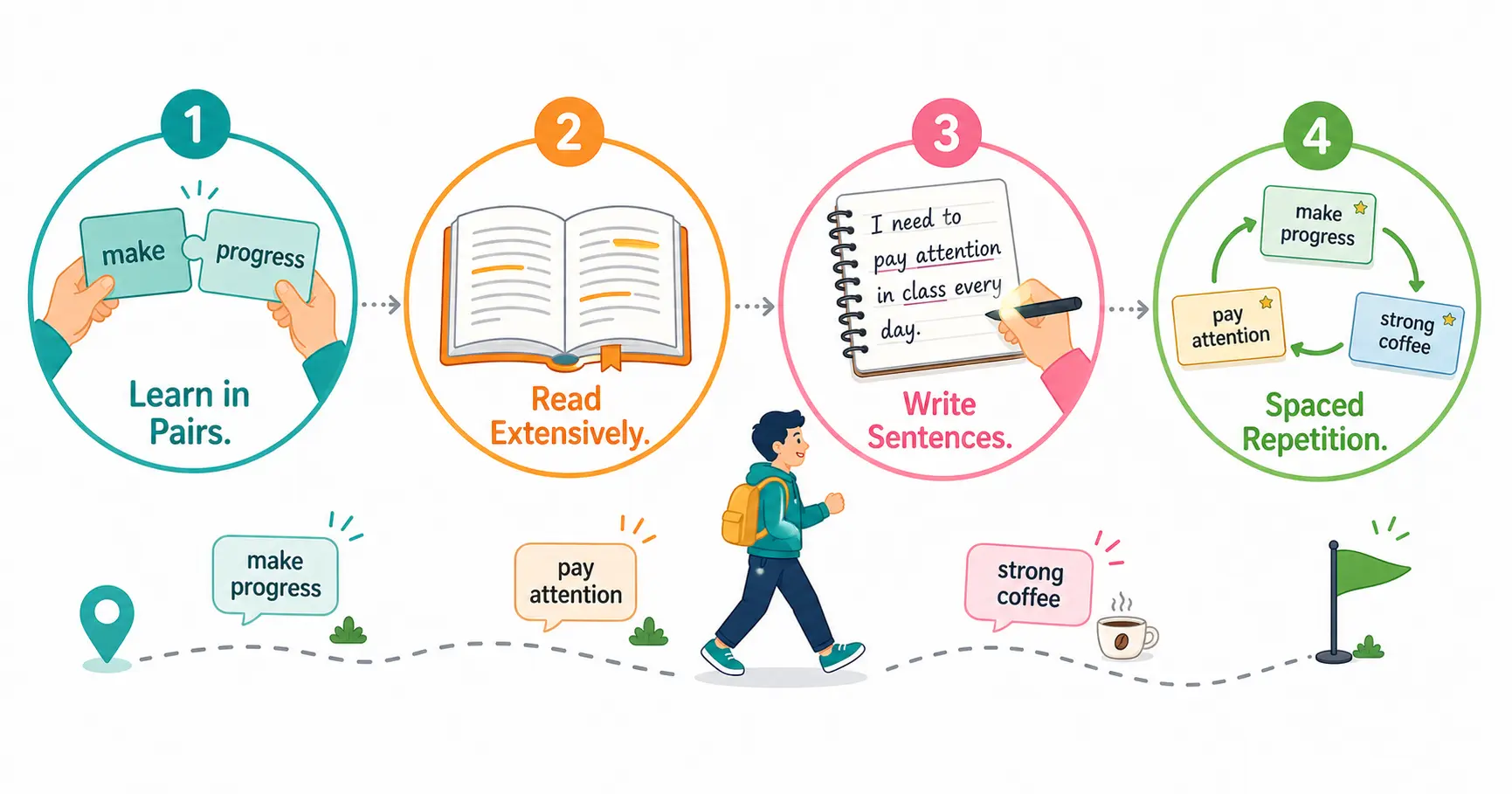
1. Aprenda palavras em pares, não isoladas
Nunca aprenda uma palavra isolada. Ao aprender “decision”, aprenda também “make a decision”; ao aprender “rain”, registre “heavy rain”. Organize seu caderno de vocabulário em duas colunas: a palavra e as colocações mais comuns em que ela aparece.
2. Leia extensivamente
As colocações são assimiladas mais pela exposição do que pela memorização. Leia artigos do Economist, da BBC, do Guardian e de periódicos acadêmicos. Quando encontrar uma combinação de palavras que soe natural, anote-a. Com o tempo, as colocações corretas começarão a “soar certas”, mesmo que você não saiba explicar o motivo.
3. Use um dicionário de colocações
O Oxford Collocations Dictionary for Students of English é a melhor obra de referência especializada. Ao consultar uma palavra, você encontra suas colocações mais comuns organizadas por tipo (verbo+, adjetivo+, substantivo+ etc.). Ferramentas on-line como o Ozdic.com também permitem pesquisar colocações gratuitamente.
4. Aprenda com seus erros
Quando um falante nativo ou professor corrigir sua escolha de palavras — “We say ‘heavy rain,’ not ‘strong rain’” — anote a colocação correta. Erros que você percebe e corrige ficam na memória por muito mais tempo do que colocações que apenas leu passivamente.
5. Use repetição espaçada
Adicione colocações ao Linglify ou a outro sistema de repetição espaçada. Estude cada uma como uma unidade completa — “make + decision” em um único cartão, e não “make” e “decision” separados. Para conhecer uma abordagem de memorização baseada em ciência, veja Como Memorizar Vocabulário.
6. Pratique com construção de frases
Para cada colocação nova, escreva três frases em contextos diferentes. Com “heavy rain”, por exemplo: (1) “We cancelled the picnic due to heavy rain.” (2) “Heavy rain is expected throughout the week.” (3) “The heavy rain caused flooding in low-lying areas.” Assim, você aprende a usar a combinação com flexibilidade, em vez de apenas reconhecê-la.
O Que Ler a Seguir
Este guia principal apresenta a estrutura completa para entender as colocações. A seguir, você encontra materiais mais específicos para cada necessidade:
Por nível:
- Colocações em Inglês em Uso: Combinações Essenciais por Nível — combinações organizadas do nível A2 ao C2
- Colocações Avançadas em Inglês: Combinações C1–C2 — para estudantes do intermediário superior ao avançado
Para exames:
- Colocações para PTE e IELTS: A Lista de Colocações para Exames — combinações específicas que ajudam a melhorar sua pontuação em Lexical Resource
- Vocabulário para IELTS Writing Task 1 — colocações para descrever dados na Task 1
- Vocabulário para IELTS Writing Task 2 — combinações para usar em redações
Vocabulário relacionado:
- Expressões Idiomáticas em Inglês: 500+ Expressões Comuns — expressões fixas com significados figurados
- Phrasal Verbs em Inglês: O Guia Completo — combinações de verbo e partícula
- Como Melhorar seu Vocabulário — uma estratégia completa para ampliar o vocabulário
- Palavras Avançadas em Inglês: Vocabulário C1–C2 com 300+ — palavras isoladas que se combinam com as colocações estudadas aqui
FAQ
O que é uma colocação em palavras simples?
Uma colocação é um par ou grupo de duas ou mais palavras que aparece junto naturalmente em inglês. “Make a decision” é uma colocação porque falantes de inglês dizem “make” com “decision” — não “do a decision” nem “take a decision”. Colocações são parcerias entre palavras: algumas simplesmente combinam, e usar a palavra errada soa estranho mesmo quando a gramática está correta.
Quantas colocações existem em inglês?
Dezenas de milhares. Cada substantivo comum pode aparecer em várias colocações com verbos, adjetivos e advérbios. O Oxford Collocations Dictionary lista mais de 150.000 colocações para 9.000 palavras principais. Para se comunicar com fluência, aprender as colocações das 2.000 palavras mais comuns em inglês cobre a maior parte do que você precisará no dia a dia e em exames.
Qual é a diferença entre uma colocação e uma palavra composta?
Uma palavra composta é uma unidade fixa que funciona como uma só palavra: “traffic jam,” “greenhouse,” “cell phone.” Já uma colocação é uma combinação mais flexível: “heavy rain,” “make a decision,” “strongly recommend.” Muitos substantivos compostos começaram como colocações e se fixaram tanto que passaram a representar um único conceito. Na prática, substantivos compostos aparecem como verbetes próprios nos dicionários; colocações são encontradas em dicionários de colocações ou aprendidas pelo contato com o idioma.
As colocações diferem entre o inglês britânico e americano?
A maioria das colocações é igual nas duas variedades. No entanto, algumas mudam: americanos dizem “take a shower”, enquanto alguns britânicos dizem “have a shower”; americanos dizem “do the math”, enquanto britânicos dizem “do the maths”. São diferenças pequenas, e as duas formas são amplamente compreendidas. No IELTS e no TOEFL, qualquer uma das variedades é aceita.
Quão importantes são as colocações para o IELTS?
São muito importantes. Os descritores do IELTS para o critério Lexical Resource mencionam colocações em todos os níveis. Na Banda 6, espera-se “some less common items despite some inaccuracy”; na Banda 7, “awareness of style and collocation”; e na Banda 8, “uncommon lexical items” com “skilful use of collocation”. Na prática, usar colocações corretamente é uma das maneiras mais rápidas de avançar da Banda 6,5 para a 7 ou mais.
Qual é a melhor maneira de aprender colocações?
Aprenda-as em pares (nunca estude “decision” sem aprender “make a decision”), leia bastante em inglês — as colocações são assimiladas pelo contato com o idioma —, use um dicionário de colocações (o Oxford Collocations Dictionary é a principal referência) e revise com repetição espaçada. A ideia central é que colocações não podem ser deduzidas de regras gramaticais: você precisa encontrá-las, percebê-las e praticá-las.
Posso usar um dicionário de sinônimos para encontrar colocações?
Não. Um dicionário de sinônimos oferece alternativas (“big” → “large,” “huge,” “massive”), mas não mostra qual delas combina com cada substantivo. Ele pode indicar que “big” e “strong” são intensificadores, mas não que a chuva é “heavy” (e não “big” ou “strong”) e o vento é “strong” (e não “heavy” ou “big”). Para isso, use um dicionário específico de colocações.