
Английские коллокации: 300+ естественных словосочетаний с примерами
Можно знать 10 000 английских слов и всё равно звучать неправильно. Не аграмматично — именно неправильно. Так, что носитель сделает паузу и скажет: «Я тебя понял, но мы так не говорим». Причина почти всегда — коллокации.
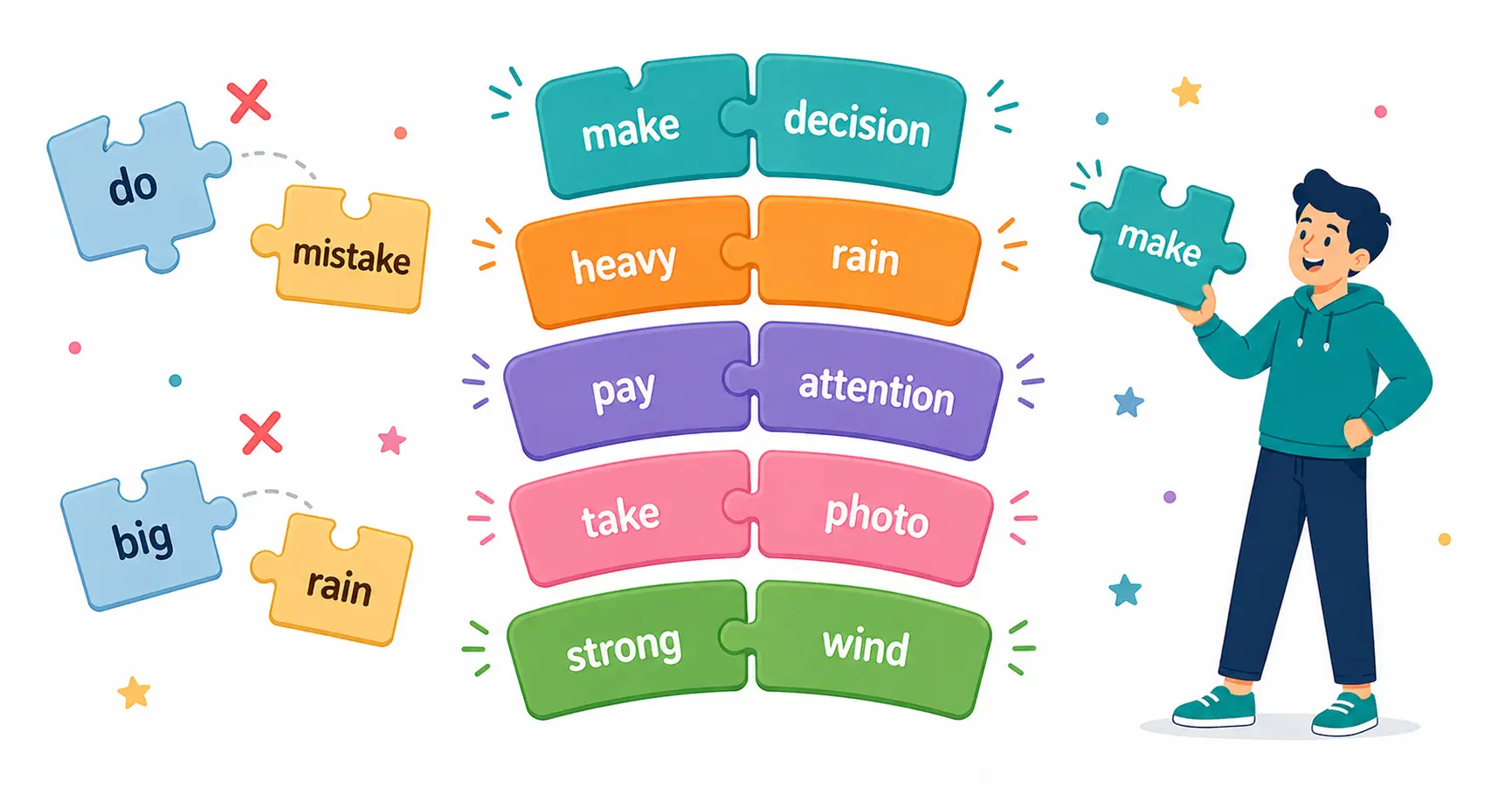
Коллокация — это пара или группа слов, которые естественно сочетаются в английском языке. Носители говорят «make a decision» — не «do a decision». Говорят «heavy rain» — не «strong rain». Говорят «take a photo» — не «catch a photo». Каждое отдельное слово правильное. Грамматика в порядке. Но сочетание неверное, и это сразу выдаёт в вас неносителя.
Разница между уровнями B2 и C1 — это редко грамматика. Это коллокации. Именно этот навык учебники пропускают, приложения игнорируют, а он больше всего влияет на то, насколько естественно звучит ваш английский.
В этом руководстве:
- что такое коллокации и почему они важны,
- 6 типов коллокаций с примерами,
- 300+ основных коллокаций по типам,
- самые частые ошибки в коллокациях,
- как эффективно учить коллокации.
Что такое коллокация?
Коллокация — это сочетание слов, которые часто встречаются вместе и звучат естественно для носителей. Слово происходит от латинского: co- (вместе) + locare (помещать) — буквально «помещённые вместе».
Главное: коллокации — это не правила, а привычки. Нет грамматического правила, что «heavy rain» правильно, а «strong rain» — нет. Оба слова означают «много, сильно». Но англоговорящие выбрали «heavy» для дождя, и за столетия это сочетание стало устойчивым. Коллокации нужно учить парами, а не выводить логически.
| Естественно (правильно) | Неестественно (неправильно) | Почему? |
|---|---|---|
| make a decision |
|
С «decision» используется MAKE |
| heavy rain |
|
«Heavy» сочетается с «rain» |
| take a photo |
|
С «photo» используется TAKE |
| fast food |
|
«Fast» — фиксированное определение для этого типа еды |
| pay attention |
|
С «attention» используется PAY |
| do homework |
|
С «homework» используется DO |
Почему коллокации важны
1. Они отличают беглую речь от просто правильной. Можно быть на 100% грамматически корректным и всё равно звучать неестественно. Коллокации — то, что создаёт разницу.
2. Они влияют на баллы экзаменов. В IELTS критерий «Lexical Resource» напрямую оценивает точность коллокаций. Band 7 требует «awareness of style and collocation» (понимание стиля и коллокаций). Band 8 — «skilful use of uncommon lexical items» (умелое использование нечастотной лексики) с «only occasional inaccuracies in word choice and collocation» (лишь редкие неточности в выборе слов и коллокациях).
3. Они ускоряют коммуникацию. Когда вы используете правильные коллокации, собеседник воспринимает речь быстрее, потому что сочетания слов совпадают с его ожиданиями. Неверные коллокации создают микропаузы в восприятии.
4. Они — основа естественного письма. Академические эссе, деловые письма и творческие тексты строятся на стандартных коллокациях. «Conduct research» звучит профессионально. «Do research» — приемлемо. «Make research» — неправильно.
Коллокации, идиомы и фразовые глаголы — в чём разница?
| Признак | Коллокация | Идиома | Фразовый глагол |
|---|---|---|---|
| Значение | Предсказуемо из частей | Небуквальное | Небуквальное |
| Пример | make a mistake | kick the bucket (= умереть) | give up (= сдаться) |
| Фиксированность | Полуфиксированное | Полностью фиксированное | Фиксированное |
| Переводимость | Часто да | Обычно нет | Обычно нет |
| Ключевой навык | Знать, какие слова сочетаются | Знать скрытый смысл | Знать новое значение |
Зоны пересечения: некоторые фразовые глаголы — одновременно коллокации («take off» в «the plane took off»), а некоторые идиомы содержат коллокации («break the ice» = «break» + «ice»). Но главное различие сохраняется: коллокации — о том, какие слова стоят рядом, идиомы — о скрытых значениях.
Полный справочник по идиомам: Английские идиомы: 500+ распространённых выражений. Фразовые глаголы: Фразовые глаголы английского языка: полное руководство.
Типы коллокаций
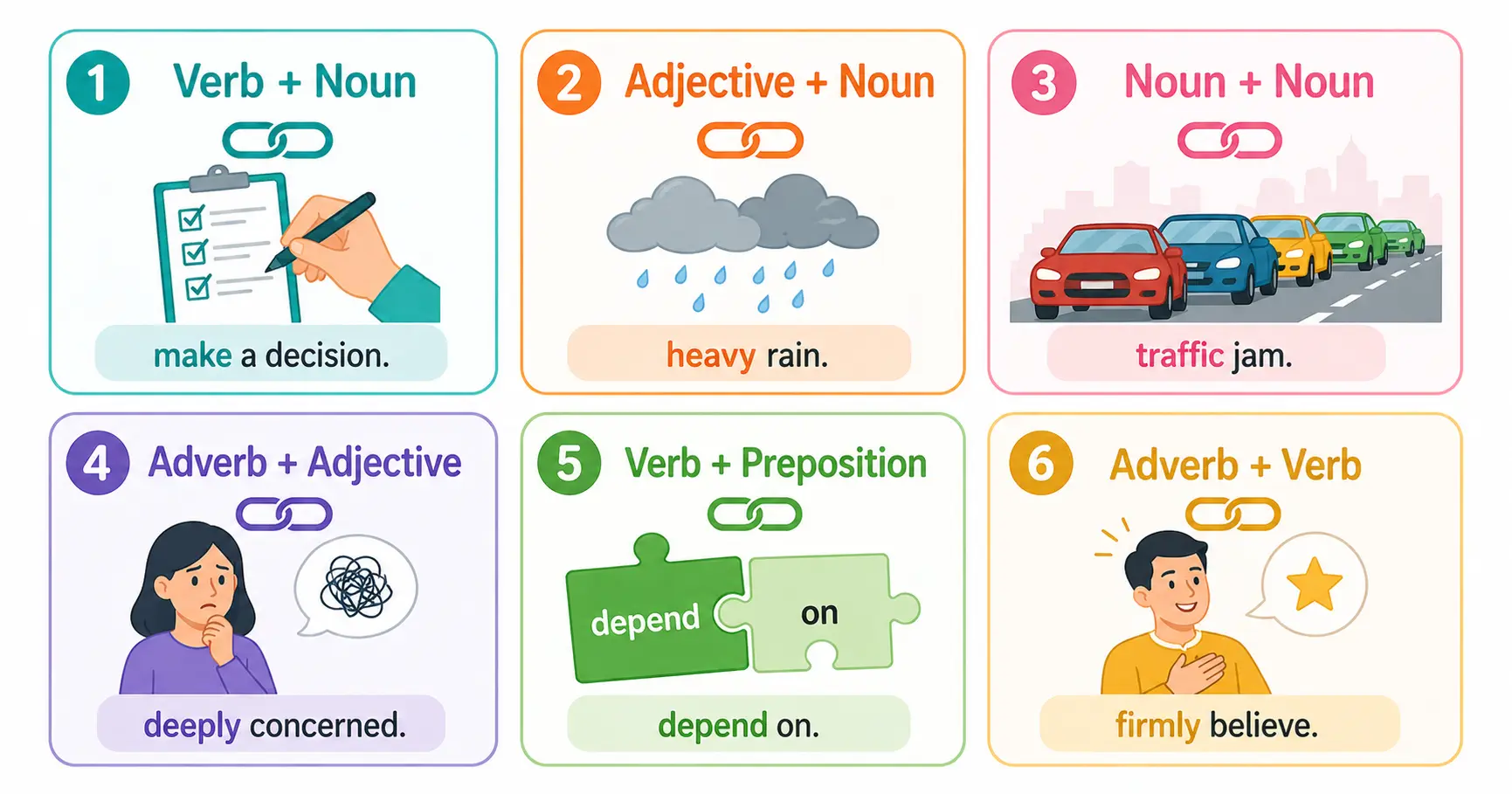
Английские коллокации делятся на 6 основных типов. Понимание типа помогает предсказывать паттерны и учить быстрее.
Тип 1: Глагол + Существительное
Самый важный тип для изучающих. MAKE, DO, TAKE, GET, HAVE, PAY, GIVE, KEEP, BREAK и CATCH — у каждого десятки фиксированных сочетаний с существительными.
MAKE
| Коллокация | Пример |
|---|---|
| make a decision | We need to make a decision by Friday. |
| make a mistake | Everyone makes mistakes — the key is learning from them. |
| make progress | The students are making good progress this term. |
| make an effort | He didn’t even make an effort to arrive on time. |
| make money | She makes good money as a software engineer. |
| make a difference | Small changes can make a big difference over time. |
| make a plan | Let’s make a plan before we start the project. |
| make an appointment | I need to make an appointment with the dentist. |
| make a complaint | She made a formal complaint about the noise. |
| make a promise | He made a promise to his daughter and kept it. |
| make an impression | First impressions matter — make a good one. |
| make a choice | You have to make a choice between the two options. |
| make sense | That explanation doesn’t make sense to me. |
| make room | Can you make room for one more person? |
| make a living | It’s hard to make a living as a freelance writer. |
| make a suggestion | Can I make a suggestion? |
| make an exception | I’ll make an exception this time, but don’t be late again. |
| make arrangements | We need to make arrangements for the conference. |
DO
| Коллокация | Пример |
|---|---|
| do homework | Have you done your homework yet? |
| do the dishes | I’ll do the dishes after dinner. |
| do business (with) | We’ve been doing business with them for 10 years. |
| do research | She’s doing research on climate change. |
| do damage | The storm did significant damage to the coast. |
| do your best | Just do your best — that’s all anyone can ask. |
| do a favor | Could you do me a favor and check my email? |
| do the laundry | I need to do the laundry this weekend. |
| do a good job | She did a great job on the presentation. |
| do harm | The new policy may do more harm than good. |
| do exercise | I try to do some exercise every morning. |
| do an experiment | The students did an experiment to test the hypothesis. |
TAKE
| Коллокация | Пример |
|---|---|
| take a photo / picture | Can you take a photo of us? |
| take a break | Let’s take a 10-minute break. |
| take action | The government must take action to reduce pollution. |
| take a risk | Starting a business means taking risks. |
| take a look | Take a look at this report. |
| take a seat | Please take a seat — the doctor will see you shortly. |
| take notes | She always takes detailed notes in class. |
| take responsibility | He took responsibility for the error. |
| take advice | I should have taken your advice. |
| take a chance | I took a chance and applied for the job. |
| take care (of) | Take care of yourself while I’m away. |
| take turns | The children took turns playing with the toy. |
| take part (in) | Over 200 people took part in the marathon. |
| take place | The meeting will take place on Monday at 3 PM. |
| take time | Learning a language takes time. |
GET, HAVE, PAY, GIVE
| Коллокация | Пример |
|---|---|
| get permission | You need to get permission from the manager. |
| get a job | She got a job at a tech company after graduation. |
| get an idea | I’ve just got an idea for the project. |
| get the impression | I got the impression that he wasn’t happy. |
| have a meeting | We’re having a meeting at 2 PM. |
| have a conversation | Let’s have a conversation about your performance. |
| have an argument | They had an argument about money. |
| have a look | Have a look at this and tell me what you think. |
| have an effect (on) | Sleep has a huge effect on your concentration. |
| have access (to) | Students have access to the library 24/7. |
| pay attention | Pay attention — this will be on the exam. |
| pay a compliment | He paid her a compliment on her presentation. |
| pay a visit | I’ll pay you a visit when I’m in London. |
| give advice | She gave me some excellent advice. |
| give permission | The teacher gave them permission to leave early. |
| give a speech | The CEO gave a speech at the conference. |
| give priority (to) | We should give priority to urgent cases. |
KEEP, BREAK, CATCH, COME
| Коллокация | Пример |
|---|---|
| keep a secret | Can you keep a secret? |
| keep a promise | Always keep your promises. |
| keep in touch | Let’s keep in touch after you move. |
| keep a record | Keep a record of all your expenses. |
| keep calm | Keep calm — panicking won’t help. |
| break the law | If you break the law, you face consequences. |
| break a record | She broke the world record in the 100m sprint. |
| break the rules | He’s always breaking the rules at school. |
| break the news | I had to break the news to her about the layoffs. |
| break a habit | Breaking a bad habit takes about 66 days on average. |
| catch a cold | I caught a cold from someone at the office. |
| catch fire | The building caught fire due to faulty wiring. |
| catch someone’s attention | The headline caught my attention immediately. |
| come to a conclusion | After reviewing the data, we came to a conclusion. |
| come to an agreement | Both parties came to an agreement after long negotiations. |
Тип 2: Прилагательное + Существительное
Эти коллокации определяют, какие прилагательные «принадлежат» каким существительным. Правильное их использование — один из самых быстрых способов звучать естественнее.
| Коллокация | НЕ | Пример |
|---|---|---|
| heavy rain |
|
There was heavy rain all weekend. |
| strong wind |
|
A strong wind blew the tent away. |
| heavy traffic |
|
We were stuck in heavy traffic for two hours. |
| fast food |
|
I try to avoid fast food as much as possible. |
| deep sleep |
|
She was in such a deep sleep that the alarm didn’t wake her. |
| high temperature |
|
The patient has a high temperature. |
| strong coffee |
|
I need a strong coffee this morning. |
| broad daylight |
|
The robbery happened in broad daylight. |
| close friend |
|
She’s one of my closest friends. |
| bitter cold |
|
We endured the bitter cold for three hours. |
| narrow escape |
|
We had a narrow escape — the car missed us by inches. |
| bright idea |
|
Whose bright idea was it to start at 5 AM? |
| keen interest |
|
She took a keen interest in the project. |
| blissful ignorance |
|
He lived in blissful ignorance of the company’s problems. |
| sharp increase |
|
There was a sharp increase in online sales. |
| slight problem |
|
There’s a slight problem with the schedule. |
| steady progress |
|
The team is making steady progress toward the deadline. |
| bitter disappointment |
|
The result was a bitter disappointment for the team. |
| golden opportunity |
|
This is a golden opportunity to expand the business. |
| overwhelming majority |
|
The overwhelming majority voted in favor. |
Тип 3: Существительное + Существительное
Некоторые существительные традиционно стоят рядом.
| Коллокация | Пример |
|---|---|
| traffic jam | We were stuck in a traffic jam for an hour. |
| road rage | Road rage incidents have increased this year. |
| blood pressure | The doctor checked my blood pressure. |
| cell phone | I left my cell phone at home. |
| greenhouse effect | The greenhouse effect is causing global warming. |
| heart attack | He suffered a heart attack at the age of 52. |
| job satisfaction | Job satisfaction is more important than a high salary to many people. |
| budget cuts | The university announced major budget cuts. |
| career change | She made a career change at 40 and became a teacher. |
| human rights | The organization campaigns for human rights worldwide. |
| climate change | Climate change is the defining issue of our time. |
| time management | Good time management is essential for university success. |
| brain drain | Brain drain is a serious problem for developing countries. |
| birth rate | The birth rate has been declining in many European countries. |
| action plan | We need a clear action plan for the next quarter. |
Тип 4: Наречие + Прилагательное
Эти коллокации усиливают или уточняют прилагательные устойчивым, фиксированным образом.
| Коллокация | НЕ | Пример |
|---|---|---|
| highly unlikely |
|
It’s highly unlikely that the project will finish on time. |
| deeply concerned |
|
I am deeply concerned about the recent test results. |
| bitterly disappointed |
|
She was bitterly disappointed with the outcome. |
| perfectly natural |
|
It’s perfectly natural to feel nervous before an interview. |
| fully aware |
|
I’m fully aware of the risks involved. |
| utterly ridiculous |
|
The suggestion was utterly ridiculous. |
| wildly popular |
|
The show became wildly popular overnight. |
| painfully obvious |
|
It was painfully obvious that he hadn’t prepared. |
| blissfully unaware |
|
She was blissfully unaware of the chaos behind her. |
| seriously injured |
|
Three people were seriously injured in the accident. |
| heavily influenced |
|
Her work was heavily influenced by Japanese art. |
| vitally important |
|
It is vitally important to follow the safety procedures. |
| strictly forbidden |
|
Smoking is strictly forbidden inside the building. |
| widely recognized |
|
She is widely recognized as a leading expert in the field. |
Тип 5: Глагол + Предлог
Это не фразовые глаголы — глагол сохраняет основное значение, но требует конкретного предлога.
| Коллокация | НЕ | Пример |
|---|---|---|
| depend on |
|
The outcome depends on several factors. |
| believe in |
|
Do you believe in life after death? |
| succeed in |
|
She succeeded in passing the bar exam on her first try. |
| apologize for |
|
He apologized for being late. |
| insist on |
|
She insisted on paying for dinner. |
| complain about |
|
He always complains about the weather. |
| concentrate on |
|
I need to concentrate on my work. |
| consist of |
|
The team consists of five members. |
| refer to |
|
Are you referring to the report I sent yesterday? |
| belong to |
|
This book belongs to the library. |
| respond to |
|
She hasn’t responded to my email yet. |
| participate in |
|
Over 500 students participated in the competition. |
| result in |
|
The accident resulted in two injuries. |
| suffer from |
|
He suffers from chronic back pain. |
| invest in |
|
The company invested heavily in new technology. |
Тип 6: Наречие + Глагол
Эти коллокации описывают, как обычно выполняются действия.
| Коллокация | Пример |
|---|---|
| firmly believe | I firmly believe that education changes lives. |
| strongly recommend | I strongly recommend this book to all language learners. |
| deeply regret | We deeply regret the inconvenience caused. |
| fully understand | I fully understand your concerns. |
| flatly refuse | He flatly refused to answer the question. |
| greatly appreciate | I would greatly appreciate your help. |
| seriously consider | You should seriously consider the offer before declining. |
| wholeheartedly agree | I wholeheartedly agree with your proposal. |
| categorically deny | The company categorically denied the allegations. |
| vaguely remember | I vaguely remember meeting her at a party years ago. |
| thoroughly enjoy | We thoroughly enjoyed the concert last night. |
| totally disagree | I totally disagree with that assessment. |
| readily available | The information is readily available online. |
| carefully consider | The committee carefully considered all options. |
Типичные ошибки в коллокациях
Эти ошибки допускают даже студенты среднего уровня. Запомнив правильные варианты, вы мгновенно улучшите свой английский.
MAKE или DO
Это самая распространённая ошибка в коллокациях среди неносителей.
| Правильно | Неправильно |
|---|---|
| make a decision |
|
| make a mistake |
|
| make money |
|
| make progress |
|
| make a suggestion |
|
| do homework |
|
| do research |
|
| do business |
|
| do a favor |
|
| do exercise |
|
Паттерн: MAKE используется для создания, производства чего-то (make a plan, make a cake, make an effort). DO — для выполнения действия или задачи (do the laundry, do work, do an experiment).
Типичные ошибки: Прилагательное + Существительное
| Правильно | Неправильно | Почему |
|---|---|---|
| heavy rain |
|
Дождь по-английски «heavy» |
| strong wind |
|
Ветер — «strong», не «heavy» |
| fast food |
|
Фиксированное словосочетание |
| high price |
|
Цены бывают «high» или «low», не «expensive» |
| big mistake |
|
Ошибки бывают «big» (или «huge»), не «large» |
| do/cause damage |
|
Ущерб «наносят» (do/cause), не «делают» |
Типичные ошибки: Глагол + Существительное
| Правильно | Неправильно | Почему |
|---|---|---|
| take a photo |
|
По-английски TAKE, не MAKE |
| pay attention |
|
Устойчивое сочетание с PAY |
| catch a cold |
|
«Catch» — стандартная коллокация |
| break the law |
|
«Break» — повседневная коллокация |
| tell a lie |
|
Ложь «рассказывают» (tell), не «говорят» (say) |
| tell the truth |
|
Тот же паттерн: TELL, не SAY |
Коллокации по уровням
A2–B1 (от элементарного до среднего)
Первые коллокации для изучения — они постоянно встречаются в повседневной речи:
make a mistake, do homework, take a photo, have a meeting, pay attention, give advice, keep a secret, break the rules, catch a cold, fast food, heavy rain, strong wind, make a decision, do your best, take a break, have fun, get a job, close friend, big deal, traffic jam
B2 (выше среднего)
Встречаются в академическом контексте, новостях и профессиональной коммуникации:
make progress, do research, take action, have an effect, pay a compliment, give priority, keep in touch, break a record, come to a conclusion, sharp increase, steady progress, golden opportunity, bitter disappointment, highly unlikely, deeply concerned, firmly believe, strongly recommend, career change, time management, budget cuts
C1–C2 (продвинутый)
Именно они отличают речь, близкую к носительской, от всей остальной:
make an allegation, do justice (to), take precedence, have ramifications, pay dividends, give rise to, keep abreast (of), break new ground, come to fruition, stark contrast, vested interest, sweeping changes, heightened awareness, categorically deny, flatly refuse, wholly inadequate, bitterly divided, disproportionately affected, inextricably linked, mutually exclusive
Подробный справочник по продвинутым коллокациям: Продвинутые английские коллокации: C1–C2.
Коллокации для IELTS и академического письма
Если вы готовитесь к IELTS, TOEFL или пишете академические тексты, эти коллокации незаменимы. Они постоянно встречаются в экзаменационных темах и высоко оцениваются по критерию «Lexical Resource».
Коллокации для вступления к эссе
| Коллокация | Пример |
|---|---|
| raise a question | This trend raises the question of whether traditional education is still relevant. |
| a growing concern | Air pollution is a growing concern in major cities. |
| play a significant role | Technology plays a significant role in modern education. |
| draw attention to | The report draws attention to the widening gap between rich and poor. |
| a matter of debate | Whether zoos should exist remains a matter of debate. |
Коллокации причины и следствия
| Коллокация | Пример |
|---|---|
| have a profound impact | Social media has had a profound impact on how we communicate. |
| lead to consequences | Deforestation can lead to devastating consequences for biodiversity. |
| pose a threat | Plastic waste poses a serious threat to marine ecosystems. |
| trigger a response | The crisis triggered an immediate government response. |
| face a challenge | Developing countries face unique challenges in combating climate change. |
Данные и тренды (IELTS Task 1)
| Коллокация | Пример |
|---|---|
| show a steady increase | The graph shows a steady increase in renewable energy adoption. |
| reach a peak | Unemployment reached a peak of 12% in 2009. |
| undergo a dramatic change | The industry underwent a dramatic change between 2015 and 2020. |
| remain relatively stable | Consumer spending remained relatively stable throughout the period. |
| account for a significant proportion | Asia accounted for a significant proportion of global exports. |
Комплексная стратегия подготовки лексики: Полное руководство по лексике для IELTS. Экзаменационные коллокации: Коллокации для PTE и IELTS.
Слова для практики
Добавьте эти 25 слов, которые входят в основные коллокации, в свой словарь Linglify для интервального повторения.
affordable
прилагательное
доступный, по средствам
Примеры
- The government is working to provide affordable housing for low-income families.
- This restaurant offers delicious and affordable meals for college students.
commute
глагол
ездить на работу, добираться, путешествовать
Примеры
- Public transportation helps people commute efficiently reducing traffic congestion.
- Workers commute daily between suburban homes and downtown offices.
conservation
существительное
сохранение, охрана, консервация
Примеры
- Water conservation becomes increasingly important during periods of severe drought.
- Wildlife conservation is essential for protecting endangered species from extinction.
demanding
прилагательное
требовательный, трудный, напряженный
Примеры
- Medical school is very demanding and requires years of intensive study.
- She has a demanding boss who expects perfection in all tasks.
DJ
существительное
диджей
Примеры
- The DJ played my favorite song.
- The DJ took song requests all night.
heritage
существительное
наследие, наследство, культурное наследие
Примеры
- She inherited a rich heritage of family traditions from her grandparents.
- The ancient castle is an important part of our cultural heritage.
leisure
существительное
досуг, свободное время
Примеры
- People enjoy various leisure activities during weekends and holidays.
- Reading books is popular leisure pursuit for many educated people.
luxurious
прилагательное
роскошный, шикарный
Примеры
- She dreams of owning luxurious car with leather seats and sunroof.
- The luxurious hotel suite includes marble bathroom and ocean view.
memorable
прилагательное
запоминающийся, памятный
Примеры
- Graduation day was memorable occasion for entire family.
- The memorable speech inspired students to pursue their dreams.
nutritious
прилагательное
питательный
Примеры
- Fresh vegetables are nutritious and support overall health.
- Nutritious breakfast provides energy for productive school day.
passionate
прилагательное
страстный, увлеченный
Примеры
- Passionate speech moves audience to take action.
- Passionate teacher inspires students to learn more.
pollution
существительное
загрязнение
Примеры
- Air pollution affects public health in cities.
- Ocean pollution threatens marine life worldwide.
privacy
существительное
приватность, конфиденциальность
Примеры
- Hotel guests expect privacy during their stay.
- Internet privacy becomes increasingly important issue nowadays.
scenic
прилагательное
живописный
Примеры
- Scenic overlook provides perfect spot for photographs.
- Scenic route takes longer but offers beautiful.
traditional
прилагательное
традиционный
Примеры
- Traditional cooking methods preserve authentic flavors perfectly.
- Traditional music reflects cultural history and values.
uneven
прилагательное
неровный
Примеры
- Uneven ground makes walking difficult and dangerous.
- Uneven performance shows inconsistent skill level development.
volunteer
глагол
добровольно помогать
Примеры
- Citizens volunteer time for community improvement projects.
- Students volunteer at local charity organizations regularly.
substantially
наречие
значительно, существенно, в значительной степени
Примеры
- Her performance substantially improved after additional training and practice.
- Prices have increased substantially over the past few months.
liaison
существительное
связь, связующее звено, координатор
Примеры
- Military liaison officers coordinate operations between allied forces.
- She serves as liaison between different departments.
sustainable
прилагательное
устойчивый, жизнеспособный, экологичный
Примеры
- Company implements sustainable business model for long-term success.
- Sustainable farming practices protect soil and water resources.
acclaimed
прилагательное
заслуженно признанный, восторженно встреченный, восхищаемый
Примеры
- His performance was acclaimed by critics.
- The acclaimed author received many awards for her novel.
cancellation
существительное
отмена, аннулирование, прекращение
Примеры
- Due to weather, the flight cancellation was inevitable.
- The concert's cancellation disappointed many fans.
discretion
существительное
осторожность, рассудительность, деликатность
Примеры
- He exercised discretion in his decisions.
- Use your discretion when sharing information.
indication
существительное
признак, указание, симптом
Примеры
- The indication of his illness was clear after the tests.
- There was no indication that she was unhappy.
serenity
существительное
спокойствие, умиротворение, безмятежность
Примеры
- She maintained her serenity despite the chaos.
- The serenity of the lake was calming.
Как учить коллокации
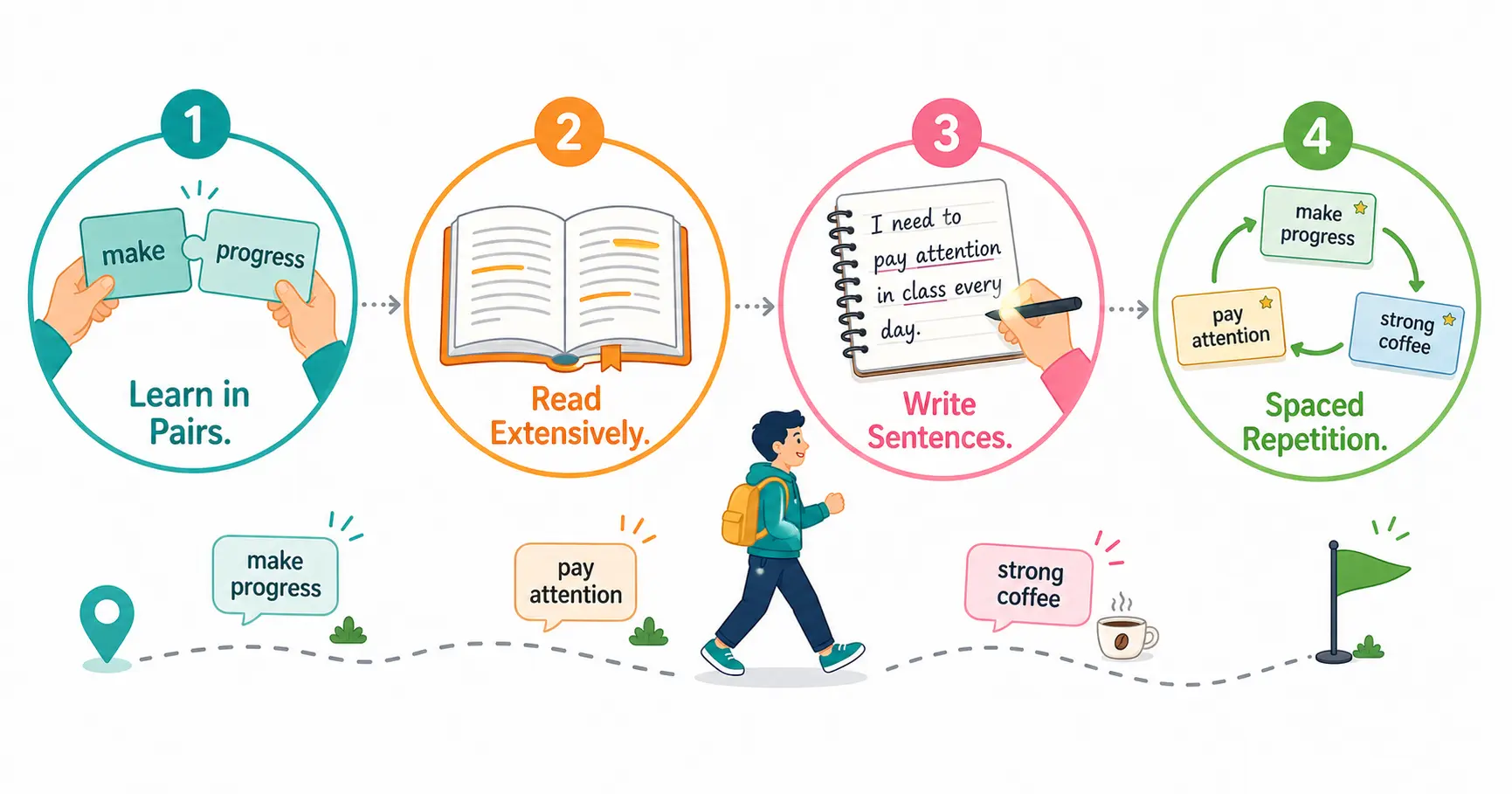
1. Учите слова парами, не по отдельности
Никогда не учите слово изолированно. Узнав слово «decision», сразу запоминайте «make a decision». Узнав «rain» — «heavy rain». В вашем словарном блокноте должно быть две колонки: слово и его основные коллокации.
2. Много читайте
Коллокации усваиваются через контакт с языком больше, чем через заучивание. Читайте статьи Economist, BBC, Guardian, академические журналы. Заметив естественное словосочетание, запишите его. Со временем правильные коллокации начнут «звучать правильно», даже если вы не сможете объяснить почему.
3. Используйте словарь коллокаций
Oxford Collocations Dictionary for Students of English — лучший специализированный ресурс. Для любого слова он показывает все распространённые коллокации, организованные по типу (глагол+, прилагательное+, существительное+ и т.д.). Онлайн-инструменты вроде Ozdic.com предлагают бесплатный поиск коллокаций.
4. Учитесь на ошибках
Когда носитель или преподаватель поправляет выбор слов — «Мы говорим “heavy rain”, а не “strong rain”» — запишите правильную коллокацию. Ошибки, которые вы заметили и исправили, остаются в памяти гораздо дольше, чем коллокации, прочитанные пассивно.
5. Используйте интервальное повторение
Добавьте коллокации в Linglify или любую систему интервального повторения. Изучайте их как цельные единицы: «make + decision» одной карточкой, а не «make» и «decision» по отдельности. Научный подход к запоминанию: Как запоминать слова.
6. Практикуйтесь через составление предложений
Для каждой новой коллокации составьте 3 предложения в разных контекстах. «Heavy rain» → (1) «We cancelled the picnic due to heavy rain.» (2) «Heavy rain is expected throughout the week.» (3) «The heavy rain caused flooding in low-lying areas.» Это развивает гибкость, а не просто узнавание.
Что читать дальше
Это базовый справочник по коллокациям. Вот углублённые руководства для конкретных задач:
По уровням:
- Английские коллокации в использовании: по уровням — коллокации от A2 до C2
- Продвинутые английские коллокации: C1–C2 — для уровней выше среднего и продвинутого
По типам:
- Коллокации по типам: прилагательное+существительное, глагол+существительное и другие — детальный разбор каждой категории
Для экзаменов:
- Коллокации для PTE и IELTS — экзаменационные коллокации для повышения балла Lexical Resource
- Лексика для IELTS Writing Task 1 — коллокации для описания данных
- Лексика для IELTS Writing Task 2 — коллокации для эссе
Смежная лексика:
- Английские идиомы: 500+ распространённых выражений — устойчивые выражения с переносным значением
- Фразовые глаголы английского языка: полное руководство — сочетания глагол + частица
- Как улучшить словарный запас — полная стратегия расширения лексики
- Продвинутая лексика: 300+ слов уровня C1–C2 — отдельные слова, которые сочетаются с этими коллокациями
Часто задаваемые вопросы
Что такое коллокация простыми словами?
Коллокация — это два или более слов, которые естественно стоят рядом в английском. «Make a decision» — коллокация, потому что англоговорящие всегда говорят «make» с «decision», а не «do a decision» или «take a decision». Коллокации — это партнёрства слов: определённые слова просто принадлежат друг другу, и использование неправильного партнёра звучит неестественно, даже если грамматика верна.
Сколько коллокаций в английском?
Десятки тысяч. У каждого распространённого существительного есть множество глагольных, адъективных и наречных коллокаций. Oxford Collocations Dictionary содержит более 150 000 коллокаций для 9 000 заглавных слов. Для практической беглости достаточно выучить коллокации 2 000 наиболее распространённых английских слов — они покроют подавляющее большинство того, что потребуется в жизни и на экзаменах.
Чем коллокация отличается от составного слова?
Составное слово — это фиксированная единица, функционирующая как одно слово: «traffic jam», «greenhouse», «cell phone». Коллокация — более свободное партнёрство слов: «heavy rain», «make a decision», «strongly recommend». Многие составные существительные начинались как коллокации, которые стали настолько устойчивыми, что слились в единое понятие. Практическое различие: составные существительные есть в словарях как отдельные статьи; коллокации — в словарях коллокаций или усваиваются через контакт с языком.
Отличаются ли коллокации в британском и американском английском?
Большинство коллокаций одинаковы в обоих вариантах. Однако некоторые различаются: американцы говорят «take a shower», а некоторые британцы — «have a shower». Американцы говорят «do the math», британцы — «do the maths». Эти различия незначительны, и обе формы широко понятны. На IELTS и TOEFL принимается любой вариант.
Насколько коллокации важны для IELTS?
Очень важны. В дескрипторах IELTS для Lexical Resource коллокации упоминаются на каждом уровне баллов. Band 6 — «uses some less common items despite some inaccuracy». Band 7 — «awareness of style and collocation». Band 8 — «uncommon lexical items» с «skilful use of collocation». На практике правильные коллокации — один из самых быстрых способов перейти от Band 6.5 к Band 7+.
Как лучше всего учить коллокации?
Учите парами (никогда не учите «decision» без «make a decision»), много читайте на английском (коллокации усваиваются через контакт с языком), используйте словарь коллокаций (Oxford Collocations Dictionary — золотой стандарт) и занимайтесь с интервальным повторением. Главное: коллокации нельзя вывести из грамматических правил — их нужно встречать, замечать и практиковать.
Можно ли найти коллокации в тезаурусе?
Нет. Тезаурус даёт синонимы («big» → «large», «huge», «massive»), но не подсказывает, какой синоним подходит к какому существительному. Тезаурус покажет, что «big» и «strong» — оба усилители, но не скажет, что дождь — «heavy» (не «big» и не «strong»), а ветер — «strong» (не «heavy» и не «big»). Используйте специализированный словарь коллокаций.