
按CEFR程度學英語詞彙:從A1初學者到C2熟練
「我的英語程度是什麼?」是語言學習者最常問的問題之一。答案很大程度上取決於詞彙——你知道多少單字、你對它們了解多深,以及你是否能在語境中使用它們。
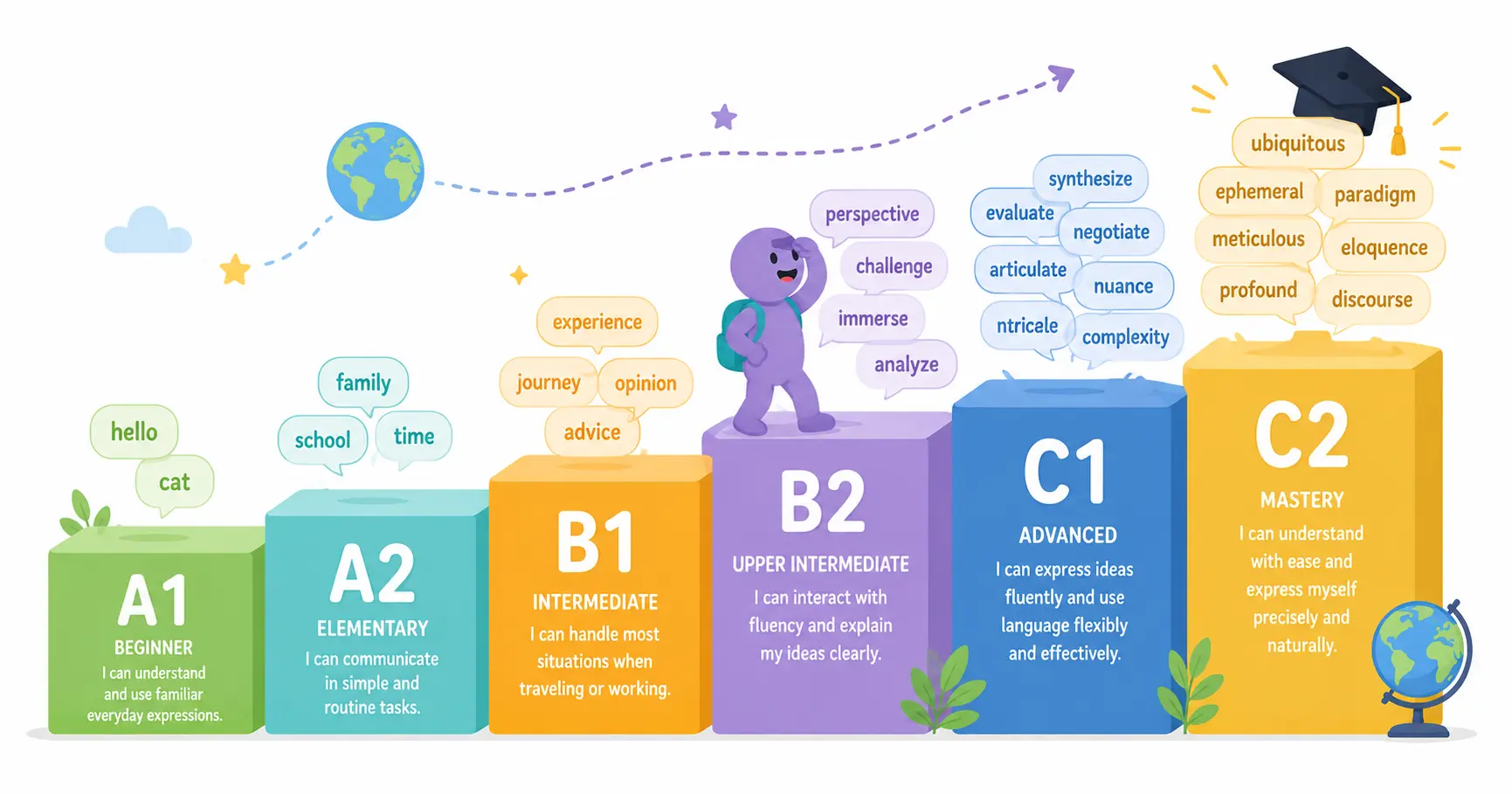
CEFR(歐洲語言共同參考框架)提供了衡量語言水平的全球標準。它將學習者分為6個程度——從A1(完全初學者)到C2(掌握)——詞彙是每個階段的關鍵指標之一。
本指南將英語詞彙對應到所有6個CEFR程度。對於每個程度,你將看到:
- 你需要多少單字,
- 預期什麼類型的詞彙,
- 範例單字和短語,
- 以及在該程度建立詞彙的資源。
什麼是CEFR?
歐洲語言共同參考框架(CEFR)由歐洲委員會於2001年創建。它是全球最廣泛使用的語言能力描述框架。
CEFR將語言水平分為3個大類和6個具體程度:
| 大類 | 程度 | 名稱 | 描述 |
|---|---|---|---|
| A — 基礎使用者 | A1 | 突破 | 能處理非常基本的互動 |
| A2 | 路標 | 能處理日常任務和簡單對話 | |
| B — 獨立使用者 | B1 | 門檻 | 能應對大多數旅行和日常情況 |
| B2 | 優勢 | 能在廣泛主題上流暢互動 | |
| C — 熟練使用者 | C1 | 有效操作熟練度 | 能靈活表達複雜想法 |
| C2 | 精通 | 能理解幾乎所有內容並精確表達含義 |
CEFR被以下機構使用:
- 語言考試:IELTS、TOEFL、Cambridge、TOEIC都將分數對應到CEFR程度
- 學校和大學:入學要求通常指定CEFR程度
- 雇主:歐洲和亞洲的職位描述通常要求「B2英語」或「C1英語」
每個CEFR程度需要多少單字?
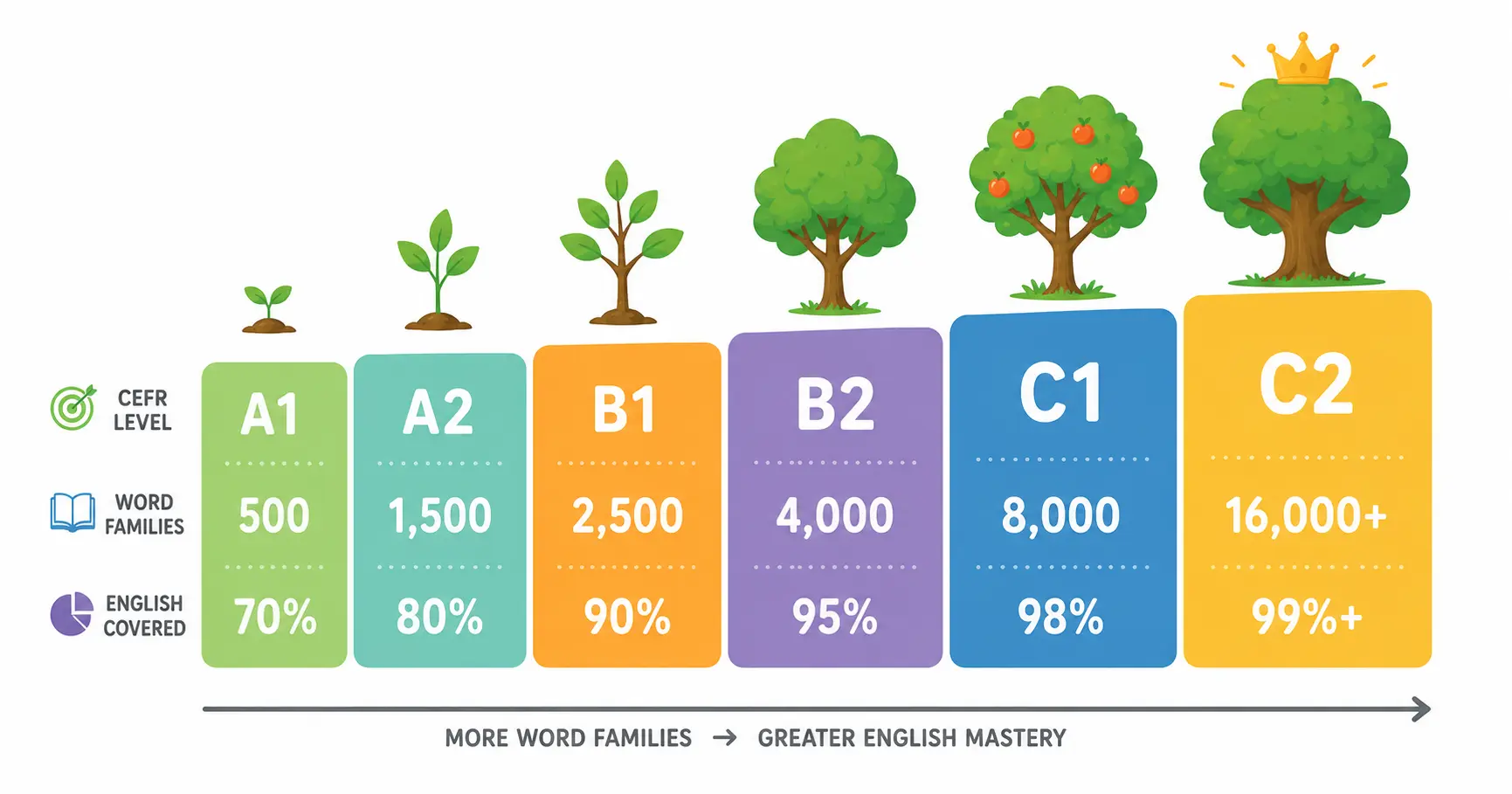
詞彙量與CEFR程度之間的關係研究充分。以下是廣泛接受的估計:
| CEFR程度 | 詞彙家族 | 總詞形 | 日常英語覆蓋率 |
|---|---|---|---|
| A1 | ~500 | ~700–1,000 | 基礎口語英語的~70% |
| A2 | ~1,000–1,500 | ~1,500–2,500 | 基礎口語英語的~80% |
| B1 | ~2,000–2,500 | ~3,000–4,000 | 日常口語英語的~90% |
| B2 | ~3,500–4,500 | ~5,000–7,000 | 一般英語的~95% |
| C1 | ~6,000–8,000 | ~8,000–12,000 | 一般英語的~98% |
| C2 | ~10,000–16,000+ | ~15,000–25,000+ | 所有英語語境的~99%+ |
詞彙家族 = 一個基本單字加上其形式(例如「happy」+「unhappy」+「happiness」+「happily」= 1個詞彙家族)。
95%覆蓋率門檻
語言學家Paul Nation的研究表明,你需要理解文本中大約95%的單字才能舒適地閱讀它——從語境中猜測其餘部分。這大致對應於B2程度(約4,000個詞彙家族)。
這就是為什麼B2通常被認為是「獨立門檻」——你可以在不持續使用字典的情況下使用英語的程度。
A1 — 初學者(500個詞彙家族)
A1詞彙的樣子
在A1,你知道最基本的生存單字:介紹自己、數字、顏色、日期、家庭、食物和簡單動作。
CEFR描述符:「能理解和使用熟悉的日常表達和非常基本的短語,旨在滿足具體類型的需要。」
按類別分類的A1詞彙
個人信息:name(名字)、age(年齡)、country(國家)、address(地址)、phone number(電話號碼)、birthday(生日)
人:mother(母親)、father(父親)、brother(兄弟)、sister(姐妹)、friend(朋友)、teacher(老師)、student(學生)
數字:one through one hundred(一到一百)、first(第一)、second(第二)、last(最後)
時間:today(今天)、tomorrow(明天)、yesterday(昨天)、morning(早晨)、afternoon(下午)、evening(傍晚)、Monday–Sunday(星期一到星期日)、January–December(一月到十二月)
地點:home(家)、school(學校)、office(辦公室)、hospital(醫院)、shop(商店)、restaurant(餐廳)、city(城市)、country(國家)
食物和飲料:water(水)、milk(牛奶)、tea(茶)、coffee(咖啡)、bread(麵包)、rice(飯)、egg(蛋)、chicken(雞肉)
常見動詞:be(是)、have(有)、do(做)、go(去)、come(來)、see(看)、know(知道)、want(想要)、like(喜歡)、eat(吃)、drink(喝)、sleep(睡覺)、work(工作)、live(住)、speak(說)
形容詞:good(好)、bad(壞)、big(大)、small(小)、new(新)、old(舊)、hot(熱)、cold(冷)、happy(快樂)、sad(悲傷)、easy(容易)、difficult(困難)
疑問詞:what(什麼)、where(哪裡)、when(什麼時候)、who(誰)、how(如何)、how much(多少錢)、why(為什麼)
A1範例句子
| 句子 | 語境 |
|---|---|
| My name is Anna. I am from Russia. | 介紹 |
| I live in Tokyo. I am a student. | 個人信息 |
| How much is this? | 購物 |
| I like coffee. Can I have water, please? | 食物/飲料 |
| Where is the bathroom? | 方向 |
| I don’t understand. Can you speak slowly? | 溝通 |
A2 — 初級(1,000-1,500個詞彙家族)
A2詞彙的樣子
在A2,你可以處理日常任務:購物、點餐、問路、談論你的日常作息和過去經歷。
CEFR描述符:「能理解與最直接相關領域相關的句子和常用表達(例如非常基本的個人和家庭信息、購物、當地地理、就業)。」
A2詞彙補充(A1之外)
日常作息:wake up(起床)、get dressed(穿衣服)、brush teeth(刷牙)、take a shower(洗澡)、have breakfast(吃早餐)、go to work(去上班)、go to bed(去睡覺)
旅行:airport(機場)、ticket(票)、passport(護照)、hotel(酒店)、taxi(計程車)、bus(公車)、train(火車)、station(車站)、map(地圖)、left(左)、right(右)、straight(直走)、near(近)、far(遠)
購物:price(價格)、sale(特賣)、discount(折扣)、size(尺寸)、color(顏色)、try on(試穿)、pay(付錢)、cash(現金)、receipt(收據)
健康:doctor(醫生)、hospital(醫院)、medicine(藥)、sick(生病)、pain(疼痛)、headache(頭痛)、cold(感冒)、fever(發燒)
情感:excited(興奮)、bored(無聊)、scared(害怕)、surprised(驚訝)、worried(擔心)、angry(生氣)、tired(疲倦)
連接詞:because(因為)、but(但是)、so(所以)、and(和)、or(或者)、also(也)、then(然後)、before(之前)、after(之後)、if(如果)
A2範例句子
| 句子 | 語境 |
|---|---|
| I went to the supermarket and bought some vegetables. | 日常生活 |
| I would like to book a table for two, please. | 餐廳 |
| The train to London leaves at 10:15. | 旅行 |
| I have a headache. Do you have any medicine? | 健康 |
| I worked at a school last year. Now I work at a bank. | 工作 |
B1 — 中級(2,000-2,500個詞彙家族)
B1詞彙的樣子
B1是一個轉折點。你可以處理旅行中的大多數情況,談論經歷和計劃,給出理由和意見,理解熟悉主題的清晰文本的主要觀點。
CEFR描述符:「能理解工作、學校、休閒等熟悉事物的清晰標準輸入的要點。能處理旅行時可能出現的大多數情況。」
B1詞彙補充(A2之外)
意見和論點:I think(我認為)、I believe(我相信)、in my opinion(在我看來)、I agree(我同意)、I disagree(我不同意)、on the other hand(另一方面)、however(然而)、although(雖然)、therefore(因此)
工作和職業:apply(申請)、interview(面試)、hire(聘用)、resign(辭職)、salary(薪資)、experience(經驗)、deadline(截止日期)、project(項目)、team(團隊)、manager(經理)、skill(技能)、achieve(實現)、promotion(晉升)、career(職業)
教育:course(課程)、degree(學位)、graduate(畢業)、assignment(作業)、research(研究)、presentation(報告)、knowledge(知識)、improve(改進)、practice(練習)、develop(發展)
搭配詞:make a decision(做決定)、take responsibility(承擔責任)、give advice(給建議)、pay attention(注意)、keep in touch(保持聯繫)、make progress(取得進步)、do research(做研究)
B1範例句子
| 句子 | 語境 |
|---|---|
| I think public transport is more convenient than driving in big cities. | 意見 |
| I applied for a marketing position and I have an interview next week. | 職業 |
| Although the weather was terrible, we decided to go hiking anyway. | 對比 |
| I’ve been studying English for three years and I can see real progress. | 經驗 |
| You should probably make a reservation because the restaurant is always full. | 建議 |
B2 — 中高級(3,500-4,500個詞彙家族)
B2詞彙的樣子
B2是獨立開始的地方。你可以閱讀新聞文章、參與對不熟悉主題的討論、撰寫清晰的論文,並在沒有字幕的情況下理解大多數電影。這是大多數雇主要求的程度。
CEFR描述符:「能理解具體和抽象主題的複雜文本的主要想法,包括在其專業領域的技術討論。能與母語者進行足夠流暢和自然的互動。」
B2詞彙補充(B1之外)
學術詞彙:analyze(分析)、evaluate(評估)、significant(重要)、relevant(相關)、contribute(貢獻)、imply(暗示)、perspective(視角)、phenomenon(現象)、theory(理論)、assumption(假設)、evidence(證據)、conclude(得出結論)、demonstrate(展示)、consistent(一致)
表達細微差別:tend to(傾向於)、be likely to(可能)、apparently(顯然)、presumably(大概)、to some extent(在某種程度上)、somewhat(有些)、relatively(相對地)、considerably(相當地)、nevertheless(儘管如此)
複雜搭配:draw a conclusion(得出結論)、raise awareness(提高意識)、gain experience(獲得經驗)、pose a threat(構成威脅)、address an issue(處理問題)、meet a requirement(滿足要求)
習語和比喻語言:break the ice(打破僵局)、get the hang of(掌握訣竅)、keep an eye on(注意)、at the end of the day(最終)、in the long run(從長遠來看)、take for granted(視為理所當然)
B2範例句子
| 句子 | 語境 |
|---|---|
| Despite the economic downturn, the company managed to maintain profitability. | 商業 |
| Research suggests that bilingual individuals tend to have better cognitive flexibility. | 學術 |
| The government needs to address the issue of air pollution before it gets worse. | 意見/新聞 |
| The film explores the phenomenon of social media addiction from multiple perspectives. | 評論 |
C1 — 進階(6,000-8,000個詞彙家族)
C1詞彙的樣子
C1使用者可以靈活表達複雜想法,理解長篇和要求較高的文本(包括隱含含義),並在複雜主題上產生結構良好的詳細文本。這是專業和學術英語的程度。
CEFR描述符:「能理解各種要求較高的、較長的文本,並識別隱含含義。能流暢自然地表達自己,無需太明顯地搜尋表達方式。」
C1詞彙補充(B2之外)
複雜學術詞彙:exacerbate(加劇)、mitigate(緩和)、unprecedented(前所未有)、paradigm(範式)、scrutinize(審查)、ubiquitous(無處不在)、pragmatic(務實)、resilient(有韌性)、volatile(易變)、ambiguous(模糊)、inherent(固有)、proliferate(激增)
精確連接詞:notwithstanding(儘管)、insofar as(在…程度上)、in light of(鑑於)、with respect to(關於)、contingent upon(取決於)、irrespective of(不管)
正式語體:It is worth noting that…(值得注意的是…)、One might argue that…(有人可能會爭辯說…)、This raises the question of…(這提出了…的問題)
語感意識:childish(幼稚,負面)vs childlike(孩子般的,正面);thrifty(節儉,正面)vs cheap/stingy(小氣,負面)
C1範例句子
| 句子 | 語境 |
|---|---|
| The proliferation of misinformation online has exacerbated societal polarization. | 學術論文 |
| Notwithstanding the methodological limitations, the findings corroborate previous research. | 研究論文 |
| The company’s decision to prioritize short-term profits was, in retrospect, deeply shortsighted. | 商業分析 |
| The policy is contingent upon bipartisan support, which remains far from assured. | 政治分析 |
C2 — 熟練(10,000-16,000+個詞彙家族)
C2詞彙的樣子
C2接近母語者的掌握程度。你幾乎理解你閱讀或聽到的一切,包括俚語、古語、專業術語和微妙幽默。
CEFR描述符:「能輕鬆理解幾乎所有聽到或閱讀的內容。能從不同的口頭和書面來源摘要信息,在連貫的報告中重建論點和敘述。」
C2詞彙補充(C1之外)
罕見和文學詞彙:ephemeral(短暫)、ineffable(難以言說)、surreptitious(偷偷摸摸)、magnanimous(慷慨大方)、perfunctory(敷衍)
古語和正式表達:henceforth(從此以後)、albeit(雖然)、heretofore(到目前為止)、pursuant to(根據)、in lieu of(代替)
習語掌握:know the ropes(了解訣竅)、cut to the chase(開門見山)、a Pyrrhic victory(慘勝)、a Catch-22(兩難困境)
語體靈活性:在正式學術(「The data corroborate the hypothesis」)、非正式對話(「The numbers check out」)和口語/俚語(「The stats totally back it up」)之間流暢切換
牛津3000和牛津5000
牛津3000和牛津5000是牛津大學出版社創建的精選單字清單,根據頻率、範圍和熟悉度選擇。
| 清單 | 單字數 | CEFR程度 | 目的 |
|---|---|---|---|
| 牛津3000 | 3,000個單字 | A1-B2 | 日常英語的核心詞彙 |
| 牛津5000 | 5,000個單字(3000+2000) | A1-C1 | 包括學術英語的擴展詞彙 |
| CEFR程度 | 牛津3000單字 | 牛津5000單字 |
|---|---|---|
| A1 | ~600 | ~600 |
| A2 | ~800 | ~800 |
| B1 | ~900 | ~900 |
| B2 | ~700 | ~700 |
| C1 | — | ~2,000 |
CEFR和語言考試
CEFR程度直接對應主要英語考試的分數:
| CEFR程度 | IELTS | TOEFL iBT | Cambridge | TOEIC(聽讀) |
|---|---|---|---|---|
| A1 | — | — | — | ~120 |
| A2 | — | — | KET (A2 Key) | ~225 |
| B1 | 4.0–5.0 | 42–71 | PET (B1 Preliminary) | ~550 |
| B2 | 5.5–6.5 | 72–94 | FCE (B2 First) | ~785 |
| C1 | 7.0–8.0 | 95–113 | CAE (C1 Advanced) | ~945 |
| C2 | 8.5–9.0 | 114–120 | CPE (C2 Proficiency) | — |
Linglify如何按程度組織詞彙
Linglify的單字庫按CEFR程度標記,因此你可以學習與你當前水平匹配的詞彙,並逐步進步到下一個程度。
當你將一個單字添加到個人字典時,Linglify顯示其CEFR程度(A1-C2)並以最佳間隔安排間隔重複複習:
- 初學者(A1-A2) 可以專注於他們每天實際使用的高頻單字
- 中級學習者(B1-B2) 可以針對日常英語和學術英語之間的詞彙差距
- 進階學習者(C1-C2) 可以研究區分好英語和優秀英語的細微、低頻單字
練習詞彙
這24個單字跨越所有6個CEFR程度——每個程度4個,從基礎到進階。
academy
名詞
學院
範例
- She graduated from the military academy with honors last spring.
- The film academy recognizes outstanding achievements in cinema each year.
affordable
形容詞
經濟實惠
範例
- The government is working to provide affordable housing for low-income families.
- This restaurant offers delicious and affordable meals for college students.
assault
名詞
攻擊
範例
- The army launched a fierce assault on the enemy fortress.
- The police arrested the man for assault and battery charges.
biotechnology
名詞
生物技術, 生技, 生物工程
範例
- Agricultural biotechnology helps create disease-resistant crop varieties.
- Biotechnology companies develop new medical treatments and therapies.
choose
動詞
選擇
範例
- She will choose the dress that looks best for the wedding ceremony.
- Students must choose their courses carefully for next semester's schedule.
continent
名詞
大陸
department store
名詞
百貨公司, 商店
範例
- Holiday shopping at the department store can be crowded and stressful.
- The department store sells everything from clothing to electronics.
earth
名詞
地球
範例
- Earth is the third planet from the sun in our solar system.
- Farmers plant seeds in rich earth to grow healthy crops.
firearm
名詞
槍械
範例
- Police officers receive extensive training in firearm safety and usage.
- The museum displays historical firearms from different time periods.
have to
動詞
必須
範例
- She doesn't have to work on weekends unless there's an emergency.
- Students have to complete their homework before coming to class tomorrow.
indirect
形容詞
間接的
範例
- His indirect criticism was subtle but everyone understood his meaning.
- The indirect route takes longer but avoids the heavy traffic areas.
know
動詞
知道
範例
- Do you know anyone who speaks fluent Spanish or Portuguese?
- I know the answer to that difficult mathematical question.
memorial
名詞
紀念館, 紀念物
範例
- The memorial service celebrated her life and achievements.
- War memorial honors soldiers who died serving their country.
optimism
名詞
樂觀
範例
- Her optimism helped family through difficult financial times.
- Optimism about future motivates people to work harder.
personnel
名詞
人員
範例
- Military personnel receive specialized training for duties.
- Qualified personnel ensures company operates efficiently and safely.
proven
形容詞
已證實的
範例
- Proven method ensures consistent successful results always.
- Proven remedy helps treat common cold symptoms.
restriction
名詞
限制
範例
- Age restriction prevents minors from purchasing alcohol.
- Speed restriction protects drivers on dangerous mountain roads.
shoplifter
名詞
扒手
範例
- Experienced shoplifter knows how to avoid detection.
- Store security catches shoplifter stealing expensive items.
spell
名詞
拼字
範例
- Cold spell brings freezing temperatures to region.
- Magic spell transforms pumpkin into carriage magically.
teamwork
名詞
團隊合作
範例
- Good teamwork achieves better results than individuals.
- Successful teamwork requires trust and clear communication.
voice
名詞
嗓音
範例
- Clear voice helps effective communication and understanding.
- Singer's voice captivates audience during performance show.
minutiae
名詞
瑣事
範例
- She focused on the minutiae rather than the big picture.
- The contract's minutiae required careful examination by lawyers.
lust
名詞
慾望
範例
- Character's lust for power ultimately leads to downfall.
- Traveler felt intense lust for adventure in foreign countries.
emulate
動詞
模仿, 效法
範例
- Software developers emulate successful applications to create competitive products.
- Young athletes emulate professional sports stars' training techniques and dedication.
你的詞彙建立路徑
第1步:評估你當前的程度
如果你不確定你的CEFR程度,一個粗略的自測:閱讀上面每個部分中的範例句子。你開始在每個句子中超過2-3個單字遇到困難的程度大約就是你當前的程度。
第2步:專注于高一個程度
如果你在B1很舒適,學習B2詞彙。試圖從B1跳到C1是低效的——差距太大,而且C1詞彙在你的B2基礎牢固之前很少有用。
第3步:使用正確的資源
| 你的程度 | 要學什麼 | 推薦文章 |
|---|---|---|
| A1 → A2 | 高頻單字、日常情境 | 英語日常用語 |
| A2 → B1 | 片語動詞、意見、連接詞 | 英語片語動詞指南 |
| B1 → B2 | 搭配詞、習語、抽象詞彙 | 英語搭配詞指南 |
| B2 → C1 | 學術詞彙、細微表達 | 進階英語單字 |
| C1 → C2 | 罕見單字、語感、語體 | 難英語單字 |
第4步:用間隔重複練習
將適當程度的單字添加到 Linglify 並每天複習。研究表明,間隔重複是將詞彙從短期記憶移動到長期記憶的最有效方式。
接下來閱讀什麼
按程度:
按類型:
學習策略:
常見問題
IELTS 6.5是什麼CEFR程度?
IELTS 6.5對應CEFR的B2程度。這意味著你可以理解複雜文本,以合理的流暢度互動,並在一系列主題上撰寫清晰的文章。要達到C1(IELTS 7.0-8.0),你通常需要在B2之外再擴展2,000-3,000個詞彙家族。
從一個CEFR程度到下一個需要多長時間?
Cambridge English的估計是:A1→A2:約200小時學習;A2→B1:約200小時;B1→B2:約200小時;B2→C1:約200小時;C1→C2:約200+小時。
B2英語夠用嗎?
對於大多數專業角色,B2是最低功能程度。你可以參與會議、撰寫電子郵件、閱讀報告並處理客戶溝通。然而,需要談判、說服、細膩寫作的角色通常需要C1。
知道一個單字和「擁有」它到CEFR程度有什麼區別?
在CEFR程度上知道一個單字意味著三件事:(1)識別——當你聽到或閱讀時理解它;(2)產生——能在自己的口語和寫作中正確使用它;(3)搭配意識——知道它自然地與哪些其他單字組合。
在進入下一個程度之前,我應該學習當前程度的所有單字嗎?
不。語言程度有顯著的重疊,你在閱讀和聆聽時自然會遇到上一個程度的單字。實用方法:學習當前程度80%的詞彙,然後開始添加下一個程度的單字。
我怎麼知道哪些單字是A1、A2、B1等?
最可靠的參考是牛津3000/5000清單,它用CEFR程度標記每個單字。在Linglify中,圖書館中的每個單字都有其CEFR程度標記,因此你可以直接按程度篩選和學習。


