Palavras em Inglês por Classe Gramatical: Listas Completas e Exemplos
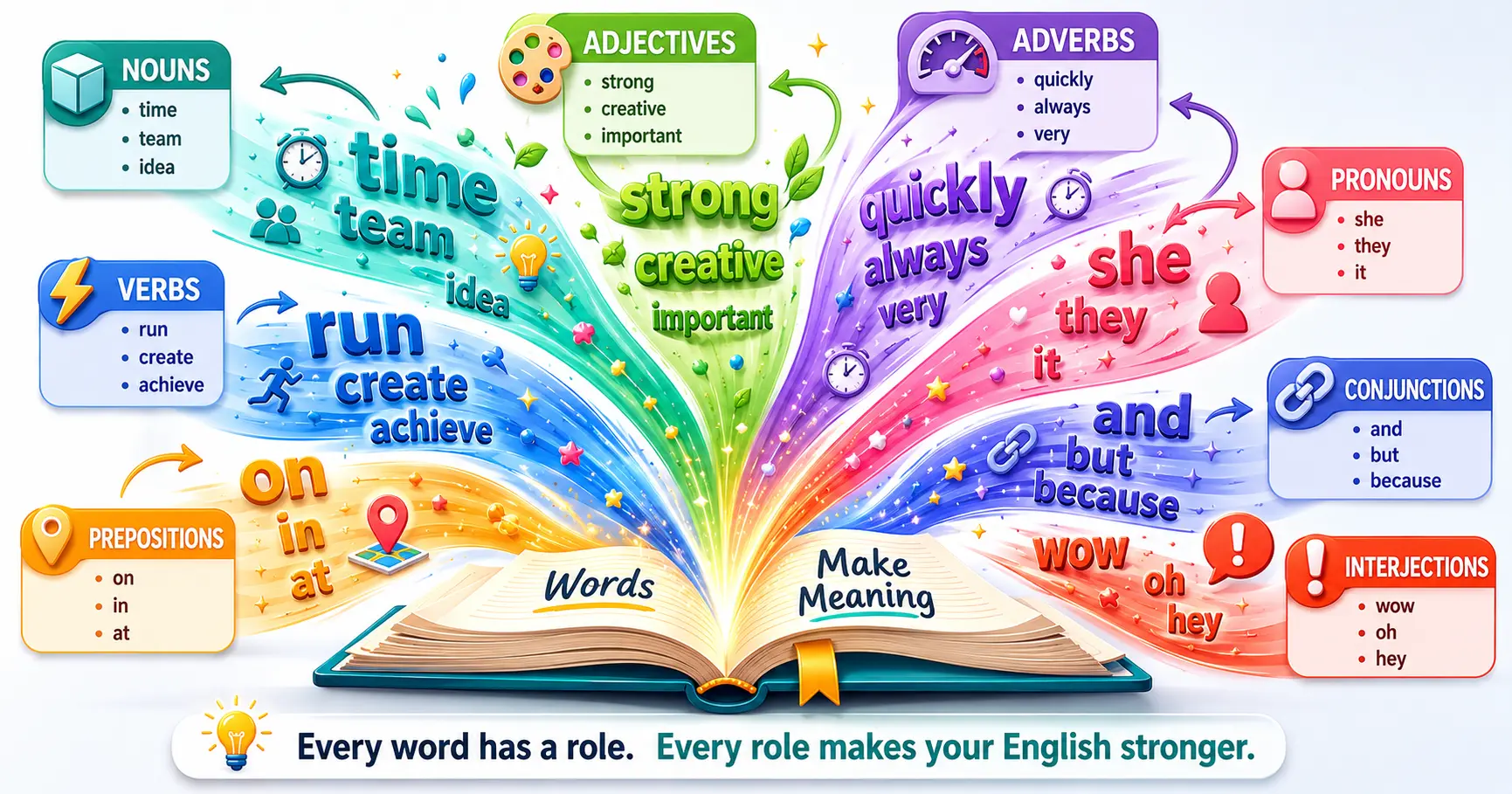
Cada palavra em inglês pertence a pelo menos uma classe gramatical. Seja lendo uma notícia, escrevendo um e-mail ou fazendo uma prova, toda frase é construída com as mesmas oito categorias: substantivos, verbos, adjetivos, advérbios, pronomes, preposições, conjunções e interjeições. Entender as classes gramaticais não é apenas um exercício de gramática: é a chave para ampliar o vocabulário de forma sistemática e usar as palavras corretamente.
A maioria dos estudantes estuda vocabulário como itens isolados: uma palavra, uma definição, talvez uma frase de exemplo. Mas saber a que classe gramatical uma palavra pertence mostra como ela se comporta — onde aparece na frase, com quais palavras se combina e como sua forma pode mudar. “Success” é um substantivo; “succeed” é um verbo; “successful” é um adjetivo; “successfully” é um advérbio. A mesma raiz exerce quatro funções diferentes numa frase. Se você confundir essas formas, a frase fica errada.
Este guia cobre:
- Todas as 8 classes gramaticais em inglês com definições e exemplos claros
- Listas de palavras para cada categoria, organizadas por nível e frequência
- Como identificar classes gramaticais em qualquer frase
- Como as classes gramaticais ajudam você a construir vocabulário mais rápido
- Links para listas detalhadas de verbos, adjetivos, advérbios e outras categorias
O Que São as Classes Gramaticais?
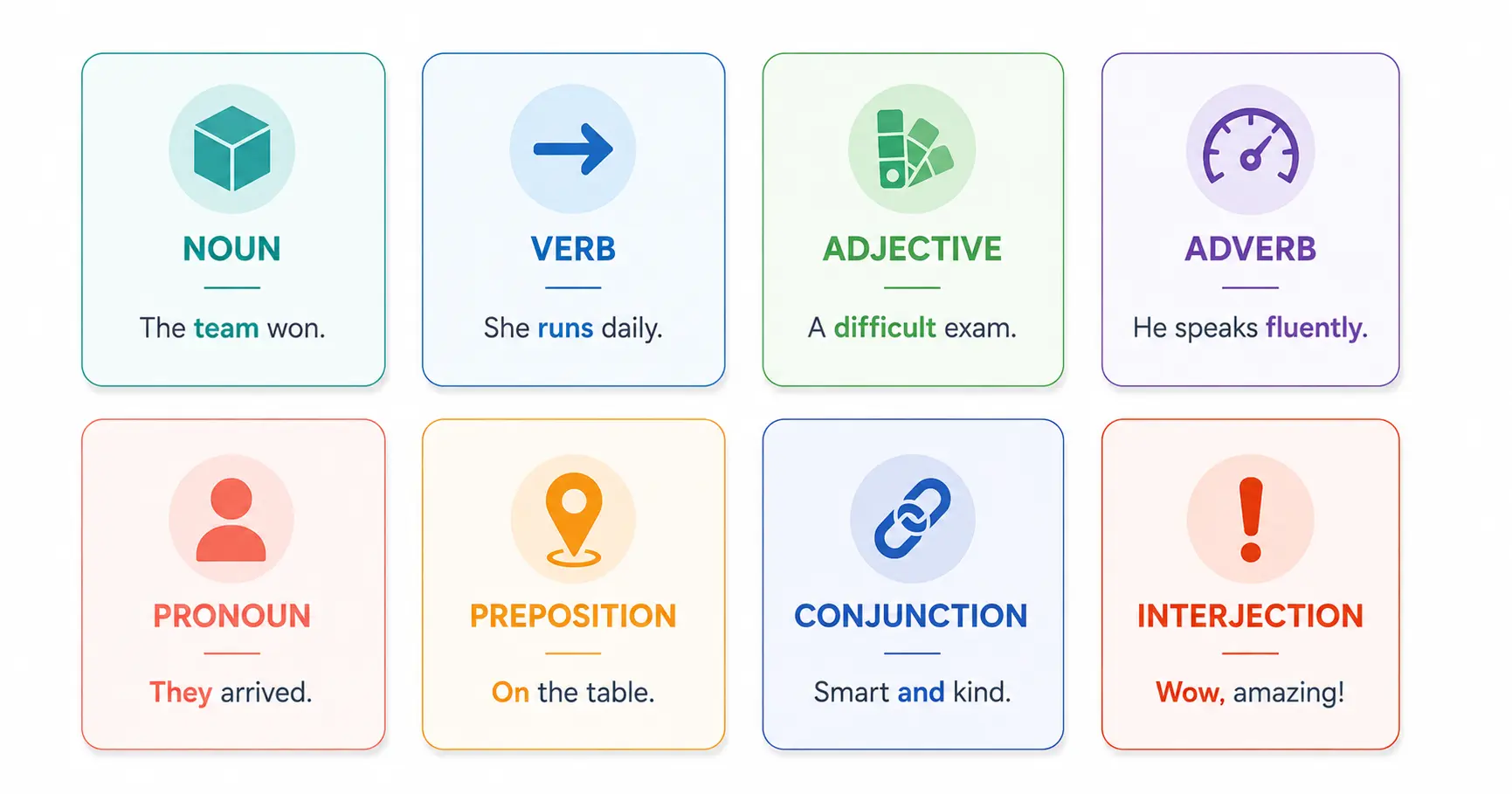
As classes gramaticais são categorias que classificam palavras por sua função numa frase. O inglês tem oito:
| Classe Gramatical | Função | Exemplo |
|---|---|---|
| Substantivo | Nomeia uma pessoa, lugar, coisa ou ideia | The team won the game. |
| Verbo | Expressa uma ação ou estado | She runs every morning. |
| Adjetivo | Descreve um substantivo | That was a difficult exam. |
| Advérbio | Modifica um verbo, adjetivo ou outro advérbio | He speaks fluently. |
| Pronome | Substitui um substantivo | They arrived early. |
| Preposição | Mostra relação entre palavras | The book is on the table. |
| Conjunção | Conecta palavras, frases ou orações | I studied and passed. |
| Interjeição | Expressa emoção | Wow, that was fast! |
Essas oito categorias se aplicam a todas as palavras da língua inglesa. Algumas palavras podem pertencer a mais de uma classe, dependendo do contexto: “run” pode ser verbo (“I run daily”) ou substantivo (“a morning run”). Entender essa flexibilidade faz parte do domínio do vocabulário em inglês.
Substantivos: Os Blocos de Construção
Os substantivos são a classe gramatical mais comum. Eles nomeiam pessoas, lugares, coisas, ideias e conceitos. Numa frase típica em inglês, pelo menos uma ou duas palavras são substantivos.
Tipos de Substantivos
| Tipo | O Que Nomeia | Exemplos |
|---|---|---|
| Substantivos comuns | Coisas gerais | city, teacher, idea, computer |
| Substantivos próprios | Nomes específicos (maiúsculos) | London, Dr. Smith, Monday, Toyota |
| Substantivos abstratos | Coisas que não se podem tocar | freedom, happiness, knowledge, courage |
| Substantivos concretos | Coisas percebidas pelos sentidos | table, music, rain, chocolate |
| Substantivos contáveis | Podem ser contados | book/books, apple/apples, idea/ideas |
| Substantivos incontáveis | Não podem ser contados | water, information, furniture, advice |
| Substantivos coletivos | Grupos | team, family, audience, committee |
Como Identificar um Substantivo
Substantivos tipicamente:
- Vêm após artigos: a report, the meeting, an idea
- Vêm após adjetivos: a new report, the important meeting
- Podem ser pluralizados: report → reports, idea → ideas
- Podem vir depois de possessivos: my suggestion, their decision
Substantivos de Alta Frequência por Nível
A1–A2 (Iniciante): name, time, day, year, people, way, man, woman, child, world, life, hand, part, place, case, week, company, system, program, question
B1–B2 (Intermediário): environment, government, development, experience, opportunity, community, relationship, responsibility, technology, education, situation, organization, performance, population, communication
C1–C2 (Avançado): infrastructure, paradigm, phenomenon, implication, bureaucracy, jurisdiction, pragmatism, sustainability, accountability, methodology, stakeholder, discourse, trajectory, scrutiny, resilience
Pratique o vocabulário de substantivos no Linglify.
Para substantivos do dia a dia e vocabulário essencial, consulte nossas 1.000 palavras mais comuns em inglês — os substantivos representam cerca de 30% da lista.
Verbos: As Palavras de Ação
Os verbos são o motor de cada frase. Nenhuma frase em inglês está completa sem um verbo. Eles expressam ações (run, write, build), estados (be, seem, exist) e acontecimentos (happen, become, change).
Tipos de Verbos
| Tipo | Função | Exemplos |
|---|---|---|
| Verbos de ação | Ações físicas ou mentais | write, think, run, calculate |
| Verbos estativos | Estados, não ações | know, believe, own, prefer |
| Verbos de ligação | Conectam sujeito à descrição | be, seem, appear, become, feel |
| Verbos auxiliares | Ajudam verbos principais | have (eaten), is (running), do (not go) |
| Verbos modais | Expressam possibilidade, habilidade, permissão | can, could, may, might, should, must |
| Phrasal verbs | Verbo + partícula(s) com novo significado | give up, look after, carry out |
Formas Verbais Que Todo Estudante Precisa
Os verbos em inglês podem ter até cinco formas. Dominá-las é essencial para usar os tempos verbais e escrever corretamente:
| Base | 3ª Pessoa | Passado Simples | Particípio Passado | Particípio Presente |
|---|---|---|---|---|
| work | works | worked | worked | working |
| write | writes | wrote | written | writing |
| go | goes | went | gone | going |
| begin | begins | began | begun | beginning |
Verbos regulares formam o passado com -ed (worked, played, decided). Os verbos irregulares não seguem esse padrão — e há mais de 200 deles.
→ Veja a Lista Completa de Verbos Irregulares: 200 Verbos com Formas no Passado
Verbos de Alta Frequência por Nível
A1–A2 (Iniciante): be, have, do, say, go, get, make, know, think, take, see, come, want, look, use, find, give, tell, work, call
B1–B2 (Intermediário): achieve, consider, develop, establish, indicate, maintain, obtain, produce, require, suggest, involve, assume, contribute, demonstrate, generate
C1–C2 (Avançado): undermine, scrutinize, encompass, exacerbate, facilitate, substantiate, alleviate, circumvent, perpetuate, consolidate, elicit, stipulate, supersede, transcend, corroborate
→ Leia a Lista Completa de Verbos em Inglês: 300 Verbos Mais Importantes → Pratique o vocabulário de verbos no Linglify.
Os phrasal verbs são uma categoria especial que costuma causar dificuldades. Eles combinam um verbo com uma ou duas partículas para criar significados novos: look up (procurar uma informação), por exemplo, não tem relação com olhar para cima. Nosso guia de phrasal verbs reúne mais de 300 exemplos organizados pelo verbo principal.
Adjetivos: Palavras que Descrevem
Os adjetivos modificam substantivos. Eles respondem a perguntas como “que tipo?”, “quantos?” e “qual?”. Sem adjetivos, você consegue comunicar ideias básicas; com eles, pode ser mais preciso, vívido e convincente.
Tipos de Adjetivos
| Tipo | O Que Faz | Exemplos |
|---|---|---|
| Descritivos | Descreve qualidades | tall, beautiful, expensive, interesting |
| Quantitativos | Indica quantidade | many, few, several, enough, some |
| Demonstrativos | Aponta para substantivos específicos | this, that, these, those |
| Possessivos | Mostra posse | my, your, his, her, their, our |
| Interrogativos | Faz perguntas | which, what, whose |
| Comparativos | Compara duas coisas | taller, more expensive, better |
| Superlativos | Indica o extremo | tallest, most expensive, best |
Ordem dos Adjetivos
Quando vários adjetivos descrevem o mesmo substantivo, o inglês segue uma ordem fixa. Falantes nativos a usam intuitivamente; estudantes precisam memorizá-la:
Opinião → Tamanho → Idade → Forma → Cor → Origem → Material → Propósito
| Posição | Categoria | Exemplo |
|---|---|---|
| 1 | Opinião | beautiful, ugly, amazing |
| 2 | Tamanho | big, small, tiny, enormous |
| 3 | Idade | old, new, young, ancient |
| 4 | Forma | round, flat, rectangular |
| 5 | Cor | red, blue, dark, bright |
| 6 | Origem | British, Japanese, European |
| 7 | Material | wooden, metal, cotton, glass |
| 8 | Propósito | cooking (pot), sleeping (bag) |
Por isso, dizemos “a beautiful large old round brown Italian wooden dining table” — e não em outra ordem. Na prática, raramente usamos mais de dois ou três adjetivos juntos, mas conhecer essa ordem evita frases que soam estranhas.
Adjetivos de Alta Frequência por Nível
A1–A2 (Iniciante): good, new, big, small, long, old, young, different, important, possible, last, first, next, early, great, little, high, free, right, sure
B1–B2 (Intermediário): available, significant, appropriate, effective, relevant, essential, substantial, consistent, comprehensive, fundamental, competitive, sufficient, legitimate, subsequent, compatible
C1–C2 (Avançado): ubiquitous, ostensible, unprecedented, innocuous, pejorative, idiosyncratic, perfunctory, unequivocal, recalcitrant, commensurate, ephemeral, indefatigable, quintessential, perspicacious, superfluous
Aprofunde-se: leia a lista de 500 adjetivos em inglês, do básico ao avançado ou pratique adjetivos no Linglify.
Advérbios: Os Modificadores
Os advérbios modificam verbos, adjetivos, outros advérbios ou frases inteiras. Eles respondem “como?”, “quando?”, “onde?”, “com que frequência?” e “em que grau?”
Tipos de Advérbios
| Tipo | Pergunta | Exemplos |
|---|---|---|
| Modo | Como? | quickly, carefully, fluently, well |
| Tempo | Quando? | now, yesterday, soon, already, recently |
| Lugar | Onde? | here, there, everywhere, outside, nearby |
| Frequência | Com que frequência? | always, usually, sometimes, rarely, never |
| Grau | Quanto? | very, extremely, quite, fairly, barely |
| Sentença | Qual é a atitude do falante? | fortunately, obviously, apparently, frankly |
Formação de Advérbios
A maioria dos advérbios é formada adicionando -ly a um adjetivo:
| Adjetivo | Advérbio |
|---|---|
| quick | quickly |
| careful | carefully |
| comfortable | comfortably |
| easy | easily |
| dramatic | dramatically |
Mas alguns dos advérbios mais comuns são irregulares — eles não seguem o padrão -ly:
| Adjetivo | Advérbio | Erro Comum |
|---|---|---|
| good | well |
|
| fast | fast |
|
| hard | hard |
|
| late | late |
|
Posição dos Advérbios
A posição dos advérbios em inglês segue alguns padrões:
| Tipo de Advérbio | Posição Típica | Exemplo |
|---|---|---|
| Modo | Depois do verbo ou do objeto | She speaks English fluently. |
| Frequência | Antes do verbo principal | I always check my email first. |
| Tempo | No início ou no fim da frase | Yesterday we had a meeting. |
| Grau | Antes da palavra que modifica | This is extremely important. |
| Sentença | No início da frase | Unfortunately, the flight was cancelled. |
Advérbios de Alta Frequência por Nível
A1–A2 (Iniciante): very, also, often, always, sometimes, never, here, there, now, today, already, still, just, really, well, too, only, then, again, enough
B1–B2 (Intermediário): significantly, approximately, essentially, increasingly, primarily, consequently, furthermore, specifically, relatively, inevitably, typically, ultimately, presumably, simultaneously, predominantly
C1–C2 (Avançado): ostensibly, inadvertently, unequivocally, paradoxically, categorically, indiscriminately, exponentially, disproportionately, unconditionally, retrospectively
→ Leia a Lista Completa de Advérbios em Inglês: 200+ Palavras por Categoria → Pratique o vocabulário de advérbios no Linglify.
Pronomes: Os Substitutos
Os pronomes substituem substantivos para evitar repetições. Em vez de dizer “Sarah said Sarah would bring Sarah’s laptop to Sarah’s office”, dizemos “Sarah said she would bring her laptop to her office”.
Tipos de Pronomes
| Tipo | Função | Exemplos |
|---|---|---|
| Pessoal | Substituem pessoas/coisas específicas | I, you, he, she, it, we, they |
| Objeto | Recebem a ação | me, you, him, her, it, us, them |
| Possessivo | Mostram posse | mine, yours, his, hers, ours, theirs |
| Reflexivo | Referem-se ao sujeito | myself, yourself, himself, herself, ourselves |
| Demonstrativo | Apontam para coisas específicas | this, that, these, those |
| Relativo | Conectam orações | who, whom, which, that, whose |
| Interrogativo | Fazem perguntas | who, what, which, whom, whose |
| Indefinido | Referem-se a coisas não específicas | someone, anyone, everyone, nobody, each, both |
Tabela de Referência de Pronomes
| Sujeito | Objeto | Adj. Possessivo | Pron. Possessivo | Reflexivo |
|---|---|---|---|---|
| I | me | my | mine | myself |
| you | you | your | yours | yourself |
| he | him | his | his | himself |
| she | her | her | hers | herself |
| it | it | its | — | itself |
| we | us | our | ours | ourselves |
| they | them | their | theirs | themselves |
Erros Comuns com Pronomes
- it’s vs. its: it’s significa it is ou it has; its indica posse. “The company changed its name.”
- who vs. whom: who é sujeito; whom é objeto. “Who called?” vs. “To whom did you speak?”
- they no singular: no inglês atual, they é amplamente aceito como pronome singular para alguém cujo gênero não é conhecido. “If a student has a question, they should ask.”
Preposições: Os Conectores
As preposições mostram relações entre palavras — geralmente em termos de tempo, lugar, direção ou modo. São palavras curtas, mas têm grande impacto: trocar “on” por “in” ou “at”, por exemplo, muda completamente o sentido.
Preposições por Categoria
Tempo:
| Preposição | Uso | Exemplo |
|---|---|---|
| at | Horários específicos | at 3 PM, at midnight, at noon |
| on | Dias e datas | on Monday, on July 4th, on my birthday |
| in | Meses, anos, estações, partes do dia | in March, in 2026, in summer, in the morning |
| by | Prazo | by Friday, by next week |
| during | Ao longo de um período | during the meeting, during summer |
| since | A partir de um ponto no passado | since 2020, since Monday |
| for | Duração | for three hours, for a long time |
Lugar:
| Preposição | Uso | Exemplo |
|---|---|---|
| at | Ponto ou local específico | at the airport, at home, at the corner |
| on | Superfície ou linha | on the table, on the wall, on Main Street |
| in | Espaço fechado | in the room, in Tokyo, in a box |
| between | Dois pontos de referência | between the bank and the post office |
| among | Dentro de um grupo | among the students, among friends |
Direção:
| Preposição | Uso | Exemplo |
|---|---|---|
| to | Em direção a um destino | go to school, fly to Paris |
| into | Movimento para dentro | walk into the room, dive into the water |
| out of | Movimento para fora | get out of the car, move out of the city |
| through | Movimento por dentro e para fora | walk through the park, drive through the tunnel |
| across | De um lado ao outro | swim across the river, walk across the street |
As Preposições Mais Difíceis para Estudantes
O trio at / on / in causa mais erros do que qualquer outro grupo de preposições. Não há uma única regra que explique todos os casos; é preciso aprender as combinações mais comuns:
- at work, at school, at a party, at the beginning
- on the phone, on a team, on vacation, on time
- in trouble, in charge, in a hurry, in advance
Muitas expressões com preposições precisam ser memorizadas como unidades fixas. Veja nosso guia de colocações em inglês para consultar centenas de combinações de verbos e preposições.
Conjunções: Os Construtores de Frases
As conjunções unem palavras, frases e orações. Elas são essenciais para construir frases complexas e expressar relações entre ideias, como causa, contraste, adição e tempo.
Três Tipos de Conjunções
Conjunções coordenativas (FANBOYS) unem elementos iguais:
| Conjunção | Função | Exemplo |
|---|---|---|
| for | razão | She stayed home, for she was ill. |
| and | adição | I study English and Japanese. |
| nor | adição negativa | He does not sing, nor does he dance. |
| but | contraste | It is old but reliable. |
| or | alternativa | Tea or coffee? |
| yet | contraste/surpresa | Simple yet effective. |
| so | resultado | It rained, so we stayed inside. |
Conjunções subordinativas conectam orações dependentes às principais:
| Função | Conjunções | Exemplo |
|---|---|---|
| Tempo | when, while, before, after, until, since, as soon as | Call me when you arrive. |
| Causa | because, since, as | I left early because traffic was bad. |
| Condição | if, unless, provided that, as long as | I will go if you come with me. |
| Contraste | although, even though, while, whereas | Although it rained, we went outside. |
| Propósito | so that, in order that | She studies hard so that she can pass. |
Conjunções correlativas funcionam em pares:
| Par | Exemplo |
|---|---|
| both…and | Both Japan and Korea use TOEIC. |
| either…or | You can study either online or in class. |
| neither…nor | Neither the teacher nor the students were late. |
| not only…but also | She is not only smart but also hardworking. |
| whether…or | I cannot decide whether to stay or to go. |
Para consultar uma referência completa de conectores usados na escrita, veja Palavras de Ligação em Inglês: Mais de 100 Conectores para Redação.
Interjeições: Expressões Emocionais
As interjeições são palavras ou frases curtas que expressam emoção. São gramaticalmente independentes — não se conectam às outras partes da frase. Aparecem principalmente no inglês falado e na escrita informal.
| Emoção | Interjeição | Exemplo |
|---|---|---|
| Surpresa | oh, wow, whoa | Wow, that is amazing! |
| Dor | ouch, ow | Ouch, that hurt! |
| Felicidade | yay, hooray, yes | Hooray, we won! |
| Frustração | ugh, argh, damn | Ugh, not again. |
| Hesitação | um, uh, er, hmm | Hmm, let me think about that. |
| Concordância | yeah, sure, absolutely | Sure, I can help. |
| Saudação | hi, hey, hello | Hey, how are you? |
| Compreensão | oh, aha, I see | Aha, now I understand! |
As interjeições são a classe gramatical menos importante para provas e textos formais. Ainda assim, são essenciais para falar inglês com naturalidade e entender conversas informais, filmes e podcasts.
Como as Classes Gramaticais Ajudam a Construir Vocabulário
Entender as classes gramaticais não é apenas saber gramática: elas multiplicam seu vocabulário. Veja como:
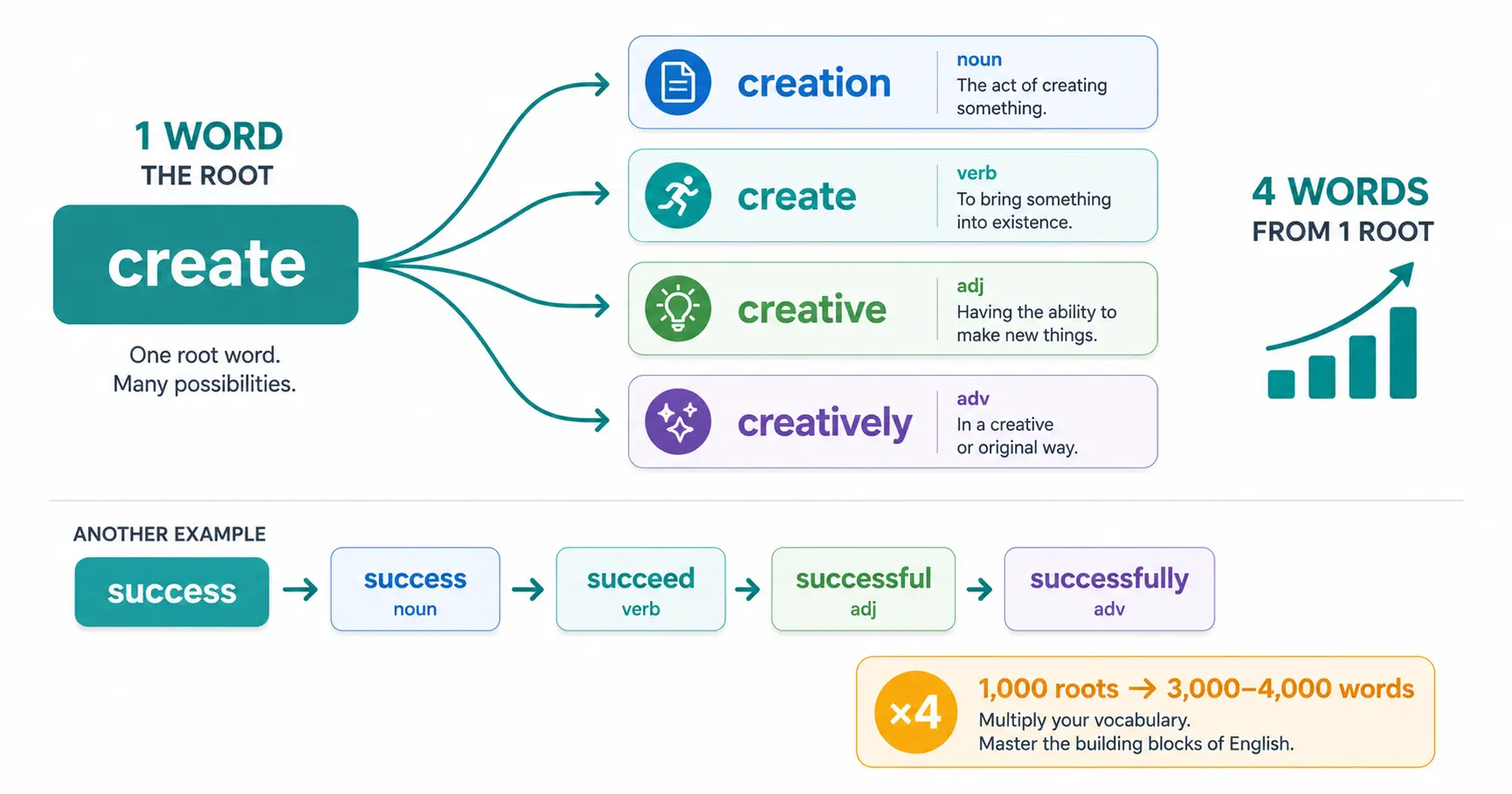
1. Famílias de Palavras Expandem Seu Vocabulário 4x
Quando você aprende uma palavra, sua família de palavras dá três ou quatro mais:
| Substantivo | Verbo | Adjetivo | Advérbio |
|---|---|---|---|
| success | succeed | successful | successfully |
| creation | create | creative | creatively |
| decision | decide | decisive | decisively |
| importance | — | important | importantly |
| analysis | analyze | analytical | analytically |
| strength | strengthen | strong | strongly |
| difference | differ | different | differently |
| achievement | achieve | achievable | — |
Se você conhece 1.000 palavras-base e aprende também suas famílias, seu vocabulário funcional pode chegar a 3.000–4.000 palavras. Essa é uma das maneiras mais rápidas de ampliar seu vocabulário.
2. Sufixos Sinalizam a Classe Gramatical
Você frequentemente consegue identificar a classe gramatical de uma palavra pelo seu final:
| Final | Classe Gramatical | Exemplos |
|---|---|---|
| -tion, -sion, -ment, -ness, -ity | Substantivo | education, decision, improvement, kindness, creativity |
| -ate, -ize, -ify, -en | Verbo | educate, realize, simplify, strengthen |
| -ous, -ive, -ful, -less, -able | Adjetivo | dangerous, creative, helpful, careless, comfortable |
| -ly | Advérbio (geralmente) | quickly, carefully, unfortunately |
Ao encontrar uma palavra desconhecida durante a leitura, observe o sufixo. Se terminar em -tion, provavelmente é um substantivo; se terminar em -ize, provavelmente é um verbo. Isso já oferece pistas sobre o contexto e o significado.
3. Classe Gramatical Correta = Frases Corretas
Muitos erros de estudantes vêm de usar a classe gramatical errada:
| Incorreto | Correto | Problema |
|---|---|---|
| The important of education is clear. | The importance of education is clear. | Adjetivo usado onde substantivo é necessário |
| She success in her career. | She succeeded in her career. | Substantivo usado onde verbo é necessário |
| He runs quick. | He runs quickly. | Adjetivo usado onde advérbio é necessário |
| This is a beauty day. | This is a beautiful day. | Substantivo usado onde adjetivo é necessário |
IELTS, TOEFL e TOEIC avaliam especificamente sua capacidade de escolher a forma correta da palavra. Conhecer as classes gramaticais elimina uma categoria inteira de erros.
Como Estudar Classes Gramaticais Efetivamente
Passo 1: Aprenda as Oito Categorias
Use a tabela de visão geral no início deste artigo. Para cada classe gramatical, entenda a função e pratique identificando exemplos numa frase.
Passo 2: Estude Famílias de Palavras, Não Palavras Isoladas
Quando aprender uma nova palavra, sempre verifique:
- Qual é a sua classe gramatical?
- Quais são suas outras formas? (substantivo → verbo → adjetivo → advérbio)
- Qual forma preciso mais?
Adicione ao seu dicionário Linglify todas as formas que possam ser úteis.
Passo 3: Pratique Identificação
Escolha qualquer parágrafo em inglês e identifique a classe gramatical de cada palavra. Comece por frases simples e avance para as mais complexas. Esse exercício desenvolve uma percepção que ajuda na leitura, na escrita e nas provas.
Passo 4: Foque em Uma Classe Gramatical de Cada Vez
Dedique sessões de estudo a tipos específicos de palavras. Passe uma semana em verbos, outra em adjetivos e outra em advérbios. O foco em uma categoria aprofunda o aprendizado mais do que estudar vocabulário variado ao mesmo tempo.
Passo 5: Use Repetição Espaçada
Adicione ao seu dicionário Linglify palavras identificadas por classe gramatical e revise-as em intervalos cada vez maiores. Nosso guia sobre como memorizar vocabulário explica por que esse método é de três a quatro vezes mais eficaz do que o estudo tradicional.
Vocabulário para Praticar
Estas 25 palavras abrangem as principais classes gramaticais e vários níveis. Adicione-as ao seu dicionário Linglify para praticar com repetição espaçada.
boom
substantivo
explosão, auge
Exemplos
- The boom of thunder echoed across the valley.
- The technology boom created many new millionaires.
cooperate
verbo
cooperar, colaborar
candidate
substantivo
candidato
Exemplos
- Each presidential candidate presented their policy plans to voters.
- The job candidate impressed the interview panel with her experience.
evaluate
verbo
avaliar, julgar
Exemplos
- Companies evaluate job candidates based on experience, skills, and personality.
- Teachers evaluate student progress through tests, projects, and classroom participation.
indispensable
adjetivo
indispensável, essencial, fundamental
Exemplos
- Clean water is indispensable for human survival and good health.
- Her experience and skills make her indispensable to the research team.
normally
advérbio
normalmente
Exemplos
- Heart normally beats between sixty and hundred times per minute.
- Students normally arrive at school before morning bell rings.
discourage
verbo
desencorajar
Exemplos
- Don't let one failure discourage you from pursuing your dreams.
- High prices discourage many people from buying organic food products.
jury
substantivo
juri
Exemplos
- The jury deliberated for several hours before reaching a verdict.
- The talent show jury consisted of professional musicians and entertainers.
resolve
verbo
resolver
Exemplos
- Mediator helps parties resolve dispute through negotiation.
- Technical team will resolve software problems quickly.
graduate
verbo
se formar
Exemplos
- She will graduate from university next year with a degree in engineering.
- Students must complete all requirements before they can graduate from high school.
total
adjetivo
total
Exemplos
- Total cost includes all fees and expenses.
- Total silence fills room during meditation session.
donate
verbo
doar
Exemplos
- Many people donate money to charities that help homeless individuals.
- She decided to donate blood to help patients in emergency situations.
firmly
advérbio
firmemente, com firmeza
Exemplos
- Hold the rope firmly while climbing down the steep mountain slope.
- The manager firmly believed in treating all employees with respect.
lifelong
adjetivo
para toda a vida
Exemplos
- Learning is a lifelong process that never truly ends.
- Their lifelong friendship began during elementary school years.
guide
verbo
orientar
Exemplos
- Parents should guide their children to make responsible decisions.
- The experienced hiker will guide the group through the mountain trail safely.
tragedy
substantivo
tragédia
Exemplos
- Natural tragedy affects thousands of innocent people.
- Personal tragedy changes person's life perspective completely.
motivated
adjetivo
motivado
Exemplos
- Motivated employee seeks additional responsibilities and challenges at work.
- Success requires being motivated even when facing difficult obstacles.
prejudice
substantivo
preconceito
Exemplos
- Education helps overcome prejudice and promotes understanding.
- Racial prejudice damages communities and individuals alike.
voyage
substantivo
viagem
Exemplos
- Space exploration represents humanity's greatest voyage into the unknown.
- The ocean voyage from Europe to America took several weeks in the past.
horizon
substantivo
horizonte
Exemplos
- The sun disappeared behind the horizon as evening approached.
- Traveling broadens your horizon and exposes you to new cultures.
off
adjetivo
fora, desligado, apagado
Exemplos
- Please turn off the lights before leaving the room.
- The dog ran off into the forest chasing wild rabbits.
stress
verbo
estressar, sobrecarregar, pressionar
Exemplos
- Heavy workload may stress employees beyond limits.
- Teacher will stress importance of homework completion.
union
substantivo
união, associação
Exemplos
- Labor union protects worker rights and interests.
- Marriage union joins two people in partnership.
humorous
adjetivo
engraçado, divertido, cômico
Exemplos
- She writes humorous articles about everyday life and family experiences.
- The humorous speech made everyone laugh and lightened the serious mood.
admission
substantivo
admissão
Exemplos
- Her admission to the prestigious medical school was the result of hard work.
- The museum offers free admission on the first Sunday of every month.
Erros Comuns a Evitar
-
Confundir adjetivos e advérbios. “She sings beautiful” está errado — o correto é “She sings beautifully.” Verbos são modificados por advérbios, não por adjetivos. Se a palavra explica como uma ação é realizada, use a forma com -ly.
-
Usar a forma errada da palavra na frase. “The develop of technology” deve ser “The development of technology.” Observe qual classe gramatical a posição exige: depois de “the”, por exemplo, costuma vir um substantivo.
-
Tratar substantivos incontáveis como contáveis. “Many informations” e “an advice” são incorretos. Information, advice, furniture, equipment e research são substantivos incontáveis: não têm plural e não vêm precedidos por “a/an”.
-
Esquecer formas irregulares. Nem todos os passados terminam em -ed, nem todos os advérbios em -ly e nem todos os plurais em -s. As formas irregulares precisam ser memorizadas. Consulte nossa lista de verbos irregulares para ver as mais importantes.
-
Ignorar colocações de preposições. Você “depend on“ alguém (não “depend of”), “consist of“ partes (não “consist from”), e “interested in“ algo (não “interested for”).
-
Usar demais palavras simples. Se todos os substantivos do seu texto são “thing” e todos os adjetivos são “good” ou “bad”, você não está aproveitando toda a variedade do inglês. Estude palavras avançadas em inglês para expressar suas ideias com mais precisão.
O Que Fazer a Seguir
-
Comece pela classe gramatical que é seu ponto fraco. Se verbos são seu maior desafio, estude nossa Lista de Verbos em Inglês: 300 Verbos Mais Importantes e a Lista de Verbos Irregulares. Se precisa melhorar os adjetivos, leia a lista de 500 adjetivos em inglês.
-
Adicione 10 palavras da seção de prática ao seu dicionário do Linglify. Marque cada uma com sua classe gramatical.
-
Aprenda famílias de palavras que partem de termos que você já conhece. Escolha 20 palavras do seu vocabulário atual e descubra suas formas de substantivo, verbo, adjetivo e advérbio. Isso amplia de imediato o vocabulário que você consegue usar.
-
Leia algo em inglês hoje e identifique as classes gramaticais no primeiro parágrafo. O exercício leva cinco minutos e desenvolve a consciência gramatical que melhora todas as outras habilidades.
-
Explore nossos guias de vocabulário para cada tipo principal de palavra:
FAQ
Quais são as 8 classes gramaticais em inglês?
As oito classes gramaticais são: substantivos, verbos, adjetivos, advérbios, pronomes, preposições, conjunções e interjeições. Toda palavra em inglês pertence a pelo menos uma dessas categorias. Algumas podem exercer mais de uma função conforme o contexto: light, por exemplo, pode ser substantivo (the light), verbo (light a candle) ou adjetivo (a light color).
Qual classe gramatical é mais importante aprender primeiro?
Verbos e substantivos devem ser sua primeira prioridade — eles formam o núcleo de cada frase, e não é possível se comunicar sem eles. Depois de dominar os verbos e substantivos essenciais, passe para os adjetivos, que acrescentam detalhes, e os advérbios, que dão precisão. Em seguida, estude pronomes, preposições e conjunções. Interjeições são a prioridade mais baixa no estudo formal.
Como identifico a classe gramatical de uma palavra?
Observe a função da palavra na frase e sua forma. Pergunte: ela nomeia algo (substantivo), expressa uma ação (verbo), modifica um substantivo (adjetivo) ou modifica um verbo (advérbio)? Os sufixos também ajudam: -tion costuma indicar substantivos; -ous, adjetivos; -ly, advérbios; e -ize, verbos.
Uma palavra pode ser mais de uma classe gramatical?
Sim, muitas palavras em inglês podem pertencer a mais de uma classe gramatical. “Run” pode ser verbo (“I run”) ou substantivo (“a morning run”); “fast” pode ser adjetivo (“a fast car”) ou advérbio (“drive fast”); e “light” pode ser substantivo, verbo ou adjetivo. O contexto determina a função da palavra em cada frase.
Quantos substantivos, verbos e adjetivos existem em inglês?
Não é possível determinar números exatos, porque o idioma está sempre mudando. As estimativas indicam que o inglês tem cerca de 100.000 substantivos ou mais, mais de 25.000 verbos e mais de 20.000 adjetivos. Os estudantes precisam conhecer bem menos: as 4.000 palavras mais essenciais em inglês cobrem aproximadamente 95% do inglês cotidiano e incluem cerca de 1.200 substantivos, 600 verbos e 500 adjetivos.
Por que o IELTS e o TOEFL testam classes gramaticais?
Esses exames avaliam se você consegue usar a forma correta da palavra em contexto. Escrever “the important of education” em vez de “the importance of education”, por exemplo, sinaliza um domínio fraco da gramática. Tanto o IELTS quanto o TOEFL incluem exercícios de completar lacunas, paráfrases e redações, nos quais escolher a classe gramatical correta afeta diretamente sua nota.
Qual é a diferença entre adjetivos e advérbios?
Adjetivos modificam substantivos (a quick decision), enquanto advérbios modificam verbos, adjetivos ou outros advérbios (she decided quickly). O erro mais comum é usar um adjetivo onde é necessário um advérbio: “He drives careful” está errado; o correto é “He drives carefully”, pois carefully modifica o verbo drives.
Como as classes gramaticais ajudam na construção de vocabulário?
Quando você aprende uma palavra e sua família (suas formas em todas as classes gramaticais), multiplica o vocabulário. Aprender create (verbo) também ensina creation (substantivo), creative (adjetivo) e creatively (advérbio) — quatro palavras a partir de uma raiz. Conhecer os sufixos também ajuda a deduzir palavras desconhecidas: sabendo sustain, você pode inferir que sustainability é substantivo e sustainable é adjetivo. Nosso guia para ampliar o vocabulário explica esse sistema em detalhes.