Expressões Idiomáticas em Inglês: O Que São e Como Usá-las
Você pode conhecer cada palavra de “She let the cat out of the bag” e ainda assim não entender o sentido da frase. Isso acontece porque ela é uma expressão idiomática: seu significado não pode ser deduzido das palavras isoladas. A frase não tem nada a ver com gatos ou bolsas; significa “ela revelou um segredo”.
As expressões idiomáticas estão por toda parte no inglês. Falantes nativos as usam em conversas, e-mails, reuniões e mensagens — muitas vezes sem perceber. Para quem está aprendendo, isso cria uma lacuna frustrante: a gramática está correta, o vocabulário é sólido, mas metade do que as pessoas dizem parece não fazer sentido.
Este guia explica o que são expressões idiomáticas, como funcionam, quais tipos existem e, principalmente, como aprendê-las e usá-las. Você encontrará mais de 100 exemplos organizados por tipo e tema, com significados claros e frases naturais.
- O que você aprenderá: definição, tipos e estrutura das expressões idiomáticas
- Exemplos incluídos: 100+ expressões idiomáticas com significados
- Nível: B1–C1
- Para: compreender o inglês natural, preparar-se para provas e conversar com fluência
Para ver uma lista completa com mais de 500 expressões, consulte Expressões Idiomáticas em Inglês: mais de 500 expressões comuns.
O Que É uma Expressão Idiomática?
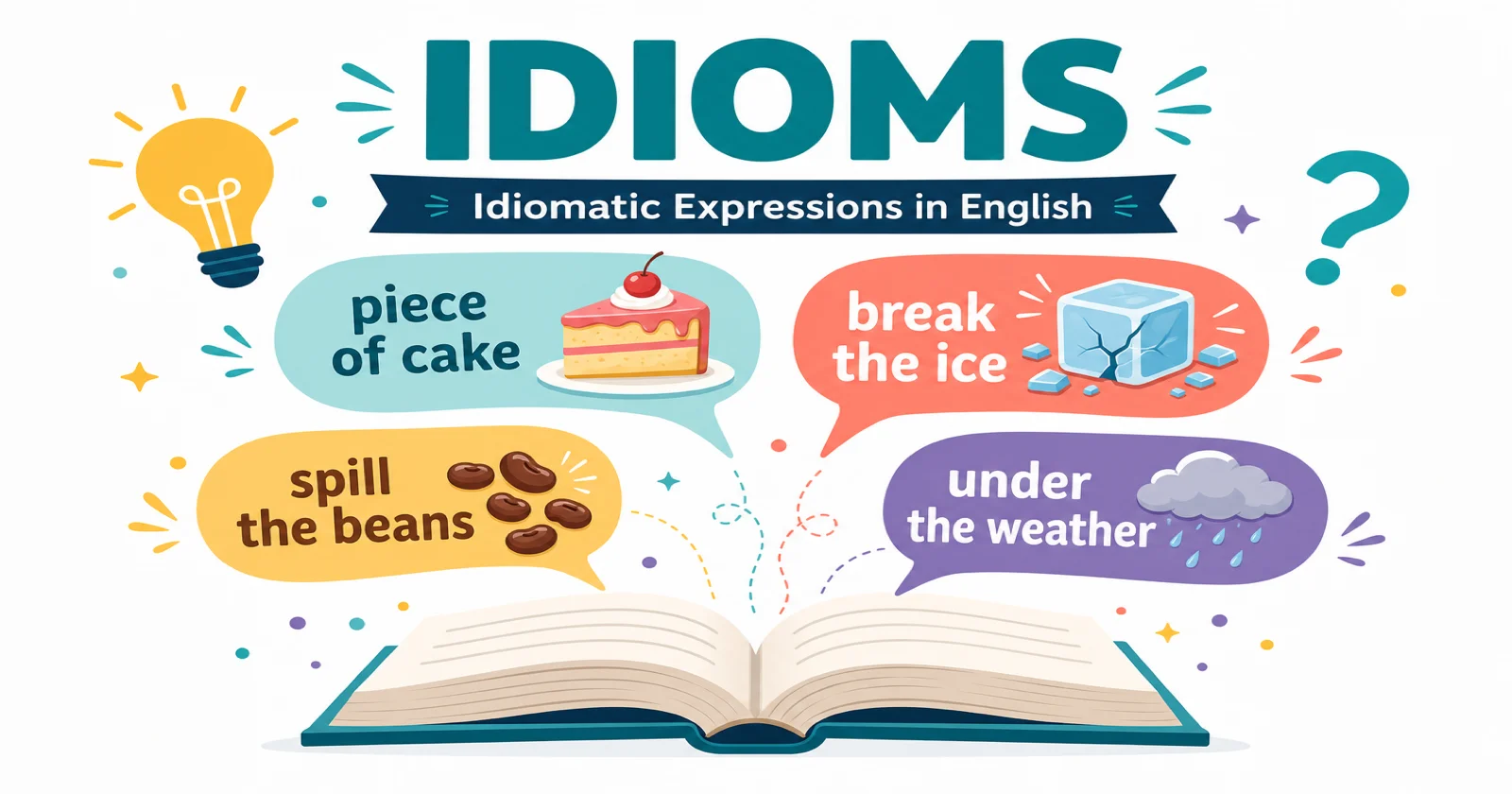
Uma expressão idiomática (em inglês, idiom) é uma frase ou sentença cujo significado difere do sentido literal de cada uma de suas palavras.
| Expressão | Significado Literal | Significado Real (Idiomático) |
|---|---|---|
| break the ice | fisicamente quebrar gelo | iniciar uma conversa em uma situação estranha |
| hit the nail on the head | martelar um prego | dizer algo exatamente certo |
| under the weather | abaixo do clima | sentindo-se doente |
| piece of cake | uma fatia de bolo | algo muito fácil |
| cost an arm and a leg | perder partes do corpo como pagamento | ser muito caro |
A característica principal é que não dá para adivinhar o significado pelas palavras. Se alguém disser “It’s a piece of cake”, não está falando de sobremesa. Se disser “He kicked the bucket”, não está falando de chutar nada: quer dizer que ele morreu.
É isso que diferencia as expressões idiomáticas de outros tipos de frase. Em “heavy rain” (chuva forte), por exemplo, “heavy” é usado em sentido metafórico, mas ainda dá para entender o significado. Já nas expressões idiomáticas, não é possível deduzir o sentido apenas pelas palavras.
Idiomático vs. Literal
| Característica | Linguagem Literal | Linguagem Idiomática |
|---|---|---|
| Significado | corresponde às palavras | difere das palavras |
| Previsível? | sim | não |
| Traduzível? | palavra por palavra | deve-se traduzir o significado |
| Exemplo | “She closed the door” | “She let the cat out of the bag” |
Por Que as Expressões Idiomáticas Existem?
Todas as línguas têm expressões idiomáticas. Elas se desenvolvem naturalmente ao longo dos séculos por várias razões:
1. Eficiência. “He kicked the bucket” é mais curto e mais expressivo do que “He died” (ele morreu). As expressões idiomáticas condensam ideias complexas em frases curtas.
2. Experiência cultural compartilhada. Muitas expressões vêm de atividades históricas específicas — agricultura (“separate the wheat from the chaff”), navegação (“learn the ropes”), esportes (“move the goalposts”) ou guerra (“bury the hatchet”). O contexto original desaparece, mas a expressão sobrevive.
3. Cor emocional. “I’m a bit tired” (estou um pouco cansado) é neutro. “I’m running on empty” (estou no limite) cria uma imagem. As expressões idiomáticas acrescentam profundidade emocional e personalidade à linguagem.
4. Vínculo social. Usar expressões idiomáticas sinaliza que você faz parte de uma comunidade linguística. Quando um colega diz “Let’s not reinvent the wheel” (não vamos reinventar a roda), quem conhece a expressão sente que compartilha algo com ele. As expressões idiomáticas funcionam como senhas culturais.
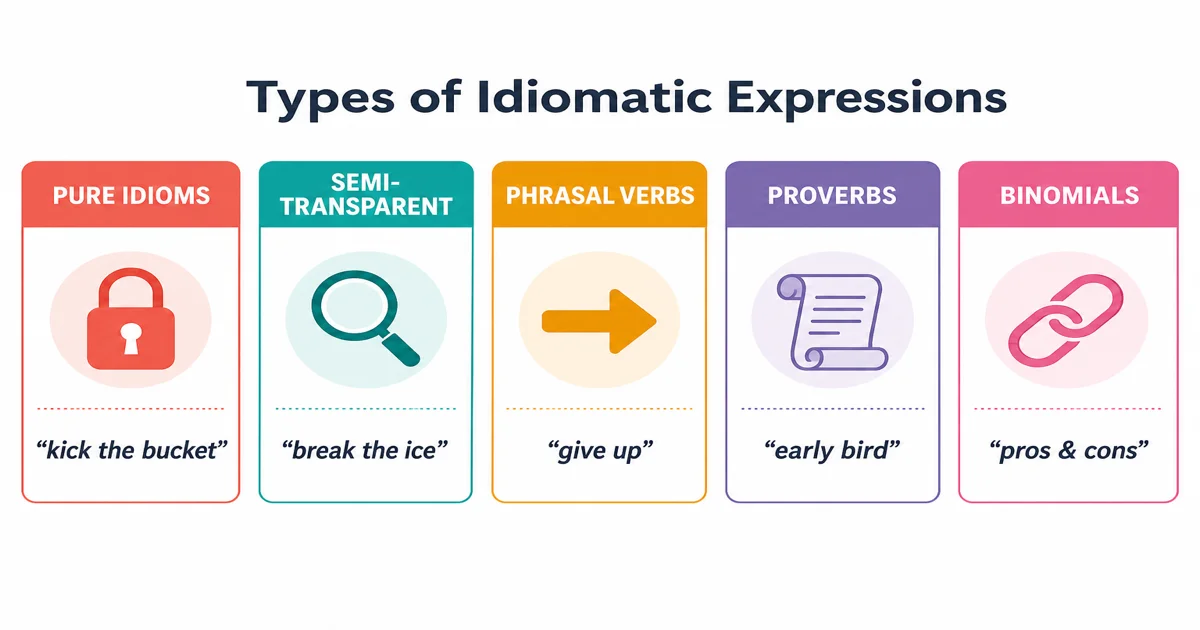
Tipos de Expressões Idiomáticas
Nem todas as expressões idiomáticas funcionam da mesma maneira. Entender os diferentes tipos ajuda a reconhecê-las e aprendê-las com mais eficiência.
1. Expressões Idiomáticas Puras (Opacas)
O significado não tem conexão com as palavras literais. Você não pode adivinhar o significado de forma alguma.
| Expressão | Significado |
|---|---|
| kick the bucket | morrer |
| spill the beans | revelar um segredo |
| bite the bullet | suportar algo doloroso |
| break a leg | boa sorte |
| by the skin of your teeth | por muito pouco, a tempo |
| once in a blue moon | muito raramente |
| the whole nine yards | tudo, a quantidade total |
| fly off the handle | ficar subitamente com raiva |
Esses são os mais difíceis de aprender porque não há ponte lógica entre as palavras e o significado. Você deve memorizá-los.
2. Expressões Idiomáticas Semitransparentes
O significado é parcialmente adivinhável a partir das palavras. Há uma conexão metafórica, mas não é óbvia.
| Expressão | Significado | Por que é semitransparente? |
|---|---|---|
| break the ice | iniciar uma conversa | gelo = frieza/estranheza social |
| see eye to eye | concordar completamente | olhos se encontrando = entendimento mútuo |
| burn bridges | danificar um relacionamento permanentemente | ponte = conexão |
| light at the end of the tunnel | esperança após dificuldade | túnel = período escuro |
| turn over a new leaf | fazer um novo começo | folha = página de um livro |
| let sleeping dogs lie | não mexer em uma situação tranquila | dormindo = em paz |
| hit the nail on the head | dizer algo exatamente certo | prego = o ponto |
| beat around the bush | evitar o assunto principal | arbusto = o ponto |
Esses são mais fáceis de lembrar porque a metáfora dá um gancho mental.
3. Phrasal Verbs Idiomáticos
Muitos phrasal verbs são idiomáticos — seu significado não pode ser adivinhado a partir da combinação verbo + partícula.
| Phrasal Verb | Significado |
|---|---|
| give up | parar de tentar |
| look up to | admirar e respeitar |
| put up with | tolerar |
| get away with | evitar punição |
| run into | encontrar inesperadamente |
| come across | encontrar por acaso |
| bring up | mencionar um tópico; criar uma criança |
| figure out | entender após reflexão |
Para saber mais sobre phrasal verbs, leia os guias Phrasal Verbs com GET e Guia Completo de Phrasal Verbs em Inglês.
4. Provérbios e Ditados
Os provérbios são frases completas que expressam uma verdade geral ou conselho. Muitos são idiomáticos.
| Provérbio | Significado |
|---|---|
| Don’t put all your eggs in one basket. | Não arrisque tudo em um único plano. |
| The early bird catches the worm. | O sucesso vem para quem age primeiro. |
| Every cloud has a silver lining. | Algo bom pode vir de uma situação ruim. |
| Don’t count your chickens before they hatch. | Não presuma o sucesso antes que aconteça. |
| Actions speak louder than words. | O que você faz importa mais do que o que você diz. |
| When in Rome, do as the Romans do. | Adapte-se aos costumes locais. |
| The grass is always greener on the other side. | Outras situações sempre parecem melhores. |
| You can’t judge a book by its cover. | As aparências podem enganar. |
5. Expressões Binomiais (Pares)
Duas palavras unidas por “and” ou “or” em uma ordem fixa.
| Binomial | Significado |
|---|---|
| pros and cons | vantagens e desvantagens |
| give and take | compromisso mútuo |
| now and then | ocasionalmente |
| sick and tired | completamente farto |
| odds and ends | itens miscelâneos pequenos |
| by and large | geralmente, em sua maioria |
| sooner or later | eventualmente |
| more or less | aproximadamente |
A ordem das palavras é fixa: “pros and cons” está correto; “cons and pros” soa errado.
100 Expressões Idiomáticas Essenciais por Tema
Vida Cotidiana
| # | Expressão | Significado | Exemplo |
|---|---|---|---|
| 1 | a piece of cake | muito fácil | The test was a piece of cake. |
| 2 | break the ice | iniciar uma conversa | He told a joke to break the ice. |
| 3 | call it a day | parar de trabalhar | We’ve done enough — let’s call it a day. |
| 4 | get out of hand | tornar-se incontrolável | The party got out of hand quickly. |
| 5 | in the long run | ao longo de muito tempo | Exercise pays off in the long run. |
| 6 | on the same page | em concordância | Let’s make sure we’re all on the same page. |
| 7 | the last straw | o problema final que causa uma reação | His late arrival was the last straw. |
| 8 | at the end of the day | no final das contas | At the end of the day, family matters most. |
| 9 | give it a shot | tentar | I’ve never done it, but I’ll give it a shot. |
| 10 | no-brainer | uma decisão fácil | Accepting the scholarship was a no-brainer. |
Sucesso e Fracasso
| # | Expressão | Significado | Exemplo |
|---|---|---|---|
| 11 | hit the nail on the head | estar exatamente certo | You hit the nail on the head with that analysis. |
| 12 | back to square one | recomeçar | The plan failed, so we’re back to square one. |
| 13 | cut corners | fazer algo barato ou inadequado | They cut corners on safety to save money. |
| 14 | go the extra mile | fazer mais esforço do que o necessário | She always goes the extra mile for her clients. |
| 15 | miss the boat | perder uma oportunidade | If you don’t apply now, you’ll miss the boat. |
| 16 | the ball is in your court | é sua decisão/vez | I’ve made my offer — the ball is in your court. |
| 17 | learn the ropes | aprender o básico de um trabalho | It took a month to learn the ropes. |
| 18 | throw in the towel | desistir | After three failed attempts, he threw in the towel. |
| 19 | up in the air | incerto, não decidido | Our vacation plans are still up in the air. |
| 20 | ahead of the curve | mais avançado do que os outros | Their technology is ahead of the curve. |
Dinheiro e Negócios
| # | Expressão | Significado | Exemplo |
|---|---|---|---|
| 21 | cost an arm and a leg | ser muito caro | The repair cost an arm and a leg. |
| 22 | break the bank | ser muito caro | A weekend trip doesn’t have to break the bank. |
| 23 | make ends meet | ter apenas dinheiro suficiente | It’s hard to make ends meet on minimum wage. |
| 24 | penny for your thoughts | querendo saber o que alguém está pensando | You look worried — penny for your thoughts? |
| 25 | get the ball rolling | iniciar um processo | Let’s get the ball rolling on this project. |
| 26 | in the red | em dívida, perdendo dinheiro | The company has been in the red for two quarters. |
| 27 | bring to the table | contribuir | What skills do you bring to the table? |
| 28 | think outside the box | ser criativo | We need to think outside the box to solve this. |
| 29 | the bottom line | o ponto mais importante | The bottom line is we need more revenue. |
| 30 | a ballpark figure | uma estimativa aproximada | Give me a ballpark figure for the project cost. |
Emoções e Sentimentos
| # | Expressão | Significado | Exemplo |
|---|---|---|---|
| 31 | on cloud nine | extremamente feliz | She’s been on cloud nine since the proposal. |
| 32 | under the weather | sentindo-se doente | I’m feeling under the weather today. |
| 33 | over the moon | extremamente feliz | They were over the moon about the baby. |
| 34 | down in the dumps | triste, deprimido | He’s been down in the dumps since the breakup. |
| 35 | butterflies in my stomach | nervosismo animado | I always get butterflies before a presentation. |
| 36 | blow off steam | liberar estresse ou raiva | I go for a run to blow off steam. |
| 37 | keep a stiff upper lip | manter a calma sob pressão | The British are famous for keeping a stiff upper lip. |
| 38 | lose your cool | ficar com raiva ou perder a calma | Try not to lose your cool during the interview. |
| 39 | get cold feet | ficar nervoso antes de um grande evento | He got cold feet before the wedding. |
| 40 | have a heart of gold | ser muito gentil e generoso | Despite her tough exterior, she has a heart of gold. |
Comunicação
| # | Expressão | Significado | Exemplo |
|---|---|---|---|
| 41 | beat around the bush | evitar o assunto principal | Stop beating around the bush and tell me the truth. |
| 42 | spill the beans | revelar um segredo | Someone spilled the beans about the surprise party. |
| 43 | get straight to the point | falar sobre o assunto principal diretamente | I’ll get straight to the point — we need to cut costs. |
| 44 | speak your mind | dizer o que você realmente pensa | She’s not afraid to speak her mind. |
| 45 | read between the lines | entender o significado oculto | You have to read between the lines of his email. |
| 46 | keep someone in the loop | informar alguém regularmente | Please keep me in the loop on any developments. |
| 47 | ring a bell | soar familiar | The name rings a bell, but I can’t place it. |
| 48 | word of mouth | informação espalhada por conversas | The restaurant became famous through word of mouth. |
| 49 | take with a grain of salt | não acreditar em tudo | Take his claims with a grain of salt. |
| 50 | cut to the chase | ir direto ao ponto | Let’s cut to the chase — what do you want? |
Relacionamentos
| # | Expressão | Significado | Exemplo |
|---|---|---|---|
| 51 | see eye to eye | concordar completamente | We don’t always see eye to eye on politics. |
| 52 | get along like a house on fire | tornar-se amigos imediatamente | They got along like a house on fire. |
| 53 | stab in the back | trair alguém | I can’t believe he stabbed me in the back. |
| 54 | give someone the cold shoulder | ignorar deliberadamente alguém | She gave him the cold shoulder after the argument. |
| 55 | bend over backwards | tentar muito para ajudar | She bent over backwards to make us comfortable. |
| 56 | bury the hatchet | fazer as pazes, encerrar um conflito | It’s time to bury the hatchet and move on. |
| 57 | a shoulder to cry on | alguém que ouve seus problemas | She’s always been a shoulder to cry on. |
| 58 | give someone the benefit of the doubt | confiar em alguém apesar da incerteza | I’ll give him the benefit of the doubt this time. |
| 59 | hit it off | se dar bem imediatamente | We hit it off on our first date. |
| 60 | two-faced | falso, hipócrita | She’s two-faced — nice to you, then talks behind your back. |
Tempo
| # | Expressão | Significado | Exemplo |
|---|---|---|---|
| 61 | in the nick of time | por muito pouco em tempo | We arrived at the airport in the nick of time. |
| 62 | once in a blue moon | muito raramente | I only eat fast food once in a blue moon. |
| 63 | around the clock | 24 horas por dia | The team worked around the clock to finish. |
| 64 | at the eleventh hour | no último momento possível | The deal was saved at the eleventh hour. |
| 65 | time flies | o tempo passa rapidamente | Time flies when you’re having fun. |
| 66 | kill time | fazer algo enquanto espera | I killed time by reading a magazine. |
| 67 | behind the times | ultrapassado, antiquado | His management style is behind the times. |
| 68 | stand the test of time | permanecer relevante ou eficaz | Their friendship has stood the test of time. |
| 69 | ahead of time | antes do esperado | She finished the project ahead of time. |
| 70 | rain or shine | aconteça o que acontecer | We’ll be there, rain or shine. |
Conhecimento e Aprendizado
| # | Expressão | Significado | Exemplo |
|---|---|---|---|
| 71 | learn the hard way | aprender com experiência dolorosa | He learned the hard way not to trust strangers online. |
| 72 | a steep learning curve | algo difícil de aprender no começo | There’s a steep learning curve with this software. |
| 73 | know something inside out | conhecer algo profundamente | She knows the industry inside out. |
| 74 | pick someone’s brain | pedir conselhos ou informações a alguém | Can I pick your brain about the marketing strategy? |
| 75 | food for thought | algo para pensar | Your proposal is food for thought. |
| 76 | in a nutshell | em resumo | In a nutshell, we need more time and money. |
| 77 | get the hang of it | aprender como fazer algo | It takes a few weeks to get the hang of it. |
| 78 | scratch the surface | tratar apenas uma pequena parte | We’ve barely scratched the surface of this topic. |
| 79 | do your homework | pesquisar antes de tomar uma decisão | Make sure you do your homework before investing. |
| 80 | the tip of the iceberg | apenas uma pequena parte visível | What we found is just the tip of the iceberg. |
Dificuldade e Problemas
| # | Expressão | Significado | Exemplo |
|---|---|---|---|
| 81 | between a rock and a hard place | em uma situação difícil sem boas opções | He’s between a rock and a hard place. |
| 82 | the elephant in the room | um problema óbvio que ninguém menciona | The company’s debt is the elephant in the room. |
| 83 | at the end of your rope | estar no limite da paciência ou da resistência | I’m at the end of my rope with this project. |
| 84 | a can of worms | uma situação complicada | That question opened a whole can of worms. |
| 85 | add fuel to the fire | piorar uma situação ruim | His comments only added fuel to the fire. |
| 86 | a blessing in disguise | algo ruim que acaba sendo bom | Losing that job was a blessing in disguise. |
| 87 | burn the midnight oil | trabalhar até tarde da noite | Students burn the midnight oil before finals. |
| 88 | weather the storm | sobreviver a um período difícil | The company managed to weather the storm. |
| 89 | nip it in the bud | parar um problema cedo | Address the issue now — nip it in the bud. |
| 90 | turn a blind eye | ignorar deliberadamente algo | Management turned a blind eye to the violations. |
Ações e Decisões
| # | Expressão | Significado | Exemplo |
|---|---|---|---|
| 91 | bite the bullet | suportar algo difícil | I bit the bullet and booked the dentist appointment. |
| 92 | pull someone’s leg | brincar com alguém | I’m just pulling your leg — I didn’t really quit. |
| 93 | let the cat out of the bag | revelar um segredo | Who let the cat out of the bag about the surprise? |
| 94 | play it by ear | decidir conforme o andamento | We don’t have a plan — let’s play it by ear. |
| 95 | sit on the fence | não tomar uma decisão | Stop sitting on the fence and choose a side. |
| 96 | take it with a pinch of salt | não acreditar totalmente em algo | Take online reviews with a pinch of salt. |
| 97 | bite off more than you can chew | assumir tarefas demais | I think I bit off more than I could chew with this project. |
| 98 | jump on the bandwagon | seguir uma tendência popular | Everyone’s jumping on the AI bandwagon. |
| 99 | cross that bridge when you come to it | lidar com problemas quando surgem | Don’t worry about it now — cross that bridge when you come to it. |
| 100 | leave no stone unturned | procurar em todo lugar, tentar tudo | The police left no stone unturned in their investigation. |
Como as Expressões Idiomáticas Funcionam na Gramática
As expressões idiomáticas seguem regras gramaticais específicas. Entendê-las ajuda você a usar essas expressões corretamente, em vez de apenas reconhecê-las.
Estrutura Fixa vs. Flexível
Algumas expressões idiomáticas são completamente fixas — você não pode mudar nenhuma palavra:
- Fixo: by and large, once in a blue moon, under the weather
- VOCÊ NÃO PODE dizer: “under a weather” ou “once in a red moon”
Outros permitem algumas mudanças gramaticais (tempo, pronome):
- Flexível: break the ice → She broke the ice. / The ice was broken.
- Flexível: spill the beans → He spilled the beans. / Don’t spill the beans.
Separável vs. Inseparável
Alguns phrasal verbs idiomáticos podem ser separados; outros não:
| Tipo | Exemplo | Forma Separada |
|---|---|---|
| Separável | figure out | She figured it out. |
| Separável | bring up | He brought the topic up. |
| Inseparável | run into | I ran into her. (NÃO: I ran her into.) |
| Inseparável | look up to | I look up to my teacher. |
Expressões Idiomáticas em Forma de Sintagma Nominal
Algumas expressões idiomáticas funcionam como substantivos:
- It’s a piece of cake. (predicativo do sujeito)
- That’s the tip of the iceberg. (predicativo do sujeito)
- He’s a jack of all trades. (predicativo do sujeito)
Erros Comuns com Expressões Idiomáticas
| Erro | Forma Correta | Problema |
|---|---|---|
| “under weather” | under the weather | Artigo faltando |
| “break the legs” | break a leg | Artigo errado + número errado |
| “it costs arm and leg” | it costs an arm and a leg | Artigos faltando |
| “I’m on the cloud nine” | I’m on cloud nine | Artigo extra |
| “by large” | by and large | “and” faltando |
| “He bit the dust” (= morreu) | He bit the dust | Não é um erro, mas usar expressões sobre morte sem cuidado pode ser insensível |
A regra mais importante: aprenda as expressões idiomáticas como frases completas, não palavra por palavra. Trate cada expressão como um único item de vocabulário.
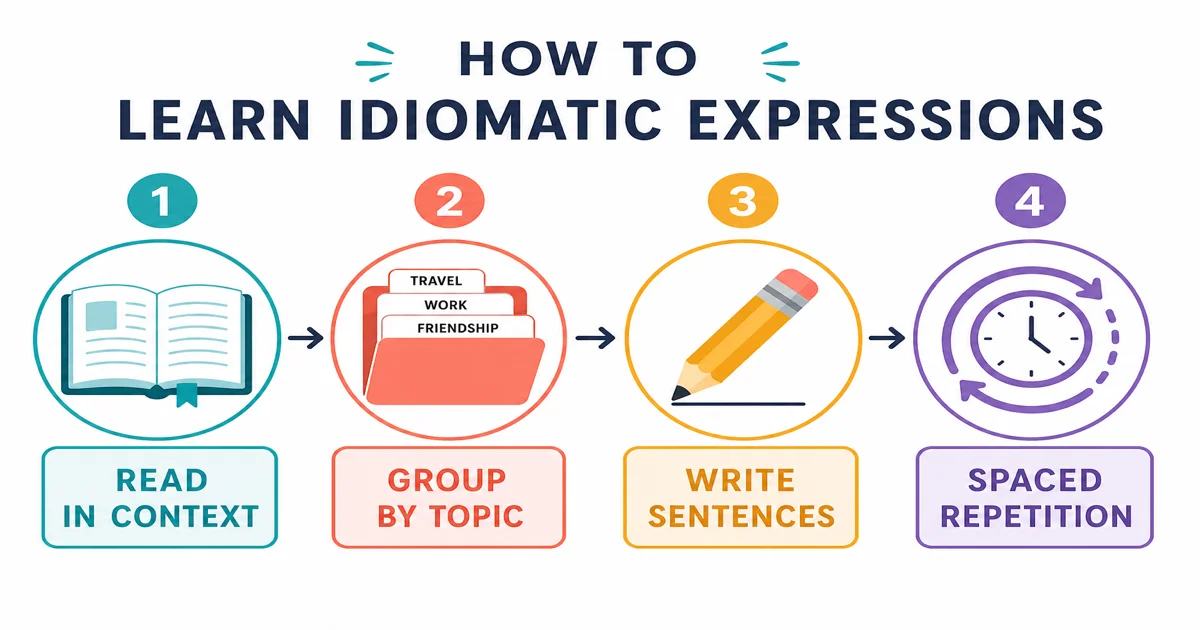
Como Aprender Expressões Idiomáticas
Passo 1: Aprenda em Contexto
Nunca memorize expressões idiomáticas a partir de listas isoladas. Leia-as em artigos, acompanhe-as em filmes e preste atenção nelas em podcasts. Quando você encontra uma expressão em um contexto natural, fica mais fácil lembrar tanto o significado quanto o uso.
Passo 2: Agrupe por Tema
Aprender juntas expressões relacionadas ao corpo (break a leg, cold shoulder, heart of gold) é mais eficaz do que estudar listas aleatórias. O cérebro cria uma categoria mental, e cada nova expressão reforça as outras.
Passo 3: Crie Frases de Exemplo
Para cada expressão que aprender, escreva de duas a três frases sobre sua própria vida. “I got butterflies in my stomach before my job interview” (fiquei com frio na barriga antes da entrevista de emprego) é um exemplo pessoal e fácil de lembrar. Exemplos genéricos são esquecidos rapidamente.
Passo 4: Pratique Uso Ativo
Use as expressões de propósito em conversas e na escrita. Comece pelas mais neutras (piece of cake, in the long run, at the end of the day) antes de passar para as mais expressivas. Se você nunca usar uma expressão ativamente, nunca vai incorporá-la de verdade ao seu vocabulário.
Passo 5: Use Repetição Espaçada
Adicione as expressões ao seu vocabulário do Linglify. O sistema faz revisões em intervalos cada vez maiores e ajuda a transferi-las automaticamente da memória de curto prazo para a de longo prazo.
Palavras para Praticar
boom
substantivo
explosão, auge
Exemplos
- The boom of thunder echoed across the valley.
- The technology boom created many new millionaires.
cooperate
verbo
cooperar, colaborar
evaluate
verbo
avaliar, julgar
Exemplos
- Companies evaluate job candidates based on experience, skills, and personality.
- Teachers evaluate student progress through tests, projects, and classroom participation.
graduate
verbo
se formar
Exemplos
- She will graduate from university next year with a degree in engineering.
- Students must complete all requirements before they can graduate from high school.
horizon
substantivo
horizonte
Exemplos
- The sun disappeared behind the horizon as evening approached.
- Traveling broadens your horizon and exposes you to new cultures.
indispensable
adjetivo
indispensável, essencial, fundamental
Exemplos
- Clean water is indispensable for human survival and good health.
- Her experience and skills make her indispensable to the research team.
jury
substantivo
juri
Exemplos
- The jury deliberated for several hours before reaching a verdict.
- The talent show jury consisted of professional musicians and entertainers.
lifelong
adjetivo
para toda a vida
Exemplos
- Learning is a lifelong process that never truly ends.
- Their lifelong friendship began during elementary school years.
motivated
adjetivo
motivado
Exemplos
- Motivated employee seeks additional responsibilities and challenges at work.
- Success requires being motivated even when facing difficult obstacles.
normally
advérbio
normalmente
Exemplos
- Heart normally beats between sixty and hundred times per minute.
- Students normally arrive at school before morning bell rings.
off
adjetivo
fora, desligado, apagado
Exemplos
- Please turn off the lights before leaving the room.
- The dog ran off into the forest chasing wild rabbits.
prejudice
substantivo
preconceito
Exemplos
- Education helps overcome prejudice and promotes understanding.
- Racial prejudice damages communities and individuals alike.
resolve
verbo
resolver
Exemplos
- Mediator helps parties resolve dispute through negotiation.
- Technical team will resolve software problems quickly.
stress
verbo
estressar, sobrecarregar, pressionar
Exemplos
- Heavy workload may stress employees beyond limits.
- Teacher will stress importance of homework completion.
total
adjetivo
total
Exemplos
- Total cost includes all fees and expenses.
- Total silence fills room during meditation session.
tragedy
substantivo
tragédia
Exemplos
- Natural tragedy affects thousands of innocent people.
- Personal tragedy changes person's life perspective completely.
union
substantivo
união, associação
Exemplos
- Labor union protects worker rights and interests.
- Marriage union joins two people in partnership.
voyage
substantivo
viagem
Exemplos
- Space exploration represents humanity's greatest voyage into the unknown.
- The ocean voyage from Europe to America took several weeks in the past.
candidate
substantivo
candidato
Exemplos
- Each presidential candidate presented their policy plans to voters.
- The job candidate impressed the interview panel with her experience.
discourage
verbo
desencorajar
Exemplos
- Don't let one failure discourage you from pursuing your dreams.
- High prices discourage many people from buying organic food products.
donate
verbo
doar
Exemplos
- Many people donate money to charities that help homeless individuals.
- She decided to donate blood to help patients in emergency situations.
firmly
advérbio
firmemente, com firmeza
Exemplos
- Hold the rope firmly while climbing down the steep mountain slope.
- The manager firmly believed in treating all employees with respect.
guide
verbo
orientar
Exemplos
- Parents should guide their children to make responsible decisions.
- The experienced hiker will guide the group through the mountain trail safely.
humorous
adjetivo
engraçado, divertido, cômico
Exemplos
- She writes humorous articles about everyday life and family experiences.
- The humorous speech made everyone laugh and lightened the serious mood.
admission
substantivo
admissão
Exemplos
- Her admission to the prestigious medical school was the result of hard work.
- The museum offers free admission on the first Sunday of every month.
O Que Fazer a Seguir
- Comece com 10 expressões. Escolha 10 da lista acima que você já ouviu, mas ainda não usa. Escreva uma frase com cada uma.
- Fique atento às expressões no inglês real. Na próxima vez que assistir a um filme ou ler um artigo, anote as expressões idiomáticas que encontrar. Pesquise o significado e adicione-as à sua coleção.
- Adicione as expressões ao Linglify para revisá-las com repetição espaçada.
- Explore a lista completa — Expressões Idiomáticas em Inglês: mais de 500 expressões comuns organiza as expressões por 20 temas.
- Aprenda com exemplos — Exemplos de Expressões Idiomáticas: mais de 200 com significados traz outras frases em contexto.
FAQ
Qual é a diferença entre uma expressão idiomática e uma frase?
Uma frase é qualquer grupo de palavras que funciona em conjunto (“in the morning” = de manhã; “very quickly” = muito rapidamente; “on the table” = sobre a mesa). Uma expressão idiomática é um tipo específico de frase cujo sentido não pode ser deduzido das palavras literais (“kick the bucket” = morrer; “spill the beans” = revelar um segredo). Toda expressão idiomática é uma frase, mas nem toda frase é idiomática. A diferença principal é se o sentido é figurado ou literal.
Quantas expressões idiomáticas existem em inglês?
As estimativas variam de 5 mil a 25 mil, dependendo de quão abrangente é a definição de “idiom” (expressão idiomática). Se a contagem incluir phrasal verbs, provérbios e gírias, o total será ainda maior. Para fins práticos, conhecer de 200 a 300 expressões comuns cobre a maior parte do que você encontrará em conversas cotidianas, filmes e na comunicação profissional.
Posso usar expressões idiomáticas na escrita formal?
Depende da expressão e do contexto. Algumas são aceitáveis na escrita formal (“in the long run”, “at the end of the day”, “the bottom line”), enquanto outras são informais demais (“piece of cake”, “no-brainer”, “kick the bucket”). Evite expressões idiomáticas em redações acadêmicas e documentos jurídicos. Em e-mails e apresentações de trabalho, use com moderação as expressões mais comuns e neutras. No IELTS Writing, uma ou duas expressões bem colocadas podem demonstrar a amplitude do seu vocabulário.
Por que expressões idiomáticas são tão difíceis de traduzir?
Porque as expressões idiomáticas carregam significado cultural, não apenas linguístico. “It’s raining cats and dogs” significa “está chovendo muito” em inglês, mas a tradução literal para outro idioma não faria sentido. Cada língua tem suas próprias expressões para a mesma ideia: em francês, diz-se “il pleut des cordes” (chovem cordas); em japonês, “土砂降り” (chuva torrencial). É preciso traduzir o sentido, não as palavras.
Qual é a forma mais rápida de aprender expressões idiomáticas?
Três estratégias funcionam melhor: (1) aprenda expressões por tema — por exemplo, agrupe as relacionadas a dinheiro ou a tempo — para que reforcem umas às outras; (2) aprenda em contextos reais, como filmes, podcasts e livros, em vez de usar listas isoladas; e (3) pratique a repetição espaçada para passar do reconhecimento ao uso ativo. O maior erro é tentar memorizar centenas de uma vez. Comece com 30 a 50 expressões comuns e use-as antes de acrescentar outras.