Exemplos de Expressões Idiomáticas em Inglês: Mais de 200 com Significados e Frases
Aprender expressões idiomáticas fica muito mais fácil com exemplos. A definição explica o significado, mas é nas frases reais, com contexto, que você vê como cada expressão funciona. Aqui você encontra mais de 200 exemplos, cada um com uma explicação clara e uma frase natural que mostra como falantes nativos usam a expressão.
Estas não são expressões literárias raras. Todas aparecem com frequência em conversas, filmes, notícias, no trabalho e no inglês acadêmico. Se estiver se preparando para IELTS, TOEFL ou TOEIC, vai encontrar muitas delas na prova. E, se aprende inglês para trabalhar ou viajar, provavelmente vai ouvi-las todos os dias.
- Total: mais de 200 exemplos de expressões idiomáticas
- Formato: expressão idiomática → significado → frase de exemplo
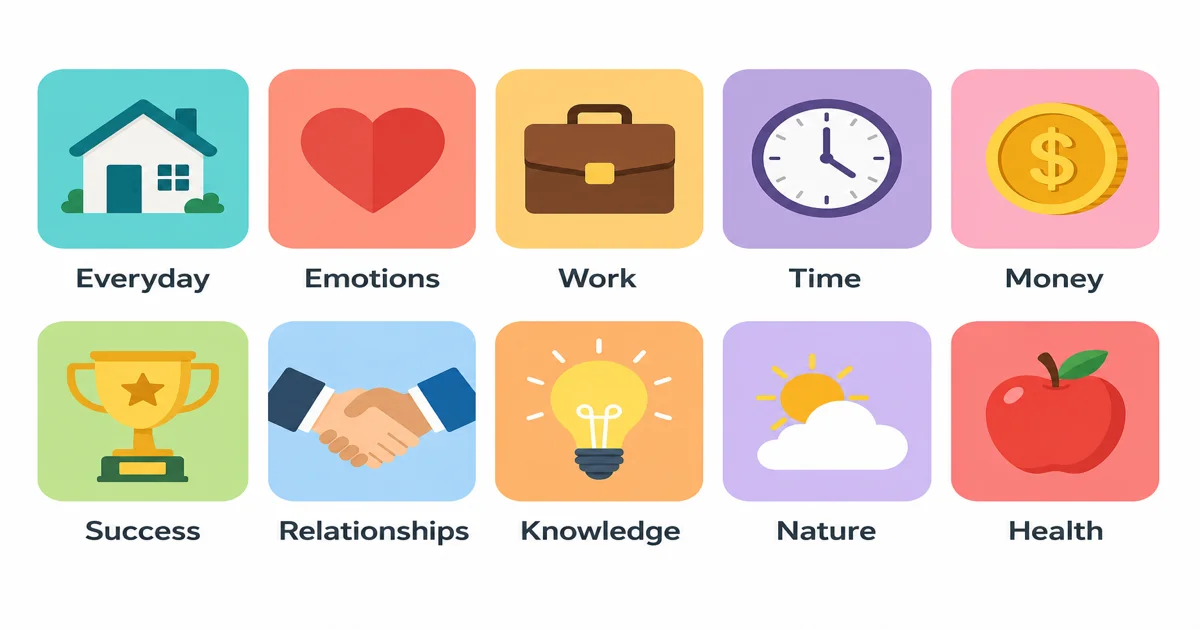
- Organizado por: 10 categorias temáticas
- Nível: A2–C1
- Para: preparação para exames, fluência e compreensão de falantes nativos
Para consultar uma referência completa com mais de 500 expressões, veja nosso guia completo de expressões idiomáticas em inglês.
Vida Cotidiana
Estas expressões aparecem na conversa do dia a dia mais do que quaisquer outras.
| # | Expressão idiomática | Significado | Exemplo |
|---|---|---|---|
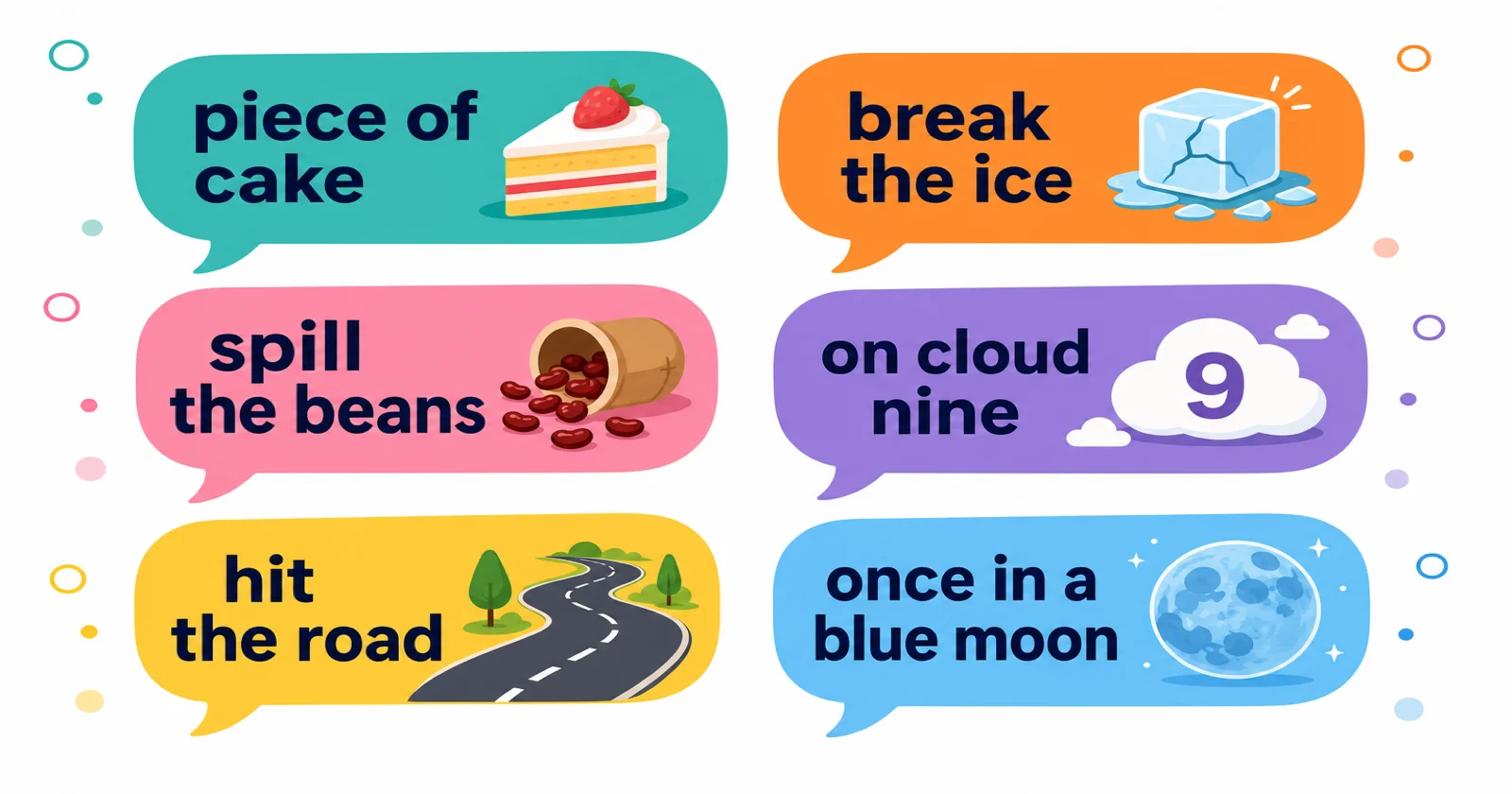
| 1 | a piece of cake | algo muito fácil | The driving test was a piece of cake — I passed on the first try. |
| 2 | break the ice | iniciar uma conversa em uma situação desconfortável | The team-building exercise helped break the ice on the first day. |
| 3 | hit the nail on the head | estar exatamente certo | You hit the nail on the head — that is exactly the problem. |
| 4 | under the weather | sentindo-se um pouco mal | I’m feeling a bit under the weather today, so I’ll work from home. |
| 5 | once in a blue moon | muito raramente | We only eat out once in a blue moon — maybe twice a year. |
| 6 | call it a day | parar de trabalhar no dia | We’ve been at this for eight hours — let’s call it a day. |
| 7 | the last straw | o problema final que causa uma reação | Being late again was the last straw — they fired him. |
| 8 | get out of hand | tornar-se incontrolável | The party got out of hand after midnight. |
| 9 | in the long run | ao longo de um longo período de tempo | Learning English is hard now, but it will pay off in the long run. |
| 10 | at the end of the day | no final das contas; quando tudo é considerado | At the end of the day, your health is more important than your job. |
| 11 | give it a shot | tentar algo | I’ve never tried skiing, but I’ll give it a shot. |
| 12 | a blessing in disguise | algo ruim que acaba sendo bom | Losing that job was a blessing in disguise — I found a much better one. |
| 13 | better late than never | é melhor fazer algo tarde do que não fazer | You finally finished the report? Well, better late than never. |
| 14 | bite off more than you can chew | assumir tarefas demais | She bit off more than she could chew by signing up for five courses. |
| 15 | burn the midnight oil | trabalhar muito tarde da noite | I’ve been burning the midnight oil to finish this project. |
| 16 | hit the road | partir; começar uma jornada | It’s getting late — we should hit the road. |
| 17 | on the same page | em concordância | Let’s make sure we’re all on the same page before the meeting. |
| 18 | the tip of the iceberg | uma pequena parte visível de um problema muito maior | The complaints we received are just the tip of the iceberg. |
| 19 | go the extra mile | fazer mais do que o esperado | She always goes the extra mile for her clients. |
| 20 | a no-brainer | uma decisão fácil | Taking the promotion was a no-brainer — better pay, better hours. |
Emoções e Sentimentos
As expressões idiomáticas são especialmente comuns quando falamos de sentimentos.
| # | Expressão idiomática | Significado | Exemplo |
|---|---|---|---|
| 21 | on cloud nine | extremamente feliz | She’s been on cloud nine since she got the job offer. |
| 22 | over the moon | encantado; extasiado | They were over the moon when they heard about the baby. |
| 23 | down in the dumps | sentindo-se triste ou deprimido | He’s been down in the dumps since his girlfriend left. |
| 24 | have butterflies in your stomach | sentir-se nervoso | I always have butterflies in my stomach before interviews. |
| 25 | get cold feet | ficar nervoso demais para fazer algo | He got cold feet and cancelled the presentation. |
| 26 | blow off steam | liberar estresse ou raiva | After a tough week, I blow off steam by going to the gym. |
| 27 | keep your chin up | manter-se positivo em uma situação difícil | I know you didn’t get the job, but keep your chin up. |
| 28 | on edge | nervoso e ansioso | Everyone has been on edge since the layoff announcements. |
| 29 | sick and tired | extremamente irritado; farto | I’m sick and tired of hearing excuses. |
| 30 | lose your temper | ficar com raiva | She rarely loses her temper, but today was an exception. |
| 31 | have a change of heart | mudar sua opinião ou decisão | He was going to sell the house, but he had a change of heart. |
| 32 | get something off your chest | falar sobre algo que estava te incomodando | I need to get this off my chest — I disagree with the plan. |
| 33 | bite your tongue | parar de dizer algo | I wanted to argue, but I bit my tongue. |
| 34 | cry over spilled milk | perder tempo lamentando algo que já aconteceu | The deadline passed — there’s no point crying over spilled milk. |
| 35 | drive someone up the wall | irritar muito alguém | That constant noise is driving me up the wall. |
| 36 | have a soft spot for | ter uma afeição especial por | She has a soft spot for stray animals. |
| 37 | wear your heart on your sleeve | mostrar suas emoções abertamente | He wears his heart on his sleeve — you always know how he feels. |
| 38 | a weight off your shoulders | um alívio após remover um fardo | Finishing the thesis was a huge weight off my shoulders. |
| 39 | jump for joy | estar extremamente feliz | When she heard the news, she literally jumped for joy. |
| 40 | scared stiff | extremamente assustado | I was scared stiff during the horror movie. |
Trabalho e Negócios
Essencial para contextos profissionais e exames de inglês de negócios como TOEIC.
| # | Expressão idiomática | Significado | Exemplo |
|---|---|---|---|
| 41 | back to square one | começar de novo desde o início | The client rejected our proposal, so it’s back to square one. |
| 42 | think outside the box | pensar de forma criativa | We need to think outside the box to solve this problem. |
| 43 | get the ball rolling | iniciar um processo | Let’s get the ball rolling on the new marketing campaign. |
| 44 | cut corners | fazer algo da forma mais fácil, sacrificando a qualidade | The builder cut corners on materials, and the roof leaked within a year. |
| 45 | in the loop | informado sobre algo | Please keep me in the loop about any changes to the schedule. |
| 46 | pull strings | usar conexões pessoais para conseguir algo | He pulled some strings to get his son the internship. |
| 47 | a game changer | algo que muda significativamente uma situação | Remote work was a game changer for employee satisfaction. |
| 48 | bring to the table | contribuir algo de valor | What skills do you bring to the table? |
| 49 | up in the air | incerto; ainda não decidido | The project timeline is still up in the air. |
| 50 | a win-win situation | um resultado que beneficia todos | The deal was a win-win — both companies increased their market share. |
| 51 | the bottom line | o fato mais importante | The bottom line is that we need to cut costs by 15%. |
| 52 | go back to the drawing board | começar a planejar novamente do zero | That approach failed completely — time to go back to the drawing board. |
| 53 | ahead of the curve | mais avançado do que os outros | Their use of AI puts them ahead of the curve in the industry. |
| 54 | call the shots | tomar as decisões | As team lead, you’ll be calling the shots on this project. |
| 55 | on the same wavelength | pensando da mesma forma | We finished each other’s sentences — we were on the same wavelength. |
| 56 | raise the bar | definir padrões mais altos | The new CEO raised the bar for product quality. |
| 57 | a steep learning curve | algo difícil de aprender a princípio | The new software has a steep learning curve, but it’s worth it. |
| 58 | touch base | fazer contato brevemente | Let’s touch base next week to check progress. |
| 59 | play it by ear | improvisar; decidir conforme o andamento | We don’t have a fixed agenda — let’s just play it by ear. |
| 60 | burn bridges | destruir relacionamentos ou oportunidades | Don’t burn bridges when you leave a job — you may need those contacts later. |
Tempo e Velocidade
| # | Expressão idiomática | Significado | Exemplo |
|---|---|---|---|
| 61 | in the nick of time | por muito pouco em tempo | The ambulance arrived in the nick of time. |
| 62 | time flies | o tempo passa rapidamente | I can’t believe it’s December already — time flies. |
| 63 | around the clock | 24 horas por dia; constantemente | The team worked around the clock to meet the deadline. |
| 64 | in a heartbeat | imediatamente; sem hesitação | I’d move to Japan in a heartbeat if I got the chance. |
| 65 | against the clock | com pressa; com tempo limitado | We’re working against the clock to finish before Friday. |
| 66 | behind the times | desatualizado; antiquado | Their marketing strategy is behind the times. |
| 67 | a matter of time | algo que inevitavelmente acontecerá | It’s only a matter of time before they find out. |
| 68 | from time to time | ocasionalmente | I still think about my old school friends from time to time. |
| 69 | kill time | fazer algo sem importância enquanto espera | I was just killing time at the airport, browsing the shops. |
| 70 | at the eleventh hour | no último momento | The agreement was reached at the eleventh hour. |
Dinheiro e Valor
| # | Expressão idiomática | Significado | Exemplo |
|---|---|---|---|
| 71 | cost an arm and a leg | ser muito caro | The car repair cost an arm and a leg. |
| 72 | break the bank | gastar mais do que pode pagar | A weekend trip doesn’t have to break the bank. |
| 73 | a rip-off | algo injustamente caro | $15 for a cup of coffee? That’s a rip-off. |
| 74 | make ends meet | ganhar apenas o suficiente para cobrir as despesas | After losing her job, she struggled to make ends meet. |
| 75 | save for a rainy day | poupar dinheiro para emergências futuras | My grandmother always told me to save for a rainy day. |
| 76 | worth its weight in gold | extremamente valioso ou útil | A good mentor is worth their weight in gold. |
| 77 | penny for your thoughts | perguntando o que alguém está pensando | You’ve been quiet all evening — penny for your thoughts? |
| 78 | pay through the nose | pagar demais | We paid through the nose for those concert tickets. |
| 79 | tighten your belt | gastar menos dinheiro | After the pay cut, the whole family had to tighten their belts. |
| 80 | money talks | a riqueza dá poder e influência às pessoas | He got the best lawyer — money talks. |
| 81 | foot the bill | pagar por algo | The company will foot the bill for the team dinner. |
| 82 | bring home the bacon | ganhar a renda doméstica | Both parents bring home the bacon in most families today. |
| 83 | go Dutch | dividir a conta igualmente | We always go Dutch when we eat out together. |
| 84 | put your money where your mouth is | apoiar suas palavras com ação | If you really believe in the idea, put your money where your mouth is. |
| 85 | a dime a dozen | muito comum e sem valor | Business ideas are a dime a dozen — execution is what matters. |
Sucesso e Fracasso
| # | Expressão idiomática | Significado | Exemplo |
|---|---|---|---|
| 86 | hit the jackpot | ter grande sucesso inesperado | We hit the jackpot with our new hire — she’s brilliant. |
| 87 | back to the drawing board | recomeçar depois de uma tentativa malsucedida | The experiment failed, so it’s back to the drawing board. |
| 88 | miss the boat | perder uma oportunidade | If you don’t apply this week, you’ll miss the boat. |
| 89 | a long shot | algo com poucas chances de dar certo | Getting into Harvard is a long shot, but worth trying. |
| 90 | break new ground | fazer algo inovador | The research team broke new ground in renewable energy. |
| 91 | on a roll | passar por uma sequência de sucessos | She’s won three games in a row — she’s on a roll. |
| 92 | the sky’s the limit | não há limite para o que pode ser alcançado | With your talent, the sky’s the limit. |
| 93 | throw in the towel | desistir | After three failed attempts, he threw in the towel. |
| 94 | come up short | não atingir uma meta | We came up short of our sales target by just 2%. |
| 95 | fall flat | fracassar completamente | The joke fell flat — nobody laughed. |
| 96 | have the upper hand | levar vantagem | With more experience, she has the upper hand in negotiations. |
| 97 | make or break | algo que determina o sucesso ou o fracasso | This presentation is make or break for the entire project. |
| 98 | from rags to riches | da pobreza à riqueza | Her from-rags-to-riches story inspired millions. |
| 99 | a hard nut to crack | um problema ou uma pessoa difícil | Getting planning permission was a hard nut to crack. |
| 100 | learn the ropes | aprender o básico de um novo trabalho ou atividade | It took me a few weeks to learn the ropes at the new office. |
Relacionamentos e Pessoas
| # | Expressão idiomática | Significado | Exemplo |
|---|---|---|---|
| 101 | see eye to eye | concordar completamente | My sister and I rarely see eye to eye on politics. |
| 102 | stab someone in the back | trair alguém | I trusted him, and he stabbed me in the back. |
| 103 | give someone the cold shoulder | ignorar deliberadamente alguém | After the argument, she gave me the cold shoulder for a week. |
| 104 | let someone off the hook | permitir que alguém escape da responsabilidade | The teacher let him off the hook for missing the deadline. |
| 105 | break the ice | aliviar a tensão em uma situação social | A simple joke can break the ice at a networking event. |
| 106 | hit it off | se dar bem imediatamente | We hit it off the moment we met at the conference. |
| 107 | go behind someone’s back | fazer algo em segredo, sem que alguém saiba | He went behind my back and complained to the manager. |
| 108 | the apple of someone’s eye | a pessoa favorita de alguém | Their granddaughter is the apple of their eye. |
| 109 | be on thin ice | estar em uma situação arriscada | You’re on thin ice with the boss after missing two deadlines. |
| 110 | bend over backwards | fazer um grande esforço para ajudar alguém | She bent over backwards to make the guests feel welcome. |
| 111 | birds of a feather | pessoas com interesses semelhantes | They’re both data nerds — birds of a feather. |
| 112 | bury the hatchet | encerrar um conflito; fazer as pazes | After years of rivalry, they finally buried the hatchet. |
| 113 | get on someone’s nerves | irritar alguém | His constant humming really gets on my nerves. |
| 114 | pull someone’s leg | brincar com alguém | Relax, I’m just pulling your leg — of course you passed. |
| 115 | a shoulder to cry on | alguém que ouve e oferece conforto | Everyone needs a shoulder to cry on sometimes. |
Conhecimento e Aprendizado
Estas expressões são especialmente úteis em contextos acadêmicos e em provas.
| # | Expressão idiomática | Significado | Exemplo |
|---|---|---|---|
| 116 | know something inside out | conhecer algo extremamente bem | She knows the company’s policies inside out. |
| 117 | pick someone’s brain | pedir o conhecimento ou o conselho de alguém | Can I pick your brain about investing? |
| 118 | a steep learning curve | situação em que é preciso aprender muita coisa rapidamente | Starting a new programming language is always a steep learning curve. |
| 119 | ring a bell | soar familiar | The name rings a bell, but I can’t remember where I heard it. |
| 120 | the penny dropped | entender algo de repente | I stared at the puzzle for an hour, and then the penny dropped. |
| 121 | do your homework | pesquisar e se preparar a fundo | Before the interview, do your homework on the company. |
| 122 | learn by heart | memorizar completamente | She learned the entire poem by heart. |
| 123 | a quick study | alguém que aprende rápido | He’s a quick study — he picked up the software in one day. |
| 124 | have a lot on your plate | ter muitas responsabilidades | She has a lot on her plate between work and evening classes. |
| 125 | food for thought | algo que vale a pena considerar seriamente | The lecture was food for thought — I’m reconsidering my approach. |
| 126 | think on your feet | tomar decisões rápidas sob pressão | Good managers need to think on their feet. |
| 127 | know the ropes | entender como as coisas funcionam | After six months, I finally know the ropes. |
| 128 | back to basics | voltar aos princípios fundamentais | The team needs to go back to basics and focus on quality. |
| 129 | read between the lines | entender o significado oculto | If you read between the lines, the email is actually a warning. |
| 130 | on the right track | estar progredindo na direção certa | Your essay is on the right track — just needs a stronger conclusion. |
Natureza e Clima
| # | Expressão idiomática | Significado | Exemplo |
|---|---|---|---|
| 131 | raining cats and dogs | chovendo muito forte | We can’t go out — it’s raining cats and dogs. |
| 132 | under the weather | sentindo-se um pouco doente | I’m a bit under the weather — I think I caught a cold. |
| 133 | a storm in a teacup | muito barulho por algo sem importância | The argument at the meeting was a storm in a teacup. |
| 134 | every cloud has a silver lining | algo bom pode surgir de toda situação ruim | I lost my job, but I found a better one — every cloud has a silver lining. |
| 135 | break the ice | aliviar a tensão no início de uma conversa | His joke broke the ice and everyone relaxed. |
| 136 | tip of the iceberg | pequena parte visível de um problema muito maior | The accounting errors are just the tip of the iceberg. |
| 137 | when it rains, it pours | os problemas tendem a surgir todos de uma vez | First the car broke down, then I lost my wallet — when it rains, it pours. |
| 138 | get wind of | ficar sabendo de algo, muitas vezes de um segredo | The press got wind of the merger before the official announcement. |
| 139 | a breath of fresh air | algo novo ou diferente que traz alívio | Her creative approach was a breath of fresh air for the team. |
| 140 | calm before the storm | período tranquilo antes de algo caótico | The office was quiet on Friday — it was the calm before the storm. |
| 141 | snowed under | extremamente ocupado; sobrecarregado de trabalho | I’m completely snowed under this week — can we meet next Monday? |
| 142 | nip something in the bud | impedir que um problema cresça | We need to nip this issue in the bud before it affects other departments. |
| 143 | come rain or shine | aconteça o que acontecer | I walk to work every day, come rain or shine. |
| 144 | twist someone’s arm | persuadir alguém a fazer algo que não quer | I didn’t want to go, but she twisted my arm. |
| 145 | beat around the bush | evitar falar sobre o assunto principal | Stop beating around the bush and tell me what happened. |
Ações e Decisões
| # | Expressão idiomática | Significado | Exemplo |
|---|---|---|---|
| 146 | take the plunge | fazer algo arriscado ou decisivo | After years of planning, she finally took the plunge and started her own business. |
| 147 | go the extra mile | fazer mais do que é exigido | He always goes the extra mile to satisfy customers. |
| 148 | cross that bridge when you come to it | lidar com um problema quando ele realmente acontecer | We might not get rejected — let’s cross that bridge when we come to it. |
| 149 | sleep on it | esperar até o dia seguinte antes de tomar uma decisão | That’s a big commitment — why don’t you sleep on it? |
| 150 | jump on the bandwagon | seguir uma tendência popular | Every company is jumping on the AI bandwagon right now. |
| 151 | turn over a new leaf | começar a se comportar melhor | After the warning, he promised to turn over a new leaf. |
| 152 | sit on the fence | evitar tomar uma decisão | Stop sitting on the fence and choose a direction. |
| 153 | take it with a grain of salt | não acreditar totalmente em algo | He exaggerates — take everything he says with a grain of salt. |
| 154 | put all your eggs in one basket | arriscar tudo em um único plano | Don’t put all your eggs in one basket — apply to several companies. |
| 155 | let the cat out of the bag | revelar acidentalmente um segredo | I was planning a surprise, but my brother let the cat out of the bag. |
| 156 | face the music | aceitar as consequências de suas ações | You made the mistake — now you have to face the music. |
| 157 | get your act together | se organizar; começar a agir com responsabilidade | If you want to pass the exam, you need to get your act together. |
| 158 | take the bull by the horns | enfrentar uma dificuldade de forma direta e corajosa | Instead of waiting, she took the bull by the horns and spoke to the director. |
| 159 | a taste of your own medicine | receber o mesmo tratamento ruim que você deu a alguém | He’s always late, so we left without him — a taste of his own medicine. |
| 160 | cut to the chase | ir direto ao ponto sem demora | Let’s cut to the chase — how much will it cost? |
Saúde e Corpo
| # | Expressão idiomática | Significado | Exemplo |
|---|---|---|---|
| 161 | in good shape | em boa forma física; indo bem | The economy is in good shape despite recent challenges. |
| 162 | a clean bill of health | confirmação de que alguém está saudável | The doctor gave her a clean bill of health. |
| 163 | feel on top of the world | sentir-se extremamente saudável e feliz | After the vacation, I feel on top of the world. |
| 164 | keep body and soul together | ganhar apenas o suficiente para sobreviver | During the recession, many families struggled to keep body and soul together. |
| 165 | back on your feet | recuperado de uma doença ou dificuldade | After six months of treatment, she’s back on her feet. |
| 166 | an apple a day keeps the doctor away | hábitos saudáveis ajudam a prevenir doenças | I eat fruit every morning — an apple a day keeps the doctor away. |
| 167 | burn the candle at both ends | trabalhar muito, descansando pouco | You’re burning the candle at both ends — you need to slow down. |
| 168 | alive and kicking | com boa saúde e ativo | She’s 90 years old and still alive and kicking. |
| 169 | at death’s door | extremamente doente | He looked like he was at death’s door, but he recovered completely. |
| 170 | break a leg | boa sorte (usado antes de uma apresentação) | You’re going on stage? Break a leg! |
Como Aprender Expressões Idiomáticas com Eficiência
Memorizar 200 expressões idiomáticas de uma vez não é realista. Veja uma abordagem prática:
Passo 1: Aprenda em grupos de 5–10
Escolha uma categoria temática desta lista (emoções, trabalho ou dinheiro) e estude de 5 a 10 expressões. Entenda o significado, leia o exemplo e escreva uma frase própria para cada uma.
Passo 2: Use repetição espaçada
Adicione as expressões ao seu dicionário do Linglify para revisá-las automaticamente. Elas são fáceis de esquecer porque não seguem os padrões habituais do vocabulário; por isso, a repetição espaçada é essencial.
Passo 3: Ouça para identificá-las
Assista a um filme ou série em inglês e tente identificar as expressões. Quando ouvir uma, pause e confira se entendeu o significado. Esse exercício treina sua capacidade de reconhecê-las na fala natural.
Passo 4: Use-as em conversa
Escolha de duas a três expressões por semana e use-as de propósito na fala ou na escrita. Usar uma expressão corretamente no contexto vale mais do que saber a definição de 50 que você nunca coloca em prática.
Erros comuns com expressões idiomáticas
- Traduzir expressões ao pé da letra. “Break a leg” não deve ser traduzida palavra por palavra. Aprenda a expressão como uma unidade, junto com o sentido que ela tem em inglês.
- Confundir expressões parecidas. “Hit the road” (ir embora) e “hit the books” (estudar bastante) têm formas semelhantes, mas significados bem diferentes.
- Usar expressões em excesso. Uma ou duas por parágrafo costumam soar naturais; cinco no mesmo parágrafo parecem forçadas. No IELTS Speaking, use no máximo uma ou duas por resposta.
- Usar o registro inadequado. Algumas expressões são informais (“no-brainer”, “rip-off”) e não combinam com textos acadêmicos formais. Outras, como “in the long run” e “the bottom line”, funcionam tanto em contextos formais quanto informais.
Para aprender a usar expressões idiomáticas em provas, veja nosso guia de expressões idiomáticas para o IELTS Speaking.
Palavras para Praticar
Estas 25 palavras aparecem com frequência junto de expressões idiomáticas no inglês natural. Adicione-as ao seu dicionário do Linglify para revisá-las com repetição espaçada.
boom
substantivo
explosão, auge
Exemplos
- The boom of thunder echoed across the valley.
- The technology boom created many new millionaires.
cooperate
verbo
cooperar, colaborar
evaluate
verbo
avaliar, julgar
Exemplos
- Companies evaluate job candidates based on experience, skills, and personality.
- Teachers evaluate student progress through tests, projects, and classroom participation.
graduate
verbo
se formar
Exemplos
- She will graduate from university next year with a degree in engineering.
- Students must complete all requirements before they can graduate from high school.
horizon
substantivo
horizonte
Exemplos
- The sun disappeared behind the horizon as evening approached.
- Traveling broadens your horizon and exposes you to new cultures.
indispensable
adjetivo
indispensável, essencial, fundamental
Exemplos
- Clean water is indispensable for human survival and good health.
- Her experience and skills make her indispensable to the research team.
jury
substantivo
juri
Exemplos
- The jury deliberated for several hours before reaching a verdict.
- The talent show jury consisted of professional musicians and entertainers.
lifelong
adjetivo
para toda a vida
Exemplos
- Learning is a lifelong process that never truly ends.
- Their lifelong friendship began during elementary school years.
motivated
adjetivo
motivado
Exemplos
- Motivated employee seeks additional responsibilities and challenges at work.
- Success requires being motivated even when facing difficult obstacles.
normally
advérbio
normalmente
Exemplos
- Heart normally beats between sixty and hundred times per minute.
- Students normally arrive at school before morning bell rings.
off
adjetivo
fora, desligado, apagado
Exemplos
- Please turn off the lights before leaving the room.
- The dog ran off into the forest chasing wild rabbits.
prejudice
substantivo
preconceito
Exemplos
- Education helps overcome prejudice and promotes understanding.
- Racial prejudice damages communities and individuals alike.
resolve
verbo
resolver
Exemplos
- Mediator helps parties resolve dispute through negotiation.
- Technical team will resolve software problems quickly.
stress
verbo
estressar, sobrecarregar, pressionar
Exemplos
- Heavy workload may stress employees beyond limits.
- Teacher will stress importance of homework completion.
total
adjetivo
total
Exemplos
- Total cost includes all fees and expenses.
- Total silence fills room during meditation session.
tragedy
substantivo
tragédia
Exemplos
- Natural tragedy affects thousands of innocent people.
- Personal tragedy changes person's life perspective completely.
union
substantivo
união, associação
Exemplos
- Labor union protects worker rights and interests.
- Marriage union joins two people in partnership.
voyage
substantivo
viagem
Exemplos
- Space exploration represents humanity's greatest voyage into the unknown.
- The ocean voyage from Europe to America took several weeks in the past.
candidate
substantivo
candidato
Exemplos
- Each presidential candidate presented their policy plans to voters.
- The job candidate impressed the interview panel with her experience.
discourage
verbo
desencorajar
Exemplos
- Don't let one failure discourage you from pursuing your dreams.
- High prices discourage many people from buying organic food products.
donate
verbo
doar
Exemplos
- Many people donate money to charities that help homeless individuals.
- She decided to donate blood to help patients in emergency situations.
firmly
advérbio
firmemente, com firmeza
Exemplos
- Hold the rope firmly while climbing down the steep mountain slope.
- The manager firmly believed in treating all employees with respect.
guide
verbo
orientar
Exemplos
- Parents should guide their children to make responsible decisions.
- The experienced hiker will guide the group through the mountain trail safely.
humorous
adjetivo
engraçado, divertido, cômico
Exemplos
- She writes humorous articles about everyday life and family experiences.
- The humorous speech made everyone laugh and lightened the serious mood.
admission
substantivo
admissão
Exemplos
- Her admission to the prestigious medical school was the result of hard work.
- The museum offers free admission on the first Sunday of every month.
O Que Fazer a Seguir
- Escolha uma categoria acima e aprenda 10 expressões nesta semana. Escreva uma frase de exemplo própria para cada uma.
- Adicione suas favoritas ao Linglify para revisão espaçada. Marque-as com a etiqueta “expressões idiomáticas” para revisar essa categoria em conjunto.
- Leia o guia completo de expressões idiomáticas — nosso Guia de Expressões Idiomáticas em Inglês: mais de 500 expressões aborda cada categoria principal em detalhes.
- Pratique com conteúdo de prova — se estiver se preparando para o IELTS, nosso guia de expressões idiomáticas para o IELTS Speaking mostra como usá-las para alcançar uma pontuação mais alta.
- Explore vocabulário relacionado — expressões idiomáticas são apenas uma parte do inglês natural. Veja nossos guias de phrasal verbs, collocations e sinônimos e antônimos.
FAQ
O que é uma expressão idiomática? Pode dar um exemplo?
Uma expressão idiomática é uma expressão fixa cujo sentido não pode ser deduzido apenas de suas palavras. Por exemplo, “break the ice” não significa literalmente quebrar gelo: quer dizer começar uma conversa em uma situação desconfortável. Exemplo: “The host told a joke to break the ice at the party.” A característica principal é que a expressão completa tem um sentido diferente do significado literal de cada palavra.
Quais são as 10 expressões idiomáticas mais comuns em inglês?
Entre as expressões mais usadas no inglês do dia a dia estão: (1) a piece of cake (algo fácil), (2) break the ice (quebrar o gelo), (3) hit the nail on the head (acertar em cheio), (4) under the weather (sentir-se indisposto), (5) once in a blue moon (muito raramente), (6) call it a day (encerrar o trabalho), (7) in the long run (a longo prazo), (8) the last straw (a gota d’água), (9) on the same page (estar de acordo) e (10) a no-brainer (uma decisão óbvia).
Quantas expressões idiomáticas existem em inglês?
Estima-se que o inglês tenha mais de 25 mil expressões idiomáticas. No entanto, a maioria dos falantes nativos usa ativamente apenas de 200 a 500 no dia a dia. Para quem está aprendendo, conhecer de 100 a 200 expressões comuns costuma ser suficiente para entender a maioria das conversas e ter um bom desempenho em provas. Nosso guia completo de expressões idiomáticas reúne mais de 500 das mais importantes.
Como posso aprender expressões idiomáticas rapidamente?
A abordagem mais rápida combina três técnicas: (1) aprenda expressões por tema — por exemplo, todas as relacionadas a dinheiro ou trabalho — para criar associações mentais; (2) use a repetição espaçada para revisá-las em intervalos cada vez maiores; e (3) pratique usando duas ou três por semana na fala ou na escrita. Aprender pelo contexto é de três a quatro vezes mais eficaz do que apenas ler definições.
Devo usar expressões idiomáticas no IELTS Writing?
Use expressões idiomáticas com moderação no IELTS Writing: no máximo uma ou duas por redação, e somente quando soarem naturais. A prova valoriza a linguagem acadêmica formal, e muitas expressões são informais demais (como “a piece of cake” e “go bananas”). Opções mais seguras incluem “in the long run”, “the tip of the iceberg” e “a double-edged sword”, que também podem ser usadas em contextos acadêmicos. No IELTS Speaking, as expressões são mais apropriadas: use uma ou duas por resposta para demonstrar naturalidade.
Qual é a diferença entre expressões idiomáticas e phrasal verbs?
Expressões idiomáticas são combinações fixas com sentido não literal (“kick the bucket” = morrer). Phrasal verbs são combinações de verbo e partícula que ganham um novo significado (“give up” = desistir). As categorias se sobrepõem: alguns phrasal verbs são idiomáticos (“come across” = encontrar por acaso), e algumas expressões idiomáticas contêm phrasal verbs. Na prática, phrasal verbs seguem regras gramaticais e podem ser conjugados (“gave up”, “giving up”), enquanto expressões idiomáticas costumam ser frases fixas que não podem ser modificadas.