
Exemplos de Phrasal Verbs: 200 Frases para Todos os Níveis
Definições dizem o que um phrasal verb significa. Exemplos mostram como ele realmente funciona. Há uma razão pela qual todo livro de gramática inclui frases de exemplo — ver um phrasal verb em contexto revela sua gramática (separável ou não?), seu registro (formal ou casual?) e suas colocações naturais (quais substantivos e situações combinam com ele?).
Este guia oferece 200 exemplos de phrasal verbs em frases completas e naturais. As frases são organizadas por nível CEFR — dos básicos A2 como “wake up” e “turn off” às expressões C1 como “play down” e “phase out”. Cada entrada inclui o significado, uma frase clara e uma nota de uso quando útil.
Use isso como referência ao escrever, uma lista de estudo para construir confiança ou uma fonte de padrões naturais para absorver. Quanto mais frases de exemplo você ler e repetir, mais naturalmente os phrasal verbs virão a você.
- Total de exemplos: 200 frases
- Níveis cobertos: A2, B1, B2, C1
- Formato: Phrasal verb → significado → frase de exemplo
- Ideal para: aprendizes que conhecem definições, mas têm dificuldade em usar phrasal verbs naturalmente
Para definições e explicações detalhadas de cada phrasal verb, veja o Guia Completo de Phrasal Verbs em Inglês. Para phrasal verbs agrupados por verbo base, veja Phrasal Verbs com GET ou Phrasal Verbs com MAKE.
Como Usar Estes Exemplos
Ler frases de exemplo passivamente ajuda, mas a prática ativa constrói fluência real. Veja como aproveitar ao máximo esta lista:
- Leia a frase em voz alta. Pronúncia e ritmo importam. Phrasal verbs soam diferentes de suas palavras individuais — “pick UP” tem ênfase diferente de “pick” + “up” ditos separadamente.
- Cubra o significado e tente adivinhar pelo contexto. Teste a si mesmo. Se você consegue entender a frase sem a definição, está progredindo.
- Escreva sua própria versão. Substitua os substantivos e detalhes pela sua própria vida. “She turned down the job offer” → “I turned down the invitation to the party.” Frases pessoais ficam mais fáceis de memorizar.
- Observe a gramática. O objeto fica entre o verbo e a partícula (separável) ou depois (inseparável)? Isso mostra como formar suas próprias frases corretamente.
Nível A2: Phrasal Verbs Básicos (50 Exemplos)
Estes são os phrasal verbs que todo aprendiz encontra primeiro. Eles descrevem rotinas diárias, ações básicas e interações simples.
Rotinas Diárias
| # | Phrasal Verb | Significado | Frase de Exemplo |
|---|---|---|---|
| 1 | wake up | parar de dormir | I wake up at 7 every morning, even on weekends. |
| 2 | get up | levantar da cama | She got up immediately when the alarm rang. |
| 3 | put on | colocar uma roupa no corpo | He put on his coat and went outside. |
| 4 | take off | tirar roupa | Please take off your shoes at the door. |
| 5 | turn on | ativar um dispositivo | Can you turn on the light? It’s getting dark. |
| 6 | turn off | desativar um dispositivo | Turn off the TV — dinner is ready. |
| 7 | go out | sair de casa | We usually go out on Friday evenings. |
| 8 | come back | retornar | She went to the store and came back in ten minutes. |
| 9 | sit down | sentar | Please sit down. The meeting will start soon. |
| 10 | stand up | levantar-se | Everyone stood up when the teacher entered. |
Ações Básicas
| # | Phrasal Verb | Significado | Frase de Exemplo |
|---|---|---|---|
| 11 | pick up | pegar algo de uma superfície | He picked up the phone and called his mother. |
| 12 | put down | colocar algo em uma superfície | She put down her bag and sat on the sofa. |
| 13 | throw away | jogar no lixo | Don’t throw away that box — I need it. |
| 14 | give back | devolver algo para alguém | Can you give back my pen when you’re finished? |
| 15 | look for | tentar encontrar | I’m looking for my keys. Have you seen them? |
| 16 | find out | descobrir informações | I found out that the store closes at 9 PM. |
| 17 | write down | anotar no papel | Write down the address so you don’t forget it. |
| 18 | fill in | preencher um formulário | Please fill in your name and email address. |
| 19 | hand in | entregar | Students must hand in their homework by Friday. |
| 20 | try on | experimentar roupa | She tried on three dresses before choosing one. |
Comunicação e Pessoas
| # | Phrasal Verb | Significado | Frase de Exemplo |
|---|---|---|---|
| 21 | call back | retornar uma ligação | He’s busy right now. Can he call you back in an hour? |
| 22 | hang up | encerrar uma chamada | She said goodbye and hung up. |
| 23 | look after | cuidar de | My neighbor looks after our cat when we travel. |
| 24 | get along | ter um bom relacionamento | The new employee gets along with everyone in the office. |
| 25 | grow up | tornar-se adulto | She grew up in a small town near the coast. |
| 26 | ask for | solicitar | He asked for a glass of water. |
| 27 | talk about | discutir | We talked about the problem for over an hour. |
| 28 | wait for | aguardar alguém/algo chegar | I waited for the bus for twenty minutes in the rain. |
| 29 | listen to | prestar atenção ao som | She listens to podcasts every morning on her commute. |
| 30 | belong to | ser propriedade de | This laptop belongs to the company, not to me. |
Movimento e Direção
| # | Phrasal Verb | Significado | Frase de Exemplo |
|---|---|---|---|
| 31 | come in | entrar | Come in! The door is open. |
| 32 | go away | partir, ir embora | The headache went away after I took medicine. |
| 33 | get on | embarcar (ônibus, trem, avião) | We got on the bus at the Central Station stop. |
| 34 | get off | descer de um veículo | Get off at the next stop — that’s the city center. |
| 35 | get in | entrar em um carro ou táxi | She got in the taxi and told the driver the address. |
| 36 | get out | sair de um carro ou espaço pequeno | He got out of the car and walked to the building. |
| 37 | run away | escapar correndo | The cat ran away when it heard the thunder. |
| 38 | fall down | cair no chão | The child fell down but got up without crying. |
| 39 | move in | começar a morar em um novo lugar | They moved in last weekend and are still unpacking. |
| 40 | move out | sair de casa permanentemente | He moved out of his parents’ house at 18. |
Tempo e Rotina
| # | Phrasal Verb | Significado | Frase de Exemplo |
|---|---|---|---|
| 41 | hurry up | fazer algo mais rápido | Hurry up! The movie starts in five minutes. |
| 42 | slow down | reduzir a velocidade | The driver slowed down when he saw the school. |
| 43 | carry on | continuar | Carry on reading — I didn’t mean to interrupt. |
| 44 | go on | continuar, acontecer | What’s going on? I heard a loud noise. |
| 45 | end up | finalmente estar em uma situação | We got lost and ended up in the wrong part of town. |
| 46 | set up | preparar, organizar | They set up the chairs for the presentation. |
| 47 | clean up | arrumar um lugar | We need to clean up before the guests arrive. |
| 48 | use up | consumir completamente | We used up all the milk — someone needs to buy more. |
| 49 | run out | ficar sem algo | We ran out of coffee, so I’m drinking tea today. |
| 50 | show up | chegar, aparecer | He showed up 20 minutes late to the meeting. |
Nível B1: Phrasal Verbs Intermediários (50 Exemplos)
No B1, os phrasal verbs tornam-se mais abstratos. Os significados são mais difíceis de deduzir a partir das palavras isoladas, e muitos têm vários sentidos.
Trabalho e Produtividade
| # | Phrasal Verb | Significado | Frase de Exemplo |
|---|---|---|---|
| 51 | take over | assumir o controle | She took over as team leader when Mark resigned. |
| 52 | set up | estabelecer, iniciar (um negócio) | He set up his own company after years of working for others. |
| 53 | carry out | realizar, completar (uma tarefa) | The researchers carried out experiments for six months. |
| 54 | deal with | lidar com, gerenciar | She deals with customer complaints every day. |
| 55 | put off | adiar | They put off the decision until next week. |
| 56 | come up with | pensar em, inventar | He came up with a brilliant idea during the meeting. |
| 57 | figure out | entender após pensar | I can’t figure out how to use this software. |
| 58 | keep up with | manter o mesmo ritmo | It’s hard to keep up with all the changes in technology. |
| 59 | work out | calcular; exercitar; ter sucesso | We need to work out the total cost before signing the contract. |
| 60 | take on | aceitar (uma responsabilidade) | She took on extra work to save money for the trip. |
Relacionamentos e Vida Social
| # | Phrasal Verb | Significado | Frase de Exemplo |
|---|---|---|---|
| 61 | break up | terminar um relacionamento | They broke up after three years together. |
| 62 | make up | reconciliar após uma discussão | They argued all morning but made up before dinner. |
| 63 | get together | se reunir socialmente | Let’s get together for coffee this weekend. |
| 64 | look up to | admirar, respeitar | She looks up to her grandmother as a role model. |
| 65 | let down | decepcionar | I trusted him, and he let me down. |
| 66 | put up with | tolerar | I can’t put up with this noise anymore. |
| 67 | fall out | ter uma discussão, deixar de ser amigos | They fell out over money and haven’t spoken since. |
| 68 | bring up | mencionar um assunto; criar uma criança | Don’t bring up politics at the dinner table. |
| 69 | turn out | resultar, acontecer no final | The party turned out to be much better than I expected. |
| 70 | cheer up | ficar mais feliz, animar alguém | She bought him flowers to cheer him up after the bad news. |
Aprendizado e Compreensão
| # | Phrasal Verb | Significado | Frase de Exemplo |
|---|---|---|---|
| 71 | look up | buscar informações | I looked up the word in the dictionary. |
| 72 | find out | descobrir | She found out that her flight was canceled only at the airport. |
| 73 | go over | revisar, examinar | Let’s go over the plan one more time before we start. |
| 74 | point out | chamar atenção para algo | My teacher pointed out several errors in my essay. |
| 75 | make sense | ser lógico, compreensível | This explanation doesn’t make sense to me at all. |
| 76 | pick up | aprender informalmente | He picked up some Spanish while living in Barcelona. |
| 77 | catch on | começar a entender | The new system is complex, but most people catch on quickly. |
| 78 | mix up | confundir uma coisa com outra | I always mix up “affect” and “effect.” |
| 79 | come across | encontrar por acaso | I came across an interesting article while browsing online. |
| 80 | think over | considerar cuidadosamente | I need to think it over before making a decision. |
Mudanças de Vida e Decisões
| # | Phrasal Verb | Significado | Frase de Exemplo |
|---|---|---|---|
| 81 | give up | parar de tentar; abandonar um hábito | He gave up smoking three years ago. |
| 82 | turn down | rejeitar, recusar | She turned down the job offer because the salary was too low. |
| 83 | take up | começar um novo hobby ou atividade | I took up running during the pandemic and still do it. |
| 84 | drop out | sair da escola ou de um curso | He dropped out of university to start a business. |
| 85 | sign up | se registrar, se inscrever | Over 500 people signed up for the online course. |
| 86 | go ahead | prosseguir, começar | The project was approved — we can go ahead with construction. |
| 87 | hold on | esperar um momento | Hold on — I’ll check the schedule and call you back. |
| 88 | come up | surgir, aparecer inesperadamente | Something came up at work, so I’ll be late tonight. |
| 89 | sort out | organizar, resolver | We need to sort out the accommodation before the trip. |
| 90 | get over | se recuperar de | It took her weeks to get over the flu this winter. |
Situações do Dia a Dia
| # | Phrasal Verb | Significado | Frase de Exemplo |
|---|---|---|---|
| 91 | run into | encontrar por acaso | I ran into my old teacher at the supermarket yesterday. |
| 92 | look forward to | sentir entusiasmo por um evento futuro | I’m looking forward to the holiday — I need a break. |
| 93 | cut down on | reduzir a quantidade | The doctor told him to cut down on sugar and salt. |
| 94 | get rid of | eliminar, jogar fora | We got rid of the old sofa and bought a new one. |
| 95 | put away | guardar no lugar correto | Please put away your toys before dinner. |
| 96 | check in | fazer check-in em hotel ou aeroporto | We checked in at the hotel at around 3 PM. |
| 97 | check out | sair de um hotel; examinar | We need to check out by 11 AM tomorrow. |
| 98 | come along | progredir; acompanhar | How is your English coming along? |
| 99 | calm down | ficar menos chateado ou animado | Calm down — getting angry won’t solve anything. |
| 100 | break down | parar de funcionar (máquina) | Our car broke down on the highway during the trip. |
Nível B2: Phrasal Verbs Intermediário-Avançado (50 Exemplos)
No B2, os phrasal verbs tornam-se mais idiomáticos. Muitos têm significados figurados que diferem bastante do sentido literal das palavras.
Profissional e Acadêmico
| # | Phrasal Verb | Significado | Frase de Exemplo |
|---|---|---|---|
| 101 | draw up | preparar um documento formal | The lawyers drew up a new contract with revised terms. |
| 102 | lay off | demitir | The company laid off 200 workers due to falling revenue. |
| 103 | take into account | considerar como fator | You need to take into account the cost of shipping when pricing products. |
| 104 | rule out | eliminar como possibilidade | The police have not ruled out foul play in the investigation. |
| 105 | account for | explicar; representar uma proporção | Online sales account for 40% of the company’s revenue. |
| 106 | bring about | causar | The new policy brought about significant changes in working conditions. |
| 107 | follow up | continuar a investigar ou seguir | I’ll follow up with the supplier next week about the delivery date. |
| 108 | come up against | enfrentar uma dificuldade | We came up against several technical problems during testing. |
| 109 | call off | cancelar | They called off the outdoor event because of the storm warning. |
| 110 | hand over | transferir controle ou posse | She handed over her responsibilities to her replacement before leaving. |
Pensamento e Tomada de Decisões
| # | Phrasal Verb | Significado | Frase de Exemplo |
|---|---|---|---|
| 111 | narrow down | reduzir opções para uma lista menor | We’ve narrowed down the candidates to three finalists. |
| 112 | weigh up | considerar prós e contras | He spent days weighing up whether to accept the transfer. |
| 113 | talk into | persuadir alguém a fazer algo | She talked me into running the marathon with her. |
| 114 | talk out of | persuadir alguém a não fazer algo | His friends talked him out of quitting his job impulsively. |
| 115 | go through with | completar algo apesar das dificuldades | She was nervous but went through with the presentation anyway. |
| 116 | back out of | retirar-se de um compromisso | They backed out of the deal at the last minute. |
| 117 | look into | investigar | The manager promised to look into the customer’s complaint. |
| 118 | open up | tornar-se disposto a compartilhar sentimentos | He finally opened up about the stress he’d been feeling at work. |
| 119 | come around | mudar de ideia; recuperar a consciência | She was against the idea at first but eventually came around. |
| 120 | work through | lidar com algo sistematicamente | They worked through their disagreements with the help of a mediator. |
Comunicação e Expressão
| # | Phrasal Verb | Significado | Frase de Exemplo |
|---|---|---|---|
| 121 | speak up | falar mais alto; expressar uma opinião | If you disagree, you should speak up during the meeting. |
| 122 | bring up | levantar um assunto em conversa | She brought up an interesting point about the budget. |
| 123 | get across | comunicar com sucesso | He tried to get his point across, but nobody was listening. |
| 124 | brush off | dispensar como sem importância | She brushed off the criticism and continued with her plan. |
| 125 | turn to | buscar ajuda de | When things got difficult, she turned to her family for support. |
| 126 | pass on | compartilhar informações com outros | Could you pass on the message to everyone in the team? |
| 127 | take back | retratar uma declaração | I take back what I said — you were completely right. |
| 128 | cut in | interromper uma conversa | He cut in before she could finish explaining her idea. |
| 129 | go into | discutir em detalhes | I won’t go into all the reasons now — we can talk later. |
| 130 | sum up | resumir | To sum up, we need to reduce costs and increase sales. |
Mudança e Desenvolvimento
| # | Phrasal Verb | Significado | Frase de Exemplo |
|---|---|---|---|
| 131 | build up | aumentar gradualmente | She built up her savings over five years before buying the apartment. |
| 132 | break through | alcançar apesar dos obstáculos | After months of research, the team finally broke through with a solution. |
| 133 | set back | atrasar o progresso | The funding problem set the project back by three months. |
| 134 | cut back | reduzir gastos ou consumo | The government cut back on education funding this year. |
| 135 | branch out | expandir para novas áreas | The restaurant branched out into catering for corporate events. |
| 136 | phase in | introduzir gradualmente | The company is phasing in a new remote work policy over six months. |
| 137 | wind down | reduzir gradualmente a atividade; relaxar | The conference was winding down, and people started leaving. |
| 138 | step down | renunciar a uma posição | The CEO stepped down after 15 years leading the company. |
| 139 | scale up | aumentar em tamanho ou escopo | They scaled up production to meet the sudden demand. |
| 140 | hold back | impedir o progresso; conter | Fear of failure held her back from applying for the promotion. |
Emoções e Comportamento
| # | Phrasal Verb | Significado | Frase de Exemplo |
|---|---|---|---|
| 141 | bottle up | suprimir emoções | He bottles up his feelings and never talks about what’s bothering him. |
| 142 | lash out | atacar verbalmente ou fisicamente | She lashed out at her colleague after a stressful morning. |
| 143 | pull through | sobreviver a uma situação difícil | The patient was critical but pulled through after surgery. |
| 144 | burn out | ficar exausto por excesso de trabalho | She burned out after working 70-hour weeks for six months straight. |
| 145 | snap out of | se forçar a sair de um estado negativo | He told himself to snap out of it and focus on the solution. |
| 146 | live up to | atender às expectativas | The film didn’t live up to the hype — it was disappointing. |
| 147 | own up to | admitir responsabilidade | Nobody owned up to breaking the window in the office. |
| 148 | play along | fingir concordar ou cooperar | She didn’t believe his excuse but played along to avoid conflict. |
| 149 | wear off | desaparecer gradualmente (efeito) | The excitement of the new job wore off after a few months. |
| 150 | get away with | evitar punição | He was late every day and somehow got away with it for months. |
Nível C1: Phrasal Verbs Avançados (50 Exemplos)
Esses phrasal verbs aparecem na escrita acadêmica, em contextos profissionais e na fala sofisticada. Eles mostram que você é um falante de inglês confiante e capaz de se expressar com nuances.
Negócios e Estratégia
| # | Phrasal Verb | Significado | Frase de Exemplo |
|---|---|---|---|
| 151 | buy out | comprar a parte de alguém em um negócio | The partners disagreed, so one bought the other out for $2 million. |
| 152 | bail out | resgatar financeiramente | The government bailed out the failing bank to prevent economic collapse. |
| 153 | cash in on | lucrar com uma situação | Competitors were quick to cash in on the company’s PR disaster. |
| 154 | ramp up | aumentar rapidamente | They ramped up marketing spending ahead of the product launch. |
| 155 | phase out | descontinuar gradualmente | The manufacturer is phasing out the old model by the end of the year. |
| 156 | pencil in | agendar provisoriamente | Let’s pencil in Thursday for the review — we can confirm later. |
| 157 | hammer out | negociar com dificuldade | The two sides hammered out an agreement after twelve hours of talks. |
| 158 | sign off on | dar aprovação formal | The director still hasn’t signed off on the revised budget. |
| 159 | factor in | incluir como consideração | You need to factor in inflation when planning your retirement savings. |
| 160 | iron out | resolver pequenos problemas | We need to iron out the details before presenting to the board. |
Comunicação Sutil
| # | Phrasal Verb | Significado | Frase de Exemplo |
|---|---|---|---|
| 161 | play down | fazer algo parecer menos importante | The spokesperson played down the severity of the data breach. |
| 162 | talk down to | falar de forma condescendente | She hated how her manager talked down to her in front of clients. |
| 163 | come out with | dizer algo surpreendente | He came out with the most bizarre excuse anyone had ever heard. |
| 164 | own up | admitir culpa | After a week of denials, the politician finally owned up to the mistake. |
| 165 | water down | enfraquecer, tornar menos eficaz | Critics accused the government of watering down the environmental regulations. |
| 166 | gloss over | evitar discutir em detalhes | The report glossed over the safety concerns raised by engineers. |
| 167 | spell out | explicar muito claramente | Let me spell out exactly what will happen if we miss the deadline. |
| 168 | fend off | defender contra, resistir | The company fended off a hostile takeover attempt from a larger rival. |
| 169 | put forward | propor, sugerir formalmente | She put forward a radical plan to restructure the entire department. |
| 170 | touch on | mencionar brevemente | The speaker touched on climate change but didn’t go into detail. |
Análise e Raciocínio
| # | Phrasal Verb | Significado | Frase de Exemplo |
|---|---|---|---|
| 171 | boil down to | reduzir ao ponto essencial | The whole argument boils down to one question: who pays? |
| 172 | stem from | originar-se, ser causado por | Most of the delays stem from poor planning in the early stages. |
| 173 | hinge on | depender inteiramente de | The success of the project hinges on securing funding by March. |
| 174 | pan out | desenvolver-se, resultar | We’ll have to wait and see how the new strategy pans out. |
| 175 | stack up | comparar com algo | How does our proposal stack up against the competition? |
| 176 | flesh out | adicionar detalhes a uma ideia | The concept is good — now we need to flesh out the implementation plan. |
| 177 | zero in on | focar-se estreitamente em uma coisa | The investigators zeroed in on a discrepancy in the financial records. |
| 178 | piece together | entender combinando fragmentos | Detectives pieced together what happened from CCTV footage and witness statements. |
| 179 | rule out | excluir como possibilidade | Doctors ruled out serious illness but ordered further tests. |
| 180 | map out | planejar em detalhes | She mapped out her career goals for the next five years. |
Sociedade e Mudança
| # | Phrasal Verb | Significado | Frase de Exemplo |
|---|---|---|---|
| 181 | crack down on | aplicar regras mais rigorosamente | The authorities cracked down on illegal parking near schools. |
| 182 | clamp down on | tomar medidas fortes para parar | The platform clamped down on fake accounts spreading misinformation. |
| 183 | stand for | representar; tolerar | What does this abbreviation stand for? |
| 184 | stamp out | eliminar completamente | The campaign aims to stamp out bullying in schools. |
| 185 | cave in | ceder sob pressão | After weeks of protests, the council caved in and reversed the decision. |
| 186 | opt out of | escolher não participar | More families are opting out of traditional schooling. |
| 187 | usher in | introduzir, marcar o início de | The invention of the internet ushered in a new era of communication. |
| 188 | die down | tornar-se gradualmente menos intenso | The controversy eventually died down after the company issued an apology. |
| 189 | crop up | aparecer de forma súbita e inesperada | Problems keep cropping up whenever we try to launch the feature. |
| 190 | fall through | falhar em acontecer como planejado | The acquisition fell through because the two companies couldn’t agree on price. |
Pessoal e Emocional (Avançado)
| # | Phrasal Verb | Significado | Frase de Exemplo |
|---|---|---|---|
| 191 | draw on | usar como recurso | She drew on her years of experience to handle the crisis calmly. |
| 192 | measure up | atender a um padrão exigido | He constantly felt he didn’t measure up to his parents’ expectations. |
| 193 | see through | reconhecer um engano | She saw through his apology immediately — it wasn’t sincere. |
| 194 | come to terms with | aceitar algo difícil | It took him months to come to terms with the loss. |
| 195 | dwell on | pensar sobre algo negativo por muito tempo | Don’t dwell on past mistakes — focus on what you can do now. |
| 196 | wear down | enfraquecer a resistência ao longo do tempo | Constant criticism from her boss gradually wore her down. |
| 197 | fall back on | depender de quando nada mais funciona | If the business fails, at least he has his engineering degree to fall back on. |
| 198 | write off | dispensar como sem importância ou sem esperança | Critics wrote off the startup, but it’s now worth $500 million. |
| 199 | turn around | mudar de ruim para bom | The new CEO managed to turn the company around in just two years. |
| 200 | pay off | produzir bons resultados após esforço | All those late nights studying finally paid off — she got the highest score. |
Padrões que Você Deve Notar
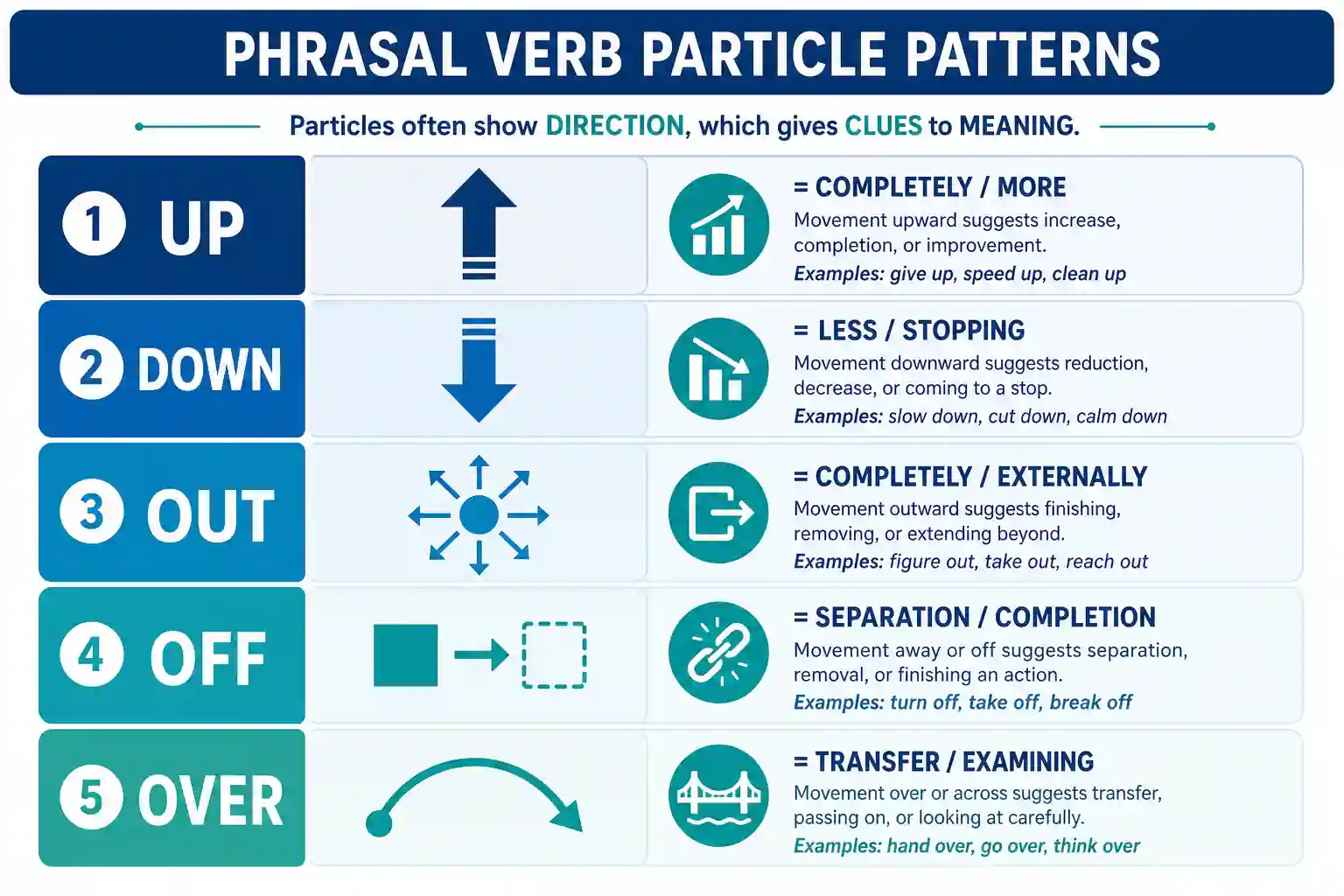
Após ler 200 exemplos, certos padrões ficam claros. Esses padrões ajudam você a entender novos phrasal verbs sem precisar consultá-los.
UP Frequentemente Significa “Completamente” ou “Mais”
| Phrasal Verb | O que UP adiciona |
|---|---|
| clean up | limpar completamente |
| use up | usar completamente (sem sobras) |
| build up | aumentar gradualmente |
| hurry up | aumentar a velocidade |
| speak up | falar mais alto / com mais ousadia |
DOWN Frequentemente Significa “Menos” ou “Parar Completamente”
| Phrasal Verb | O que DOWN adiciona |
|---|---|
| slow down | reduzir a velocidade |
| cut down | reduzir a quantidade |
| break down | parar de funcionar completamente |
| calm down | ficar menos agitado |
| wind down | parar gradualmente |
OUT Frequentemente Significa “Completamente” ou “Para Fora”
| Phrasal Verb | O que OUT adiciona |
|---|---|
| find out | descobrir (a informação vem à tona) |
| work out | resolver completamente |
| phase out | retirar completamente, de forma gradual |
| spell out | explicar de forma completa e clara |
| burn out | esgotar completamente |
OFF Frequentemente Significa “Separação” ou “Conclusão”
| Phrasal Verb | O que OFF adiciona |
|---|---|
| call off | cancelar (separar do plano) |
| pay off | alcançar um resultado (a dívida é quitada) |
| brush off | dispensar (afastar) |
| wear off | desaparecer gradualmente |
| lay off | demitir do emprego |
OVER Frequentemente Significa “Transferência” ou “Análise”
| Phrasal Verb | O que OVER adiciona |
|---|---|
| take over | transferir o controle |
| hand over | transferir a posse |
| go over | examinar cuidadosamente |
| think over | considerar com cuidado |
| get over | superar (passar para além de algo) |
Separável vs. Inseparável: Referência Rápida
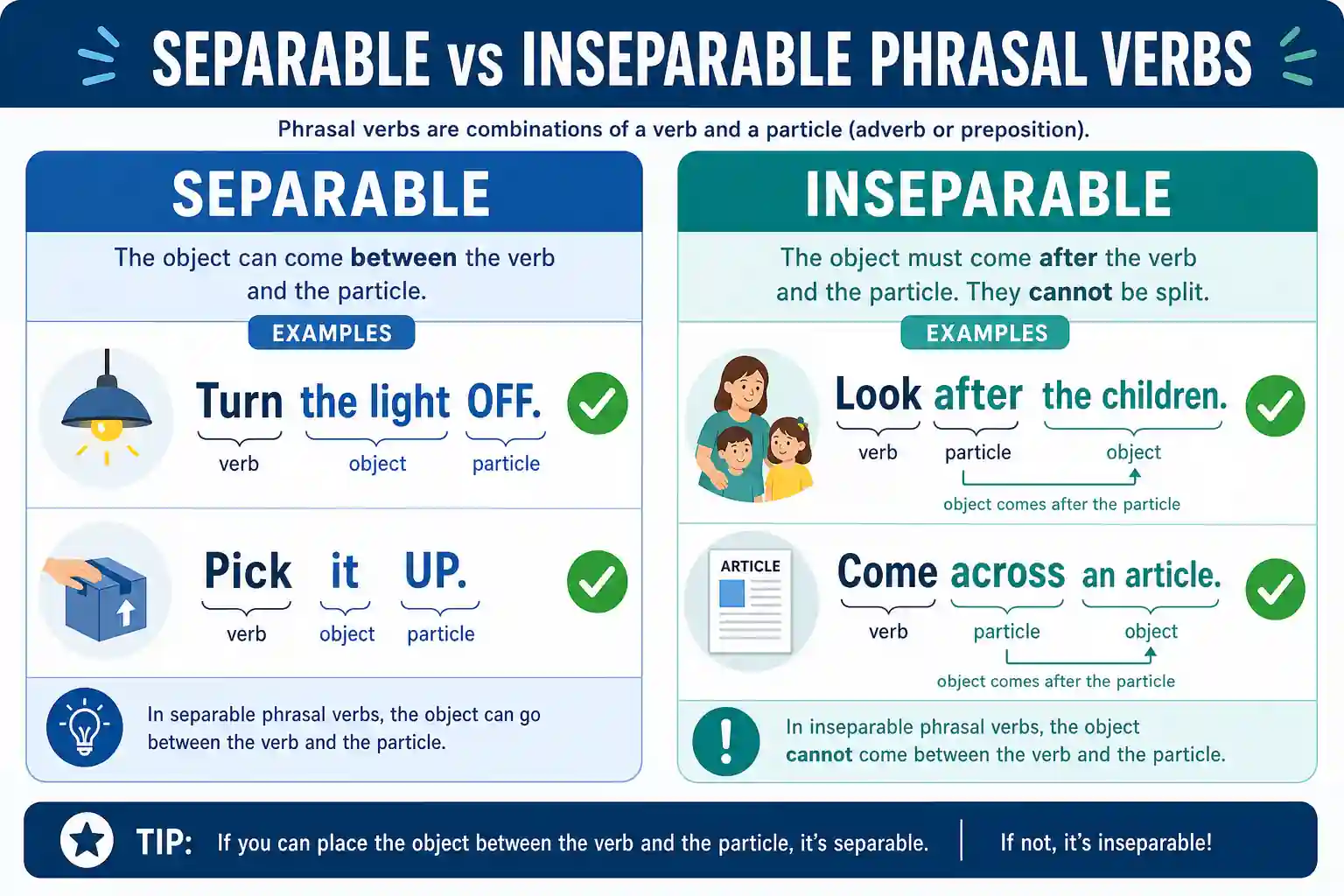
Muitos aprendizes têm dificuldade com a ordem das palavras. Veja como identificar se um phrasal verb é separável:
Separável — você pode (e às vezes deve) colocar o objeto entre o verbo e a partícula:
- Turn off the light → Turn the light off → Turn it off (com pronomes, a separação é obrigatória)
- Pick up the book → Pick the book up → Pick it up
Inseparável — o verbo e a partícula devem ficar juntos:
-
Look after the children →
Look the children after(errado) -
Come across an article →
Come an article across(errado)
Phrasal verbs de três palavras são sempre inseparáveis:
- Look forward to → I look forward to the trip
- Put up with → She put up with the noise
- Come up with → He came up with a plan
Palavras para Praticar
Aqui estão 25 verbos de alta frequência que formam a base da maioria dos phrasal verbs deste artigo. Adicione-os ao seu dicionário e pratique combiná-los com diferentes partículas.
artery
substantivo
artéria
Exemplos
- The blocked artery required immediate surgical intervention to save his life.
- This highway is a major artery connecting the city to surrounding areas.
coastal
adjetivo
costeiro
Exemplos
- Coastal towns often depend on fishing and tourism for their economy.
- The coastal erosion threatens many beachfront properties and buildings.
cooperate
verbo
cooperar, colaborar
donate
verbo
doar
Exemplos
- Many people donate money to charities that help homeless individuals.
- She decided to donate blood to help patients in emergency situations.
evaluate
verbo
avaliar, julgar
Exemplos
- Companies evaluate job candidates based on experience, skills, and personality.
- Teachers evaluate student progress through tests, projects, and classroom participation.
graduate
verbo
se formar
Exemplos
- She will graduate from university next year with a degree in engineering.
- Students must complete all requirements before they can graduate from high school.
guide
verbo
orientar
Exemplos
- Parents should guide their children to make responsible decisions.
- The experienced hiker will guide the group through the mountain trail safely.
implication
substantivo
implicação, consequência
Exemplos
- Scientists are studying the implications of climate change for future generations.
- The implication of his statement was that he disagreed with the policy.
candidate
substantivo
candidato
Exemplos
- Each presidential candidate presented their policy plans to voters.
- The job candidate impressed the interview panel with her experience.
prejudice
substantivo
preconceito
Exemplos
- Education helps overcome prejudice and promotes understanding.
- Racial prejudice damages communities and individuals alike.
discourage
verbo
desencorajar
Exemplos
- Don't let one failure discourage you from pursuing your dreams.
- High prices discourage many people from buying organic food products.
resolve
verbo
resolver
Exemplos
- Mediator helps parties resolve dispute through negotiation.
- Technical team will resolve software problems quickly.
off
adjetivo
fora, desligado, apagado
Exemplos
- Please turn off the lights before leaving the room.
- The dog ran off into the forest chasing wild rabbits.
tragedy
substantivo
tragédia
Exemplos
- Natural tragedy affects thousands of innocent people.
- Personal tragedy changes person's life perspective completely.
admission
substantivo
admissão
Exemplos
- Her admission to the prestigious medical school was the result of hard work.
- The museum offers free admission on the first Sunday of every month.
boom
substantivo
explosão, auge
Exemplos
- The boom of thunder echoed across the valley.
- The technology boom created many new millionaires.
horizon
substantivo
horizonte
Exemplos
- The sun disappeared behind the horizon as evening approached.
- Traveling broadens your horizon and exposes you to new cultures.
jury
substantivo
juri
Exemplos
- The jury deliberated for several hours before reaching a verdict.
- The talent show jury consisted of professional musicians and entertainers.
lifelong
adjetivo
para toda a vida
Exemplos
- Learning is a lifelong process that never truly ends.
- Their lifelong friendship began during elementary school years.
motivated
adjetivo
motivado
Exemplos
- Motivated employee seeks additional responsibilities and challenges at work.
- Success requires being motivated even when facing difficult obstacles.
total
adjetivo
total
Exemplos
- Total cost includes all fees and expenses.
- Total silence fills room during meditation session.
humorous
adjetivo
engraçado, divertido, cômico
Exemplos
- She writes humorous articles about everyday life and family experiences.
- The humorous speech made everyone laugh and lightened the serious mood.
indispensable
adjetivo
indispensável, essencial, fundamental
Exemplos
- Clean water is indispensable for human survival and good health.
- Her experience and skills make her indispensable to the research team.
firmly
advérbio
firmemente, com firmeza
Exemplos
- Hold the rope firmly while climbing down the steep mountain slope.
- The manager firmly believed in treating all employees with respect.
normally
advérbio
normalmente
Exemplos
- Heart normally beats between sixty and hundred times per minute.
- Students normally arrive at school before morning bell rings.
O Que Fazer a Seguir
-
Escolha o seu nível. Encontre a seção que corresponde à sua capacidade atual e foque nesses 50 exemplos primeiro.
-
Escreva cinco frases suas. Escolha cinco phrasal verbs do seu nível e escreva frases sobre a sua própria vida. Frases pessoais são muito mais fáceis de lembrar do que exemplos de livros didáticos.
-
Estude por verbo base. Para explicações detalhadas de cada significado, explore nossos guias específicos: GET, MAKE, ou 50 Mais Comuns.
-
Pratique com repetição espaçada. Adicione phrasal verbs ao seu dicionário Linglify e revise-os nos intervalos ideais. Explore também a biblioteca completa de phrasal verbs, com listas organizadas por categoria.
-
Aprenda as regras. Se a diferença entre separáveis e inseparáveis ainda causa confusão, leia nosso Guia Completo de Phrasal Verbs, que explica a gramática em detalhes.
FAQ
O que são phrasal verbs com exemplos?
Phrasal verbs são combinações de um verbo com uma preposição ou um advérbio que criam um significado diferente do verbo original. Por exemplo, “give up” significa parar de tentar (não “give” + “up” literalmente), “run into” significa encontrar por acaso e “break down” significa parar de funcionar. O inglês tem milhares de phrasal verbs, usados constantemente por falantes nativos na conversa do dia a dia.
Como você usa phrasal verbs em frases?
Use phrasal verbs exatamente onde você usaria um verbo comum. “She gave up smoking” funciona da mesma forma que “She quit smoking.” A regra principal: com phrasal verbs separáveis, os pronomes devem ficar entre o verbo e a partícula (“Turn it off,” não “Turn off it”). Com os inseparáveis, o objeto sempre vem depois da expressão inteira (“Look after the children,” não “Look the children after”).
Quais são 10 exemplos de phrasal verbs em frases?
Aqui estão 10 comuns: (1) I wake up at 7 AM. (2) Please turn off the light. (3) She gave up her job. (4) We ran out of time. (5) He came up with a great idea. (6) They broke up last month. (7) I’m looking forward to the weekend. (8) She turned down the offer. (9) The car broke down on the highway. (10) He picked up Spanish while living abroad.
Quantos phrasal verbs existem em inglês?
As estimativas variam de 5.000 a 10.000, dependendo de como se contam os diferentes significados. No entanto, a maioria dos falantes nativos usa regularmente cerca de 200–300 na conversa diária. Para quem está aprendendo, conhecer os 100 phrasal verbs mais comuns permite lidar com a grande maioria das situações do dia a dia.
Qual é o nível dos phrasal verbs?
Os phrasal verbs aparecem em todos os níveis. Os básicos, como “wake up”, “turn on” e “sit down”, são do nível A2. Muitos dos mais comuns, como “give up”, “look forward to” e “find out”, são B1. Os mais abstratos, como “bring about”, “rule out” e “phase in”, são B2. Os muito idiomáticos, como “cash in on”, “boil down to” e “play down”, são C1. Este artigo está organizado por nível para ajudar você a estudar de forma sistemática.