English Vocabulary by Topic: 20+ Themed Word Lists for Every Level
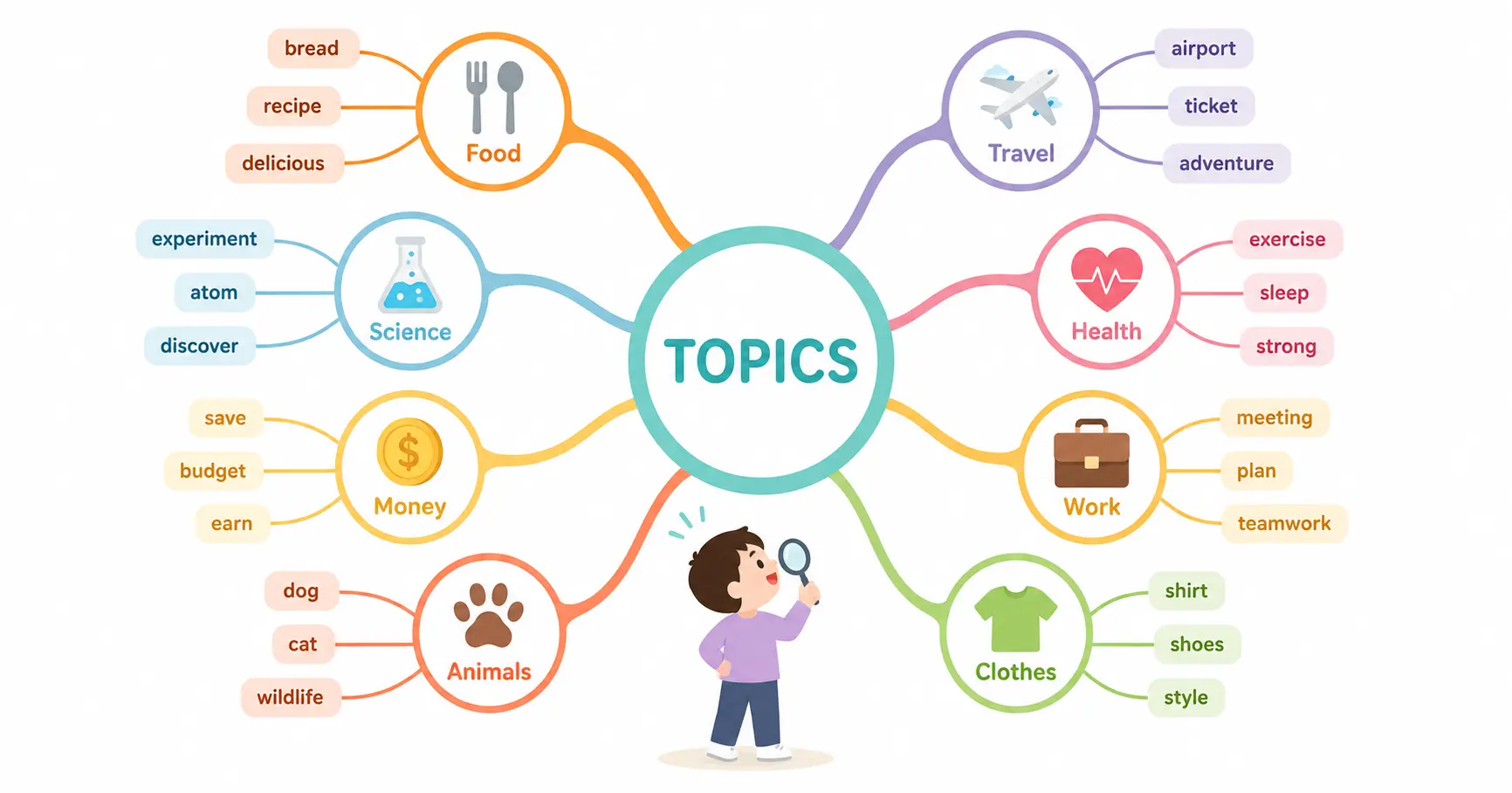
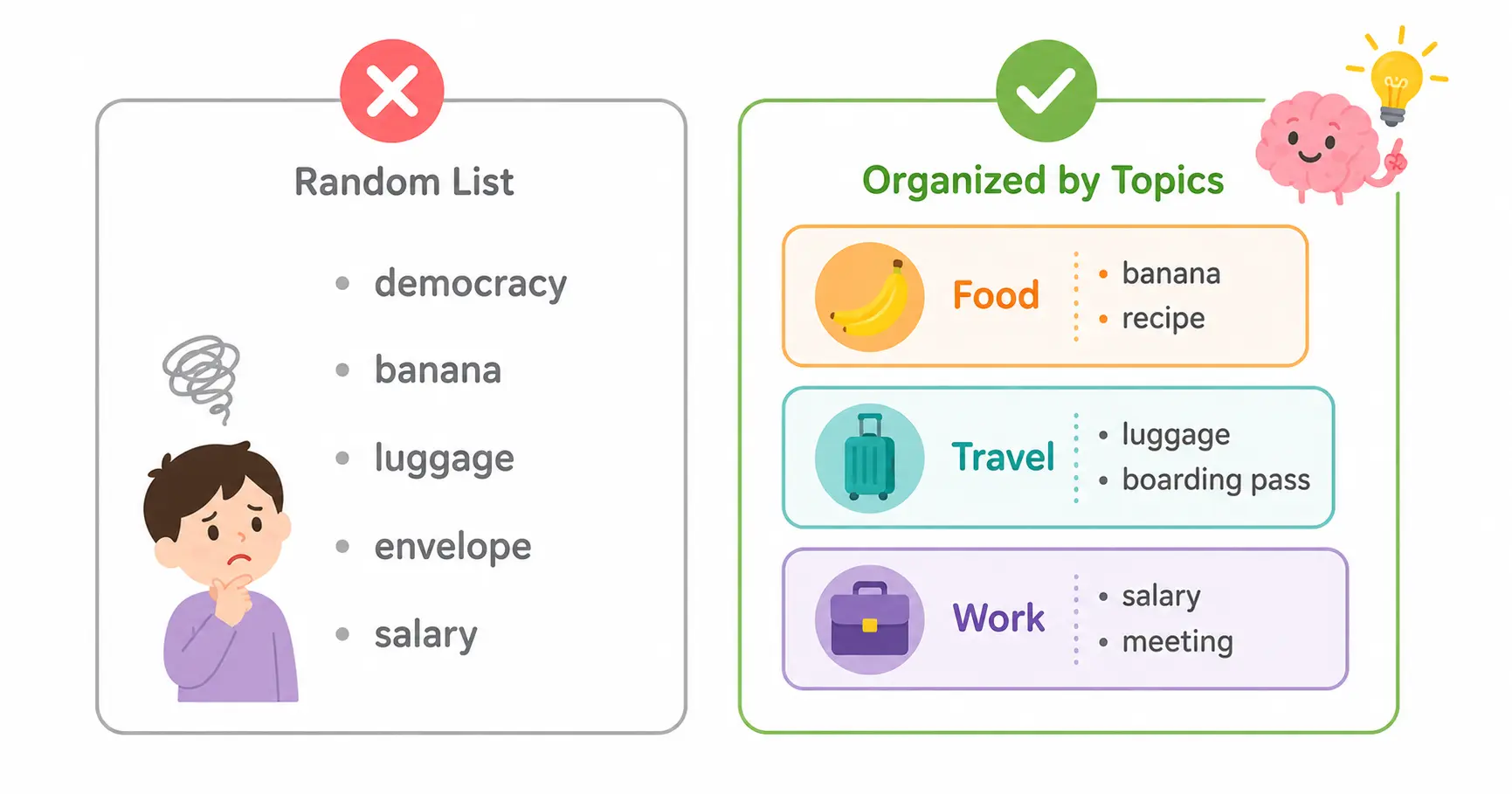
Learning English vocabulary by topic is one of the most efficient strategies. When you study words in thematic clusters — food, travel, health, work — your brain connects them naturally because they share context. You remember “boarding pass” better when it sits next to “gate,” “departure,” and “luggage” than when it appears on a random word list between “democracy” and “envelope.”
Research in cognitive linguistics supports this: words stored in semantic networks (groups of related meanings) are recalled faster and more accurately than words learned in isolation. This is how native speakers organize vocabulary internally — not alphabetically, but by topic and association.
This guide gives you 20+ vocabulary topics with 15–20 sample words each, organized from everyday basics (A1–A2) to advanced professional and academic areas (B2–C1). Each section includes a table with key words, their meanings, and example sentences. Use this page as a hub: find the topics you need, study the samples here, then follow the links to our full topic guides for complete word lists of 200–300+ words each.
- Topics covered: 20+
- Words per topic: 15–20 (samples; full lists available in dedicated articles)
- Levels: A1 through C1
- Best for: building vocabulary systematically, exam preparation (IELTS, TOEFL, TOEIC), filling topic gaps
How to Use Topic-Based Vocabulary
Before diving into the word lists, here are four principles that make topic-based learning work:
1. Start with topics you need now. If you are traveling next month, start with Travel. If you are preparing for IELTS, start with topics that appear in Speaking Part 2 — Health, Environment, Education, Technology. Do not study all 20 topics at once.
2. Learn in clusters of 10–15 words. Research shows that 10–15 new words per session is the upper limit for effective retention. Study one cluster, then review it the next day before adding more. Our vocabulary learning system explains the full process.
3. Always learn words in context. Every word below includes an example sentence. Read the sentence, imagine the situation, and try to create your own sentence using the word. A word without context is a word you will forget.
4. Use spaced repetition to retain them. Add words to your Linglify dictionary after studying each topic. The spaced repetition system shows you each word right before you would forget it — the most time-efficient way to build permanent vocabulary.
Everyday Life Topics (A1–A2)
These are the topics every English learner starts with. They cover the situations you encounter daily — at home, in shops, on the street. If you are a beginner, start here.
1. Greetings and Introductions
The first words you need in any language. These phrases get you through your first conversations.
| Word / Phrase | Meaning | Example |
|---|---|---|
| hello | a general greeting | Hello, my name is Sara. |
| goodbye | parting word | Goodbye, see you tomorrow. |
| please | polite request word | Can I have some water, please? |
| thank you | expression of gratitude | Thank you for helping me. |
| sorry | apology | Sorry, I’m late. |
| nice to meet you | greeting when meeting someone new | Nice to meet you. I’m Alex. |
| excuse me | getting attention / passing by | Excuse me, where is the bank? |
| how are you | asking about well-being | How are you? — I’m fine, thanks. |
| my name is… | introducing yourself | My name is Kenji. |
| welcome | greeting someone’s arrival | Welcome to our office. |
For a complete guide with 200+ phrases for beginners, see English for Beginners: Essential Words and Phrases.
2. Numbers, Time, and Days
Numbers and time expressions are essential for schedules, prices, dates, and appointments.
| Word / Phrase | Meaning | Example |
|---|---|---|
| one, two, three… | counting numbers | I need three tickets. |
| hundred | 100 | There are a hundred students. |
| thousand | 1,000 | The phone costs two thousand dollars. |
| today | this day | I have a meeting today. |
| tomorrow | the next day | The exam is tomorrow. |
| yesterday | the day before today | I saw her yesterday. |
| Monday – Sunday | days of the week | The class is on Wednesday. |
| January – December | months of the year | My birthday is in March. |
| morning | early part of the day | I exercise in the morning. |
| evening | later part of the day | We eat dinner in the evening. |
| o’clock | exact hour | It’s 3 o’clock. |
| half past | 30 minutes after the hour | It’s half past six. |
3. Food and Drink
One of the largest vocabulary topics and one of the first you will use in any English-speaking country.
| Word | Meaning | Example |
|---|---|---|
| bread | a basic food made from flour | Can I have some bread, please? |
| rice | a staple grain food | I eat rice every day. |
| chicken | meat from a chicken | I ordered grilled chicken. |
| fish | meat from a fish | The fish is very fresh. |
| water | clear liquid for drinking | Just water, please. |
| coffee | popular hot drink | I drink coffee every morning. |
| vegetable | plant-based food | You should eat more vegetables. |
| fruit | sweet food from plants (apple, banana) | I had fruit for breakfast. |
| sugar | sweet substance | Do you take sugar in your tea? |
| salt | seasoning / mineral | The soup needs more salt. |
| menu | list of food in a restaurant | Can I see the menu? |
| delicious | very tasty | This pasta is delicious! |
| hungry | wanting to eat | I’m so hungry right now. |
| recipe | instructions for cooking | I found a great recipe online. |
| dessert | sweet food after a meal | What’s for dessert? |
4. Clothes and Fashion
Clothing vocabulary is essential for shopping, describing people, and daily conversation. It is the most searched topic vocabulary in English.
| Word | Meaning | Example |
|---|---|---|
| shirt | upper body clothing with collar | He’s wearing a white shirt. |
| pants / trousers | clothing for legs | These pants are too long. |
| dress | one-piece clothing (usually for women) | She wore a beautiful dress. |
| shoes | footwear | I need new running shoes. |
| jacket | outer clothing for warmth | Bring a jacket — it’s cold outside. |
| hat | head covering | She always wears a hat in summer. |
| socks | cloth covering for feet | I packed three pairs of socks. |
| belt | strip worn around the waist | His belt matches his shoes. |
| scarf | cloth worn around the neck | I wore a warm scarf in winter. |
| size | measurement of clothing | What size do you wear? |
| try on | to test clothing before buying | Can I try on this jacket? |
| fit | whether clothing is the right size | This shirt fits perfectly. |
| cotton | a natural fabric | This T-shirt is 100% cotton. |
| casual | informal style | The dress code is casual. |
| formal | official, dressy style | You need formal clothes for the interview. |
5. Home and Daily Routines
Words for your living space and the things you do every day.
| Word | Meaning | Example |
|---|---|---|
| bedroom | room for sleeping | The apartment has two bedrooms. |
| kitchen | room for cooking | I cook dinner in the kitchen. |
| bathroom | room with toilet and shower | The bathroom is on the second floor. |
| furniture | tables, chairs, beds, etc. | We need new furniture. |
| key | metal object to open locks | Don’t forget your keys. |
| wake up | to stop sleeping | I wake up at 7 AM. |
| take a shower | to wash your body | I take a shower every morning. |
| cook | to prepare food | My father cooks dinner on weekends. |
| clean | to remove dirt | I clean the apartment on Saturdays. |
| sleep | to rest at night | I usually sleep 8 hours. |
| alarm | device that wakes you | My alarm goes off at 6:30. |
| neighbor | person who lives next to you | Our neighbors are very friendly. |
6. Family and Relationships
| Word | Meaning | Example |
|---|---|---|
| mother / father | parents | My mother is a teacher. |
| brother / sister | siblings | I have two brothers and one sister. |
| son / daughter | children | Their daughter starts school this year. |
| husband / wife | married partners | My wife works at a hospital. |
| friend | a person you like and trust | She’s my best friend from school. |
| grandparents | parents of your parents | My grandparents live in the countryside. |
| uncle / aunt | parents’ siblings | My uncle lives in London. |
| cousin | child of your uncle/aunt | I have 12 cousins. |
| wedding | marriage ceremony | The wedding is in June. |
| baby | very young child | The baby is sleeping now. |
Practical Situation Topics (A2–B1)
These topics come into play when you start navigating the real world in English — traveling, seeing a doctor, managing money.
7. Travel and Tourism
Travel vocabulary is critical for airports, hotels, and getting around in any English-speaking country.
| Word | Meaning | Example |
|---|---|---|
| passport | travel identity document | Don’t forget your passport. |
| ticket | proof of paid travel | I booked a one-way ticket. |
| flight | airplane journey | The flight to London takes 11 hours. |
| boarding pass | card to enter the airplane | Please show your boarding pass. |
| luggage / baggage | bags you carry while traveling | My luggage weighs 23 kilos. |
| departure | leaving a place | The departure time is 8:15 AM. |
| arrival | reaching a destination | Check the arrival board for your train. |
| reservation | booking in advance | I have a reservation for two nights. |
| hotel | place to stay while traveling | The hotel is near the city center. |
| sightseeing | visiting places of interest | We went sightseeing in Rome. |
| customs | border inspection area | You must go through customs. |
| currency | money used in a country | The local currency is the euro. |
| guidebook | book with travel information | I bought a guidebook before the trip. |
| souvenir | object bought as a travel memory | I got a souvenir for my mother. |
8. Directions and Transportation
| Word | Meaning | Example |
|---|---|---|
| left / right | directions | Turn left at the traffic light. |
| straight | without turning | Go straight for 200 meters. |
| corner | where two streets meet | The café is on the corner. |
| bus stop | where buses pick up passengers | The bus stop is across the street. |
| train station | building for train services | How do I get to the train station? |
| map | visual guide of an area | Can you show me on the map? |
| crosswalk | place to cross the street | Use the crosswalk to cross safely. |
| traffic | vehicles on the road | There’s heavy traffic on this road. |
| parking | area for leaving vehicles | Is there parking near the museum? |
| subway / underground | underground railway | Take the subway to downtown. |
9. Shopping and Money
| Word | Meaning | Example |
|---|---|---|
| price | how much something costs | What’s the price of this? |
| discount | reduced price | There’s a 20% discount today. |
| receipt | proof of purchase | Can I get a receipt, please? |
| cash | physical money | Do you accept cash? |
| credit card | plastic card for payments | I’ll pay by credit card. |
| change | money returned after paying | Here’s your change — $3.50. |
| refund | money returned for a returned item | Can I get a refund? |
| sale | event with lower prices | The store is having a sale. |
| expensive | high price | This restaurant is too expensive. |
| cheap | low price | The market has cheap vegetables. |
| customer | person who buys | The customer asked for help. |
| store / shop | place to buy things | There’s a shoe store on that street. |
10. Health and Body
Health vocabulary is essential for doctor visits, understanding medicine labels, and describing how you feel.
| Word | Meaning | Example |
|---|---|---|
| headache | pain in the head | I have a terrible headache. |
| fever | body temperature above normal | She has a high fever. |
| cough | forcing air from the lungs | I can’t stop coughing. |
| medicine | substance to treat illness | Take this medicine twice a day. |
| doctor | medical professional | You should see a doctor. |
| hospital | place for medical treatment | He was taken to the hospital. |
| pain | physical suffering | I have a pain in my back. |
| allergy | negative reaction to a substance | I have a nut allergy. |
| prescription | doctor’s written order for medicine | The pharmacy needs a prescription. |
| symptom | sign of an illness | What are your symptoms? |
| blood | red liquid in the body | The nurse took a blood sample. |
| surgery | medical operation | He had knee surgery last month. |
| recover | to get better after illness | It takes time to fully recover. |
| healthy | in good physical condition | Eating vegetables keeps you healthy. |
11. Weather and Nature
| Word | Meaning | Example |
|---|---|---|
| sunny | bright with sunlight | It’s sunny and warm today. |
| cloudy | sky covered with clouds | It was cloudy all morning. |
| rain | water falling from clouds | Bring an umbrella — it might rain. |
| snow | frozen white precipitation | It snows a lot in December here. |
| wind | air movement | The wind is very strong today. |
| storm | severe weather with rain/wind | A storm is coming tonight. |
| temperature | degree of heat or cold | The temperature dropped to 5°C. |
| fog | thick mist near the ground | The fog made driving difficult. |
| season | time of year (spring, summer, etc.) | Autumn is my favorite season. |
| sunrise / sunset | when the sun appears / disappears | The sunset was beautiful. |
| ocean | large body of salt water | We live near the ocean. |
| mountain | very high land formation | They went hiking in the mountains. |
| forest | large area of trees | The forest is full of wildlife. |
12. Animals
| Word | Meaning | Example |
|---|---|---|
| dog | common pet animal | My dog loves playing in the park. |
| cat | common pet animal | The cat is sleeping on the sofa. |
| bird | feathered flying animal | I hear birds singing every morning. |
| fish | aquatic animal | There are tropical fish in the tank. |
| horse | large animal used for riding | She has been riding horses since age 5. |
| elephant | largest land animal | We saw elephants at the zoo. |
| lion | large wild cat | The lion is called the king of the jungle. |
| pet | animal kept at home | Do you have any pets? |
| wild | living in nature, not tamed | Wild animals should stay in their habitat. |
| endangered | at risk of extinction | Many species are endangered. |
| insect | small creature with six legs | Butterflies are beautiful insects. |
| farm | place where animals are raised | The farm has cows, chickens, and sheep. |
Academic and Professional Topics (B1–B2)
These topics matter for exams, academic writing, and professional environments. They use more specialized vocabulary.
13. Education and School
| Word | Meaning | Example |
|---|---|---|
| university | institution for higher education | She studies at the University of Tokyo. |
| degree | academic qualification | He has a degree in engineering. |
| exam | formal test | The final exam is next Monday. |
| lecture | academic talk / class | The professor gave a lecture on economics. |
| assignment | piece of work given by a teacher | The assignment is due on Friday. |
| research | systematic study to discover facts | She is doing research on climate change. |
| scholarship | financial award for students | He received a full scholarship. |
| graduate | to complete a degree program | I graduated in 2024. |
| tuition | cost of education | Tuition fees are increasing every year. |
| curriculum | the subjects in a course of study | The curriculum includes math and science. |
| semester | half of the academic year | I’m taking 5 courses this semester. |
| campus | the grounds of a university | The campus has a beautiful library. |
14. Work and Business
| Word | Meaning | Example |
|---|---|---|
| salary | money paid for work | The salary is paid monthly. |
| interview | meeting to assess a job candidate | I have a job interview tomorrow. |
| résumé / CV | document listing work experience | Update your résumé before applying. |
| deadline | final date to complete something | The project deadline is next week. |
| colleague | person you work with | My colleague helped me with the report. |
| meeting | gathering to discuss work | We have a team meeting at 10. |
| promotion | advancement to a higher position | She got a promotion to manager. |
| client | person or company you serve | The client approved the design. |
| budget | planned amount of money | The marketing budget is $50,000. |
| profit | money earned after costs | The company made a good profit this year. |
| contract | legal agreement | Read the contract before signing. |
| remote | working from outside the office | I work remotely three days a week. |
15. Technology and Computers
| Word | Meaning | Example |
|---|---|---|
| software | programs that run on a computer | We installed new software yesterday. |
| hardware | physical computer components | The hardware needs an upgrade. |
| download | to copy data from the internet | I downloaded the file in 2 minutes. |
| upload | to send data to the internet | Please upload your photo to the website. |
| password | secret word for access | Change your password regularly. |
| Wi-Fi | wireless internet connection | Is there free Wi-Fi here? |
| app | application (program for phone/computer) | This app translates text instantly. |
| update | newer version of software | Install the latest update. |
| cloud | online storage accessible from anywhere | I saved the document to the cloud. |
| website | page on the internet | Visit our website for more information. |
| data | information stored digitally | The company collects user data. |
| cybersecurity | protection against digital attacks | Cybersecurity is a growing field. |
16. Crime and Law
| Word | Meaning | Example |
|---|---|---|
| crime | illegal act | Crime rates have decreased in the area. |
| law | official rules of a country | The new law takes effect in January. |
| police | law enforcement officers | The police are investigating the case. |
| judge | person who decides legal cases | The judge gave a fair sentence. |
| court | place where legal cases are decided | The case will go to court next month. |
| evidence | proof supporting a claim | The evidence was presented to the jury. |
| guilty | responsible for a crime | The jury found him guilty. |
| innocent | not guilty | She was found innocent of all charges. |
| lawyer | person who practices law | You should consult a lawyer. |
| arrest | to take someone into police custody | The suspect was arrested yesterday. |
| witness | person who saw an event | The witness described what happened. |
| sentence | punishment given by a court | He received a 5-year prison sentence. |
17. Money and Finance
| Word | Meaning | Example |
|---|---|---|
| bank account | arrangement to keep money at a bank | I opened a bank account last week. |
| savings | money kept for future use | I’m building my savings for a car. |
| loan | money borrowed that must be repaid | She took out a student loan. |
| interest | extra money charged on borrowed money | The interest rate is 4.5%. |
| investment | money put into something to earn more | Real estate can be a good investment. |
| tax | money paid to the government | Income tax is deducted from your salary. |
| debt | money that you owe | I’m trying to pay off my debt. |
| inflation | rising prices over time | Inflation is affecting food prices. |
| budget | plan for spending money | We need to stick to our monthly budget. |
| income | money earned from work or investments | Her annual income is $60,000. |
| expense | money spent on something | My biggest expense is rent. |
| exchange rate | value of one currency vs another | What’s the exchange rate today? |
Advanced and Specialized Topics (B2–C1)
These topics are relevant for academic essays, IELTS/TOEFL Writing and Speaking, and advanced professional contexts.
18. Environment and Ecology
This topic appears frequently in IELTS Writing Task 2 and Speaking Part 3.
| Word | Meaning | Example |
|---|---|---|
| pollution | harmful substances in the environment | Air pollution is a serious problem in cities. |
| climate change | long-term shifts in global temperatures | Climate change affects every country. |
| renewable | can be used again (energy) | Solar power is a renewable energy source. |
| carbon footprint | total greenhouse gases produced | We should reduce our carbon footprint. |
| deforestation | cutting down large areas of forest | Deforestation destroys animal habitats. |
| ecosystem | community of living organisms | Coral reefs are fragile ecosystems. |
| biodiversity | variety of life in an area | Biodiversity is declining worldwide. |
| sustainable | able to continue without harm | Sustainable farming protects the soil. |
| recycle | to convert waste into reusable material | We recycle paper, plastic, and glass. |
| conservation | protection of natural resources | Wildlife conservation is essential. |
| emissions | gases released into the atmosphere | The factory reduced its emissions by 30%. |
| fossil fuel | energy source from ancient organisms | Fossil fuels include oil, coal, and gas. |
19. Science and Research
| Word | Meaning | Example |
|---|---|---|
| experiment | a scientific test | The students conducted an experiment. |
| hypothesis | a proposed explanation to be tested | The hypothesis was confirmed by the data. |
| theory | an explanation supported by evidence | The theory of evolution is well-established. |
| atom | the smallest unit of matter | Water is made of hydrogen and oxygen atoms. |
| cell | the basic unit of life | The human body has trillions of cells. |
| species | a group of similar organisms | Many species are threatened by habitat loss. |
| DNA | molecule carrying genetic information | DNA determines many physical traits. |
| energy | the ability to do work | Solar panels convert sunlight into energy. |
| gravity | force that pulls objects toward each other | Gravity keeps us on the ground. |
| microscope | instrument for seeing very small things | We observed the cells under a microscope. |
| data | facts and statistics collected for analysis | The data shows a clear trend. |
| laboratory | room for scientific experiments | The laboratory has modern equipment. |
For a full list of 200+ science terms, see our science vocabulary guide.
20. Media and Communication
| Word | Meaning | Example |
|---|---|---|
| news | information about recent events | I read the news every morning. |
| article | a piece of writing in a newspaper/website | I read an interesting article about AI. |
| journalist | person who reports news | The journalist interviewed the president. |
| broadcast | to transmit on TV or radio | The match will be broadcast live. |
| social media | online platforms for sharing content | Social media influences public opinion. |
| advertisement | paid promotion of a product | I saw an advertisement for the new phone. |
| headline | title of a news story | The headline shocked everyone. |
| subscribe | to sign up for regular content | Subscribe to our newsletter for updates. |
| content | material published online or in print | The website has great educational content. |
| audience | people who watch, read, or listen | The show has a large audience. |
| viral | spreading rapidly online | The video went viral overnight. |
| podcast | audio program available online | I listen to English podcasts on my commute. |
21. Emotions and Psychology
| Word | Meaning | Example |
|---|---|---|
| anxiety | feeling of worry or unease | She suffers from anxiety before exams. |
| confidence | belief in your own abilities | His confidence has grown this year. |
| motivation | reason or desire to do something | I need more motivation to study. |
| stress | mental or emotional pressure | Work stress is affecting my sleep. |
| empathy | understanding another’s feelings | Good leaders show empathy. |
| frustration | feeling upset by inability to change something | His frustration was visible. |
| resilience | ability to recover from difficulty | Resilience is key to long-term success. |
| self-esteem | how you value yourself | Positive feedback improves self-esteem. |
| mindset | a person’s way of thinking | A growth mindset leads to better learning. |
| habit | regular behavior, often automatic | Reading is a healthy habit. |
| therapy | treatment for mental health | Therapy helped her manage stress. |
| well-being | state of being comfortable and healthy | Exercise improves overall well-being. |
22. Sports and Fitness
| Word | Meaning | Example |
|---|---|---|
| exercise | physical activity for health | I exercise three times a week. |
| coach | person who trains athletes | The coach designed a new training plan. |
| score | points earned in a game | The final score was 3–1. |
| match | a competitive game | The tennis match lasted three hours. |
| tournament | a series of competitive games | She won the regional tournament. |
| gym | place for physical exercise | I go to the gym after work. |
| opponent | person you compete against | His opponent was very experienced. |
| championship | competition to decide the best | The world championship starts next week. |
| marathon | a 42.2 km running race | She completed her first marathon. |
| injury | physical damage to the body | He missed the season due to a knee injury. |
| warm up | to prepare the body for exercise | Always warm up before running. |
| stamina | ability to sustain physical effort | Swimming builds stamina. |
Words to Practice
These 25 topic-based vocabulary words span multiple themes and levels. Add them to your Linglify dictionary for spaced repetition.
accomplish
verb
To succeed in doing or completing something difficult.
Examples
- She was able to accomplish all her goals before the deadline.
- Working together, the team can accomplish much more than individuals working alone.
admire
verb
To look at someone or something with admiration or approval.
Examples
- I really admire people who volunteer their time to help others.
- Tourists often stop to admire the stunning architecture of the ancient cathedral.
agonize
verb
To suffer mental or physical pain due to worry or distress.
Examples
- Don't agonize too much about past mistakes that you cannot change.
- She continued to agonize over the difficult decision for weeks.
ambiguity
noun
Uncertainty or inexactness in meaning or expression.
Examples
- Legal documents should be written clearly to avoid any ambiguity.
- The contract's ambiguity led to disagreements between the two companies.
anxiously
adverb
In a worried or nervous way.
Examples
- Students anxiously checked their phones for exam results.
- The family waited anxiously for news about their missing relative.
artery
noun
A blood vessel that carries blood away from the heart to the body.
Examples
- The blocked artery required immediate surgical intervention to save his life.
- This highway is a major artery connecting the city to surrounding areas.
attainable
adjective
Possible to achieve or reach with effort.
Examples
- Setting realistic and attainable goals helps maintain motivation for success.
- With proper training, running a marathon is an attainable objective.
badly
adverb
In a poor or ineffective way; not skillfully or properly.
Examples
- She badly wanted to visit Paris before the end of summer.
- The team played badly and lost the championship game.
bathroom
noun
A room equipped with a toilet, sink, and usually a shower or bathtub.
Examples
- Excuse me, could you tell me where the bathroom is located?
- The hotel bathroom was spacious and beautifully decorated.
bestseller
noun
A very successful book or product that sells in large quantities.
Examples
- Her novel became an international bestseller within six months.
- The bookstore has a special section dedicated to current bestsellers.
bless
verb
To ask for God's favor or help; to make holy or blessed.
Examples
- She felt blessed to have such wonderful friends.
- The priest blessed the newborn baby during the ceremony.
bottom
adjective
Located at the lowest part or point; not raised or elevated.
Examples
- She keeps her shoes on the bottom shelf.
- The bottom line is that we need more funding.
broadcast
noun
A program or event of transmitting information or entertainment to a broad audience.
Examples
- Millions watched the live broadcast of the event.
- The news broadcast revealed shocking new information.
buy
verb
To acquire something by paying money or exchanging goods or services.
Examples
- She decided to buy organic vegetables at the local farmer's market.
- We plan to buy a new car before our summer vacation trip.
cardboard
noun
A material made from pressed paper fibers, used for packaging or crafts.
Examples
- Children made creative art projects using colored cardboard and glue.
- The moving boxes were made of sturdy corrugated cardboard material.
century
noun
A period of 100 years.
Examples
- Medical advances in the past century have greatly improved human health.
- The ancient castle was built in the fourteenth century by local nobles.
choir
noun
A group of people who sing together, often in a church or school.
Examples
- She joined the school choir to improve her singing skills and confidence.
- The church choir performed beautiful hymns during the Sunday service.
coastal
adjective
Coastal describes areas near or along the coast.
Examples
- Coastal towns often depend on fishing and tourism for their economy.
- The coastal erosion threatens many beachfront properties and buildings.
compile
verb
To gather information, data, or items from different sources into one place.
Examples
- Programmer must compile source code before executing software application.
- Research team will compile data from multiple studies and sources.
conservative
noun
A person who prefers traditional ideas and values., A person who prefers traditional methods and resists change, especially in politics or social issues.
Examples
- Many conservatives oppose rapid changes to established social institutions.
- She is a conservative who believes in maintaining traditional family values.
corona
noun
A noun for a circular, often golden, crown-shaped part of the head or a disease caused by a virus.
critic
noun
A person who expresses opinions or judgments about art, literature, or performances.
Examples
- Even his harshest critic admitted that the plan had merit.
- The restaurant critic wrote a positive review of the new establishment.
dash
noun
A quick, sudden movement, or a short burst of speed or effort.
Examples
- Add just a dash of salt to improve the soup's flavor.
- She made a mad dash for the door when it started raining.
deliberately
adverb
Intentionally, with a clear purpose or plan.
Examples
- She deliberately arrived late to avoid the crowded opening ceremony.
- The artist deliberately used bright colors to create emotional impact.
devote
verb
To give a large part of one's time or resources to a person or activity.
Examples
- Parents devote much time and energy to raising their children properly.
- She will devote her entire weekend to studying for final examinations.
How to Study Vocabulary by Topic: A System
Here is a step-by-step approach that works for any topic on this page:
Step 1: Choose Your Topic
Pick one topic that matters to your life right now. If you are job hunting, start with Work and Business. If you are traveling soon, start with Travel. If you are preparing for IELTS, start with the topics that appear in the exam — Environment, Education, Technology, Health, and Crime are the most common.
Step 2: Study 10–15 Words per Session
Do not try to learn all 15–20 words from a topic at once. Take 10–12, study them with example sentences, then test yourself. Add the ones you do not remember to your Linglify dictionary.
Step 3: Create Your Own Sentences
For each word, write one sentence from your own life. “Pollution” + “My city has air pollution” is more memorable than any example in a textbook because it connects to your experience.
Step 4: Review with Spaced Repetition
Come back to the words the next day. Which ones did you forget? Those need more repetitions. The Linglify spaced repetition system handles this automatically.
Step 5: Move to the Next Topic
Once you can recall 80%+ of a topic’s words, move to the next one. Do not aim for perfection — aim for progress.
For a complete study system with all 7 stages, see our step-by-step vocabulary learning guide.
Topic Vocabulary for Exams
IELTS
IELTS Speaking and Writing test your ability to discuss a range of topics. The most common IELTS topics align directly with the vocabulary on this page:
| IELTS Topic | Sections on This Page |
|---|---|
| Health and fitness | Health and Body, Sports and Fitness |
| Education | Education and School |
| Environment | Environment and Ecology |
| Technology | Technology and Computers |
| Crime | Crime and Law |
| Work | Work and Business |
| Travel and tourism | Travel and Tourism |
| Media | Media and Communication |
| Food and diet | Food and Drink |
For exam-specific vocabulary, see our IELTS Vocabulary guide.
TOEFL
TOEFL Reading and Listening use academic topics heavily — especially Science, Environment, Education, and History. The vocabulary in the Academic and Specialized section above maps directly to TOEFL passages. For a dedicated TOEFL word list, see our TOEFL exam guide.
Connecting Topics to CEFR Levels
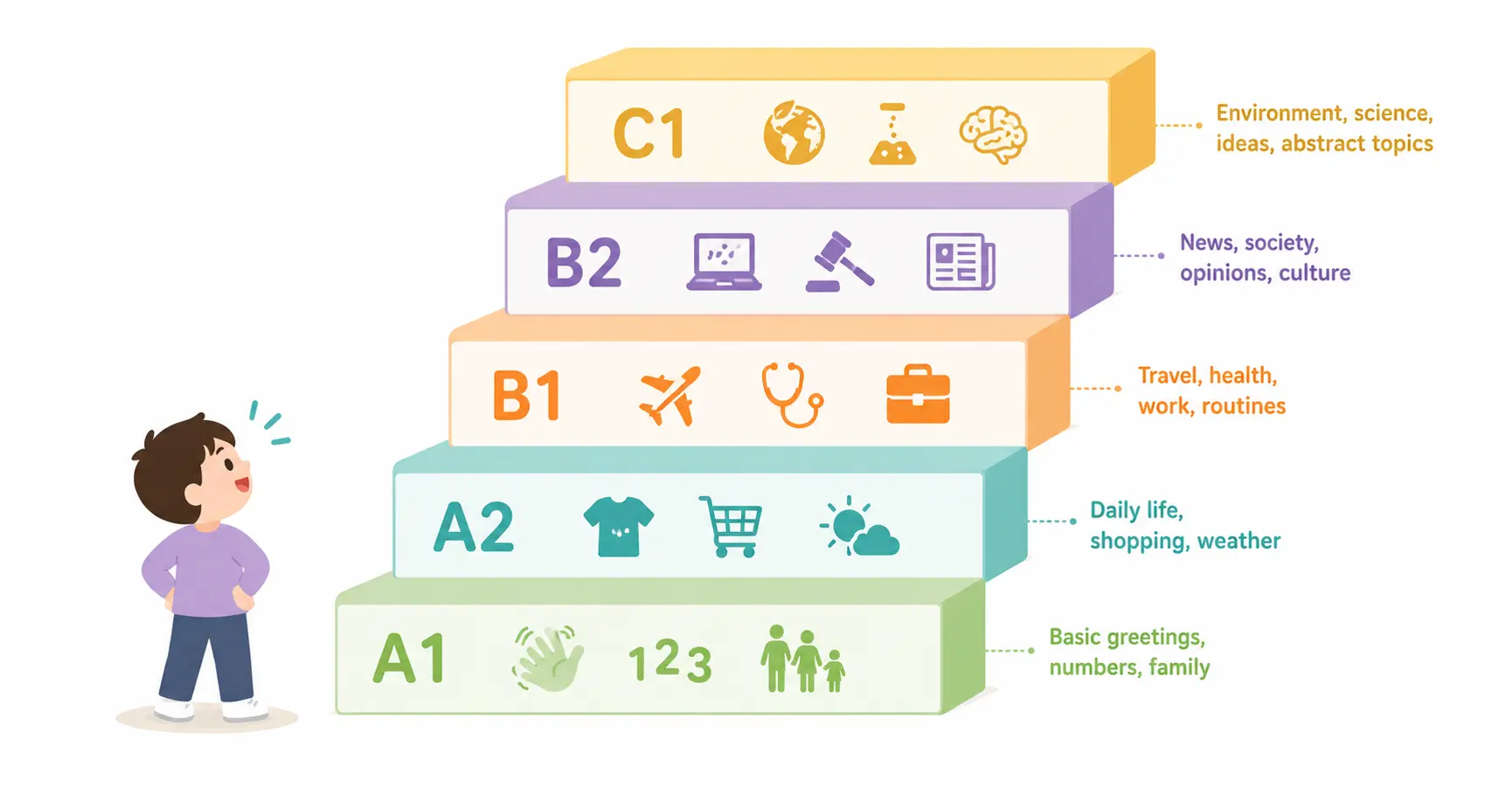
Each vocabulary topic corresponds roughly to specific CEFR levels:
| CEFR Level | Topics to Study |
|---|---|
| A1 (Beginner) | Greetings, Numbers, Family, Home, Animals, basic Food |
| A2 (Elementary) | Clothes, Shopping, Directions, Weather, Daily Routines |
| B1 (Intermediate) | Travel, Health, Education, Work basics, Sports |
| B2 (Upper-Intermediate) | Technology, Crime, Finance, Media, advanced Work |
| C1 (Advanced) | Environment, Science, Psychology, specialized Business |
To see which words belong to each level, see our complete guide to English vocabulary by CEFR level.
What to Study Next
This pillar page gives you a sample of each topic. Here is how to go deeper:
-
Build your daily vocabulary. If you want the most practical words first, our English words for daily use guide gives you 500+ words organized by situation.
-
Master the most common words. The 1000 most common English words cover 85% of everyday speech. This is the foundation before going deep into topics.
-
Learn the right study method. Topic-based learning works best when combined with a proper system. Our vocabulary learning guide gives you the 7-step process.
-
Understand your level. If you are not sure which topics to study, check your level first. The CEFR vocabulary guide explains exactly what is expected at each stage.
-
Aim for 4,000 words. Research shows that 4,000 word families let you understand 95% of everyday English. Our 4000 essential words guide maps the full journey.
-
Use effective memorization. Science-backed techniques make vocabulary stick. Read how to memorize vocabulary for proven strategies.
FAQ
What are the best vocabulary topics for beginners?
Start with topics you use daily: Greetings, Numbers, Food, Family, Home, and Clothes. These cover the situations you encounter most often and give you words you can practice immediately. The Greetings and Food sections above are perfect starting points, and our English for Beginners guide covers them in even more detail.
How many topic vocabulary words should I learn per day?
Research suggests 10–15 new words per study session is optimal for retention. Studying more than that leads to forgetting. Focus on quality over quantity — learn each word with its meaning, pronunciation, and an example sentence. Review the previous day’s words before adding new ones. At this rate, you can comfortably learn one topic (15–20 words) per week.
Which vocabulary topics appear most often in IELTS?
The top IELTS topics are Environment, Education, Health, Technology, Crime, Work, and Media. These appear regularly in Speaking Part 2, Speaking Part 3, and Writing Task 2. Study the corresponding sections on this page, then go deeper with our IELTS vocabulary guide for exam-specific words and collocations.
Is it better to learn vocabulary by topic or by frequency?
Both approaches work — and the best strategy combines them. Start with the most common 1,000 words (frequency-based) to build your foundation. Then switch to topic-based learning to fill gaps in specific areas you need. For example, if you know common words but struggle with doctor visits, study the Health topic specifically.
How do I remember topic vocabulary long-term?
Three techniques work best: (1) Learn words in context with example sentences, not as isolated translations. (2) Use spaced repetition — review words at increasing intervals. Add words to your Linglify dictionary for automatic scheduling. (3) Use the words actively — write sentences, speak them out loud, or find them in articles and podcasts. Passive recognition fades; active use creates permanent memory.