English Vocabulary by CEFR Level: From A1 Beginner to C2 Proficiency
“What level is my English?” is one of the most common questions language learners ask. The answer depends heavily on vocabulary — how many words you know, how well you know them, and whether you can use them in context.
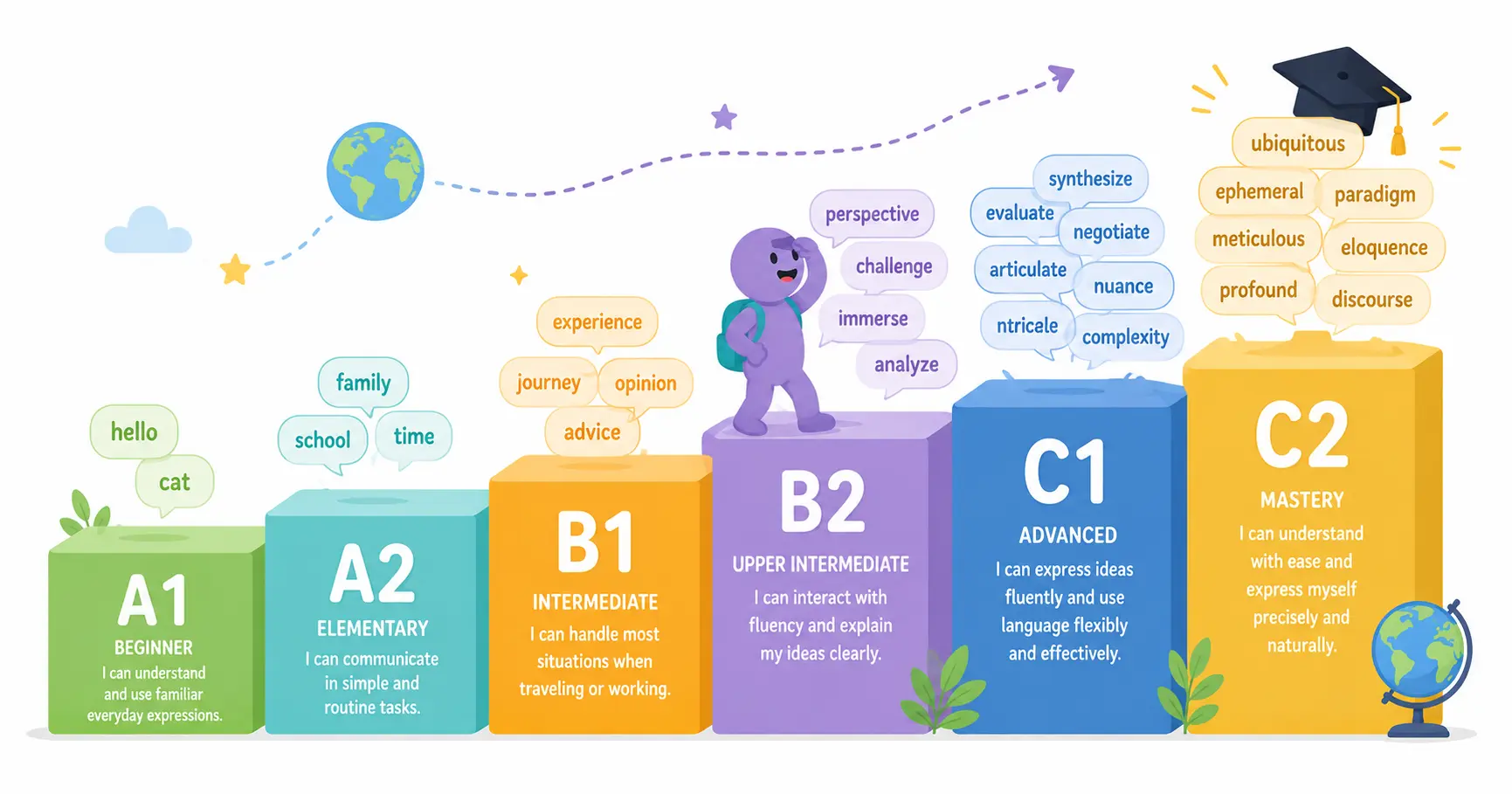
The CEFR (Common European Framework of Reference for Languages) provides the global standard for measuring language proficiency. It divides learners into 6 levels — from A1 (complete beginner) to C2 (mastery) — and vocabulary is one of the key indicators at each stage.
This guide maps English vocabulary to all 6 CEFR levels. For each level, you will see:
- how many words you need,
- what kind of vocabulary is expected,
- sample words and phrases,
- and resources for building your vocabulary at that level.
What Is CEFR?
The Common European Framework of Reference for Languages (CEFR) was created by the Council of Europe in 2001. It is the most widely used framework for describing language ability worldwide.
CEFR divides language proficiency into 3 broad bands and 6 specific levels:
| Band | Level | Name | Description |
|---|---|---|---|
| A — Basic User | A1 | Breakthrough | Can handle very basic interactions |
| A2 | Waystage | Can handle routine tasks and simple conversations | |
| B — Independent User | B1 | Threshold | Can deal with most travel and everyday situations |
| B2 | Vantage | Can interact fluently on a range of topics | |
| C — Proficient User | C1 | Effective Operational Proficiency | Can express complex ideas flexibly |
| C2 | Mastery | Can understand virtually everything and express meaning precisely |
CEFR is used by:
- Language exams: IELTS, TOEFL, Cambridge, TOEIC all map their scores to CEFR levels
- Schools and universities: Admission requirements often specify a CEFR level
- Employers: Job postings in Europe and Asia commonly require “B2 English” or “C1 English”
- Textbook publishers: Materials like “English Vocabulary in Use” are organized by CEFR level
How Many Words Do You Need at Each CEFR Level?
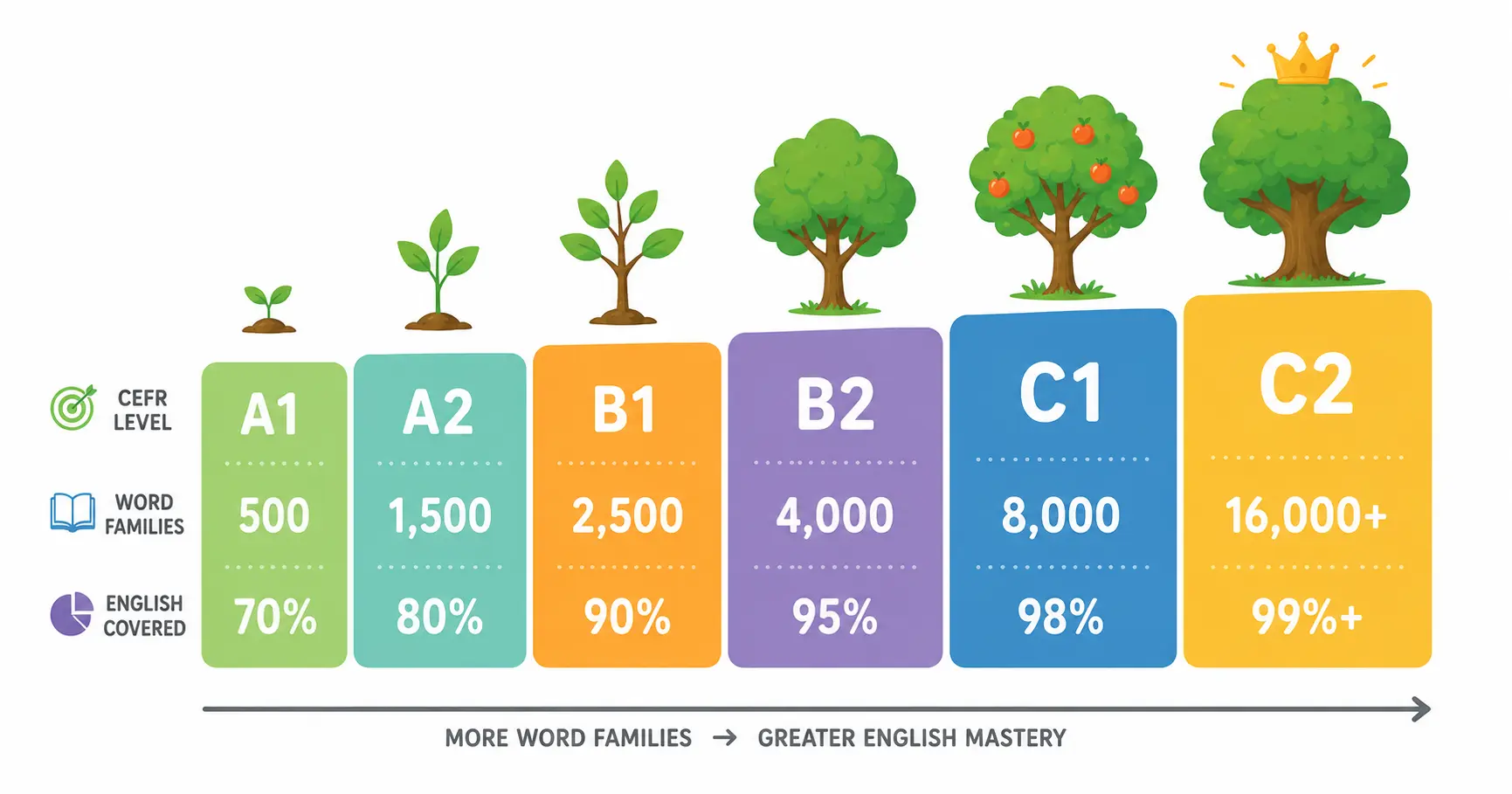
The relationship between vocabulary size and CEFR level is well-researched. Here are the widely accepted estimates:
| CEFR Level | Word Families | Total Word Forms | % of Everyday English Covered |
|---|---|---|---|
| A1 | ~500 | ~700–1,000 | ~70% of basic spoken English |
| A2 | ~1,000–1,500 | ~1,500–2,500 | ~80% of basic spoken English |
| B1 | ~2,000–2,500 | ~3,000–4,000 | ~90% of everyday spoken English |
| B2 | ~3,500–4,500 | ~5,000–7,000 | ~95% of general English |
| C1 | ~6,000–8,000 | ~8,000–12,000 | ~98% of general English |
| C2 | ~10,000–16,000+ | ~15,000–25,000+ | ~99%+ of all English contexts |
Word family = a base word plus its forms (e.g., “happy” + “unhappy” + “happiness” + “happily” = 1 word family). Word forms = each individual variation counted separately.
These are estimates, not sharp boundaries. A learner might have B2-level vocabulary but B1-level grammar, or vice versa.
The 95% Coverage Threshold
Research by linguist Paul Nation shows that you need to understand about 95% of the words in a text to read it comfortably — guessing the rest from context. This corresponds roughly to B2 level (~4,000 word families). For academic reading and listening without difficulty, you need 98% coverage, which corresponds to C1 (~8,000 word families).
This is why B2 is often considered the “independence threshold” — the level where you can function in English without constant dictionary use.
A1 — Beginner (500 Word Families)
What A1 Vocabulary Looks Like
At A1, you know the most basic words for survival: introducing yourself, numbers, colors, days, family, food, and simple actions. You can handle very predictable everyday situations.
CEFR descriptor: “Can understand and use familiar everyday expressions and very basic phrases aimed at the satisfaction of needs of a concrete type.”
A1 Vocabulary by Category
Personal information: name, age, country, address, phone number, email, birthday, language
People: mother, father, brother, sister, friend, teacher, student, boy, girl, man, woman, child, baby
Numbers: one through one hundred, first, second, third, last
Time: today, tomorrow, yesterday, morning, afternoon, evening, night, Monday–Sunday, January–December
Places: home, school, office, hospital, shop, restaurant, park, street, city, country
Food & drink: water, milk, tea, coffee, bread, rice, egg, chicken, fruit, apple, banana
Common verbs: be, have, do, go, come, see, know, want, like, eat, drink, sleep, work, live, speak, read, write, listen, open, close, buy, help
Adjectives: good, bad, big, small, new, old, hot, cold, happy, sad, easy, difficult, beautiful, ugly, cheap, expensive
Question words: what, where, when, who, how, how much, how many, why
A1 Sample Sentences
| Sentence | Context |
|---|---|
| My name is Anna. I am from Russia. | Introduction |
| I live in Tokyo. I am a student. | Personal info |
| How much is this? | Shopping |
| I like coffee. Can I have water, please? | Food/drink |
| Where is the bathroom? | Directions |
| I don’t understand. Can you speak slowly? | Communication |
Go deeper: A1 English Vocabulary: 500 Essential Beginner Words
A2 — Elementary (1,000–1,500 Word Families)
What A2 Vocabulary Looks Like
At A2, you can handle routine tasks: shopping, ordering food, asking for directions, talking about your daily routine and past experiences. You know enough words to survive in an English-speaking country.
CEFR descriptor: “Can understand sentences and frequently used expressions related to areas of most immediate relevance (e.g., very basic personal and family information, shopping, local geography, employment).”
A2 Vocabulary Additions (Beyond A1)
Daily routine: wake up, get dressed, brush teeth, take a shower, have breakfast, go to work, come home, go to bed
Travel: airport, ticket, passport, hotel, taxi, bus, train, station, map, left, right, straight, near, far
Shopping: price, sale, discount, size, color, try on, pay, cash, card, receipt, bag
Health: doctor, hospital, medicine, sick, pain, headache, cold, cough, fever, hurt, feel
Past tense markers: yesterday, last week, ago, already, just, yet
Common phrasal verbs: get up, wake up, turn on, turn off, look for, pick up, put on, take off
Emotions: excited, bored, scared, surprised, worried, angry, tired, nervous, proud
Connectors: because, but, so, and, or, also, then, before, after, if
A2 Sample Sentences
| Sentence | Context |
|---|---|
| I went to the supermarket and bought some vegetables. | Daily life |
| I would like to book a table for two, please. | Restaurant |
| The train to London leaves at 10:15. | Travel |
| I have a headache. Do you have any medicine? | Health |
| I worked at a school last year. Now I work at a bank. | Work (past/present) |
Go deeper: A2 English Vocabulary: Moving Past Beginner
B1 — Intermediate (2,000–2,500 Word Families)
What B1 Vocabulary Looks Like
B1 is a turning point. You can handle most situations while traveling, talk about experiences and plans, give reasons and opinions, and understand the main points of clear texts on familiar topics.
CEFR descriptor: “Can understand the main points of clear standard input on familiar matters regularly encountered in work, school, leisure, etc. Can deal with most situations likely to arise whilst travelling.”
B1 Vocabulary Additions (Beyond A2)
Opinions and arguments: I think, I believe, in my opinion, I agree, I disagree, on the other hand, however, although, therefore, the reason is
Work & career: apply, interview, hire, resign, salary, experience, deadline, project, team, manager, skill, achieve, promotion, career
Education: course, degree, graduate, assignment, research, presentation, knowledge, improve, practice, develop
Abstract concepts: opportunity, experience (abstract), success, problem, solution, decision, advantage, disadvantage, difference, situation
Collocations: make a decision, take responsibility, give advice, pay attention, keep in touch, get in trouble, make progress, do research
Modals and hedging: might, could, should, would, probably, perhaps, it seems, it depends, I’m not sure, I suppose
Describing processes: first, next, then, after that, finally, as a result, in order to, so that
B1 Sample Sentences
| Sentence | Context |
|---|---|
| I think public transport is more convenient than driving in big cities. | Opinion |
| I applied for a marketing position and I have an interview next week. | Career |
| Although the weather was terrible, we decided to go hiking anyway. | Contrast |
| I’ve been studying English for three years and I can see real progress. | Experience |
| You should probably make a reservation because the restaurant is always full. | Advice |
Go deeper: B1 Intermediate English Vocabulary: 500 Words
B2 — Upper-Intermediate (3,500–4,500 Word Families)
What B2 Vocabulary Looks Like
B2 is where independence begins. You can read news articles, participate in discussions on unfamiliar topics, write clear essays, and understand most films without subtitles. This is the level most employers require.
CEFR descriptor: “Can understand the main ideas of complex text on both concrete and abstract topics, including technical discussions in their field of specialisation. Can interact with a degree of fluency and spontaneity that makes regular interaction with native speakers quite possible.”
B2 Vocabulary Additions (Beyond B1)
Academic vocabulary: analyze, evaluate, significant, relevant, contribute, imply, perspective, phenomenon, theory, assumption, evidence, conclude, demonstrate, consistent
Expressing nuance: tend to, be likely to, apparently, presumably, to some extent, somewhat, relatively, considerably, nevertheless, furthermore, whereas, despite
Complex collocations: draw a conclusion, raise awareness, gain experience, pose a threat, address an issue, meet a requirement, take into account, come to terms with
Idioms and figurative language: break the ice, get the hang of, keep an eye on, at the end of the day, by and large, in the long run, take for granted, miss the point
Phrasal verbs (formal alternatives): set up → establish, carry out → conduct, come up with → devise, look into → investigate, turn down → decline, bring about → cause
Topic vocabulary: politics (government, policy, election, democracy), economics (inflation, recession, investment), environment (pollution, sustainability, renewable), technology (algorithm, data, artificial intelligence)
B2 Sample Sentences
| Sentence | Context |
|---|---|
| Despite the economic downturn, the company managed to maintain profitability. | Business |
| Research suggests that bilingual individuals tend to have better cognitive flexibility. | Academic |
| I’d been taking my health for granted until I was hospitalized last year. | Personal reflection |
| The government needs to address the issue of air pollution before it gets worse. | Opinion/news |
| The film explores the phenomenon of social media addiction from multiple perspectives. | Review |
Go deeper: B2 Upper-Intermediate Vocabulary: 500 Words
C1 — Advanced (6,000–8,000 Word Families)
What C1 Vocabulary Looks Like
C1 speakers can express complex ideas flexibly, understand long and demanding texts (including implicit meaning), and produce well-structured detailed text on complex subjects. This is the level of professional and academic English.
CEFR descriptor: “Can understand a wide range of demanding, longer texts, and recognise implicit meaning. Can express ideas fluently and spontaneously without much obvious searching for expressions.”
C1 Vocabulary Additions (Beyond B2)
Sophisticated academic words: exacerbate, mitigate, unprecedented, paradigm, scrutinize, ubiquitous, pragmatic, resilient, volatile, ambiguous, inherent, proliferate, corroborate, juxtapose, delineate
Precise connectors: notwithstanding, insofar as, inasmuch as, in light of, with respect to, contingent upon, irrespective of, in conjunction with
Abstract and nuanced concepts: dichotomy, catharsis, hegemony, epistemology, cognitive dissonance, confirmation bias, socioeconomic, sustainability, commodification
Formal register: It is worth noting that…, One might argue that…, This raises the question of…, It would be remiss not to mention…, The implications of this are significant.
Connotation awareness: childish (negative) vs. childlike (positive); thrifty (positive) vs. cheap/stingy (negative); assertive (positive) vs. aggressive (negative)
Low-frequency collocations: deeply entrenched, inextricably linked, diametrically opposed, categorically deny, resounding success, tacit approval
C1 Sample Sentences
| Sentence | Context |
|---|---|
| The proliferation of misinformation online has exacerbated societal polarization. | Academic essay |
| Notwithstanding the methodological limitations, the findings corroborate previous research. | Research paper |
| The company’s decision to prioritize short-term profits was, in retrospect, deeply shortsighted. | Business analysis |
| Her prose juxtaposes the mundane and the extraordinary with remarkable precision. | Literary criticism |
| The policy is contingent upon bipartisan support, which remains far from assured. | Political analysis |
Go deeper: C1 Advanced English Vocabulary: 500 Words | IELTS Advanced Vocabulary: Band 8–9
C2 — Proficiency (10,000–16,000+ Word Families)
What C2 Vocabulary Looks Like
C2 is near-native mastery. You understand virtually everything you read or hear, including slang, archaic language, specialized jargon, and subtle humor. You can express yourself precisely and distinguish fine shades of meaning.
CEFR descriptor: “Can understand with ease virtually everything heard or read. Can summarise information from different spoken and written sources, reconstructing arguments and accounts in a coherent presentation.”
C2 Vocabulary Additions (Beyond C1)
Rare and literary words: ephemeral, ineffable, surreptitious, obsequious, magnanimous, recalcitrant, lugubrious, perfunctory, sesquipedalian, defenestration
Archaic and formal expressions: henceforth, albeit, heretofore, notwithstanding, pursuant to, in lieu of, vis-à-vis, ipso facto, modus operandi
Idiomatic mastery: know the ropes, cut to the chase, a Pyrrhic victory, a Catch-22, beyond the pale, a red herring, tongue-in-cheek, a Faustian bargain
Register flexibility: switching fluently between formal academic (“The data corroborate the hypothesis”), informal conversational (“The numbers check out”), and colloquial/slang (“The stats totally back it up”)
Connotation mastery: understanding that aroma (pleasant), smell (neutral), and stench (unpleasant) all mean “odor” but carry different emotional weight
Domain-specific vocabulary: the ability to discuss specialized topics (law, medicine, finance, technology, philosophy) using field-appropriate terminology without oversimplifying
C2 Sample Sentences
| Sentence | Context |
|---|---|
| The chairman’s obsequious deference to the board belied a more surreptitious agenda. | Corporate fiction |
| Her argument, albeit compelling on its surface, rests on a fundamentally flawed epistemological premise. | Philosophy |
| He described the policy as a Pyrrhic victory — technically a win, but at a cost that rendered it meaningless. | Political commentary |
| The report was perfunctory at best, offering a lugubrious recitation of statistics devoid of genuine insight. | Critique |
Go deeper: C2 Proficiency Vocabulary: Mastering Nuance | Hard English Words: 500+ Difficult Words
The Oxford 3000 and Oxford 5000
The Oxford 3000 and Oxford 5000 are curated word lists created by Oxford University Press, selected based on frequency, range, and familiarity. They are widely used in English teaching and are organized by CEFR level.
| List | Words | CEFR Levels | Purpose |
|---|---|---|---|
| Oxford 3000 | 3,000 words | A1–B2 | Core vocabulary for everyday English |
| Oxford 5000 | 5,000 words (3000 + 2000) | A1–C1 | Extended vocabulary including academic English |
How the Oxford Lists Map to CEFR
| CEFR Level | Oxford 3000 Words | Oxford 5000 Words |
|---|---|---|
| A1 | ~600 | ~600 |
| A2 | ~800 | ~800 |
| B1 | ~900 | ~900 |
| B2 | ~700 | ~700 |
| C1 | — | ~2,000 |
The Oxford 3000 covers A1–B2 and represents the vocabulary a learner needs for general English communication. The additional 2,000 words in the Oxford 5000 are primarily C1-level academic vocabulary.
Why this matters: If you learn the Oxford 3000, you have the core vocabulary for B2-level proficiency — enough to handle most everyday and professional situations. Adding the Oxford 5000 brings you to C1 and prepares you for academic contexts.
For a detailed guide, see The Oxford 3000 and 5000 Word Lists by CEFR Level.
CEFR and Language Exams
CEFR levels map directly to scores on major English exams:
| CEFR Level | IELTS | TOEFL iBT | Cambridge | TOEIC (L&R) |
|---|---|---|---|---|
| A1 | — | — | — | ~120 |
| A2 | — | — | KET (A2 Key) | ~225 |
| B1 | 4.0–5.0 | 42–71 | PET (B1 Preliminary) | ~550 |
| B2 | 5.5–6.5 | 72–94 | FCE (B2 First) | ~785 |
| C1 | 7.0–8.0 | 95–113 | CAE (C1 Advanced) | ~945 |
| C2 | 8.5–9.0 | 114–120 | CPE (C2 Proficiency) | — |
For IELTS preparation, vocabulary is a critical component of the Lexical Resource scoring criterion. See IELTS Advanced Vocabulary: Words for Band 8–9 for level-specific word lists.
How Linglify Organizes Vocabulary by Level
Linglify’s word library is tagged by CEFR level, so you can study vocabulary that matches your current proficiency and gradually progress to the next level.
When you add a word to your personal dictionary, Linglify shows its CEFR level (A1–C2) and schedules spaced repetition reviews at optimal intervals. This means:
- Beginners (A1–A2) can focus on high-frequency words they will actually use daily
- Intermediate learners (B1–B2) can target the vocabulary gap between everyday and academic English
- Advanced learners (C1–C2) can work on nuanced, low-frequency words that distinguish good English from excellent English
Vocabulary to Practice
These 24 words span all 6 CEFR levels — 4 per level, from basic to advanced.
academy
noun
A place for study or training in a special subject.
Examples
- She graduated from the military academy with honors last spring.
- The film academy recognizes outstanding achievements in cinema each year.
affordable
adjective
Able to be bought or reached at a reasonable price.
Examples
- The government is working to provide affordable housing for low-income families.
- This restaurant offers delicious and affordable meals for college students.
assault
noun
A sudden, violent attack or act of violence.
Examples
- The army launched a fierce assault on the enemy fortress.
- The police arrested the man for assault and battery charges.
biotechnology
noun
The use of living organisms or systems to develop products or processes.
Examples
- Agricultural biotechnology helps create disease-resistant crop varieties.
- Biotechnology companies develop new medical treatments and therapies.
choose
verb
To select or prefer one thing over another.
Examples
- She will choose the dress that looks best for the wedding ceremony.
- Students must choose their courses carefully for next semester's schedule.
continent
noun
A large landmass on Earth, such as Africa or Asia.
department store
noun
A store selling a variety of goods, often located in a shopping center.
Examples
- Holiday shopping at the department store can be crowded and stressful.
- The department store sells everything from clothing to electronics.
earth
noun
The planet we live on; the ground or soil of the world.
Examples
- Earth is the third planet from the sun in our solar system.
- Farmers plant seeds in rich earth to grow healthy crops.
firearm
noun
A noun for a weapon that shoots bullets or projectiles.
Examples
- Police officers receive extensive training in firearm safety and usage.
- The museum displays historical firearms from different time periods.
have to
verb
Must do something because of a rule or obligation.
Examples
- She doesn't have to work on weekends unless there's an emergency.
- Students have to complete their homework before coming to class tomorrow.
indirect
adjective
Not directly caused by or connected to something; not straightforward.
Examples
- His indirect criticism was subtle but everyone understood his meaning.
- The indirect route takes longer but avoids the heavy traffic areas.
know
verb
This verb describes being aware of facts or information.
Examples
- Do you know anyone who speaks fluent Spanish or Portuguese?
- I know the answer to that difficult mathematical question.
memorial
noun
A structure or object built to honor or remember a person or event.
Examples
- The memorial service celebrated her life and achievements.
- War memorial honors soldiers who died serving their country.
optimism
noun
A positive attitude that expects good outcomes and believes things will improve.
Examples
- Her optimism helped family through difficult financial times.
- Optimism about future motivates people to work harder.
personnel
noun
A noun for a group of people employed in an organization or for a specific purpose.
Examples
- Military personnel receive specialized training for duties.
- Qualified personnel ensures company operates efficiently and safely.
proven
adjective
Shown to be true or proven by evidence.
Examples
- Proven method ensures consistent successful results always.
- Proven remedy helps treat common cold symptoms.
restriction
noun
A rule or law that limits or restricts something.
Examples
- Age restriction prevents minors from purchasing alcohol.
- Speed restriction protects drivers on dangerous mountain roads.
shoplifter
noun
A person who steals goods from a shop.
Examples
- Experienced shoplifter knows how to avoid detection.
- Store security catches shoplifter stealing expensive items.
spell
noun
A word or series of words that spells a particular name or meaning.
Examples
- Cold spell brings freezing temperatures to region.
- Magic spell transforms pumpkin into carriage magically.
teamwork
noun
The cooperative effort of a group working towards a common goal.
Examples
- Good teamwork achieves better results than individuals.
- Successful teamwork requires trust and clear communication.
voice
noun
The sound produced by a person's voice; the spoken or sung expression of a person.
Examples
- Clear voice helps effective communication and understanding.
- Singer's voice captivates audience during performance show.
minutiae
noun
Small, precise details or trivial aspects of something.
Examples
- She focused on the minutiae rather than the big picture.
- The contract's minutiae required careful examination by lawyers.
lust
noun
A strong desire or craving, often related to sexual or material satisfaction.
Examples
- Character's lust for power ultimately leads to downfall.
- Traveler felt intense lust for adventure in foreign countries.
emulate
verb
To imitate or copy someone's behavior, style, or achievements, often to match or surpass.
Examples
- Software developers emulate successful applications to create competitive products.
- Young athletes emulate professional sports stars' training techniques and dedication.
Your Vocabulary Building Path
Step 1: Assess your current level
If you are unsure of your CEFR level, a rough self-test: read the sample sentences in each section above. The level where you start to struggle with more than 2–3 words per sentence is approximately your current level.
Step 2: Focus one level up
If you are comfortably at B1, study B2 vocabulary. Trying to jump from B1 to C1 is inefficient — the gap is too large, and C1 words are rarely useful until your B2 foundation is solid.
Step 3: Use the right resources
| Your Level | What to Study | Recommended Articles |
|---|---|---|
| A1 → A2 | High-frequency words, daily situations | English Words for Daily Use |
| A2 → B1 | Phrasal verbs, opinions, connectors | English Phrasal Verbs Guide |
| B1 → B2 | Collocations, idioms, abstract vocabulary | English Collocations Guide |
| B2 → C1 | Academic words, nuanced expression | Advanced English Words |
| C1 → C2 | Rare words, connotation, register | Hard English Words |
Step 4: Practice with spaced repetition
Add words from the appropriate level to Linglify and review them daily. Research shows that spaced repetition is the most efficient way to move vocabulary from short-term to long-term memory. See How to Memorize Vocabulary: Science-Backed Techniques for the full methodology.
What to Read Next
By level:
- A1 English Vocabulary: 500 Essential Beginner Words
- B1 Intermediate English Vocabulary
- B2 Upper-Intermediate Vocabulary
- C1 Advanced English Vocabulary
- C2 Proficiency Vocabulary
By type:
- 1000 Most Common English Words — the essential word list
- English Words for Daily Use — practical everyday vocabulary
- English Synonyms and Antonyms Guide — upgrade word choices at any level
- English Homophones: 300+ Examples — avoid common spelling confusion
Learning strategies:
- How to Improve Your Vocabulary — the complete system
- How to Memorize Vocabulary — science-backed techniques
FAQ
What CEFR level is IELTS 6.5?
IELTS 6.5 corresponds to B2 on the CEFR scale. This means you can understand complex texts, interact with reasonable fluency, and produce clear writing on a range of topics. A score of 6.5 is the most common minimum requirement for university admission in English-speaking countries. To reach C1 (IELTS 7.0–8.0), you typically need to expand your vocabulary by 2,000–3,000 additional word families beyond B2.
How long does it take to go from one CEFR level to the next?
The Cambridge English estimates are: A1 → A2: ~200 hours of study; A2 → B1: ~200 hours; B1 → B2: ~200 hours; B2 → C1: ~200 hours; C1 → C2: ~200+ hours. These are guided study hours (classroom or structured self-study). The gap between C1 and C2 is the widest in practice because C2 requires mastering nuance, rare vocabulary, and near-native cultural knowledge.
Is B2 enough for working in English?
For most professional roles, B2 is the minimum functional level. You can participate in meetings, write emails, read reports, and handle client communication. However, roles that require negotiation, persuasion, nuanced writing (marketing, law, diplomacy), or academic work typically require C1. Many international companies set B2 as the minimum for non-English-speaking employees and C1 for client-facing or management roles.
What is the difference between knowing a word and “having” it at a CEFR level?
Knowing a word at a CEFR level means three things: (1) Recognition — you understand it when you hear or read it; (2) Production — you can use it correctly in your own speech and writing; (3) Collocation awareness — you know which other words it naturally combines with. At A1, you might “know” the word “make” but only use it in “make breakfast.” At B2, you use “make a decision,” “make progress,” “make an effort.” At C1, you use “make a concession,” “make a compelling case.”
Should I learn all the words at my level before moving to the next?
No. Language levels overlap significantly, and you will naturally encounter words from the level above as you read and listen. A practical approach: learn 80% of the vocabulary at your current level, then start adding words from the next level. You do not need to “complete” B1 before touching B2 vocabulary — especially for topics that interest you personally or relate to your work.
How do I know which words are A1, A2, B1, etc.?
The most reliable reference is the Oxford 3000/5000 list, which tags every word with its CEFR level. The English Vocabulary Profile (EVP) by Cambridge is another research-based resource. In Linglify, every word in the library is tagged with its CEFR level, so you can filter and study by level directly. Major learner dictionaries (Oxford, Cambridge, Longman) also mark word frequency and level in their entries.
Can I skip levels if I already know some English?
You should never skip vocabulary fundamentals. Even learners who test at B2 often have gaps in A2–B1 vocabulary (especially phrasal verbs, collocations, and function words). However, you can absolutely study vocabulary from multiple levels simultaneously — review lower-level gaps while learning new higher-level words. The key is not skipping the assessment step: test yourself honestly to identify where your actual gaps are, then fill them systematically.