English Words by Part of Speech: Complete Lists and Examples
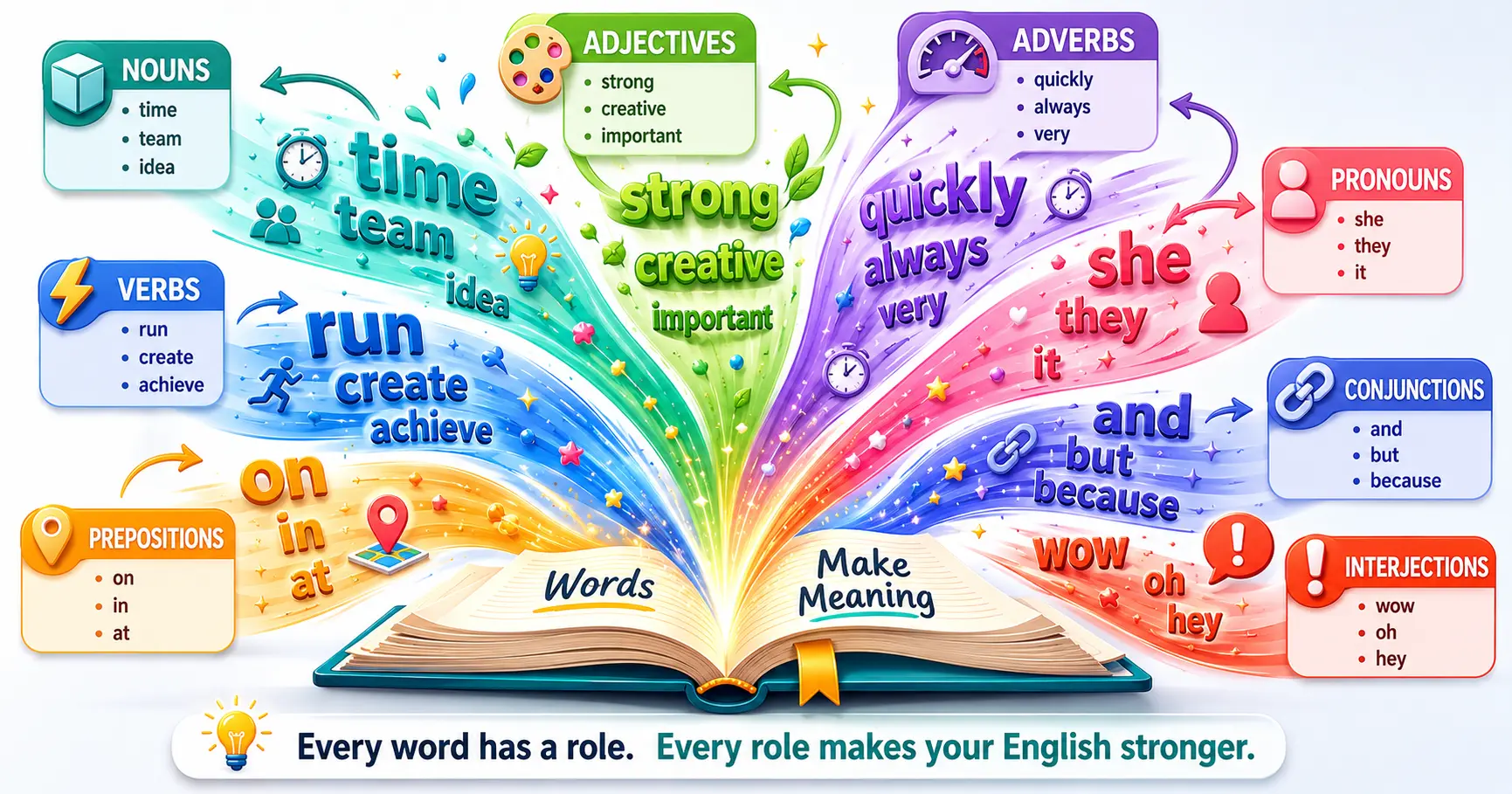
Every English word belongs to at least one part of speech. Whether you are reading a news article, writing an email, or taking an exam, every sentence you encounter is built from the same eight categories: nouns, verbs, adjectives, adverbs, pronouns, prepositions, conjunctions, and interjections. Understanding parts of speech is not just a grammar exercise — it is the key to building vocabulary systematically and using words correctly.
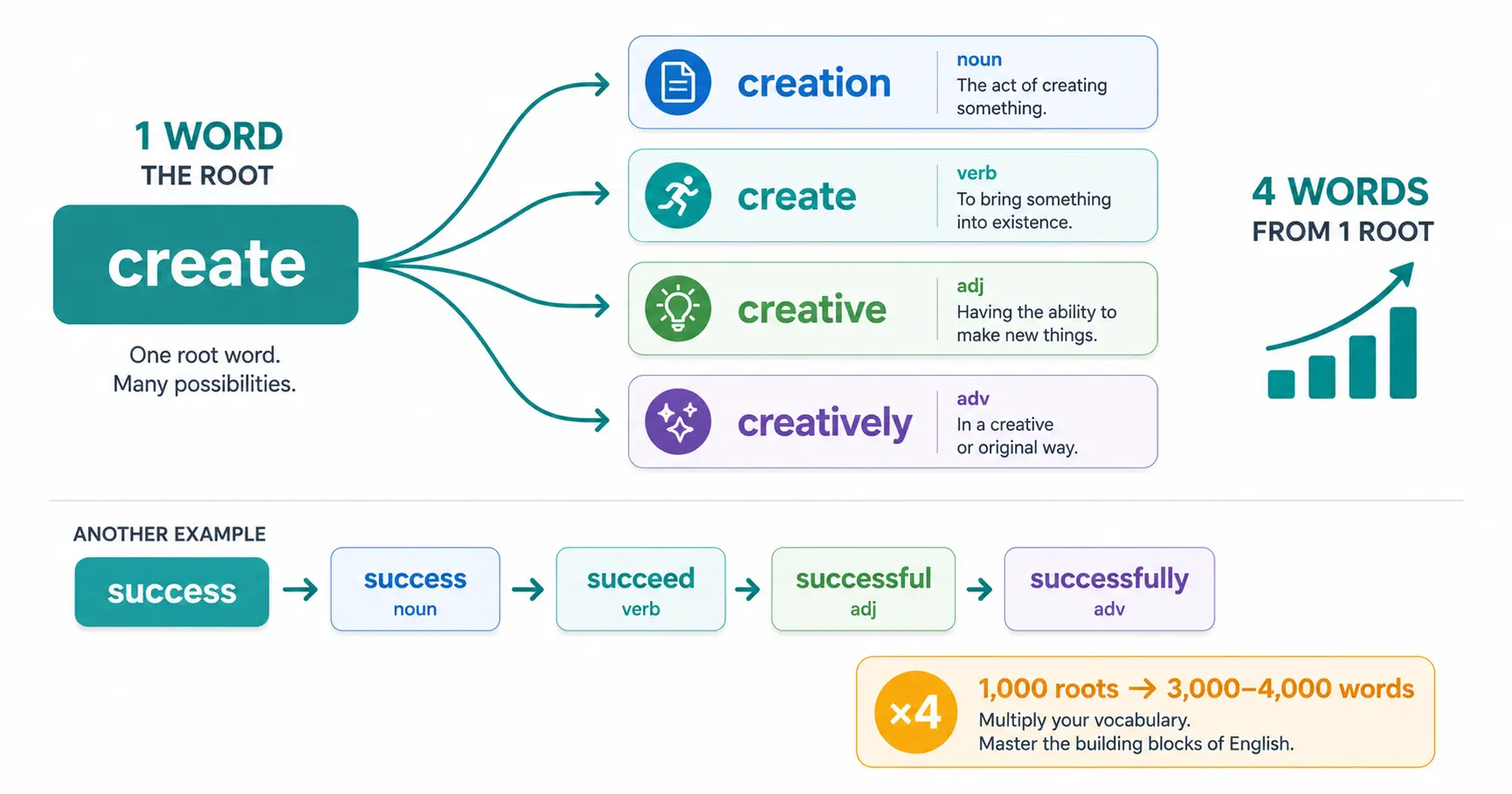
Most learners study vocabulary as isolated items: a word, a definition, maybe an example sentence. But knowing which part of speech a word belongs to tells you how it behaves — where it goes in a sentence, which words it combines with, and how to change its form. “Success” is a noun; “succeed” is a verb; “successful” is an adjective; “successfully” is an adverb. Same root, four different jobs in a sentence. If you confuse them, your sentences break.
This guide covers:
- All 8 parts of speech in English with clear definitions and examples
- Word lists for each category, organized by level and frequency
- How to identify parts of speech in any sentence
- How parts of speech help you build vocabulary faster
- Links to detailed word lists for verbs, adjectives, adverbs, and more
What Are the Parts of Speech?
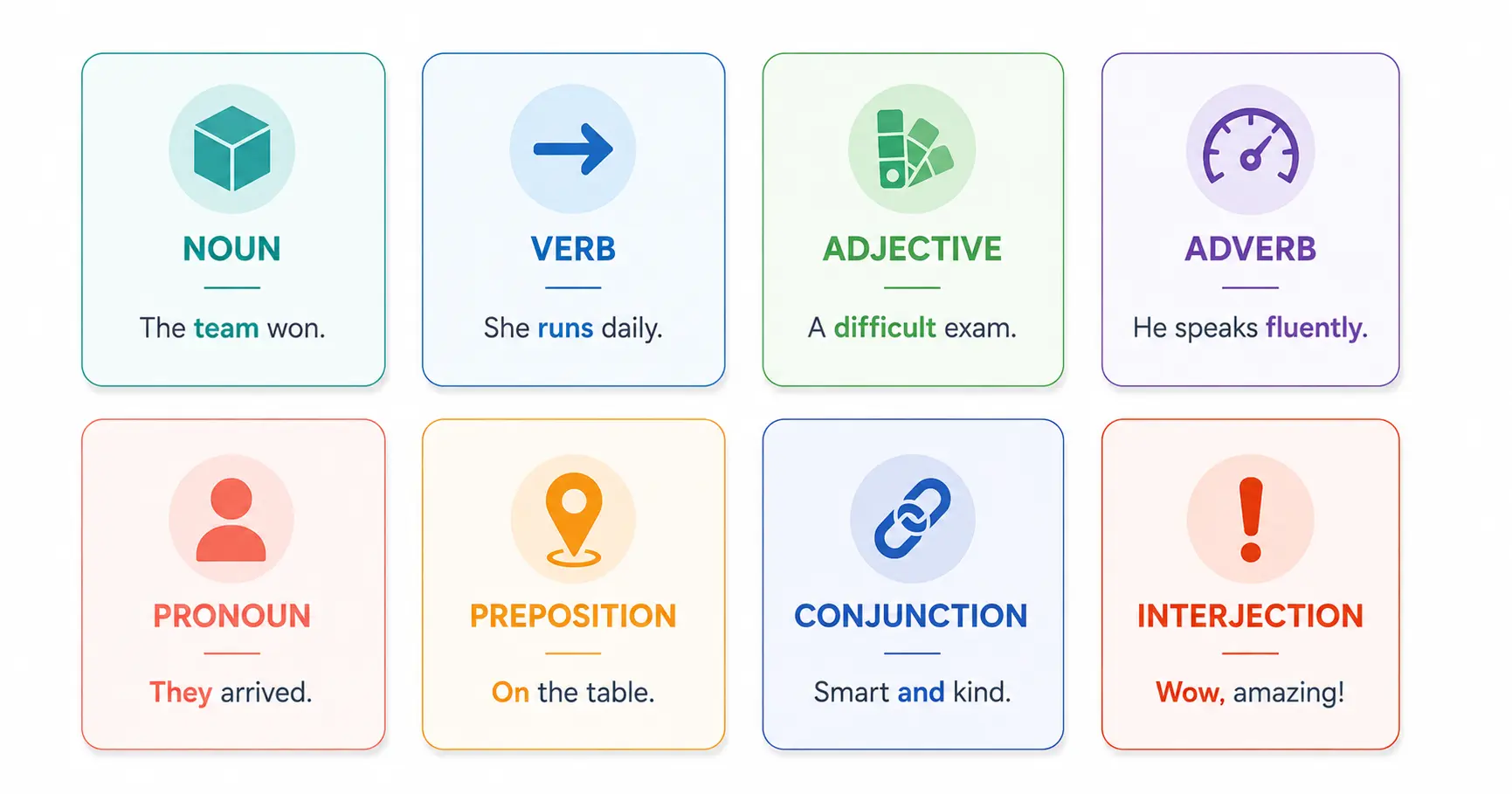
Parts of speech are categories that classify words by their function in a sentence. English has eight:
| Part of Speech | Function | Example |
|---|---|---|
| Noun | Names a person, place, thing, or idea | The team won the game. |
| Verb | Expresses an action or state | She runs every morning. |
| Adjective | Describes a noun | That was a difficult exam. |
| Adverb | Modifies a verb, adjective, or another adverb | He speaks fluently. |
| Pronoun | Replaces a noun | They arrived early. |
| Preposition | Shows relationship between words | The book is on the table. |
| Conjunction | Connects words, phrases, or clauses | I studied and passed. |
| Interjection | Expresses emotion | Wow, that was fast! |
These eight categories apply to every word in the English language. Some words belong to multiple categories depending on context — “run” can be a verb (“I run daily”) or a noun (“a morning run”). Understanding this flexibility is part of mastering English vocabulary.
Nouns: The Building Blocks
Nouns are the most common part of speech. They name people, places, things, ideas, and concepts. In a typical English sentence, at least one or two words are nouns.
Types of Nouns
| Type | What It Names | Examples |
|---|---|---|
| Common nouns | General things | city, teacher, idea, computer |
| Proper nouns | Specific names (capitalized) | London, Dr. Smith, Monday, Toyota |
| Abstract nouns | Things you cannot touch | freedom, happiness, knowledge, courage |
| Concrete nouns | Things you can perceive with senses | table, music, rain, chocolate |
| Countable nouns | Can be counted | book/books, apple/apples, idea/ideas |
| Uncountable nouns | Cannot be counted | water, information, furniture, advice |
| Collective nouns | Groups | team, family, audience, committee |
How to Spot a Noun
Nouns typically:
- Come after articles: a report, the meeting, an idea
- Come after adjectives: a new report, the important meeting
- Can be made plural: report → reports, idea → ideas
- Can be preceded by possessives: my suggestion, their decision
High-Frequency Nouns by Level
A1–A2 (Beginner): name, time, day, year, people, way, man, woman, child, world, life, hand, part, place, case, week, company, system, program, question
B1–B2 (Intermediate): environment, government, development, experience, opportunity, community, relationship, responsibility, technology, education, situation, organization, performance, population, communication
C1–C2 (Advanced): infrastructure, paradigm, phenomenon, implication, bureaucracy, jurisdiction, pragmatism, sustainability, accountability, methodology, stakeholder, discourse, trajectory, scrutiny, resilience
→ Practice noun vocabulary on Linglify
For daily-use nouns and essential vocabulary, see our 1000 most common English words — nouns make up roughly 30% of the list.
Verbs: The Action Words
Verbs are the engine of every sentence. No English sentence is complete without one. They express actions (run, write, build), states (be, seem, exist), and occurrences (happen, become, change).
Types of Verbs
| Type | Function | Examples |
|---|---|---|
| Action verbs | Physical or mental actions | write, think, run, calculate |
| Stative verbs | States, not actions | know, believe, own, prefer |
| Linking verbs | Connect subject to description | be, seem, appear, become, feel |
| Auxiliary verbs | Help main verbs | have (eaten), is (running), do (not go) |
| Modal verbs | Express possibility, ability, permission | can, could, may, might, should, must |
| Phrasal verbs | Verb + particle(s) with new meaning | give up, look after, carry out |
Verb Forms Every Learner Needs
English verbs have up to five forms. Mastering them is essential for tenses and grammar accuracy:
| Base | 3rd Person | Past Simple | Past Participle | Present Participle |
|---|---|---|---|---|
| work | works | worked | worked | working |
| write | writes | wrote | written | writing |
| go | goes | went | gone | going |
| begin | begins | began | begun | beginning |
Regular verbs add -ed for past forms (worked, played, decided). Irregular verbs break this pattern — and there are over 200 of them.
→ See the complete Irregular Verbs List: 200 Verbs with Past Forms
High-Frequency Verbs by Level
A1–A2 (Beginner): be, have, do, say, go, get, make, know, think, take, see, come, want, look, use, find, give, tell, work, call
B1–B2 (Intermediate): achieve, consider, develop, establish, indicate, maintain, obtain, produce, require, suggest, involve, assume, contribute, demonstrate, generate
C1–C2 (Advanced): undermine, scrutinize, encompass, exacerbate, facilitate, substantiate, alleviate, circumvent, perpetuate, consolidate, elicit, stipulate, supersede, transcend, corroborate
→ Read the full English Verbs List: 300 Most Important Verbs → Practice verb vocabulary on Linglify
Phrasal verbs are a special category that gives learners the most trouble. They combine a verb with one or two particles to create entirely new meanings: “look up” (search for information) has nothing to do with looking upward. Our phrasal verbs guide covers 300+ phrasal verbs organized by base verb.
Adjectives: Words That Describe
Adjectives modify nouns. They answer questions like “what kind?”, “how many?”, and “which one?” Without adjectives, you can communicate basic ideas — but with them, you can be precise, vivid, and persuasive.
Types of Adjectives
| Type | What It Does | Examples |
|---|---|---|
| Descriptive | Describes qualities | tall, beautiful, expensive, interesting |
| Quantitative | Indicates quantity | many, few, several, enough, some |
| Demonstrative | Points to specific nouns | this, that, these, those |
| Possessive | Shows ownership | my, your, his, her, their, our |
| Interrogative | Asks questions | which, what, whose |
| Comparative | Compares two things | taller, more expensive, better |
| Superlative | Indicates the extreme | tallest, most expensive, best |
Adjective Order
When multiple adjectives describe the same noun, English has a fixed order. Native speakers follow it intuitively; learners need to memorize it:
Opinion → Size → Age → Shape → Color → Origin → Material → Purpose
| Position | Category | Example |
|---|---|---|
| 1 | Opinion | beautiful, ugly, amazing |
| 2 | Size | big, small, tiny, enormous |
| 3 | Age | old, new, young, ancient |
| 4 | Shape | round, flat, rectangular |
| 5 | Color | red, blue, dark, bright |
| 6 | Origin | British, Japanese, European |
| 7 | Material | wooden, metal, cotton, glass |
| 8 | Purpose | cooking (pot), sleeping (bag) |
So you say “a beautiful large old round brown Italian wooden dining table” — never in any other order. In practice, you rarely stack more than two or three adjectives, but knowing the order prevents awkward-sounding phrases.
High-Frequency Adjectives by Level
A1–A2 (Beginner): good, new, big, small, long, old, young, different, important, possible, last, first, next, early, great, little, high, free, right, sure
B1–B2 (Intermediate): available, significant, appropriate, effective, relevant, essential, substantial, consistent, comprehensive, fundamental, competitive, sufficient, legitimate, subsequent, compatible
C1–C2 (Advanced): ubiquitous, ostensible, unprecedented, innocuous, pejorative, idiosyncratic, perfunctory, unequivocal, recalcitrant, commensurate, ephemeral, indefatigable, quintessential, perspicacious, superfluous
→ Read the full 500 English Adjectives List: From Basic to Advanced → Practice adjective vocabulary on Linglify
Adverbs: The Modifiers
Adverbs modify verbs, adjectives, other adverbs, or entire sentences. They answer “how?”, “when?”, “where?”, “how often?”, and “to what degree?”
Types of Adverbs
| Type | Question | Examples |
|---|---|---|
| Manner | How? | quickly, carefully, fluently, well |
| Time | When? | now, yesterday, soon, already, recently |
| Place | Where? | here, there, everywhere, outside, nearby |
| Frequency | How often? | always, usually, sometimes, rarely, never |
| Degree | How much? | very, extremely, quite, fairly, barely |
| Sentence | What is the speaker’s attitude? | fortunately, obviously, apparently, frankly |
Adverb Formation
Most adverbs are formed by adding -ly to an adjective:
| Adjective | Adverb |
|---|---|
| quick | quickly |
| careful | carefully |
| comfortable | comfortably |
| easy | easily |
| dramatic | dramatically |
But some of the most common adverbs are irregular — they do not follow the -ly pattern:
| Adjective | Adverb | Common Mistake |
|---|---|---|
| good | well |
|
| fast | fast |
|
| hard | hard |
|
| late | late |
|
Adverb Placement
Adverb position in English follows patterns:
| Adverb Type | Typical Position | Example |
|---|---|---|
| Manner | After the verb/object | She speaks English fluently. |
| Frequency | Before the main verb | I always check my email first. |
| Time | Beginning or end of sentence | Yesterday we had a meeting. |
| Degree | Before the word it modifies | This is extremely important. |
| Sentence | Beginning of sentence | Unfortunately, the flight was cancelled. |
High-Frequency Adverbs by Level
A1–A2 (Beginner): very, also, often, always, sometimes, never, here, there, now, today, already, still, just, really, well, too, only, then, again, enough
B1–B2 (Intermediate): significantly, approximately, essentially, increasingly, primarily, consequently, furthermore, specifically, relatively, inevitably, typically, ultimately, presumably, simultaneously, predominantly
C1–C2 (Advanced): ostensibly, inadvertently, unequivocally, paradoxically, categorically, indiscriminately, exponentially, disproportionately, unconditionally, retrospectively
→ Read the full English Adverbs List: 200+ Words by Category → Practice adverb vocabulary on Linglify
Pronouns: The Replacements
Pronouns replace nouns to avoid repetition. Instead of “Sarah said Sarah would bring Sarah’s laptop to Sarah’s office,” we say “Sarah said she would bring her laptop to her office.”
Types of Pronouns
| Type | Function | Examples |
|---|---|---|
| Personal | Replace specific people/things | I, you, he, she, it, we, they |
| Object | Receive the action | me, you, him, her, it, us, them |
| Possessive | Show ownership | mine, yours, his, hers, ours, theirs |
| Reflexive | Refer back to subject | myself, yourself, himself, herself, ourselves |
| Demonstrative | Point to specific things | this, that, these, those |
| Relative | Connect clauses | who, whom, which, that, whose |
| Interrogative | Ask questions | who, what, which, whom, whose |
| Indefinite | Refer to non-specific things | someone, anyone, everyone, nobody, each, both |
Pronoun Reference Table
| Subject | Object | Possessive Adj. | Possessive Pron. | Reflexive |
|---|---|---|---|---|
| I | me | my | mine | myself |
| you | you | your | yours | yourself |
| he | him | his | his | himself |
| she | her | her | hers | herself |
| it | it | its | — | itself |
| we | us | our | ours | ourselves |
| they | them | their | theirs | themselves |
Common Pronoun Mistakes
- it’s vs its: “it’s” = “it is” or “it has.” “Its” = belonging to it. “The company changed its name.”
- who vs whom: “who” = subject. “Whom” = object. “Who called?” vs “To whom did you speak?”
- they (singular): In modern English, “they” is widely accepted as a singular pronoun for a person of unknown gender. “If a student has a question, they should ask.”
Prepositions: The Connectors
Prepositions show relationships between words — usually in terms of time, place, direction, or manner. They are small words with enormous impact: changing “on” to “in” or “at” completely changes meaning.
Prepositions by Category
Time:
| Preposition | Usage | Example |
|---|---|---|
| at | Specific times | at 3 PM, at midnight, at noon |
| on | Days and dates | on Monday, on July 4th, on my birthday |
| in | Months, years, seasons, parts of day | in March, in 2026, in summer, in the morning |
| by | Deadline | by Friday, by next week |
| during | Throughout a period | during the meeting, during summer |
| since | From a point in past | since 2020, since Monday |
| for | Duration | for three hours, for a long time |
Place:
| Preposition | Usage | Example |
|---|---|---|
| at | Specific point or location | at the airport, at home, at the corner |
| on | Surface or line | on the table, on the wall, on Main Street |
| in | Enclosed space | in the room, in Tokyo, in a box |
| between | Two reference points | between the bank and the post office |
| among | Within a group | among the students, among friends |
Direction:
| Preposition | Usage | Example |
|---|---|---|
| to | Toward a destination | go to school, fly to Paris |
| into | Moving inside | walk into the room, dive into the water |
| out of | Moving outside | get out of the car, move out of the city |
| through | Moving within and exiting | walk through the park, drive through the tunnel |
| across | From one side to the other | swim across the river, walk across the street |
The Hardest Prepositions for Learners
The trio at / on / in causes more errors than any other prepositions. There is no single rule that covers all cases — you need to learn common collocations:
- at work, at school, at a party, at the beginning
- on the phone, on a team, on vacation, on time
- in trouble, in charge, in a hurry, in advance
Many prepositional phrases must be memorized as fixed units. See our English collocations guide for hundreds of verb + preposition combinations.
Conjunctions: The Sentence Builders
Conjunctions join words, phrases, and clauses. They are essential for writing complex sentences and expressing relationships between ideas — cause, contrast, addition, and time.
Three Types of Conjunctions
Coordinating conjunctions (FANBOYS) join equal elements:
| Conjunction | Function | Example |
|---|---|---|
| for | reason | She stayed home, for she was ill. |
| and | addition | I study English and Japanese. |
| nor | negative addition | He does not sing, nor does he dance. |
| but | contrast | It is old but reliable. |
| or | alternative | Tea or coffee? |
| yet | contrast/surprise | Simple yet effective. |
| so | result | It rained, so we stayed inside. |
Subordinating conjunctions connect dependent clauses to main clauses:
| Function | Conjunctions | Example |
|---|---|---|
| Time | when, while, before, after, until, since, as soon as | Call me when you arrive. |
| Cause | because, since, as | I left early because traffic was bad. |
| Condition | if, unless, provided that, as long as | I will go if you come with me. |
| Contrast | although, even though, while, whereas | Although it rained, we went outside. |
| Purpose | so that, in order that | She studies hard so that she can pass. |
Correlative conjunctions work in pairs:
| Pair | Example |
|---|---|
| both…and | Both Japan and Korea use TOEIC. |
| either…or | You can study either online or in class. |
| neither…nor | Neither the teacher nor the students were late. |
| not only…but also | She is not only smart but also hardworking. |
| whether…or | I cannot decide whether to stay or to go. |
For a comprehensive reference on connecting words used in writing, see our Linking Words in English: 100+ Connectors for Writing.
Interjections: Emotional Expressions
Interjections are words or short phrases that express emotion. They are grammatically independent — they do not connect to other parts of the sentence. They appear mostly in spoken English and informal writing.
| Emotion | Interjection | Example |
|---|---|---|
| Surprise | oh, wow, whoa | Wow, that is amazing! |
| Pain | ouch, ow | Ouch, that hurt! |
| Happiness | yay, hooray, yes | Hooray, we won! |
| Frustration | ugh, argh, damn | Ugh, not again. |
| Hesitation | um, uh, er, hmm | Hmm, let me think about that. |
| Agreement | yeah, sure, absolutely | Sure, I can help. |
| Greeting | hi, hey, hello | Hey, how are you? |
| Understanding | oh, aha, I see | Aha, now I understand! |
Interjections are the least important part of speech for exams and formal writing. But they are essential for natural spoken English and for understanding casual conversations, movies, and podcasts.
How Parts of Speech Help You Build Vocabulary
Understanding parts of speech is not just grammar knowledge — it is a vocabulary multiplier. Here is how:
1. Word Families Expand Your Vocabulary 4x
When you learn one word, its word family gives you three or four more:
| Noun | Verb | Adjective | Adverb |
|---|---|---|---|
| success | succeed | successful | successfully |
| creation | create | creative | creatively |
| decision | decide | decisive | decisively |
| importance | — | important | importantly |
| analysis | analyze | analytical | analytically |
| strength | strengthen | strong | strongly |
| difference | differ | different | differently |
| achievement | achieve | achievable | — |
If you know 1,000 base words and learn their word families, your functional vocabulary jumps to 3,000–4,000 words. This is one of the fastest ways to improve your vocabulary.
2. Suffixes Signal Part of Speech
You can often identify a word’s part of speech from its ending alone:
| Ending | Part of Speech | Examples |
|---|---|---|
| -tion, -sion, -ment, -ness, -ity | Noun | education, decision, improvement, kindness, creativity |
| -ate, -ize, -ify, -en | Verb | educate, realize, simplify, strengthen |
| -ous, -ive, -ful, -less, -able | Adjective | dangerous, creative, helpful, careless, comfortable |
| -ly | Adverb (usually) | quickly, carefully, unfortunately |
When you encounter an unfamiliar word in reading, check its suffix. If it ends in -tion, it is probably a noun. If it ends in -ize, it is probably a verb. This instantly gives you context for guessing the meaning.
3. Correct Part of Speech = Correct Sentences
Many learner errors come from using the wrong part of speech:
| Incorrect | Correct | Problem |
|---|---|---|
| The important of education is clear. | The importance of education is clear. | Adjective used where noun is needed |
| She success in her career. | She succeeded in her career. | Noun used where verb is needed |
| He runs quick. | He runs quickly. | Adjective used where adverb is needed |
| This is a beauty day. | This is a beautiful day. | Noun used where adjective is needed |
Exams like IELTS, TOEFL, and TOEIC specifically test your ability to choose the correct word form. Knowing parts of speech eliminates an entire category of errors.
How to Study Parts of Speech Effectively
Step 1: Learn the Eight Categories
Use the overview table at the top of this article. For each part of speech, make sure you understand its function and can identify examples in a sentence.
Step 2: Study Word Families, Not Isolated Words
When you learn a new word, always check:
- What part of speech is it?
- What are its other forms? (noun → verb → adjective → adverb)
- Which form do I need most often?
Add all useful forms to your Linglify dictionary.
Step 3: Practice Identification
Take any English paragraph and label the part of speech for each word. Start with simple sentences and work up to complex ones. This exercise builds awareness that transfers to reading, writing, and exam performance.
Step 4: Focus on One Part of Speech at a Time
Dedicate study sessions to specific word types. Spend a week on verbs, another week on adjectives, another on adverbs. This focused approach builds deeper knowledge than studying mixed vocabulary.
Step 5: Use Spaced Repetition
Add words to your Linglify dictionary tagged by part of speech. Review them at increasing intervals. Our guide on how to memorize vocabulary explains why this method is 3–4 times more effective than traditional study.
Words to Practice
These 25 words span all major parts of speech and multiple levels. Add them to your Linglify dictionary for spaced repetition practice.
boom
noun
A loud, deep sound or a sudden increase in activity or popularity.
Examples
- The boom of thunder echoed across the valley.
- The technology boom created many new millionaires.
cooperate
verb
To work together with others towards a common goal.
candidate
noun
A person who is competing in an election or contest.
Examples
- Each presidential candidate presented their policy plans to voters.
- The job candidate impressed the interview panel with her experience.
evaluate
verb
To judge or measure the value, quality, or importance of something.
Examples
- Companies evaluate job candidates based on experience, skills, and personality.
- Teachers evaluate student progress through tests, projects, and classroom participation.
indispensable
adjective
Absolutely necessary; essential.
Examples
- Clean water is indispensable for human survival and good health.
- Her experience and skills make her indispensable to the research team.
normally
adverb
Usually; under normal conditions.
Examples
- Heart normally beats between sixty and hundred times per minute.
- Students normally arrive at school before morning bell rings.
discourage
verb
To try to make someone feel less confident or hopeful about something.
Examples
- Don't let one failure discourage you from pursuing your dreams.
- High prices discourage many people from buying organic food products.
jury
noun
A group of people who listen to evidence in a court and decide if someone is guilty.
Examples
- The jury deliberated for several hours before reaching a verdict.
- The talent show jury consisted of professional musicians and entertainers.
resolve
verb
To find a solution or answer to a problem or question.
Examples
- Mediator helps parties resolve dispute through negotiation.
- Technical team will resolve software problems quickly.
graduate
verb
To complete a course of study at a school or university.
Examples
- She will graduate from university next year with a degree in engineering.
- Students must complete all requirements before they can graduate from high school.
total
adjective
An adjective describing something that is complete or whole, not divided or broken.
Examples
- Total cost includes all fees and expenses.
- Total silence fills room during meditation session.
donate
verb
To give something, especially money or goods, to help a cause or person.
Examples
- Many people donate money to charities that help homeless individuals.
- She decided to donate blood to help patients in emergency situations.
firmly
adverb
An adverb indicating a way of doing something with certainty or stability.
Examples
- Hold the rope firmly while climbing down the steep mountain slope.
- The manager firmly believed in treating all employees with respect.
lifelong
adjective
Continuing for a very long time or for the whole life.
Examples
- Learning is a lifelong process that never truly ends.
- Their lifelong friendship began during elementary school years.
guide
verb
To show or direct someone how to do something.
Examples
- Parents should guide their children to make responsible decisions.
- The experienced hiker will guide the group through the mountain trail safely.
tragedy
noun
An extremely sad or serious event that causes suffering or loss.
Examples
- Natural tragedy affects thousands of innocent people.
- Personal tragedy changes person's life perspective completely.
motivated
adjective
Feeling driven or inspired to do something because of a reason or goal.
Examples
- Motivated employee seeks additional responsibilities and challenges at work.
- Success requires being motivated even when facing difficult obstacles.
prejudice
noun
Preconceived opinions or feelings, often negative, about a person or group.
Examples
- Education helps overcome prejudice and promotes understanding.
- Racial prejudice damages communities and individuals alike.
voyage
noun
A long journey to a distant place, often by sea or air.
Examples
- Space exploration represents humanity's greatest voyage into the unknown.
- The ocean voyage from Europe to America took several weeks in the past.
horizon
noun
The line where the earth or the sky appears to meet in the distance.
Examples
- The sun disappeared behind the horizon as evening approached.
- Traveling broadens your horizon and exposes you to new cultures.
off
adjective
Describes something that is not fresh or is no longer suitable for eating, often used for food and drinks.
Examples
- Please turn off the lights before leaving the room.
- The dog ran off into the forest chasing wild rabbits.
stress
verb
To feel mental or emotional pressure or worry; to emphasize or give importance to something.
Examples
- Heavy workload may stress employees beyond limits.
- Teacher will stress importance of homework completion.
union
noun
A group of people or things joined together for a purpose.
Examples
- Labor union protects worker rights and interests.
- Marriage union joins two people in partnership.
humorous
adjective
Funny or amusing, often making people laugh.
Examples
- She writes humorous articles about everyday life and family experiences.
- The humorous speech made everyone laugh and lightened the serious mood.
admission
noun
The process or fact of being allowed to enter or join.
Examples
- Her admission to the prestigious medical school was the result of hard work.
- The museum offers free admission on the first Sunday of every month.
Common Mistakes to Avoid
-
Confusing adjectives and adverbs. “She sings beautiful” is wrong — it should be “She sings beautifully.” Verbs are modified by adverbs, not adjectives. If the word describes how an action is done, use the -ly form.
-
Using the wrong word form in sentences. “The develop of technology” should be “The development of technology.” Check which part of speech the sentence position requires (after “the” → noun).
-
Treating uncountable nouns as countable. “Many informations” and “an advice” are incorrect. Information, advice, furniture, equipment, and research are uncountable nouns — no plural, no “a/an.”
-
Forgetting irregular forms. Not all past tenses end in -ed, not all adverbs end in -ly, and not all plurals end in -s. Irregular forms must be memorized. See our irregular verbs list for the most important ones.
-
Ignoring preposition collocations. You “depend on“ someone (not “depend of”), “consist of“ parts (not “consist from”), and are “interested in“ something (not “interested for”). These must be learned as fixed phrases.
-
Overusing simple words. If every noun in your writing is “thing” and every adjective is “good” or “bad,” you are not using the full range of English. Study advanced English words to add precision to your vocabulary.
What to Do Next
-
Start with your weakest part of speech. If verbs are your biggest challenge, work through our English Verbs List: 300 Most Important Verbs and Irregular Verbs List. If adjectives need work, read the 500 English Adjectives List.
-
Add 10 words from the practice section above to your Linglify dictionary. Tag each with its part of speech so you can review by category.
-
Learn word families for words you already know. Pick 20 words from your existing vocabulary and find their noun, verb, adjective, and adverb forms. This instantly expands your usable vocabulary.
-
Read something in English today and identify the parts of speech in the first paragraph. This takes 5 minutes and builds grammatical awareness that improves everything else.
-
Explore our vocabulary guides for each major word type:
FAQ
What are the 8 parts of speech in English?
The eight parts of speech are: nouns, verbs, adjectives, adverbs, pronouns, prepositions, conjunctions, and interjections. Every English word belongs to at least one of these categories. Some words can function as multiple parts of speech depending on context — for example, “light” can be a noun (the light), a verb (light a candle), or an adjective (a light color).
Which part of speech is most important to learn first?
Verbs and nouns should be your first priority — they form the core of every sentence. You cannot communicate without them. After mastering essential verbs and nouns, move to adjectives (to add detail) and adverbs (to add precision). Pronouns, prepositions, and conjunctions come next. Interjections are the lowest priority for formal learning.
How do I identify the part of speech of a word?
Look at the word’s function in the sentence and its form. Ask: Is it naming something (noun)? Describing an action (verb)? Modifying a noun (adjective)? Modifying a verb (adverb)? Suffixes help too: -tion usually signals a noun, -ous signals an adjective, -ly signals an adverb, and -ize signals a verb.
Can a word be more than one part of speech?
Yes, many English words function as multiple parts of speech. “Run” is a verb (“I run”) and a noun (“a morning run”). “Fast” is an adjective (“a fast car”) and an adverb (“drive fast”). “Light” can be a noun, verb, or adjective. Context determines which part of speech a word is in any given sentence.
How many nouns, verbs, and adjectives are there in English?
Precise counts are impossible because the language constantly grows. Estimates suggest English has roughly 100,000+ nouns, 25,000+ verbs, and 20,000+ adjectives. However, learners need far fewer: the 4000 most essential English words cover approximately 95% of everyday English, and they include roughly 1,200 nouns, 600 verbs, and 500 adjectives.
Why do IELTS and TOEFL test parts of speech?
These exams test whether you can use the correct word form in context. If you write “the important of education” instead of “the importance of education,” it signals weak grammar control. Both IELTS and TOEFL use fill-in-the-blank, paraphrasing, and essay tasks where choosing the right part of speech directly affects your score.
What is the difference between adjectives and adverbs?
Adjectives modify nouns (a quick decision), while adverbs modify verbs, adjectives, or other adverbs (she decided quickly). The most common confusion: using an adjective where an adverb is needed. “He drives careful” is wrong — “He drives carefully” is correct because “carefully” modifies the verb “drives.”
How do parts of speech help with vocabulary building?
When you learn one word and its word family (all parts of speech), you multiply your vocabulary. Learning “create” (verb) also gives you “creation” (noun), “creative” (adjective), and “creatively” (adverb) — four words from one root. Understanding suffixes lets you decode unfamiliar words: if you know “sustain,” you can guess that “sustainability” is a noun and “sustainable” is an adjective. Our vocabulary builder guide explains this system in detail.