English Collocations: Master Natural Word Combinations with 300+ Examples
You can know 10,000 English words and still sound wrong. Not ungrammatical — wrong. The kind of wrong that makes native speakers pause, tilt their head, and say “I understand you, but we don’t say it that way.” The reason is almost always collocations.
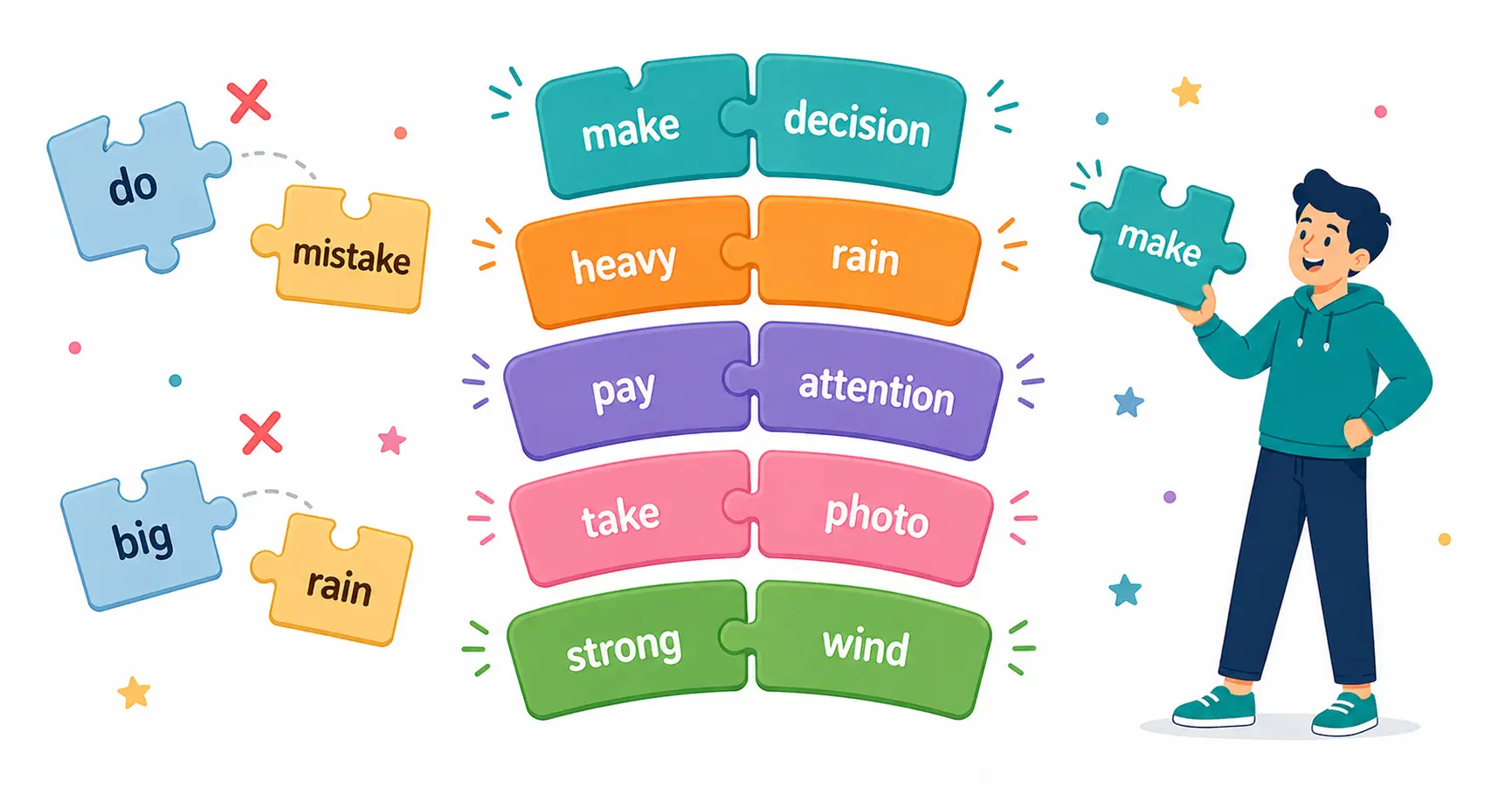
A collocation is a pair or group of words that naturally go together in English. Native speakers say “make a decision” — not “do a decision.” They say “heavy rain” — not “strong rain.” They say “take a photo” — not “catch a photo.” Each individual word is correct. The grammar is fine. But the combination is wrong, and it immediately marks you as a non-native speaker.
The difference between a B2 learner and a C1 speaker is rarely grammar. It is collocations. This is the vocabulary skill that textbooks skip, that apps ignore, and that makes the biggest difference to how natural your English sounds.
This guide covers:
- what collocations are and why they matter,
- the 6 types of collocations with clear examples,
- 300+ essential collocations organized by type,
- the most common collocation mistakes learners make,
- how to learn collocations effectively.
What Is a Collocation?
A collocation is a combination of words that frequently appear together and sound natural to native speakers. The word comes from Latin: co- (together) + locare (to place) — literally “placed together.”
The key feature: collocations are not rules — they are habits. There is no grammar rule that says “heavy rain” is correct and “strong rain” is wrong. Both words mean “a lot.” But English speakers chose “heavy” for rain, and over centuries, that combination became fixed. You must learn them as pairs, not deduce them from logic.
| Natural (Correct) | Unnatural (Wrong) | Why? |
|---|---|---|
| make a decision |
|
English uses MAKE with “decision” |
| heavy rain |
|
“Heavy” collocates with rain |
| take a photo |
|
English uses TAKE with “photo” |
| fast food |
|
“Fast” is the fixed modifier for this type of food |
| pay attention |
|
English uses PAY with “attention” |
| do homework |
|
English uses DO with “homework” |
Why Collocations Matter
1. They separate fluent speakers from accurate speakers. You can be 100% grammatically correct and still sound unnatural. Collocations are what make the difference.
2. They affect your exam scores. In IELTS, the “Lexical Resource” criterion specifically evaluates collocation accuracy. Band 7 requires “awareness of style and collocation.” Band 8 requires “skilful use of uncommon lexical items” with “only occasional inaccuracies in word choice and collocation.”
3. They speed up communication. When you use correct collocations, listeners process your speech faster because the word combinations match their expectations. Wrong collocations create micro-pauses in comprehension.
4. They are the foundation of natural writing. Academic essays, business emails, and creative writing all rely on standard collocations. “Conduct research” sounds professional. “Do research” sounds adequate. “Make research” sounds wrong.
Collocations vs. Idioms vs. Phrasal Verbs
| Feature | Collocation | Idiom | Phrasal Verb |
|---|---|---|---|
| Meaning | Predictable from parts | Non-literal | Non-literal |
| Example | make a mistake | kick the bucket (= die) | give up (= quit) |
| Fixed? | Semi-fixed (some flexibility) | Completely fixed | Fixed |
| Translatable? | Often yes | Usually no | Usually no |
| Key skill | Knowing which words go together | Knowing the hidden meaning | Knowing the new meaning |
The overlap: some phrasal verbs are also collocations (“take off” in “the plane took off”), and some idioms contain collocations (“break the ice” uses “break” + “ice”). But the core distinction holds: collocations are about which words belong together, idioms are about hidden meanings.
For a complete idiom reference, see English Idioms: 500+ Common Expressions. For phrasal verbs, see English Phrasal Verbs: The Complete Guide.
Types of Collocations
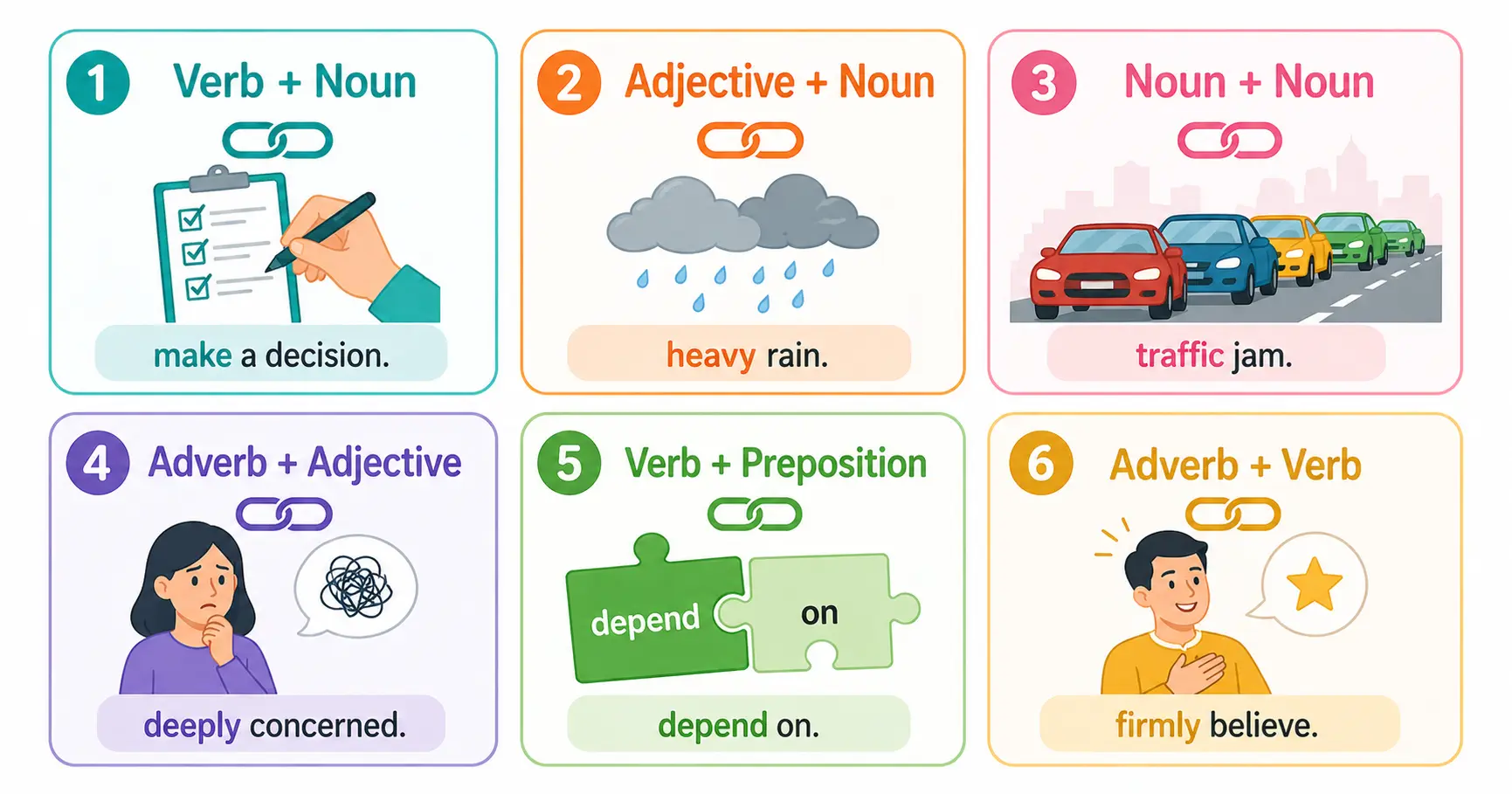
English collocations fall into 6 main types. Understanding the type helps you predict patterns and learn faster.
Type 1: Verb + Noun
The most important type for learners. MAKE, DO, TAKE, GET, HAVE, PAY, GIVE, KEEP, BREAK, and CATCH each have dozens of fixed noun partners.
MAKE
| Collocation | Example |
|---|---|
| make a decision | We need to make a decision by Friday. |
| make a mistake | Everyone makes mistakes — the key is learning from them. |
| make progress | The students are making good progress this term. |
| make an effort | He didn’t even make an effort to arrive on time. |
| make money | She makes good money as a software engineer. |
| make a difference | Small changes can make a big difference over time. |
| make a plan | Let’s make a plan before we start the project. |
| make an appointment | I need to make an appointment with the dentist. |
| make a complaint | She made a formal complaint about the noise. |
| make a promise | He made a promise to his daughter and kept it. |
| make an impression | First impressions matter — make a good one. |
| make a choice | You have to make a choice between the two options. |
| make sense | That explanation doesn’t make sense to me. |
| make room | Can you make room for one more person? |
| make a living | It’s hard to make a living as a freelance writer. |
| make a suggestion | Can I make a suggestion? |
| make an exception | I’ll make an exception this time, but don’t be late again. |
| make arrangements | We need to make arrangements for the conference. |
DO
| Collocation | Example |
|---|---|
| do homework | Have you done your homework yet? |
| do the dishes | I’ll do the dishes after dinner. |
| do business (with) | We’ve been doing business with them for 10 years. |
| do research | She’s doing research on climate change. |
| do damage | The storm did significant damage to the coast. |
| do your best | Just do your best — that’s all anyone can ask. |
| do a favor | Could you do me a favor and check my email? |
| do the laundry | I need to do the laundry this weekend. |
| do a good job | She did a great job on the presentation. |
| do harm | The new policy may do more harm than good. |
| do exercise | I try to do some exercise every morning. |
| do an experiment | The students did an experiment to test the hypothesis. |
TAKE
| Collocation | Example |
|---|---|
| take a photo / picture | Can you take a photo of us? |
| take a break | Let’s take a 10-minute break. |
| take action | The government must take action to reduce pollution. |
| take a risk | Starting a business means taking risks. |
| take a look | Take a look at this report. |
| take a seat | Please take a seat — the doctor will see you shortly. |
| take notes | She always takes detailed notes in class. |
| take responsibility | He took responsibility for the error. |
| take advice | I should have taken your advice. |
| take a chance | I took a chance and applied for the job. |
| take care (of) | Take care of yourself while I’m away. |
| take turns | The children took turns playing with the toy. |
| take part (in) | Over 200 people took part in the marathon. |
| take place | The meeting will take place on Monday at 3 PM. |
| take time | Learning a language takes time. |
GET, HAVE, PAY, GIVE
| Collocation | Example |
|---|---|
| get permission | You need to get permission from the manager. |
| get a job | She got a job at a tech company after graduation. |
| get an idea | I’ve just got an idea for the project. |
| get the impression | I got the impression that he wasn’t happy. |
| have a meeting | We’re having a meeting at 2 PM. |
| have a conversation | Let’s have a conversation about your performance. |
| have an argument | They had an argument about money. |
| have a look | Have a look at this and tell me what you think. |
| have an effect (on) | Sleep has a huge effect on your concentration. |
| have access (to) | Students have access to the library 24/7. |
| pay attention | Pay attention — this will be on the exam. |
| pay a compliment | He paid her a compliment on her presentation. |
| pay a visit | I’ll pay you a visit when I’m in London. |
| give advice | She gave me some excellent advice. |
| give permission | The teacher gave them permission to leave early. |
| give a speech | The CEO gave a speech at the conference. |
| give priority (to) | We should give priority to urgent cases. |
KEEP, BREAK, CATCH, COME
| Collocation | Example |
|---|---|
| keep a secret | Can you keep a secret? |
| keep a promise | Always keep your promises. |
| keep in touch | Let’s keep in touch after you move. |
| keep a record | Keep a record of all your expenses. |
| keep calm | Keep calm — panicking won’t help. |
| break the law | If you break the law, you face consequences. |
| break a record | She broke the world record in the 100m sprint. |
| break the rules | He’s always breaking the rules at school. |
| break the news | I had to break the news to her about the layoffs. |
| break a habit | Breaking a bad habit takes about 66 days on average. |
| catch a cold | I caught a cold from someone at the office. |
| catch fire | The building caught fire due to faulty wiring. |
| catch someone’s attention | The headline caught my attention immediately. |
| come to a conclusion | After reviewing the data, we came to a conclusion. |
| come to an agreement | Both parties came to an agreement after long negotiations. |
Type 2: Adjective + Noun
These collocations determine which adjectives “belong” with which nouns. Getting these right is one of the fastest ways to sound more natural.
| Collocation | NOT | Example |
|---|---|---|
| heavy rain |
|
There was heavy rain all weekend. |
| strong wind |
|
A strong wind blew the tent away. |
| heavy traffic |
|
We were stuck in heavy traffic for two hours. |
| fast food |
|
I try to avoid fast food as much as possible. |
| deep sleep |
|
She was in such a deep sleep that the alarm didn’t wake her. |
| high temperature |
|
The patient has a high temperature. |
| strong coffee |
|
I need a strong coffee this morning. |
| broad daylight |
|
The robbery happened in broad daylight. |
| close friend |
|
She’s one of my closest friends. |
| bitter cold |
|
We endured the bitter cold for three hours. |
| narrow escape |
|
We had a narrow escape — the car missed us by inches. |
| bright idea |
|
Whose bright idea was it to start at 5 AM? |
| keen interest |
|
She took a keen interest in the project. |
| blissful ignorance |
|
He lived in blissful ignorance of the company’s problems. |
| sharp increase |
|
There was a sharp increase in online sales. |
| slight problem |
|
There’s a slight problem with the schedule. |
| steady progress |
|
The team is making steady progress toward the deadline. |
| bitter disappointment |
|
The result was a bitter disappointment for the team. |
| golden opportunity |
|
This is a golden opportunity to expand the business. |
| overwhelming majority |
|
The overwhelming majority voted in favor. |
Type 3: Noun + Noun
Some nouns are conventionally paired together.
| Collocation | Example |
|---|---|
| traffic jam | We were stuck in a traffic jam for an hour. |
| road rage | Road rage incidents have increased this year. |
| blood pressure | The doctor checked my blood pressure. |
| cell phone | I left my cell phone at home. |
| greenhouse effect | The greenhouse effect is causing global warming. |
| heart attack | He suffered a heart attack at the age of 52. |
| job satisfaction | Job satisfaction is more important than a high salary to many people. |
| budget cuts | The university announced major budget cuts. |
| career change | She made a career change at 40 and became a teacher. |
| human rights | The organization campaigns for human rights worldwide. |
| climate change | Climate change is the defining issue of our time. |
| time management | Good time management is essential for university success. |
| brain drain | Brain drain is a serious problem for developing countries. |
| birth rate | The birth rate has been declining in many European countries. |
| action plan | We need a clear action plan for the next quarter. |
Type 4: Adverb + Adjective
These collocations intensify or modify adjectives in specific, fixed ways.
| Collocation | NOT | Example |
|---|---|---|
| highly unlikely |
|
It’s highly unlikely that the project will finish on time. |
| deeply concerned |
|
I am deeply concerned about the recent test results. |
| bitterly disappointed |
|
She was bitterly disappointed with the outcome. |
| perfectly natural |
|
It’s perfectly natural to feel nervous before an interview. |
| fully aware |
|
I’m fully aware of the risks involved. |
| utterly ridiculous |
|
The suggestion was utterly ridiculous. |
| wildly popular |
|
The show became wildly popular overnight. |
| painfully obvious |
|
It was painfully obvious that he hadn’t prepared. |
| blissfully unaware |
|
She was blissfully unaware of the chaos behind her. |
| seriously injured |
|
Three people were seriously injured in the accident. |
| heavily influenced |
|
Her work was heavily influenced by Japanese art. |
| vitally important |
|
It is vitally important to follow the safety procedures. |
| strictly forbidden |
|
Smoking is strictly forbidden inside the building. |
| widely recognized |
|
She is widely recognized as a leading expert in the field. |
Type 5: Verb + Preposition
These are not phrasal verbs — the verb keeps its core meaning, but requires a specific preposition.
| Collocation | NOT | Example |
|---|---|---|
| depend on |
|
The outcome depends on several factors. |
| believe in |
|
Do you believe in life after death? |
| succeed in |
|
She succeeded in passing the bar exam on her first try. |
| apologize for |
|
He apologized for being late. |
| insist on |
|
She insisted on paying for dinner. |
| complain about |
|
He always complains about the weather. |
| concentrate on |
|
I need to concentrate on my work. |
| consist of |
|
The team consists of five members. |
| refer to |
|
Are you referring to the report I sent yesterday? |
| belong to |
|
This book belongs to the library. |
| respond to |
|
She hasn’t responded to my email yet. |
| participate in |
|
Over 500 students participated in the competition. |
| result in |
|
The accident resulted in two injuries. |
| suffer from |
|
He suffers from chronic back pain. |
| invest in |
|
The company invested heavily in new technology. |
Type 6: Adverb + Verb
These collocations describe how actions are typically performed.
| Collocation | Example |
|---|---|
| firmly believe | I firmly believe that education changes lives. |
| strongly recommend | I strongly recommend this book to all language learners. |
| deeply regret | We deeply regret the inconvenience caused. |
| fully understand | I fully understand your concerns. |
| flatly refuse | He flatly refused to answer the question. |
| greatly appreciate | I would greatly appreciate your help. |
| seriously consider | You should seriously consider the offer before declining. |
| wholeheartedly agree | I wholeheartedly agree with your proposal. |
| categorically deny | The company categorically denied the allegations. |
| vaguely remember | I vaguely remember meeting her at a party years ago. |
| thoroughly enjoy | We thoroughly enjoyed the concert last night. |
| totally disagree | I totally disagree with that assessment. |
| readily available | The information is readily available online. |
| carefully consider | The committee carefully considered all options. |
Common Collocation Mistakes
These are the errors that even intermediate learners make constantly. Learning the correct versions will immediately improve your English.
MAKE vs. DO
This is the single most common collocation error for non-native speakers.
| Correct | Incorrect |
|---|---|
| make a decision |
|
| make a mistake |
|
| make money |
|
| make progress |
|
| make a suggestion |
|
| do homework |
|
| do research |
|
| do business |
|
| do a favor |
|
| do exercise |
|
The pattern: MAKE is for creating, producing, or constructing something (make a plan, make a cake, make an effort). DO is for performing an activity or task (do the laundry, do work, do an experiment).
Common Adjective + Noun Mistakes
| Correct | Incorrect | Why |
|---|---|---|
| heavy rain |
|
Rain is “heavy” in English |
| strong wind |
|
Wind is “strong,” not “heavy” |
| fast food |
|
Fixed compound: “fast food” |
| high price |
|
Prices are “high” or “low,” not expensive |
| big mistake |
|
Mistakes are “big” (or “huge”), not “large” |
| do/cause damage |
|
Damage is “done” or “caused” |
Common Verb + Noun Mistakes
| Correct | Incorrect | Why |
|---|---|---|
| take a photo |
|
English uses TAKE, not MAKE |
| pay attention |
|
Fixed collocation with PAY |
| catch a cold |
|
“Catch” is the standard collocation |
| break the law |
|
“Break” is the everyday collocation |
| tell a lie |
|
Lies are “told,” not “said” |
| tell the truth |
|
Same pattern: TELL, not SAY |
Collocations by Level
A2–B1 (Elementary to Intermediate)
These are the first collocations to learn — they appear in everyday conversation constantly:
make a mistake, do homework, take a photo, have a meeting, pay attention, give advice, keep a secret, break the rules, catch a cold, fast food, heavy rain, strong wind, make a decision, do your best, take a break, have fun, get a job, close friend, big deal, traffic jam
B2 (Upper-Intermediate)
These appear in academic contexts, news, and professional communication:
make progress, do research, take action, have an effect, pay a compliment, give priority, keep in touch, break a record, come to a conclusion, sharp increase, steady progress, golden opportunity, bitter disappointment, highly unlikely, deeply concerned, firmly believe, strongly recommend, career change, time management, budget cuts
C1–C2 (Advanced)
These distinguish near-native speakers from everyone else:
make an allegation, do justice (to), take precedence, have ramifications, pay dividends, give rise to, keep abreast (of), break new ground, come to fruition, stark contrast, vested interest, sweeping changes, heightened awareness, categorically deny, flatly refuse, wholly inadequate, bitterly divided, disproportionately affected, inextricably linked, mutually exclusive
For a complete advanced collocation guide, see Advanced English Collocations: C1–C2 Word Combinations.
Collocations for IELTS and Academic Writing
If you are preparing for IELTS, TOEFL, or academic writing, these collocations are essential. They appear constantly in exam topics and score high on the “Lexical Resource” criterion.
Essay Introduction Collocations
| Collocation | Example |
|---|---|
| raise a question | This trend raises the question of whether traditional education is still relevant. |
| a growing concern | Air pollution is a growing concern in major cities. |
| play a significant role | Technology plays a significant role in modern education. |
| draw attention to | The report draws attention to the widening gap between rich and poor. |
| a matter of debate | Whether zoos should exist remains a matter of debate. |
Cause and Effect Collocations
| Collocation | Example |
|---|---|
| have a profound impact | Social media has had a profound impact on how we communicate. |
| lead to consequences | Deforestation can lead to devastating consequences for biodiversity. |
| pose a threat | Plastic waste poses a serious threat to marine ecosystems. |
| trigger a response | The crisis triggered an immediate government response. |
| face a challenge | Developing countries face unique challenges in combating climate change. |
Data and Trends (IELTS Task 1)
| Collocation | Example |
|---|---|
| show a steady increase | The graph shows a steady increase in renewable energy adoption. |
| reach a peak | Unemployment reached a peak of 12% in 2009. |
| undergo a dramatic change | The industry underwent a dramatic change between 2015 and 2020. |
| remain relatively stable | Consumer spending remained relatively stable throughout the period. |
| account for a significant proportion | Asia accounted for a significant proportion of global exports. |
For a comprehensive IELTS vocabulary strategy, see the Complete IELTS Vocabulary Guide. For exam-specific collocations, see Collocations for PTE and IELTS.
Vocabulary to Practice
Add these 25 words that appear in essential collocations to your Linglify dictionary for spaced repetition.
affordable
adjective
Able to be bought or reached at a reasonable price.
Examples
- The government is working to provide affordable housing for low-income families.
- This restaurant offers delicious and affordable meals for college students.
commute
verb
To travel regularly between two places, especially to work.
Examples
- Public transportation helps people commute efficiently reducing traffic congestion.
- Workers commute daily between suburban homes and downtown offices.
conservation
noun
The protection and preservation of natural resources or the environment.
Examples
- Water conservation becomes increasingly important during periods of severe drought.
- Wildlife conservation is essential for protecting endangered species from extinction.
demanding
adjective
Requiring a lot of effort, patience, or skill; often demanding more than expected.
Examples
- Medical school is very demanding and requires years of intensive study.
- She has a demanding boss who expects perfection in all tasks.
DJ
noun
A person who plays and mixes recorded music, A person who plays music or mixes sounds on a radio or at events.
Examples
- The DJ played my favorite song.
- The DJ took song requests all night.
heritage
noun
The traditions, achievements, and qualities of a particular group or nation.
Examples
- She inherited a rich heritage of family traditions from her grandparents.
- The ancient castle is an important part of our cultural heritage.
leisure
noun
Free time when someone can relax or do leisure activities.
Examples
- People enjoy various leisure activities during weekends and holidays.
- Reading books is popular leisure pursuit for many educated people.
luxurious
adjective
Extremely comfortable, elegant, or opulent; very fancy.
Examples
- She dreams of owning luxurious car with leather seats and sunroof.
- The luxurious hotel suite includes marble bathroom and ocean view.
memorable
adjective
Causing a strong impression or worth remembering.
Examples
- Graduation day was memorable occasion for entire family.
- The memorable speech inspired students to pursue their dreams.
nutritious
adjective
Providing good health benefits and nutrition.
Examples
- Fresh vegetables are nutritious and support overall health.
- Nutritious breakfast provides energy for productive school day.
passionate
adjective
Having or showing strong feelings or enthusiasm.
Examples
- Passionate speech moves audience to take action.
- Passionate teacher inspires students to learn more.
pollution
noun
The introduction of harmful substances into the environment.
Examples
- Air pollution affects public health in cities.
- Ocean pollution threatens marine life worldwide.
privacy
noun
The right or ability to keep personal matters or information secret.
Examples
- Hotel guests expect privacy during their stay.
- Internet privacy becomes increasingly important issue nowadays.
scenic
adjective
Related to beautiful natural views or landscapes.
Examples
- Scenic overlook provides perfect spot for photographs.
- Scenic route takes longer but offers beautiful.
traditional
adjective
Following the customs or ways of the past; not new or different.
Examples
- Traditional cooking methods preserve authentic flavors perfectly.
- Traditional music reflects cultural history and values.
uneven
adjective
Not level or smooth; uneven.
Examples
- Uneven ground makes walking difficult and dangerous.
- Uneven performance shows inconsistent skill level development.
volunteer
verb
To offer to do a service or task willingly, often without being asked.
Examples
- Citizens volunteer time for community improvement projects.
- Students volunteer at local charity organizations regularly.
substantially
adverb
To a large extent or degree; significantly.
Examples
- Her performance substantially improved after additional training and practice.
- Prices have increased substantially over the past few months.
liaison
noun
A close working relationship or communication link between people or organizations.
Examples
- Military liaison officers coordinate operations between allied forces.
- She serves as liaison between different departments.
sustainable
adjective
This adjective describes something that can be maintained or continued without depleting resources.
Examples
- Company implements sustainable business model for long-term success.
- Sustainable farming practices protect soil and water resources.
acclaimed
adjective
Describing someone or something that has been publicly praised or recognized.
Examples
- His performance was acclaimed by critics.
- The acclaimed author received many awards for her novel.
cancellation
noun
The act of stopping or calling off an event, activity, or arrangement.
Examples
- Due to weather, the flight cancellation was inevitable.
- The concert's cancellation disappointed many fans.
discretion
noun
The ability to judge what is appropriate or prudent in a particular situation.
Examples
- He exercised discretion in his decisions.
- Use your discretion when sharing information.
indication
noun
A sign or signal that points to or suggests something.
Examples
- The indication of his illness was clear after the tests.
- There was no indication that she was unhappy.
serenity
noun
A state of calm, peacefulness, and mental clarity.
Examples
- She maintained her serenity despite the chaos.
- The serenity of the lake was calming.
How to Learn Collocations
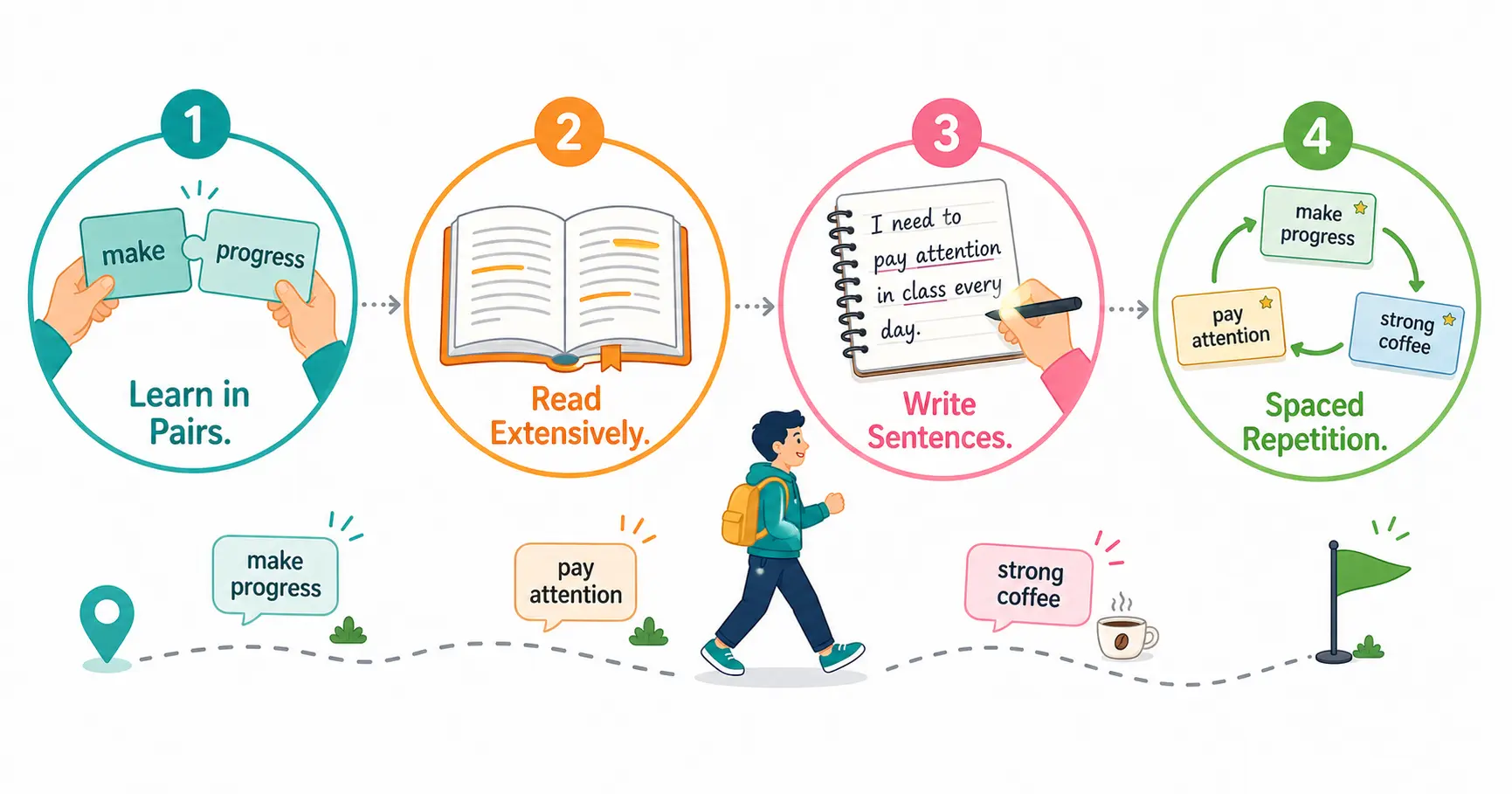
1. Learn words in pairs, not alone
Never learn a word in isolation. When you learn “decision,” immediately learn “make a decision.” When you learn “rain,” learn “heavy rain.” Your vocabulary notebook should have two columns: the word and its most common collocations.
2. Read extensively
Collocations are absorbed through exposure more than memorization. Read articles from the Economist, BBC, Guardian, and academic journals. When you notice a word combination that sounds natural, write it down. Over time, correct collocations will start to “feel right” even if you cannot explain why.
3. Use a collocation dictionary
The Oxford Collocations Dictionary for Students of English is the best dedicated resource. For any word you look up, it shows you every common collocation organized by type (verb+, adjective+, noun+, etc.). Online tools like Ozdic.com offer free collocation lookups.
4. Learn from your mistakes
When a native speaker or teacher corrects your word choice — “We say ‘heavy rain,’ not ‘strong rain’” — write down the correct collocation. Errors you notice and correct stick in your memory far longer than collocations you read passively.
5. Use spaced repetition
Add collocations to Linglify or any spaced repetition system. Study them as complete units: “make + decision” as one flashcard, not “make” and “decision” separately. For a science-backed approach to memorization, see How to Memorize Vocabulary.
6. Practice with sentence building
For each new collocation, write 3 sentences using it in different contexts. “Heavy rain” → (1) “We cancelled the picnic due to heavy rain.” (2) “Heavy rain is expected throughout the week.” (3) “The heavy rain caused flooding in low-lying areas.” This builds flexibility, not just recognition.
What to Read Next
This pillar guide gives you the complete framework for understanding collocations. Here are the deep-dive guides for specific needs:
By level:
- English Collocations in Use: Essential Combinations by Level — collocations organized from A2 to C2
- Advanced English Collocations: C1–C2 Word Combinations — for upper-intermediate and advanced learners
By type:
- Collocations by Type: Adjective+Noun, Verb+Noun, and More — a deep dive into each collocation category
For exams:
- Collocations for PTE and IELTS: The Exam Collocation List — exam-specific collocations that boost your Lexical Resource score
- IELTS Writing Task 1 Vocabulary — data description collocations for Task 1
- IELTS Writing Task 2 Vocabulary — essay collocations for Task 2
Related vocabulary:
- English Idioms: 500+ Common Expressions — fixed expressions with figurative meanings
- English Phrasal Verbs: The Complete Guide — verb + particle combinations
- How to Improve Your Vocabulary — a complete vocabulary building strategy
- Advanced English Words: 300+ C1–C2 Vocabulary — single words that pair with these collocations
FAQ
What is a collocation in simple words?
A collocation is two or more words that naturally go together in English. “Make a decision” is a collocation because English speakers always say “make” with “decision” — not “do a decision” or “take a decision.” Collocations are word partnerships: certain words just belong together, and using the wrong partner sounds unnatural even if the grammar is correct.
How many collocations are there in English?
Tens of thousands. Every common noun has multiple verb, adjective, and adverb collocations. The Oxford Collocations Dictionary lists over 150,000 collocations for 9,000 headwords. For practical fluency, learning the collocations of the 2,000 most common English words covers the vast majority of what you will need in daily life and exams.
What is the difference between a collocation and a compound word?
A compound word is a fixed unit that functions as a single word: “traffic jam,” “greenhouse,” “cell phone.” A collocation is a looser word partnership: “heavy rain,” “make a decision,” “strongly recommend.” Many compound nouns started as collocations that became so fixed they merged into a single concept. The practical difference: compound nouns are in dictionaries as single entries; collocations are found in collocation dictionaries or learned through exposure.
Do collocations change between British and American English?
Most collocations are the same in both varieties. However, a few differ: Americans “take a shower” while some British speakers “have a shower.” Americans “do the math” while British speakers “do the maths.” These differences are minor and both forms are widely understood. For IELTS and TOEFL, either variety is accepted.
How important are collocations for IELTS?
Very important. The IELTS Band Descriptors for Lexical Resource specifically mention collocation at every band level. Band 6 uses “some less common items despite some inaccuracy.” Band 7 shows “awareness of style and collocation.” Band 8 uses “uncommon lexical items” with “skilful use of collocation.” In practice, correct collocations are one of the fastest ways to move from Band 6.5 to Band 7+.
What is the best way to learn collocations?
Learn them as pairs (never learn “decision” without “make a decision”), read extensively in English (collocations are absorbed through exposure), use a collocation dictionary (the Oxford Collocations Dictionary is the gold standard), and study with spaced repetition. The key insight: collocations cannot be deduced from grammar rules — they must be encountered, noticed, and practiced.
Can I just use a thesaurus to find collocations?
No. A thesaurus gives you synonyms (“big” → “large,” “huge,” “massive”), but it does not tell you which synonym goes with which noun. A thesaurus would tell you that “big” and “strong” are both intensifiers, but it would not tell you that rain is “heavy” (not “big” or “strong”) and wind is “strong” (not “heavy” or “big”). Use a dedicated collocation dictionary instead.