Vocabulary Builder: The Complete Guide to Building Word Power
Building vocabulary is the single highest-return investment you can make in English. Grammar has a ceiling — once you know the structures, more grammar study produces diminishing returns. Pronunciation improves slowly. But every new word you truly learn opens another door: a sentence you can finally understand, an idea you can finally express, a conversation you can finally follow.
The problem is that most people approach vocabulary building randomly. They download an app, tap through some flashcards, learn a few words, forget most of them, and eventually give up. It feels productive in the moment, but weeks later they have little to show for it.
This guide gives you a complete vocabulary building system — not a list of tips, but a structured framework you can follow from beginner to advanced. It covers the science of how words stick, the methods that produce real retention, how to choose the right words to learn, and a concrete 12-week plan you can start today.
- What this covers: A complete vocabulary building system
- For: learners at any level (A1–C2), exam prep (IELTS, TOEFL, TOEIC), professionals
- Time commitment: 20–30 minutes daily
- What you need: This guide + a spaced repetition tool (Linglify, Anki, or even paper flashcards)
Why Most Vocabulary Building Fails
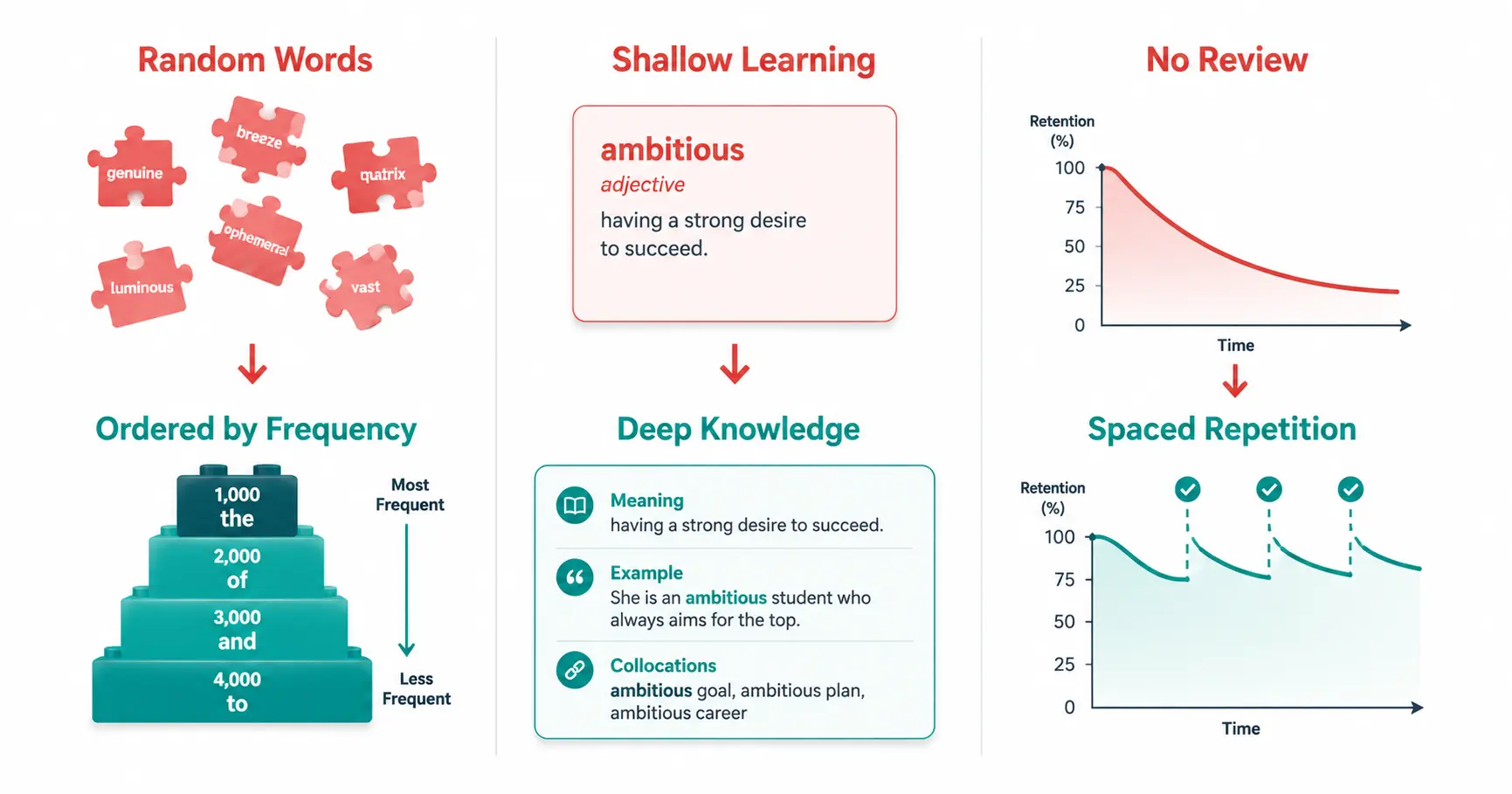
Before learning what works, it helps to understand what does not. Three patterns cause most vocabulary-building efforts to fail:
Pattern 1: Random word selection
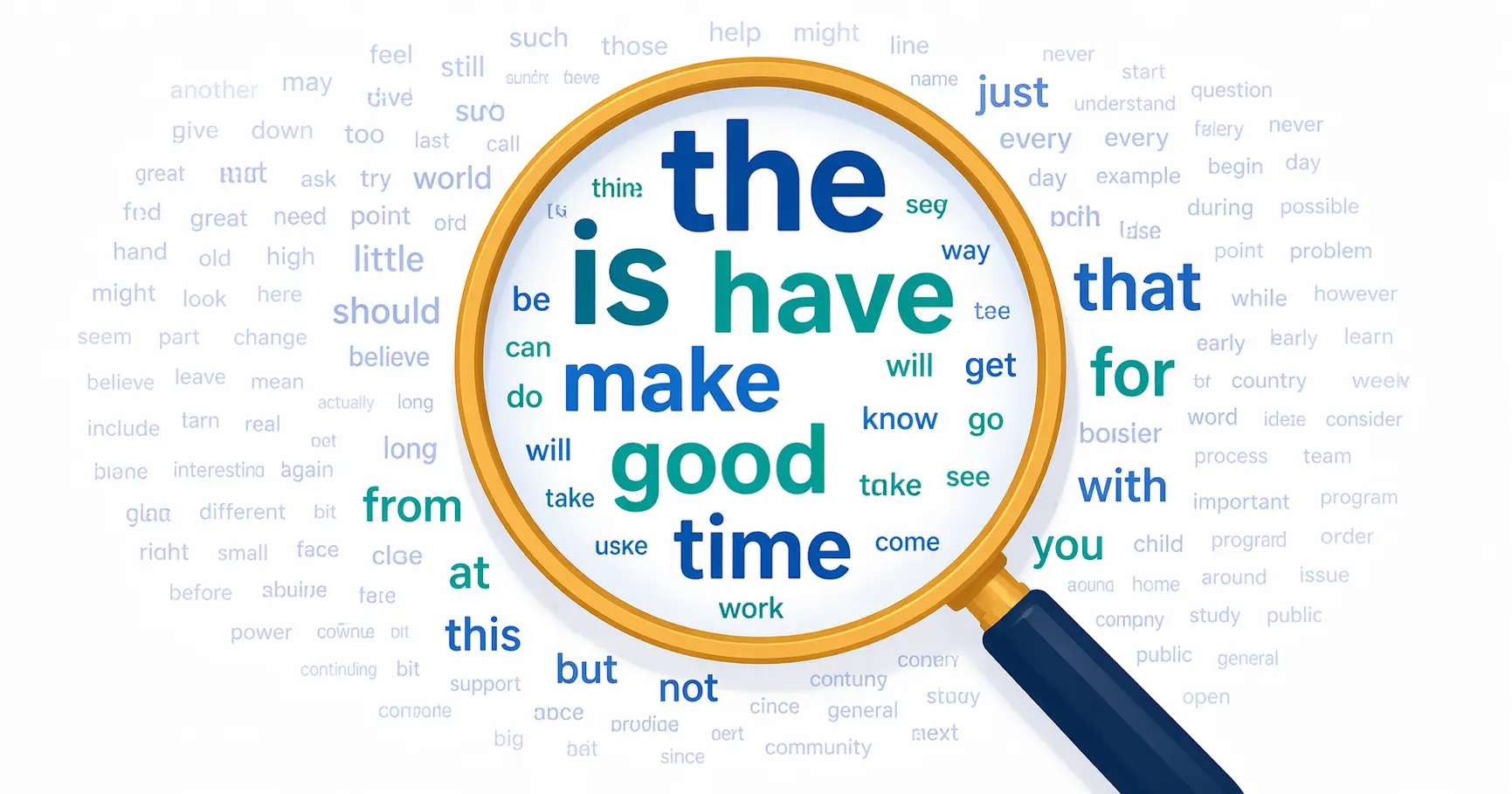
Studying words you encounter by accident — from movies, articles, or word-of-the-day apps — feels natural, but it is deeply inefficient. The words you stumble into are rarely the ones you need most. A beginner who learns “serendipity” before “appointment” has wasted study time on a word they will not use for years.
The fix: Study words in order of usefulness. High-frequency words first, then level-appropriate words, then topic-specific words. Research shows that the 1000 most common English words cover 85% of everyday speech. Start there.
Pattern 2: Shallow learning
Looking at a word, reading the definition, and moving on. This creates recognition — you might know the word when you see it — but not recall. You cannot produce the word in conversation or writing. Real word knowledge means knowing the meaning, the pronunciation, the common collocations, the register (formal vs casual), and at least one example sentence.
The fix: Study each word deeply. The “word knowledge framework” later in this article shows you what deep knowledge looks like.
Pattern 3: No review system
Learning 20 words on Monday and never looking at them again. By Friday, you remember 3. The forgetting curve is steep: without review, you lose 70% of new information within 24 hours. Studying without reviewing is like filling a bucket with a hole in it.
The fix: Use spaced repetition. This single technique can double or triple your retention rate. More on this below.
The Word Knowledge Framework: What It Means to “Know” a Word
Most learners think knowing a word means knowing its translation. That is only the first of seven dimensions. A vocabulary builder system should develop all of them:
| Dimension | What It Means | Example with “launch” |
|---|---|---|
| 1. Meaning | Core definition(s) | To start something new; to send a rocket into space |
| 2. Form | Spelling and pronunciation | /lɔːntʃ/ — note: not “lanch” or “lunch” |
| 3. Collocations | Words it commonly pairs with | launch a product, launch a campaign, launch an investigation |
| 4. Register | Formality level | Neutral-formal (used in business and news, not casual chat) |
| 5. Word family | Related forms | launch (v/n), launcher (n), relaunch (v/n) |
| 6. Connotation | Positive/negative association | Positive — implies energy, ambition, something new |
| 7. Usage | How it behaves in sentences | Transitive verb — always “launch something,” never “launch” alone |
You do not need all seven dimensions for every word on day one. But your study process should gradually build toward this depth, especially for high-priority words.
The 5 Core Methods of Vocabulary Building
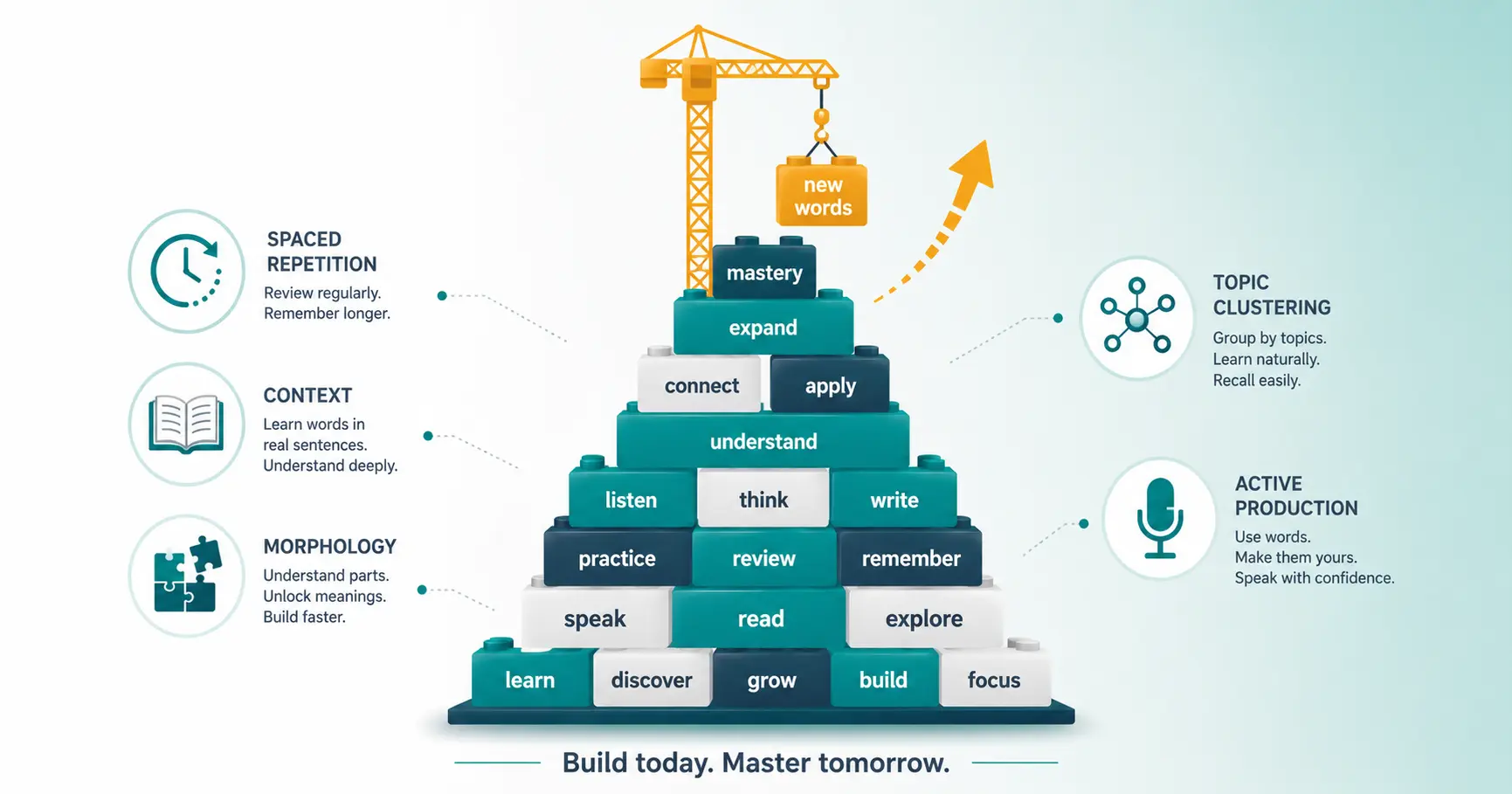
These five methods, used together, form a complete vocabulary building system. Each targets a different aspect of how your brain processes and stores words.
Method 1: Spaced Repetition — The Retention Engine
Spaced repetition is the foundation of every effective vocabulary builder. It works by reviewing words at increasing intervals — each time right before you would forget them. This directly counteracts the forgetting curve and moves words from fragile short-term memory into permanent long-term storage.
The review schedule:
| Review | When | Retention |
|---|---|---|
| 1st | 1 day after learning | ~60% → ~85% |
| 2nd | 3 days later | ~85% → ~90% |
| 3rd | 7 days later | ~90% → ~95% |
| 4th | 14 days later | ~95% → ~97% |
| 5th | 30 days later | Word enters long-term memory |
How to implement it:
- Best option: Add words to your Linglify dictionary — the system automatically schedules reviews at optimal intervals and tracks your progress.
- Alternative: Use any flashcard app with a spaced repetition algorithm (Anki is free and effective).
- Low-tech option: The Leitner box system with paper cards — three boxes, each reviewed at different intervals.
Spaced repetition alone can improve retention from ~20% to ~90%. If you adopt only one method from this article, this is the one.
For the science behind this, see our deep dive on how to memorize vocabulary.
Method 2: Contextual Learning — Words in Action
Isolated word-definition pairs produce weak memories. Words learned in context — sentences, paragraphs, real situations — produce strong ones. Your brain stores words not as standalone units but as nodes in a network of associations. The richer the context, the more connections the brain can form.
Three ways to learn in context:
-
Example sentences: For every new word, read or write at least one sentence using it. “Allocate” + “The manager allocated $50,000 to the marketing budget” is far more memorable than “allocate = to distribute.”
-
Extensive reading: Read articles, books, or news at your level. When you encounter a new word, try to guess its meaning from the surrounding text before checking a dictionary. This two-step process (guess → verify) strengthens memory.
-
Listening input: Podcasts, videos, and conversations expose you to words in their natural spoken context — with intonation, speed, and surrounding phrases that dictionaries cannot capture.
What to read/listen to at each level:
| Level | Reading | Listening |
|---|---|---|
| A1–A2 | Graded readers, simplified news | Podcasts for beginners, children’s shows |
| B1–B2 | News articles (BBC, The Guardian), blog posts | TED Talks, news podcasts, TV shows with subtitles |
| C1+ | Novels, academic articles, long-form journalism | Native podcasts, lectures, debates |
Method 3: Word Families and Morphology — One Root, Many Words
English words are built from parts: prefixes, roots, and suffixes. Learning these parts lets you decode unfamiliar words and multiply your vocabulary exponentially. If you know “predict” (pre- = before, dict = speak), you can figure out “predict, prediction, predictable, unpredictable, predictor, predictably.”
High-value prefixes:
| Prefix | Meaning | Examples |
|---|---|---|
| un- | not, reverse | unhappy, undo, unlikely |
| re- | again | rewrite, rebuild, reconsider |
| pre- | before | preview, predict, prepare |
| mis- | wrong | misunderstand, misspell, mislead |
| over- | too much | overwork, overestimate, overcrowded |
| dis- | opposite | disagree, disappear, disconnect |
High-value suffixes:
| Suffix | Creates | Examples |
|---|---|---|
| -tion / -sion | noun from verb | education, decision, promotion |
| -able / -ible | adjective (can be done) | readable, flexible, affordable |
| -ment | noun from verb | improvement, development, achievement |
| -ness | noun from adjective | happiness, kindness, weakness |
| -ful | adjective (full of) | helpful, beautiful, powerful |
| -less | adjective (without) | careless, homeless, endless |
Learning 20 common prefixes and 20 common suffixes gives you tools to decode thousands of unfamiliar words. This is especially powerful for academic and exam vocabulary.
Method 4: Topic Clustering — Building Semantic Networks
Your brain organizes vocabulary by topic, not by alphabet. Studying words in thematic groups — all travel words together, all business words together — mirrors this natural organization and improves both storage and recall.
How to cluster:
- Choose a topic relevant to your goals (work, travel, health, technology)
- Learn 10–15 words from that topic in a single session
- Create connections between the words (draw a mind map, write a short paragraph using all of them)
- Review the cluster as a group before adding new topics
Our English vocabulary by topic guide covers 20+ topics with sample word lists. For beginners, essential words and phrases organizes vocabulary by real-life situations.
Method 5: Active Production — Use It or Lose It
Recognition (understanding a word when you see it) and production (using a word correctly yourself) are two different skills. Most study methods build recognition. Only active production builds true fluency.
Four production exercises:
-
Write sentences: After learning 5 new words, write one sentence for each using a personal context. “The company launched a new campaign” is good; “My team launched a product last week that I worked on for three months” is better — the personal connection strengthens memory.
-
Speak out loud: Say the word, its definition, and a sentence using it — out loud, not just in your head. The physical act of speaking engages motor memory.
-
Teach someone: Explain the word to a friend, language partner, or even to yourself in the mirror. Teaching forces you to organize your understanding.
-
Write summaries: After reading an article, write a 3–5 sentence summary using as many new words as possible. This forces recall under pressure.
Building Your Vocabulary Builder Routine
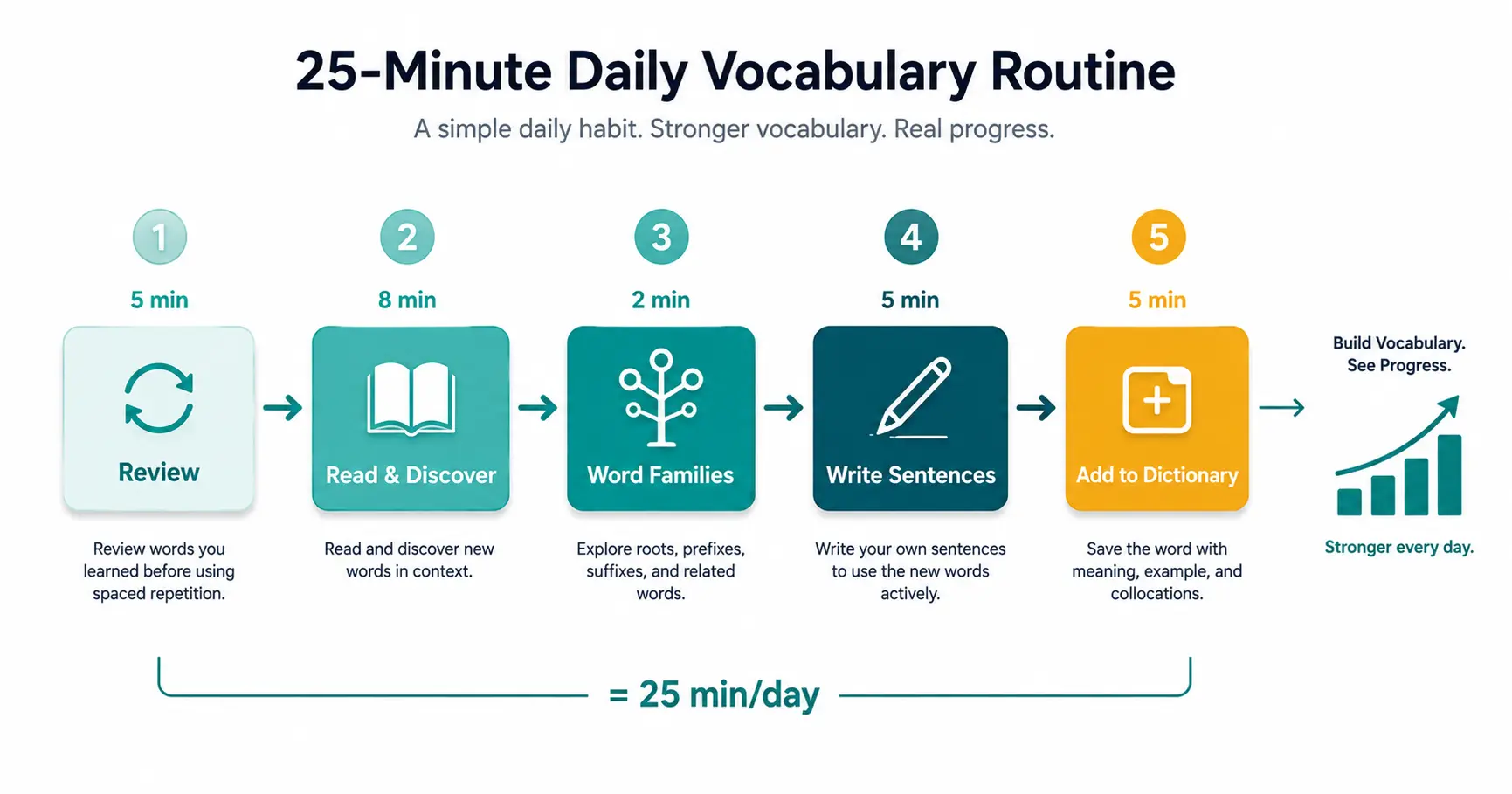
The five methods above work best when combined into a daily routine. Here is a realistic 25-minute daily routine that covers all five:
| Time | Activity | Method |
|---|---|---|
| 5 min | Review words due in spaced repetition | Method 1 (Spaced Repetition) |
| 8 min | Read an article or listen to a podcast; mark 3–5 new words | Method 2 (Context) |
| 2 min | For each new word, check word family (prefixes/suffixes) | Method 3 (Morphology) |
| 5 min | Write one sentence per new word using personal context | Method 5 (Production) |
| 5 min | Add new words to Linglify dictionary with notes and example sentences | Method 1 + 4 (Review setup + Topic tags) |
Weekly additions:
- Saturday: Review all words learned that week. Test yourself without looking at definitions.
- Sunday: Write a short paragraph (50–100 words) using as many new words from the week as possible.
This routine produces approximately 15–25 new words per week with 85%+ long-term retention — far more than the typical “study 50, remember 5” approach.
The 12-Week Vocabulary Builder Plan
Here is a structured plan that takes you from wherever you are now to measurably stronger vocabulary. Adjust the word sources to your level.
Weeks 1–2: Foundation
| Task | Details |
|---|---|
| Assess your level | Take a vocabulary size test or browse Linglify word lists until words become unfamiliar |
| Set your target | Choose a specific goal (e.g., “Learn 200 B2 words in 12 weeks”) |
| Set up your tools | Create your Linglify dictionary or set up a flashcard system |
| Start the daily routine | 25 minutes/day, 3–5 new words/day |
| Choose your reading source | Pick one article source at your level (news, graded reader, blog) |
Weeks 3–4: Build Momentum
| Task | Details |
|---|---|
| Continue daily routine | You should have 30–40 words in your review system by now |
| Add topic clustering | Pick your first topic and learn 10–15 related words together |
| Start a vocabulary notebook | Write each word with: meaning, example, collocations, word family |
| First self-test | Cover definitions and try to recall meanings. Note weak words. |
Weeks 5–8: Expand and Deepen
| Task | Details |
|---|---|
| Increase to 5–7 new words/day | Only if retention stays above 80% in reviews |
| Add a second topic cluster each week | Aim for 2 topics per week |
| Start writing summaries | After each reading session, write 3–5 sentences using new words |
| Begin active speaking practice | Use new words in conversations, language exchanges, or talking to yourself |
| Halfway check: You should know 80–120 words solidly | If lower, slow down and strengthen review |
Weeks 9–12: Consolidate and Measure
| Task | Details |
|---|---|
| Focus on production over recognition | Prioritize writing and speaking with new words |
| Review all topic clusters | Revisit earlier topics — some words will have faded |
| Take the vocabulary size test again | Compare with your Week 1 result |
| Write a “vocabulary essay” | A 200–300 word piece using as many learned words as naturally possible |
| Plan your next 12 weeks | Set a new target level and word count |
Expected results after 12 weeks (at 5 words/day, 5 days/week):
| Metric | Result |
|---|---|
| Words studied | ~300 |
| Words retained long-term (85%+) | ~250 |
| Topics covered | 8–12 |
| Daily review habit | Established |
Vocabulary Building for Exams
If you are building vocabulary for a specific exam, the system above stays the same — but the word sources change.
IELTS Vocabulary Builder
Focus areas: Academic vocabulary, topic words (environment, education, technology, health, crime), synonyms for paraphrasing, collocations for writing.
Start with: Our IELTS vocabulary complete guide for band-specific word lists. For Writing Task 2 specifically, see our IELTS Writing Task 2 vocabulary.
Target: 800–1,500 exam-specific words over 8–12 weeks, depending on your current band.
TOEFL Vocabulary Builder
Focus areas: Academic lectures (science, history, social science), reading passage vocabulary, integrated writing transitions.
Start with: Our TOEFL preparation guide.
Target: 600–1,000 academic words over 8–12 weeks.
TOEIC Vocabulary Builder
Focus areas: Business English — office, meetings, HR, finance, marketing, manufacturing, contracts.
Start with: Our TOEIC vocabulary word list organized by score target.
Target: 400–800 business words over 6–10 weeks, depending on your score goal.
General English Vocabulary Builder
Focus areas: High-frequency words first, then topic-based expansion, then advanced and nuanced vocabulary.
Path:
- 1000 most common words → covers 85% of daily speech
- 4000 essential words → covers 95% of daily speech
- Advanced English words → C1–C2 level precision
- Topic vocabulary → fill gaps in specific areas
How to Choose the Right Words to Learn
Not all words are equally valuable. Here is a prioritization framework:
Priority 1: High-frequency words you do not know
If a word appears in the top 2,000 most frequent English words and you do not know it, learn it immediately. These words appear everywhere — conversation, writing, news, exams. Missing even one creates a comprehension gap in every text you read.
Priority 2: Words for your specific goals
Preparing for IELTS? Learn IELTS topic vocabulary. Working in business? Learn business phrasal verbs and meeting language. Traveling soon? Learn travel and directions vocabulary.
Priority 3: Words you encounter repeatedly
If you see or hear a word three or more times in different contexts and still do not know it, that word is trying to enter your vocabulary. It is clearly common enough to matter. Learn it.
Priority 4: Words that fill gaps in topics you already know
If you know 80% of the words in a topic (health, technology, food) but keep stumbling on the same 20%, those specific words deserve targeted study. Our vocabulary by topic guide helps you identify these gaps.
What to skip
- Words from specialized fields you will never use (medical Latin, legal jargon — unless you work in those fields)
- Archaic or literary words (thou, whilst, hitherto — unless preparing for literature studies)
- Extremely rare words that appear only in advanced dictionaries
Measuring Your Progress
You cannot improve what you do not measure. Here are three ways to track your vocabulary growth:
1. Retention rate in spaced repetition
Your flashcard tool tracks how many words you recall correctly vs incorrectly. A healthy retention rate is 80–90%. Below 80% means you are adding words too fast — slow down. Above 95% means the system might be reviewing too often — you can push intervals further.
2. Vocabulary size tests
Take the same vocabulary size test every 4–8 weeks. Expect growth of 200–500 words per testing period with consistent daily study. A meaningful increase (e.g., from 3,500 to 4,200) confirms your system is working.
3. Real-world comprehension
The ultimate test: can you understand more than before? Pick a text that was difficult 12 weeks ago and re-read it. Count unknown words. If the number has dropped significantly, your vocabulary building is working where it matters.
Words to Practice
These 25 words span multiple levels and topics. Add them to your Linglify dictionary for spaced repetition — a practical first step in your vocabulary building journey.
boom
noun
A loud, deep sound or a sudden increase in activity or popularity.
Examples
- The boom of thunder echoed across the valley.
- The technology boom created many new millionaires.
cooperate
verb
To work together with others towards a common goal.
evaluate
verb
To judge or measure the value, quality, or importance of something.
Examples
- Companies evaluate job candidates based on experience, skills, and personality.
- Teachers evaluate student progress through tests, projects, and classroom participation.
graduate
verb
To complete a course of study at a school or university.
Examples
- She will graduate from university next year with a degree in engineering.
- Students must complete all requirements before they can graduate from high school.
horizon
noun
The line where the earth or the sky appears to meet in the distance.
Examples
- The sun disappeared behind the horizon as evening approached.
- Traveling broadens your horizon and exposes you to new cultures.
indispensable
adjective
Absolutely necessary; essential.
Examples
- Clean water is indispensable for human survival and good health.
- Her experience and skills make her indispensable to the research team.
jury
noun
A group of people who listen to evidence in a court and decide if someone is guilty.
Examples
- The jury deliberated for several hours before reaching a verdict.
- The talent show jury consisted of professional musicians and entertainers.
lifelong
adjective
Continuing for a very long time or for the whole life.
Examples
- Learning is a lifelong process that never truly ends.
- Their lifelong friendship began during elementary school years.
motivated
adjective
Feeling driven or inspired to do something because of a reason or goal.
Examples
- Motivated employee seeks additional responsibilities and challenges at work.
- Success requires being motivated even when facing difficult obstacles.
normally
adverb
Usually; under normal conditions.
Examples
- Heart normally beats between sixty and hundred times per minute.
- Students normally arrive at school before morning bell rings.
off
adjective
Describes something that is not fresh or is no longer suitable for eating, often used for food and drinks.
Examples
- Please turn off the lights before leaving the room.
- The dog ran off into the forest chasing wild rabbits.
prejudice
noun
Preconceived opinions or feelings, often negative, about a person or group.
Examples
- Education helps overcome prejudice and promotes understanding.
- Racial prejudice damages communities and individuals alike.
resolve
verb
To find a solution or answer to a problem or question.
Examples
- Mediator helps parties resolve dispute through negotiation.
- Technical team will resolve software problems quickly.
stress
verb
To feel mental or emotional pressure or worry; to emphasize or give importance to something.
Examples
- Heavy workload may stress employees beyond limits.
- Teacher will stress importance of homework completion.
total
adjective
An adjective describing something that is complete or whole, not divided or broken.
Examples
- Total cost includes all fees and expenses.
- Total silence fills room during meditation session.
tragedy
noun
An extremely sad or serious event that causes suffering or loss.
Examples
- Natural tragedy affects thousands of innocent people.
- Personal tragedy changes person's life perspective completely.
union
noun
A group of people or things joined together for a purpose.
Examples
- Labor union protects worker rights and interests.
- Marriage union joins two people in partnership.
voyage
noun
A long journey to a distant place, often by sea or air.
Examples
- Space exploration represents humanity's greatest voyage into the unknown.
- The ocean voyage from Europe to America took several weeks in the past.
candidate
noun
A person who is competing in an election or contest.
Examples
- Each presidential candidate presented their policy plans to voters.
- The job candidate impressed the interview panel with her experience.
discourage
verb
To try to make someone feel less confident or hopeful about something.
Examples
- Don't let one failure discourage you from pursuing your dreams.
- High prices discourage many people from buying organic food products.
donate
verb
To give something, especially money or goods, to help a cause or person.
Examples
- Many people donate money to charities that help homeless individuals.
- She decided to donate blood to help patients in emergency situations.
firmly
adverb
An adverb indicating a way of doing something with certainty or stability.
Examples
- Hold the rope firmly while climbing down the steep mountain slope.
- The manager firmly believed in treating all employees with respect.
guide
verb
To show or direct someone how to do something.
Examples
- Parents should guide their children to make responsible decisions.
- The experienced hiker will guide the group through the mountain trail safely.
humorous
adjective
Funny or amusing, often making people laugh.
Examples
- She writes humorous articles about everyday life and family experiences.
- The humorous speech made everyone laugh and lightened the serious mood.
admission
noun
The process or fact of being allowed to enter or join.
Examples
- Her admission to the prestigious medical school was the result of hard work.
- The museum offers free admission on the first Sunday of every month.
Common Vocabulary Building Mistakes
Mistake 1: Learning too many words at once
Studying 30 words in one sitting feels productive. But research shows that learning more than 10–15 new words per session sharply decreases retention for all of them. It is better to learn 5 words well than 30 words poorly. Quality over quantity, every time.
Mistake 2: Only studying, never using
Recognition without production creates passive vocabulary — words you understand but cannot use. If you are not writing sentences, speaking the words out loud, or using them in real situations, you are building a dictionary you cannot access.
Mistake 3: Ignoring collocations
Knowing that “make” means “to create” is not enough. You need to know that it is “make a decision” (not “do a decision”), “make progress” (not “do progress”), and “make a mistake” (not “do a mistake”). Collocations are the difference between correct English and natural English. See our collocations guide for a complete reference.
Mistake 4: Studying words without pronunciation
Reading a word on screen and storing a silent mental image of it is incomplete learning. When you hear the word spoken, you may not recognize it. When you try to say it, you may mispronounce it. Always listen to the pronunciation at least once, and say the word out loud yourself.
Mistake 5: Giving up after two weeks
Vocabulary building compounds over time. The first two weeks feel slow — you are learning the system, not yet seeing results. By week 4, reviews become faster. By week 8, you start noticing words in the wild that you recently learned. By week 12, comprehension has measurably improved. The system works, but it needs time.
What to Do Right Now
-
Assess your level. Browse Linglify word lists by CEFR level and find where words start to become unfamiliar. That is your starting point.
-
Set up spaced repetition. Create your Linglify dictionary or set up a flashcard system. This is your retention engine — everything depends on it.
-
Start the daily routine. Twenty-five minutes per day, following the routine described above. Begin with 3–5 words per day. Increase only when your retention rate stays above 80%.
-
Choose your first topic. Pick one vocabulary topic that is relevant to your life right now and learn 10–15 words from it this week.
-
Read something in English today. Even 10 minutes of reading expands your passive vocabulary. Pick an article, mark unfamiliar words, and add the most useful ones to your review system.
FAQ
What is the best vocabulary builder for English?
The best vocabulary builder is one you actually use daily. The most effective systems combine three elements: (1) curated word lists matched to your level, (2) spaced repetition for long-term retention, and (3) contextual learning through reading and listening. Linglify combines all three — level-appropriate word lists, automatic spaced repetition scheduling, and example sentences in context. Other effective tools include Anki (free flashcard app) for spaced repetition, and extensive reading apps like LingQ for context-based learning.
How many words should I learn per day?
Research suggests 5–10 new words per day is optimal for most learners. At 5 words/day (5 days/week), you add roughly 100 words per month with strong retention. Going above 10–15 per day usually causes retention to drop below 50% — you learn more but remember less. The key variable is review time: if you have only 20 minutes daily, 5 new words is realistic. With 45+ minutes, you can push to 10. Our vocabulary learning system guide covers this in detail.
How long does it take to build a strong English vocabulary?
With consistent daily study (25–30 minutes), expect to add 250–500 words to your permanent vocabulary every 12 weeks. Going from beginner (500 words) to intermediate (2,000 words) takes roughly 6–9 months. Reaching advanced level (8,000+ words) from intermediate takes another 12–18 months. The timeline shortens significantly if you combine active study with extensive reading in English — reading adds passive vocabulary that gradually becomes active.
What is the fastest way to build vocabulary for IELTS?
Focus on three word categories: (1) academic vocabulary from the Academic Word List — 570 word families that appear in every IELTS text; (2) topic-specific vocabulary for the 10–15 most common IELTS topics (environment, education, technology, health, crime); (3) synonyms for common words, since IELTS rewards paraphrasing. Study 8–10 words per day with spaced repetition and practice using them in writing. Most students can learn 500–800 exam-relevant words in 8–12 weeks. See our IELTS vocabulary guide for band-specific lists.
Do vocabulary builder apps really work?
Yes — if they use spaced repetition and you use them consistently. Apps that simply show you a word and its definition once are not effective. Apps that quiz you at increasing intervals (Linglify, Anki) leverage the scientifically proven spacing effect. The critical factor is daily usage: an app you use for 10 minutes every day will outperform one you use for an hour once a week. The app itself matters less than the habit of using it.
Should I learn vocabulary by topic or by frequency?
Both approaches work, and the best strategy combines them. Start with the most frequent 1,000–2,000 words regardless of topic — these form the foundation that makes everything else easier. Once you have a solid base, switch to topic-based learning to fill specific gaps (business, travel, health, academic). For exam preparation, topic-based learning is particularly effective because exams test vocabulary within predictable topic areas. Our topic vocabulary guide covers 20+ themes.
How do I remember vocabulary long-term?
Long-term retention requires three things: (1) spaced repetition — reviewing words at increasing intervals prevents the forgetting curve from erasing them; (2) depth of processing — learning a word with its meaning, collocations, word family, and example sentences creates multiple memory hooks; (3) active use — writing and speaking with new words converts passive recognition into active recall. If you only do one thing, use spaced repetition. Our guide on how to memorize vocabulary covers 8 science-backed techniques in detail.