Sinônimos e Antônimos em Inglês: O Guia Completo com 1000+ Pares de Palavras
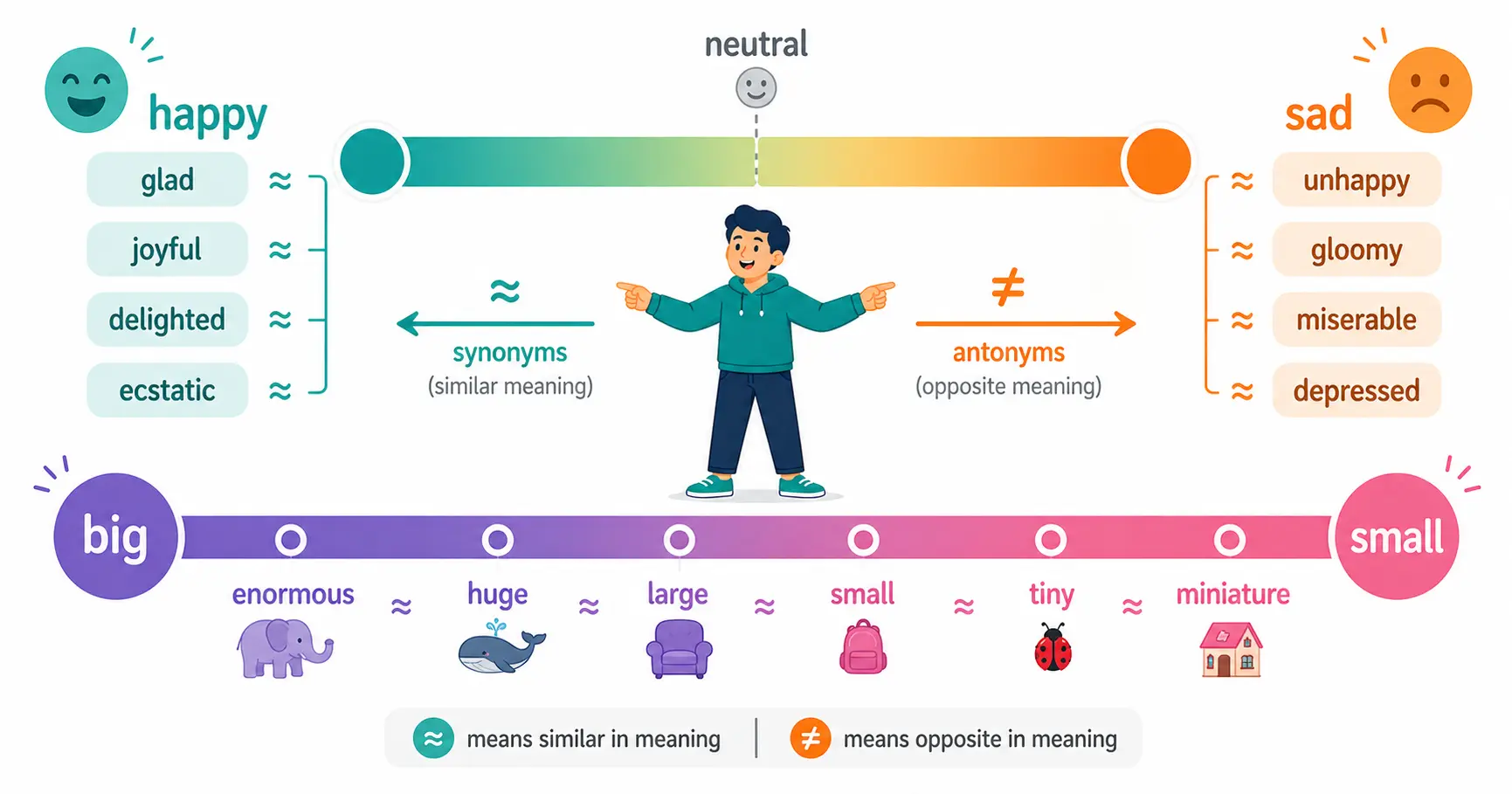
Cada palavra em inglês existe numa rede de relações. “Happy” conecta-se a “joyful”, “content”, “elated” e “cheerful” — palavras que compartilham seu significado. Também se conecta a “sad”, “miserable”, “unhappy” e “gloomy” — palavras com significado oposto. O primeiro grupo são sinônimos; o segundo, antônimos. Juntos, formam a base da flexibilidade vocabular: a capacidade de dizer a mesma coisa de maneiras diferentes e compreender todas as nuances entre dois extremos.
Isso importa na prática. No IELTS, o critério “Lexical Resource” recompensa o uso de sinônimos, em vez de repetir as mesmas palavras. Na escrita acadêmica, parafrasear com sinônimos demonstra maturidade intelectual. Na conversa cotidiana, conhecer antônimos ajuda a expressar nuances: “I’m not happy” é diferente de “I’m unhappy”, que também é diferente de “I’m miserable”. A distância entre essas palavras é a diferença entre o inglês básico e a fluência.
Este guia cobre:
- o que são sinônimos e antônimos (com definições e exemplos claros),
- 1000+ pares de sinônimos e antônimos organizados por tema,
- a diferença crítica entre sinônimos exatos e sinônimos próximos,
- 100+ pares de palavras opostas mais comuns,
- como usar sinônimos sem mudar o significado,
- um sistema de estudo para ampliar seu repertório de sinônimos e antônimos.
O Que São Sinônimos?
Um sinônimo é uma palavra que tem o mesmo ou quase o mesmo significado que outra. A palavra vem do grego: syn- (junto) + onoma (nome) — “mesmo nome.”
| Palavra | Sinônimos |
|---|---|
| big | large, huge, enormous, massive, vast |
| happy | glad, joyful, content, pleased, delighted |
| smart | intelligent, clever, bright, sharp, brilliant |
| fast | quick, rapid, swift, speedy |
| important | significant, crucial, vital, essential, key |
Os Sinônimos Significam Exatamente a Mesma Coisa?
Quase nunca. A maioria dos sinônimos são sinônimos próximos — compartilham um significado central, mas diferem em formalidade, intensidade ou contexto.
| Palavra | Sinônimo | Diferença |
|---|---|---|
| big | enormous | “Enormous” é muito mais forte que “big” |
| ask | interrogate | “Interrogate” é formal/agressivo; “ask” é neutro |
| old | ancient | “Ancient” implica milhares de anos; “old” é geral |
| thin | slim | “Slim” é positivo; “thin” pode ser neutro ou negativo |
| cheap | affordable | “Affordable” é positivo; “cheap” pode implicar baixa qualidade |
Essa distinção é essencial. Trocar sinônimos sem levar o contexto em conta é um dos maiores erros de vocabulário. “The teacher interrogated the students” significa algo bem diferente de “The teacher asked the students”.
O Que São Antônimos?
Um antônimo é uma palavra que significa o oposto de outra. A palavra vem do grego: anti- (contra) + onoma (nome) — “nome oposto.”
| Palavra | Antônimo |
|---|---|
| hot | cold |
| big | small |
| happy | sad |
| fast | slow |
| buy | sell |
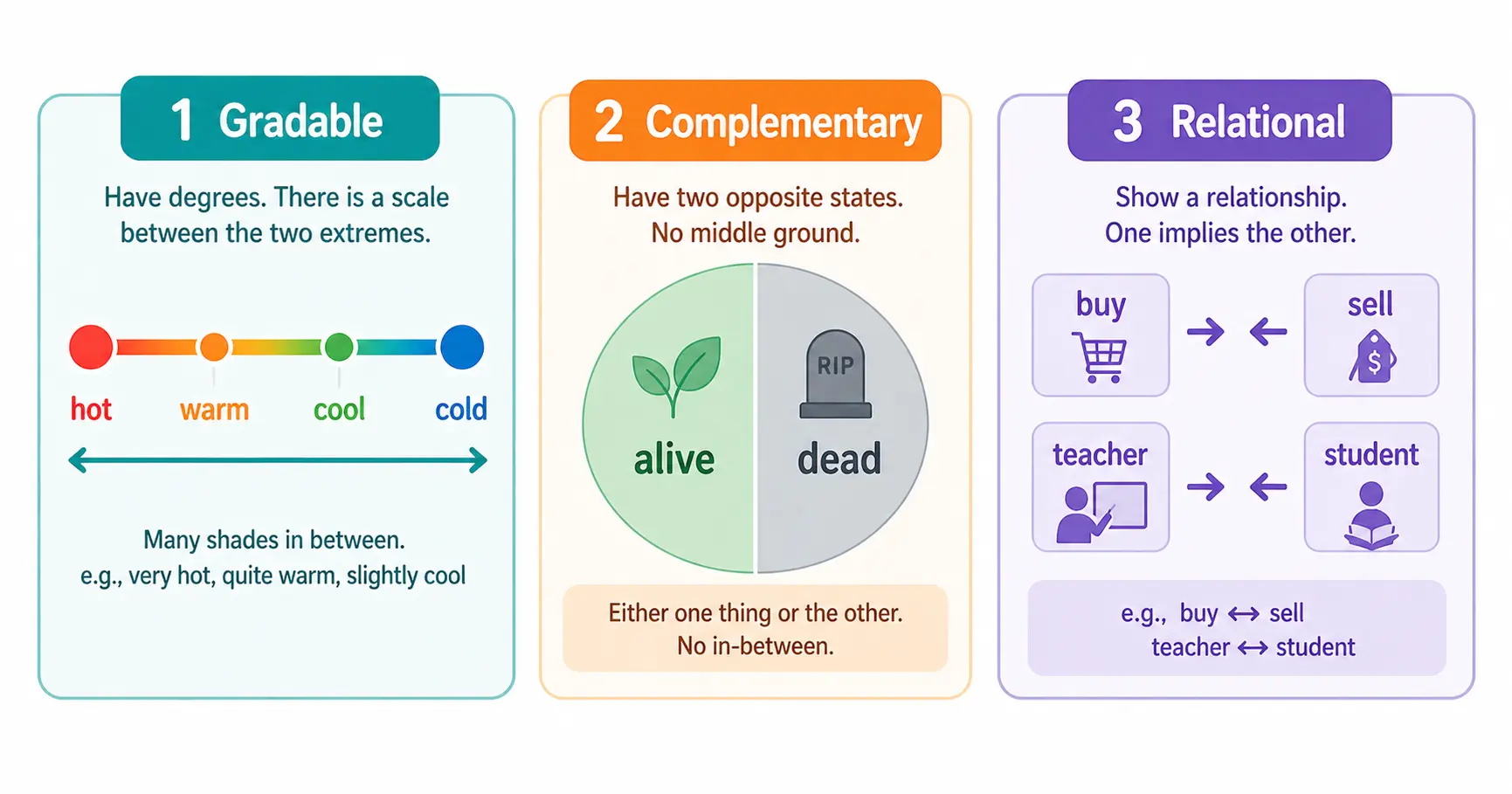
Três Tipos de Antônimos
1. Antônimos graduáveis — opostos numa escala, com graus entre eles.
- hot ↔ cold (mas também warm, cool, lukewarm)
- big ↔ small (mas também large, medium, tiny)
- happy ↔ sad (mas também content, neutral, unhappy)
2. Antônimos complementares — opostos absolutos sem meio-termo.
- alive ↔ dead
- true ↔ false
- on ↔ off
- male ↔ female
3. Antônimos relacionais — opostos que dependem um do outro; um não existe sem o outro.
- buy ↔ sell
- teacher ↔ student
- parent ↔ child
- give ↔ receive
- husband ↔ wife
Sinônimos para as 50 Palavras Mais Usadas em Excesso no Inglês
Estas são palavras que todo estudante tende a usar demais. Substituí-las por sinônimos é uma das formas mais rápidas de soar mais fluente.
Adjetivos
Good
| Sinônimo | Formalidade | Melhor Contexto | Exemplo |
|---|---|---|---|
| excellent | neutro–formal | qualidade, desempenho | The service was excellent. |
| outstanding | formal | conquista, resultados | She received outstanding reviews. |
| remarkable | formal | eventos impressionantes | His recovery was remarkable. |
| superb | neutro | qualidade, experiências | The food was superb. |
| terrific | informal | entusiasmo | That’s a terrific idea! |
| wonderful | neutro | experiências positivas | We had a wonderful time. |
| fine | neutro | qualidade aceitável | The weather looks fine today. |
| decent | neutro–informal | qualidade adequada | He makes a decent salary. |
| splendid | formal/literário | alta qualidade | The view from the top was splendid. |
Bad
| Sinônimo | Formalidade | Melhor Contexto | Exemplo |
|---|---|---|---|
| terrible | neutro | negativo forte | The traffic was terrible. |
| awful | neutro–informal | negativo forte | The movie was awful. |
| dreadful | formal | situações muito ruins | The conditions were dreadful. |
| poor | neutro | qualidade, desempenho | The essay received a poor grade. |
| unacceptable | formal | padrões, comportamento | This behavior is unacceptable. |
| inadequate | formal | qualidade insuficiente | The funding was inadequate. |
| appalling | formal | algo chocante ou muito ruim | The hygiene standards were appalling. |
| mediocre | neutro | médio a baixo | The restaurant was mediocre. |
Important
| Sinônimo | Formalidade | Melhor Contexto | Exemplo |
|---|---|---|---|
| significant | formal | dados, pesquisa | The results show a significant improvement. |
| crucial | neutro–formal | decisões críticas | Time management is crucial for success. |
| vital | neutro–formal | coisas essenciais | Water is vital for survival. |
| essential | neutro | coisas necessárias | Teamwork is essential in this job. |
| key | neutro | fatores centrais | Education is a key factor in economic growth. |
| paramount | muito formal | maior prioridade | Safety is paramount in this industry. |
| pivotal | formal | momentos decisivos | The election was a pivotal moment in history. |
| fundamental | formal | princípios básicos | Trust is fundamental to any relationship. |
Big
| Sinônimo | Formalidade | Melhor Contexto | Exemplo |
|---|---|---|---|
| large | neutro | tamanho, quantidade | They live in a large house. |
| huge | neutro | muito grande | There was a huge crowd at the concert. |
| enormous | neutro | extremamente grande | The project requires an enormous budget. |
| massive | neutro–informal | muito grande | The company made a massive profit. |
| vast | formal | área, quantidade | The Sahara is a vast desert. |
| substantial | formal | quantidade, valor | There was a substantial increase in sales. |
| immense | formal | escala, emoção | She felt immense relief after the exam. |
| considerable | formal | quantidade significativa | She has considerable experience in the field. |
Small
| Sinônimo | Formalidade | Melhor Contexto | Exemplo |
|---|---|---|---|
| tiny | neutro | tamanho físico muito pequeno | The apartment was tiny — only 20 square meters. |
| minor | neutro–formal | importância, gravidade | It was a minor issue that we fixed quickly. |
| slight | neutro–formal | pequena intensidade | There was a slight delay in the schedule. |
| negligible | formal | algo insignificante | The risk is negligible. |
| modest | neutro | pouco, sem ostentação | They started with a modest investment. |
| minimal | formal | quantidade muito pequena | The impact was minimal. |
| compact | neutro | pequeno, mas eficiente | The car has a compact design. |
Verbos
Think
| Sinônimo | Formalidade | Melhor Contexto | Exemplo |
|---|---|---|---|
| believe | neutro | opiniões | I believe education should be free. |
| consider | formal | pensamento cuidadoso | We should consider all the options. |
| assume | neutro | sem prova | I assumed you knew about the meeting. |
| suppose | neutro | crença incerta | I suppose you’re right. |
| reckon | informal (inglês britânico) | opinião casual | I reckon it’ll rain tomorrow. |
| contemplate | formal | pensamento profundo | She contemplated the offer for days. |
| reflect (on) | formal | olhar para trás, refletir sobre | He reflected on his years at the company. |
| maintain | formal | crença forte | She maintains that the decision was correct. |
| contend | muito formal | argumentando uma posição | Critics contend that the policy is flawed. |
Say
| Sinônimo | Formalidade | Melhor Contexto | Exemplo |
|---|---|---|---|
| state | formal | declarações oficiais | The report states that crime has decreased. |
| claim | neutro–formal | afirmações (possivelmente duvidosas) | He claims he was at home all evening. |
| argue | neutro–formal | apresentando um caso | She argued that the policy was unfair. |
| mention | neutro | referência breve | He mentioned the project in passing. |
| point out | neutro | chamando atenção | She pointed out several errors in the report. |
| declare | formal | anúncios oficiais | The government declared a state of emergency. |
| suggest | neutro | propor ideias | I suggest we postpone the meeting. |
| assert | formal | afirmações fortes | The CEO asserted that the company was profitable. |
| remark | neutro–formal | comentários | He remarked on the quality of the presentation. |
Show
| Sinônimo | Formalidade | Melhor Contexto | Exemplo |
|---|---|---|---|
| demonstrate | formal | prova, evidência | The study demonstrates a clear link between sleep and performance. |
| illustrate | formal | exemplos, visuais | The chart illustrates the trend over the last decade. |
| indicate | formal | dados sugerindo | The results indicate a possible solution. |
| reveal | neutro–formal | informação oculta | The investigation revealed widespread fraud. |
| display | neutro | exibição aberta | The museum displays artifacts from ancient Egypt. |
| exhibit | formal | características ou qualidade | He exhibited remarkable patience during the crisis. |
| highlight | neutro | ênfase | The report highlights several key challenges. |
Make
| Sinônimo | Formalidade | Melhor Contexto | Exemplo |
|---|---|---|---|
| create | neutro | criar algo novo | She created a beautiful sculpture. |
| produce | neutro–formal | fabricação, resultados | The factory produces 10,000 units per day. |
| generate | formal | gerar resultados ou energia | The campaign generated significant interest. |
| construct | formal | construção | They constructed a bridge in just six months. |
| develop | neutro–formal | criar ao longo do tempo | She developed a new training program. |
| establish | formal | fundar; criar sistemas | He established the company in 2010. |
| manufacture | formal | produção industrial | The phone is manufactured in South Korea. |
Get
| Sinônimo | Formalidade | Melhor Contexto | Exemplo |
|---|---|---|---|
| obtain | formal | adquirir oficialmente | She obtained a visa for Australia. |
| acquire | formal | passar a possuir | He acquired the property in 2018. |
| receive | neutro–formal | receber algo | We received your application. |
| gain | neutro–formal | conquistar ou obter | She gained valuable experience abroad. |
| earn | neutro | renda, respeito | He earns a good salary. |
| secure | formal | obter com esforço | They secured funding for the project. |
Change
| Sinônimo | Formalidade | Melhor Contexto | Exemplo |
|---|---|---|---|
| modify | formal | fazer ajustes | We need to modify the design slightly. |
| alter | neutro–formal | tornar diferente | The dress was altered to fit perfectly. |
| transform | neutro–formal | mudança significativa | Technology has transformed the education sector. |
| adjust | neutro | pequenas mudanças | Adjust the temperature to your preference. |
| revise | formal | atualizar, corrigir | They revised the report after the review. |
| convert | neutro | mudar a forma ou o uso | They converted the warehouse into apartments. |
| reshape | formal | mudar profundamente | The pandemic reshaped how we work. |
Pares Comuns de Antônimos por Adjetivos
| Palavra | Antônimo | Exemplo (Palavra) | Exemplo (Antônimo) |
|---|---|---|---|
| hot | cold | It’s a hot summer day. | It’s a cold winter night. |
| happy | sad | She looked happy at the party. | He seemed sad after the news. |
| fast | slow | He’s a fast runner. | The traffic was painfully slow. |
| young | old | She’s too young to drive. | The building is very old. |
| rich | poor | They live in a rich neighborhood. | Many poor families need support. |
| easy | difficult | The first question was easy. | The final exam was very difficult. |
| early | late | She arrived early for the meeting. | He’s always late. |
| strong | weak | He has a strong grip. | The signal was too weak. |
| deep | shallow | The lake is very deep. | The river is shallow here. |
| wide | narrow | The road was wide enough for two lanes. | The alley was narrow and dark. |
| thick | thin | The walls are very thick. | The ice was dangerously thin. |
| heavy | light | The suitcase was too heavy. | The bag was surprisingly light. |
| loud | quiet | The music was too loud. | The library was quiet. |
| bright | dark | The room was bright and airy. | It was dark outside by 5 PM. |
| smooth | rough | The surface was smooth to the touch. | The road was rough and bumpy. |
| soft | hard | The pillow was wonderfully soft. | The mattress was too hard. |
| wet | dry | My shoes are still wet. | The climate here is hot and dry. |
| full | empty | The restaurant was full. | The parking lot was empty. |
| safe | dangerous | Is this neighborhood safe? | Driving in fog is dangerous. |
| clean | dirty | The kitchen was spotlessly clean. | His hands were dirty from gardening. |
| fresh | stale | The bread was fresh from the oven. | The crackers have gone stale. |
| sweet | bitter | The mango was perfectly sweet. | The coffee was too bitter. |
| simple | complex | The instructions were simple. | The issue is more complex than it seems. |
| modern | ancient | The building has a modern design. | We visited an ancient temple. |
| temporary | permanent | It’s a temporary solution. | They’re looking for a permanent home. |
Pares Comuns de Antônimos por Verbos
| Palavra | Antônimo | Exemplo (Palavra) | Exemplo (Antônimo) |
|---|---|---|---|
| buy | sell | I bought a new laptop. | She sold her car last month. |
| start | finish | The concert starts at 8 PM. | We finished the project on time. |
| open | close | Open the window, please. | Close the door behind you. |
| arrive | leave | We arrived at 3 PM. | He left without saying goodbye. |
| win | lose | Our team won the match. | They lost the final game. |
| remember | forget | Do you remember her name? | I always forget my password. |
| accept | reject | She accepted the job offer. | The committee rejected the proposal. |
| allow | forbid | Pets are allowed in the park. | Photography is forbidden in the museum. |
| agree | disagree | I agree with your analysis. | We strongly disagree with that decision. |
| appear | disappear | A rainbow appeared after the storm. | The boat disappeared into the fog. |
| attack | defend | The army attacked at dawn. | They defended the city for months. |
| borrow | lend | Can I borrow your pen? | She lent me her umbrella. |
| create | destroy | She created a masterpiece. | The fire destroyed the building. |
| increase | decrease | Prices have increased this year. | The population has decreased slightly. |
| push | pull | Push the door to open it. | Pull the handle toward you. |
| raise | lower | They raised the minimum wage. | The company lowered its prices. |
| succeed | fail | She succeeded on her first attempt. | The experiment failed twice before working. |
| teach | learn | She teaches English at university. | I’m learning Japanese. |
Pares Comuns de Antônimos por Substantivos
| Palavra | Antônimo |
|---|---|
| advantage | disadvantage |
| beginning | end |
| cause | effect |
| question | answer |
| success | failure |
| strength | weakness |
| problem | solution |
| majority | minority |
| supply | demand |
| wealth | poverty |
| knowledge | ignorance |
| victory | defeat |
| benefit | drawback |
| progress | decline |
| similarity | difference |
Sinônimos e Antônimos por Tema
Emoções
| Positivo | Sinônimos | Negativo (Antônimo) | Sinônimos |
|---|---|---|---|
| happy | glad, cheerful, joyful, delighted, content | sad | unhappy, sorrowful, gloomy, miserable, depressed |
| excited | thrilled, enthusiastic, eager, ecstatic | bored | uninterested, indifferent, apathetic, weary |
| calm | peaceful, serene, relaxed, tranquil | anxious | nervous, worried, tense, stressed, restless |
| confident | self-assured, certain, bold, poised | insecure | uncertain, doubtful, self-conscious, hesitant |
| proud | gratified, pleased, satisfied | ashamed | embarrassed, humiliated, mortified, guilty |
| grateful | thankful, appreciative, indebted | ungrateful | unappreciative, thankless |
| brave | courageous, fearless, bold, daring | afraid | scared, frightened, terrified, fearful, timid |
| hopeful | optimistic, positive, encouraged | hopeless | pessimistic, despairing, bleak |
Caráter e Personalidade
| Positivo | Sinônimos | Negativo (Antônimo) | Sinônimos |
|---|---|---|---|
| kind | generous, compassionate, thoughtful, considerate | cruel | harsh, ruthless, heartless, merciless, brutal |
| honest | truthful, sincere, genuine, frank, candid | dishonest | deceitful, deceptive, untruthful, insincere |
| hardworking | diligent, industrious, dedicated, committed | lazy | idle, inactive, lethargic, sluggish, slothful |
| intelligent | smart, clever, bright, brilliant, sharp | foolish | stupid, ignorant, unwise, senseless, dim |
| polite | courteous, respectful, well-mannered, civil | rude | impolite, disrespectful, ill-mannered, coarse |
| patient | tolerant, calm, composed, understanding | impatient | restless, irritable, agitated, hasty |
| humble | modest, unassuming, down-to-earth | arrogant | proud, conceited, vain, haughty, pompous |
Acadêmico e Profissional
| Formal | Sinônimo Informal | Antônimo | Sinônimos do Antônimo |
|---|---|---|---|
| analyze | look at, examine | overlook | ignore, disregard |
| demonstrate | show, prove | conceal | hide, cover up |
| significant | important, notable | insignificant | trivial, minor, negligible |
| comprehensive | complete, thorough | incomplete | partial, limited, insufficient |
| beneficial | helpful, useful, positive | harmful | damaging, detrimental, destructive |
| permanent | lasting, enduring, fixed | temporary | short-term, brief, provisional |
| complex | complicated, intricate | simple | easy, straightforward, basic |
| abundant | plentiful, ample, copious | scarce | rare, limited, insufficient |
| accurate | correct, precise, exact | inaccurate | incorrect, imprecise, wrong |
| frequent | common, regular, repeated | rare | uncommon, infrequent, occasional |
Tamanho e Quantidade
| Palavra | Sinônimos (Mesma Direção) | Antônimo | Sinônimos do Antônimo |
|---|---|---|---|
| big | large, huge, enormous, massive, vast, immense | small | tiny, little, minute, miniature, compact |
| long | extended, lengthy, prolonged | short | brief, concise, compact |
| tall | high, towering, lofty | short | low, small, squat |
| wide | broad, expansive, extensive | narrow | thin, slim, tight |
| thick | dense, heavy, bulky | thin | slim, fine, slender, lean |
| many | numerous, several, countless, abundant | few | scarce, limited, sparse, rare |
| much | a lot, plenty, considerable, substantial | little | barely, hardly, scarcely, minimal |
Velocidade e Movimento
| Palavra | Sinônimos | Antônimo | Sinônimos do Antônimo |
|---|---|---|---|
| fast | quick, rapid, swift, speedy, brisk | slow | sluggish, gradual, unhurried, leisurely |
| increase | rise, grow, expand, escalate, surge | decrease | decline, drop, fall, diminish, shrink |
| arrive | reach, come, appear, show up | depart | leave, go, exit, set off |
| advance | progress, proceed, move forward | retreat | withdraw, go back, recede |
| accelerate | speed up, hasten, quicken | decelerate | slow down, brake |
Sinônimos para IELTS e Escrita Acadêmica
No IELTS, repetir a mesma palavra reduz sua pontuação em Lexical Resource. Estes grupos de sinônimos cobrem palavras que os candidatos usam em excesso.
Palavras para Substituir na Escrita do IELTS
| Palavra Sobreusada | Sinônimos Melhores para Banda 7+ | Exemplo |
|---|---|---|
| people | individuals, citizens, residents, the population, the public | Many individuals struggle to find affordable housing. |
| children | youngsters, minors, the younger generation, young people | The younger generation is more technologically literate. |
| problem | issue, concern, challenge, obstacle, dilemma, predicament | Air pollution is a growing concern in urban areas. |
| increase | rise, grow, escalate, surge, climb, expand | Housing prices have surged in the last decade. |
| decrease | decline, drop, fall, diminish, shrink, plummet | Newspaper readership has declined steadily since 2010. |
| important | significant, crucial, vital, essential, paramount | Education plays a crucial role in economic development. |
| good | beneficial, positive, advantageous, favorable | Regular exercise has beneficial effects on mental health. |
| bad | detrimental, harmful, adverse, negative, damaging | Pollution has detrimental effects on public health. |
| think | believe, argue, maintain, contend, assert | Many experts contend that renewable energy is the solution. |
| because | due to, owing to, as a result of, on account of, since | Attendance dropped due to the severe weather conditions. |
| very | highly, extremely, remarkably, considerably, significantly | The results were remarkably consistent across all groups. |
| many | numerous, a significant number of, a large proportion of | Numerous studies have confirmed these findings. |
Para um guia completo com mais de 200 palavras de paráfrase para o IELTS, veja Sinônimos para o IELTS: mais de 200 palavras para paráfrase.
Antônimos Baseados em Prefixos
Muitos antônimos são formados adicionando um prefixo à palavra original. Aprender esses padrões permite prever antônimos para centenas de palavras.
un-
| Palavra | Antônimo | Exemplo |
|---|---|---|
| happy | unhappy | She seemed unhappy with the results. |
| usual | unusual | There was an unusual silence in the room. |
| fair | unfair | The decision was unfair to the younger students. |
| likely | unlikely | It’s unlikely to rain tomorrow. |
| comfortable | uncomfortable | The chair was uncomfortable. |
| certain | uncertain | The outcome remains uncertain. |
| aware | unaware | She was unaware of the problem. |
| expected | unexpected | The result was completely unexpected. |
| reliable | unreliable | The data source proved unreliable. |
| successful | unsuccessful | The first attempt was unsuccessful. |
in- / im- / il- / ir-
| Palavra | Antônimo | Exemplo |
|---|---|---|
| possible | impossible | Nothing is impossible with hard work. |
| polite | impolite | It’s impolite to interrupt someone. |
| patient | impatient | He became impatient waiting in line. |
| legal | illegal | Downloading pirated software is illegal. |
| literate | illiterate | Millions of adults remain illiterate worldwide. |
| regular | irregular | The schedule is irregular — it changes every week. |
| responsible | irresponsible | Leaving children alone is irresponsible. |
| complete | incomplete | The application was rejected because it was incomplete. |
| dependent | independent | She became financially independent at 22. |
| accurate | inaccurate | The report contained several inaccurate figures. |
dis-
| Palavra | Antônimo | Exemplo |
|---|---|---|
| agree | disagree | I disagree with that interpretation. |
| appear | disappear | The ship disappeared over the horizon. |
| honest | dishonest | It would be dishonest to hide the truth. |
| advantage | disadvantage | The main disadvantage is the high cost. |
| connect | disconnect | The phone was disconnected after non-payment. |
| approve | disapprove | Her parents disapproved of her career choice. |
| obey | disobey | The soldiers disobeyed the order. |
| like | dislike | I dislike crowded places. |
| respect | disrespect | Disrespecting your teachers is unacceptable. |
| satisfy | dissatisfy | Several customers were dissatisfied with the service. |
mis-
| Palavra | Antônimo | Exemplo |
|---|---|---|
| understand | misunderstand | I think you misunderstood the instructions. |
| lead | mislead | The advertisement misled consumers about the product. |
| behave | misbehave | The children misbehaved during the assembly. |
| inform | misinform | The public was misinformed about the risks. |
| judge | misjudge | I misjudged the distance and missed the goal. |
over- / under-
| Palavra | Antônimo | Exemplo (over-) | Exemplo (under-) |
|---|---|---|---|
| estimate | overestimate / underestimate | They overestimated the costs. | Don’t underestimate the difficulty. |
| pay | overpay / underpay | He was overpaid for the work. | Workers are underpaid in many industries. |
| value | overvalue / undervalue | The stock was overvalued. | Her contribution was undervalued. |
| react | overreact | He overreacted to the news. | — |
| achieve | underachieve | — | The student underachieved despite high potential. |
Vocabulário para Praticar
Adicione estas 25 palavras frequentes, que aparecem em pares importantes de sinônimos e antônimos, ao seu dicionário Linglify para revisá-las com repetição espaçada.
affordable
adjetivo
acessível, barato
Exemplos
- The government is working to provide affordable housing for low-income families.
- This restaurant offers delicious and affordable meals for college students.
commute
verbo
deslocar-se, morar
Exemplos
- Public transportation helps people commute efficiently reducing traffic congestion.
- Workers commute daily between suburban homes and downtown offices.
conservation
substantivo
conservação, proteção, preservação
Exemplos
- Water conservation becomes increasingly important during periods of severe drought.
- Wildlife conservation is essential for protecting endangered species from extinction.
demanding
adjetivo
exigente, difícil
Exemplos
- Medical school is very demanding and requires years of intensive study.
- She has a demanding boss who expects perfection in all tasks.
DJ
substantivo
DJ
Exemplos
- The DJ played my favorite song.
- The DJ took song requests all night.
heritage
substantivo
patrimônio
Exemplos
- She inherited a rich heritage of family traditions from her grandparents.
- The ancient castle is an important part of our cultural heritage.
leisure
substantivo
lazer
Exemplos
- People enjoy various leisure activities during weekends and holidays.
- Reading books is popular leisure pursuit for many educated people.
luxurious
adjetivo
luxuoso, requintado
Exemplos
- She dreams of owning luxurious car with leather seats and sunroof.
- The luxurious hotel suite includes marble bathroom and ocean view.
memorable
adjetivo
memorável
Exemplos
- Graduation day was memorable occasion for entire family.
- The memorable speech inspired students to pursue their dreams.
nutritious
adjetivo
nutritivo
Exemplos
- Fresh vegetables are nutritious and support overall health.
- Nutritious breakfast provides energy for productive school day.
passionate
adjetivo
apaixonado
Exemplos
- Passionate speech moves audience to take action.
- Passionate teacher inspires students to learn more.
pollution
substantivo
poluição
Exemplos
- Air pollution affects public health in cities.
- Ocean pollution threatens marine life worldwide.
privacy
substantivo
privacidade
Exemplos
- Hotel guests expect privacy during their stay.
- Internet privacy becomes increasingly important issue nowadays.
scenic
adjetivo
cênico
Exemplos
- Scenic overlook provides perfect spot for photographs.
- Scenic route takes longer but offers beautiful.
traditional
adjetivo
tradicional
Exemplos
- Traditional cooking methods preserve authentic flavors perfectly.
- Traditional music reflects cultural history and values.
uneven
adjetivo
desigual
Exemplos
- Uneven ground makes walking difficult and dangerous.
- Uneven performance shows inconsistent skill level development.
volunteer
verbo
voluntariar-se
Exemplos
- Citizens volunteer time for community improvement projects.
- Students volunteer at local charity organizations regularly.
substantially
advérbio
substancialmente, consideravelmente
Exemplos
- Her performance substantially improved after additional training and practice.
- Prices have increased substantially over the past few months.
liaison
substantivo
ligação, contato
Exemplos
- Military liaison officers coordinate operations between allied forces.
- She serves as liaison between different departments.
sustainable
adjetivo
sustentável, viável, ecológico
Exemplos
- Company implements sustainable business model for long-term success.
- Sustainable farming practices protect soil and water resources.
acclaimed
adjetivo
reconhecido
Exemplos
- His performance was acclaimed by critics.
- The acclaimed author received many awards for her novel.
cancellation
substantivo
cancelamento, anulação, interrupção
Exemplos
- Due to weather, the flight cancellation was inevitable.
- The concert's cancellation disappointed many fans.
discretion
substantivo
discrição, cautela, moderação
Exemplos
- He exercised discretion in his decisions.
- Use your discretion when sharing information.
indication
substantivo
indicação, sinal, pista
Exemplos
- The indication of his illness was clear after the tests.
- There was no indication that she was unhappy.
serenity
substantivo
serenidade, calma, tranquilidade
Exemplos
- She maintained her serenity despite the chaos.
- The serenity of the lake was calming.
Como Aprender Sinônimos e Antônimos
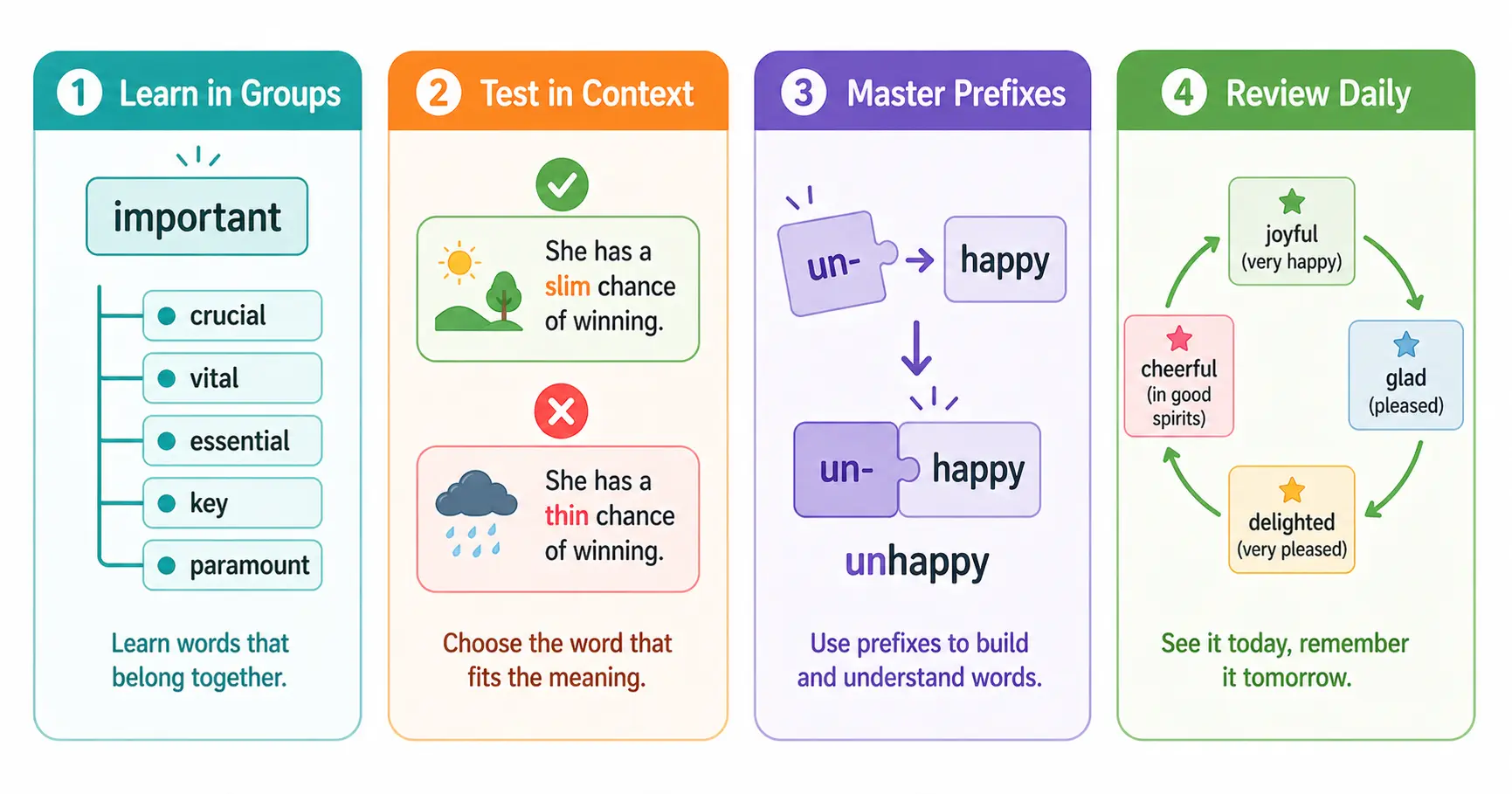
1. Aprenda em grupos, não em pares
Não aprenda apenas “big = large”. Aprenda o grupo completo de sinônimos: big → large → huge → enormous → massive → vast → immense. Cada palavra ocupa um ponto diferente na escala de formalidade e intensidade. Conhecer o grupo dá opções; aprender um único par não.
2. Sempre aprenda o contexto
“Slim” e “thin” são sinônimos, mas “slim chance” funciona enquanto “thin chance” não. “Strong tea” está correto, mas “powerful tea” não. Sempre aprenda um sinônimo dentro da frase ou colocação em que aparece. Para se aprofundar nas colocações, veja o Guia de Colocações em Inglês.
3. Use o “teste de substituição”
Quando aprender um novo sinônimo, tente substituí-lo em três frases diferentes nas quais normalmente usaria a palavra básica. Se soar errado em alguma delas, anote a restrição. “Vast” funciona em “a vast desert”, mas não em “a vast cup of coffee”. Essa prática desenvolve precisão com o tempo.
4. Estude padrões de prefixos
Aprender os padrões un-, in-, dis-, mis-, over- e under- dá antônimos para centenas de palavras de uma só vez. É uma das habilidades de vocabulário com maior retorno que você pode desenvolver.
5. Use repetição espaçada
Adicione grupos de sinônimos e antônimos ao Linglify ou a outro sistema de repetição espaçada. Estude conjuntos (todos os sinônimos de “important”), não pares isolados. Para estratégias de memorização baseadas em evidências, veja Como Memorizar Vocabulário.
6. Leia prestando atenção aos sinônimos
Ao ler artigos de jornais como The Economist, BBC ou The Guardian, observe como os autores evitam repetir palavras. Eles usam “increase” em uma frase, “rise” na seguinte e “surge” na terceira. Essa alternância natural é exatamente o que avaliadores do IELTS e leitores acadêmicos esperam.
O Que Ler a Seguir
Este guia principal apresenta a estrutura completa de sinônimos e antônimos. Para aprofundar temas específicos, veja também:
Listas de sinônimos:
- Sinônimos para Palavras Comuns em Inglês: mais de 200 alternativas — substitua “good”, “bad”, “interesting” e outras palavras
- Lista de Sinônimos: 300 Sinônimos Acadêmicos para Redações — para trabalhos universitários e provas
Listas de antônimos:
- Mais de 500 Palavras Opostas em Inglês: Lista de Antônimos A–Z — uma referência completa de antônimos
Para provas:
- Sinônimos para IELTS: mais de 200 Palavras para Paráfrase — sinônimos específicos para melhorar sua nota
- Vocabulário Avançado para IELTS: Palavras para Bandas 8–9 — vocabulário preciso para notas altas
Vocabulário relacionado:
- Guia de Colocações em Inglês — aprenda quais palavras costumam aparecer juntas
- Expressões Idiomáticas em Inglês: mais de 500 Expressões Comuns — expressões fixas com sentido figurado
- Palavras Avançadas em Inglês: mais de 300 Termos C1–C2 — termos que funcionam como sinônimos precisos
- Como Melhorar o Vocabulário — uma estratégia completa para ampliar o vocabulário
FAQ
Quantos sinônimos devo conhecer para cada palavra?
Para a fluência cotidiana, conhecer de três a cinco sinônimos para os 100 adjetivos, verbos e substantivos mais comuns é suficiente. Para a Banda 7+ do IELTS, você precisa de pelo menos três alternativas para cada palavra que costuma repetir. Para as Bandas 8–9, procure ter cinco ou mais opções e saber qual se encaixa em cada contexto. Qualidade — saber quando usar cada sinônimo — importa mais do que quantidade: conhecer 20 palavras sem entender as diferenças não ajuda.
Os sinônimos têm exatamente o mesmo significado?
Quase nunca. A maioria dos sinônimos em inglês são “sinônimos próximos”: compartilham um sentido central, mas diferem em formalidade, intensidade, conotação ou contexto. “Slim” e “skinny” significam “magro”, mas “slim” é positivo e “skinny” pode soar negativo. “Home” e “residence” indicam onde alguém mora, mas “residence” é formal. Tratar sinônimos como intercambiáveis é um dos erros de vocabulário mais comuns.
Qual é a melhor forma de aprender antônimos?
Aprenda primeiro os padrões de prefixos (un-, dis-, in-/im-/il-/ir-, mis-, over-/under-). Esses seis prefixos formam antônimos para centenas de palavras em inglês. Depois, estude antônimos complementares (alive/dead, true/false) e graduáveis (hot/cold, big/small). Por fim, aprenda os relacionais (buy/sell, teach/learn).
Os sinônimos são importantes para o IELTS?
Sim. O critério Lexical Resource do IELTS avalia especificamente o uso de sinônimos e a capacidade de parafrasear. Repetir a mesma palavra várias vezes reduz sua nota; escolher alternativas precisas demonstra domínio do vocabulário.
Qual é a diferença entre um sinônimo e uma definição?
Um sinônimo é uma palavra diferente com significado igual ou próximo: happy e joyful, por exemplo. Uma definição explica o significado de uma palavra usando outras palavras: happy significa “sentir ou demonstrar prazer”. Sinônimos ajudam a variar o vocabulário; definições ajudam a entender o sentido.
Posso usar um dicionário de sinônimos para encontrar sinônimos?
Sim, mas com cuidado. Um dicionário de sinônimos oferece opções, mas não indica qual se encaixa no seu contexto específico. Sempre confira: (1) o nível de formalidade é adequado? (2) a palavra funciona nesta colocação? (3) ela tem a mesma conotação?
Como sinônimos e antônimos são cobrados em provas?
Em provas como o IELTS, você pode precisar substituir palavras repetidas por sinônimos na escrita ou identificar antônimos em questões de vocabulário e leitura. Os exames testam se você entende as nuances, não apenas se decorou pares de palavras.