Hard English Words: 500+ Difficult Words with Meanings and Examples
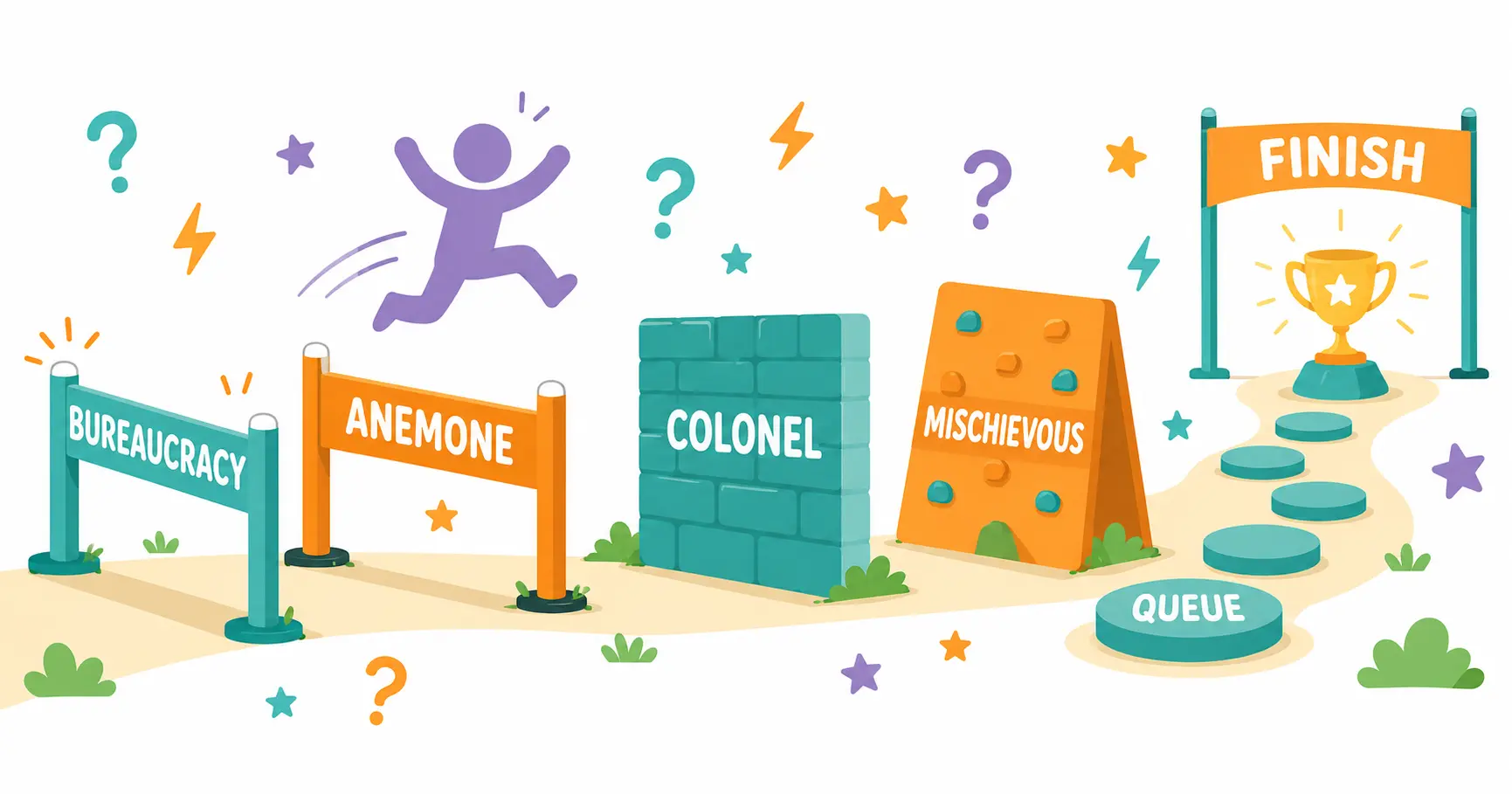
Some English words are just hard. Hard to spell (bureaucracy), hard to pronounce (anemone), hard to remember (sesquipedalian), or hard to use correctly (disinterested does not mean uninterested). And the hardest words are often the most useful — they let you express precise ideas that simpler words cannot capture.
This guide is for learners who have passed the intermediate stage and want to push into advanced territory. Whether you are preparing for IELTS Band 8–9, building academic vocabulary, or simply want to sound more articulate, these 500+ difficult English words — with clear meanings and example sentences — will take your English to the next level.
We organized them by:
- what makes them hard (spelling, pronunciation, meaning, or usage),
- topic (academic, literary, scientific, everyday),
- and CEFR level (B2, C1, C2).
Why Some English Words Are “Hard”
Not all difficult words are difficult for the same reason. Understanding why a word is hard helps you learn it more effectively.
| Type of Difficulty | The Problem | Examples |
|---|---|---|
| Hard to spell | Unusual letter combinations, silent letters, double letters | bureaucracy, embarrassment, occurrence |
| Hard to pronounce | Counter-intuitive pronunciation, unusual sounds | anemone, colonel, worcestershire |
| Hard to understand | Abstract or specialized meaning | epistemology, ontological, paradigm |
| Hard to use correctly | Subtle meaning, easily confused with similar words | disinterested ≠ uninterested, imply ≠ infer |
| Hard to remember | Long, rare, or Latin/Greek-derived | sesquipedalian, defenestration, pneumonoultramicroscopicsilicovolcanoconiosis |
Most words in this guide fall into more than one category. Bureaucracy, for example, is hard to spell AND hard to pronounce.
Part 1: Hard Words to Spell (100 Words)
These words consistently appear on “most misspelled words” lists. The spelling either does not match the pronunciation or contains tricky letter patterns.
The 50 Most Misspelled English Words
| Word | Common Misspelling | Meaning | Example |
|---|---|---|---|
| accommodate |
|
to provide space for; to adjust | The hotel can accommodate 200 guests. |
| acquaintance |
|
a person you know slightly | She’s an acquaintance from work, not a close friend. |
| apparent |
|
clearly visible; obvious | It was apparent that he hadn’t slept. |
| believe |
|
to accept as true | I believe we can finish this by Friday. |
| bureaucracy |
|
a complex administrative system | The bureaucracy slowed everything down. |
| calendar |
|
a chart of dates | Check the calendar for the meeting date. |
| Caribbean |
|
a region in the Americas | They went on a Caribbean cruise. |
| colleague |
|
a coworker | My colleague handles the design work. |
| committed |
|
dedicated; having pledged | She’s committed to finishing her degree. |
| conscience |
|
inner sense of right and wrong | His conscience wouldn’t let him lie. |
| conscious |
|
aware; awake | She was conscious of being watched. |
| consensus |
|
general agreement | We reached a consensus after long discussion. |
| definitely |
|
without doubt | I will definitely be there tomorrow. |
| desperate |
|
having an urgent need | They made a desperate attempt to escape. |
| disappear |
|
to vanish | The fog made the buildings disappear. |
| embarrassment |
|
a feeling of shame | The mistake caused great embarrassment. |
| environment |
|
surroundings; natural world | Pollution damages the environment. |
| exaggerate |
|
to overstate | Don’t exaggerate — it wasn’t that bad. |
| existence |
|
the state of existing | No one questions the existence of gravity. |
| fascinating |
|
extremely interesting | The documentary was fascinating. |
| fluorescent |
|
emitting bright light | The office had fluorescent lighting. |
| foreign |
|
from another country | She speaks three foreign languages. |
| gauge |
|
to measure; a measuring tool | It’s hard to gauge his reaction. |
| guarantee |
|
a promise of quality | The product comes with a 5-year guarantee. |
| harass |
|
to annoy persistently | It’s illegal to harass employees. |
| immediately |
|
without delay | Please respond immediately. |
| independent |
|
free from control | She became financially independent at 25. |
| intelligence |
|
ability to learn and understand | Emotional intelligence matters as much as IQ. |
| jewelry |
|
decorative accessories | She rarely wears jewelry. |
| knowledge |
|
information and skills | Knowledge is power when applied correctly. |
| leisure |
|
free time | He spends his leisure time reading. |
| liaison |
|
a connection; a contact person | She served as liaison between the two teams. |
| license |
|
official permission | You need a license to drive. |
| maintenance |
|
upkeep | Regular maintenance extends the car’s life. |
| millennium |
|
a period of 1,000 years | We entered the new millennium in 2000. |
| miniature |
|
very small | He builds miniature model trains. |
| mischievous |
|
playfully naughty | The mischievous child hid the remote. |
| necessary |
|
required; essential | Is it really necessary to leave now? |
| noticeable |
|
easily seen | There was a noticeable improvement. |
| occasionally |
|
from time to time | I occasionally work from home. |
| occurrence |
|
an event; something that happens | Flooding is a common occurrence here. |
| perseverance |
|
persistence despite difficulty | Her perseverance finally paid off. |
| privilege |
|
a special right or advantage | Education should not be a privilege. |
| pronunciation |
|
the way a word is spoken | Check the pronunciation before you speak. |
| questionnaire |
|
a set of written questions | Please complete this short questionnaire. |
| receipt |
|
proof of payment | Keep the receipt for your records. |
| recommend |
|
to suggest | I recommend this book to all students. |
| separate |
|
to divide; distinct | Separate the whites from the colors. |
| threshold |
|
a starting point; a doorway | The country has crossed the poverty threshold. |
| vacuum |
|
empty space; a cleaning device | Vacuum the living room, please. |
50 More Tricky Spellings
| Word | Meaning | Spelling Trap |
|---|---|---|
| absence | not being present | ends in “-ence” not “-ance” |
| acknowledgment | recognition | no “e” after “g” (AmE) |
| acquit | to declare not guilty | “acq-“ start |
| amateur | non-professional | “-eur” ending |
| anomaly | something unusual | “a-nom-“ not “anom-“ |
| argument | a disagreement | no “e” after “argu-“ |
| bellwether | a trend indicator | no “a” — not “bellweather” |
| camouflage | disguise | French spelling |
| cemetery | burial ground | all E’s, no A’s |
| changeable | able to change | keeps the “e” before “-able” |
| connoisseur | an expert judge | double N, double S, “-eur” |
| contemptible | deserving contempt | “-ible” not “-able” |
| daiquiri | a cocktail | unusual letter sequence |
| dilemma | a difficult choice | double M, not double L |
| dumbbell | a weight for exercise | double B in the middle |
| ecstasy | extreme happiness | ends in “-asy” not “-acy” |
| fiery | like fire | “fiery” not “firey” |
| hierarchy | a ranking system | “-ie-“ not “-ei-“ |
| humorous | funny | no second “o” before “-ous” |
| idiosyncrasy | a peculiar habit | “-asy” ending |
| indispensable | essential | “-able” not “-ible” |
| inoculate | to vaccinate | one N, one C |
| irresistible | impossible to resist | “-ible” not “-able” |
| kernel | seed; core | not “colonel” (different word!) |
| maneuver | a strategic move | “-euver” (AmE) / “-oeuvre” (BrE) |
| medieval | from the Middle Ages | “-ie-“ not “-ei-“ |
| memento | a souvenir | not “momento” |
| misspell | to spell wrong | double S (ironic!) |
| nauseous | feeling sick | “-eous” ending |
| onomatopoeia | words that imitate sounds | from Greek, complex ending |
| parallel | side by side | double L, single L at start |
| pharaoh | Egyptian ruler | “-aoh” ending |
| playwright | a person who writes plays | “wright” not “write” |
| pneumonia | lung infection | silent P |
| possession | ownership | double S twice |
| precede | to come before | “-cede” not “-ceed” |
| publicly | in public | no second “l” |
| renaissance | a cultural revival | double S, “-ance” ending |
| rhythm | a pattern of beats | no vowel between consonants |
| sacrilegious | disrespectful to sacred things | not related to “religious” spelling |
| sergeant | a military rank | “-geant” ending |
| siege | surrounding a place | “-ie-“ not “-ei-“ |
| supersede | to replace | “-sede” not “-cede” |
| surveillance | close observation | “-eill-“ |
| tyranny | oppressive rule | double N, single R |
| unanimous | fully agreed | starts “unan-“ |
| withhold | to hold back | double H |
| yacht | a luxury boat | silent letters galore |
| zealous | passionately devoted | “zeal-“ not “zell-“ |
Part 2: Hard Words to Pronounce (80 Words)
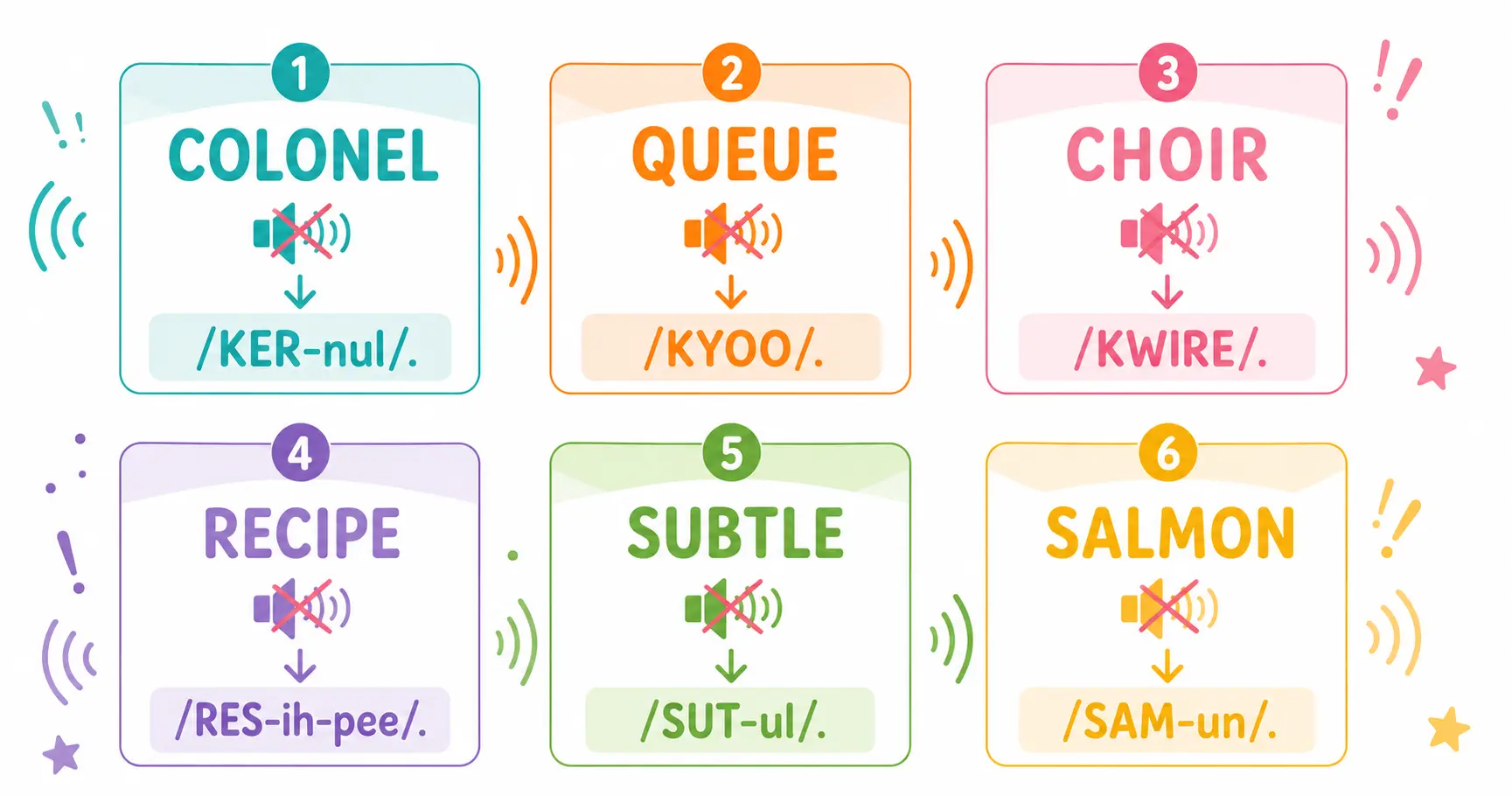
English pronunciation follows almost no rules. These words consistently stump learners (and native speakers).
Deceptive Pronunciations
Words where the spelling completely misleads you.
| Word | How It Looks | How It’s Said | Meaning |
|---|---|---|---|
| colonel | col-o-nel | /ˈkɜːrnl/ (“kernel”) | a military officer |
| worcestershire | wor-ces-ter-shire | /ˈwʊstərʃɪr/ (“WOO-ster-sher”) | a type of sauce |
| queue | q-u-e-u-e | /kjuː/ (“kyoo”) | a line of waiting people |
| choir | ch-oir | /kwaɪr/ (“kwire”) | a singing group |
| debut | de-but | /deɪˈbjuː/ (“day-BYOO”) | a first public appearance |
| recipe | re-ci-pe | /ˈresɪpi/ (“RES-ih-pee”) | cooking instructions |
| anemone | a-ne-mo-ne | /əˈneməni/ (“uh-NEM-uh-nee”) | a sea creature / flower |
| epitome | e-pi-to-me | /ɪˈpɪtəmi/ (“ih-PIT-uh-mee”) | a perfect example |
| hyperbole | hy-per-bole | /haɪˈpɜːrbəli/ (“hy-PER-buh-lee”) | extreme exaggeration |
| isthmus | isth-mus | /ˈɪsməs/ (“IS-mus”) | narrow strip of land |
| quinoa | quin-oa | /ˈkiːnwɑː/ (“KEEN-wah”) | a grain-like seed |
| subtle | sub-tle | /ˈsʌtl/ (“SUT-ul”) | not obvious |
| salmon | sal-mon | /ˈsæmən/ (“SAM-un”) | a fish |
| almond | al-mond | /ˈɑːmənd/ (“AH-mund”) | a nut |
| debris | de-bris | /dəˈbriː/ (“duh-BREE”) | scattered remains |
| niche | ni-che | /niːʃ/ or /nɪtʃ/ | a specialized segment |
| archive | ar-chive | /ˈɑːrkaɪv/ (“AR-kive”) | a collection of records |
| chaos | ch-aos | /ˈkeɪɒs/ (“KAY-os”) | complete disorder |
| draught | dr-aught | /drɑːft/ (“draft”) | a current of air (BrE) |
| quay | qu-ay | /kiː/ (“kee”) | a wharf |
Silent Letter Words
| Word | Silent Letter | Pronunciation | Meaning |
|---|---|---|---|
| knife | K | /naɪf/ | a cutting tool |
| knight | K, GH | /naɪt/ | a medieval warrior |
| pneumonia | P | /njuːˈmoʊniə/ | a lung disease |
| psychology | P | /saɪˈkɒlədʒi/ | study of the mind |
| gnaw | G | /nɔː/ | to bite persistently |
| honest | H | /ˈɒnɪst/ | truthful |
| island | S | /ˈaɪlənd/ | land surrounded by water |
| doubt | B | /daʊt/ | uncertainty |
| debt | B | /det/ | money owed |
| plumber | B | /ˈplʌmər/ | a pipe fixer |
| receipt | P | /rɪˈsiːt/ | proof of payment |
| sword | W | /sɔːrd/ | a blade weapon |
| wrestling | W | /ˈreslɪŋ/ | a combat sport |
| muscle | C | /ˈmʌsl/ | body tissue |
| fascinate | C | /ˈfæsɪneɪt/ | to captivate |
Commonly Mispronounced (Stress, Vowels, Consonants)
| Word | Common Error | Correct Pronunciation | Meaning |
|---|---|---|---|
| mischievous | mis-CHEEV-ee-us | /ˈmɪs.tʃɪ.vəs/ (3 syllables) | playfully naughty |
| February | FEB-yoo-ary | /ˈfeb.ruː.eri/ | the 2nd month |
| library | LI-berry | /ˈlaɪ.breri/ | a place for books |
| deteriorate | de-TEER-ee-ate | /dɪˈtɪr.i.ə.reɪt/ (5 syllables) | to get worse |
| temperature | TEMP-a-ture | /ˈtem.prə.tʃər/ | heat level |
| comfortable | com-FOR-ta-ble | /ˈkʌmf.tə.bl/ (3 syllables) | at ease |
| vegetable | VEJ-ta-ble | /ˈvedʒ.tə.bl/ (3 syllables) | an edible plant |
| Wednesday | WED-nes-day | /ˈwenz.deɪ/ | the 4th day of the week |
| often | OFF-ten | /ˈɒf.ən/ (silent T) or /ˈɒf.tən/ | frequently |
| Antarctic | an-AR-tic | /æntˈɑːrk.tɪk/ | southern polar region |
| nuclear | NUKE-yoo-lar | /ˈnjuː.kli.ər/ | relating to atomic nuclei |
| specific | pa-SIFIC | /spəˈsɪf.ɪk/ | precise; particular |
| espresso | EX-press-oh | /eˈspres.oʊ/ | a type of coffee |
| etcetera | ek-SET-ra | /ˌetˈset.ər.ə/ | and so on |
| jewelry | JOO-la-ree | /ˈdʒuːəl.ri/ (2–3 syllables) | decorative items |
Part 3: Hard Words to Understand (120 Words)
These words have abstract or specialized meanings. They appear in academic writing, literature, serious journalism, and IELTS/TOEFL passages.
Academic & Intellectual
| Word | Part of Speech | Meaning | Example |
|---|---|---|---|
| ambiguous | adjective | open to more than one interpretation | The contract language was deliberately ambiguous. |
| antithesis | noun | the direct opposite | War is the antithesis of peace. |
| arbitrary | adjective | based on random choice, not reason | The decision seemed completely arbitrary. |
| catharsis | noun | emotional release or purification | Writing was a catharsis for her grief. |
| cognizant | adjective | aware; having knowledge | Are you cognizant of the risks involved? |
| conundrum | noun | a confusing problem | The budget deficit is an ongoing conundrum. |
| dichotomy | noun | a division into two opposing parts | There’s a false dichotomy between art and science. |
| dogma | noun | a set of principles held as authority | He rejected the dogma of the old school. |
| eloquent | adjective | fluent and persuasive in speech | She gave an eloquent speech at the ceremony. |
| empirical | adjective | based on observation, not theory | We need empirical evidence, not guesses. |
| enigma | noun | a mystery; something puzzling | The origin of the signal remains an enigma. |
| ephemeral | adjective | lasting a very short time | Social media trends are ephemeral by nature. |
| esoteric | adjective | understood by only a small group | His research is too esoteric for a general audience. |
| exacerbate | verb | to make a problem worse | The drought exacerbated the food crisis. |
| facetious | adjective | treating serious issues with humor | He was being facetious, not serious. |
| gregarious | adjective | fond of company; sociable | She has a gregarious personality. |
| hegemony | noun | dominance of one group over others | Cultural hegemony shapes what we consider “normal.” |
| idiosyncratic | adjective | peculiar to an individual | His idiosyncratic teaching style confused some students. |
| impetuous | adjective | acting quickly without thought | His impetuous decision cost the company millions. |
| inevitable | adjective | certain to happen | Change is inevitable in any organization. |
| juxtaposition | noun | placing things side by side for contrast | The juxtaposition of wealth and poverty was striking. |
| laconic | adjective | using very few words | His laconic reply — “No” — ended the discussion. |
| loquacious | adjective | very talkative | My loquacious neighbor talks for hours. |
| magnanimous | adjective | generous and forgiving | In victory, he was magnanimous toward his opponents. |
| nonchalant | adjective | casually calm and relaxed | She seemed nonchalant about the exam results. |
| obfuscate | verb | to make unclear or confusing | Politicians often obfuscate rather than clarify. |
| paradigm | noun | a typical pattern or model | The internet created a new paradigm for communication. |
| paradox | noun | a contradictory but true statement | It’s a paradox that standing still requires balance. |
| pragmatic | adjective | dealing with things practically | We need a pragmatic solution, not an idealistic one. |
| precarious | adjective | not securely held; risky | The economy is in a precarious state. |
| prolific | adjective | producing a lot of work | She’s a prolific writer with 30 published novels. |
| quintessential | adjective | the most perfect example of something | He is the quintessential British gentleman. |
| recalcitrant | adjective | stubbornly uncooperative | The recalcitrant student refused to follow any rules. |
| resilient | adjective | able to recover from difficulty | Children are remarkably resilient. |
| rhetoric | noun | persuasive language; the art of persuasion | The speech was full of rhetoric but empty of substance. |
| sanguine | adjective | optimistic, especially in a tough situation | She remained sanguine despite the setbacks. |
| scrutinize | verb | to examine closely | The auditor will scrutinize every transaction. |
| surreptitious | adjective | done secretly | He took a surreptitious glance at her phone. |
| tenacious | adjective | holding on firmly; persistent | She’s tenacious — she never gives up. |
| ubiquitous | adjective | present everywhere | Smartphones have become ubiquitous. |
| unprecedented | adjective | never done or known before | The pandemic created unprecedented challenges. |
| verbose | adjective | using more words than necessary | His verbose writing style bored readers. |
| vicarious | adjective | experienced through someone else | She felt vicarious joy at her daughter’s graduation. |
| volatile | adjective | likely to change suddenly; explosive | The stock market has been extremely volatile. |
| zealot | noun | a fanatical supporter | He became a zealot for the new diet. |
Literary & Rare
| Word | Meaning | Example |
|---|---|---|
| ameliorate | to make something better | Medication can ameliorate the symptoms. |
| anachronism | something out of its time period | A smartphone in a medieval movie is an anachronism. |
| bellicose | aggressive and eager to fight | His bellicose tone alarmed the diplomats. |
| capricious | prone to sudden changes of mood | The weather here is capricious — sun one minute, rain the next. |
| conflagration | a large destructive fire | The conflagration consumed the entire warehouse. |
| deleterious | causing harm or damage | Smoking has deleterious effects on health. |
| ebullient | cheerful and full of energy | Her ebullient personality lights up any room. |
| fastidious | very attentive to detail | He’s fastidious about keeping his desk organized. |
| garrulous | excessively talkative | The garrulous taxi driver narrated the whole trip. |
| ignominious | causing public shame or disgrace | It was an ignominious defeat for the champion. |
| ineffable | too great to be expressed in words | The beauty of the sunset was ineffable. |
| lugubrious | looking or sounding sad | The lugubrious music set a somber tone. |
| mendacious | not telling the truth; lying | The witness gave a mendacious account of events. |
| nebulous | unclear; vague | The plan was still nebulous — no concrete details. |
| obsequious | excessively obedient or attentive | His obsequious behavior annoyed his colleagues. |
| perfunctory | carried out without care or interest | She gave a perfunctory nod and walked away. |
| quagmire | a soft, boggy area; a complex situation | The project became a bureaucratic quagmire. |
| recondite | little known; obscure | The book covers recondite aspects of medieval law. |
| soliloquy | an act of speaking one’s thoughts aloud | Hamlet’s soliloquy is the most famous in English literature. |
| truculent | eager to fight; aggressively defiant | The truculent teenager slammed the door. |
Part 4: Hard Words to Use Correctly (60 Pairs)
These words are commonly misused because they look similar, sound similar, or have overlapping meanings. Getting them right marks sophisticated English.
Commonly Confused Pairs
| Word | Meaning | Confused With | Its Meaning |
|---|---|---|---|
| disinterested | impartial, unbiased | uninterested | not interested, bored |
| imply | to suggest indirectly | infer | to conclude from evidence |
| literally | in a literal manner |
|
(misused as emphasis: “I literally died”) |
| comprise | to be made up of | compose | to make up, constitute |
| emigrate | to leave a country | immigrate | to enter a country |
| farther | greater physical distance | further | additional; to a greater degree |
| fewer | smaller number (countable) | less | smaller amount (uncountable) |
| historic | important in history | historical | relating to history in general |
| flout | to openly disobey | flaunt | to show off |
| elicit | to draw out a response | illicit | illegal |
| adverse | unfavorable; harmful | averse | having a strong dislike |
| amoral | lacking moral sense | immoral | violating moral principles |
| assure | to tell someone confidently | ensure | to make certain |
| compliment | praise | complement | something that completes |
| continual | frequent, repeated | continuous | without interruption |
| credible | believable | credulous | too willing to believe |
| defuse | to make less dangerous | diffuse | to spread out |
| deprecate | to express disapproval | depreciate | to decrease in value |
| discreet | careful, subtle | discrete | separate, distinct |
| enormity | great wickedness (original) |
|
(commonly misused) |
| faze | to disturb or disconcert | phase | a stage in a process |
| flounder | to struggle clumsily | founder | to fail completely; a person who establishes |
| fortuitous | happening by chance |
|
(does not mean “lucky”) |
| hone | to sharpen or refine | home in on | to move toward (not “hone in on”) |
| loath | reluctant (adjective) | loathe | to hate (verb) |
| militate | to be a powerful factor against | mitigate | to make less severe |
| perquisite | a special benefit (perk) | prerequisite | a prior requirement |
| prescribe | to recommend officially | proscribe | to forbid |
| reticent | reserved, not revealing thoughts |
|
(does not mean “unwilling”) |
| tortuous | full of twists | torturous | causing pain |
Part 5: Hard Words by Topic
Science & Medicine
| Word | Meaning | Example |
|---|---|---|
| algorithm | a process or set of rules | Search engines use complex algorithms. |
| carcinogen | a cancer-causing substance | Asbestos is a known carcinogen. |
| chromosome | a DNA structure in cells | Humans have 23 pairs of chromosomes. |
| diaphragm | a muscle below the lungs | Hiccups occur when the diaphragm contracts involuntarily. |
| hypothesis | a proposed explanation | The hypothesis was confirmed by experiments. |
| immunology | study of the immune system | She specializes in immunology research. |
| mitochondria | the cell’s energy producers | Mitochondria are the powerhouse of the cell. |
| pathogen | something that causes disease | The water was contaminated with a pathogen. |
| photosynthesis | how plants convert light to energy | Photosynthesis requires sunlight, water, and carbon dioxide. |
| prognosis | a predicted outcome (medical) | The doctor gave a positive prognosis. |
Law & Politics
| Word | Meaning | Example |
|---|---|---|
| acquit | to declare not guilty | The jury voted to acquit the defendant. |
| amendment | a formal change to a law | The first amendment protects free speech. |
| bipartisan | supported by two political parties | The bipartisan bill passed easily. |
| jurisdiction | the authority to govern | This falls outside our jurisdiction. |
| legislation | laws collectively | New legislation was introduced this week. |
| precedent | a previous case used as an example | The ruling set a legal precedent. |
| subpoena | a legal order to appear in court | She received a subpoena to testify. |
| usurp | to seize power illegally | He attempted to usurp the throne. |
Business & Finance
| Word | Meaning | Example |
|---|---|---|
| amortization | spreading a cost over time | The loan has a 30-year amortization schedule. |
| collateral | something pledged as security for a loan | The house served as collateral for the mortgage. |
| depreciation | a decrease in value over time | The car’s depreciation was $3,000 per year. |
| dividend | a portion of profits paid to shareholders | The company paid a quarterly dividend. |
| fiduciary | relating to trust and responsibility | Financial advisors have a fiduciary duty to clients. |
| liquidity | how easily an asset can be converted to cash | Real estate has lower liquidity than stocks. |
Vocabulary to Practice
These 25 hard words are worth adding to your Linglify dictionary for spaced repetition.
belly
noun
The soft, internal part of the front of the human body below the chest.
Examples
- After the big meal, his belly felt completely full.
- The baby laughed when his mother tickled his belly gently.
conclusion
noun
A final decision or judgment based on reasoning or evidence.
Examples
- In conclusion, the project was successful beyond our initial expectations.
- The research led to the conclusion that exercise improves mental health.
crash
noun
A sudden loud noise caused by a collision or accident.
Examples
- The car crash occurred at the busy intersection during rush hour.
- The stock market crash of 1929 led to the Great Depression.
dancing
noun
The activity of moving rhythmically to music.
Examples
- Dancing is excellent exercise that improves coordination and fitness.
- The wedding reception featured hours of dancing and celebration.
describe
verb
To give an account of or describe something in detail.
Examples
- Can you describe what the suspect looked like to police officers?
- The travel guide describes many interesting places to visit in Europe.
explore
verb
To look into or travel through an area to learn more about it.
Examples
- Scientists continue to explore the mysteries of the deep ocean.
- Young people should explore different career options before making decisions.
global
adjective
Relating to the whole world or all people everywhere.
Examples
- Climate change is a global problem that affects all countries worldwide.
- The company has expanded its operations to become a global business.
harness
noun
A device used to control or secure a harness or strap.
Examples
- Rock climbers use a special harness for safety when scaling steep cliffs.
- The horse's harness was made of high-quality leather and brass fittings.
infant
noun
A very young child who has not yet learned to walk.
Examples
- Special care is required when handling a newborn infant safely.
- The infant sleeps most of the day and wakes up only for feeding.
laundry
noun
Clothes that need washing or the process of washing clothes.
Examples
- She does laundry every Sunday to prepare for upcoming week.
- The laundry basket is full of dirty clothes and towels.
memorial
noun
A structure or object built to honor or remember a person or event.
Examples
- The memorial service celebrated her life and achievements.
- War memorial honors soldiers who died serving their country.
optimism
noun
A positive attitude that expects good outcomes and believes things will improve.
Examples
- Her optimism helped family through difficult financial times.
- Optimism about future motivates people to work harder.
personnel
noun
A noun for a group of people employed in an organization or for a specific purpose.
Examples
- Military personnel receive specialized training for duties.
- Qualified personnel ensures company operates efficiently and safely.
proven
adjective
Shown to be true or proven by evidence.
Examples
- Proven method ensures consistent successful results always.
- Proven remedy helps treat common cold symptoms.
restriction
noun
A rule or law that limits or restricts something.
Examples
- Age restriction prevents minors from purchasing alcohol.
- Speed restriction protects drivers on dangerous mountain roads.
shoplifter
noun
A person who steals goods from a shop.
Examples
- Experienced shoplifter knows how to avoid detection.
- Store security catches shoplifter stealing expensive items.
spell
noun
A word or series of words that spells a particular name or meaning.
Examples
- Cold spell brings freezing temperatures to region.
- Magic spell transforms pumpkin into carriage magically.
teamwork
noun
The cooperative effort of a group working towards a common goal.
Examples
- Good teamwork achieves better results than individuals.
- Successful teamwork requires trust and clear communication.
too
adverb
An adverb meaning also or to a greater degree, used to add information or emphasize.
Examples
- Student wants to participate in activity too.
- Weather seems too cold for outdoor swimming.
voice
noun
The sound produced by a person's voice; the spoken or sung expression of a person.
Examples
- Clear voice helps effective communication and understanding.
- Singer's voice captivates audience during performance show.
minutiae
noun
Small, precise details or trivial aspects of something.
Examples
- She focused on the minutiae rather than the big picture.
- The contract's minutiae required careful examination by lawyers.
preach
verb
To deliver a religious or moral message with passion or authority.
Examples
- Don't preach to others about lifestyle choices constantly.
- Minister will preach about compassion during Sunday service.
lust
noun
A strong desire or craving, often related to sexual or material satisfaction.
Examples
- Character's lust for power ultimately leads to downfall.
- Traveler felt intense lust for adventure in foreign countries.
emulate
verb
To imitate or copy someone's behavior, style, or achievements, often to match or surpass.
Examples
- Software developers emulate successful applications to create competitive products.
- Young athletes emulate professional sports stars' training techniques and dedication.
How to Learn Hard English Words
1. Learn roots, prefixes, and suffixes
Over 60% of English words have Latin or Greek roots. Learning common roots unlocks hundreds of words at once:
| Root | Meaning | Words |
|---|---|---|
| bene- | good | benefit, benevolent, benefactor |
| mal- | bad | malicious, malevolent, malfunction |
| cogn- | to know | cognizant, recognize, cognitive |
| dict- | to say | dictate, predict, contradict |
| scrib/script- | to write | describe, manuscript, prescription |
| spec- | to look | inspect, spectacle, perspective |
| voc/vok- | voice, call | vocabulary, invoke, provoke |
| chron- | time | chronological, synchronize, chronic |
2. Use spaced repetition
Hard words are forgotten quickly without review. Add them to Linglify’s spaced repetition system and review them at increasing intervals.
3. Read challenging material
Academic articles, quality journalism (The Economist, The Atlantic), and literary fiction expose you to hard words in real context. When you encounter an unknown word, pause, look it up, and note the sentence.
4. Learn in collocations, not isolation
“Empirical” alone is hard to remember. “Empirical evidence” is a natural phrase that sticks. For more on this approach, see English Collocations: Master Natural Word Combinations.
5. Use the word within 24 hours
Research shows that using a new word in a sentence (writing or speaking) within the first day dramatically increases retention. Try using 3 new hard words in your journal, emails, or conversations each day.
What to Read Next
More vocabulary by difficulty:
- Advanced English Words: 300+ C1–C2 Vocabulary — the step below this guide
- IELTS Advanced Vocabulary: Words for Band 8–9 — hard words specifically for IELTS
- 1000 Most Common English Words — start here if this list is too advanced
Related topics:
- English Homophones: 300+ Examples — words that sound alike but differ in meaning
- English Synonyms and Antonyms — upgrade your word choices
- How to Improve Your Vocabulary — the complete strategy guide
- English Phrasal Verbs: Complete Guide — another challenging area of English
FAQ
What are the hardest words in English?
The hardest words depend on what makes them difficult. For spelling, words like bureaucracy, onomatopoeia, and accommodation consistently top misspelled lists. For pronunciation, Worcestershire, colonel, and anemone are notoriously tricky. For meaning, words like sesquipedalian (meaning “characterized by long words”), defenestration (throwing someone out a window), and antidisestablishmentarianism are famously challenging.
How many hard words should I learn per day?
Quality matters more than quantity. For most learners, 3–5 new hard words per day with proper review (spaced repetition) is more effective than trying to memorize 20+ words at once. Focus on words you are likely to encounter or use — learning ubiquitous is more valuable than learning defenestration.
Do I need to know hard words for IELTS?
For Band 7+, yes. The IELTS Lexical Resource criterion rewards “less common vocabulary” used accurately. For Band 8–9, examiners specifically look for sophisticated vocabulary that goes beyond everyday words. You do not need obscure or archaic words — words like exacerbate, unprecedented, pragmatic, and scrutinize are perfect for IELTS. See IELTS Advanced Vocabulary for a focused list.
What is the longest word in English?
The longest word in a major English dictionary is pneumonoultramicroscopicsilicovolcanoconiosis (45 letters), a lung disease caused by inhaling very fine silica dust. However, this word was deliberately coined to be long. The longest commonly used English word is antidisestablishmentarianism (28 letters), referring to opposition to the separation of church and state.
How can I remember hard words that I keep forgetting?
Three techniques work best: (1) Create vivid mental images — for ephemeral, picture a butterfly that lives for just one day; (2) Connect the word to its root — ephemeral comes from Greek ephemeros (“lasting only a day”); (3) Use spaced repetition software like Linglify that automatically schedules reviews at optimal intervals. The combination of imagery, etymology, and timed repetition makes even the hardest words stick.
Are hard words the same in British and American English?
Most hard words are shared across dialects, but there are differences. Some words are harder to pronounce in one dialect (e.g., schedule is /ˈʃedjuːl/ in British English but /ˈskedʒuːl/ in American). Some spellings differ (manoeuvre vs. maneuver, colour vs. color), and a few words exist in one dialect but not the other (fortnight is common in British English but rare in American). This guide covers both where they differ.