CEFRレベル別 英語語彙ガイド:A1初級からC2上級まで
「自分の英語力はどのレベル?」――これは語学学習者が最もよく抱く疑問のひとつです。その答えは語彙力に大きく左右されます。どれだけの単語を知っているか、どれだけ深く理解しているか、そして文脈の中で使いこなせるかどうかが鍵になります。
CEFR(ヨーロッパ言語共通参照枠)は、語学力を測る世界標準のフレームワークです。学習者をA1(完全な初心者)からC2(熟達者)までの6段階に分類し、語彙力は各段階を判断する主要な指標のひとつとなっています。
このガイドでは、英語の語彙をCEFRの全6レベルに対応させて解説します。各レベルについて以下の情報を紹介します:
- 必要な語数
- 求められる語彙の種類
- 語彙の例とフレーズ
- そのレベルの語彙を強化するためのリソース
CEFRとは?
CEFR(ヨーロッパ言語共通参照枠)は、2001年に欧州評議会によって策定されたフレームワークです。世界で最も広く使われている語学力の基準として知られています。日本では英検のレベルとも対応付けられることが多く、英語学習の指標として浸透しつつあります。
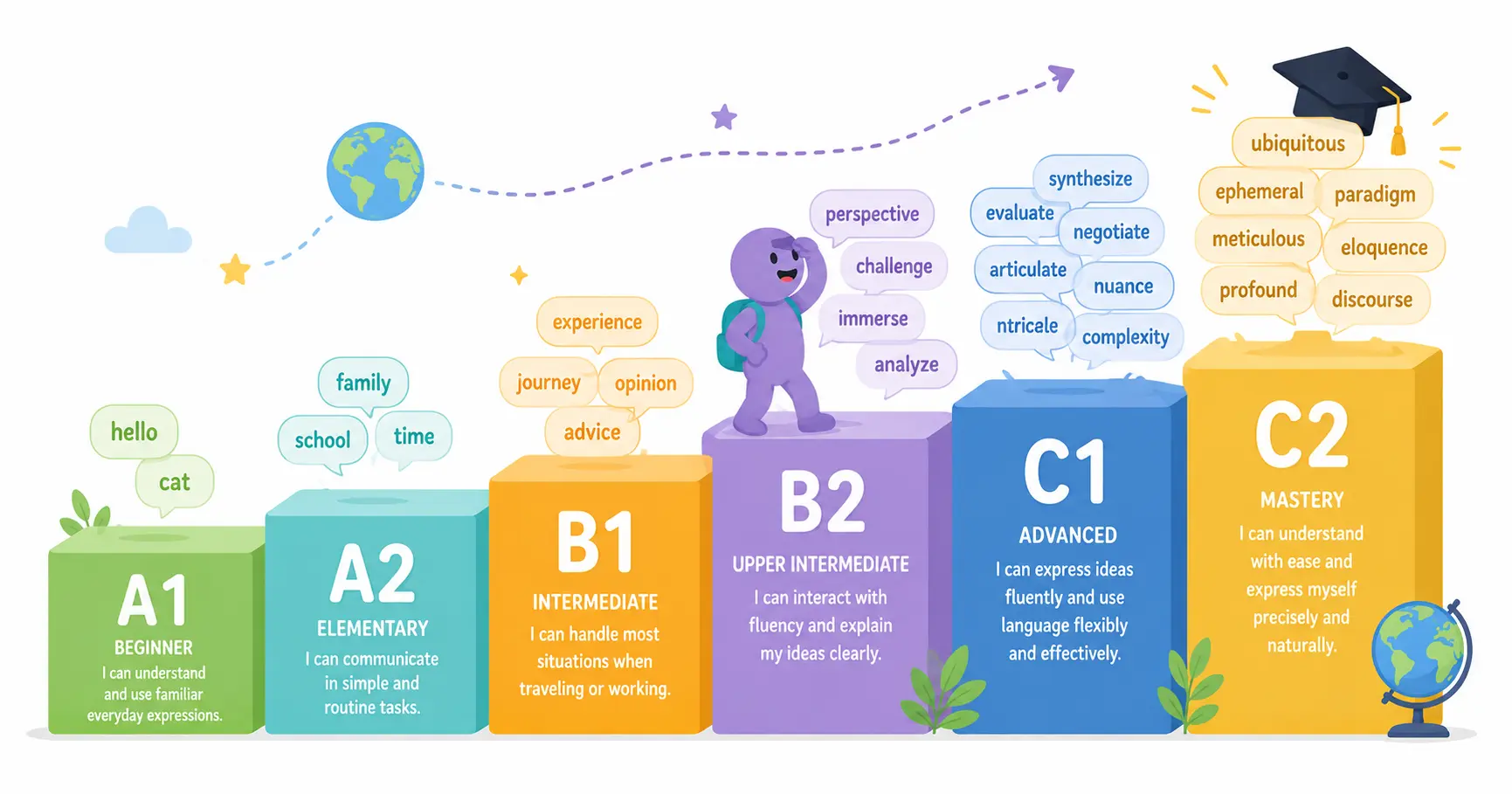
CEFRは語学力を3つの大きな区分と6つの具体的なレベルに分類しています:
| 区分 | レベル | 名称 | 説明 |
|---|---|---|---|
| A — 基礎段階の言語使用者 | A1 | 入門(Breakthrough) | ごく基本的なやり取りができる(英検3〜5級相当) |
| A2 | 初級(Waystage) | 日常的な作業や簡単な会話に対応できる(英検準2級相当) | |
| B — 自立した言語使用者 | B1 | 中級(Threshold) | 旅行や日常的な場面にほぼ対応できる(英検2級相当) |
| B2 | 中上級(Vantage) | 幅広い話題について流暢にやり取りできる(英検準1級相当) | |
| C — 熟達した言語使用者 | C1 | 上級(Effective Operational Proficiency) | 複雑なアイデアを柔軟に表現できる(英検1級相当) |
| C2 | 最上級(Mastery) | あらゆる内容を理解し、正確に表現できる(英検1級以上) |
CEFRは以下の場面で活用されています:
- 語学試験: IELTS、TOEFL、Cambridge、TOEICなど主要な試験はすべてCEFRレベルと対応しています
- 学校・大学: 入学要件としてCEFRレベルが指定されることが多くあります
- 雇用主: ヨーロッパやアジアの求人では「B2英語」「C1英語」といった要件がよく見られます
- 教材出版社: 「English Vocabulary in Use」などの教材はCEFRレベル別に編成されています
各CEFRレベルに必要な語数は?
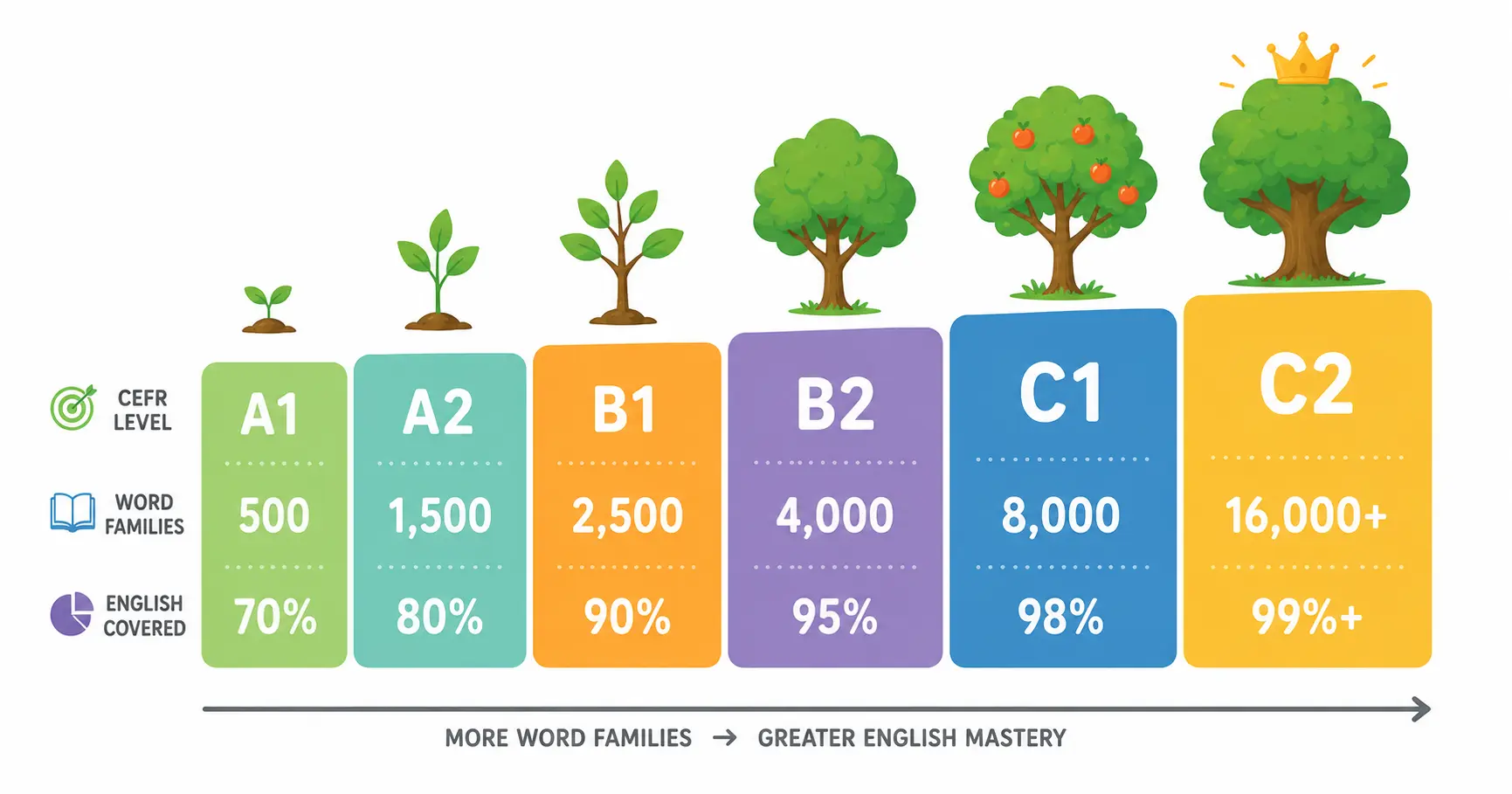
語彙数とCEFRレベルの関係は多くの研究で明らかにされています。広く認められている推定値は以下の通りです:
| CEFRレベル | 語族数 | 総語形数 | 日常英語のカバー率 |
|---|---|---|---|
| A1(入門) | 約500 | 約700〜1,000 | 基本的な話し言葉の約70% |
| A2(初級) | 約1,000〜1,500 | 約1,500〜2,500 | 基本的な話し言葉の約80% |
| B1(中級) | 約2,000〜2,500 | 約3,000〜4,000 | 日常会話の約90% |
| B2(中上級) | 約3,500〜4,500 | 約5,000〜7,000 | 一般英語の約95% |
| C1(上級) | 約6,000〜8,000 | 約8,000〜12,000 | 一般英語の約98% |
| C2(最上級) | 約10,000〜16,000以上 | 約15,000〜25,000以上 | あらゆる英語の約99%以上 |
語族(word family) = 基本語とその派生形をまとめたもの(例:”happy” + “unhappy” + “happiness” + “happily” = 1語族)。語形(word forms) = 個々の変化形をそれぞれ1語として数えたもの。
これらはあくまで目安であり、厳密な境界線ではありません。語彙力はB2レベルでも文法力はB1レベルという学習者もいれば、その逆もあり得ます。
95%カバー率の閾値
言語学者Paul Nationの研究によると、テキストを快適に読むためには約95%の単語を理解する必要があります(残りは文脈から推測可能)。これはおおよそB2レベル(約4,000語族)に相当します。学術的な読解やリスニングを困難なくこなすには98%のカバー率が必要で、これはC1(約8,000語族)に相当します。
B2が「自立の閾値」と言われるのはこのためです。辞書に頼らず英語で生活できるようになるレベルがB2なのです。
A1 — 入門(500語族)
A1レベルの語彙とは
A1では、最も基本的な生存に必要な単語を知っている段階です。自己紹介、数字、色、曜日、家族、食べ物、基本的な動作など、非常に予測しやすい日常場面に対応できます。
CEFRの定義: 「具体的な要求を満たすための、ごく基本的な日常的表現や言い回しを理解し、使うことができる。」
A1の語彙カテゴリー別
個人情報: name, age, country, address, phone number, email, birthday, language
人: mother, father, brother, sister, friend, teacher, student, boy, girl, man, woman, child, baby
数字: one〜one hundred, first, second, third, last
時間: today, tomorrow, yesterday, morning, afternoon, evening, night, Monday〜Sunday, January〜December
場所: home, school, office, hospital, shop, restaurant, park, street, city, country
食べ物・飲み物: water, milk, tea, coffee, bread, rice, egg, chicken, fruit, apple, banana
基本動詞: be, have, do, go, come, see, know, want, like, eat, drink, sleep, work, live, speak, read, write, listen, open, close, buy, help
形容詞: good, bad, big, small, new, old, hot, cold, happy, sad, easy, difficult, beautiful, ugly, cheap, expensive
疑問詞: what, where, when, who, how, how much, how many, why
A1の例文
| 例文 | 場面 |
|---|---|
| My name is Anna. I am from Russia. | 自己紹介 |
| I live in Tokyo. I am a student. | 個人情報 |
| How much is this? | 買い物 |
| I like coffee. Can I have water, please? | 飲食 |
| Where is the bathroom? | 道案内 |
| I don’t understand. Can you speak slowly? | コミュニケーション |
さらに詳しく: A1英語語彙:初心者に必須の500語
A2 — 初級(1,000〜1,500語族)
A2レベルの語彙とは
A2では、日常的な作業に対応できます。買い物、食事の注文、道を尋ねること、日課や過去の経験について話すことができます。英語圏の国で生活するのに十分な語彙を持っています。
CEFRの定義: 「最も身近な領域(ごく基本的な個人情報や家族情報、買い物、地元の地理、仕事など)に関する文や頻出表現を理解できる。」
A2の語彙(A1からの追加)
日課: wake up, get dressed, brush teeth, take a shower, have breakfast, go to work, come home, go to bed
旅行: airport, ticket, passport, hotel, taxi, bus, train, station, map, left, right, straight, near, far
買い物: price, sale, discount, size, color, try on, pay, cash, card, receipt, bag
健康: doctor, hospital, medicine, sick, pain, headache, cold, cough, fever, hurt, feel
過去時制のマーカー: yesterday, last week, ago, already, just, yet
基本的な句動詞: get up, wake up, turn on, turn off, look for, pick up, put on, take off
感情: excited, bored, scared, surprised, worried, angry, tired, nervous, proud
接続詞: because, but, so, and, or, also, then, before, after, if
A2の例文
| 例文 | 場面 |
|---|---|
| I went to the supermarket and bought some vegetables. | 日常生活 |
| I would like to book a table for two, please. | レストラン |
| The train to London leaves at 10:15. | 旅行 |
| I have a headache. Do you have any medicine? | 健康 |
| I worked at a school last year. Now I work at a bank. | 仕事(過去/現在) |
さらに詳しく: A2英語語彙:初心者からのステップアップ
B1 — 中級(2,000〜2,500語族)
B1レベルの語彙とは
B1は転換点です。旅行中のほとんどの場面に対応でき、経験や計画について話し、理由や意見を述べ、身近なトピックの明確なテキストの要点を理解できます。
CEFRの定義: 「仕事、学校、娯楽などで日常的に接する身近な事柄について、標準的な明確なインプットの要点を理解できる。旅行中に起こりうるほとんどの状況に対処できる。」
B1の語彙(A2からの追加)
意見と議論: I think, I believe, in my opinion, I agree, I disagree, on the other hand, however, although, therefore, the reason is
仕事とキャリア: apply, interview, hire, resign, salary, experience, deadline, project, team, manager, skill, achieve, promotion, career
教育: course, degree, graduate, assignment, research, presentation, knowledge, improve, practice, develop
抽象概念: opportunity, experience(抽象的用法), success, problem, solution, decision, advantage, disadvantage, difference, situation
コロケーション: make a decision, take responsibility, give advice, pay attention, keep in touch, get in trouble, make progress, do research
法助動詞とヘッジング: might, could, should, would, probably, perhaps, it seems, it depends, I’m not sure, I suppose
プロセスの説明: first, next, then, after that, finally, as a result, in order to, so that
B1の例文
| 例文 | 場面 |
|---|---|
| I think public transport is more convenient than driving in big cities. | 意見 |
| I applied for a marketing position and I have an interview next week. | キャリア |
| Although the weather was terrible, we decided to go hiking anyway. | 対比 |
| I’ve been studying English for three years and I can see real progress. | 経験 |
| You should probably make a reservation because the restaurant is always full. | アドバイス |
さらに詳しく: B1中級英語語彙:500語
B2 — 中上級(3,500〜4,500語族)
B2レベルの語彙とは
B2は自立が始まるレベルです。ニュース記事を読み、馴染みのないトピックについて議論に参加し、明確なエッセイを書き、字幕なしでほとんどの映画を理解できます。多くの雇用主が求めるレベルがこのB2です。
CEFRの定義: 「具体的・抽象的なトピックの複雑なテキストの要点を理解でき、専門分野での技術的な議論も含まれる。流暢さと自然さの度合いは、ネイティブスピーカーとの日常的なやり取りを十分に可能にする。」
B2の語彙(B1からの追加)
学術語彙: analyze, evaluate, significant, relevant, contribute, imply, perspective, phenomenon, theory, assumption, evidence, conclude, demonstrate, consistent
ニュアンスの表現: tend to, be likely to, apparently, presumably, to some extent, somewhat, relatively, considerably, nevertheless, furthermore, whereas, despite
複雑なコロケーション: draw a conclusion, raise awareness, gain experience, pose a threat, address an issue, meet a requirement, take into account, come to terms with
イディオムと比喩表現: break the ice, get the hang of, keep an eye on, at the end of the day, by and large, in the long run, take for granted, miss the point
句動詞(フォーマルな代替表現): set up → establish, carry out → conduct, come up with → devise, look into → investigate, turn down → decline, bring about → cause
トピック別語彙: 政治(government, policy, election, democracy)、経済(inflation, recession, investment)、環境(pollution, sustainability, renewable)、テクノロジー(algorithm, data, artificial intelligence)
B2の例文
| 例文 | 場面 |
|---|---|
| Despite the economic downturn, the company managed to maintain profitability. | ビジネス |
| Research suggests that bilingual individuals tend to have better cognitive flexibility. | 学術 |
| I’d been taking my health for granted until I was hospitalized last year. | 個人的振り返り |
| The government needs to address the issue of air pollution before it gets worse. | 意見/ニュース |
| The film explores the phenomenon of social media addiction from multiple perspectives. | レビュー |
さらに詳しく: B2中上級語彙:500語
C1 — 上級(6,000〜8,000語族)
C1レベルの語彙とは
C1の話者は、複雑なアイデアを柔軟に表現でき、長く難解なテキスト(暗示的な意味を含む)を理解し、複雑な主題について明確に構成された詳細な文章を書くことができます。これは専門的・学術的な英語のレベルです。
CEFRの定義: 「幅広い分野の高度で長いテキストを理解し、暗示的な意味を認識できる。表現を探す苦労をほとんど見せずに、流暢かつ自然にアイデアを表現できる。」
C1の語彙(B2からの追加)
高度な学術語彙: exacerbate, mitigate, unprecedented, paradigm, scrutinize, ubiquitous, pragmatic, resilient, volatile, ambiguous, inherent, proliferate, corroborate, juxtapose, delineate
精緻な接続表現: notwithstanding, insofar as, inasmuch as, in light of, with respect to, contingent upon, irrespective of, in conjunction with
抽象的かつニュアンスのある概念: dichotomy, catharsis, hegemony, epistemology, cognitive dissonance, confirmation bias, socioeconomic, sustainability, commodification
フォーマルなレジスター: It is worth noting that…, One might argue that…, This raises the question of…, It would be remiss not to mention…, The implications of this are significant.
語感(ニュアンス)の認識: childish(否定的)と childlike(肯定的)の違い、thrifty(肯定的)と cheap/stingy(否定的)の違い、assertive(肯定的)と aggressive(否定的)の違い
低頻度のコロケーション: deeply entrenched, inextricably linked, diametrically opposed, categorically deny, resounding success, tacit approval
C1の例文
| 例文 | 場面 |
|---|---|
| The proliferation of misinformation online has exacerbated societal polarization. | 学術論文 |
| Notwithstanding the methodological limitations, the findings corroborate previous research. | 研究論文 |
| The company’s decision to prioritize short-term profits was, in retrospect, deeply shortsighted. | ビジネス分析 |
| Her prose juxtaposes the mundane and the extraordinary with remarkable precision. | 文芸批評 |
| The policy is contingent upon bipartisan support, which remains far from assured. | 政治分析 |
さらに詳しく: C1上級英語語彙:500語 | IELTS上級語彙:バンド8〜9
C2 — 最上級(10,000〜16,000語族以上)
C2レベルの語彙とは
C2はネイティブに近い熟達レベルです。スラング、古語、専門用語、微妙なユーモアを含め、読んだり聞いたりするほぼすべてを理解できます。自分の考えを正確に表現し、意味の細かなニュアンスを区別できます。
CEFRの定義: 「聞いたり読んだりするほぼすべてを容易に理解できる。さまざまな話し言葉や書き言葉の情報源から情報を要約し、議論や説明を一貫したプレゼンテーションに再構成できる。」
C2の語彙(C1からの追加)
稀少・文語的な語彙: ephemeral, ineffable, surreptitious, obsequious, magnanimous, recalcitrant, lugubrious, perfunctory, sesquipedalian, defenestration
古風・格式高い表現: henceforth, albeit, heretofore, notwithstanding, pursuant to, in lieu of, vis-à-vis, ipso facto, modus operandi
イディオムの完全な習得: know the ropes, cut to the chase, a Pyrrhic victory, a Catch-22, beyond the pale, a red herring, tongue-in-cheek, a Faustian bargain
レジスターの柔軟な切り替え: フォーマルな学術表現(”The data corroborate the hypothesis”)、インフォーマルな会話表現(”The numbers check out”)、口語/スラング(”The stats totally back it up”)を流暢に使い分けられる
語感の完全な習得: aroma(心地よい)、smell(中立)、stench(不快)がすべて「匂い」を意味しながら異なる感情的ニュアンスを持つことを理解している
専門分野の語彙: 法律、医学、金融、テクノロジー、哲学などの専門トピックについて、過度に単純化せず分野に適した用語を使って議論できる
C2の例文
| 例文 | 場面 |
|---|---|
| The chairman’s obsequious deference to the board belied a more surreptitious agenda. | 企業小説 |
| Her argument, albeit compelling on its surface, rests on a fundamentally flawed epistemological premise. | 哲学 |
| He described the policy as a Pyrrhic victory — technically a win, but at a cost that rendered it meaningless. | 政治論評 |
| The report was perfunctory at best, offering a lugubrious recitation of statistics devoid of genuine insight. | 批評 |
さらに詳しく: C2最上級語彙:ニュアンスを極める | 難しい英単語:500語以上の高難度語彙
Oxford 3000とOxford 5000
Oxford 3000とOxford 5000は、Oxford University Pressが作成した厳選された単語リストで、頻度・範囲・認知度に基づいて選定されています。英語教育で広く使用され、CEFRレベル別に整理されています。
| リスト | 語数 | CEFRレベル | 目的 |
|---|---|---|---|
| Oxford 3000 | 3,000語 | A1〜B2 | 日常英語の中核語彙 |
| Oxford 5000 | 5,000語(3000 + 2000) | A1〜C1 | 学術英語を含む拡張語彙 |
OxfordリストとCEFRの対応
| CEFRレベル | Oxford 3000の語数 | Oxford 5000の語数 |
|---|---|---|
| A1 | 約600 | 約600 |
| A2 | 約800 | 約800 |
| B1 | 約900 | 約900 |
| B2 | 約700 | 約700 |
| C1 | — | 約2,000 |
Oxford 3000はA1〜B2をカバーし、一般的な英語コミュニケーションに必要な語彙を網羅しています。Oxford 5000の追加2,000語は主にC1レベルの学術語彙です。
なぜこれが重要か: Oxford 3000を学べば、B2レベルの中核語彙を習得したことになります。日常的・職業的なほとんどの場面に対応できる語彙力です。Oxford 5000まで学べばC1に到達し、学術的な場面にも対応できるようになります。
詳しくはOxford 3000/5000語リスト:CEFRレベル別ガイドをご覧ください。
CEFRと語学試験
CEFRレベルは主要な英語試験のスコアと直接対応しています:
| CEFRレベル | IELTS | TOEFL iBT | Cambridge | TOEIC (L&R) | 英検 |
|---|---|---|---|---|---|
| A1 | — | — | — | 約120 | 3〜5級 |
| A2 | — | — | KET (A2 Key) | 約225 | 準2級 |
| B1 | 4.0〜5.0 | 42〜71 | PET (B1 Preliminary) | 約550 | 2級 |
| B2 | 5.5〜6.5 | 72〜94 | FCE (B2 First) | 約785 | 準1級 |
| C1 | 7.0〜8.0 | 95〜113 | CAE (C1 Advanced) | 約945 | 1級 |
| C2 | 8.5〜9.0 | 114〜120 | CPE (C2 Proficiency) | — | 1級以上 |
IELTS対策について: 語彙力はIELTSの「Lexical Resource(語彙の豊富さ)」評価基準の重要な要素です。レベル別の単語リストはIELTS上級語彙:バンド8〜9の単語をご覧ください。
Linglifyのレベル別語彙学習
Linglifyの語彙ライブラリはCEFRレベル別にタグ付けされているため、現在の実力に合った語彙を学習し、段階的に次のレベルへ進むことができます。
個人辞書に単語を追加すると、LinglifyはそのCEFRレベル(A1〜C2)を表示し、最適な間隔で間隔反復(spaced repetition)の復習をスケジュールします。これにより:
- 初心者(A1〜A2) は、実際に毎日使う高頻度語に集中できます
- 中級者(B1〜B2) は、日常英語と学術英語の間のギャップを埋める語彙に取り組めます
- 上級者(C1〜C2) は、「良い英語」と「優れた英語」を分けるニュアンスのある低頻度語を学べます
練習用語彙
以下の24語はCEFRの全6レベルにまたがっています。各レベル4語ずつ、基礎から高度な語彙まで収録しています。
academy
名詞
学院, アカデミー
例
- She graduated from the military academy with honors last spring.
- The film academy recognizes outstanding achievements in cinema each year.
affordable
形容詞
手頃な, 買いやすい
例
- The government is working to provide affordable housing for low-income families.
- This restaurant offers delicious and affordable meals for college students.
assault
名詞
襲撃, 攻撃
例
- The army launched a fierce assault on the enemy fortress.
- The police arrested the man for assault and battery charges.
biotechnology
名詞
バイオテクノロジー
例
- Agricultural biotechnology helps create disease-resistant crop varieties.
- Biotechnology companies develop new medical treatments and therapies.
choose
動詞
選ぶ
例
- She will choose the dress that looks best for the wedding ceremony.
- Students must choose their courses carefully for next semester's schedule.
continent
名詞
大陸
department store
名詞
デパート
例
- Holiday shopping at the department store can be crowded and stressful.
- The department store sells everything from clothing to electronics.
earth
名詞
地球, 大地, 土
例
- Earth is the third planet from the sun in our solar system.
- Farmers plant seeds in rich earth to grow healthy crops.
firearm
名詞
火器
例
- Police officers receive extensive training in firearm safety and usage.
- The museum displays historical firearms from different time periods.
have to
動詞
しなければならない, ~しなくてはいけない, ~しなきゃ
例
- She doesn't have to work on weekends unless there's an emergency.
- Students have to complete their homework before coming to class tomorrow.
indirect
形容詞
間接の
例
- His indirect criticism was subtle but everyone understood his meaning.
- The indirect route takes longer but avoids the heavy traffic areas.
know
動詞
知る
例
- Do you know anyone who speaks fluent Spanish or Portuguese?
- I know the answer to that difficult mathematical question.
memorial
名詞
記念碑, 追悼碑
例
- The memorial service celebrated her life and achievements.
- War memorial honors soldiers who died serving their country.
optimism
名詞
楽観主義
例
- Her optimism helped family through difficult financial times.
- Optimism about future motivates people to work harder.
personnel
名詞
人員
例
- Military personnel receive specialized training for duties.
- Qualified personnel ensures company operates efficiently and safely.
proven
形容詞
証明された
例
- Proven method ensures consistent successful results always.
- Proven remedy helps treat common cold symptoms.
restriction
名詞
制限, 制約, 規制
例
- Age restriction prevents minors from purchasing alcohol.
- Speed restriction protects drivers on dangerous mountain roads.
shoplifter
名詞
万引き犯, 万引き者, 盗人
例
- Experienced shoplifter knows how to avoid detection.
- Store security catches shoplifter stealing expensive items.
spell
名詞
綴り, 呪文
例
- Cold spell brings freezing temperatures to region.
- Magic spell transforms pumpkin into carriage magically.
teamwork
名詞
チームワーク
例
- Good teamwork achieves better results than individuals.
- Successful teamwork requires trust and clear communication.
voice
名詞
声
例
- Clear voice helps effective communication and understanding.
- Singer's voice captivates audience during performance show.
minutiae
名詞
細部, 些細なこと, 細かい点
例
- She focused on the minutiae rather than the big picture.
- The contract's minutiae required careful examination by lawyers.
lust
名詞
欲望, 色欲
例
- Character's lust for power ultimately leads to downfall.
- Traveler felt intense lust for adventure in foreign countries.
emulate
動詞
模倣する, 競う
例
- Software developers emulate successful applications to create competitive products.
- Young athletes emulate professional sports stars' training techniques and dedication.
語彙力アップのロードマップ
ステップ1:現在のレベルを把握する
自分のCEFRレベルがわからない場合、簡単なセルフテストがあります。上記の各セクションの例文を読んでみてください。1文あたり2〜3語以上わからない単語が出てくるレベルが、おおよそあなたの現在のレベルです。
ステップ2:1つ上のレベルに集中する
B1に十分到達しているなら、B2の語彙を学びましょう。B1からC1へ一気に跳ぶのは非効率です。ギャップが大きすぎ、B2の基盤が固まるまではC1の語彙はほとんど実用的ではありません。
ステップ3:適切なリソースを使う
| 現在のレベル | 学ぶべき内容 | おすすめの記事 |
|---|---|---|
| A1 → A2 | 高頻度語、日常場面の語彙 | 日常で使う英単語 |
| A2 → B1 | 句動詞、意見の表現、接続詞 | 英語の句動詞 完全ガイド |
| B1 → B2 | コロケーション、イディオム、抽象語彙 | 英語コロケーション ガイド |
| B2 → C1 | 学術語彙、ニュアンスのある表現 | 上級英単語 |
| C1 → C2 | 稀少語、語感、レジスター | 難しい英単語 |
ステップ4:間隔反復で練習する
適切なレベルの単語をLinglifyに追加し、毎日復習しましょう。研究によると、間隔反復は語彙を短期記憶から長期記憶へ移す最も効率的な方法です。詳しい方法論は語彙の覚え方:科学に基づくテクニックをご覧ください。
次に読むべき記事
レベル別:
タイプ別:
- 最頻出英単語1000語 — 必須の単語リスト
- 日常で使う英単語 — 実用的な日常語彙
- 英語の類義語・対義語ガイド — あらゆるレベルで語彙力をアップ
- 英語の同音異義語:300以上の例 — よくあるスペルの混同を防ぐ
学習法:
よくある質問
IELTS 6.5はCEFRのどのレベルに相当しますか?
IELTS 6.5はCEFRのB2に相当します。複雑なテキストを理解し、ある程度流暢にやり取りし、さまざまなトピックについて明確な文章を書けるレベルです。6.5は英語圏の大学入学に最もよく求められる最低スコアです。C1(IELTS 7.0〜8.0)に到達するには、通常B2から2,000〜3,000語族を追加で習得する必要があります。
CEFRで1つ上のレベルに上がるにはどれくらいかかりますか?
Cambridge Englishの推定によると、A1 → A2:約200時間、A2 → B1:約200時間、B1 → B2:約200時間、B2 → C1:約200時間、C1 → C2:200時間以上です。これは指導付き学習時間(授業または体系的な自習)を指します。C1からC2への差が実際には最も大きく、ニュアンス、稀少語彙、ネイティブに近い文化的知識の習得が求められるためです。
B2は仕事で使うのに十分ですか?
ほとんどの職務において、B2は最低限の実用的レベルです。会議に参加し、メールを書き、レポートを読み、顧客対応をこなすことができます。ただし、交渉、説得、ニュアンスのある文章作成(マーケティング、法律、外交)、または学術的な業務にはC1が通常求められます。多くの国際企業では、英語を母語としない社員にはB2を最低基準、顧客対応や管理職にはC1を求めています。
単語を「知っている」ことと、CEFRレベルで「使いこなせる」ことの違いは何ですか?
CEFRレベルで単語を使いこなすとは、3つのことを意味します:(1) 認識 — 聞いたり読んだりしたときに理解できる、(2) 産出 — 自分の発話や文章で正しく使える、(3) コロケーションの認識 — その単語が自然に組み合わさる他の単語を知っている。A1では “make” という単語を「知っている」かもしれませんが、使えるのは “make breakfast” だけかもしれません。B2では “make a decision”、”make progress”、”make an effort” を使います。C1では “make a concession”、”make a compelling case” を使いこなします。
次のレベルに進む前に、現在のレベルの単語をすべて覚えるべきですか?
いいえ。言語レベルは大幅に重なり合っており、読んだり聞いたりする中で自然と上のレベルの単語に出会います。実用的なアプローチとしては、現在のレベルの語彙の80%を学んでから、次のレベルの語彙を追加し始めることです。B2の語彙に手を付ける前にB1を「完了」させる必要はありません。特に自分が興味のあるトピックや仕事に関連する語彙はなおさらです。
どの単語がA1、A2、B1などのレベルかを知るにはどうすればいいですか?
最も信頼できる参照元はOxford 3000/5000リストで、すべての単語にCEFRレベルがタグ付けされています。CambridgeのEnglish Vocabulary Profile(EVP)もリサーチに基づいた資料です。Linglifyでは、ライブラリ内のすべての単語にCEFRレベルがタグ付けされているため、レベル別にフィルターして直接学習できます。主要な学習者向け辞書(Oxford、Cambridge、Longman)も、各見出し語に頻度とレベルを記載しています。
すでに英語の知識がある場合、レベルを飛ばしてもいいですか?
語彙の基礎を飛ばすべきではありません。B2レベルのテスト結果が出る学習者でも、A2〜B1の語彙(特に句動詞、コロケーション、機能語)にギャップがあることは珍しくありません。ただし、複数のレベルの語彙を同時に学ぶことは十分に可能です。低レベルのギャップを復習しながら、新しい高レベルの語彙を学びましょう。重要なのは評価のステップを飛ばさないことです。正直に自己テストを行い、実際のギャップがどこにあるかを特定してから、体系的に埋めていきましょう。