How Many Words Are There in English? The Real Answer
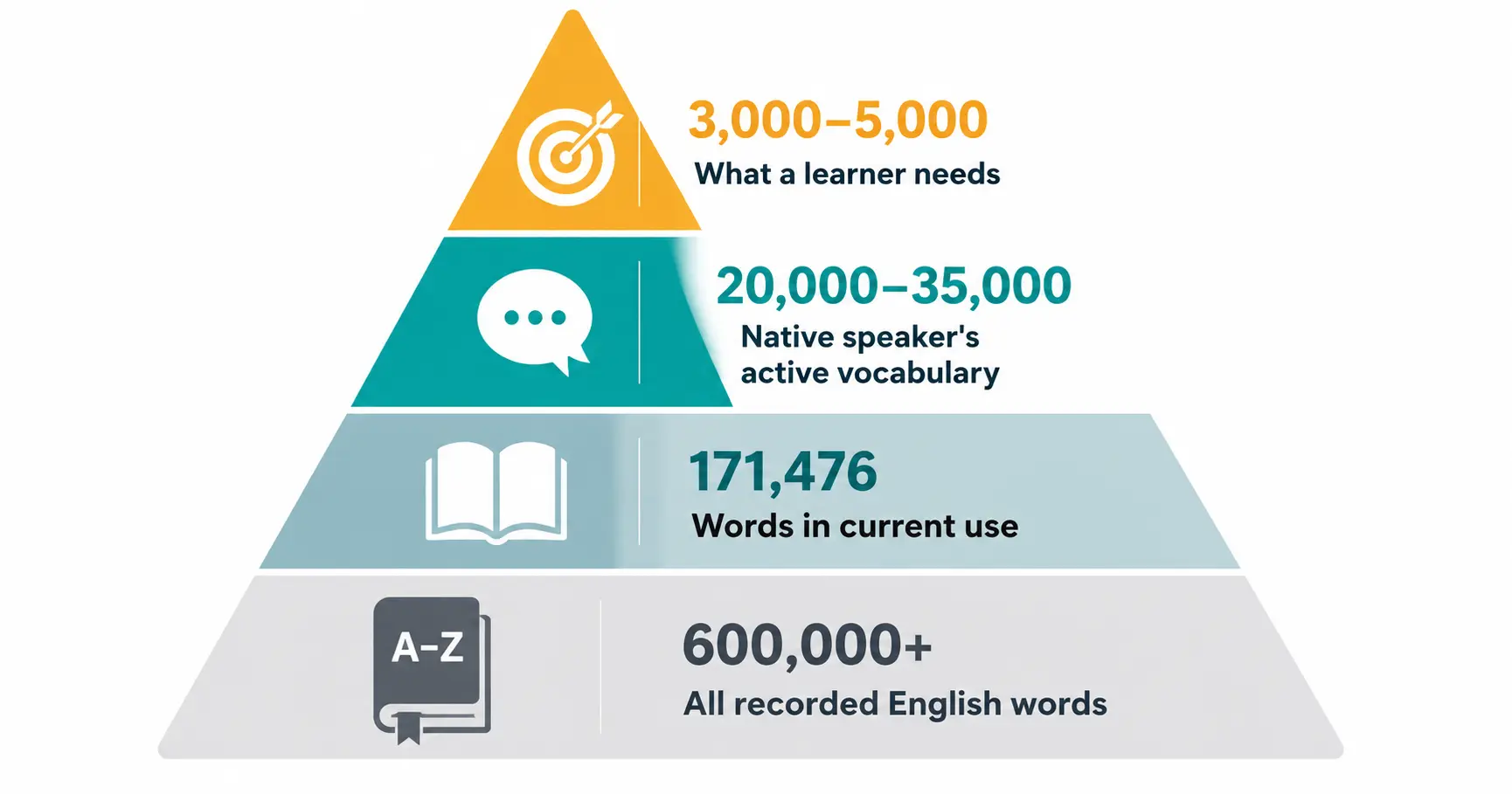
How many words are there in the English language? The short answer depends on how you count. The Oxford English Dictionary contains approximately 273,000 headwords. Webster’s Third New International Dictionary lists about 470,000 entries. If you include technical terms, scientific nomenclature, regional dialects, and slang, credible estimates range from 750,000 to over 1 million words.
But here is the more useful answer: the number of words in English does not determine how many words you need to learn. A native English speaker uses 20,000–35,000 words in their lifetime. A fluent non-native speaker operates comfortably with 8,000–12,000. And research shows that just 1,000 words cover 85% of everyday conversation.
This article breaks down the real numbers, explains why estimates vary so wildly, and — most importantly — tells you exactly how many words you need at each stage of learning.
The Numbers: How Dictionaries Count
Different dictionaries report different totals because they use different rules for what counts as a “word.”
| Dictionary / Source | Headwords | Includes |
|---|---|---|
| Oxford English Dictionary (OED) | ~273,000 | Historical + current, all documented meanings since 1000 AD |
| Webster’s Third | ~470,000 | Includes compound words, technical terms |
| Global Language Monitor | ~1,050,000+ | Includes neologisms, slang, global English variants |
| Google/Harvard corpus | ~1,022,000 | Unique word forms found in digitized books (1500–2008) |
Why the massive range? It comes down to three decisions every word-counter must make.
Decision 1: What counts as a word?
Is “run” one word or many? As a noun, it means a jog. As a verb, it has over 600 documented meanings in the OED — the most of any English word. The OED counts “run” as one headword with multiple senses. A frequency corpus might count “run,” “runs,” “running,” and “ran” as four separate word forms, or group them under one lemma.
Decision 2: Do you include technical vocabulary?
Chemistry alone has over 300,000 named compounds. Medicine has roughly 170,000 terms. Biology has millions of species names. Most dictionaries exclude highly specialized terms. Include them, and the word count explodes past 1 million.
Decision 3: Do you include obsolete words?
The OED is a historical dictionary — it includes words that have not been used for centuries. “Snollygoster” (a shrewd, unprincipled person) is still in the OED, even though nobody has used it since the 1800s. A dictionary tracking only current usage would be much smaller.
The honest answer: English has between 250,000 and 1,000,000+ words, depending on how strictly you define “word.”
How English Compares to Other Languages
English is often called one of the largest languages by vocabulary. Is that true?
| Language | Estimated Vocabulary Size | Notes |
|---|---|---|
| English | 250,000–1,000,000+ | Absorbs words from many languages freely |
| Korean | ~1,100,000 | Korean Language Dictionary includes many compound forms |
| Japanese | ~500,000+ | Kanji combinations create enormous compound vocabulary |
| French | ~130,000–200,000 | Académie française regulates which words are “official” |
| Spanish | ~150,000–200,000 | Real Academia Española maintains a controlled list |
| German | ~300,000–500,000 | Compound nouns inflate the count (Handschuhschneeballwerfer = “someone who throws snowballs with gloves on”) |
| Chinese | ~370,000+ | Characters combine into vast numbers of compound words |
These comparisons are problematic because languages have fundamentally different structures. German creates single compound words where English uses multi-word phrases. Chinese characters combine into new words without new “dictionary entries.” Agglutinative languages like Finnish and Turkish generate potentially infinite word forms from a base root.
The takeaway: English has a very large vocabulary — partly because it borrows freely from Latin, French, German, Norse, Greek, Arabic, Hindi, and dozens of other languages. Unlike French or Spanish, English has no official body that decides which words are “real.” If people use a word, it eventually enters the dictionary.
Why English Has So Many Words
English did not start out with a massive vocabulary. Old English (circa 500–1100 AD) had an estimated 50,000–60,000 words. The explosive growth happened through a series of historical events that each added a layer of vocabulary.
Layer 1: Germanic foundations (before 1066)
The original Anglo-Saxon vocabulary. These are the shortest, most common everyday words: house, water, bread, child, sleep, eat, run, cold, strong, good. About 25% of modern English vocabulary comes from this Germanic root — but these words account for approximately 60% of everyday speech.
Layer 2: French and Latin (1066–1500)
The Norman Conquest of 1066 brought tens of thousands of French and Latin words into English. These words tend to be longer and more formal: government, justice, parliament, authority, liberty, courage, language, art, fashion, beauty. This is why English often has two words for the same concept — a Germanic word for everyday use and a French/Latin word for formal contexts.
| Concept | Germanic (everyday) | French/Latin (formal) |
|---|---|---|
| Ask | ask | inquire |
| Start | begin | commence |
| Buy | buy | purchase |
| End | end | terminate |
| Help | help | assist |
| Freedom | freedom | liberty |
| Kingly | kingly | royal |
Layer 3: Greek and Latin (Renaissance, 1500–1700)
Science, philosophy, and medicine imported thousands of Greek and Latin terms: biology, psychology, democracy, hypothesis, microscope, phenomenon. This layer is responsible for most of English’s technical and academic vocabulary.
Layer 4: Global borrowing (1600–present)
Through colonialism, trade, immigration, and cultural exchange, English absorbed words from virtually every language on Earth:
| Source | Examples |
|---|---|
| Hindi/Urdu | jungle, shampoo, bungalow, pajamas, thug |
| Arabic | algorithm, algebra, alcohol, magazine, zero |
| Japanese | tsunami, karate, emoji, tofu, sake |
| Spanish | tornado, mosquito, plaza, cargo, vanilla |
| Dutch | cookie, yacht, coleslaw, boss, landscape |
| African languages | banana, zombie, jazz, banjo, gumbo |
Layer 5: New coinages (ongoing)
English adds an estimated 800–1,000 new words per year. Technology, internet culture, social change, and scientific discovery continuously expand the vocabulary. The Oxford English Dictionary added 650 new words in its March 2024 update alone. Our guide to new English words in 2026 tracks the latest additions.
How Many Words Does a Native Speaker Know?
The difference between “total words in English” and “words a person actually knows” is enormous.
| Metric | Typical Range | Source |
|---|---|---|
| Active vocabulary (words you use in speech/writing) | 20,000–35,000 | Nation (2001), Brysbaert et al. (2016) |
| Passive vocabulary (words you recognize when reading/hearing) | 40,000–70,000 | Brysbaert et al. (2016) |
| Total word families recognized | ~42,000 average | Brysbaert et al. (2016) — study of 220,000 adults |
A 2016 study by Brysbaert, Stevens, Mandera, and Keuleers tested over 220,000 native English speakers and found that the average adult knows about 42,000 lemmas (base word forms) and 62,000 word forms (including inflections). The number grows throughout life — a 60-year-old typically knows more words than a 20-year-old.
Key insight for learners: native speakers acquire most of their vocabulary passively, through reading and conversation, over decades. They do not memorize lists. You, as a learner, can accelerate this process by combining active study with massive reading input.
How Many Words Do You Need as a Learner?
This is the question that matters. Research in applied linguistics gives us clear benchmarks:
| Vocabulary Size | Comprehension Level | Real-World Ability |
|---|---|---|
| 250–500 words | ~50% of speech | Survival basics: greetings, food, emergencies |
| 1,000 words | ~85% of speech | Simple daily conversations, basic news |
| 2,000 words | ~90% of speech | Most everyday situations handled comfortably |
| 4,000 words | ~95% of speech | Read simple newspapers, follow most TV shows |
| 8,000 words | ~98% of speech | Read novels, understand lectures, participate in discussions |
| 12,000–15,000 words | ~99% of speech | Near-native comprehension across most domains |
These numbers come from Paul Nation’s research on vocabulary coverage — one of the most cited frameworks in language learning. The pattern is clear: the first 1,000 words give you the most comprehension per word learned. After that, each additional 1,000 words adds less and less.
What CEFR levels require
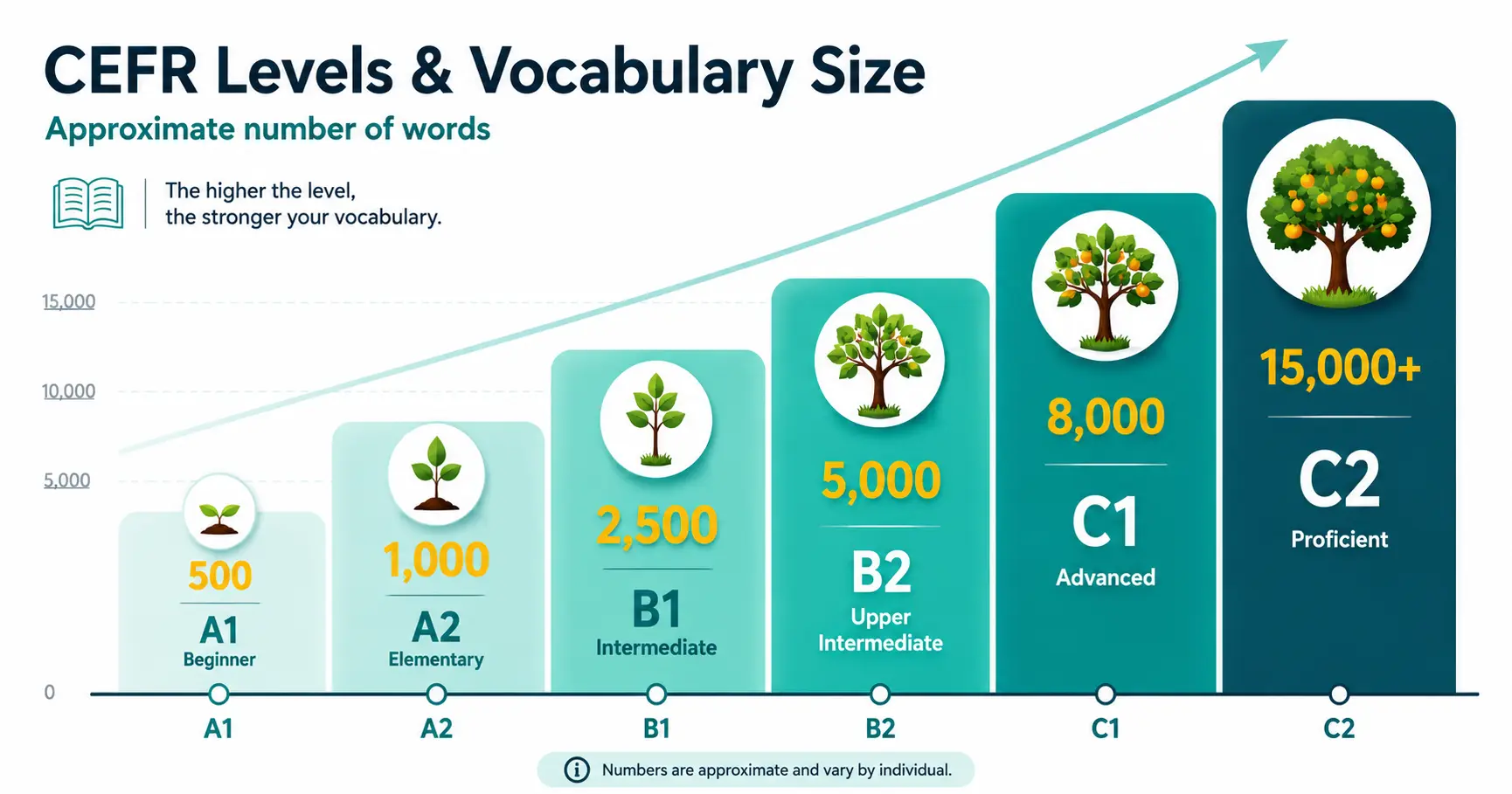
The Common European Framework maps vocabulary expectations to each level:
| CEFR Level | Expected Vocabulary | What You Can Do |
|---|---|---|
| A1 | ~500 words | Introduce yourself, ask simple questions |
| A2 | ~1,000–1,500 words | Handle daily routines, shopping, directions |
| B1 | ~2,500–3,000 words | Travel independently, discuss familiar topics |
| B2 | ~4,000–5,000 words | Understand complex texts, express detailed opinions |
| C1 | ~8,000–10,000 words | Use language flexibly for social, academic, and professional purposes |
| C2 | ~12,000–15,000+ words | Understand virtually everything, express subtle distinctions |
For a complete breakdown, see our guide to English vocabulary by CEFR level.
What exams require
| Exam | Target Score | Approximate Vocabulary Needed |
|---|---|---|
| TOEIC | 600 | ~4,000–5,000 |
| TOEIC | 800+ | ~6,000–8,000 |
| IELTS | Band 6.0 | ~5,000–6,000 |
| IELTS | Band 7.0+ | ~7,000–9,000 |
| TOEFL | 80+ | ~6,000–8,000 |
| TOEFL | 100+ | ~8,000–12,000 |
For exam-specific vocabulary, see our IELTS vocabulary guide, TOEFL preparation guide, or TOEIC vocabulary list.
Active vs Passive Vocabulary: The Hidden Gap
When we say someone “knows” 10,000 words, what does that actually mean? Vocabulary knowledge exists on a spectrum:
Active vocabulary — Words you can produce without help. You use them in conversation and writing. These are fully owned words.
Passive vocabulary — Words you recognize when you read or hear them, but cannot recall on demand. You understand them in context but would not use them yourself.
For most people, passive vocabulary is 2–3 times larger than active vocabulary. A B2-level learner might actively use 3,000 words but recognize 8,000+.
Why this matters for study planning:
-
Reading builds passive vocabulary fast. Every article, novel, or podcast expands what you recognize. Over time, passive words gradually become active through repeated exposure. This is how native speakers learn most of their vocabulary.
-
Active study (flashcards, writing, speaking) converts passive to active. If you only read, you will understand more and more but still struggle to express yourself. Active practice forces recall.
-
The optimal strategy combines both: massive reading input + targeted active study of high-priority words. This is exactly what the Linglify learning system is designed for.
How Fast Is English Growing?
English does not stand still. The language adds new words constantly:
| Period | Major Sources of New Words |
|---|---|
| 2000–2010 | Internet culture: blog, selfie, hashtag, app, tweet, unfriend |
| 2010–2020 | Social media + tech: influencer, cryptocurrency, deepfake, binge-watch, ghosting |
| 2020–2026 | AI + pandemic + culture: hallucinate (AI), long COVID, doomscroll, quiet quitting, generative AI, enshittification |
The Oxford English Dictionary adds approximately 1,000–1,500 new entries per year. Merriam-Webster adds 600–700 annually. Some new words are entirely novel (selfie, bitcoin); others are existing words with new meanings (cloud, viral, stream).
The internet has accelerated word creation dramatically. Slang, memes, and technical terms spread globally in days. Words like “rizz” (charisma, charm) went from niche slang to Oxford’s Word of the Year in under two years.
For the latest additions, see our guide to new English words in 2026 and 50 new English words with meanings.
Words English Has Borrowed (And Where They Came From)
English is a magpie language — it borrows from everywhere. The vocabulary breakdown by origin looks roughly like this:
| Origin | Approximate % of English Vocabulary |
|---|---|
| Latin (directly or via French) | ~29% |
| French | ~29% |
| Germanic (Old English, Norse) | ~26% |
| Greek | ~6% |
| Other languages | ~10% |
This means only about a quarter of English vocabulary comes from English’s own Germanic roots. The rest is imported. This is why English has so many synonyms — often one word from Germanic and another from Latin/French for the same concept.
It also means English shares vocabulary with many other languages. If you speak a Romance language (Spanish, French, Italian, Portuguese), you already recognize thousands of English words through shared Latin roots. If you speak German, Dutch, or a Scandinavian language, the core everyday vocabulary feels familiar.
The Practical Takeaway: How Many Words Should You Learn?
Forget the million-word total. Here is what to actually aim for:
If you are a beginner (A1–A2)
Target: 1,000 words. This covers 85% of everyday conversation. Focus on high-frequency words — greetings, numbers, daily actions, common objects. Start with our beginner’s essential words guide and then move to the 1000 most common English words.
If you are intermediate (B1–B2)
Target: 4,000 words. This gets you to 95% comprehension. You can read news, follow TV shows, and hold conversations about most everyday topics. Our 4000 essential English words guide gives you a structured plan.
If you are advanced or preparing for exams (B2–C1)
Target: 8,000–10,000 words. This is where you stop guessing word meanings from context and start truly understanding texts. For exam-specific vocabulary, see our IELTS vocabulary guide or TOEIC vocabulary list.
If you want near-native comprehension (C1–C2)
Target: 15,000+ words. At this level, you understand subtle differences between synonyms, catch cultural references, and rarely encounter unknown words outside of specialized fields. See our guides to advanced English words and hard English words.
Words to Practice
These 25 words span beginner to advanced levels — a sample of the vocabulary range you will encounter as you move through the levels. Add them to your Linglify dictionary for spaced repetition.
candidate
noun
A person who is competing in an election or contest.
Examples
- Each presidential candidate presented their policy plans to voters.
- The job candidate impressed the interview panel with her experience.
evaluate
verb
To judge or measure the value, quality, or importance of something.
Examples
- Companies evaluate job candidates based on experience, skills, and personality.
- Teachers evaluate student progress through tests, projects, and classroom participation.
total
adjective
An adjective describing something that is complete or whole, not divided or broken.
Examples
- Total cost includes all fees and expenses.
- Total silence fills room during meditation session.
resolve
verb
To find a solution or answer to a problem or question.
Examples
- Mediator helps parties resolve dispute through negotiation.
- Technical team will resolve software problems quickly.
cooperate
verb
To work together with others towards a common goal.
humorous
adjective
Funny or amusing, often making people laugh.
Examples
- She writes humorous articles about everyday life and family experiences.
- The humorous speech made everyone laugh and lightened the serious mood.
motivated
adjective
Feeling driven or inspired to do something because of a reason or goal.
Examples
- Motivated employee seeks additional responsibilities and challenges at work.
- Success requires being motivated even when facing difficult obstacles.
indispensable
adjective
Absolutely necessary; essential.
Examples
- Clean water is indispensable for human survival and good health.
- Her experience and skills make her indispensable to the research team.
tragedy
noun
An extremely sad or serious event that causes suffering or loss.
Examples
- Natural tragedy affects thousands of innocent people.
- Personal tragedy changes person's life perspective completely.
prejudice
noun
Preconceived opinions or feelings, often negative, about a person or group.
Examples
- Education helps overcome prejudice and promotes understanding.
- Racial prejudice damages communities and individuals alike.
donate
verb
To give something, especially money or goods, to help a cause or person.
Examples
- Many people donate money to charities that help homeless individuals.
- She decided to donate blood to help patients in emergency situations.
discourage
verb
To try to make someone feel less confident or hopeful about something.
Examples
- Don't let one failure discourage you from pursuing your dreams.
- High prices discourage many people from buying organic food products.
graduate
verb
To complete a course of study at a school or university.
Examples
- She will graduate from university next year with a degree in engineering.
- Students must complete all requirements before they can graduate from high school.
union
noun
A group of people or things joined together for a purpose.
Examples
- Labor union protects worker rights and interests.
- Marriage union joins two people in partnership.
horizon
noun
The line where the earth or the sky appears to meet in the distance.
Examples
- The sun disappeared behind the horizon as evening approached.
- Traveling broadens your horizon and exposes you to new cultures.
off
adjective
Describes something that is not fresh or is no longer suitable for eating, often used for food and drinks.
Examples
- Please turn off the lights before leaving the room.
- The dog ran off into the forest chasing wild rabbits.
lifelong
adjective
Continuing for a very long time or for the whole life.
Examples
- Learning is a lifelong process that never truly ends.
- Their lifelong friendship began during elementary school years.
firmly
adverb
An adverb indicating a way of doing something with certainty or stability.
Examples
- Hold the rope firmly while climbing down the steep mountain slope.
- The manager firmly believed in treating all employees with respect.
normally
adverb
Usually; under normal conditions.
Examples
- Heart normally beats between sixty and hundred times per minute.
- Students normally arrive at school before morning bell rings.
boom
noun
A loud, deep sound or a sudden increase in activity or popularity.
Examples
- The boom of thunder echoed across the valley.
- The technology boom created many new millionaires.
stress
verb
To feel mental or emotional pressure or worry; to emphasize or give importance to something.
Examples
- Heavy workload may stress employees beyond limits.
- Teacher will stress importance of homework completion.
guide
verb
To show or direct someone how to do something.
Examples
- Parents should guide their children to make responsible decisions.
- The experienced hiker will guide the group through the mountain trail safely.
admission
noun
The process or fact of being allowed to enter or join.
Examples
- Her admission to the prestigious medical school was the result of hard work.
- The museum offers free admission on the first Sunday of every month.
jury
noun
A group of people who listen to evidence in a court and decide if someone is guilty.
Examples
- The jury deliberated for several hours before reaching a verdict.
- The talent show jury consisted of professional musicians and entertainers.
voyage
noun
A long journey to a distant place, often by sea or air.
Examples
- Space exploration represents humanity's greatest voyage into the unknown.
- The ocean voyage from Europe to America took several weeks in the past.
FAQ
Exactly how many words are in the English language?
There is no single definitive answer. The Oxford English Dictionary contains approximately 273,000 headwords. Webster’s Third has about 470,000. If you include technical terms, scientific names, and all global variants of English, estimates exceed 1 million. The number depends on whether you count inflections (run, runs, running), compound words, technical terms, and obsolete words as separate entries.
How many words does the average person know?
A 2016 study of 220,000 native English speakers found the average adult knows about 42,000 base word forms and recognizes approximately 62,000 word forms including inflections. Vocabulary grows throughout life — adults in their 60s typically know significantly more words than those in their 20s. Non-native fluent speakers typically know 8,000–15,000 word families.
How many English words do I need to be fluent?
Research suggests you need approximately 8,000 word families for general fluency. This gives you about 98% comprehension of everyday speech and written text. However, “fluent” is relative: 4,000 words gets you through most daily situations (95% coverage), while truly native-like comprehension requires 15,000+ words.
Does English have more words than other languages?
English is among the largest languages by vocabulary count, but direct comparisons are misleading. German creates compound words that English expresses as phrases. Chinese characters combine in ways that make “word” counts ambiguous. Korean dictionaries list over a million entries. What is clear: English has an exceptionally large vocabulary because it borrows freely from dozens of other languages with no central authority limiting what counts as an English word.
How many new words are added to English each year?
Major dictionaries add 600–1,500 new entries per year. The Oxford English Dictionary added approximately 650 new words in its March 2024 update. The Global Language Monitor estimates that a new English word is created roughly every 98 minutes, though most never reach mainstream dictionaries. Technology, internet culture, and scientific discovery are the fastest-growing sources.
What is the longest word in English?
The longest word in a major dictionary is “pneumonoultramicroscopicsilicovolcanoconiosis” (45 letters) — a lung disease caused by inhaling fine silica dust. However, chemical names can be technically longer. The protein titin has a chemical name that is 189,819 letters long, though no linguist considers it a real “word.” In practical English, most words are 4–8 letters, and longer words are rarely used in conversation.
How many words do I need for IELTS Band 7?
Research and test preparation experts suggest approximately 7,000–9,000 word families for consistent IELTS Band 7 scores. This includes about 4,000 general high-frequency words plus 3,000–5,000 academic and topic-specific terms. The key is not just knowing definitions but being able to use words accurately in writing and speaking — IELTS rewards precise, varied vocabulary over rote memorization.